
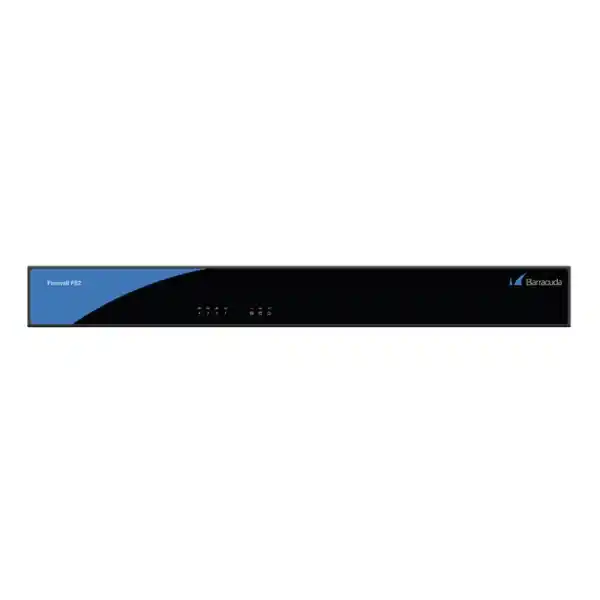
Barracuda CloudGen Firewall F82 DSL Annex B
A compact branch firewall with integrated Annex B/J DSL connectivity, 1GbE SFP uplink capability, Wi-Fi, SD-WAN, VPN and next-generation security services for distributed offices that need a practical all-in-one edge platform.
The F82 DSL Annex B is best understood as a legacy EMEA branch-security appliance for sites that specifically need Annex B/J DSL integration or compatibility with an existing Barracuda CloudGen environment. Barracuda lists the F82 Rev. A end-of-sale date as 28 February 2022 and end-of-life date as 28 February 2027, so any 2026 procurement should include an explicit support, licensing and migration review.
Published F82.DSLB figure under optimized test conditions; real deployments vary by packet mix and enabled services.
Useful for sizing when IPS, application control and web filtering are enabled together.
Published test value; encrypted application performance depends on protocol, traffic profile and software configuration.
Barracuda’s historical recommendation; application behavior and security inspection matter more than headcount alone.
What the F82 DSL Annex B is designed to do
The Barracuda CloudGen Firewall F82 DSL Annex B is a compact security gateway built for the branch edge. Its distinguishing feature is not simply firewalling; it is the combination of branch routing, security inspection, VPN, SD-WAN capabilities, local wireless access and an integrated Annex B/J DSL interface in a desktop appliance. In a small office, retail branch, temporary project location, service counter, remote operations site or distributed enterprise network, that combination can reduce the number of separate edge devices required to terminate a WAN connection, enforce policy and connect the site to headquarters or cloud applications.
The appliance belongs to Barracuda’s CloudGen Firewall family, historically known for policy-driven network security and WAN connectivity across distributed environments. Rather than treating every branch as an isolated firewall, the broader platform is intended to support centrally coordinated security, VPN and routing behavior. This matters in UAE organizations with many sites because operational consistency often becomes a bigger challenge than raw throughput. A network team may be able to configure one firewall manually, but maintaining dozens of independent rule bases, tunnel definitions, application policies and update procedures creates risk. A branch-oriented platform can reduce that administrative fragmentation when it is deployed with the appropriate Barracuda management components and licensing.
For 2026 projects, however, the F82 must be evaluated in the context of its lifecycle. Barracuda’s published lifecycle information places F82 Rev. A at end of sale on 28 February 2022 and end of life on 28 February 2027. That makes the product a specialized choice rather than a default recommendation for a new greenfield security architecture. It may still be relevant where a customer has a defined replacement requirement, a compatible installed base, a specific DSL dependency, spares strategy or migration window. FourTeck can help determine whether sourcing an F82 is justified or whether moving to a supported current-generation appliance is operationally and commercially safer.
Hardware and interface map
LAN and service interfaces
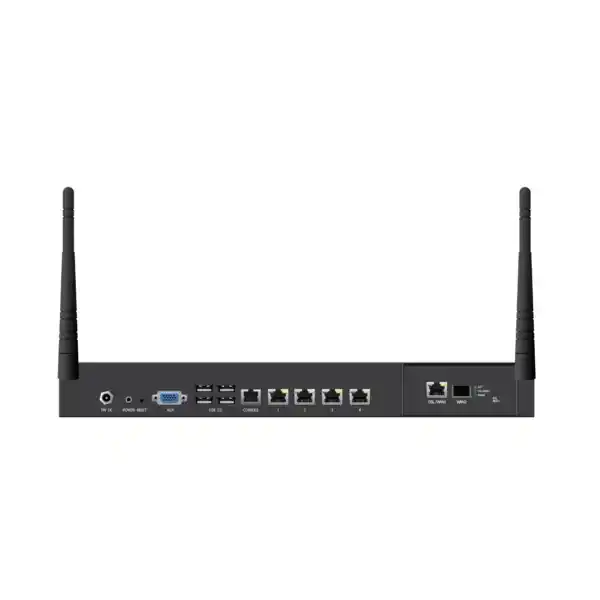
The F82 DSL Annex B provides four 10/100/1000 Mbps copper Ethernet interfaces for LAN or segmented network use. This is sufficient for a compact branch where the firewall connects to a managed access switch and carries user, voice, wireless, printer, CCTV or operations VLANs through tagged or routed interfaces. The appliance documentation also identifies USB 2.0 ports, an RJ45 serial console and VGA service access on the hardware platform, giving administrators local options for maintenance and recovery workflows.
A key design point is that four copper ports do not mean the appliance should replace a properly designed access switch. Use the firewall for security-zone boundaries, WAN attachment and routed segmentation; use managed switching for endpoint density, PoE, access-layer VLANs and resilient campus wiring. Keeping roles clean simplifies troubleshooting and avoids turning a compact security device into an improvised switching core.
WAN, DSL and SFP connectivity
The Annex B/J variant is documented with an RJ45 DSL interface and a 1GbE optical SFP interface. That gives the appliance two very different ways to participate at the WAN edge: direct DSL termination where the service and local carrier handoff are compatible, plus Ethernet-over-fiber or copper-via-transceiver possibilities through the SFP slot. This flexibility can be useful during migrations because the branch can retain a legacy DSL circuit while introducing a newer Ethernet service.
SFP selection should never be assumed from connector shape alone. Fiber type, wavelength, distance, connector standard, carrier presentation and transceiver compatibility all need to match. Likewise, Annex B/J is a specific DSL characteristic historically associated with ISDN-oriented deployments in many EMEA markets. Before ordering an F82 specifically for DSL, confirm the circuit type with the service provider and verify that the intended handoff actually requires the integrated modem rather than an external carrier CPE device.
Integrated Wi-Fi
The F82 DSL platform includes integrated IEEE 802.11b/g/n Wi-Fi. For a very small office this can provide local wireless coverage without another access point, particularly for low-density administrative use, temporary deployments or management access. It is not equivalent to a modern high-density enterprise Wi-Fi system, and its older radio standards should be considered when planning performance, channel use and security policy.
Where a site requires strong roaming, Wi-Fi 6 or newer client performance, multiple SSIDs, guest onboarding, location analytics or predictable coverage across a large floor plate, use dedicated enterprise access points instead. The firewall’s integrated Wi-Fi is best treated as a useful branch feature rather than the primary WLAN architecture for a demanding contemporary office.
Desktop form factor and power
Barracuda documentation identifies the F82 as a compact desktop platform with a single external power supply. Published dimensions for the earlier F82 family are approximately 378 × 160 × 44 mm, with a weight around 2.2 kg. That physical profile is easy to place in a branch communications cabinet, on a secure shelf or in a small network enclosure where full rack-depth hardware would be impractical.
A single external power supply also means power resilience must be designed outside the appliance. In UAE deployments, connect the unit to an appropriately sized UPS and surge-protected circuit, document the power brick as a replaceable dependency, and consider spare-power arrangements for locations where outage recovery time is important. Environmental stability, clean power and secure physical access are often as important to branch uptime as the firewall configuration itself.
Annex B/J DSL: the detail that should drive model selection
The “DSL Annex B” designation is not a cosmetic suffix. It identifies the integrated modem variant and is therefore central to ordering accuracy. The F82 family existed in Annex A and Annex B forms. Barracuda documentation differentiates the Annex A model with an RJ11 DSL interface, while the Annex B/J version uses an RJ45 DSL interface. These are not interchangeable assumptions. A procurement request should state the circuit technology, local carrier handoff and exact desired F82 variant so that the appliance matches the branch line.
In practical network design, it is also important to decide whether the firewall should terminate DSL directly at all. Many current UAE business circuits are delivered through carrier-managed CPE, Ethernet NTE, GPON/ONT equipment or other provider devices. In such cases, the firewall may receive a normal Ethernet handoff and the integrated DSL modem may not be used. Buying a DSL-specific firewall only makes sense when it solves a real circuit requirement or preserves compatibility with an existing design.
If the branch is migrating from DSL to Ethernet or fiber, the 1GbE SFP path can be strategically useful, but it does not convert the F82 into a high-capacity modern edge appliance. The firewall’s security throughput remains the principal sizing constraint. An access circuit can be physically 1 Gbps while the desired inspection stack, VPN encryption and application mix yield a much lower effective secure throughput. Circuit speed and firewall performance must therefore be planned separately.
FourTeck recommends collecting the ISP service order, WAN handoff type, IP addressing method, VLAN tagging requirement, PPP parameters where applicable, authentication details, expected bandwidth and failover design before confirming the hardware. That prevents a common branch deployment problem: receiving a firewall whose physical interfaces are technically present but whose modem type, optics or service assumptions do not match the circuit delivered at the site.
Performance: interpret the numbers as engineering limits, not promises
Barracuda historically published up to 1.35 Gbps firewall throughput, 240 Mbps VPN throughput, 500 Mbps IPS throughput and 400 Mbps NGFW throughput for the F82.DSLB. The same family was positioned for roughly 50 to 100 users. These figures are useful reference points, but they were measured under controlled conditions and should not be read as guaranteed application performance. Real traffic includes small packets, bidirectional flows, TLS encryption, SaaS sessions, voice, file transfers, backups, DNS, authentication, security updates and bursts that interact differently with inspection engines.
For a branch firewall, the most misleading sizing error is to compare the ISP bandwidth only with the headline stateful-firewall throughput. If an office has a 500 Mbps Internet connection but intends to run IPS, application control, web filtering, VPN and possibly SSL inspection, the relevant baseline is closer to the security-services throughput than to the packet-forwarding maximum. Headroom is also necessary. A firewall operating near saturation may show rising latency, session setup delays and poor user experience before a simple bandwidth graph appears completely full.
User count is similarly approximate. Fifty engineers synchronizing large repositories, using video meetings and maintaining VPN tunnels can impose more load than one hundred transactional users operating lightweight web applications. A branch with CCTV uploads, cloud backup and software distribution may produce sustained traffic independent of interactive users. Sizing must account for concurrency, application behavior, inspection policies, encrypted traffic ratios and peak-hour demand.
For replacement planning in 2026, also include future growth. Even if an existing F82 is adequate today, a new five-year design should consider the increasing proportion of encrypted traffic, richer SaaS use, cloud security integration, faster access circuits and changing support requirements. Where the project objective is long-term capacity rather than like-for-like continuity, FourTeck can map the existing F82 policy and WAN design to a newer platform rather than simply reproducing the old hardware specification.
Security services and policy architecture
Stateful firewalling
At its foundation, the F82 enforces stateful network policy between WAN, LAN and logical security zones. A clean rule base should follow least-privilege principles: explicitly define permitted sources, destinations, services and applications, keep administrative access separate, remove unused objects and document why each exception exists. For distributed branches, template-driven consistency reduces the chance that one location quietly accumulates risky “any-to-any” rules over time.
Application control
Application-aware policy allows traffic decisions to be based on application behavior rather than port numbers alone. This is useful when web-based tools, collaboration platforms, consumer applications and business SaaS services share TCP 443. Policies can be built to prioritize required business traffic, restrict unwanted applications and provide better visibility into how branch bandwidth is consumed.
Intrusion prevention
IPS inspection is intended to identify malicious or exploit-like network behavior and block traffic according to security policy. Effective IPS deployment is not simply “enable everything.” Signature coverage, false-positive handling, server exposure, traffic direction and business impact should be reviewed. Monitoring before aggressive enforcement can help teams tune policy without unnecessarily disrupting legitimate branch applications.
Web filtering
Web filtering adds category and policy controls for outbound browsing. In a branch environment it can support acceptable-use policy, reduce exposure to known malicious destinations and provide another enforcement point when users access the Internet directly from the site. Filtering decisions should be aligned with organizational policy and legal requirements rather than relying on broad category blocking without exception processes.
SSL interception
The platform supports SSL interception, which can improve visibility into encrypted traffic when deployed appropriately. This capability has major operational considerations: certificate distribution, application pinning, privacy boundaries, performance impact and exclusion handling. A successful rollout therefore needs endpoint trust preparation, a documented bypass policy and testing for banking, healthcare, government or other sensitive application categories.
Advanced threat protection
Barracuda has offered Advanced Threat Protection as an optional service on this class of appliance. The purpose is to add deeper analysis for suspicious files and advanced threats beyond conventional inspection. Because subscription names and entitlements change over product lifecycles, current availability should be confirmed against the exact serial number, software release and support contract before a purchase or renewal is committed.
SD-WAN and multi-link branch connectivity
SD-WAN capability is important because modern branches rarely depend on one application path. A site may have an MPLS or private WAN, public Internet, DSL, Ethernet fiber, or a secondary carrier connection. The firewall can participate in policy-driven path selection so that traffic is steered according to application, availability and network conditions rather than relying only on a single static default route. In practice, this can improve resilience and make better use of lower-cost Internet connectivity.
For example, latency-sensitive voice or business applications can be assigned to a preferred path while software updates and general browsing use another. If the preferred circuit fails, defined failover behavior can move traffic to the surviving path. The exact result depends on topology and licensing, and application continuity is not instantaneous for every protocol; some sessions must reconnect after a path change. Therefore, resilience should be tested using realistic business workflows, not just by checking whether ICMP ping succeeds.
Branch designs also need route discipline. Dynamic routing support allows the firewall to integrate with more sophisticated networks, but the protocol choice should reflect operational need. A small two-link office may be simpler with static routes and policy-based selection. A larger distributed environment may benefit from dynamic routing to exchange reachable prefixes, support failover and reduce manual configuration. Complexity should earn its place: every dynamic protocol introduces timers, adjacency state, redistribution behavior and troubleshooting requirements.
Where a customer already uses centralized CloudGen policy across many sites, preserving WAN behavior during replacement can be more valuable than changing platforms abruptly. Conversely, if the F82 is the last legacy device at a branch, its 2027 end-of-life milestone is an opportunity to simplify the architecture and standardize on a current secure SD-WAN platform. FourTeck’s Firewall Dubai practice can assist with that branch-edge assessment and transition planning.
VPN architecture for site-to-site and remote access
Barracuda documentation lists site-to-site and client-to-site VPN support on the F82 family. In a distributed UAE organization, site-to-site VPNs can link branches to headquarters, data centers, cloud networks or regional hubs across commodity Internet services. The advantage is not merely encryption; a well-designed VPN overlay can provide predictable addressing, centralized access control and a consistent method for carrying internal services across diverse carrier connections.
The published VPN throughput figure of up to 240 Mbps should be evaluated against real encryption settings and traffic. Test methodologies historically used specific protocols, ciphers and packet sizes. Production environments can differ considerably, particularly when small packets, many concurrent tunnels or CPU-intensive security services are involved. If a branch has a 500 Mbps Internet circuit and most business traffic traverses an encrypted overlay, the VPN engine rather than the physical interface may become the practical bottleneck.
Remote-access design requires additional controls. User identity, multifactor authentication, endpoint posture, split-tunnel policy, DNS behavior and access segmentation all affect risk. Remote users should not automatically receive broad access because a VPN successfully authenticates them. Instead, provide role-based access to the applications and networks they require. Logging should capture authentication events, assigned addresses and relevant connection metadata to support investigation and troubleshooting.
For organizations moving toward zero-trust access or cloud-delivered security, an F82-based remote-access design should be compared with newer service models before renewing long-term dependencies. The right answer may still be to keep an existing F82 through a defined migration period, but that should be a deliberate transitional choice. A lifecycle-aware plan defines the replacement date, configuration export strategy, tunnel migration sequence, rollback method and user communication before support deadlines become urgent.
Recommended UAE deployment patterns
Small branch with direct DSL
Use the Annex B/J DSL interface as the primary WAN only when the carrier service is compatible and the integrated modem is specifically required. Connect the LAN side to a managed switch, separate business, voice, guest and operational devices into VLANs where appropriate, and apply security policy between those zones. Add UPS protection and preserve console access for recovery. This pattern is most relevant for legacy sites where changing the circuit is difficult or where the existing deployment already depends on the F82 modem variant.
DSL plus Ethernet backup
Retain DSL as one path and use the SFP or an appropriate Ethernet interface for a second ISP, subject to the actual handoff design. Apply health checks and routing policy so critical traffic fails over when the primary path is unavailable. Test DNS, VPN and cloud application behavior during failover because a public-address change can force session reconnection. This design can materially improve branch availability without requiring a large chassis, although the appliance itself remains a single hardware node unless a broader redundancy design is implemented.
Existing CloudGen branch refresh
Where an F82 is already deployed, a replacement project should start with configuration discovery rather than a factory-default rebuild. Inventory firewall rules, routes, NAT, tunnels, network objects, authentication dependencies, certificates, logging destinations and management relationships. Identify legacy rules that should not be migrated. Then design the replacement so verified business services move cleanly while obsolete exceptions are removed. This approach turns an end-of-life exercise into a security improvement rather than a simple hardware swap.
Temporary or project office
A compact appliance can be useful for construction, consulting, events, logistics or temporary project environments where rapid deployment is more important than campus-scale performance. Zero-touch capabilities, predefined VPN policy and integrated Wi-Fi can shorten setup time. However, temporary does not mean unmanaged: define an asset owner, backup the configuration, use centralized logging, apply firmware policy and establish a decommission process so branch credentials and tunnels are removed when the project ends.
Routing, segmentation and policy design
The quality of a firewall deployment is determined as much by network architecture as by security subscriptions. A clean branch design separates trust zones according to business function. Corporate endpoints, IP phones, guest devices, building systems, cameras, printers and administrative interfaces should not automatically share one flat broadcast domain. Even when the firewall has only a small number of physical interfaces, VLAN subinterfaces can create logical boundaries through a managed switch, allowing policy to control east-west traffic between categories.
Segmentation should be specific enough to reduce risk but simple enough to operate. A branch with five employees does not need dozens of microsegments merely because the technology allows it. Start with meaningful trust boundaries: managed corporate devices, untrusted guest access, infrastructure management, voice and operational technology where present. Define which zone initiates communication to which service, and deny unnecessary inbound paths. This structure makes later troubleshooting easier because traffic intent is visible in the policy rather than hidden inside an undifferentiated LAN.
Network address translation should also be documented. Outbound Internet NAT is straightforward, but inbound publishing, policy NAT, overlapping branch addresses and VPN translation can become complicated quickly. Avoid using NAT to compensate for poor IP planning when routes can solve the problem cleanly. If overlapping private ranges already exist across acquired or legacy sites, record the translation logic carefully because it becomes a critical dependency during migration.
Dynamic routing can be valuable where the branch exchanges multiple prefixes with hubs or carriers, but route filtering and redistribution policy are essential. An accidental default-route advertisement or uncontrolled redistribution can affect many locations. For simpler branches, static routing remains easier to audit. The design objective is not maximum protocol sophistication; it is predictable forwarding under normal operation, circuit failure, tunnel loss and maintenance events.
Centralized operations, zero-touch deployment and configuration governance
Barracuda positions CloudGen Firewall for distributed environments where centralized control and zero-touch deployment can reduce branch rollout effort. The operational concept is important: local staff should not need deep firewall expertise to bring every remote site online. A device can be prepared with an approved configuration model, shipped to the branch and connected according to a documented cabling plan, while central administrators retain policy authority.
Centralization does not remove the need for change governance. Security policies should have owners, change tickets, peer review for high-impact modifications and clear rollback methods. Branch administrators should receive only the privileges they require. Shared administrator accounts should be avoided where identity-aware access is available because individual accountability makes auditing and incident investigation more reliable.
Configuration backup is especially important for lifecycle-stage hardware. Maintain a current export before upgrades or changes, document software versions and preserve recovery information securely. If an appliance fails near its support deadline, recovery can become more complicated if replacement stock is limited. A backup should be tested conceptually against the intended recovery platform; having a file is not the same as knowing it can be restored to available hardware and software.
FourTeck can combine firewall work with broader UAE infrastructure services through FourTeck IT Services UAE, particularly where a branch refresh includes switching, structured cabling, UPS, Wi-Fi, server connectivity or migration support. Treating the firewall as part of the site architecture helps avoid handoff gaps between networking, security and physical installation teams.
Logging, monitoring and incident readiness
A firewall that blocks traffic but does not provide usable telemetry is difficult to operate. Configure logging so the network team can understand allowed and denied sessions, VPN state, authentication events, system health, WAN availability and security detections. Retention requirements depend on organizational policy and compliance needs, but the practical objective is consistent: when an incident occurs, operators should be able to reconstruct what happened without discovering that the required logs were overwritten days earlier.
Alerting should focus on actionable conditions. A constant stream of low-value events trains teams to ignore dashboards. Prioritize link failure, tunnel failure, resource saturation, repeated administrative authentication errors, severe security detections, license or subscription problems and hardware health issues. Establish escalation contacts for branches that operate outside central office hours, especially if the site supports customer-facing, warehouse, retail or industrial processes.
Time synchronization is a basic but critical control. Firewall events, authentication records, server logs and endpoint telemetry must share reliable time if they are to be correlated during investigation. DNS configuration is similarly foundational; many apparent application failures are actually resolver issues. A branch runbook should therefore include time source, DNS path, default gateway, WAN addressing, tunnel endpoints and management access details.
Monitoring also supports capacity planning. Track peak WAN utilization, CPU and memory trends, session behavior and security-engine load where telemetry is available. If the F82 is repeatedly operating near performance ceilings, treat that as a migration trigger rather than waiting for user complaints. Capacity management is particularly important as cloud applications and encrypted traffic increase over time.
Lifecycle notice for 2026 procurement
Barracuda’s published lifecycle table lists the F82 Rev. A with an end-of-sale date of 28 February 2022 and an end-of-life date of 28 February 2027. As of September 2026, that date is close enough that any purchase, renewal, spare strategy or deployment extension needs a formal lifecycle decision. This does not automatically mean every existing F82 must be removed immediately, but it does mean a new project should not treat the model as a long-horizon current-generation platform.
For an existing installed base, the useful question is: what business dependency keeps this appliance in place? It may be an integrated DSL circuit, a standardized CloudGen configuration, a support contract, a temporary branch closure schedule, a pending carrier migration or a need for a short-term spare. If the dependency is clear and temporary, retaining the model through a controlled transition can be reasonable. If there is no such dependency, replacement planning generally offers a cleaner path.
For a new branch, examine supported successor options before ordering legacy stock. Barracuda’s lifecycle information points toward newer models and, for certain F82 use cases, references a newer appliance with a third-party DSL SFP transceiver rather than the old integrated modem design. Exact successor suitability depends on throughput, interface and subscription requirements, so model mapping should be performed against the real site design rather than on name alone.
Stock condition matters as well. If an F82 is sourced after end of sale, confirm whether the unit is new old stock, refurbished, previously registered or otherwise limited by serial-number status. Hardware availability does not guarantee entitlement to software updates, security subscriptions or vendor support. FourTeck recommends validating those commercial and lifecycle details before delivery acceptance.
Licensing and subscription planning
Next-generation firewall capability depends on more than the chassis. Security services, support and advanced features may require subscriptions or entitlements. On a lifecycle-stage product, the exact contract position is especially important because older bundle names, renewal eligibility and support terms can differ from current commercial packages. A procurement request should therefore include the intended security functions, not merely “F82 appliance.”
Start with the operational baseline: stateful firewalling, routing, site-to-site VPN, client access if required, application control, IPS, web filtering, SSL inspection policy and centralized management. Then identify optional services such as advanced threat protection or advanced remote access. Confirm whether those functions remain available for the exact hardware revision and software release, and confirm the term length that can actually be supported before the published end-of-life milestone.
Licensing should also align with migration timing. A customer planning to retire an F82 in six months may not want a commercial structure that locks the site into a much longer legacy term unless entitlements can be transferred or credited. Conversely, running without required security updates simply because the hardware still powers on is not a sound strategy. The purchase decision should connect the support term, replacement date and budget.
Document license ownership and administrative account details as corporate assets. Branch security infrastructure should not depend on a former employee’s personal mailbox or an undocumented reseller account. Clear entitlement records make renewals, support cases and migrations substantially easier.
Sizing methodology for real branch traffic
1. Measure the WAN, not just the contract
Record the contracted circuit speed, but also collect real utilization over representative business periods. Peak demand, sustained demand and burst behavior can differ. A 200 Mbps branch that uses only 40 Mbps most days may have ample capacity, while a 100 Mbps branch that runs at 95 Mbps for hours has no headroom. Include upstream demand because cloud backup, cameras, collaboration and VPN traffic can make upload performance just as important as download speed.
2. Identify the inspection stack
Determine which traffic will pass through IPS, application control, web filtering and SSL interception. Do not size from the 1.35 Gbps firewall figure if the business expects the 400 Mbps-class NGFW workload to apply to most traffic. Security features consume resources for a reason: they perform more work per flow. The target design should preserve useful headroom during peak inspection load.
3. Count applications and sessions
Headcount is only a starting point. Inventory video collaboration, ERP, CRM, virtual desktop, cloud storage, code repositories, point-of-sale, SIP, CCTV, remote management and software distribution. Some users generate hundreds of background sessions without realizing it. The objective is to understand session concurrency and packet behavior, not to attach a simplistic Mbps number to each employee.
4. Add growth and failure-state demand
A resilient branch must still work when one path fails. If two circuits normally share load, the surviving circuit and firewall path should handle critical traffic during an outage. Add growth for planned staff, cloud migration and faster carrier services. A firewall selected at 95% of today’s requirement is already undersized for tomorrow.
UAE deployment considerations
Dubai and UAE branch projects often involve multiple teams: the Internet service provider, building facilities, structured-cabling contractor, corporate IT, security operations and the equipment supplier. Many deployment delays occur at the boundaries between those teams rather than inside the firewall itself. Before installation, confirm rack or shelf space, power socket type, UPS capacity, cooling, patching, fiber termination, ISP demarcation point and site access permissions.
Carrier handoff should be written down in precise terms. “Fiber Internet” is not enough. The firewall team needs to know whether the provider presents copper Ethernet, SFP fiber, ONT Ethernet, PPP-based DSL or another service; whether VLAN tagging is required; whether addressing is static, dynamic or PPP-assigned; whether a public subnet is routed; and whether provider CPE must remain in path. This is particularly relevant to the F82 DSL Annex B because purchasing the modem variant is only useful when the local service can actually use it.
Operational support coverage should match branch importance. A back-office site that can operate offline for several hours has different requirements from a retail location, warehouse gate, call center or customer service facility. Define the acceptable outage window, remote-hands availability, spare hardware strategy and escalation contacts. If rapid onsite replacement is required, confirm stock and logistics before treating any legacy model as business-critical infrastructure.
For organizations with requirements beyond the UAE, FourTeck can coordinate regional infrastructure discussions through its Africa technology practice as well as its UAE teams. The objective is to keep branch standards consistent while respecting local carrier, logistics and support realities.
Migration planning from an existing F82
A good migration starts with observation. Export or document the current configuration and then verify what is actually in use. Firewall rule bases often contain years of accumulated objects, temporary exceptions and retired services. Migrating everything blindly carries technical debt into the new platform. Instead, compare configuration with live traffic logs and business-owner input. Mark rules as required, unknown or obsolete, and resolve the unknowns before the cutover where practical.
Document every WAN dependency. Record public IPs, PPP credentials, provider VLANs, routed subnets, DNS settings, upstream gateway behavior and modem details. Capture site-to-site VPN peers, encryption parameters, remote networks and failover logic. If certificates are used, confirm whether keys are exportable and whether any certificate must be reissued. For client VPN, identify software versions and user communication requirements.
Build a cutover test plan that reflects business processes. A simple ping test cannot prove that the migration is complete. Test DNS resolution, web access, SaaS login, ERP, printing, voice calling, inbound services, site-to-site applications, remote access, monitoring, backup jobs and security logging. Include negative tests such as verifying that guest users cannot reach internal subnets and that blocked categories or applications remain restricted.
Define rollback before the change window starts. Preserve the old appliance configuration, label cables, record switch ports and keep provider contact details available. If the new platform cannot establish a critical tunnel or carrier session, the team should know exactly how to restore the previous topology. Rollback planning is not pessimism; it reduces pressure and allows technical staff to make better decisions during a change.
After cutover, monitor closely for several business cycles before declaring the project closed. Review dropped traffic, CPU load, tunnel stability, link utilization and help-desk tickets. Then remove temporary migration rules and retire old credentials. If the F82 is retained as a spare, define how long it remains supported and where its configuration is stored; otherwise, decommission it securely and update the asset register.
Operational checklist after installation
Configuration hygiene
Name interfaces and network objects clearly. Remove default or temporary admin access. Use role-based administration. Back up the running configuration after acceptance. Record firmware level, serial number, support status and recovery contacts. Keep a change log so later troubleshooting can distinguish a network incident from a recent policy modification.
Security validation
Confirm intended inbound exposure only, verify management interfaces are not unnecessarily reachable from the Internet, review IPS and application policy, test web filtering, validate SSL interception exceptions and ensure threat-protection services are licensed and updating where required. A firewall that is physically installed but not receiving security updates should be treated as an operational exception.
Resilience testing
Disconnect each WAN path in a controlled window and observe failover. Test tunnel restoration, DNS behavior and application reconnection. Verify the UPS runtime expectation and the branch’s recovery procedure after a full power loss. If the appliance is a single point of failure, document that fact and make sure the business owner understands the resulting outage risk.
Monitoring
Send critical events to the chosen monitoring or logging platform. Create alerts for WAN loss, VPN failure, license expiry, resource saturation and significant security detections. Verify alerts reach a monitored mailbox or ticketing workflow rather than an individual who may be unavailable.
Documentation
Maintain a current logical diagram showing WAN circuits, addressing, VLANs, VPN peers and important routes. Add a physical diagram for power, switch ports and carrier equipment. Good documentation reduces recovery time when the engineer responding to an outage is not the person who originally installed the firewall.
Lifecycle action
Record 28 February 2027 as the published F82 end-of-life milestone and assign an owner for the migration decision. Do not rely on calendar memory. A tracked action with budget, target platform and implementation window prevents the branch from drifting beyond the planned support period.
Why the F82 may still appear in replacement and expansion requests
Legacy products often remain operational long after end of sale because networks change more slowly than product catalogs. A branch may have a stable configuration that has been running for years, a specific modem dependency or an approved standard that cannot be changed until a larger project is funded. In those situations, organizations may seek a like-for-like F82 to replace failed hardware or maintain consistency for a limited period. The technical requirement is legitimate even though the model is no longer the preferred choice for a new long-term deployment.
The procurement process should make that distinction explicit. A replacement request can be fulfilled around compatibility and short-term continuity, while a greenfield design should prioritize current support lifecycle, modern performance and future connectivity. Mixing those two use cases creates confusion. A customer asking for “one more F82” might actually need a migration spare, not a production standard for the next five years.
There is also value in maintaining architectural consistency during staged migrations. If twenty branches use the same policy framework and only three remain to be upgraded, the organization may choose a controlled transition instead of introducing a different platform under emergency conditions. The key is to define the end state. Temporary compatibility measures should have an expiration date and a named project owner.
FourTeck can support both paths: sourcing discussions for a compatibility-driven requirement where feasible, and architecture guidance for customers who want to replace the F82 with a supported alternative. The wider FourTeck UAE portfolio can also help coordinate adjacent switching, Wi-Fi, server and communications dependencies during a branch refresh.
Security engineering notes for expert buyers
The F82 should not be evaluated as if it were an ASIC-accelerated contemporary data-center firewall. Barracuda’s product positioning emphasizes software-defined network security, VPN, SD-WAN and centralized control on a compact branch appliance. For engineering purposes, the relevant question is the measured service throughput under the desired feature set, not whether a marketing architecture term can be applied. This is why NGFW and VPN figures are more meaningful than interface line rate when predicting branch experience.
Packet size distribution matters. Large-packet throughput tests represent an efficient forwarding workload, while real enterprise traffic includes short transactions, DNS, acknowledgments, voice packets and encrypted session establishment. Small packets increase packets-per-second processing demand even when Mbps appears modest. If the branch hosts many chatty clients or real-time workloads, capacity should be assessed with more margin than a bulk-transfer benchmark would suggest.
TLS inspection adds another dimension because the firewall must participate in encrypted-session processing. Certificate validation, cipher negotiation and content inspection consume resources and can introduce compatibility issues with pinned applications. Mature deployments define categories that must not be decrypted, maintain a trusted inspection CA on managed endpoints and monitor failure logs so application breakage is identified quickly.
VPN design should similarly be based on cryptographic policy and topology. Hub-and-spoke tunnels centralize control but can hairpin cloud-bound traffic through the data center. Direct Internet breakout reduces latency but moves more security responsibility to the branch. Full-mesh VPN reduces path length between sites but increases tunnel and routing complexity. SD-WAN can provide policy flexibility, but architecture should follow application flows rather than assuming one topology fits every branch.
Finally, hardware lifecycle is part of security architecture. Once a platform can no longer receive the required software fixes or vendor support, operational risk changes even if throughput remains acceptable. Security teams should therefore treat end-of-life dates as design constraints, integrate them into asset governance and fund replacement before emergency failure or unsupported vulnerability forces an unplanned outage.
Procurement guidance: what to verify before issuing a purchase order
Because the F82 is beyond its published end-of-sale date, purchasing requires more diligence than ordering a current model. Confirm the exact hardware designation “F82 DSL Annex B” or “F82.DSLB,” not merely “F82.” The Annex A and Annex B modem variants differ. Verify the physical WAN requirement, and do not substitute one variant because the chassis looks similar. If the integrated modem is not needed, reconsider whether another supported platform would provide a better lifecycle outcome.
Ask for the hardware condition and provenance. New old stock, refurbished units and previously deployed appliances can have different warranty or entitlement implications. Confirm serial-number eligibility for the support and security subscriptions you need. If the unit is intended as a cold spare, decide whether it must be pre-licensed and staged or whether the business can tolerate a licensing workflow during failure recovery.
Verify accessories. The appliance uses an external power supply, so the correct adapter and regional power lead matter. If the SFP interface will be used, specify the optic separately unless confirmed as included. If Wi-Fi is required, verify the hardware package and antenna components. For DSL, confirm the correct cable and carrier handoff. Small missing accessories can delay an otherwise complete branch installation.
Define the service scope. Hardware supply alone is different from a staged deployment that includes configuration migration, VPN cutover, ISP coordination, testing, documentation and post-change support. For business-critical sites, the project should identify who owns each task. A firewall supplier cannot configure a circuit that the carrier has not delivered, and a carrier cannot validate security policy. Clear scope boundaries prevent last-minute disputes during cutover.
Finally, compare total cost with migration. A legacy unit may appear cheaper as a one-off replacement, but if it requires short-term licensing, scarce spares and another migration within months, the total cost can exceed moving directly to a supported platform. Procurement should evaluate the cost of two changes, not just the price of one appliance.
Frequently asked technical questions
Is the F82 DSL Annex B suitable for a 1 Gbps Internet line?
Its interface can participate in gigabit connectivity, but the published security-service throughput is below 1 Gbps. Barracuda historically lists up to 1.35 Gbps firewall throughput, 500 Mbps IPS, 400 Mbps NGFW and 240 Mbps VPN for F82.DSLB. If most traffic requires full security inspection or VPN, a 1 Gbps circuit is likely to exceed the appliance’s practical secure-throughput class.
Does Annex B mean the firewall works with any DSL service?
No. Annex B/J identifies a particular DSL modem variant and physical interface. Carrier technologies and handoffs differ. Confirm the exact service with the ISP before selecting the model. Many modern business connections are delivered through Ethernet handoffs even when the access network behind the provider is fiber or another technology.
Can the integrated Wi-Fi replace enterprise access points?
For a small low-density branch, the integrated 802.11b/g/n radio may be adequate for basic wireless access. For modern office coverage, roaming, high client density, newer Wi-Fi standards or centrally managed WLAN features, dedicated enterprise access points are generally more appropriate.
Is the F82 still a good new purchase in 2026?
Only for a clearly justified compatibility or short-term lifecycle requirement. Barracuda lists end of life for F82 Rev. A as 28 February 2027. A greenfield deployment should normally compare newer supported options so that security updates, hardware support and capacity remain viable over the intended service life.
Does the F82 support SD-WAN and dynamic routing?
Yes, Barracuda’s historical feature set for the F82 family includes SD-WAN and dynamic routing. The actual configuration should be designed around the branch’s circuits, preferred paths and failure behavior rather than enabling features without a defined traffic objective.
Can FourTeck assist with replacement planning?
Yes. FourTeck can review the installed F82, WAN handoff, current rules, VPN dependencies, subscription position and performance requirements, then help determine whether a like-for-like short-term replacement or migration to a supported platform is the better fit for the site.
FourTeck engagement model for F82 projects
A useful firewall engagement begins with the requirement rather than the part number. FourTeck can review whether the branch truly needs the F82 DSL Annex B hardware, whether the existing carrier line is compatible, what security subscriptions are required and how long the appliance is expected to remain in service. This is particularly important when a request comes from an old bill of materials that may not reflect current lifecycle reality.
For replacement projects, FourTeck can structure discovery around the running configuration and business traffic. The resulting plan can include hardware recommendation, optics, cabling, WAN parameters, migration of network objects and policies, VPN recreation, test procedures and documentation. Where the customer has internal network engineers, the scope can focus on supply and design validation. Where a turnkey change is required, implementation responsibilities can be defined in the quotation.
For multi-site customers, standardization is usually more valuable than isolated branch optimization. A reference architecture can define common VLANs, naming, security zones, logging, VPN topology, routing and monitoring so each site follows the same operational pattern. Site-specific variations such as DSL, fiber, dual ISP or wireless backup can then be treated as controlled exceptions rather than unique one-off configurations.
Customers evaluating broader infrastructure options can also explore the global FourTeck portfolio at FourTeck Global. Keeping firewall, network and branch-infrastructure discussions coordinated can simplify responsibility during a migration and provide one documented technical baseline for future support.
Decision recap: when to choose, retain or replace the F82 DSL Annex B
Choose or source for compatibility
The strongest case is a defined short-term need: an existing F82 environment, a failed branch unit, a known Annex B/J DSL requirement, a staged migration or a spare strategy that depends on matching hardware. Confirm serial status, licensing and support before purchase.
Retain temporarily with a plan
An installed appliance can remain useful if it is stable, appropriately supported and scheduled for migration before the lifecycle deadline. Track the replacement date, maintain configuration backups, monitor capacity and keep required support entitlements active.
Replace for long-term design
For a new branch, major bandwidth upgrade, modern Wi-Fi requirement, longer support horizon or full security inspection above the F82’s class, evaluate a current-generation platform. The 28 February 2027 end-of-life date makes a fresh multi-year F82 standard difficult to justify.
The deciding factors are therefore not brand familiarity or chassis price alone. They are lifecycle, actual WAN handoff, required inspected throughput, VPN load, security subscriptions, branch criticality and the organization’s migration roadmap. A well-documented requirement will quickly show whether the F82 remains the correct transitional tool or whether moving forward is the lower-risk option.
Quotation input checklist
To produce an accurate quotation and avoid interface or licensing mismatches, provide the following information with the request. Complete details are especially important for the F82 DSL Annex B because the product is lifecycle-stage hardware and the modem type is model-specific.
Dubai/UAE site location, ISP name, contracted bandwidth, primary and backup circuit type, provider handoff, PPP or static IP details, VLAN tagging, public subnet requirement and confirmation of Annex B/J DSL compatibility.
Existing model, hardware revision, serial status if relevant, firmware release, support expiry, current subscriptions, configuration backup availability and reason for replacement or expansion.
Approximate user count, peak Internet utilization, critical SaaS or internal applications, voice/video use, cloud backup, CCTV or large uploads, expected growth and whether full SSL inspection is planned.
Number of site-to-site tunnels, remote-access users, peer platforms, routed networks, dynamic routing protocols, NAT requirements, dual-WAN behavior and any overlapping IP ranges.
IPS, application control, web filtering, advanced threat protection, SSL interception, centralized management, logging integration, authentication requirements and any regulatory or internal policy constraints.
Required hardware condition, accessories, optics, power requirements, target delivery date, onsite installation need, change window, rollback expectation, documentation scope and post-cutover support requirement.
Consult FourTeck before committing to a legacy F82 purchase
The Barracuda CloudGen Firewall F82 DSL Annex B remains technically relevant for specific EMEA branch scenarios, especially when an existing environment or Annex B/J DSL requirement creates a compatibility need. Its published 1.35 Gbps firewall, 400 Mbps NGFW, 500 Mbps IPS and 240 Mbps VPN performance place it in the small-branch class, while its integrated modem, SFP uplink and Wi-Fi provide useful edge flexibility.
The decisive issue in 2026 is lifecycle. With Barracuda listing 28 February 2027 as end of life for F82 Rev. A, every procurement should include a support and migration check. FourTeck can review the circuit, existing configuration, security services, required throughput and replacement timeline, then advise whether a compatible F82 deployment is still appropriate or whether a current platform will deliver better long-term value.
FourTeck will align hardware, lifecycle, licensing, connectivity and migration scope before quotation.

Reviews
There are no reviews yet.