
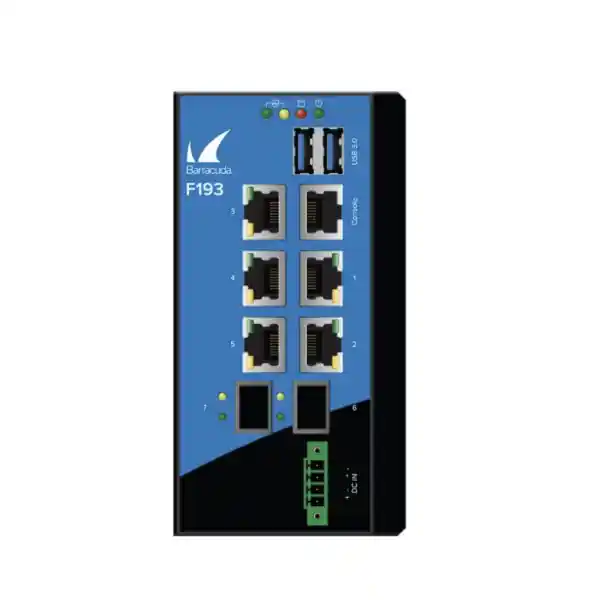
Barracuda CloudGen Firewall F193 Rugged Revision A
The Barracuda CloudGen Firewall F193 Rugged Revision A is a compact industrial firewall designed for locations where ordinary office appliances are difficult to deploy. Barracuda identifies the platform as the F193a.R rugged model. It combines fanless operation, DIN-rail installation, five copper Gigabit Ethernet ports, two Gigabit SFP fiber interfaces, solid-state storage, DC power input and a hardened operating-temperature range with the CloudGen Firewall software stack for secure routing, VPN, SD-WAN and policy enforcement.
For UAE organizations, the F193a.R is especially relevant at industrial edge sites, utility cabinets, transport facilities, manufacturing cells, warehouses, remote telemetry locations, branch infrastructure and OT/IT demarcation points where central policy control must be extended into compact field environments. FourTeck can assist with solution sizing, interface planning, SFP selection, power architecture, licensing alignment, configuration, staged rollout and lifecycle support.
Choose the F193 Rugged when you need a fanless DIN-rail appliance with copper and fiber networking, centralized CloudGen policy management and industrial-temperature operation without moving to a full rackmount platform.
Port 1 is the default management interface; ports 2–5 provide additional copper connectivity for WAN, LAN, OT zones or routed segments.
Useful for optical uplinks, electrically isolated inter-building runs and industrial network designs that require fiber handoff.
Compact industrial housing with the DIN-rail mounting clip included, supporting installation in appropriately designed cabinets and edge enclosures.
A wider operating range than typical office appliances, with non-condensing operating humidity specified from 5% to 90%.
Intel Atom X-Series, four cores, 4GB RAM and a 100GB SSD according to the current model-specific hardware documentation.
Vendor performance figures are laboratory “up to” measurements; real sizing must consider packet size, inspection services, VPN, logging and application mix.
What is the Barracuda CloudGen Firewall F193 Rugged Revision A?
The F193 Rugged Revision A is the higher-port-density model in Barracuda’s compact rugged CloudGen Firewall family. Its role is not simply to place a conventional branch firewall into a smaller metal enclosure. The platform is designed to bring enterprise firewall, VPN and WAN-control functions to locations where physical footprint, temperature range, mechanical mounting and power architecture matter as much as security throughput. In Barracuda’s model naming, the appliance is commonly shown as F193a.R, where the rugged designation differentiates it from ordinary desktop and rackmount systems.
The hardware includes five 1GbE copper RJ45 interfaces and two 1GbE optical SFP interfaces. This is a practical combination for industrial edge segmentation because copper can terminate local switches, controllers, maintenance networks or standard Ethernet handoffs while fiber can be used for plant backbones, long-distance building links, electrically isolated connections or uplinks where electromagnetic conditions make optical media attractive. The system also provides two USB 3.0 ports and an RJ45 serial console interface for local administration and recovery workflows.
Barracuda specifies an Intel Atom X-Series four-core processor, 4GB of memory and 100GB SSD storage for the model. The appliance is fanless, which eliminates a moving cooling component and can be advantageous in dusty or access-constrained environments, although fanless does not mean maintenance-free. Cabinet airflow, ambient temperature, mounting clearances, conductive dust, humidity and overall enclosure design still require engineering attention. The F193a.R is rated for operation from −20°C to +70°C and storage from −55°C to +85°C, with 5% to 90% non-condensing operating humidity. Its enclosure is rated IP20, so it should not be treated as weatherproof or installed directly where it can be exposed to water, heavy dust ingress or uncontrolled outdoor conditions.
For businesses in Dubai, Abu Dhabi and other UAE locations, the key design question is therefore not “is this an outdoor firewall?” but “does this rugged appliance fit the environmental envelope of the engineered cabinet or equipment room?” In an outdoor roadside cabinet, solar loading can push internal temperatures well beyond ambient. In a production plant, contaminant control may matter more than outside air temperature. In a utility or transport environment, DC power design, earthing, surge protection, fiber transceivers and upstream redundancy can determine availability. FourTeck approaches the F193 as part of a complete edge architecture rather than as an isolated box.
F193a.R hardware specification overview
| Category | Barracuda F193a.R specification | Deployment meaning |
|---|---|---|
| Copper Ethernet | 5 × 1GbE RJ45 | Supports multiple routed or switched handoffs, management, LAN/WAN separation and local zone connectivity. |
| Fiber Ethernet | 2 × 1GbE SFP | Enables optical uplinks and can help separate plant-floor or inter-building links electrically. |
| Default management | Port 1 / p1 | Initial staging should preserve known management access before production policy changes are applied. |
| USB | 2 × USB 3.0 | Provides local hardware connectivity for supported operational workflows. |
| Console | 1 × RJ45 serial console | Important for controlled commissioning and local troubleshooting when in-band management is unavailable. |
| Processor | Intel Atom X-Series, 4 cores | Compact x86 compute platform used to run the CloudGen firewall services and networking stack. |
| Memory / storage | 4GB RAM / 100GB SSD | Supports operating system, configuration and local operational data; retention expectations should be aligned with central logging strategy. |
| Cooling | Fanless | Reduces moving parts but makes correct passive airflow and cabinet thermal design essential. |
| Mounting | Compact industrial; DIN-rail clip included | Suited to industrial cabinets and distributed edge installation rather than only data-center racks. |
| Dimensions | 68 × 150 × 130mm (W × D × H) | Compact footprint still requires cable bend radius, connector clearance and safe thermal spacing. |
| Weight | Approximately 1.4kg | Appropriate DIN-rail and cabinet support remain important in vibration-prone installations. |
| Operating temperature | −20°C to +70°C | Provides broader tolerance than office appliances, but enclosure internal temperature must be modeled. |
| Storage temperature | −55°C to +85°C | Relevant for logistics, warehousing and pre-deployment storage conditions. |
| Humidity | 5% to 90%, non-condensing | Cabinets must prevent condensation even when temperature cycling occurs. |
| Ingress protection | IP20 | Not weatherproof; environmental protection must be provided by the installation enclosure where necessary. |
Port architecture and segmentation planning
The F193a.R has seven data interfaces in total: five copper Gigabit Ethernet ports and two Gigabit SFP fiber ports. Barracuda’s default port mapping identifies the copper interfaces as p1 through p5 and the fiber interfaces as p6 and p7. Port p1 is marked as the default management port. A robust deployment plan starts by documenting how every physical interface will be used before the appliance is shipped to site. This sounds basic, but it is one of the highest-value steps in remote industrial rollouts because mislabeled cables, ambiguous WAN/LAN handoffs and undocumented management paths can turn a simple commissioning activity into a prolonged outage.
In a typical OT edge design, one copper interface may serve the upstream corporate or service-provider path, another may terminate an industrial distribution switch, and additional interfaces may create physically separate zones for maintenance, telemetry, cameras, building-management systems or a local engineering workstation network. The two SFP slots can be reserved for resilient fiber uplinks or for separate trust zones that must traverse longer distances. The exact layout depends on the security architecture. Physical separation is not automatically superior to VLAN separation, but dedicated interfaces can simplify troubleshooting, reduce dependence on upstream tagging and make boundaries more obvious to field engineers.
When VLANs are used, the firewall can sit as a routed policy-enforcement point between logical segments. That makes it possible to control traffic based on source, destination, service, user or application context rather than allowing broad Layer-2 reachability between devices. In industrial environments this is important because many controllers, HMIs, gateways and legacy devices were designed for operational availability rather than exposure to large flat IP networks. A zone-based architecture can limit which management stations reach programmable controllers, which historians communicate with enterprise systems, which vendor-access services are permitted and which subnets are allowed to reach the internet.
The SFP ports should be quoted with the correct optical modules and fiber type. “1GbE SFP” defines the slot speed class but does not by itself determine whether the deployment needs multimode or single-mode optics, wavelength, connector type or distance budget. The optical bill of materials therefore needs to match the existing fiber plant. In UAE campuses and industrial sites, this is particularly relevant when control rooms, warehouses, substations, guard houses and production buildings are connected through different generations of fiber infrastructure. A survey should confirm fiber type and patch-panel presentation rather than assuming an SFP based only on link distance.
Management-path design deserves the same level of attention. The default p1 assignment is useful during staging, but production management should be aligned with the organization’s operational model. A dedicated management subnet can reduce accidental exposure. Central administration through Barracuda Firewall Control Center can reduce the need for direct local management at each site. Out-of-band console access can provide a last-resort path during commissioning, but physical access to serial interfaces must be controlled. Configuration backups, administrative roles, logging destinations and change procedures should be agreed before the firewall is placed into a remote cabinet.
FourTeck can integrate the F193a.R with broader UAE network projects through FourTeck UAE and can align installation, migration and managed support requirements through FourTeck IT Services UAE. The objective is to make the interface plan part of the deployment document, not an assumption left to the engineer standing in front of the cabinet.
Performance: how to interpret Barracuda’s published numbers
Barracuda has published the F193a.R with firewall throughput up to 2.1Gbps, VPN performance around 320Mbps in relevant model collateral, IPS throughput around 790Mbps, NGFW throughput around 800Mbps, threat-protection throughput around 700Mbps, approximately 100,000 concurrent sessions and approximately 9,000 new sessions per second. These are useful comparison values, but they should never be treated as a guarantee of application throughput in a production network. Vendor performance testing uses controlled traffic profiles and explicit measurement conditions. Packet size, traffic direction, security services, encryption algorithms, tunnel count, inspection depth, logging level, policy complexity and application behavior all influence real results.
The most important distinction is between raw firewall forwarding and inspected traffic. Basic stateful forwarding is computationally lighter than a session that is decrypted, inspected for intrusion signatures, classified by application, checked against web policy, scanned for malware, logged in detail and then encrypted into a VPN tunnel. A design that expects a 1Gbps ISP circuit to remain saturated while every advanced service is enabled should be evaluated against the NGFW or threat-protection figures rather than the headline firewall throughput. If traffic patterns include small packets or a high rate of short-lived sessions, session-creation capacity can become more relevant than aggregate Mbps.
Industrial networks often have very different traffic behavior from office networks. PLC polling, telemetry and supervisory traffic may consume little bandwidth yet demand predictable latency. Video surveillance can dominate throughput. Remote desktop or engineering applications may be interactive and sensitive to loss. Software distribution or historian replication can create bursts. A remote-site firewall may therefore require capacity planning based on several dimensions: sustained bandwidth, peak bandwidth, packets per second, concurrent sessions, new sessions per second, VPN encryption load, security inspection load and expected growth.
A practical sizing exercise begins by measuring current WAN and inter-zone traffic over a representative period. The design team should identify the 95th-percentile throughput, known peak windows and application categories. Next, decide which flows will be inspected. East-west OT traffic may have different requirements from internet-bound traffic. Some encrypted sessions may require SSL/TLS inspection, subject to policy and application compatibility. Site-to-site tunnels can add encryption overhead. If the appliance will perform SD-WAN path selection across multiple uplinks, WAN characteristics such as latency, jitter and packet loss become part of the performance model.
Headroom should be deliberate. A firewall deployed at an unmanned utility site should not be sized to operate at the edge of its tested capability during normal conditions. Maintenance windows, firmware changes, threat-signature updates, traffic growth and incident-response logging can all alter utilization. The correct safety margin varies by environment, but the principle is consistent: design for the service set that will actually be enabled and retain capacity for abnormal conditions. Where traffic demand exceeds a comfortable F193 envelope, a larger CloudGen Firewall may be more appropriate even if the rugged form factor is attractive.
For procurement, ask for a sizing statement that lists the assumptions behind the recommendation. It should name WAN speeds, expected inspected throughput, VPN topology, number of active users or devices, approximate sessions, security subscriptions and retention architecture. This makes the decision auditable and avoids comparing firewall models solely by a single “Gbps” value.
CloudGen security services at the industrial edge
The F193a.R runs the Barracuda CloudGen Firewall platform, which combines stateful firewalling with application-aware controls, intrusion prevention, VPN, web security functions, traffic management and centralized policy administration. The exact services available in a deployment depend on the software version, license and subscription package. Buyers should therefore separate “hardware capability” from “entitled security service.” The chassis provides the compute and interfaces; the commercial configuration determines which subscription-backed services and support entitlements are active.
Stateful firewalling remains the foundation. Rules define which network conversations are permitted and track session state so that return traffic is handled correctly. In a well-segmented industrial environment, policy can be much more restrictive than a traditional branch-office rule set. For example, a controller VLAN may be permitted to communicate only with designated engineering servers and time services. A camera network may reach video-recording infrastructure but not business workstations. Vendor remote access may terminate through a controlled gateway rather than exposing equipment directly. The firewall becomes an enforcement point for documented communication flows.
Intrusion prevention adds signature and protocol-analysis capabilities intended to detect or block known malicious patterns, exploits and anomalous traffic. Its value is strongest when policies are tuned to the protected environment. An industrial network with older systems may contain protocols and device behaviors that differ from modern office traffic. Blindly enabling every possible security function without testing can create operational risk, while disabling inspection entirely sacrifices visibility. The preferred approach is staged deployment: observe, validate, tune and then enforce according to change-control processes.
Application control allows policy to consider applications or application categories in addition to ports and IP addresses. This matters because modern applications frequently share standard web ports, making simple TCP/UDP port rules insufficient for many internet-facing scenarios. At industrial sites, application awareness can also help distinguish approved business or maintenance use from traffic that should not traverse the segment. Policies should still be based on a complete architectural understanding; classification is a tool, not a replacement for network design.
Barracuda’s web filtering and malware-protection capabilities can be relevant when users, maintenance laptops or local services browse externally through the edge firewall. Advanced Threat Protection, where licensed and architecturally appropriate, adds cloud-based analysis including sandboxing for advanced threats. These services are especially valuable on mixed IT/OT edge networks where users and general-purpose operating systems coexist with industrial equipment. They may be less relevant for deterministic machine-to-machine flows that never access external content, so security profiles should follow the actual traffic path.
SSL/TLS interception can increase visibility into encrypted traffic but requires careful governance. Decryption changes certificate trust relationships, creates privacy considerations, consumes processing resources and can break applications using certificate pinning or unsupported protocols. In the UAE, organizations should align inspection with internal policy, regulatory obligations and data-handling requirements. Technical teams should create bypass rules for traffic that should not or cannot be decrypted and should test critical industrial vendor applications before broad rollout.
User-identity awareness can improve office or mixed-site access policy by connecting network activity to authenticated users rather than relying only on IP addresses. In pure OT environments, many devices do not authenticate like users, so identity may instead be represented by fixed assets, network zones, address objects or application rules. The CloudGen platform supports object-based policy management, which helps administrators define reusable objects for networks, hosts, services and other policy elements. Consistent object naming is particularly useful in multi-site deployments where the same logical roles appear at dozens of locations.
For a UAE buyer, the practical question is not how many features can be enabled but which controls reduce risk without undermining availability. FourTeck’s Firewall Dubai solutions can be used to structure the project around segmentation, secure remote connectivity, inspection policy, logging, rollout and support rather than a feature checklist alone.
Secure SD-WAN and resilient remote-site connectivity
A rugged firewall is frequently deployed where connectivity is less predictable than in a head office. A remote pumping station, warehouse, construction facility, logistics yard, branch workshop or distributed energy site may depend on a combination of leased Ethernet, broadband, private carrier services and cellular connectivity delivered through upstream devices. Barracuda CloudGen Firewall’s SD-WAN capabilities are designed to use multiple uplinks, measure path characteristics and make application-aware transport decisions. That can turn the F193a.R from a basic perimeter device into a policy-controlled WAN edge.
The principle of SD-WAN is to separate application intent from a single fixed path. Instead of sending all traffic over the same provider regardless of quality, the firewall can consider network conditions and policy when choosing transport. Barracuda describes dynamic bandwidth and latency detection, performance-based transport selection and application-aware prioritization. For a distributed enterprise, this allows business-critical traffic to receive preference while lower-priority traffic can be shifted when a preferred path becomes constrained.
In industrial deployments, availability policy should be explicit. A supervisory-control tunnel may require immediate failover when the primary circuit becomes unavailable. Bulk software updates may tolerate higher latency and can use a secondary path. Voice or interactive maintenance traffic may be sensitive to jitter. Internet browsing at a staffed site may be lower priority than telemetry. These requirements should be converted into measurable classes and tested under link failure, degradation and restoration. A failover design is only proven when engineers have observed what happens to real sessions during a controlled test.
Barracuda also supports secure VPN connectivity for site-to-site and client-to-site use cases. VPN design should specify the trust boundaries, authentication model, cryptographic policy, address plan and routing behavior. Site-to-site tunnels can connect the F193a.R to a central data center, another CloudGen Firewall, a cloud environment or a managed security hub depending on the architecture. Client-to-site VPN can support administrators or approved remote users when direct access to internal resources is required. Remote access should normally be combined with strong authentication and narrowly scoped authorization.
Barracuda’s TINA VPN technology is part of the CloudGen ecosystem and is used for advanced site connectivity and WAN optimization scenarios. In multi-site designs, VPN topology may be hub-and-spoke, partial mesh or fully meshed. The right pattern depends on traffic flow. If all remote sites primarily communicate with centralized applications, a hub design can simplify control. If branches exchange significant traffic directly, a mesh or dynamic approach can reduce hairpinning. Cloud applications may justify local internet breakout, provided local security enforcement is strong enough to replace the security once provided by central backhaul.
Zero-touch deployment is valuable when sites do not have firewall specialists. In a centrally managed environment, appliances can be prepared so that remote personnel connect power and network links while configuration is delivered from Barracuda Firewall Control Center through secure management workflows. Zero-touch does not remove the need for design work; it shifts the work earlier. Port assignments, provider settings, management reachability, software versions, certificates, license status and fallback procedures must be correct before the equipment reaches the field.
When engineering WAN resilience, include dependencies outside the firewall. A dual-WAN firewall connected to a single access switch, single power circuit and single carrier duct is not truly redundant. The F193a.R can support a resilient architecture, but service continuity depends on independent power, carrier diversity, switch design, routing, DNS, authentication systems and monitoring. FourTeck can map these dependencies during design so the SD-WAN policy reflects the actual failure domains at the UAE site.
Why the rugged design matters in UAE deployments
The UAE combines modern data-center infrastructure with operational environments that can be physically demanding. Warehouses, industrial parks, transport systems, utility sites, outdoor cabinets, plant rooms and remote compounds may experience greater temperature variation, dust exposure, vibration, power fluctuations and access constraints than conventional offices. The F193a.R addresses some of these challenges through an industrial form factor, DIN-rail mounting, fanless cooling and extended temperature ratings. It does not remove the need for an engineered enclosure.
The published −20°C to +70°C operating range should be interpreted as the appliance’s specified ambient operating envelope, not permission to ignore cabinet thermodynamics. A sealed cabinet exposed to sunlight can become substantially hotter than the surrounding air. Adjacent power supplies, PLCs, drives and switches add heat. Cable bundles can restrict convection. If the enclosure uses filtration or active cooling, maintenance intervals matter. Temperature monitoring should ideally be part of the site design, especially where an outage would require a long drive, access permit or safety escort.
Fanless operation can improve reliability by avoiding fan bearings and reducing the tendency to pull airborne particles directly through the appliance. However, passive cooling depends on correct orientation and clearance. Engineers should follow Barracuda mounting guidance and avoid packing the unit against hot power components. Conductive dust, moisture and corrosive atmospheres require enclosure-level mitigation. The IP20 rating indicates protection appropriate to controlled installation rather than outdoor environmental sealing.
Power design is another major differentiator. Barracuda documentation for the F193a.R identifies DC operation with a 12–36V input range, maximum power draw of 60W and a Phoenix-style locking power connector. It also states that the external power supply is not included with the appliance and must be ordered separately where that power option is required. Barracuda specifies dual external PSU adapter capability and lists the PA009 external supply in current product documentation. Because rugged product collateral across revisions can depict connector details differently, the safest procurement method is to quote the power accessory against the exact F193a.R revision and serial-family requirements rather than ordering a generic adapter from a photo or older sheet.
In a 24VDC industrial system, published maximum draw is 2.5A at 24VDC. The upstream DC supply should be sized with appropriate margin and should account for startup behavior, cable length, protection devices and the broader panel load. Redundant supply design can improve resilience only when upstream power sources are genuinely independent. If both adapters are connected to the same failing branch circuit, dual inputs offer limited protection. Critical sites may use separate protected DC feeds backed by UPS or plant DC systems, subject to the local electrical design.
Grounding and surge protection should be included in the electrical scope. Long copper runs between buildings or equipment zones can carry surge risk and ground-potential differences; fiber can help eliminate a conductive Ethernet path where appropriate. The two SFP ports therefore have value beyond bandwidth. In industrial campuses, a fiber link may offer better electromagnetic immunity and electrical isolation than copper. The transceiver and fiber system must still be selected for temperature, distance and optical budget if the environment itself is demanding.
A procurement package for a rugged firewall should therefore include more than the firewall SKU. It should consider power supply, mounting accessories, SFP modules, patch leads, cabinet space, surge protection, network labels, serial-console access, spare strategy and configuration documentation. This is particularly important for distributed UAE projects where the cost of a missing accessory can exceed the price of the accessory once site access, mobilization and downtime are considered.
Industrial and OT segmentation with the F193 Rugged
Operational technology networks benefit from segmentation because industrial devices often have long service lives, limited host-security capabilities and strict availability requirements. The goal is not to assume that every controller is insecure; it is to acknowledge that many field systems cannot be patched or reconfigured as frequently as user endpoints. A firewall such as the F193a.R can create enforceable boundaries between operational zones, business networks, vendor access paths and external services.
Start with an asset and communication-flow inventory. List PLCs, HMIs, SCADA servers, historians, engineering workstations, cameras, access-control controllers, building-management systems, IoT gateways and maintenance laptops. For each asset class, identify required source and destination relationships, protocols, service ports, DNS dependencies, time synchronization, update paths and remote-support requirements. The firewall policy should then permit documented flows and deny unnecessary connectivity. This is more defensible than starting with a broad “inside to outside allow” rule and trying to narrow it later.
The F193’s interface density enables several segmentation patterns. A simple cell design may use separate physical interfaces for the upstream OT core, a maintenance network and a local machine network. A more complex facility can use VLAN trunks to support multiple zones on a limited number of physical ports. Fiber interfaces can uplink to an industrial core switch or a distant control room. Where extremely high availability is required, the overall design should evaluate firewall redundancy, upstream switch redundancy, power redundancy and routing convergence rather than relying on a single device.
Policy enforcement should be accompanied by logging. Allowed and denied connections can provide useful evidence during troubleshooting and incident response. However, logging every packet or every permitted connection can create unnecessary overhead and data volume. Define which security events matter, where logs will be retained and how alerts will be triaged. Centralized reporting and Barracuda Firewall Insights options may support broader visibility, while external SIEM integration can align firewall telemetry with enterprise monitoring where supported and configured.
Remote vendor access requires particular discipline. Many industrial organizations need OEM engineers to troubleshoot equipment, but permanent broad VPN access can undermine segmentation. A better model uses named identities, strong authentication, time-limited access, destination restrictions and logging. Where operationally possible, remote sessions can be mediated through a jump host so that the firewall only permits the vendor to reach a controlled access point. Changes to vendor access should follow an approval process, especially at critical infrastructure sites.
Patch and update traffic also deserves a defined path. Some OT systems receive updates from centralized repositories; others must remain isolated and are updated during planned maintenance. The firewall should not accidentally permit uncontrolled internet access simply because a device occasionally needs a vendor package. A staging repository or controlled maintenance subnet can reduce exposure. Web filtering, malware inspection and application control may be applied to general-purpose systems that access external resources, while deterministic control traffic can be handled with purpose-built rules.
FourTeck can use the F193a.R as part of a broader industrial segmentation engagement that documents the target topology, zone matrix, firewall rules, remote-access model and migration sequence. For organizations with connected operations outside the UAE, FourTeck Africa can also provide a reference point for regionally distributed infrastructure planning while maintaining a consistent architectural approach.
Centralized management with Barracuda Firewall Control Center
The operational value of a rugged edge firewall increases significantly when it can be managed consistently across many sites. Barracuda Firewall Control Center is designed to centrally manage CloudGen Firewalls and Secure Connectors, including configuration, monitoring, software updates and license distribution. It supports a model in which reusable objects and templates are defined centrally and applied across multiple appliances rather than manually recreating similar rules on every box.
For enterprises with ten, fifty or hundreds of remote firewalls, central management can reduce configuration drift. A network object representing a corporate DNS service can be defined once and reused. Common security rules can be applied globally while site-specific settings remain local. Naming standards, folder structures and template inheritance become part of the architecture. This makes changes easier to review because administrators can see whether a setting is inherited, overridden or unique to a site.
Centralized software updates are particularly useful in distributed environments. Instead of arranging local access for each firewall, updates can be coordinated through the management platform. That does not eliminate maintenance planning. Firmware dependencies, release notes, backup status, rollback procedures and application testing still matter. A sensible lifecycle process typically moves a release through a lab or pilot group before broad deployment. Industrial sites may require longer validation because an unexpected behavior can affect control-system availability.
The Control Center supports role-based administration and multiple administrators. This can align with organizations where security engineering, network operations and managed-service teams have different responsibilities. An auditor may require read access to policy and logs without the ability to modify configuration. A customer administrator may manage a defined subset. A central security team may own global policy while a local network team manages approved site parameters. The permissions model should reflect governance rather than simply granting full administrative rights to every engineer.
Revision control and configuration history improve operational discipline. Changes can be tracked and, where supported, previous configuration versions can be reviewed or restored. This is valuable during incident response and troubleshooting because the team can correlate a service issue with a recent policy modification. Change tickets should reference the relevant configuration revision, affected sites, rollback plan and validation results.
Zero-touch deployment uses central management to simplify remote rollout. Appliances can be staged logically in advance so local personnel do not need to understand the full firewall configuration. The site still needs the correct cabling and internet reachability for initial contact. A deployment package should include a simple connection diagram, port labels, power instructions and an escalation contact. This converts a complex security deployment into a repeatable field procedure.
For UAE organizations planning a multi-site standard, central management is often as important as the firewall model itself. The hardware decision should therefore be made alongside questions about Control Center architecture, administrator access, management tunnels, configuration templates, software release policy, logging, monitoring and backup. A consistent operational model lowers the long-term cost of supporting rugged devices after the initial installation team has left the site.
Licensing, subscriptions and support: what to include in the quotation
The F193a.R should not be quoted as hardware alone unless the buyer deliberately wants only a specific hardware entitlement and understands the resulting feature set. Barracuda CloudGen Firewall licensing can include base firewall functionality and subscription services such as Energize Updates, malware protection, Advanced Threat Protection, Firewall Insights and advanced remote-access capabilities depending on the chosen package and commercial model. Support and replacement entitlements also affect the operational outcome.
Energize Updates is associated with ongoing update services such as firewall-related signature and definition updates in relevant Barracuda packaging. Advanced Threat Protection extends detection to advanced malware analysis and sandboxing. Malware protection provides antivirus-oriented inspection capabilities. Firewall Insights is intended to provide centralized reporting and visibility. Advanced Remote Access adds functions for remote-access use cases. The correct bundle depends on whether the F193 is protecting a fully isolated industrial segment, a staffed branch with internet browsing, a mixed OT/IT site or a remote location requiring external vendor access.
Subscription term should align with the organization’s budgeting and refresh cycle. A one-year term may suit a proof of concept or a short-lived project, while multi-year coverage can simplify lifecycle budgeting for long-lived remote sites. Buyers should compare the total support period with the expected hardware service life. It is inefficient to deploy a rugged firewall in a difficult-to-access location and discover later that support coverage or security subscriptions end much earlier than the planned operational period.
Support level matters most when the firewall is operationally important. Hardware replacement service, support response and software entitlement should be checked against business continuity requirements. If a remote site cannot tolerate extended downtime, the design may need local spares, redundant appliances or an agreed replacement workflow in addition to vendor support. The distance from the UAE staging center to the site, access permit process, customs situation for cross-border projects and availability of trained engineers can all affect the practical recovery time.
Power accessories deserve their own line item. Current model-specific documentation states that the external power supply is not included in the appliance packaging and needs to be ordered separately. If the installation uses the site’s regulated DC plant directly, the engineering team should validate the input range, connector, protection and wiring. If an AC-to-DC adapter is required, it should be included in the quote explicitly. The same discipline applies to SFPs: the firewall has SFP slots, but the optical transceivers and patch leads must match the fiber design.
A complete quote should therefore describe the appliance, exact revision, support period, security subscription package, management licensing where applicable, power accessories, transceivers, implementation services and any spare strategy. It should also identify assumptions: number of sites, WAN bandwidth, intended VPN topology, inspection services and whether centralized management already exists. This makes the commercial comparison meaningful and reduces the risk of accepting a low hardware price that omits essential operational components.
FourTeck can prepare a bill of materials and implementation scope for UAE customers covering supply, configuration, migration and support. The specification should be treated as a controlled design artifact so the procurement team, network team and site engineers are purchasing the same solution.
Sizing methodology for an F193 Rugged deployment
Correct firewall sizing is a workload problem, not a port-count problem. The F193a.R has enough physical interfaces for many compact edge deployments, but interface quantity does not indicate whether the appliance has adequate processing headroom for a specific traffic profile. FourTeck recommends documenting at least eight sizing variables: peak throughput, inspected throughput, concurrent sessions, new sessions per second, VPN bandwidth, number of tunnels, expected SSL/TLS inspection volume and growth margin.
Start with bandwidth measurements from the existing environment. Capture normal averages, 95th percentile and known peaks. If the site is new, estimate each traffic source separately. CCTV cameras can be calculated from stream bitrate and camera count. Backup windows can be estimated from data volume and completion target. Cloud application traffic can be derived from similar branches. OT telemetry may be low bandwidth but constant. Remote desktop traffic can be modest in Mbps yet sensitive to latency. Summing peak theoretical values usually overstates demand, while relying only on average utilization understates bursts; scenario-based modeling is more useful.
Next, map security services to flows. Internet access from user devices may require IPS, web filtering, application control and malware inspection. Site-to-site replication may require encryption but little content inspection. Machine-to-machine OT traffic may require strict stateful rules and selected intrusion signatures. Management traffic may need detailed logging. Once traffic is categorized, compare the volume requiring each service with the vendor’s corresponding benchmark rather than applying raw firewall throughput to every case.
Session count is essential for sites with many IoT devices or web users. A thousand sensors may generate relatively low bandwidth but maintain many concurrent connections. Browsers and cloud applications create numerous short sessions. Network-address translation can add state. Published support of around 100,000 concurrent sessions and around 9,000 new sessions per second provides a reference point, but the design should leave substantial margin rather than planning to run continuously at the laboratory maximum.
VPN design adds another dimension. The published F193 performance figures should be compared against the combined encrypted traffic expected across all tunnels, not just a single WAN circuit. A branch with two 200Mbps links may attempt to push significant encrypted traffic during backup or failover. If one link fails, the remaining path may carry the whole workload. Sizing should therefore test normal mode and degraded mode. The firewall must remain responsive when traffic is concentrated after a failure.
High availability may change the model choice. If the service cannot tolerate a single appliance failure, one F193 may be insufficient regardless of performance. The architecture should evaluate whether two firewalls can be deployed with the desired HA behavior, whether the site has redundant switches and power, and whether the carrier topology supports failover. For smaller unmanned sites, some organizations instead choose a single rugged appliance plus a rapidly deployable spare. The decision should be driven by recovery-time objective and site logistics.
Environmental margin is part of sizing too. A processor operating in a hot cabinet may encounter different thermal conditions than a laboratory device. While the unit is specified to +70°C, consistently designing near the maximum leaves little room for unexpected cabinet heat. Likewise, the 60W maximum power figure should be used to size electrical capacity with headroom. The site’s enclosure, DC supply, UPS and cooling system must be considered together.
Finally, include growth. A remote facility may add cameras, sensors, a new SaaS platform or additional vendor tunnels over its lifetime. A firewall that is sufficient on day one but lacks room for expected expansion can create an early refresh. The sizing worksheet should state a forecast horizon and expected growth rate. This converts the purchase from a reaction to current traffic into an engineering decision for the full service period.
Deployment topologies for the Barracuda F193a.R
1. Industrial cell firewall
Place the F193 between a production cell and the plant network. One interface faces the cell switch; another faces the upstream OT distribution layer. Policies allow only required engineering, historian, time and management flows. This topology is suitable when a sensitive cell needs stronger isolation than VLAN access control alone. The rugged DIN-rail form factor allows the firewall to reside near the controlled equipment, provided the cabinet meets environmental requirements.
2. Remote branch SD-WAN edge
Use multiple WAN handoffs with policy-based path selection and VPN connectivity to headquarters or cloud resources. Local internet breakout can reduce SaaS latency while security services inspect local traffic. This pattern is relevant to warehouses, workshops, remote offices and service depots where a rackmount firewall is unnecessary but centralized control and resilient connectivity are important.
3. Fiber-connected utility cabinet
Terminate optical plant infrastructure on one or both 1GbE SFP ports and use copper locally for controllers, switches or maintenance access. Fiber can reduce conductive paths between structures and support longer distances. The design should include the correct SFP optics, patching, surge protection for copper connections and a DC power system appropriate to the cabinet.
4. OT/IT demarcation firewall
Position the F193 at the boundary between an operational network and enterprise IT. Use explicit allow rules for historian replication, directory or DNS dependencies, patch repositories and approved remote administration. The firewall becomes a documented policy checkpoint. Logging and change control are especially important because policy modifications can directly affect production communication.
5. Secure vendor-access gateway
Use the firewall to terminate controlled remote access to a maintenance segment or jump host. Enforce narrow destinations, strong authentication and time-bound access processes. The design should avoid exposing controllers directly to public networks. Session logging and approvals provide accountability when third-party engineers support industrial equipment.
6. Distributed security node
Deploy multiple F193 units across geographically separated facilities and manage them from Barracuda Firewall Control Center. Central templates establish a common baseline while local objects accommodate site-specific addressing and providers. This topology reduces configuration drift and makes software lifecycle management more systematic across a regional estate.
UAE implementation considerations
A UAE deployment should be planned around the actual site type. A firewall installed in a climate-controlled Dubai office has very different constraints from a unit mounted in a roadside cabinet, warehouse mezzanine, remote utility compound or factory panel. The F193’s rugged rating expands where the firewall can be used, but installation standards must still protect it from direct weather, condensation, excessive dust, mechanical stress and unsuitable power.
For hot environments, calculate enclosure temperature rather than relying on outdoor weather data. Solar gain, equipment density, ventilation and heat from power electronics can create internal temperatures far above ambient. If a cabinet has an air conditioner or heat exchanger, verify capacity under worst-case conditions and account for filter loading. Alarm contacts or remote temperature sensors can provide early warning before thermal conditions become a network outage.
For remote sites, staging is critical. The firewall should arrive with the appropriate software level, entitlement, management configuration and site-specific parameters. Where zero-touch deployment is used, the central Control Center configuration should be prepared and tested before shipment. The field kit should include labeled patch leads, optics where needed, power accessories, console cable requirements and a one-page installation diagram. A technician who has never used Barracuda should be able to identify which cable goes to which port without interpreting a full network design document.
Carrier handoffs in the UAE can vary from standard Ethernet to managed routers or fiber media devices. Confirm whether the firewall receives public addressing directly, private addressing behind a provider device or a VLAN-tagged service. For dual-provider designs, document whether both circuits are physically diverse and whether each provider device has independent power. SD-WAN cannot compensate for two links that fail together because they share the same upstream dependency.
Cybersecurity governance may require logs to be retained centrally, administrator actions to be audited and remote access to use multi-factor authentication. These requirements should be captured before the configuration is built. Retrofitting them after deployment can create unnecessary change. Organizations in regulated sectors should map firewall controls to their applicable internal and regulatory frameworks and confirm data-handling requirements for cloud-based security services.
Spares and replacement logistics deserve attention. A rugged firewall may be chosen because the site is difficult to reach; that same difficulty increases the impact of hardware failure. Options include vendor replacement support, a centrally held cold spare pre-positioned in the UAE, or redundant appliances at the most critical sites. The correct strategy depends on how quickly service must be restored and how long site access typically takes.
FourTeck’s role can include supply, preconfiguration, migration support, documentation and post-deployment services. The aim is to create a repeatable edge standard that can be used across multiple UAE sites rather than engineering each location from scratch.
Firmware and lifecycle planning
Barracuda’s hardware documentation lists the F193 Revision a.R with required CloudGen Firewall firmware baselines including 8.0.3 or higher and 8.2.0 or higher in the relevant release families. Barracuda has also documented F193 Revision A support in later firmware migration notes. A new deployment should not simply install the oldest supported release. It should use a currently supported release that is validated against the organization’s feature requirements, management platform, subscriptions and upgrade policy.
Firmware lifecycle management should begin before production. Record the shipped version, target version and upgrade path. Review migration notes for changes in configuration behavior, certificates, VPN settings, disk requirements and deprecated features. Back up configuration before change. For centrally managed estates, confirm Control Center compatibility with both the existing and target firewall versions. A mixed-version environment may be supported, but that does not remove the need for a planned upgrade sequence.
Pilot upgrades reduce risk. Choose a representative low-impact site, upgrade it first, then validate WAN, VPN, routing, DNS, authentication, logging, application control and remote administration. If the site runs industrial protocols, verify actual operational communication rather than relying only on firewall status. Monitor for a suitable period before moving to the next batch. The exact validation window depends on the process cycle; some industrial events occur only once per shift or once per day.
Configuration backups should be stored outside the appliance. Central management can simplify configuration history, but organizations should still define recovery procedures for scenarios where a site cannot connect to the Control Center. Document console access, replacement steps, license reassignment and how a spare appliance is introduced. A recovery process should be tested at least once before it is needed during an incident.
Certificate lifecycle is another operational concern. VPNs, management channels and SSL inspection can depend on certificates. Expired certificates can create outages that appear to be routing or provider problems. Maintain an inventory of certificate owners, expiration dates and renewal procedures. Where an internal PKI is used, ensure remote sites can reach the required enrollment or revocation services if those are part of the security design.
A rugged edge appliance may remain in service for years, so lifecycle cost is strongly influenced by software maintenance discipline. Standardize release tracking, backup, change approval, testing and rollback. The F193a.R’s hardware resilience is most valuable when matched by equally resilient operational processes.
Security policy engineering: from requirement to rulebase
A firewall delivers value only when its rulebase expresses the intended security architecture. The starting point should be a traffic matrix. Each row describes a source zone, source object, destination zone, destination object, service or application, business purpose, owner and logging requirement. In an OT environment, add operational criticality and approved maintenance window. This creates a defensible link between business need and firewall configuration.
Use specific objects wherever practical. A rule that permits a maintenance server to reach three controllers on required management ports is easier to audit than a rule that permits an entire corporate subnet to reach an entire plant subnet. Reusable objects in the Barracuda management ecosystem can make this specificity manageable across many sites. Naming conventions should convey role, site and environment so an administrator can understand the intent without opening multiple diagrams.
Rule order and cleanup behavior should be documented. Broad rules placed above narrow rules can unintentionally bypass intended controls. Temporary rules are especially dangerous when they remain after troubleshooting. Assign expiration dates or change tickets to temporary access. Periodic reviews should identify unused, shadowed or overly permissive rules and confirm that the business owner still requires them.
NAT policy should be equally deliberate. Network address translation may be required for internet access, overlapping networks, third-party connectivity or migration scenarios. In industrial mergers and multi-site estates, overlapping private address space is common. NAT can solve reachability conflicts but adds troubleshooting complexity. Document original and translated addresses in the topology and ensure monitoring systems know which identity to use.
Routing decisions should align with security zones. Static routes can be simple and predictable at small sites. Dynamic routing may be useful where multiple paths and larger topologies exist. SD-WAN policy may influence which provider carries a given application. Avoid building a routing design that depends on undocumented behavior. The firewall configuration, upstream routers and monitoring platform should agree on primary and backup paths.
Logging policy should strike a balance between visibility and noise. Denied traffic at zone boundaries is often important, but expected broadcast, scan or health-check traffic can generate excessive events. Allowed connections to critical management services may merit logging. Security alerts from IPS or malware protection should feed an operational process with defined ownership. An alert that no one reviews does not improve security.
Administrative access must be restricted. Use named accounts, appropriate roles and secure management networks. Avoid exposing management services directly to untrusted networks. Where remote administration is necessary, use secure VPN or centralized management paths and multi-factor authentication where supported. Review administrator membership periodically and remove accounts when responsibilities change.
Policy design is therefore an engineering activity, not just firewall syntax. FourTeck can convert network diagrams and access requirements into a structured rulebase, test the result in a staged environment and document the final configuration for operations and audit teams.
Migration from an existing firewall to the F193 Rugged
Replacing an existing industrial or branch firewall requires more than translating rules. The first phase is discovery. Export the existing configuration and identify interfaces, VLANs, routes, NAT, VPNs, DHCP or relay functions, DNS dependencies, authentication, objects, security profiles, logging destinations and monitoring. Compare this technical inventory with actual traffic because legacy configurations often contain obsolete rules and undocumented exceptions.
Next, design the target configuration using Barracuda concepts rather than attempting a line-by-line syntax conversion. Consolidate duplicate objects, remove confirmed obsolete rules and correct naming. Preserve business-critical behavior. Where existing policies are excessively broad, schedule hardening as a controlled second step if tightening them during the cutover would create too much risk. A migration can improve security without turning the maintenance window into an uncontrolled redesign.
VPN migration needs coordination with remote peers. Record tunnel endpoints, proposals, keys or certificate requirements, local and remote networks, routing behavior and dead-peer detection. If the peer is managed by a third party, obtain a change contact and test schedule. For sites that cannot tolerate loss of connectivity, consider building the new tunnel in parallel where addressing and provider design permit it.
Cutover planning should define physical steps in sequence: connect power, confirm boot, connect management, verify software and license state, move WAN link, move LAN or OT uplink, confirm link speed, verify routing, test DNS, test application flows, validate VPN, check logs and monitor errors. Each step should have an acceptance criterion. A rollback point should be clearly stated. If rollback requires reconnecting the old firewall, label every cable before work begins.
For remote industrial sites, pre-staging can reduce on-site time substantially. Build the F193 configuration in a controlled environment, simulate key networks where practical and pre-register it with central management. Photograph the final labeled unit and provide the field technician with a matching diagram. If SFPs are used, verify optical compatibility before dispatch. If the external PSU is required, include it in the same shipment rather than treating it as a later accessory.
Post-cutover validation should include more than ping. Test representative applications, industrial communication, remote management, monitoring, failover and logging. Confirm that denied traffic is expected and that no critical flow is blocked silently. Check CPU, memory, interface errors and session counts during a normal workload period. Retain the old firewall configuration and rollback package until the change is formally accepted.
Finally, update documentation. Network diagrams, IP address records, support contacts, warranty details, software versions and password-vault entries should reflect the new appliance. Operational teams should know how to identify the site in Firewall Control Center, where alerts are sent and what information to capture before escalating a fault.
Power, thermal and enclosure engineering checklist
Rugged-network projects often fail at the edges of responsibility between IT, electrical and facilities teams. The firewall may be specified correctly while the cabinet lacks adequate thermal headroom, the DC supply is undersized or the fiber patching is incomplete. Treat the F193a.R as an electrical and mechanical component as well as a network device.
Power: confirm whether the site provides suitable 12–36VDC or whether an external AC-to-DC power adapter will be used. Current Barracuda model documentation states that the external supply is not included and lists a maximum 60W draw. Size upstream protection and wiring appropriately. Document polarity, connector pinout according to the exact appliance documentation and the source of redundant power if dual feeds are planned.
Thermal: calculate internal cabinet temperature at the highest expected ambient condition. Include heat from the firewall, power supplies, switches, PLCs, radios and other components. Maintain recommended clearances and ventilation. For outdoor enclosures, account for direct sun and color of the enclosure. Consider temperature monitoring and alarms for critical sites.
Ingress: remember that IP20 is not an outdoor weather rating. If the site has dust, moisture, insects, salt atmosphere or wash-down exposure, select an enclosure that provides the required protection while still managing heat. Cable glands and unused openings should match the enclosure’s protection strategy.
Mechanical: ensure DIN rail is securely mounted and that cable strain does not pull on the appliance. Allow room for RJ45 latch access, SFP removal, console access and power connectors. Fiber patch cords need appropriate bend radius. In vibration-prone environments, cable management and locking connections are especially important.
Grounding and surge: coordinate with electrical standards applicable to the site. Protect copper connections that leave the cabinet or building where required. Fiber may be preferred for links between structures because it avoids a conductive data path. Grounding should follow the equipment and enclosure design rather than improvised connections.
A photographed and signed-off cabinet checklist can be valuable for multi-site deployments. It gives the network team confidence that the environment matches the firewall specification and gives field engineers a reference when troubleshooting later.
Monitoring and incident response
A remotely installed firewall must be observable. At minimum, operations should monitor reachability, interface state, VPN status, CPU and memory utilization, temperature-related conditions where available, security events and license status. WAN quality monitoring becomes particularly important in SD-WAN designs because a path can be technically “up” while suffering latency or packet loss that damages application performance.
Alert thresholds should be actionable. If every transient WAN flap generates a critical incident, teams quickly learn to ignore alarms. If thresholds are too relaxed, a degrading link may go unnoticed until users report a problem. Define severity according to business impact: loss of both uplinks is different from increased latency on a backup link; an IPS block against an unused public service is different from repeated attacks against a published application.
During an incident, central logs and configuration history can shorten diagnosis. Engineers should be able to answer whether the fault began after a policy change, firmware update, provider event or power interruption. Correlate firewall events with switch, server and carrier monitoring. Industrial outages often involve multiple systems, so avoid assuming the firewall is the cause merely because it sits between communicating endpoints.
Create a standard evidence package for escalation: site name, appliance serial, software version, time of incident with timezone, affected applications, source and destination addresses, relevant rule names, interface status, VPN status, packet captures where appropriate and recent change references. Consistent evidence reduces back-and-forth with vendor support and managed service teams.
Security incidents may require temporary containment rules. Predefine who can authorize emergency changes and how they will be documented afterward. In OT networks, containment must consider safety and process impact. Blocking a compromised engineering workstation may be straightforward; blocking a controller communication path without understanding the process can create operational consequences. Security and operations teams should agree on response playbooks before an event.
Periodic health reviews should examine more than uptime. Review unused rules, failed login attempts, subscription status, firmware currency, certificate expiration, interface errors, resource trends and repeated failovers. A rugged appliance is deployed for resilience; proactive operations ensure that resilience is preserved throughout its life.
Who should choose the F193 Rugged?
Manufacturing
Suitable for production cells, line networks and plant edge locations that need segmentation, secure remote service and centralized policy in a fanless DIN-rail appliance. Validate protocol flows and cabinet conditions before enforcement.
Utilities and energy
Useful at substations, pumping facilities, solar sites and distributed infrastructure where DC power, fiber connectivity and a wide temperature range are valuable. High-availability requirements must be assessed separately.
Transport and logistics
Can secure remote depots, warehouses, gate systems, telemetry networks and operational facilities while providing SD-WAN and VPN connectivity back to central applications.
Smart buildings
Can isolate building-management, access-control, sensor and facilities networks from tenant or enterprise traffic, subject to correct capacity and environmental design.
Remote branches
A fit for small sites needing enterprise policy, multiple uplinks and centralized management where standard desktop hardware is undesirable because of mounting or environmental constraints.
OT/IT convergence projects
Provides a practical policy enforcement point when organizations are formalizing the boundary between production systems and business networks, especially where fiber and copper must coexist.
When the F193 may not be the right model
The F193a.R is not automatically the correct choice simply because a site is industrial. If the environment requires multi-gigabit inspected throughput, large numbers of high-bandwidth VPN tunnels, very high session rates or interfaces faster than 1GbE, a larger CloudGen Firewall platform may be more appropriate. Likewise, if the installation requires native high-density 10GbE connectivity, the F193’s 1GbE port architecture is a constraint.
If the firewall must be exposed directly to rain, wash-down, sand ingress or other outdoor hazards, the IP20 appliance needs a suitably rated enclosure. In some projects, the enclosure and thermal-management cost may change the economics. A rugged firewall simplifies part of the solution but is not a substitute for environmental engineering.
If the site requires hardware redundancy with strict sub-second application failover, confirm the desired HA topology and test it against upstream and downstream equipment. Two appliances cannot create end-to-end availability if the provider, switch, power feed or application has a single point of failure. A larger redundant architecture may be justified for critical production sites.
If the deployment is a conventional air-conditioned office with no DIN-rail requirement, a standard branch appliance may offer a more economical form factor or different interface mix. Ruggedization should solve a real physical requirement. The best firewall is the model that fits performance, environment, lifecycle and commercial needs simultaneously.
FourTeck can compare the F193a.R against other Barracuda CloudGen Firewall models based on measured traffic and physical constraints, helping the project avoid both undersizing and unnecessary over-specification.
Recommended commissioning workflow
Discovery
Capture topology, addressing, VLANs, provider handoffs, OT flows, VPN peers, user access, environmental conditions and power source. Confirm whether central Firewall Control Center already exists.
Sizing
Measure bandwidth and sessions, identify enabled security services, estimate encrypted traffic and define headroom. Validate whether F193 performance and 1GbE interface limits suit the requirement.
Bill of materials
Specify exact F193a.R hardware, subscription term, support, external PSU if needed, SFP optics, patch leads, cabinet accessories and spare strategy. Verify all revision-sensitive accessories.
Staging
Upgrade to the approved release, register licensing, create objects and rules, configure VPN/SD-WAN, connect central management, define logging and label physical ports.
Site installation
Mount on DIN rail, connect approved power, terminate copper and fiber, confirm link characteristics, verify management access and validate environmental conditions.
Acceptance
Test business and OT applications, failover, VPN, security logging, remote management and rollback. Record final configuration, serial number, firmware and support entitlement.
Decision recap: is the Barracuda F193 Rugged right for your project?
The F193a.R is a strong candidate when the project needs a physically compact, fanless and DIN-rail-mountable firewall with both copper and fiber Gigabit interfaces, a wide operating-temperature specification and the CloudGen Firewall feature set. It is particularly compelling when the firewall will become part of a centrally managed distributed network rather than operate as an isolated box.
Choose it when
You need DIN-rail installation, fanless operation, up to seven 1GbE data interfaces including two SFPs, remote-site VPN/SD-WAN, centralized management, industrial segmentation and a −20°C to +70°C operating envelope within a properly engineered enclosure.
Re-evaluate when
You require interfaces above 1GbE, inspected throughput beyond the F193’s practical headroom, a weatherproof standalone enclosure, unusually high session rates or an HA architecture that points toward a larger platform and more redundant infrastructure.
The decisive factor should be the complete engineering fit. Port count, throughput, security subscriptions, WAN design, enclosure conditions, power accessories, management architecture and recovery objectives all need to align. A model selected solely because it is “rugged” can still be wrong if performance or lifecycle requirements exceed its design envelope.
Quotation input checklist
Provide the following information with your request so FourTeck can quote the F193a.R as a complete deployable solution instead of an incomplete hardware line item.
Number of UAE sites, city or emirate, indoor/outdoor cabinet, approximate ambient conditions, site-access restrictions and whether the equipment is located in an office, warehouse, plant, utility or transport environment.
Provider count, circuit speeds, handoff type, public/private addressing, VLAN requirements, expected failover behavior and whether cellular connectivity is delivered through an external modem/router.
Number of copper links, fiber links, VLANs, existing SFP type, fiber mode and distance, upstream switch models and required segmentation zones.
Peak internet throughput, inter-zone throughput, estimated sessions, IPS requirement, application control, web filtering, malware inspection, ATP and SSL/TLS inspection expectations.
Number of site tunnels, remote users, expected encrypted bandwidth, hub or mesh topology, critical applications, preferred paths and recovery expectations during provider failure.
Available DC voltage, need for AC-to-DC PSU, redundancy requirement, UPS availability and any panel standards that affect power connectors or protective devices.
Standalone or Firewall Control Center managed, administrator roles, logging destination, monitoring platform, configuration backup process and software maintenance policy.
Desired subscription duration, support expectations, spare strategy, implementation scope, staging requirements, migration services and preferred delivery location in the UAE.
Plan the F193 Rugged as a complete UAE edge-security solution
FourTeck can help validate whether the Barracuda CloudGen Firewall F193 Rugged Revision A is the correct model for your industrial or remote-site requirement, then develop the bill of materials around the exact deployment. The consultation can cover performance sizing, rugged enclosure conditions, DC power, SFP optics, network segmentation, VPN/SD-WAN, subscriptions, Firewall Control Center, staging, migration and support.
For larger projects, provide one representative site design plus a schedule of site variations. A standardized template can then be adapted for differences such as WAN speed, fiber type, number of OT zones, power source and remote-access requirements. This approach reduces per-site engineering effort while keeping security policy consistent.
You can also review broader network-security and infrastructure capabilities through FourTeck UAE, Firewall Dubai, IT Services UAE and FourTeck Africa. These are included as supporting FourTeck resources for customers building security standards across UAE and regional operations.
Share site count, WAN bandwidth, VPN requirements, security services, expected traffic, copper/fiber interfaces, DC power details, environmental conditions and preferred support term.

Reviews
There are no reviews yet.