
Enterprise Network Security • Dubai & UAE
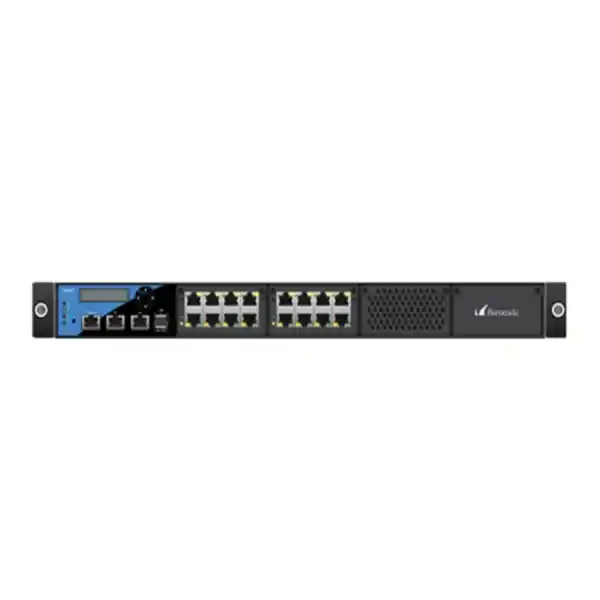
Barracuda CloudGen Firewall F600.C10 Revision D
The Barracuda CloudGen Firewall F600.C10 Revision D is a mid-range 1U security platform for enterprises that require substantial firewall capacity, advanced threat controls, secure WAN connectivity, policy-driven SD-WAN, and a high number of copper Ethernet interfaces in a single rack appliance. For organizations in Dubai and across the United Arab Emirates, the F600.C10 is particularly relevant where existing switching, ISP handoffs, server segments, demilitarized zones, partner networks, and internal security zones are predominantly presented over 1 GbE copper.
What the F600.C10 Revision D is designed to solve
Enterprise firewalls are increasingly expected to do far more than basic stateful packet filtering. A production edge may need to terminate multiple internet circuits, separate business units, secure guest and corporate networks, protect public-facing applications, maintain encrypted tunnels to branches and cloud environments, identify applications, inspect traffic for exploits, enforce web and security policies, and steer traffic dynamically according to WAN quality. The F600.C10 Revision D is intended for that consolidated role, delivering the CloudGen Firewall software stack on a purpose-built rack platform rather than forcing the organization to assemble separate routing, VPN, intrusion prevention, and WAN optimization appliances.
The C10 variant should be understood first by its interface profile. It provides eighteen copper Gigabit Ethernet ports rather than the mixed copper and optical layouts available on other F600 Revision D variants. That makes it especially practical for sites with many direct copper handoffs: dual or triple WAN links, dedicated DMZs, server VLAN trunks, out-of-band administration, partner extranet segments, voice or unified communications zones, building-management networks, secure wireless controller uplinks, and isolated operational technology segments. By keeping these connections physically distinct where required, architects can reduce dependence on intermediate switching and simplify certain security designs.
For UAE buyers, the most important design question is not simply whether the appliance has a high headline firewall number. The correct selection depends on real traffic composition, enabled security services, encrypted traffic, tunnel count, user concurrency, east-west segmentation requirements, future bandwidth, high-availability strategy, and the operational model of the IT team. FourTeck approaches the F600.C10 as a complete security architecture component rather than a box-only purchase, helping customers align the appliance, subscriptions, interfaces, policies, routing, and deployment plan to the actual environment.
Verified F600.C10 Revision D hardware profile
| Attribute | F600.C10 Revision D | Design significance |
|---|---|---|
| Form factor | 1U rack mount | Fits standard enterprise racks and data-center cabinets. |
| Copper interfaces | 18× 10/100/1000 Mbps RJ45 | High port density for WAN, LAN, DMZ, management and segmented networks. |
| Management-capable port | Port 1 is identified for management capability | Supports disciplined administrative access design. |
| Storage | 240 GB or higher platform configuration | Provides local appliance storage for system operation and logs according to configuration. |
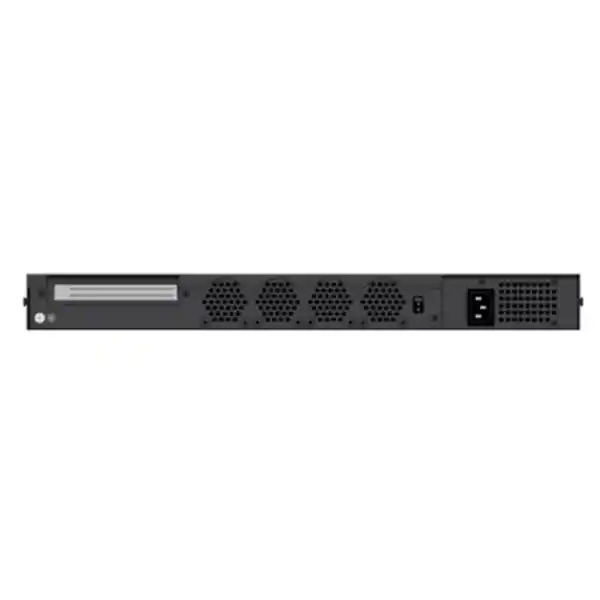
| Power supply | Single internal AC supply on C10 | Power-path planning and UPS design should account for a single appliance PSU. |
| Input | 100–240 V AC, 50–60 Hz, auto-sensing | Suitable for standard UAE enterprise power environments. |
| Maximum power draw | 250 W for C10/F10 single-supply models | Useful for rack PDU, UPS and thermal calculations. |
| Dimensions / weight | Approx. 440 × 480 × 44 mm; 10 kg appliance weight | Confirm cabinet depth, rails, airflow and handling requirements before installation. |
Published performance values are laboratory “up to” values and can vary by firmware, enabled services, packet size, traffic mix, policy design, encryption, logging, and infrastructure. Production sizing should therefore use service-enabled estimates rather than raw firewall throughput alone.
Port architecture: eighteen copper interfaces for practical segmentation
The defining hardware characteristic of the F600.C10 Revision D is its eighteen 10/100/1000 Mbps RJ45 ports. Barracuda identifies standard interfaces 1 through 16 as port1 through port16, with two additional copper interfaces labeled E1 and E2. Port 1 is marked as the management-capable interface. This dense copper layout gives network architects substantial flexibility when physical separation is preferred over extensive VLAN multiplexing. A single appliance can connect directly to multiple access or distribution switches, separate ISP routers, an MPLS handoff, a dedicated management network, a DMZ switch, a server segment, and special-purpose networks without exhausting physical ports.
That flexibility can be valuable in mixed-generation sites common in long-established UAE offices, warehouses, schools, healthcare facilities, hospitality properties, and industrial environments. Many such locations still present core security handoffs as copper Gigabit Ethernet even when newer backbone segments use fiber. The C10 can therefore fit into an existing topology with less media conversion. At the same time, architects should recognize the absence of native SFP or SFP+ ports on this particular submodel. If the design requires direct optical 1 GbE or 10 GbE termination at the firewall, another F600 Revision D interface variant may be more appropriate, or a properly designed switch handoff may be needed.
Port quantity should not lead to unnecessary complexity. Good design still groups networks logically, documents security zones clearly, and minimizes accidental policy overlap. Physical ports can be assigned to routed interfaces, VLAN trunks, redundant links, or dedicated security contexts according to the supported software design. During deployment, FourTeck can map existing firewall interfaces to the C10, identify which links should remain physically separate, consolidate interfaces that are better handled as VLANs, and reserve capacity for future WAN or DMZ expansion.
Performance that must be interpreted in security context
Firewall
Published throughput is up to 15 Gbps for the relevant F600D C/F models. This measures optimized firewall processing and should not be treated as the expected rate with every security inspection feature simultaneously enabled.
SD-WAN
Published SD-WAN performance is up to approximately 3.8 Gbps for this F600D class, providing a useful reference for policy-based multi-WAN and encrypted branch connectivity planning.
IPS
Published IPS throughput reaches up to about 4.8 Gbps for the C10-class profile, indicating the much more relevant ceiling when intrusion prevention is actively inspecting real traffic.
NGFW
Published next-generation firewall performance is up to about 4.2 Gbps, combining a more realistic set of security functions than basic forwarding alone.
Threat protection
Published threat-protection throughput is up to about 4.0 Gbps, useful when sizing for inspection-heavy internet access rather than assuming raw firewall performance.
Sessions
The F600 platform is published for up to roughly 2.1 million concurrent sessions and approximately 115,000 new sessions per second, supporting busy enterprise traffic patterns when correctly configured.
These figures illustrate why firewall sizing must be workload-based. A 1 Gbps internet circuit can still stress an appliance if nearly all traffic is encrypted, subject to deep inspection, filtered by complex application rules, logged intensively, scanned for malware, and carried through multiple tunnels. Conversely, a larger nominal WAN link may impose modest security-processing load if traffic is simple and inspection requirements are limited. FourTeck recommends sizing around the highest sustained inspected throughput expected during the deployment life, then maintaining headroom for growth, failover events, firmware changes, new security features, and unexpected traffic bursts.
Next-generation firewall policy enforcement
The security value of the F600.C10 comes from the CloudGen Firewall software capabilities that sit above stateful packet inspection. Traditional rules based only on source address, destination address, and service port are no longer sufficient for many enterprise environments because applications frequently share common web ports and users move between locations. CloudGen Firewall policies can be designed around application context, network zones, identities, destinations, schedules, and security requirements so that access decisions reflect business intent rather than only transport-layer information.
A well-designed ruleset typically begins with clear zone definitions. Internet, corporate user, server, voice, guest, management, partner, development, backup, and public-service networks should not automatically trust one another. The F600.C10’s interface density helps create the physical or logical boundaries, while firewall policy controls permitted flows across those boundaries. Administrators can then restrict lateral movement, limit management access to hardened jump hosts, prevent guest traffic from reaching internal applications, isolate vulnerable legacy systems, and expose public services only through explicitly controlled paths.
Policy quality matters as much as platform capability. Over time, firewall rules can accumulate duplicated objects, broad any-to-any exceptions, temporary access that becomes permanent, and logging settings that generate noise instead of insight. A migration to the F600.C10 is a useful opportunity to normalize objects, remove unused services, document business owners, introduce least-privilege rules, and create a review process. FourTeck can assist customers in converting legacy policy sets into a more structured model instead of mechanically recreating years of technical debt on the new platform.
Intrusion prevention and exploit-focused inspection
Intrusion prevention is a core reason to size an enterprise firewall using inspected throughput rather than basic forwarding speed. IPS examines traffic patterns for signatures and behaviors associated with exploit attempts, protocol misuse, known vulnerabilities, reconnaissance, and other malicious activity. In a perimeter deployment, this can reduce exposure when attackers probe internet-facing services or attempt to exploit client systems through outbound sessions. Between internal security zones, IPS can also provide compensating control for systems that cannot be patched immediately.
The published F600-class IPS figure of up to approximately 4.8 Gbps provides an important planning reference, but production performance will depend on packet characteristics, enabled protections, firmware, logging, and other simultaneous functions. Enabling every available signature without regard to relevance can increase processing overhead and alert volume. A more disciplined policy aligns inspection profiles to the assets behind each rule. Internet-facing servers may require a different signature set from standard user browsing, while operational systems may require carefully tested protections to avoid disrupting sensitive protocols.
Operationally, IPS is not a set-and-forget feature. Security teams need a process for updates, false-positive review, exception handling, event correlation, and vulnerability remediation. Blocking an exploit at the firewall protects the immediate connection but does not remove the underlying software weakness. FourTeck can help integrate IPS events into broader monitoring and incident workflows, making the firewall an active enforcement point within the organization’s security program rather than an isolated alert generator.
Application-aware control for modern enterprise traffic
Business traffic no longer maps cleanly to port numbers. Collaboration platforms, cloud storage, social media, remote support tools, software updates, video services, and SaaS applications often operate over HTTP or HTTPS. An application-aware firewall can classify traffic beyond the basic destination port and apply differentiated policy. This enables administrators to permit a business application while restricting risky functions, identify unexpected application usage, prioritize critical workflows, and create controls that remain meaningful even when many services share TCP 443.
In UAE enterprises with hybrid workforces, application visibility is also useful for capacity planning. A branch may report poor performance on an ERP or cloud calling platform even though overall bandwidth appears below the circuit maximum. Detailed application information can reveal large backups, synchronization traffic, personal streaming, or software distribution competing with latency-sensitive workloads. When integrated with SD-WAN and traffic shaping policy, the firewall can become part of an application-performance strategy instead of merely blocking unauthorized connections.
Application controls should still be implemented with governance. Blocking categories without understanding business dependencies can disrupt legitimate SaaS integrations, embedded content, or automated services. During deployment, FourTeck can help identify critical applications, define business-priority classes, establish acceptable-use controls, and create monitoring periods before aggressive enforcement. This staged approach provides visibility first, then converts validated observations into policy with a lower risk of unintended impact.
Malware protection, web security and encrypted traffic considerations
Modern perimeter protection requires controls beyond network-layer filtering. Malware can arrive through web downloads, compromised websites, email-linked payloads, remote management tools, or legitimate cloud services abused by attackers. CloudGen Firewall security subscriptions can add content-security functions that examine files and traffic for malicious indicators. Depending on the licensed services and software configuration, organizations can use layered inspection to supplement endpoint controls and reduce the chance that malicious content reaches internal systems.
Encrypted traffic is a critical design issue. A large proportion of internet applications use TLS, which protects confidentiality but also hides payloads from network inspection unless the organization implements appropriate SSL/TLS inspection. Decryption introduces technical, privacy, certificate-management, compatibility, and performance considerations. Sensitive categories such as financial, healthcare, and personal services may require bypass policies, while managed endpoints need trusted inspection certificates and rigorous change control. Performance planning must consider how much traffic will actually be decrypted rather than simply comparing internet line rate to the headline firewall throughput.
For a production project, FourTeck can help define which user groups and destinations should be inspected, how certificates are deployed, what exclusions are required, and how failures are handled. The objective is not to decrypt everything indiscriminately; it is to create a defensible inspection policy that delivers meaningful security without creating avoidable operational or compliance risk. The F600.C10 should be sized with these services enabled in the expected mix, especially if the appliance will protect a large user population or multiple high-volume internet circuits.
Site-to-site VPN for branches, data centers and partner networks
Secure site-to-site connectivity remains a fundamental firewall workload. UAE organizations frequently connect Dubai headquarters with Abu Dhabi offices, Northern Emirates branches, regional warehouses, overseas subsidiaries, cloud environments, disaster-recovery facilities, or partner networks. IPsec VPN can protect traffic across the public internet while routing and policy determine which networks can communicate. A centrally governed firewall platform allows the enterprise to combine tunnel security with application rules, intrusion prevention, traffic shaping, and WAN failover.
Tunnel design requires more than exchanging pre-shared keys. Architects should define encryption proposals, authentication method, routing behavior, failover conditions, NAT requirements, overlapping subnet strategy, monitoring, rekey timers, and ownership of each endpoint. When many branches are connected, manual configuration becomes difficult to audit and maintain. Standardized templates and centrally managed objects reduce mistakes and make large-scale changes easier to control. Dynamic routing can also be used where supported and appropriate, avoiding large static-route tables in complex environments.
Performance should be tested against the expected encrypted traffic profile. VPN throughput is affected by cryptographic algorithms, packet size, tunnel count, security inspection, and the processing performed before and after encryption. For business-critical links, the design should include secondary tunnels across alternate ISPs or carriers. FourTeck can plan tunnel migration in stages, validate routes and policies before cutover, and maintain rollback paths so that a firewall replacement does not become a high-risk all-or-nothing event.
SD-WAN: using multiple circuits as an intelligent transport fabric
Organizations increasingly deploy multiple WAN links at important sites: dedicated internet access, business broadband, MPLS, 4G/5G backup through an external router, or links from different carriers. Traditional failover uses a primary connection until it is completely unavailable, but users often experience performance problems long before a circuit is technically down. SD-WAN adds continuous path awareness and policy-driven steering so applications can prefer the link that best satisfies latency, jitter, packet loss, availability, cost, or other defined conditions.
The F600.C10’s many copper interfaces are useful in these designs because multiple carrier handoffs can terminate directly on dedicated ports while LAN and DMZ networks remain separately connected. Business-critical applications can be steered toward stable low-latency paths, bulk traffic can use lower-cost links, and backup connectivity can be reserved until primary service quality deteriorates. For voice, video, virtual desktop, transaction processing, and cloud applications, performance-based steering can improve user experience substantially compared with simple active-passive routing.
SD-WAN policy needs realistic measurements and sensible thresholds. Overly aggressive failover can cause route flapping, session resets, or constant path changes; overly relaxed thresholds may leave users on a degraded link. FourTeck can baseline normal WAN behavior, classify critical applications, establish health checks, define path-selection logic, and test failure scenarios. The result should be predictable application delivery during carrier issues, not merely an impressive topology diagram.
High availability design with F600.C10 appliances
A perimeter firewall is often a single point through which internet access, remote connectivity, branch tunnels, public services, and cloud traffic all pass. For environments where downtime carries significant business cost, deploying a single appliance is rarely sufficient. A high-availability pair can provide device-level redundancy so that a standby unit assumes the security role when the active firewall fails or is intentionally taken out of service, subject to the supported HA configuration and licensing model.
HA architecture must consider much more than the two firewall units. Both appliances need access to equivalent WAN, LAN, DMZ and management networks. Upstream and downstream switches must be designed without hidden single points of failure. ISP equipment and carrier circuits should be assessed independently from firewall redundancy. Power deserves particular attention with the C10 because the appliance uses a single internal power supply. In a redundant pair, placing each unit on a different UPS/PDU path can reduce the risk that one electrical failure affects both devices, although the overall rack design must support that separation.
Failover testing should be part of commissioning. Teams should verify expected behavior for appliance shutdown, interface failure, WAN outage, switch failure, and planned maintenance. Critical tunnels, public NAT rules, routing adjacencies, DNS dependencies, monitoring systems, and management access need validation after state transition. FourTeck can create an HA test plan and document the operational process so administrators understand not only that redundancy exists but also how it behaves during real faults.
Segmentation for users, servers, guests, IoT and operational networks
Segmentation is one of the most valuable uses of an enterprise firewall. Flat networks make it easier for malware, compromised credentials, or unauthorized users to move from one system to another. By placing important groups in separate security zones, organizations can restrict communication to the minimum required business flows and gain visibility into cross-zone traffic. The F600.C10 provides enough physical interfaces to support dedicated segments where separate cabling is desirable, while VLANs can provide further logical scale.
A typical corporate design may separate employee devices, servers, printers, CCTV, building management, access control, guest Wi-Fi, voice, finance systems, backup infrastructure, hypervisor management, and public-facing applications. Rules between these zones can specify source, destination, service, application, user context, schedule, and security inspection. For example, user networks may access application servers on defined ports but have no direct path to database management interfaces. Guest networks can reach the internet but not internal RFC1918 destinations. CCTV systems can be limited to their management platform and necessary update services.
Segmentation is not automatically secure simply because VLANs exist. Inter-VLAN routing on a core switch can bypass firewall inspection if the network is not designed carefully. FourTeck can review Layer 2 and Layer 3 topology, identify where routing should occur, and ensure security policy is enforced at the intended boundary. For high-throughput internal workloads, this analysis is especially important because routing large east-west data volumes through a security appliance changes capacity requirements substantially.
Central management and multi-site operational consistency
Organizations operating multiple firewalls need consistent configuration, change governance, and visibility. Managing each device independently can lead to drift: different object names, inconsistent security profiles, forgotten temporary rules, mismatched VPN parameters, and uneven software versions. Barracuda’s CloudGen Firewall ecosystem supports centralized management approaches that can standardize policy and reduce the effort required to operate many sites. This is particularly useful for UAE-headquartered organizations with branches across the GCC, Africa, Europe, or Asia.
Centralization should still preserve site-specific requirements. A warehouse may need specialized scanner and operational traffic; a retail site may require PCI-oriented segmentation; a head office may host public services and remote-access gateways; a small branch may need only secure internet breakout and SD-WAN. The correct management model separates reusable templates from local exceptions. Global objects, common security profiles, standard VPN settings, and monitoring policies can be governed centrally while defined site parameters remain configurable.
For customers building a broader infrastructure standard, FourTeck can coordinate firewall work with other network and IT requirements through FourTeck UAE. The goal is to avoid treating security as a disconnected appliance project. Firewall addressing, VLANs, switch trunks, ISP circuits, DNS, identity, remote access, server publishing, monitoring, backup, and change management all interact. A coordinated deployment reduces late-stage surprises and makes documentation more useful for the operations team after handover.
Routing, NAT and multi-WAN design
The F600.C10 can participate in the network as a sophisticated Layer 3 security gateway rather than only a transparent filter. Enterprise deployments may combine static routes, dynamic routing, policy-based routing, source and destination NAT, multiple default routes, WAN health checks, and tunnel routes. The routing model should be intentionally documented because subtle asymmetry can break stateful firewall sessions even when each individual network path appears reachable.
NAT design also deserves discipline. Outbound source NAT often appears simple until multiple ISPs, public address pools, partner exceptions, inbound services, and VPN traffic are introduced. Administrators need to know which source addresses are expected on each WAN, which services are published to the internet, how failover affects public DNS, and whether partner systems permit traffic only from specific addresses. Destination NAT for public servers should be paired with narrow firewall rules and appropriate security inspection rather than broad exposure.
During a migration, FourTeck can build a routing and NAT matrix that lists existing interfaces, gateways, public IPs, objects, inbound mappings, outbound translation behavior, VPN exclusions, and dependencies. This preparation makes validation far easier during cutover. Instead of discovering one application at a time after users report failures, the implementation team has a defined list of expected flows and can verify them systematically.
Remote access and secure administrative connectivity
Remote work and third-party administration have made secure remote access a permanent enterprise requirement. Depending on software version and licensed services, CloudGen Firewall deployments can support controlled remote connectivity so authorized users reach internal applications without exposing those services directly to the internet. The security architecture should combine strong authentication, identity-based authorization, least-privilege access, endpoint requirements where applicable, and detailed logging.
Remote access should be separated by user role. Employees may require access to general business applications, IT administrators may need restricted management paths, vendors may need temporary access to a specific device, and contractors may require only a published application. Giving all groups a broad internal tunnel creates unnecessary lateral-movement risk. Dedicated policies, groups, schedules, and destination restrictions create a more defensible model. Multi-factor authentication should be considered wherever supported by the chosen identity and access architecture.
The firewall management plane itself needs special protection. Administrative access should come from defined management networks rather than the general user LAN, and internet-facing management should be avoided unless a carefully secured design specifically requires it. Logging of administrator actions, role separation, configuration backups, and formal change procedures make troubleshooting and incident response significantly easier. FourTeck can incorporate these controls into the commissioning checklist instead of leaving management security as an afterthought.
Logging, monitoring and incident-response value
A firewall produces valuable operational and security telemetry: accepted and denied connections, intrusion events, application classifications, VPN status, system health, interface statistics, administrative changes, and potentially malware or web-security events. The usefulness of this data depends on retention, time synchronization, event quality, and integration with the organization’s monitoring process. Excessive logging can create storage and analysis noise, while insufficient logging leaves teams unable to explain what happened during an outage or suspected breach.
Critical policies should log enough context to support investigations. Internet-facing services, privileged management paths, remote-access connections, significant deny rules, and important security events generally deserve special attention. Logs should use accurate NTP time and, where required, be forwarded to a centralized log collector or SIEM so records remain available even if the appliance is unavailable or compromised. Alert thresholds should distinguish actionable conditions such as failed HA state, interface loss, tunnel failure, resource pressure, or repeated attack patterns from routine background events.
FourTeck’s UAE IT services capability can be relevant where firewall deployment must integrate with broader monitoring, infrastructure support, server administration, or managed operational processes. A successful project should define who receives alerts, who can change policies, how emergency changes are approved, where backups are stored, and what evidence is retained. Technology provides the telemetry; operational ownership turns it into resilience.
Sizing methodology for the F600.C10
Correct sizing starts with measured traffic, not user count alone. Two organizations with 500 users can have radically different firewall loads. A software development office moving large repositories and cloud backups may consume far more bandwidth than a transactional office using lightweight SaaS applications. Likewise, a 24-hour logistics facility may maintain sustained traffic while a professional-services firm experiences short daytime peaks. The first step is to collect current WAN utilization, peak throughput, connection rates, application mix, VPN load, and growth expectations.
The next step is to define which security functions will be enabled. IPS, application inspection, malware scanning, TLS inspection, detailed logging, and advanced threat services consume more resources than simple stateful filtering. If a 2 Gbps internet connection is expected to run near capacity with full inspection, a design based solely on a 15 Gbps firewall number is misleading. The more relevant reference is the security-services throughput under a workload resembling production. Headroom should remain for bursts, failover, policy expansion, and software changes.
Sessions and new-session rates matter for environments with many short-lived connections, public web services, large Wi-Fi populations, NAT-heavy traffic, or automated applications. Interface layout matters independently of throughput. The C10 offers many 1 GbE copper ports but no native 10 GbE optical interfaces, so aggregate performance and physical link speed must be considered together. A site may need a different submodel if one individual northbound or southbound link must exceed 1 Gbps without link aggregation or switching.
Finally, design horizon should usually cover more than today’s needs. New cloud services, additional branches, increased remote access, higher ISP speeds, segmentation projects, and security inspection can raise load during the appliance life. FourTeck can review these factors and recommend whether the F600.C10 has appropriate margin or whether another platform profile would produce a more sustainable deployment.
Licensing and subscription planning
Enterprise firewall procurement involves both hardware and software entitlements. The exact features available depend on the selected Barracuda licensing and subscription package, software release, support terms, and purchased security services. Buyers should therefore avoid comparing quotes only by appliance model. Two proposals containing an F600.C10 can represent very different functional outcomes if one includes advanced security subscriptions, support, replacement services, or centralized management entitlements that the other omits.
Licensing should map directly to the security design. If intrusion prevention, malware protection, advanced threat analysis, remote access, web controls, or other subscription-driven functions are required, they should appear explicitly in the bill of materials. Support duration should align with the organization’s budgeting cycle and expected deployment period. For high-availability pairs, the commercial requirements for both nodes must be confirmed rather than assumed. Renewal ownership should also be recorded so subscriptions do not expire unnoticed.
Because product lifecycle and firmware support policies can change, FourTeck recommends validating the exact orderable part number, subscription eligibility, support dates, and current replacement options at quotation time. This is especially important for a specific hardware revision such as F600 Revision D. A technically suitable used, stocked, or previously standardized appliance is not automatically the best choice for a new long-term deployment unless supportability is confirmed. The quotation process should therefore treat lifecycle verification as a formal checkpoint.
Firmware baseline, upgrades and lifecycle discipline
Barracuda’s hardware documentation lists F600.C10 Revision D with support beginning from CloudGen Firewall firmware 8.0.1 or higher in the platform compatibility context. That historical minimum does not mean an organization should deploy an old firmware build today. Production software selection must consider the currently supported release train, security fixes, hardware compatibility, feature requirements, known issues, and the organization’s change-management policy. Firmware should be obtained and validated through supported channels.
Upgrade planning is particularly important for security appliances because configuration behavior, VPN interoperability, routing, signatures, user interfaces, and management functions can change across releases. Administrators should read release notes, confirm upgrade paths, back up configuration, record current licenses, verify HA status, and schedule a rollback window. In a cluster, upgrade order and failover behavior should be understood before maintenance begins. Critical remote sites need an out-of-band recovery option where practical.
Hardware revisions also have finite commercial and software lifecycles. Before a new procurement, FourTeck can verify current status and recommend whether the F600.C10 Revision D remains appropriate for the intended service period. Existing customers may have strong reasons to maintain platform consistency during a phased refresh, while greenfield projects may benefit from evaluating a successor model. The right answer depends on supportability, available stock, technical fit, budget, and migration timing—not merely on whether the appliance can still forward traffic.
UAE data-center and rack installation considerations
The F600 Revision D chassis is approximately 440 mm wide, 480 mm deep, and 44 mm high, corresponding to a 1U rack footprint. Appliance weight is approximately 10 kg. These dimensions are straightforward for most enterprise cabinets, but installation should still confirm usable rack depth, rail or shelf requirements, front and rear clearance, cable bend radius, airflow, PDU outlet availability, and service access. Barracuda documentation notes rack installation as optional for the F600 C10 Revision D, so the exact mounting accessories supplied or required should be confirmed with the ordered hardware.
Thermal planning is significant in UAE environments because ambient conditions outside controlled data rooms can be severe. The documented operating temperature range is 0°C to 40°C, with operating humidity from 10% to 85% non-condensing. The appliance should therefore be installed in properly conditioned, monitored IT space rather than exposed to uncontrolled warehouse heat, dust, or moisture. Cooling depends on internal fans, so front-to-back or specified airflow paths must not be obstructed by cabling or blanking errors.
The C10 uses a single internal AC power supply and supports 100–240 V AC, 50–60 Hz with auto sensing. Published maximum power draw is 250 W for the C10/F10 single-supply hardware. UPS and PDU capacity should include suitable headroom rather than allocating exactly the nameplate wattage. In an HA pair, each firewall should ideally use an independently protected power path where the facility design permits. Power, grounding, rack stability, and labeling should be completed before logical cutover.
FourTeck can coordinate physical installation with network cabling and device labeling so every WAN, LAN, DMZ, HA, and management connection is traceable. This reduces troubleshooting time later and prevents accidental cable swaps during maintenance.
Branch-office deployment scenario
At a large branch or regional office, the F600.C10 can consolidate internet security, site-to-site VPN, multi-WAN control, local segmentation, and remote-access functions. A typical design might terminate two ISP circuits on dedicated ports, connect a routed corporate LAN, isolate guest wireless traffic, provide a dedicated voice segment, protect local servers, and maintain a separate management interface. Additional ports remain available for a secondary switch stack, partner equipment, backup network, or future expansion.
SD-WAN can steer Microsoft 365, collaboration, voice, ERP, and web traffic according to business priority and link quality. VPN tunnels can connect the branch to headquarters or cloud resources while local internet breakout prevents all browsing traffic from hairpinning through a central data center. Security profiles can be applied locally so the branch receives inspection even if the WAN path to headquarters is unavailable. Central management can keep rule structures consistent across many branches.
Branch resilience should include more than two internet circuits. Local DHCP or DNS dependencies, switch redundancy, UPS runtime, LTE backup, authentication reachability, and remote management can determine whether the site remains usable during an incident. FourTeck can document these dependencies and design the firewall as part of the complete branch architecture. This is especially useful for retail, logistics, education, healthcare, and multi-office organizations where local IT staff may be limited and remote recovery needs to be predictable.
Head-office or data-center perimeter scenario
At a headquarters or smaller data-center edge, the F600.C10 can protect internet access, published services, partner connectivity, branch VPNs, and internal segmentation. Its eighteen copper interfaces are helpful where multiple distribution switches and provider handoffs use 1 GbE. A pair of appliances can be deployed for high availability, with independent switch and power paths where possible. Public-facing services can be placed in dedicated DMZ networks rather than on the same segments as internal applications.
This role demands careful attention to throughput because traffic aggregates from many users and sites. Internet line rate, remote-access load, branch tunnels, public application sessions, threat inspection, and internal cross-zone traffic can occur simultaneously. The design should model normal and failure-state traffic. If one WAN circuit fails, the surviving link and firewall must handle the redistributed load. If one firewall in an HA pair fails, the remaining unit must sustain the complete security workload without operating continuously at its limit.
For organizations with broader global requirements, FourTeck Global can provide a reference point for multi-region technology coordination. Standardization is valuable when headquarters policy needs to extend to overseas offices, but local carriers, address plans, regulations, and operational practices still need to be considered. A shared security architecture with documented site variations gives central teams control without forcing every location into an impractical identical configuration.
Hybrid cloud and cloud-service connectivity
Many UAE organizations now operate a hybrid environment in which users remain in physical offices while applications are spread across local servers, colocation facilities, Microsoft Azure, AWS, SaaS platforms, and partner networks. The perimeter firewall therefore becomes a traffic-policy hub rather than merely the gateway to the public internet. Site-to-site VPN and routing can connect cloud virtual networks, while SD-WAN selects suitable local paths and security policy controls which internal segments can reach each cloud environment.
Hybrid designs must prevent accidental route overlap and uncontrolled trust. Cloud networks often use private address ranges that may collide with existing branches. SaaS platforms may publish frequently changing destination addresses. Cloud application teams may expect direct connectivity that bypasses legacy security boundaries. The architecture should document route ownership, security inspection points, DNS resolution, identity dependencies, and failure behavior. Where cloud-native security controls are also used, responsibilities should be clearly divided rather than duplicated without purpose.
The F600.C10 can serve as the on-premises anchor for this architecture, but overall capacity must include cloud traffic that was not previously present. Backups to cloud storage, replication, virtual desktop, data analytics, and large SaaS synchronization jobs can substantially increase WAN utilization. FourTeck can include these flows in sizing and policy design so the firewall is not selected solely from historical internet usage that underestimates future hybrid-cloud demand.
Migration from an existing firewall
Replacing a production firewall is a dependency-management exercise. The old configuration may contain hundreds of network objects, service groups, NAT statements, VPN peers, static routes, dynamic routing policies, remote-access settings, certificates, authentication integrations, web filters, IPS exceptions, and monitoring rules. Some entries are business-critical; others may be obsolete. A successful migration identifies the difference before cutover.
FourTeck typically begins by inventorying interfaces, VLANs, IP addresses, gateways, routing tables, NAT, firewall rules, site-to-site tunnels, public services, authentication sources, DNS/NTP settings, logging destinations, certificates, and current performance. Policies are then rationalized into a migration workbook. Duplicate objects can be normalized, expired temporary rules identified, broad rules flagged for review, and each inbound service assigned an owner. This produces a cleaner target design and a clear test plan.
Cutover should be staged where possible. Preconfigure the F600.C10 offline, validate software and licensing, connect management, load objects and policies, establish non-disruptive tunnels where practical, and prepare switch or ISP changes in advance. During the change window, move links in a documented sequence and test internet, DNS, VPN, public NAT, critical applications, remote access, monitoring, and redundancy. A rollback plan should specify exactly how to restore the previous firewall if a blocking issue cannot be resolved within the window.
After cutover, monitoring is as important as initial success. Hidden dependencies may appear only during scheduled backups, overnight batch jobs, weekly partner transfers, or remote user access. Maintaining the old configuration, packet captures, logs, and migration workbook during stabilization gives the support team evidence to resolve those issues quickly.
Policy cleanup and security hardening during deployment
A new firewall should not simply inherit every weakness of the old one. Migration creates a natural checkpoint to improve rule hygiene, reduce unnecessary exposure, and introduce stronger operational controls. Common issues include unused address objects, duplicate services, any-source rules, wide destination ranges, obsolete VPNs, permanent vendor access, management from user networks, overly broad outbound permissions, disabled security profiles, and rules with no clear owner.
Hardening starts with the management plane. Restrict administrator access, use individual accounts, integrate strong authentication where supported, disable unnecessary services, synchronize time, configure secure logging, and protect configuration backups. The data plane should then apply least privilege between zones. Public services should expose only required ports. Administrative protocols should originate only from management networks. Guest and IoT zones should have explicit limits. Outbound access can be narrowed for servers that do not require unrestricted internet connectivity.
Security profiles should be matched to traffic rather than applied blindly. A database replication flow does not need the same inspection as user web browsing, while public web servers may need stronger exploit protection. This targeted approach can improve both security and performance. FourTeck can document the baseline configuration so future administrators understand why each major control exists and can distinguish intentional exceptions from configuration drift.
Operational runbook requirements
Firewall reliability depends heavily on operational discipline after installation. A runbook should record device names, management addresses, rack location, serial information, support details, subscription dates, software version, backup procedure, HA roles, WAN circuits, public IP allocations, VPN peers, logging destinations, escalation contacts, and recovery steps. This documentation should be stored somewhere available even when the firewall or primary network is unavailable.
Routine operations should include configuration backup, software and security-update review, license monitoring, log-capacity checks, interface health, HA status, tunnel status, certificate expiry monitoring, and policy recertification. A quarterly or semiannual firewall rule review can remove access that is no longer required and validate that exceptions still have business owners. The change process should record who requested a rule, why it is needed, which systems are affected, how it was tested, and when it should be reviewed again.
Incident procedures should cover both security and availability. Administrators need to know how to capture traffic, identify blocked sessions, review IPS events, isolate a network, disable a compromised VPN account, force a failover, restore a configuration, and contact vendor support. FourTeck can provide handover documentation and knowledge transfer so the customer’s IT team can operate the F600.C10 confidently rather than depending on undocumented implementation knowledge.
Why the C10 interface profile may be the right choice
Within the F600 Revision D family, the C10 is the copper-dense standard model. It is a strong fit when the firewall connects mostly to 1 GbE electrical interfaces and the design values port quantity over native optical connectivity. Typical examples include offices with copper distribution switches, carrier routers presenting RJ45 Ethernet, multiple physical DMZs, direct connections to security appliances, or environments that intentionally dedicate separate physical links to sensitive network zones.
The C10 may be less suitable when the core requirement is native fiber termination or individual 10 GbE links. F600 Revision D variants with SFP or SFP+ interfaces exist specifically for those scenarios. Choosing the C10 and then adding multiple external media converters can complicate power, monitoring, fault diagnosis, and rack cabling. The interface decision should therefore be made from a port map that identifies connector type, speed, redundancy, switch location, and expected growth for every firewall-facing link.
The power model also differentiates the C10 from certain sibling variants. The C10 has a single internal power supply, while some other F600 Revision D models use dual hot-swap power supplies. Organizations requiring PSU-level redundancy inside each appliance should account for that difference. In many deployments, an HA pair of C10 appliances on independent UPS paths can still provide strong overall service resilience, but that architecture is not identical to dual PSUs per chassis. FourTeck can help compare these tradeoffs during bill-of-materials design.
Security architecture for UAE compliance and governance programs
Organizations in the UAE often operate under internal governance frameworks, industry requirements, customer security obligations, and data-protection expectations that require demonstrable access control and monitoring. A firewall contributes evidence and enforcement, but it does not create compliance by itself. The architecture should map firewall controls to actual requirements: network separation, restricted administrative access, logging, remote connectivity, vulnerability protection, change management, and incident response.
Segmentation can reduce the scope of sensitive environments by limiting which users and systems can communicate with regulated applications. Logging can demonstrate connection attempts and policy enforcement. VPN encryption can protect traffic crossing untrusted networks. IPS can provide an additional layer against known exploits. Strong administrative controls reduce the risk of unauthorized configuration changes. However, each of these controls needs documented ownership and periodic review to remain effective.
FourTeck can work with technical stakeholders to translate governance objectives into implementable firewall policies while leaving legal and formal compliance interpretation to the organization’s appropriate advisers. This distinction matters: technology can enforce a defined network requirement, but business owners must decide what the requirement is and what evidence is needed. A structured firewall deployment makes that evidence easier to produce because zones, rules, logs, and operational procedures are designed intentionally from the beginning.
Performance headroom and growth planning
Security appliances should not be purchased to run permanently at their published maximum. Resource usage can rise suddenly during backups, software deployment, incident response, cloud migration, major meetings, guest events, or WAN failover. New signatures and firmware can change processing characteristics. Enabling additional inspection features can reduce effective throughput. A capacity plan therefore needs reserve margin for both expected growth and unusual events.
A useful approach is to measure sustained and peak traffic on current links, model the security-service throughput required after migration, then project circuit upgrades and business growth over the intended ownership period. If the organization plans to move from 1 Gbps to 2 or 5 Gbps internet, add major cloud backup workloads, or route large internal segments through the firewall, those projects must be included now. Physical interfaces may become the limiting factor before compute capacity: each C10 port is Gigabit Ethernet, so the topology must support the desired aggregate and per-link speeds.
High availability adds another requirement: a single surviving appliance must handle the entire production load during maintenance or failure. Capacity calculations should therefore assume one active unit carrying normal peak traffic, not divide production load across two devices unless the specific supported design truly does so. FourTeck can document normal, degraded, and growth-state utilization targets so the customer understands the conditions under which the chosen model remains appropriate.
Common use cases for the Barracuda F600.C10 in Dubai
Corporate headquarters
Protect multiple internet circuits, internal zones, server networks, partner access, remote users and branch VPNs from a centrally managed 1U platform.
Large branch
Combine secure internet breakout, SD-WAN, local segmentation, cloud access and resilient tunnels to head office without requiring separate routing appliances.
Education campus
Separate administration, faculty, student, guest, lab, CCTV and server networks while controlling high-volume internet and cloud application traffic.
Healthcare facility
Create controlled boundaries between clinical, administrative, guest, medical-device and vendor networks with detailed audit-oriented logging.
Logistics and warehouse
Protect ERP, scanners, Wi-Fi, CCTV, automation and branch connectivity while maintaining multiple ISP paths for operational continuity.
Regional hub
Aggregate VPN connectivity from offices in the GCC or Africa and enforce consistent routing and security policy at a central UAE location.
The suitability of each use case depends on measured bandwidth, enabled security services, port requirements, redundancy, and lifecycle objectives. FourTeck can evaluate the proposed topology before quotation so the selected hardware aligns with the actual workload instead of relying on generic user-count estimates.
Regional connectivity and Africa-facing deployments
Dubai is frequently used as a regional technology hub for organizations with operations across Africa. In these networks, the firewall may terminate tunnels from countries with very different carrier quality, latency, bandwidth, and outage characteristics. SD-WAN path measurement, efficient VPN design, and centrally standardized policy become especially valuable because the network cannot assume that every branch has the same connectivity profile as a UAE office.
Regional architectures should define which applications are accessed locally, which are hosted in Dubai, and which are consumed directly from public cloud services. Sending all traffic through a central UAE firewall can simplify control but may introduce latency and unnecessary bandwidth cost. Local internet breakout with central policy can be more efficient, while private applications remain reachable through encrypted tunnels. DNS, identity, SaaS tenancy, and update services should be evaluated so routing decisions match actual application dependencies.
Organizations coordinating technology across multiple African markets can also reference FourTeck Africa for regional engagement. The F600.C10 at a Dubai hub can be one part of a wider standardized architecture, but remote-site firewall models and circuit designs should be sized locally. Centralization works best when global standards define security intent while each site retains enough flexibility for carrier realities and business-critical services.
Physical port mapping example
One practical advantage of eighteen copper ports is the ability to create a clean, labeled interface plan. An example design could assign port1 to a dedicated management network, port2 to ISP-A, port3 to ISP-B, port4 to an MPLS or private WAN handoff, ports5 and 6 to redundant LAN distribution switches, port7 to a public-services DMZ, port8 to a partner extranet, port9 to guest internet, port10 to voice services, port11 to CCTV, port12 to building management, and remaining interfaces to growth, test, backup, or specialized networks. E1 and E2 can be reserved for architecture-specific needs according to the final configuration.
This is only an example; production port assignments should match the organization’s cabling, switch topology, HA design, and security requirements. In many environments, fewer physical connections with VLAN trunks provide cleaner scaling. In others, direct dedicated interfaces make troubleshooting and separation easier. The best approach often combines both methods: dedicated ports for WAN, management, and high-risk DMZs, with tagged VLANs used for related internal segments.
FourTeck can produce an interface schedule before installation that records firewall port, switch port, cable label, VLAN, IP address, security zone, speed/duplex expectations, and redundancy role. This small amount of documentation has significant operational value. During a future incident, an engineer can identify the physical path quickly without tracing unlabeled cables or guessing which switch interface corresponds to a firewall zone.
Change control and staged commissioning
Firewall changes have unusually broad impact because a single rule, route, NAT statement, or interface setting can affect many applications. The F600.C10 deployment should therefore follow a controlled commissioning process. Start with documented requirements, build the configuration offline or on a staging network where practical, peer-review critical policies, verify licenses and subscriptions, update to the approved firmware baseline, back up the configuration, and prepare a change plan with success and rollback criteria.
Testing should be grouped by function. Validate management access and monitoring first, then basic routing, DNS, DHCP relay if used, internet access, NAT, published services, VPN, authentication, security inspection, SD-WAN, and HA. Each test should have a defined expected result. For example, guest Wi-Fi should reach the internet and fail to reach internal private networks; an inbound public service should be reachable only on the required port; branch traffic should fail over to the secondary WAN within the intended behavior window.
After handover, the production baseline should be saved and versioned. Future changes can then be compared against a known-good state. FourTeck can structure this process to fit the customer’s change calendar, including after-hours migration where required, coordination with ISP teams, and post-change monitoring. The objective is controlled risk: no firewall migration can eliminate all uncertainty, but disciplined preparation dramatically reduces the chance that hidden dependencies become prolonged outages.
Security policy documentation that remains usable
Firewall documentation often fails because it is either too sparse or too detailed in the wrong way. A screenshot of hundreds of rules does not explain business intent, while a high-level diagram may omit the technical information needed to troubleshoot. A useful documentation set connects both layers. It identifies security zones, trusted boundaries, public services, major application flows, WAN circuits, VPN peers, routing domains, HA relationships, logging destinations, and management dependencies.
For each important rule, the organization should record purpose, owner, source, destination, service or application, security profile, logging behavior, ticket reference, and review date. Temporary vendor access should include an expiry date. Rules protecting public services should map to application owners. Management rules should identify authorized administrator networks. This metadata makes future recertification much faster and helps auditors understand why access exists.
FourTeck can deliver as-built documentation alongside the configured F600.C10. The document can include physical port maps, logical topology, IP addressing, HA design, circuit information, VPN matrices, NAT mappings, policy summary, monitoring setup, software baseline, backup process, and escalation details. Documentation should be updated after significant changes rather than treated as a one-time project artifact.
Procurement considerations in Dubai and the UAE
A complete firewall quotation should identify the exact hardware revision and submodel, required licenses, subscription duration, support level, high-availability quantity, rack accessories, transceivers or cabling if applicable, installation scope, migration services, and any training or managed support. The F600.C10 is specifically the copper-only 18-port profile within F600 Revision D, so the quote should not simply state “F600” without the C10 designation when interface requirements depend on that variant.
Lead time and lifecycle status should be confirmed at the time of order. Specific revisions can move through end-of-sale and support stages as manufacturers release successor hardware. For a greenfield deployment, remaining support life can be as important as purchase price. For an existing standardized environment, compatibility with deployed management, spares, policy templates, and operational knowledge may carry additional value. FourTeck can present the tradeoffs rather than assuming every project has the same procurement priority.
Implementation scope should also be explicit. Box delivery, remote configuration, onsite rack installation, policy migration, VPN migration, HA setup, SD-WAN design, testing, documentation, and post-cutover support are separate activities that may require different levels of effort. The customer should know which are included before the change window is scheduled.
For UAE projects requiring coordinated security, networking, and infrastructure procurement, the FourTeck team can align the firewall bill of materials with switches, cabling, racks, UPS capacity, ISP presentation, and server or cloud dependencies. This integrated approach prevents a technically correct firewall from being delayed by a missing rack accessory, unavailable port type, undocumented public address, or incompatible handoff.
When to consider another F600 Revision D interface variant
The C10 is not the only F600 Revision D configuration. Barracuda documents F10/F20 versions with a mix of copper and 1 GbE SFP interfaces, and an E20 model that adds 10 GbE SFP+ ports. This matters because the correct firewall is not just a performance tier; it is also a physical connectivity decision. A data center with fiber distribution and 10 GbE aggregation has very different needs from a campus using copper Gigabit switch uplinks.
Choose the C10 when its eighteen copper 1 GbE ports fit the topology cleanly and there is no requirement for direct SFP/SFP+ termination. Consider a fiber-oriented variant when the firewall must connect directly to optical distribution, when electrical-to-optical conversion would add unnecessary components, or when an individual uplink must operate at 10 GbE. Also compare power-supply configuration: C10 and F10 use a single internal supply, while C20, F20 and E20 use dual hot-swap internal supplies according to Barracuda hardware documentation.
FourTeck can produce a side-by-side interface and resilience comparison during presales. This avoids a common procurement problem where an appliance meets throughput requirements but arrives with the wrong port media or redundancy profile. Interface compatibility should be signed off by the network engineer before order placement, especially when the firewall connects to carrier equipment or production core switches with fixed optics.
Frequently asked technical questions
How many Ethernet ports does the F600.C10 Revision D have?
It provides eighteen 10/100/1000 Mbps RJ45 Ethernet interfaces. Ports 1–16 are standard numbered interfaces and E1/E2 are additional copper interfaces. Port 1 is identified as management-capable in Barracuda documentation.
Does the C10 include SFP or SFP+ ports?
No native optical SFP or SFP+ ports are listed for the C10 configuration. Other F600 Revision D variants provide optical interface combinations and may be more suitable when fiber termination is required.
Is the appliance rack mountable?
Yes. The F600 Revision D is a 1U rack platform. Rack depth, mounting accessories, power, airflow, and cable management should be confirmed before installation.
What is the published firewall performance?
Barracuda publishes up to 15 Gbps firewall throughput for the relevant F600D C/F models. Security-enabled performance is lower and is the more useful figure for sizing production inspection workloads.
Can it be deployed in high availability?
The CloudGen Firewall platform supports HA design scenarios. Exact licensing, topology and supported configuration should be validated for the intended deployment. Both network and power paths must be designed for redundancy.
Does it suit multi-WAN and SD-WAN?
Yes, the platform is designed for SD-WAN and policy-driven multi-link connectivity. Real design must account for circuit types, health probes, application priorities, routing, tunnel architecture, and expected throughput.
Why engage FourTeck for Barracuda firewall projects
Firewall projects intersect with almost every part of an enterprise network. The appliance connects to ISP circuits, switches, VLANs, servers, cloud platforms, DNS, identity, monitoring, remote users, branch tunnels, and public applications. FourTeck can support the project from presales discovery through architecture, bill of materials, migration, onsite deployment, validation, documentation, and post-cutover assistance. This reduces coordination gaps between hardware procurement and the engineering work required to make the platform useful.
The engagement can begin with a current-state assessment. FourTeck reviews link speeds, traffic levels, existing firewall configuration, security zones, tunnel count, public services, growth plans, redundancy objectives, and operational constraints. The proposed design then maps these requirements to the F600.C10 or a more appropriate alternative. This evidence-based approach helps avoid both undersizing and unnecessary overspending.
Customers can also use FourTeck’s regional delivery capabilities when a UAE security standard must extend to other offices. The design can define reusable naming conventions, policy templates, VPN architecture, monitoring and documentation while allowing site-specific adjustments. The result is a firewall deployment that is easier to operate consistently over time, not merely a one-off appliance installation.
Pre-deployment discovery checklist
A practical sizing example
Consider a Dubai head office with two 1 Gbps internet circuits, 400 employees, several branch VPNs, Microsoft 365, cloud backup, public web services, guest Wi-Fi, CCTV, and an on-premises ERP. Raw internet bandwidth suggests a maximum of 2 Gbps, which appears comfortably below the F600.C10’s published firewall figure. However, actual sizing needs more detail. If most user traffic is inspected by IPS and application controls, some encrypted traffic is decrypted, backup jobs generate sustained throughput, and branch tunnels terminate on the same appliance, the security workload is materially higher than simple 2 Gbps forwarding.
Now add failure conditions. If the primary ISP fails, the secondary circuit may carry all internet and tunnel traffic. If one firewall in an HA pair is down for maintenance, the remaining unit must process the entire workload. If the company upgrades both circuits to higher speeds next year or migrates more backups to cloud storage, peak utilization increases again. These scenarios determine required headroom.
The example demonstrates why model choice should be confirmed using actual traffic and future plans. The F600.C10 may be an excellent fit, but the conclusion should come from measured evidence. FourTeck can collect or review utilization data, identify high-bandwidth applications, estimate security-service impact, and document the assumptions behind the recommendation. This gives the customer a defensible sizing decision rather than a guess based only on employee count.
Troubleshooting approach after deployment
When a user reports that “the firewall is blocking the application,” engineers need a structured method to confirm or reject that assumption. Start with source IP, destination IP or hostname, time of failure, protocol, user identity, and expected behavior. Review firewall logs for matching sessions, policy decisions, NAT translation, route selection, security-profile events, and interface state. Packet capture on relevant interfaces can show whether traffic arrives, how it is translated, and whether return traffic follows the expected path.
Many apparent firewall problems are actually DNS, asymmetric routing, server listening, application certificates, upstream provider filtering, MTU, or identity issues. Good documentation and logging allow the team to isolate the layer quickly. For VPN problems, verify peer reachability, negotiation proposals, tunnel state, route entries, interesting traffic, NAT exclusions, and return routing. For SD-WAN problems, verify health-check results and path-selection policy rather than looking only at physical interface status.
A standard troubleshooting runbook reduces recovery time and avoids random configuration changes that create additional faults. FourTeck can include common diagnostic commands, log locations, packet-capture procedure, failover checks, and escalation information in the handover pack. This operational detail is particularly important for environments with 24×7 sites or distributed support teams.
Business continuity and disaster recovery integration
The firewall is a key part of business continuity because it controls access to backup sites, cloud environments, remote workers, and alternative WAN paths. Disaster recovery design should therefore include network security explicitly. If production services move to a secondary data center, the organization needs to know how users and branches will reach them, whether VPN tunnels are preconfigured, how DNS changes, which public IPs are available, and whether security policies at the DR site match production requirements.
An F600.C10 deployed at the primary site can participate in this design through redundant tunnels and route policies, but continuity depends on the whole architecture. A backup internet circuit connected to the same failed building does not provide site disaster recovery. Likewise, an HA firewall pair in one rack protects against appliance failure but not against a facility outage. Business impact analysis should identify which failure modes require device redundancy, carrier redundancy, power redundancy, or geographic redundancy.
FourTeck can help map firewall behavior into the customer’s DR runbook and test scenarios. A planned exercise might fail the primary WAN, disable the active firewall, withdraw a route, or shift an application to a secondary site. Observing the actual behavior reveals hidden dependencies before a real incident. The firewall should support the continuity plan with predictable routing and policy, not become another undocumented variable during recovery.
Security operations integration
A modern firewall is most effective when integrated with the organization’s security operations. High-severity IPS events, repeated denied scans, suspicious outbound connections, administrative logins, VPN anomalies, and system-health alerts should feed a process that determines whether investigation is required. Where a SIEM or centralized logging platform exists, firewall events can be correlated with endpoint, identity, server, and cloud telemetry to build a more complete incident picture.
Event quality matters. Logging every accepted session at the same priority can overwhelm analysts and increase storage cost. Critical security rules should generate actionable records, while routine operational traffic can be logged according to retention and troubleshooting needs. Administrator changes deserve particular visibility because malicious or accidental configuration changes can weaken protections without triggering ordinary traffic alerts.
Response procedures should identify actions that can be taken safely on the F600.C10 during an incident: blocking a malicious source, isolating a compromised subnet, disabling a VPN account, restricting outbound access, adding temporary indicators, or capturing traffic for analysis. Emergency rules should be documented and reviewed after the incident so temporary containment does not become permanent technical debt. FourTeck can help align firewall controls with the customer’s broader incident-response workflow.
Configuration backup and recovery planning
A firewall configuration represents years of accumulated network knowledge. Losing it can extend a hardware incident from minutes to many hours. Backup should therefore be treated as a security and continuity requirement. Administrators should maintain current configuration exports or supported system backups, protect them from unauthorized access, and store copies outside the appliance. Backup files may contain sensitive addressing, credentials, certificates, VPN information, and policy data, so storage must be appropriately secured.
Recovery planning should identify the exact replacement procedure. If the C10 fails, can a replacement appliance be obtained under the selected support contract? Which firmware must be installed before configuration restore? Are licenses tied to serial numbers? What credentials are required to reach vendor portals? Does the organization have console access and suitable cables? Can the backup be restored to a different revision if identical stock is unavailable? These questions should be answered before a failure occurs.
In an HA pair, configuration synchronization provides resilience but is not a substitute for offline backup. A bad change can synchronize to both nodes. A configuration backup allows the team to return to a known-good state. FourTeck can define a backup schedule, document restore steps, and capture a baseline after commissioning so the customer begins operations with a recoverable configuration.
Environmental and facility readiness
Enterprise firewalls are built for controlled IT environments, not arbitrary office spaces. The F600 Revision D operating range of 0°C to 40°C and 10% to 85% non-condensing humidity should be considered in UAE sites where ambient outdoor temperature can be far higher. A server room should have stable air conditioning, monitored temperature, controlled dust, adequate airflow, and a plan for cooling failure. The rack should not be placed where cleaning water, construction dust, or direct sunlight can affect equipment.
Power quality is equally important. UPS systems should provide sufficient runtime for short outages and graceful operational decisions during longer ones. Rack PDUs should be rated for the connected load with headroom. The C10’s single internal supply makes external power-path quality particularly important. In an HA pair, the two appliances should not accidentally share the same single PDU or UPS if independent power is available, because that recreates a common failure point.
Cable organization contributes to reliability. Label both ends of every firewall cable, separate power and data paths where practical, avoid sharp bends, and leave service loops that permit maintenance without pulling adjacent connections. Document switch port numbers and carrier handoffs. Physical-layer discipline may seem basic compared with NGFW features, but many outages come from cabling and power rather than software. FourTeck can include these checks in site readiness before the migration window.
Total cost of ownership beyond appliance price
Firewall cost includes more than the initial chassis. Organizations should budget for security subscriptions, support, replacement coverage, rack accessories, implementation, migration, management, monitoring, training, and renewals. High availability doubles some hardware requirements but can materially reduce downtime risk. Advanced security services may increase subscription cost but replace separate point products or provide stronger consolidated protection. The correct financial comparison should evaluate the whole architecture over the intended service life.
Operational simplicity can also have financial value. A platform that combines firewall, VPN, SD-WAN, security inspection, and centralized management can reduce the number of systems administrators must maintain. However, consolidation also increases the importance of resilience and skilled configuration because more services depend on the same security platform. Training, documentation, and support should therefore be considered part of the investment rather than optional extras.
FourTeck can structure quotations so hardware, subscription, support and services are visible separately. This helps procurement teams compare equivalent scopes and understand renewal obligations. If the F600.C10 Revision D is being considered because of existing standardization or available stock, FourTeck can also compare the lifecycle and feature implications against newer alternatives so the customer can evaluate total value rather than purchase price alone.
Decision recap: is the Barracuda F600.C10 Revision D suitable?
The F600.C10 Revision D is a strong candidate when an organization needs a 1U enterprise firewall with a dense set of copper Gigabit Ethernet interfaces, multi-WAN and SD-WAN capability, site-to-site VPN, application-aware controls, intrusion prevention, threat-protection services, segmentation, and centralized operational management. Its eighteen RJ45 ports are especially useful in networks with multiple physical security zones or copper carrier handoffs.
The design must still account for its specific characteristics. The C10 does not provide native SFP/SFP+ interfaces, so fiber or 10 GbE requirements may favor another variant. It uses a single internal power supply, so appliance-level PSU redundancy is not the same as on dual-supply models. Published performance figures are “up to” values, and real capacity depends on enabled security services and traffic mix. Lifecycle and support eligibility should be verified before new procurement.
Quotation input checklist for FourTeck UAE
For the most accurate F600.C10 quotation and design recommendation, provide the following information. Exact answers are not required for every item; existing firewall screenshots, topology diagrams, ISP documents or configuration exports can often supply the needed detail.
Plan your Barracuda F600.C10 deployment with FourTeck
FourTeck can help validate the correct F600 Revision D submodel, confirm current orderability and support status, size the appliance against real inspected traffic, design high availability and SD-WAN, migrate policies and VPNs, coordinate rack and network installation, and produce the operational documentation required for a stable handover.

Reviews
There are no reviews yet.