
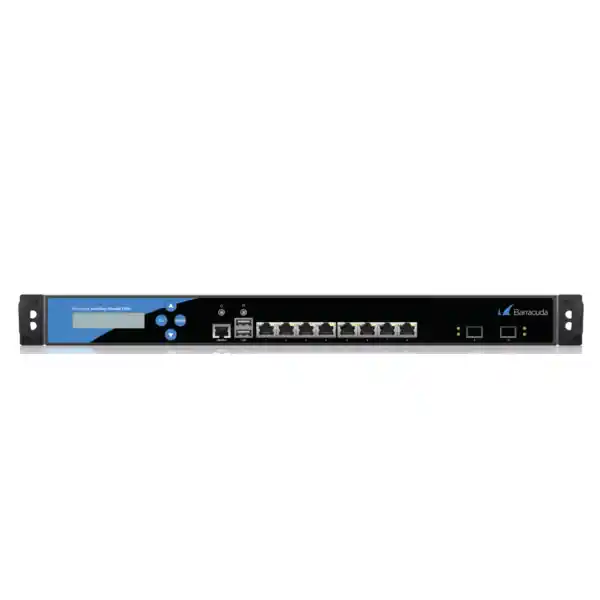
Barracuda CloudGen Firewall F600.C20 Revision D
A resilient 1U security gateway for UAE headquarters, data centers, regional hubs, and large distributed enterprises that need dense Gigabit copper connectivity, high session scale, application-aware security, encrypted WAN connectivity, and centralized operations.
Direct answer: where the F600.C20 Revision D fits
The Barracuda CloudGen Firewall F600.C20 Revision D is best positioned as a mid-range to upper-mid-range enterprise perimeter and SD-WAN appliance for organizations that require significant session capacity and multi-gigabit inspection without moving to a larger chassis. Its defining physical characteristic is dense copper networking: the current Revision D hardware documentation identifies 18 10/100/1000 Mbps RJ45 Ethernet interfaces in a 1U rack-mount form factor. Barracuda performance material for the F600D.C20 lists up to 15 Gbps firewall throughput, 3.8 Gbps SD-WAN throughput with the referenced AES-128 TINA profile, 4.8 Gbps IPS throughput, 4.2 Gbps NGFW throughput, and 4.0 Gbps threat-protection throughput. It is rated for 2,100,000 concurrent sessions and 115,000 new sessions per second, with a published recommended concurrent-user range of approximately 1,000 to 4,000 users.
Those headline figures should be used as design references rather than as a promise that every production network will achieve the same rate. Real throughput depends on packet size, security services enabled, SSL/TLS inspection coverage, traffic mix, VPN encryption, logging, policy complexity, firmware version, and the percentage of flows that require deeper inspection. In a Dubai enterprise, a 1 Gbps or 2 Gbps internet circuit can therefore be very different from a 1 Gbps inspected application workload. FourTeck sizes the platform around the inspected workload, expected growth, WAN topology, encrypted traffic ratio, and high-availability requirement rather than selecting a firewall solely from the ISP bandwidth printed on a contract.
For customers seeking a UAE deployment partner, the F600.C20 can be integrated into branch consolidation, headquarters internet edge, data-center segmentation, site-to-site VPN, and SD-WAN designs. FourTeck can coordinate the appliance with broader Firewall Dubai solutions, UAE network services, carrier handoff planning, and migration from an existing firewall while retaining a clear rollback path.
Performance profile for real enterprise traffic
Firewall throughput
Up to 15 Gbps is the published firewall figure in current F600D performance material. This number is most useful for understanding the forwarding ceiling before deeper security inspection is added. In practical sizing, internet speed is only one input: east-west traffic, VLAN routing, NAT volume, inter-zone policy enforcement, and backup replication can all consume firewall capacity even when public internet circuits are smaller.
IPS throughput
The published IPS figure of up to 4.8 Gbps provides a more meaningful sizing anchor for environments where intrusion prevention is applied broadly. IPS capacity should be assessed with realistic traffic patterns, especially when business applications use small packets, many parallel connections, or encrypted sessions that are inspected before threat controls can act on the payload.
NGFW throughput
Barracuda publishes up to 4.2 Gbps NGFW throughput for the F600D.C20. This is a stronger reference for mixed enterprise policies using application-aware controls and security inspection. Capacity planning should reserve headroom for peaks, signature updates, remote-access surges, application growth, and the operational preference to keep failover capacity available during maintenance or an HA event.
Threat protection
The published threat-protection figure is up to 4.0 Gbps. This is the most conservative of the key headline rates and is therefore useful when the design objective is to enable a broad security stack. Licensing and service configuration still matter: organizations should confirm which subscriptions are included in the selected commercial bundle and which controls are intended for each traffic zone.
Session scale
A stated capacity of 2.1 million concurrent sessions and 115,000 new sessions per second gives the F600.C20 substantial connection-handling scope for busy campuses, application-heavy offices, and public-facing services. Session count can become a more important constraint than raw Mbps when users, SaaS applications, collaboration tools, IoT systems, and modern web browsers create large numbers of short-lived connections.
SD-WAN capacity
Current Barracuda material lists 3.8 Gbps SD-WAN throughput under a specified AES-128 TINA test profile, with a lower figure for AES-256 in the same published material. Real WAN overlay performance depends on encryption, tunnel count, path characteristics, packet loss, and enabled optimization. FourTeck therefore maps SD-WAN design to actual carrier links and branch traffic rather than assuming headline throughput equals usable encrypted application capacity.
F600.C20 Revision D hardware architecture
The C20 configuration is designed for organizations that value a high count of copper interfaces and power resilience in a compact rack footprint. Barracuda’s current Revision D hardware documentation identifies an Intel Core i3 four-core processor, 16 GB RAM, SSD storage of 240 GB or higher, two USB 2.0 interfaces, and one RJ45 serial console. The appliance uses a 1U chassis and the C20 variant is specified with dual hot-swappable internal power supplies. These attributes make the platform suitable for conventional data-center and communications-room deployments where the firewall must connect directly to multiple copper handoffs, switches, service networks, or isolated zones.
| Item | Revision D C20 reference | Design meaning |
|---|---|---|
| Ethernet | 18 × 10/100/1000 Mbps RJ45 | Dense copper connectivity for WAN, LAN, DMZ, HA, service, and segmented network roles. |
| Management | Port 1 identified as management-capable in the standard port map | Supports deliberate out-of-band or protected management design where architecture permits. |
| Console / USB | 1 × RJ45 serial console, 2 × USB 2.0 | Useful for local installation, maintenance, and supported service workflows. |
| Compute / memory | Intel Core i3, 4 cores; 16 GB RAM in current Revision D hardware documentation | Appliance resources are fixed-platform characteristics and should be matched to the intended security workload. |
| Storage | SSD, 240 GB or higher | Local system and operational storage; retention design should still consider central logging requirements. |
| Power | Dual hot-swap internal AC supplies on C20 | Supports A/B power-feed design when each PSU is connected to an independent protected source. |
| Form factor | 1U rack mount, approximately 440 × 480 × 44 mm in current hardware documentation | Compact rack deployment; confirm cabinet depth, airflow, rail requirements, cable bend radius, and maintenance clearance. |
Published hardware and performance documents can be revised as firmware and manufacturing specifications change. A production quotation should therefore state the exact F600.C20 Revision D part number, subscription bundle, support term, included accessories, power cords, transceivers or network modules if required, and the firmware branch intended for deployment.
Understanding the 18-port copper layout
The standard C10/C20 port map exposes a large set of Gigabit copper interfaces, giving architects more freedom than a firewall with only four or eight physical ports. Port density matters when an enterprise wants to keep traffic domains physically separated, connect multiple upstream carriers, attach DMZ switching independently, dedicate ports to HA or monitoring functions, or migrate from a legacy firewall without collapsing every interface into VLAN trunks on day one. Barracuda documentation identifies Port 1 as the management port in the standard map, while the remaining physical interfaces can be assigned according to the required design. The exact interface role is a configuration decision, not a permanent label imposed by the appliance.
A common UAE headquarters architecture may dedicate one or more ports to primary internet, secondary internet, core LAN, server or data-center aggregation, DMZ, guest access, voice services, management, and high-availability synchronization or monitored networks. Other designs use 802.1Q VLAN trunks so that several logical zones share a physical uplink to the switching fabric. The advantage of the F600.C20 is that the architect is not forced to choose one approach solely because of port scarcity. Physical separation can be retained where it improves fault isolation, troubleshooting, or security governance, while trunks can be used where they simplify cabling and allow scalable segmentation.
The limitation is equally important: the C20 standard configuration is copper-focused. If the switching core, carrier NID, or data-center fabric requires native fiber or 10 GbE connectivity, the bill of materials must be checked carefully. Barracuda supports specific network modules on F600 Revision D platforms, but supported combinations, module availability, interface type, firmware requirements, and actual chassis configuration should be confirmed before ordering. FourTeck can map the physical port plan against switch optics, carrier presentation, HA wiring, and rack topology before the purchase order is finalized.
Security engine: more than stateful packet filtering
Stateful deep packet inspection
CloudGen Firewall evaluates connection state and inspects packet content against defined policy. Malformed traffic can be rejected before it reaches protected infrastructure, while protocol-compliant flows are evaluated against security rules. This gives enterprises a policy foundation that goes beyond basic source, destination, and port matching.
Application Control
Application classification allows policy decisions based on application identity and sub-functions rather than assuming TCP or UDP port equals application. Administrators can control, prioritize, throttle, or block application traffic by user, group, category, location, or time, subject to the licensed feature set and policy design.
Intrusion prevention
IPS inspects traffic for exploit patterns and malicious behavior. Policy tuning matters in production: signature scope, exceptions, application context, logging, and update management should be designed to reduce risk without creating avoidable false positives or imposing inspection on traffic where it is not appropriate.
SSL/TLS interception
Barracuda supports applying controls such as IPS, URL filtering, application control, virus protection, and advanced threat functions to eligible SSL-encrypted web traffic through SSL interception. UAE organizations should deploy decryption with documented privacy, certificate, exception, application-compatibility, and regulatory policies.
Identity-aware policy
CloudGen Firewall can associate users with network identities and enforce access based on authenticated user or group context. Supported authentication integrations include common enterprise directory, RADIUS, certificate, and other methods, helping policy teams move from IP-only controls toward user-aware enforcement.
Single-pass inspection approach
Barracuda describes a single-pass architecture in which security inspection mechanisms can operate on the opened packet or stream without repeatedly handing the same flow through disconnected proxy stages. The practical objective is integrated inspection with predictable policy sequencing and reduced architectural complexity.
Secure SD-WAN for multi-carrier UAE networks
For many Dubai organizations, the firewall is also the WAN edge. A headquarters may have a primary dedicated internet circuit, a secondary broadband or DIA service, private connectivity to a data center, and 4G or 5G backup. Branches may use a mix of fiber, broadband, and mobile services. Barracuda CloudGen Firewall combines security with SD-WAN functions so path selection can consider more than a static route metric. The platform can measure bandwidth and latency between VPN endpoints and make those measurements available to policy logic. Application-aware routing can then direct business-critical traffic toward the path that best matches defined performance and availability requirements.
This is valuable when a business wants to reduce dependence on a single expensive circuit without treating all WAN links as identical. Voice and interactive applications may require low latency and low loss, while backups can tolerate slower paths but consume significant bandwidth. SaaS traffic may benefit from direct internet breakout under inspection rather than backhauling every session to another site. A well-designed SD-WAN policy classifies these flows, defines health thresholds, specifies preferred and alternate transports, and establishes behavior when a path degrades rather than waiting for it to fail completely.
Barracuda also supports traffic duplication for selected workloads, sending packet copies over primary and secondary VPN transports so the far endpoint can reassemble traffic and reduce loss for sensitive applications. This is not a reason to duplicate every flow; it consumes additional bandwidth. It is a targeted tool for applications where continuity matters more than transport efficiency. Likewise, encryption strength, tunnel count, inspection, and packet size affect usable SD-WAN throughput, so the published benchmark should not be equated with guaranteed application bandwidth.
FourTeck can incorporate firewall deployment into broader UAE IT services covering LAN readiness, routing changes, DNS dependencies, remote-site coordination, and migration planning. This is important because an SD-WAN project succeeds when carrier circuits, internal routing, security policy, application dependencies, and operations are treated as one design rather than as separate purchases.
Sizing methodology: choose by inspected workload, not internet speed alone
The most common firewall sizing mistake is selecting a model because its maximum firewall throughput is higher than the ISP circuit. A 2 Gbps internet service does not mean a 2 Gbps firewall requirement. The device may also route inter-VLAN traffic, terminate site-to-site tunnels, decrypt SSL/TLS sessions, apply IPS, classify applications, log events, scan selected traffic, serve remote users, and remain capable of carrying the full production load when its HA peer is unavailable. Peak traffic may also exceed average utilization by several multiples during backups, cloud synchronization, software distribution, video events, or incident response.
FourTeck begins with a traffic inventory: current WAN capacity, 95th-percentile utilization where available, internal routed traffic, expected growth, encrypted traffic ratio, number of sites, VPN profile, remote-user concurrency, public services, application mix, and security services planned. Next comes policy scope. SSL inspection of a limited set of outbound categories is not the same workload as broad decryption of most user web traffic. IPS on external-to-internal server flows is not the same as IPS on all internet, branch, and east-west traffic. Logging every accepted connection locally and remotely also behaves differently from selective event logging.
The F600.C20 published 4.0 Gbps threat-protection and 4.2 Gbps NGFW rates offer a useful planning boundary for a security-heavy configuration. A design should still preserve operational headroom. Running a security appliance permanently near its benchmark ceiling makes future growth, firmware changes, unexpected traffic spikes, and an HA failover harder to absorb. Many organizations therefore size normal steady-state operation well below maximum tested capacity and confirm that a single node in an HA pair can handle the essential load during maintenance.
Session rate is assessed separately. Modern SaaS and browser workloads can create many short-lived flows, while IoT and branch aggregation can maintain large concurrent connection tables. The F600.C20 figures of 2.1 million concurrent sessions and 115,000 new sessions per second provide significant scale, but design validation should include NAT behavior, connection churn, logging, and service mix. The published 1,000–4,000 recommended concurrent-user range is a guideline, not a substitute for traffic profiling.
High availability and resilient power design
HA is a system design
Deploying two firewalls is only the beginning of high availability. The network must also provide redundant upstream carrier handoffs where possible, resilient switching, duplicate power paths, synchronized configuration, supported HA links, and routing behavior that converges correctly after a failover. A single upstream switch or single ISP handoff can undermine an otherwise redundant firewall pair.
Dual hot-swap power
The C20 Revision D is documented with dual hot-swappable internal power supplies. For meaningful resilience, connect each PSU to an independent protected feed, ideally separate PDU or UPS paths. Connecting both supplies to the same overloaded extension, PDU, or UPS does not provide the intended power-path separation.
Capacity during failover
An HA pair should be sized so one appliance can carry the critical production load after its peer fails or is taken offline for maintenance. If normal operations already consume nearly all inspected throughput or session capacity across the active unit, the presence of a second chassis does not automatically create usable failover headroom.
Maintenance without panic
Resilience is also operational. Planned firmware upgrades, policy changes, power work, and hardware replacement are safer when failover has been documented and tested. FourTeck can define pre-change checks, traffic validation, rollback conditions, and post-change monitoring so maintenance is not dependent on assumptions about HA behavior.
Centralized management with Barracuda Firewall Control Center
Organizations with multiple sites often spend more operational time maintaining policy consistency than configuring the first firewall. Barracuda Firewall Control Center is designed to centrally manage CloudGen Firewalls and provides a hierarchical configuration model, reusable objects, templates, versioned configuration, monitoring, and centralized distribution of settings. This becomes important in UAE groups with a headquarters in Dubai or Abu Dhabi and branches across the Emirates, GCC, Africa, or other regions. Instead of recreating equivalent policies independently at every location, teams can structure common controls centrally and apply site-specific differences where required.
Centralization is not the same as making every site identical. A retail branch, warehouse, data center, and corporate office may need different VLANs, WAN providers, local services, and access policies. The Control Center model allows architects to separate global intent from site-level parameters. Naming standards, object ownership, change approval, administrative roles, configuration backups, and software-version strategy should be defined at the beginning. Without governance, a centralized tool can reproduce inconsistent design faster; with governance, it becomes a strong mechanism for repeatability and auditability.
Control Center can also support mixed hardware, virtual, and cloud deployments, which is useful when the network is not purely appliance-based. A physical F600.C20 at a primary site can coexist with different CloudGen models at branches and virtual or cloud firewall instances where appropriate. This enables a common operational framework while allowing form factor and capacity to vary by location.
For multi-site projects, FourTeck documents management reachability, addressing, site naming, template inheritance, certificate handling, licensing, administrator roles, monitoring, and escalation workflow before mass deployment. The objective is to make the hundredth firewall deployment more predictable than the first, not to create a central console that only one engineer understands.
Zero Touch Deployment for distributed rollouts
Barracuda supports Zero Touch Deployment for CloudGen Firewall hardware. In a centrally managed design, the firewall configuration can be prepared before the appliance reaches the destination site. The new unit contacts the Zero Touch service after it receives suitable network connectivity, then retrieves the prepared configuration and establishes its management relationship. Barracuda documentation for current generations describes Control Center integration with the Zero Touch service and supports workflows for appliances ordered with ZTD association as well as appliances that are claimed later using the appropriate serial and linking information.
For F12 through F800 hardware in documented ZTD workflows, the appliance uses a predefined port as the DHCP client during initial deployment. That detail matters in the staging guide: remote staff must know exactly which port connects to the internet-capable network, what DHCP and outbound access are required, and what success indicators to expect. The site still needs correct physical installation, protected power, carrier service, and cabling. Zero Touch reduces configuration work at the remote location; it does not eliminate the need for a well-prepared implementation plan.
For a UAE or regional rollout, FourTeck can create a repeatable site kit containing a port map, rack position, cable labels, ISP handoff details, DHCP requirements for initial activation, target LAN addressing, escalation contacts, and acceptance tests. This lets local technicians perform the minimum physical work while centralized engineers retain control of policy and validation. HA deployments can also be planned using supported Barracuda Zero Touch approaches, but sequential or paired deployment behavior should be designed in advance so the correct appliance receives the intended role.
Application-aware policy and quality of service
Port-based firewall rules are no longer sufficient for many enterprise applications. Different services can share TCP 443, applications can shift ports, and users can access cloud services that are not easily represented by a single IP address. Barracuda Application Control uses deep packet inspection and behavioral traffic analysis to classify applications and sub-applications. Policy can then use application identity alongside network and user context. This supports controls such as blocking an unwanted application for a specific group, throttling non-critical traffic, preserving bandwidth for business applications, or restricting a particular application function rather than disabling the entire service.
In a Dubai office with Microsoft 365, cloud ERP, CRM, voice, video conferencing, remote desktop, large file transfers, and guest internet access, application awareness can improve both security and performance. The objective should not be to create hundreds of micro-rules simply because the platform can identify many applications. Effective policy begins with business categories: critical interactive services, approved collaboration, standard web access, high-bandwidth but non-critical traffic, prohibited applications, and unknown or risky behavior. Technical controls then enforce those priorities with clear ownership and change management.
Quality of Service and application-based path selection become especially useful across multiple WAN links. A voice session may be sent over the lowest-latency path, while cloud backup can use a lower-cost connection. If the preferred circuit degrades beyond defined thresholds, policy can redirect selected application classes. This is more deliberate than equal-cost load balancing because it recognizes that not all packets have the same business value or performance sensitivity.
FourTeck typically validates application-policy designs against actual user workflows before broad enforcement. Observe traffic, identify critical dependencies, create a baseline, then phase controls with logging and defined rollback. This reduces the chance that an over-aggressive rule disrupts an essential SaaS function or third-party integration.
SSL/TLS inspection: security value with governance requirements
A large percentage of modern application traffic is encrypted. Without authorized decryption, a firewall can often see connection metadata but may not be able to inspect the full content needed for certain IPS, malware, URL, or application controls. Barracuda CloudGen Firewall supports SSL interception so eligible encrypted web traffic can be inspected and security engines can act on the decrypted stream. This can significantly improve visibility, but it must be implemented as a controlled enterprise function rather than enabled indiscriminately.
The technical prerequisites include an enterprise certificate strategy, trusted root distribution to managed endpoints, exception handling for certificate-pinned applications, privacy-sensitive categories, and systems that should not be intercepted. The security team should define which user groups and networks are in scope, which destinations are exempt, how certificate errors are handled, and how the policy aligns with company privacy rules and applicable UAE requirements. Endpoint management is important because unmanaged devices may not trust the inspection certificate, producing browser errors or application failures.
SSL inspection also changes sizing. Decryption and re-encryption add compute work, while the traffic is then exposed to security engines that may not have processed it deeply before. A firewall selected solely from unencrypted throughput can therefore become undersized after an organization expands decryption. The right capacity plan estimates the percentage of inspected TLS traffic, peak bandwidth, cipher profile, concurrent connections, and security services applied after decryption.
FourTeck recommends a staged rollout: laboratory validation, a small pilot user group, application exception list, certificate deployment check, performance baseline, then controlled expansion. The result should improve security visibility while preserving business application reliability and maintaining documented exceptions that can be reviewed over time.
Remote access, site-to-site VPN, and authentication
The F600.C20 can serve as an encrypted connectivity hub for branches, partners, administrators, and remote users, subject to the selected license and configured services. Barracuda CloudGen Firewall supports client-to-site and site-to-site VPN capabilities, and its SD-WAN architecture uses secure encrypted transports between locations. The practical design question is not only whether VPN exists, but how many tunnels and users will be active, what applications cross them, which authentication method is required, and what happens when a WAN path fails.
For site-to-site connectivity, route design should be agreed before tunnels are built. Overlapping address spaces, inconsistent subnet summarization, asymmetric paths, and unplanned NAT are common causes of difficult migrations. If branches are being moved from another firewall platform, the project should inventory every tunnel, peer address, local and remote subnet, encryption proposal, routing dependency, monitoring rule, and business owner. This prevents forgotten partner tunnels or legacy routes from becoming emergency issues during cutover.
For remote users, authentication and device posture can be more important than tunnel throughput. CloudGen Firewall supports multi-factor authentication capabilities including time-based one-time passwords and can integrate with enterprise authentication systems. Access should be based on user role and required resources rather than providing every VPN user unrestricted reachability to the internal network. Administrative remote access deserves especially strict controls, dedicated groups, MFA, logging, source restrictions where practical, and limited management-plane exposure.
Sizing must account for encrypted traffic and failover. If remote work is business-critical, a single firewall and a single internet circuit create concentration risk. An HA pair, redundant carrier services, tested DNS and routing behavior, and a documented remote-access continuity plan can convert the firewall from a single access appliance into a resilient remote-work platform.
UAE deployment architecture examples
Dubai headquarters edge
Use the C20 as the security and SD-WAN perimeter between two carrier circuits and a resilient LAN core. Separate corporate, server, guest, voice, management, and DMZ zones using physical ports or VLAN trunks. Apply application-aware internet policy, IPS, selected TLS inspection, remote-access controls, and path steering for critical SaaS and voice services.
Regional VPN hub
Place an HA pair at the primary UAE site to terminate encrypted overlays from multiple branches. Centralized Control Center policy can standardize branch objects and templates while the headquarters pair handles aggregated internet, private application access, and traffic between sites. Capacity is validated against aggregate tunnel traffic, not against the largest single branch.
Data-center segmentation gateway
Deploy the firewall between server zones, management networks, internet-facing services, and selected user or branch segments. Dense copper ports can support physical separation where the adjacent switching architecture is Gigabit Ethernet. If the fabric requires 10 GbE, validate interface-module options or consider a model with native higher-speed interfaces.
Large branch consolidation
At a major warehouse, campus, or remote office, consolidate firewalling, VPN, SD-WAN, application visibility, and WAN failover into one managed platform. The F600.C20 provides substantial session scale for a large user and device population, while central operations can retain policy ownership from headquarters.
If the firewall is being deployed near virtualization hosts, storage systems, or other core infrastructure, FourTeck can also coordinate dependencies with server and data-center solutions in Dubai. This prevents security cutovers from being planned without awareness of host networking, bonded interfaces, hypervisor VLANs, backup traffic, and management networks.
Migration from an existing firewall
Replacing a firewall is not a configuration-copy exercise. Legacy rule bases contain years of technical history: temporary exceptions that became permanent, objects named after former projects, NAT rules for retired servers, duplicate VPN definitions, any-to-any policies, and logging choices that nobody wants to touch during business hours. Migrating all of that literally can reproduce old risk on a new platform. Removing too much at once can break production. A controlled migration separates rules into confirmed active requirements, suspected legacy entries, and items that need an owner decision.
The discovery phase captures interface addressing, VLANs, routes, dynamic routing, NAT, inbound publishing, DNS dependencies, VPNs, remote access, authentication, web and application controls, certificates, public IP assignments, DHCP or relay functions, monitoring, syslog, SNMP, and HA behavior. Network diagrams should be updated before the change, not after it. Where possible, traffic logs from the old platform are used to identify active rules and dependencies. Public-facing services are tested from external networks, while internal application flows are validated from representative user segments.
The cutover plan defines exact cable moves and switch-port changes because the F600.C20 has many physical interfaces and a simple labeling mistake can create a large outage. Every old interface should map to a new port or VLAN with source and destination device identified. Carrier handoffs may require MAC updates, ARP clearing, PPPoE credentials, static routing, or provider-side changes. These are confirmed before the maintenance window. The rollback plan states what conditions trigger reversal and how long the old firewall remains cabled or ready for restoration.
After cutover, validation should include internet access, DNS, business SaaS, internal applications, published services, every critical VPN, remote access, management reachability, logging, monitoring, failover, and ISP redundancy. Performance baselines are compared to pre-change values so high CPU, unexpected drops, asymmetric routing, or inspection bottlenecks can be identified before the project is declared complete.
Licensing and subscriptions: define the security outcome before ordering
The appliance hardware establishes the physical platform, but the commercial bundle determines which subscription-backed security services, updates, and support entitlements are available. A procurement request that says only “Barracuda F600.C20” is therefore incomplete. The quote should specify the exact hardware revision, required security subscription or bundle, term length, support level, centralized management requirements, high-availability licensing implications, and any optional network modules or accessories. Feature names and packaging can evolve, so FourTeck verifies the current Barracuda offering at quotation time rather than relying on an old bill of materials.
Security teams should begin with required outcomes: intrusion prevention, application visibility and control, URL filtering, malware protection, advanced threat analysis, SSL inspection, remote access, SD-WAN, centralized management, logging, and support response. Not every organization needs every service on every traffic path. For example, a dedicated inter-system firewall may have different subscription priorities from an internet edge serving thousands of users. A branch primarily used for encrypted SD-WAN transport may have a different policy profile from the headquarters internet gateway.
Term alignment is also important for organizations purchasing multiple sites over time. If subscriptions expire on different dates, renewal administration becomes harder. Larger rollouts can benefit from a licensing calendar and asset register containing serial numbers, locations, support dates, firmware versions, HA pairing, and named operational owners. This turns renewal from an emergency purchase into a predictable lifecycle process.
FourTeck can prepare a quotation that separates mandatory hardware, required subscriptions, optional security services, HA peer requirements, accessories, deployment, and support. Customers can then compare options on the basis of operational scope rather than comparing two prices that include different entitlements.
Routing, segmentation, and policy architecture
A firewall at enterprise scale is frequently a routing device as well as a security device. The F600.C20 can sit between the core network and multiple external or internal domains, enforcing policy as traffic crosses zones. The design should decide whether the firewall will own default routing, inter-VLAN routing, selected server-zone gateways, branch routes, dynamic routing adjacencies, or only perimeter paths. This decision influences throughput, failure domains, troubleshooting, and the amount of traffic that must cross the security engine.
Segmentation should be built around trust and business function rather than around arbitrary subnet boundaries. User networks, privileged administration, servers, internet-facing services, IoT, voice, guest Wi-Fi, building systems, backups, and management interfaces often deserve different policy. The dense copper interface set allows some of these to be physically separated, while VLAN tagging can scale logical segments over fewer uplinks. Both approaches can be valid. Physical separation improves visual clarity and limits some shared dependencies; trunks reduce cabling and allow flexible growth.
Routing also affects asymmetric traffic. If one direction of a flow crosses the firewall and the return path bypasses it, stateful inspection may reject the session or produce inconsistent behavior. During migration, this commonly happens when a new firewall is inserted beside an old gateway or when redundant core switches use different routing preferences. A detailed path analysis is therefore part of the implementation, especially for server publishing, VPNs, and multi-WAN designs.
Policy is documented using source zone, source identity where available, destination, application or service, action, security inspection, logging, owner, and business purpose. This makes later review easier than rule names alone. FourTeck can align the firewall design with broader infrastructure standards available through FourTeck UAE, including switching, wireless, server, and managed-service dependencies that influence segmentation.
Power, rack, cooling, and environmental planning in the UAE
The F600.C20 Revision D is a 1U rack appliance, but physical installation should be treated as an engineering task. Current Barracuda Revision D documentation lists an appliance size around 440 × 480 × 44 mm and an appliance weight around 10 kg. Rack depth, mounting method, front and rear clearance, airflow, patch-cord routing, PDU access, and serviceability should be checked before installation. Barracuda lists rack installation as an optional mounting arrangement for the F600 C20 Revision D, so the exact rail or bracket requirement should be verified in the bill of materials rather than assumed.
The C20 uses dual hot-swappable internal AC power supplies. Current hardware information states 100–240 V AC, 50–60 Hz auto-sensing input and a maximum power figure associated with the dual-supply configuration. In production, each PSU should feed from a separate protected path when the facility supports it. A/B PDUs connected to independent UPS systems provide substantially better resilience than two cords connected to the same power strip. Power labeling should match the rack diagram so technicians can identify the safe supply during maintenance.
Barracuda documentation specifies an operating temperature range of 0 to 40°C and non-condensing operating humidity of 10% to 85%, with operational altitude up to 2,000 m. Dubai outdoor temperature is irrelevant if the appliance is in a properly conditioned communications room; what matters is the actual inlet environment at the rack. Poor airflow, blocked vents, recirculated exhaust, overloaded cabinets, or failed cooling can raise local temperature well above room averages. Environmental monitoring is recommended for critical sites.
Physical security is equally important. Console access, power cables, management links, and WAN handoffs should be protected from casual access. Rack diagrams and port labels should be kept current. A firewall that is logically hardened but physically exposed can still be vulnerable to accidental disconnection or unauthorized local access.
Logging, monitoring, and operational visibility
A firewall should produce useful operational evidence, not simply large volumes of logs. The monitoring design defines what events must be retained, where they are sent, how long they are stored, and which conditions generate alerts. Connection logs, blocked traffic, IPS events, authentication, configuration changes, VPN status, WAN health, HA state, and system resources have different operational value. Excessive logging can make important events harder to find; insufficient logging can leave incident responders without context.
For security operations, forward relevant events to the organization’s centralized log, SIEM, or monitoring platform where possible. Time synchronization is essential so firewall events line up with identity, endpoint, server, and cloud logs. Device names, interface labels, object names, and site identifiers should follow a consistent convention. A log saying traffic was blocked by “Rule 47” is less useful than an event tied to a policy with a descriptive business purpose.
Operational monitoring should also track interface errors, packet drops, CPU and memory behavior, session usage, tunnel state, path latency, bandwidth, license status, and update health. Baselines are established during normal periods so a change can be interpreted. A sudden increase in sessions may be normal after a new SaaS rollout, or it may indicate a scanning event or application fault. Context determines the response.
FourTeck can integrate firewall monitoring into a support workflow with named severity levels, escalation contacts, change windows, and remote-access procedures. The objective is to detect meaningful degradation before users report it, while avoiding a flood of low-value alerts that operators learn to ignore.
Threat protection and policy tuning
Threat protection is most effective when the controls match the network’s actual exposure. Internet-facing servers, user web browsing, partner connectivity, branch VPN traffic, administrative access, and IoT networks present different risks. The F600.C20 can apply multiple security mechanisms, but enabling every option with identical settings on every zone may increase false positives, consume unnecessary resources, and make troubleshooting more difficult. Policy tuning should therefore begin with business criticality and threat model.
Intrusion prevention policies should be kept current and reviewed after significant application changes. High-confidence signatures protecting exposed services may justify blocking behavior, while lower-confidence detections may begin in monitor mode until their effect is understood. Application Control can restrict unauthorized tools or prioritize approved applications. URL and web controls can enforce corporate browsing policy. SSL interception can expose eligible encrypted traffic to deeper analysis. Advanced threat services, where included in the selected subscription, can add analysis beyond local signature matching.
Exceptions deserve the same governance as blocking rules. An exception added to resolve an application incident can quietly persist for years, even after the original system has been retired. Each exception should have an owner, reason, scope, creation date, and review date. Broad exclusions such as entire networks or categories should be avoided when a narrower destination or application-specific exception will solve the problem.
Performance validation accompanies security tuning. Enabling a service may change latency or throughput, especially for encrypted or high-volume traffic. FourTeck uses staged policy activation, traffic monitoring, and business application tests so the security posture improves without introducing avoidable disruption.
Firmware, lifecycle, and change control
Firewall firmware is part of the security architecture. It contains the operating platform, networking functions, VPN services, management interfaces, and security engines that enforce policy. Upgrades can provide fixes, new capabilities, performance changes, and updated compatibility, but they can also alter defaults or behavior. Production appliances should therefore follow a defined lifecycle rather than being upgraded casually or left indefinitely on an old release.
Barracuda’s current hardware documentation identifies F600.C20 Revision D support beginning with CloudGen Firewall release 8.0.1 or higher, while present deployments may operate on later maintained branches. The correct target version depends on Barracuda support status, required features, interoperability, and organizational policy. Before an upgrade, teams should review release notes, back up configuration, confirm support entitlements, verify HA status, check management compatibility, and establish rollback procedures. Multi-site environments benefit from pilot upgrades before broad deployment.
A lifecycle record should include hardware serial number, model and revision, purchase date, warranty or support term, subscriptions, firmware version, HA peer, site location, management IP, configuration backup status, and scheduled review date. This becomes particularly useful when dozens of firewalls are managed centrally. Without an asset record, support renewal, replacement planning, and emergency response depend on tribal knowledge.
FourTeck can include lifecycle support in the deployment scope, covering configuration backup, planned upgrade assistance, health checks, and replacement planning. This complements enterprise infrastructure services available through FourTeck global solutions for organizations operating beyond a single UAE location.
Procurement checklist for Barracuda F600.C20 Revision D in Dubai
Exact model and revision
Quote the complete Barracuda CloudGen Firewall F600.C20 Revision D designation. The revision matters because physical interfaces, memory, storage, power, and compatibility can differ from earlier F600 generations or other F600 submodels.
Subscription term
State which security subscriptions and support services are required and for how long. Compare quotations only after confirming that the bundles and support periods are equivalent.
HA quantity
If high availability is required, include both appliances, required licenses, cables, power feeds, switch ports, and configuration effort. Do not price one unit and assume HA can be added without architectural impact.
Interface compatibility
The C20 is standardised around Gigabit RJ45 connectivity. Confirm whether carrier or core links are copper, SFP, or SFP+, and identify supported network modules if a different media type is required.
Rack accessories
Confirm rack installation hardware, power cords, PDU plug type, cable management, and cabinet depth. Published rack installation guidance indicates optional rack installation arrangements for this model, so verify the exact accessory set.
Professional services
Define whether the scope includes staging, rule migration, VPN migration, HA setup, SD-WAN, SSL inspection, Control Center, cutover attendance, documentation, training, and post-change support.
Why the C20 is attractive for copper-heavy enterprise environments
Many modern security appliances are optimized around a small number of high-speed ports. That is ideal for consolidated data-center fabrics, but it can be inconvenient for environments that still require numerous direct Gigabit connections. The F600.C20 Revision D addresses that use case with 18 RJ45 Gigabit interfaces. A customer can preserve dedicated physical links to multiple service zones, provider devices, switching domains, or legacy systems while still using VLANs where appropriate. This can reduce the need for an extra aggregation switch purely to overcome firewall port scarcity.
Dense copper connectivity is particularly useful during phased migrations. An existing firewall may have many directly connected networks. Rather than redesigning every switch and VLAN in the same maintenance window, the new appliance can often map physical links more directly, then the environment can be consolidated later under a separate change. This reduces simultaneous variables during the security cutover. It also supports troubleshooting because each physical interface can correspond to a clearly labeled network role.
The tradeoff is uplink speed. Gigabit copper is sufficient for many internet edges, branch aggregation points, and segmented enterprise networks, but organizations moving to multi-gigabit switch fabrics should consider whether 1 GbE physical interfaces create an architectural bottleneck. Link aggregation can solve some bandwidth and resilience requirements, but it is not identical to a native 10 GbE interface and depends on supported configuration. If the project needs multiple 10 GbE data-plane links, the C20 should be compared with an F600 submodel or larger platform offering suitable fiber and SFP+ connectivity.
A good procurement decision therefore starts with port media and topology, not only firewall throughput. FourTeck maps every required physical and logical interface before recommending the final model so the firewall arrives with a port architecture that matches the customer’s switching and carrier environment.
Designing for UAE carriers, public IPs, and WAN handoffs
Dubai enterprise internet circuits can be presented in several ways: routed public subnets, point-to-point handoffs, provider-managed CPE, VLAN-tagged Ethernet, PPP-based services, or private WAN connections. The firewall configuration must match the service exactly. Before deployment, obtain the provider’s handoff media, VLAN ID if any, WAN IP, subnet mask or prefix, next-hop gateway, routed public blocks, DNS requirements, MTU information, and escalation contact. For redundant services, document which provider owns each circuit and whether the paths enter the building through independent infrastructure.
Public IP migration deserves careful timing. Published services, VPN peers, allowlists, DNS records, and SaaS security rules may depend on existing source addresses. If a new carrier introduces new public IPs, external partners may need to update their firewalls before cutover. DNS TTL values can be reduced in advance for services that will move. Site-to-site peers can be preconfigured with alternate endpoints when supported. A list of every system that references the old public IP is more valuable than discovering dependencies during the maintenance window.
Multi-carrier designs should also define outbound NAT behavior. Some applications expect a stable source IP and may fail if SD-WAN moves them between circuits. Policy can pin those applications to a provider or use defined failover behavior. Other traffic can use dynamic path selection. Inbound services require an equally deliberate failover strategy because DNS, public addressing, and provider routing may not automatically follow an outbound path decision.
FourTeck coordinates these details during discovery so the firewall configuration is built from the carrier service design rather than from assumptions. This can include pre-cutover testing, secondary-circuit validation, failover timing, and confirmation that monitoring systems detect both complete outages and degraded links.
Data-center and server protection use cases
The F600.C20 can protect server environments where the aggregate inspected bandwidth fits its capacity profile and where Gigabit copper connectivity matches the surrounding fabric. Typical use cases include isolating internet-facing services from internal applications, separating management networks, controlling administrative access, protecting backup infrastructure, and enforcing policy between user and server segments. The 2.1 million concurrent-session specification provides useful scale for environments with many simultaneous application connections, but throughput and port speed remain separate design constraints.
Server security policy should be application-specific. A web server DMZ may accept only published HTTP/HTTPS traffic from the internet and tightly constrained application calls toward internal services. Database networks should generally be reachable only from approved application servers and administrative systems. Hypervisor and storage management should be isolated from ordinary user networks. Backup traffic may need dedicated routing or bandwidth controls so large replication jobs do not interfere with latency-sensitive applications.
East-west firewalling can increase total traffic far beyond internet bandwidth. A company with a 1 Gbps internet link may generate several gigabits of server-to-server backup, replication, virtualization, and storage-related traffic internally. If those flows are forced through the firewall for segmentation, they count toward interface and inspection capacity. Architects should therefore measure or estimate east-west traffic before using the perimeter firewall as a universal segmentation gateway.
FourTeck evaluates whether the F600.C20 should sit at the internet edge, at a data-center security boundary, or in a combined role. Combining roles can reduce device count, but separation may improve scale, change isolation, and security governance. The decision depends on traffic volume, risk, operational ownership, and available switching architecture.
Policy governance for enterprise operations
A capable firewall can still become difficult to manage if policies lack ownership. FourTeck recommends a rule standard that records business purpose, source, destination, application or service, action, inspection profile, logging requirement, owner, ticket reference, and review date. Rules should be organized by zone or function so engineers can understand the policy intent without tracing hundreds of individual objects. Temporary access should have an expiry date rather than depending on someone remembering to remove it later.
Object naming is equally important. Addresses called “Server1,” “New_Server,” and “Temp2” provide little context after a few years. Consistent names can include site, function, environment, and service role. Groups should represent business concepts such as approved finance applications or branch management networks. When the same design is used across many sites, Control Center templates and reusable objects can reinforce consistency.
Change control should distinguish low-risk updates from high-impact changes. Adding a single destination to an established outbound policy is different from modifying default routing, HA, NAT for a published service, or SSL interception. High-impact changes receive a maintenance window, peer review, backup, rollback plan, and post-change validation. Emergency changes still need documentation after the incident so the running configuration and records remain aligned.
Periodic cleanup reduces complexity and risk. Unused objects, expired rules, obsolete VPN peers, and broad exceptions should be reviewed against traffic logs and system owners. The purpose of cleanup is not to minimize rule count for its own sake; it is to ensure every permission still supports a known requirement and that incident responders can understand policy quickly.
Implementation workflow used for F600.C20 projects
Inventory traffic and dependencies
Collect topology, ISP details, interfaces, VLANs, routes, NAT, VPNs, user groups, public services, security policies, logging, HA status, traffic utilization, and growth assumptions. Identify business owners for critical flows before design begins.
Model the inspected workload
Compare peak and expected traffic against NGFW and threat-protection capacity, session scale, VPN and SD-WAN needs, SSL inspection scope, and single-node HA requirements. Validate that 1 GbE physical ports suit the topology.
Create port, routing, and security plan
Build interface mapping, VLAN strategy, addressing, routing, HA, NAT, VPN, SD-WAN, application control, SSL inspection, management, and monitoring design. Document both steady-state and failure behavior.
Configure and validate offline
Prepare software, licensing, administrator access, base interfaces, objects, rules, tunnels, certificates, central management, and logging. Run configuration review before the device reaches the production change window.
Execute a controlled migration
Follow a cable-by-cable and service-by-service sequence, monitor health, validate carriers and routes, test critical applications and VPNs, and keep the rollback path available until acceptance criteria are met.
Document, monitor, and optimize
Deliver as-built diagrams, configuration records, license information, admin handover, monitoring baselines, change procedures, and support contacts. Review traffic and tune security after users return to normal business patterns.
Technical considerations before selecting F600.C20
Choose the C20 when its strengths match the physical and performance design. It is compelling where eighteen Gigabit copper ports simplify connectivity, where dual hot-swap power is valuable, and where the published NGFW and threat-protection capacity leaves suitable headroom for the expected security workload. It is less appropriate when the architecture needs multiple native 10 GbE connections, substantially higher inspected throughput, or future growth that would push a single node close to its limits. In those cases, compare other F600 variants or larger Barracuda platforms before purchase.
Do not assume all F600 Revision D submodels have identical interfaces. C10/C20 are copper-oriented, while other submodels incorporate fiber or 10 GbE options. Similarly, do not assume a performance table from an older F600 generation applies to Revision D. The full model and revision should appear on diagrams, quotes, asset registers, and support records. This avoids confusion when replacement hardware or accessories are ordered later.
FourTeck can compare the required interface mix and security throughput against the current Barracuda portfolio and the customer’s broader network roadmap. That includes checking whether a planned switch refresh, internet upgrade, data-center move, or branch expansion will change the port-speed requirement during the intended firewall lifecycle.
Frequently asked technical questions
Is the F600.C20 Revision D suitable for a 1 Gbps or 2 Gbps internet circuit?
Often yes, provided the inspected workload, encryption, session rate, and growth remain within design limits. The published 4.0 Gbps threat-protection and 4.2 Gbps NGFW figures provide more useful security-sizing references than the 15 Gbps basic firewall number. Validate peak traffic and HA failover capacity before final selection.
Does the C20 have 10 GbE ports?
The standard C20 Revision D port configuration is documented with 18 Gigabit RJ45 Ethernet interfaces. Other F600 Revision D submodels and supported network-module combinations provide different media options. If native 10 GbE is mandatory, confirm the exact platform and module design before ordering.
Can two F600.C20 units be deployed in HA?
Yes, CloudGen Firewall supports high-availability designs, but the complete solution must include network, power, routing, and licensing considerations. Each unit should be able to carry the essential workload during failover, and the surrounding switches and WAN handoffs should avoid single points of failure.
What does 2.1 million concurrent sessions mean?
It is the published scale for simultaneous tracked connections. It does not mean 2.1 million users. A single user or device can create many sessions, particularly with SaaS applications, browsers, collaboration tools, and IoT services. Session rate and throughput should be evaluated together.
Does the firewall support centralized deployment?
Barracuda Firewall Control Center is designed for central management of CloudGen Firewalls and supports template-driven configuration, monitoring, and configuration distribution. Zero Touch Deployment can further streamline remote appliance rollout when prerequisites are met.
Is SSL inspection always recommended for all traffic?
No. SSL interception should be governed by security need, privacy requirements, application compatibility, certificate management, and performance. Many enterprises use carefully defined inclusion and exception policies rather than decrypting every encrypted session indiscriminately.
Support and professional services in Dubai and the UAE
A production firewall purchase should include an operating model. Decide who owns policy changes, who monitors health, who receives alerts, who manages subscriptions, who approves firmware upgrades, and who responds to incidents outside business hours. Internal IT teams can retain full control while using FourTeck for escalation, or they can adopt a broader managed support arrangement depending on staffing and compliance requirements.
FourTeck’s implementation scope can include pre-sales sizing, bill-of-material validation, appliance staging, HA build, WAN and VLAN configuration, route migration, NAT, site-to-site VPN, remote access, application control, IPS, SSL inspection planning, Control Center onboarding, Zero Touch preparation, logging integration, cutover support, and as-built documentation. Training can focus on the customer’s actual configuration so administrators learn the interfaces, policies, objects, troubleshooting tools, and change workflow they will use in production.
For projects spanning multiple infrastructure areas, firewall changes can be coordinated with switching, wireless, servers, and carrier work rather than managed as isolated activities. This helps avoid common dependency failures such as incorrect switch tagging, missing static routes, DNS changes performed too late, unprepared server teams, or WAN circuits that have never been tested under failover.
Customers evaluating enterprise network security can use FourTeck as a single technical point of coordination while still maintaining direct control over their Barracuda environment. The goal is a supportable architecture with clear documentation, not a deployment that depends permanently on undocumented engineer knowledge.
Performance interpretation and validation methodology
Published firewall performance data is measured under controlled test conditions. Production networks are less predictable. Packet sizes vary, applications open and close connections at different rates, encrypted sessions require additional work, and security services can inspect content at different depths. A benchmark should therefore be treated as a comparative engineering reference, not as a guaranteed throughput for every policy. The F600D.C20’s published values of 15 Gbps firewall, 4.8 Gbps IPS, 4.2 Gbps NGFW, and 4.0 Gbps threat protection show how capacity changes as security functions are added.
FourTeck validates the workload in layers. First is raw bandwidth: ISP circuits, inter-site connections, and significant internal flows. Second is concurrency: users, devices, persistent application sessions, and new connection rate. Third is inspection: which zones receive IPS, application control, filtering, malware protection, or SSL decryption. Fourth is encryption: site-to-site VPN, remote access, SD-WAN overlays, and TLS inspection. Fifth is operations: logging, monitoring, firmware, HA, and growth reserve. A model passes sizing only when all five layers are acceptable.
After deployment, monitoring validates the assumptions. If typical CPU, memory, session count, or interface utilization is materially higher than expected, policy or capacity can be reviewed before the platform reaches saturation. If SSL inspection causes unexpected application failures, exclusions can be refined. If WAN path selection moves traffic too aggressively, latency and loss thresholds can be adjusted. Sizing is therefore not a one-time arithmetic exercise; it is an engineering hypothesis that production telemetry confirms or corrects.
This approach also supports future upgrades. When an organization considers moving from 1 Gbps to 5 Gbps internet, adding hundreds of users, expanding branch VPNs, or decrypting more traffic, the current monitoring baseline provides evidence about whether the F600.C20 has enough remaining headroom or whether a higher-capacity platform should be planned.
Decision recap: when to choose the Barracuda F600.C20 Revision D
Strong match
Choose the F600.C20 when you need a 1U enterprise firewall with dense 1 GbE copper connectivity, dual hot-swap power, high session scale, multi-gigabit security inspection, SD-WAN, centralized management options, and room for a large office, headquarters, regional hub, or suitable data-center edge workload.
Validate carefully
Validate if your design uses broad SSL inspection, several gigabits of continuously inspected traffic, a large VPN hub, extensive east-west routing, or an HA requirement where one node must carry the entire peak workload. These factors can make security throughput more important than basic firewall throughput.
Consider another interface profile
Consider a different F600 submodel or larger appliance when the switching fabric requires multiple native 10 GbE ports, when copper-only connectivity creates a media mismatch, or when expected inspected throughput leaves insufficient operational and failover headroom.
For UAE customers, the final decision should join security performance with rack design, WAN providers, interface media, license term, HA, central management, and migration effort. FourTeck can prepare the complete technical and commercial scope so appliance selection is tied to a documented architecture rather than to a single specification line.
Quotation input checklist
To receive a technically accurate F600.C20 Revision D proposal, provide as much of the following information as possible. Missing details can be discovered during a sizing call, but complete inputs reduce revisions and help ensure the correct license, HA quantity, interface design, and professional-services scope are included.
Traffic and users
Primary and secondary ISP speeds; average and peak utilization; number of users and devices; internet growth plan; major cloud applications; high-volume backup or replication traffic; expected concurrent remote users.
Network topology
Current firewall model; core switch model; number of VLANs and physical zones; copper versus fiber handoffs; routing protocols; public IP blocks; DMZ services; branch count; VPN peers; overlapping subnets if any.
Security scope
IPS coverage; Application Control; URL filtering; malware or advanced threat services; SSL/TLS inspection percentage; MFA; remote access; authentication directory; logging or SIEM destination; policy compliance requirements.
Resilience and operations
HA required or single appliance; A/B power availability; maintenance-window expectations; failover targets; central management; Zero Touch rollout; required support hours; on-site versus remote implementation preferences.
Plan your Barracuda F600.C20 deployment with FourTeck
FourTeck can scope the Barracuda CloudGen Firewall F600.C20 Revision D for Dubai and UAE environments, including model validation, licensing, high availability, SD-WAN, routing, SSL inspection, migration, and implementation. Share your current firewall, ISP speeds, user count, major security services, and HA requirement to build a practical bill of materials and cutover plan.
For broader enterprise networking, security, and infrastructure planning, visit FourTeck UAE. The project can be coordinated as a firewall-only deployment or as part of a wider network refresh.
Consultation outcome
A technical consultation can produce a recommended appliance quantity, license term, interface plan, HA topology, SD-WAN approach, security-service scope, migration method, implementation assumptions, and list of customer prerequisites. This makes the quotation easier for both technical and procurement teams to evaluate.

Reviews
There are no reviews yet.