
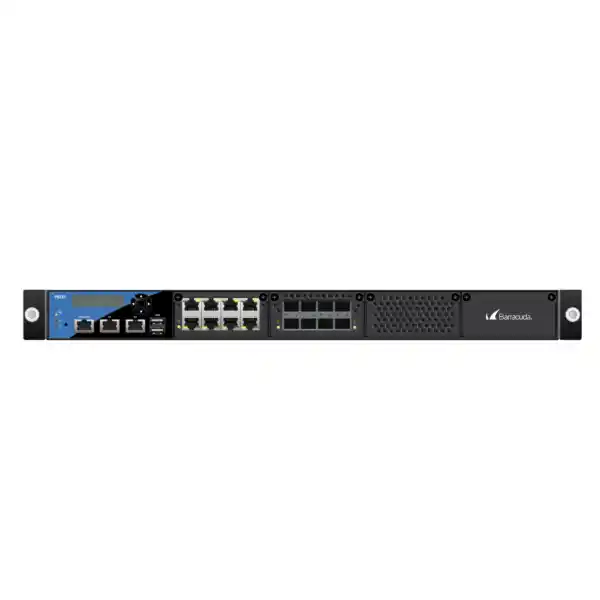
Barracuda CloudGen Firewall F600.F10 Revision D Dubai, UAE
The Barracuda CloudGen Firewall F600.F10 Revision D is positioned for organizations that need a substantial step above branch-class firewalls without moving immediately into the largest data-center chassis. It combines high session scale, multi-gigabit security performance, copper and fiber connectivity, integrated SD-WAN, advanced routing, VPN, application control, threat prevention, and centralized lifecycle management. For UAE networks, the platform is particularly relevant to headquarters, distribution hubs, regional aggregation points, large campuses, hospitality groups, education environments, healthcare networks, industrial sites, and enterprises consolidating multiple WAN links into a resilient security edge.
F600.F10 Revision D at a glance
Direct answer: what is the Barracuda F600.F10 Revision D?
The Barracuda CloudGen Firewall F600.F10 Revision D is a rack-mountable next-generation firewall appliance in Barracuda’s F600 family. The F10 designation identifies the fiber-oriented interface mix: ten 1 GbE copper Ethernet ports and eight 1 GbE SFP interfaces in a 1U platform. It is designed to terminate and secure internet, private WAN, MPLS, broadband, leased-line, and site-to-site VPN connections while applying stateful firewalling, application-aware policy, intrusion prevention, web controls, malware defenses, encrypted-traffic inspection where licensed and configured, dynamic routing, segmentation, traffic shaping, and secure SD-WAN functions. This makes it suitable not only as an internet perimeter firewall but also as a regional WAN hub, data-center edge, campus core security gateway, or consolidation platform for many remote offices.
For Dubai and the wider UAE, the value of the F600.F10 is often its balanced combination of security capacity and interface flexibility. Organizations frequently operate mixed connectivity: enterprise internet circuits delivered over copper or fiber, redundant providers, private Ethernet or MPLS, cloud connectivity, voice and collaboration traffic, remote-access services, and site-to-site encrypted overlays. The eight SFP ports are useful when the firewall needs direct optical handoffs or fiber connections to distribution switches, while the copper ports support conventional edge and management connections. FourTeck can help validate whether the F10 port mix is the right F600 variant for the intended topology before a quotation is finalized.
Published performance profile and sizing interpretation
Performance values should always be treated as comparative laboratory figures rather than guaranteed production rates. Actual throughput depends on packet size, traffic mix, enabled security services, TLS inspection, VPN encryption, logging, policy complexity, application behavior, asymmetric routing conditions, and software version. A correctly engineered deployment starts with the security profile and traffic composition, then checks bandwidth, session rate, branch count, tunnel count, logging volume, high-availability design, and planned growth. FourTeck therefore recommends sizing against the workload that will be inspected, not only against the service-provider circuit speed.
Hardware architecture of F600.F10 Revision D
Barracuda’s current F600 Revision D hardware documentation identifies the platform as a 1U rack-mount appliance with an Intel Core i3-class four-core CPU, SSD storage of 240 GB or higher, integrated fan cooling, a front display, two USB 2.0 interfaces, and an RJ45 serial console. The F10 configuration uses a single internal power supply rather than the dual hot-swap supply found on selected higher F600 Revision D variants. The documented appliance envelope is approximately 440 mm wide, 480 mm deep, and 44 mm high, with an appliance weight around 10 kg. The documented operating temperature range is 0°C to 40°C, which makes proper conditioned rack environments particularly important in the Gulf climate.
Barracuda’s dedicated 2026 F600 Revision D hardware page lists 16 GB of RAM, while some performance-oriented product literature published at different times can show different memory snapshots. For procurement, the safest practice is to validate the exact manufacturer part number and current bill of materials on the quotation rather than treating a historical PDF as the definitive shipment specification. This is especially relevant when products remain in channel inventory across hardware documentation revisions. FourTeck can align the quoted appliance, subscription bundle, power accessories, rack hardware, and SFP transceivers with the intended deployment.
The storage subsystem is not intended to turn the appliance into a general-purpose server; it supports the firewall software, event handling, operational data, updates, and local functions associated with the security platform. Long-term reporting and enterprise-wide analytics should be planned as a separate operational requirement, especially when many devices are centrally managed. In larger deployments, organizations typically combine the appliance with Barracuda centralized management and reporting components so that policy control, software rollout, licensing, remote troubleshooting, and cross-site visibility do not depend on logging in to individual gateways one at a time.
F10 interface design: copper and fiber in one security edge
The defining hardware characteristic of the F600.F10 Revision D is its combination of ten 1 GbE RJ45 Ethernet ports and eight 1 GbE SFP fiber interfaces. This provides eighteen production network interfaces before considering the serial console and USB service connections. The mix is valuable when a deployment needs a firewall to sit between multiple security zones, redundant carriers, data-center switching, server segments, guest networks, voice networks, DMZs, management networks, or dedicated partner links. Instead of consuming external media converters to transition between copper and fiber for every handoff, the F10 can accommodate a substantial number of optical connections directly, subject to using compatible optics and the correct fiber type.
A typical UAE headquarters design could dedicate two copper interfaces to independent internet edge devices, two to management or out-of-band paths, selected SFP interfaces to redundant core switches, and additional interfaces to server, DMZ, or service-provider handoffs. Another design might use SFP ports toward an access or aggregation layer while copper ports terminate provider CPE, dedicated management, or legacy zones. The exact assignment should be driven by failure domains and operational clarity rather than simply filling ports. Where possible, physically separate external, internal, management, DMZ, and HA-related connectivity so troubleshooting remains intuitive during an incident.
The F10 is a 1 GbE-oriented interface model. Buyers should not assume that an SFP cage automatically supports 10 GbE SFP+ operation. Barracuda also produced F600 Revision D variants with different high-speed interface capabilities, so model selection must match actual uplink requirements. If the project requires native 10 GbE firewall interfaces, sustained inspection beyond the practical envelope of 1 GbE links, or a high-speed east-west security design, the architecture should be reviewed before purchase. FourTeck can compare the F10 against alternative F600 configurations or newer platform options based on current availability and lifecycle requirements.
Next-generation firewall policy engine
At its core, CloudGen Firewall provides stateful packet inspection and policy enforcement for routed, bridged, and mixed enterprise environments. Traditional five-tuple policy remains important, but modern enforcement extends beyond source address, destination address, protocol, and port. Policies can incorporate user identity, application awareness, network objects, service objects, time conditions, security profiles, routing behavior, and other context. This allows administrators to build rules that represent business intent: finance users may receive one internet access profile, guest networks another, server DMZs a tightly constrained inbound and outbound policy, and industrial segments an even narrower set of permitted communications.
Application Control expands the firewall’s ability to identify and regulate applications rather than relying exclusively on port numbers. This is important because many SaaS services and consumer applications use common ports such as TCP 443. When TLS inspection is enabled and legally and operationally appropriate, encrypted application identification can become more granular. Organizations should plan TLS interception carefully because it introduces certificate-management, privacy, exception, compatibility, performance, and governance considerations. It should be deployed as an engineered security control with documented exclusions, not enabled indiscriminately.
The object-oriented management approach is useful in multi-site enterprises. Instead of embedding individual IP addresses throughout hundreds of rules, administrators can model logical objects such as Dubai-HQ-Finance, AbuDhabi-ERP, Azure-Production, Voice-SBC, Guest-DNS, or Approved-NTP and reuse them consistently. In centrally managed environments, the same object hierarchy and policy design can be propagated across multiple firewalls. This reduces configuration drift and makes change review more meaningful because engineers can reason about the intended object rather than decode repeated address literals.
Intrusion prevention and threat inspection
Intrusion prevention is central to positioning the F600.F10 as an NGFW rather than only a packet-filtering router. IPS examines traffic for signatures and behaviors associated with exploits, vulnerabilities, protocol abuse, and known attack patterns. The published F600D.F10 IPS throughput of up to 4.8 Gbps provides a useful comparison point when estimating security capacity. In production, the achievable number depends on packet distribution, enabled engines, software release, rule base, session count, logging, and whether traffic is encrypted. Because an increasing share of enterprise application traffic is TLS protected, capacity planning should consider the inspection policy that will actually be deployed.
Threat-protection sizing is even more important than raw IPS sizing when multiple engines operate simultaneously. Barracuda publishes an up-to threat-protection figure of 4.0 Gbps for the F600D.F10 under its defined test profile. A project team should use this number as a planning reference, then add headroom for growth, bursts, software updates, policy expansion, incident conditions, and changes in application behavior. For a 1 Gbps internet circuit, for example, the firewall may have substantial nominal headroom, but the final design still needs to account for a second ISP, inter-zone inspection, VPN traffic, server-published applications, and future bandwidth increases.
Security architecture should also decide where inspection belongs. Some organizations inspect primarily north-south internet traffic, while others use the firewall for internal segmentation and apply IPS between user, server, OT, guest, partner, and management zones. The latter can multiply the actual inspected traffic volume even when the internet link remains unchanged. For this reason, FourTeck sizing workshops consider traffic direction, peak utilization, east-west flows, tunnel termination, interface architecture, session counts, business-critical applications, and failover conditions instead of using only a single ISP bandwidth figure.
Secure SD-WAN and the TINA VPN architecture
Barracuda CloudGen Firewall integrates secure SD-WAN with the firewall rather than treating WAN optimization as a separate appliance layer. Barracuda’s TINA, or Transport Independent Network Architecture, extends the VPN framework to support multiple transports inside a logical site-to-site relationship. A conventional tunnel often binds connectivity to one primary path and one backup path. With secure SD-WAN, multiple WAN connections can participate, be monitored, and be selected according to policy and performance. This allows a business to combine fiber internet, broadband, private circuits, LTE or other provider links while maintaining encrypted branch-to-hub or site-to-site connectivity.
The platform can use dynamic bandwidth and round-trip-time measurements to support performance-based transport selection. This matters for real applications. Voice, interactive collaboration, VDI, ERP, backups, video, SaaS, and bulk file transfer do not have the same latency, jitter, loss, or bandwidth requirements. By designing traffic classes and uplink preferences around application behavior, the network can protect high-value sessions when one circuit degrades rather than waiting for a total link failure. In a dual-ISP Dubai headquarters, for example, voice and ERP might prefer the low-latency primary circuit while large backups use the secondary circuit, with both paths available for resilience.
Barracuda documents that SD-WAN using TINA requires Barracuda CloudGen Firewall endpoints on both sides of the logical tunnel. This should be considered early when integrating third-party firewalls or managed carrier routers. Standard IPsec remains relevant for interoperability, but the full Barracuda SD-WAN feature set is built around the Barracuda-to-Barracuda architecture. A mixed-vendor environment may therefore use TINA between Barracuda-managed sites while using interoperable VPN methods for partners, acquired companies, or external cloud gateways.
For organizations planning to reduce dependence on MPLS, secure SD-WAN can make internet-based underlays operationally practical by combining encryption, link monitoring, application-aware path selection, and centralized policy. This does not automatically mean every MPLS service should be removed. Some businesses retain private circuits for regulatory, latency, or service-level reasons and use secure internet links as additional paths. The correct WAN design is economic and technical: it should compare circuit costs, availability, latency, route diversity, failover behavior, cloud proximity, and business impact.
Site-to-site VPN and remote-access security
The F600.F10 can function as a substantial VPN concentration point for enterprise networks. Site-to-site connectivity can link UAE branches, regional offices, warehouses, data centers, cloud environments, partner networks, and disaster-recovery facilities. Barracuda’s architecture supports both its TINA-based approach and standard VPN interoperability scenarios. The engineering task is not merely to create a tunnel; it is to define encryption parameters, authentication, routing, tunnel monitoring, failover, NAT behavior, overlapping-network handling, route advertisements, and application-specific path expectations.
Remote-access requirements should be evaluated separately from site-to-site WAN requirements. User access may need role-based policy, endpoint posture checks, multi-factor authentication integration, split-tunnel or full-tunnel design, DNS behavior, certificate handling, and access to only the application segments each identity requires. Barracuda documents VPN client support across Windows, macOS, and Linux environments, while optional Advanced Remote Access capabilities can add portal-based SSL VPN and network access control functions depending on the selected licensing and deployment design. The exact entitlement should be confirmed with the current subscription bundle.
A strong remote-access architecture avoids placing all authenticated users into one trusted network. Instead, the firewall can enforce identity and service boundaries so that a contractor, finance employee, system administrator, and third-party support engineer receive different access even when all connect through the same security gateway. Logging should record authentication, assigned addresses, session duration, policy decisions, and significant security events. This approach supports incident response and makes remote access part of zero-trust-style segmentation rather than an unrestricted extension of the office LAN.
Application-aware traffic management and Quality of Service
Security policy and WAN performance increasingly overlap. An application can be permitted by the firewall but still create a business problem if it consumes bandwidth needed by voice, transaction processing, VDI, or customer-facing services. CloudGen Firewall’s application-aware traffic management and SD-WAN capabilities allow engineers to classify traffic and control how bandwidth is used across available paths. This supports a policy hierarchy in which critical applications receive predictable treatment, interactive traffic is protected from bulk transfers, and non-business traffic can be deprioritized or restricted without blocking every category outright.
A useful design starts with measurable application objectives. Voice and video need latency and jitter control. SaaS applications need low round-trip time to regional cloud edges. Backups may need high throughput but can tolerate delay. Software updates can be scheduled or rate-limited. Guest Wi-Fi should not be able to starve corporate traffic. By mapping these requirements into traffic classes and SD-WAN preferences, the F600.F10 becomes part of the application-delivery architecture rather than only a perimeter enforcement point.
In UAE multi-site deployments, this is especially useful when branches use different carriers or when internet quality varies by location. A centralized policy can define business priorities while local measurement determines which path is currently best. Engineers should still monitor actual performance because no SD-WAN policy can compensate for insufficient aggregate bandwidth or poor physical diversity. Carrier diversity, last-mile diversity, correct SLA monitoring, and well-designed failover timers remain foundational.
Dynamic routing for enterprise and data-center networks
Barracuda CloudGen Firewall supports dynamic routing protocols including BGP, OSPF, and RIP as well as IPv4 and IPv6 networking. For the F600.F10, dynamic routing becomes particularly important when the appliance sits at a regional hub, data-center edge, or multi-provider boundary. Static routes may be adequate for a small branch, but they become operationally fragile when there are multiple WAN providers, redundant core switches, many internal prefixes, cloud connections, or active/standby paths. A routing protocol allows the network to exchange reachability information and adapt to topology changes without requiring every path to be manually changed.
BGP can be used for ISP connectivity, multi-homing, cloud edge integration, or route exchange with large internal networks. OSPF may be appropriate between the firewall and campus or data-center cores. The choice depends on administrative boundaries, scale, route-control requirements, convergence goals, and the skills of the operations team. The firewall policy and routing design must be planned together: a route can exist while security policy denies the traffic, and a permissive firewall rule cannot compensate for an absent route.
High-quality deployments document route ownership, default-route behavior, redistribution boundaries, route filters, prefix limits, metrics, failover conditions, and asymmetric-path risks. This becomes even more important with SD-WAN overlays because an application path can involve underlay routing, encrypted overlay routing, local breakout, and central policy. FourTeck can develop a migration plan that keeps routing changes controlled during cutover rather than replacing the existing edge and discovering route dependencies only after production traffic moves.
Network segmentation and zone architecture
A firewall with eighteen production interfaces is most valuable when the interface count is translated into a deliberate segmentation model. Physical interfaces can represent major trust boundaries, while VLANs can subdivide them into additional logical zones. A typical enterprise may separate corporate users, servers, VoIP, guest Wi-Fi, cameras, building management, printers, OT devices, network management, DMZ services, partner connectivity, cloud transit, and internet edge networks. Each zone should have an explicit business purpose and a defined list of allowed dependencies.
Segmentation reduces lateral movement by ensuring that compromise of one device category does not automatically expose every other network. It also improves troubleshooting because flows cross known control points. For example, guest Wi-Fi can be restricted to internet access and selected DNS services; cameras can communicate only with video-management servers and required infrastructure; printers can accept jobs from defined subnets but cannot initiate arbitrary sessions into sensitive systems; management interfaces can be reachable only from jump hosts or administration networks. These controls are more sustainable when built with reusable objects and documented naming conventions.
When the F600.F10 is used as a segmentation firewall, internal traffic may materially increase total inspected load. A company with a 1 Gbps internet circuit could still move several gigabits per second between users and servers. This is why NGFW sizing must account for east-west traffic in addition to north-south traffic. The interface layout, switching architecture, link aggregation approach, routing boundaries, and expected peak flows should all be reviewed before the firewall is placed inline between high-volume internal segments.
High availability and business continuity planning
A single F600.F10 can provide substantial capacity, but an enterprise edge is often too critical to depend on one appliance. High-availability planning should therefore begin with the business requirement rather than being added after the firewall is purchased. The design should consider appliance redundancy, WAN circuit redundancy, upstream and downstream switch redundancy, power diversity, rack distribution, optics, patch paths, and management access. Two firewalls connected to one switch, one power feed, and one carrier do not provide complete resilience even if the firewall pair itself can fail over.
The F600.F10 Revision D hardware documentation identifies a single internal power supply for the F10 model. This fact makes rack-level power design especially important. Where continuous service is required, a high-availability pair can be fed from separate protected PDUs or UPS paths where the facility design permits it. Network links should similarly be arranged so that the failure of one access switch or one transceiver does not isolate both appliances. The exact HA topology depends on Barracuda software capabilities, network design, and whether interfaces are physically or logically segmented.
Failover testing is as important as failover configuration. A commissioning plan should include controlled failure of each WAN link, firewall node, selected switch path, and relevant routing adjacency. Engineers should observe session behavior, VPN recovery, routing convergence, NAT state expectations, monitoring alarms, and application impact. This produces documented evidence that the architecture works under failure rather than merely showing green status under normal conditions.
Centralized management with Barracuda Firewall Control Center
Organizations operating multiple CloudGen Firewalls can use Barracuda Firewall Control Center for centralized administration. Barracuda describes Control Center as a platform for centrally managing security, content, traffic management, networking, access policies, software updates, configuration distribution, licenses, reusable objects, templates, and remote connectivity across managed units. This is particularly useful for businesses with branches across the UAE, GCC, Africa, or other regions because engineers can maintain a consistent policy model without configuring every device independently.
Central management enables template-driven operations. A standard branch design can define common DNS, NTP, identity, logging, VPN, security, and SD-WAN objects, then apply location-specific addresses and provider details. This accelerates deployment while reducing configuration drift. It also supports controlled software lifecycle management because updates can be planned and distributed across managed gateways rather than relying on local administrators at every site.
Control Center can manage multiple releases and platforms, which is valuable during phased migrations. Hardware firewalls, virtual firewalls, and public-cloud instances can coexist while the organization transitions toward a target architecture. The operational benefit is not only convenience. Central templates, configuration history, standardized naming, role-based administration, and common monitoring can reduce the risk of inconsistent rule sets and undocumented exceptions.
For customers planning a larger security program, FourTeck can align the firewall deployment with broader UAE infrastructure and integration services available through FourTeck IT Services UAE. The implementation scope can include addressing, VLANs, routing, VPN, authentication dependencies, monitoring, cutover planning, configuration documentation, and support handover.
Cloud connectivity and hybrid network use cases
Enterprise applications are increasingly split across on-premises systems, SaaS platforms, public-cloud workloads, colocation facilities, and partner environments. A firewall at the headquarters or regional hub therefore needs to do more than protect a conventional internet edge. The F600.F10 can participate in a hybrid architecture where selected traffic exits locally to SaaS, other traffic is encrypted to cloud networks, legacy applications remain in a private data center, and remote branches use SD-WAN to reach whichever application location is optimal.
Direct internet breakout can improve SaaS performance by avoiding unnecessary backhaul through a central site, but it also changes the security model. Every breakout location becomes an enforcement point. Central management, consistent security subscriptions, DNS policy, web controls, IPS, malware defenses, application policy, and logging become important to maintain uniform standards. The F600 at a central site can act as a major aggregation point while smaller CloudGen appliances secure branches, all under common policy where the Barracuda management design supports it.
Public-cloud connectivity should be engineered around route design, encryption, address planning, cloud-native route tables, availability zones, bandwidth expectations, and failover. A physical firewall in Dubai may terminate connections toward Azure, AWS, or another environment, but latency and cloud egress design should be reviewed. In some cases a virtual CloudGen Firewall deployed inside the cloud may provide a more consistent security boundary, while the F600 secures the on-premises side. The final architecture depends on where workloads live and how users reach them.
User identity awareness and access-policy design
IP addresses alone are a weak representation of user intent in modern networks. Devices roam between wired and wireless networks, DHCP addresses change, shared systems exist, and users may connect remotely. CloudGen Firewall can incorporate identity awareness into security policy so that access rules more closely represent business roles. This can improve control over internet access, sensitive applications, administrative systems, and remote connectivity when integrated with the organization’s identity architecture.
A mature policy model might distinguish finance, HR, developers, contractors, guest users, privileged administrators, service accounts, and devices that cannot authenticate interactively. Identity should not replace network segmentation; the two controls complement each other. A privileged user still should not receive unrestricted access from an unmanaged guest network, and a server should not depend on a human identity mechanism for all policy decisions. The firewall design should combine source zone, destination zone, service, application, identity, and security profile as appropriate.
Identity integration also creates operational dependencies. Directory availability, time synchronization, certificate validation, DNS resolution, authentication latency, and failover can all affect user experience. These should be part of testing. Change management should include a fallback procedure so administrators can diagnose authentication issues without opening broad temporary rules that later remain forgotten.
TLS inspection: security value and deployment discipline
Because much of today’s web and application traffic is encrypted, a next-generation firewall can see far less application content unless TLS inspection is used. Barracuda supports interception and decryption capabilities that can improve application identification and threat inspection for encrypted sessions. However, TLS inspection must be treated as a controlled enterprise security project. It changes the trust path between clients and external services, creates certificate-distribution requirements, and can affect applications that use certificate pinning, mutual TLS, specialized cryptography, or strict compliance controls.
A responsible deployment identifies which user groups and traffic categories should be inspected, which destinations must be bypassed, how certificates are generated and protected, how endpoints receive the trusted enterprise CA, and how exceptions are documented. Banking, healthcare, personal services, software update channels, certificate-pinned applications, and regulated traffic may require special treatment depending on corporate policy and applicable law. Performance sizing should also account for the CPU cost of decryption and re-encryption.
The F600.F10’s published threat-protection throughput provides a useful high-level comparison, but TLS-heavy production environments should be validated with realistic expectations. A design that works comfortably with mostly unencrypted test flows may behave differently when thousands of concurrent encrypted sessions are being inspected. Headroom is therefore essential, especially for organizations expecting user growth, faster internet circuits, or additional internal segmentation.
NAT, published services, DMZs, and inbound security
The firewall supports source NAT, destination NAT, and port-address translation for connecting private networks to external services and publishing controlled applications. For inbound services, the security objective should be to expose the minimum possible surface. A destination NAT rule that forwards traffic to a server is only one element of the design; access control, IPS, application behavior, TLS termination, server hardening, logging, vulnerability management, and upstream DDoS considerations must also be addressed.
A DMZ should be a security zone, not merely a subnet with a familiar name. Public-facing web servers, mail gateways, VPN portals, reverse proxies, and partner-access services should have narrowly defined communication paths toward internal systems. For example, a web front end might be allowed to reach only an application tier on a specific port, and that application tier might reach only the required database service. Administrative access should use dedicated management paths and strong authentication rather than being exposed broadly to the internet.
Organizations migrating from another firewall should inventory NAT rules carefully. Old rule bases often contain historical entries for retired services, temporary vendor access, obsolete public IPs, or undocumented dependencies. Recreating every legacy rule without validation transfers technical debt to the new platform. A migration is a valuable opportunity to identify rule owners, verify business need, remove unused objects, simplify overlapping policies, and document each published service.
IPv6 readiness and dual-stack planning
CloudGen Firewall supports IPv4 and IPv6, allowing the F600.F10 to participate in dual-stack enterprise designs. IPv6 deployment should not be treated as simply adding another address family to existing rules. Neighbor discovery, router advertisements, prefix assignment, DNS, VPN design, monitoring, security policy, logging, and application dependencies require deliberate planning. A network that enables IPv6 on clients without equivalent firewall policy can create an unintended path around controls designed only for IPv4.
For UAE organizations receiving IPv6 capability from carriers or hosting services, the firewall can become the enforcement point for a gradual adoption strategy. Teams can begin with selected external services or infrastructure networks, define explicit IPv6 objects and rules, and extend the design as application owners confirm compatibility. Logging and monitoring systems must also understand IPv6 addresses so security investigations remain effective.
Dual-stack routing should be documented independently. An application may choose IPv6 when both A and AAAA records exist, so a connectivity issue can appear intermittent if one path is healthy and the other is not. Testing should verify DNS resolution, routing, security policy, internet access, VPN behavior, and published-service reachability for both protocols where both are enabled.
Industrial and operational technology awareness
Barracuda’s CloudGen Firewall feature set includes protocol awareness for selected industrial protocols and subprotocols, including examples such as S7, IEC 60870-5-104, IEC 61850, MODBUS, and DNP3. This can be relevant for manufacturing, utilities, facilities, logistics, energy, and building-management environments where IT and OT networks increasingly intersect. The presence of protocol support does not replace OT engineering, but it can strengthen segmentation and visibility at carefully chosen boundaries.
OT firewalling should prioritize availability and deterministic change control. Industrial devices may use old operating systems, proprietary stacks, fixed communication partners, and protocols that behave differently from office applications. A rule change that is low risk in a guest network can be high impact in a production process. The network team should therefore map assets, communication flows, maintenance windows, safety requirements, vendor access, and recovery procedures before applying strict inspection.
The F600.F10’s fiber connectivity can also be useful in industrial campuses where long-distance building links or electromagnetic environments favor optical media. However, physical suitability, environmental rating, power protection, dust exposure, rack cooling, and site conditions must be checked. The standard F600 Rev D operating temperature specification is for controlled environments, so it should not be installed directly in harsh field conditions that exceed the documented range without appropriate enclosure and environmental control.
UAE deployment scenarios where F600.F10 fits well
Corporate headquarters
A large Dubai or Abu Dhabi office can use the F600.F10 as the primary internet and WAN security edge, terminating redundant ISPs, protecting user and server zones, applying application-aware policy, and connecting to branches through encrypted SD-WAN.
Regional SD-WAN hub
The appliance’s session capacity and secure WAN features make it suitable as an aggregation gateway for distributed offices when tunnel scale, bandwidth, failover, routing, and central policy are correctly sized.
Campus security gateway
Universities, schools, healthcare campuses, hospitality properties, and mixed-use facilities can segment user, guest, server, voice, IoT, CCTV, and management networks while controlling internet access at a common enforcement point.
Data-center edge
The fiber-heavy F10 interface mix can connect directly to optical switching layers for north-south security, DMZs, partner links, and WAN termination where 1 GbE port speeds match the architecture.
Logistics and distribution
Warehouses and distribution operators can combine provider links, secure branch connectivity, application prioritization, voice traffic, IoT segmentation, and resilient access to ERP and cloud platforms.
Hybrid cloud enterprise
Organizations with workloads split between UAE facilities and public cloud can use the firewall to enforce policy, route securely, terminate VPNs, and support local SaaS breakout while retaining centralized security governance.
Sizing methodology: bandwidth alone is not enough
A common firewall-purchasing error is to choose a model by matching the internet circuit speed to the headline firewall throughput. If a site has a 1 Gbps ISP, buyers may assume any firewall rated above 1 Gbps is sufficient. That ignores the difference between raw forwarding and full security services. The F600D.F10’s published raw firewall throughput is far above its published NGFW and threat-protection figures because deeper inspection requires more processing. For a security-first design, the relevant question is how much traffic will pass through IPS, application control, malware protection, web filtering, TLS inspection, and VPN encryption at peak load.
The second sizing dimension is session behavior. Two networks with the same 1 Gbps bandwidth can behave very differently. A backup stream may use a small number of long-lived sessions, while a busy campus browsing workload can create a very high rate of short connections. The F600D.F10’s published capacity of 2.1 million concurrent sessions and 115,000 new sessions per second provides strong scale for many enterprise environments, but the real production profile still matters. Web proxies, NAT-heavy services, guest Wi-Fi, IoT fleets, and application gateways can all change session characteristics.
Third, account for failover. In normal operation, two firewalls or two WAN links may share load or serve separate purposes. During a failure, surviving components may need to carry the entire production load. A design that runs at 80 or 90 percent of practical security capacity during normal conditions may have no safe margin after failover. Capacity should be validated against the worst credible failure state, not only the average state.
Fourth, plan for growth. UAE internet upgrades can move quickly from hundreds of megabits to multi-gigabit services, and cloud adoption increases traffic through secure internet breakout. A firewall purchased for today’s utilization should have enough practical headroom for the organization’s expected service life. The right model is not necessarily the largest available; it is the model that meets security, interface, operational, resilience, and lifecycle requirements with justified margin.
Finally, verify interface speed. The F600.F10 offers many 1 GbE interfaces, which is excellent for segmentation and fiber connectivity, but individual physical ports can become a bottleneck if the design expects a single multi-gigabit handoff. If the ISP, core switch, server farm, or aggregation link requires native 10 GbE, the interface requirement may drive model selection even when the firewall processing capacity itself would otherwise be sufficient.
Licensing and subscription planning
Barracuda CloudGen Firewall capabilities are tied to the appliance software and to licensing or subscription services. The exact bundle should be confirmed at quotation time because security features, update entitlements, support, threat services, remote-access options, reporting, and advanced protection can depend on the selected license. Barracuda materials reference license categories such as Base, Energize Updates, Advanced Threat Protection, Malware Protection, Firewall Insights, and Advanced Remote Access. Not every project needs every service, but an enterprise firewall should not be purchased without understanding which security functions the organization expects to operate throughout the contract term.
Energize Updates is particularly important because security systems depend on continuously updated intelligence and software maintenance. Application-control behavior, security definitions, support access, and other functions can be affected by subscription status. Advanced threat services can extend protection beyond baseline firewalling, while remote-access capabilities may require additional licensing depending on the deployment. Procurement teams should align license duration with the hardware lifecycle and budget planning so that a firewall does not become operationally constrained midway through its intended service period.
FourTeck quotations can be structured around the appliance, required subscriptions, optics, rack accessories, professional services, configuration, migration, and support requirements. Customers who need a broader view of procurement and UAE technology solutions can also visit FourTeck UAE for related infrastructure and enterprise technology services.
SFP optics, fiber type, and physical connectivity
The eight 1 GbE SFP interfaces are a major reason to select the F600.F10, but the SFP cages are only part of a complete fiber design. The correct transceiver depends on the switch or carrier handoff, fiber mode, wavelength, connector type, distance, and optical budget. Multimode 1 GbE SX and single-mode 1 GbE LX-style applications are common examples, but compatibility must be verified with the exact Barracuda support matrix and connected equipment. The two ends of a fiber link must use compatible standards, and the installed fiber plant must match the optic.
Structured cabling details matter in production. Engineers should document patch-panel positions, strand IDs, polarity, fiber type, attenuation, and which firewall interface maps to which switch or provider circuit. Spare optics and patch leads can materially reduce outage time when a transceiver fails. In dusty or high-traffic equipment rooms, fiber connector cleanliness should be part of operational procedure because contamination can create intermittent loss that is difficult to diagnose.
The F10 should also be assessed against future interface requirements. If the design expects an immediate migration from 1 GbE to 10 GbE uplinks, buying a fiber-rich 1 GbE model may postpone rather than solve the capacity problem. Conversely, if the organization’s switching and carrier handoffs are predominantly 1 GbE and require many physically separated optical links, the F10 can be a very efficient fit.
Rack, power, cooling, and UAE environmental planning
The F600 Revision D is a 1U rack appliance, so physical deployment appears simple, but rack engineering still deserves attention. The unit needs appropriate rack space, airflow clearance, cable management, power protection, and access to the front and rear interfaces required for servicing. Barracuda documentation identifies fan cooling and an operating range from 0°C to 40°C. UAE equipment rooms should therefore maintain reliable air conditioning and avoid locating the firewall where hot exhaust from other equipment recirculates into the appliance intake.
The F600.F10 Revision D uses a single internal power supply and an AC input designed for common 100–240 V, 50–60 Hz supplies. Barracuda documentation lists a maximum power draw class of 250 W for the single-supply C10/F10 models. Actual consumption can vary, but the figure is useful for UPS and PDU planning. In a high-availability pair, connect each unit to independently protected power where practical. UPS runtime calculations should include switches, ISP CPE, optical devices, and management systems needed to keep the network operational, not only the firewall.
Rack mounting hardware should be confirmed as part of the order. Barracuda’s rack-installation documentation indicates rack installation is optional for the F600 F10 Revision D, so do not assume every channel package contains the same rails or brackets. A complete quotation should state what mounting components are included, what must be ordered separately, and whether FourTeck installation services will provide the necessary rack hardware and patching materials.
Migration from an existing firewall
Replacing an existing firewall is a data-reconciliation project as much as a configuration project. The old device contains years of policy decisions, address objects, NAT entries, VPN definitions, static routes, dynamic routing, authentication dependencies, monitoring settings, certificates, and exceptions. A direct line-by-line conversion can reproduce obsolete rules and hidden risks. A better migration maps current traffic requirements into a clean target design, then preserves only the rules that still have an owner and a business purpose.
The first phase is discovery. Export the current rule base, network objects, interface addressing, VLANs, routes, VPN peers, public IP usage, DHCP or DNS dependencies, identity integration, certificates, logging destinations, monitoring, and HA behavior. Compare this to physical topology diagrams and actual switch configurations. Identify undocumented subnets and NAT mappings before cutover. Where possible, analyze traffic logs to see which rules are still active and which are candidates for retirement.
The second phase is design. Define the F600.F10 interface map, zone model, object naming, routing, default gateways, SD-WAN roles, security profiles, management access, and logging. Decide whether public services retain the same IP addresses, whether VPN peers can change parameters, and whether branch devices will migrate at the same time. Build a rollback plan that states exactly what must be reconnected and restored if acceptance tests fail.
The third phase is controlled cutover and validation. Test internet access, DNS, critical SaaS, published services, site-to-site VPNs, remote access, voice, cloud routes, administrative access, monitoring, and failover. Do not declare success merely because users can browse the web. The acceptance checklist should cover every business-critical dependency identified during discovery.
Greenfield deployment methodology
A new deployment has fewer legacy constraints but still benefits from disciplined design. Start with an addressing and segmentation plan. Define which networks belong to corporate users, servers, guest devices, voice, IoT, management, DMZ, and any regulated workloads. Decide which interfaces will be physical boundaries and which will carry VLAN trunks. Map every WAN provider and note whether the handoff is copper, SFP, routed public subnet, PPP-style service, private Ethernet, or carrier-managed CPE.
Next, define the trust model and allowed application flows. Security rules should be written from business requirements rather than from a desire to make everything work quickly. For each zone, specify required DNS, DHCP relay, directory services, NTP, internet access, server access, printing, voice, monitoring, backup, and management. Public services should be documented separately with NAT, certificates, application owners, and monitoring requirements.
Then build the WAN and VPN architecture. Choose default routes, BGP or OSPF relationships, SD-WAN transports, link health measurements, application steering, and failover behavior. For branches, standardize tunnel design and naming. For remote users, define authentication and access policy. Finally, configure logging, alerting, configuration backup, software maintenance, and administrative roles so operations begins with governance rather than adding it after the first incident.
FourTeck can deliver this as a documented implementation engagement, including discovery, logical design, configuration, deployment, cutover, validation, and handover. Customers evaluating firewall-specific solutions in Dubai can also reference FourTeck Firewall Dubai for related enterprise firewall planning and support.
Policy optimization for long-term operations
A firewall rule base usually grows faster than it shrinks. Temporary access becomes permanent, project networks are retired without deleting rules, and emergency changes are not always normalized. Over time this creates overlapping policies that are harder to audit and troubleshoot. The F600.F10 should be deployed with a rule-governance process from the beginning. Every rule should have a purpose, owner, source, destination, service or application scope, logging requirement, and review expectation.
Use explicit objects and meaningful names. A rule reading Dubai-Finance-Users to ERP-Production over HTTPS is easier to review than a rule containing multiple unlabeled IP subnets and any-service. Group related services where this improves clarity, but avoid overly broad groups that hide risk. Place specific rules before broad rules when evaluation order requires it, and use deny logging strategically so blocked traffic can be investigated without overwhelming the logging platform.
Scheduled review should identify zero-hit rules, shadowed rules, overly permissive objects, expired temporary access, unused VPN peers, and legacy NAT. Software upgrades are also good moments to revisit configuration because new capabilities or defaults may change the recommended policy approach. Central management can make these practices more consistent across multiple sites.
Logging, monitoring, and incident response readiness
The operational value of a firewall depends on visibility as much as enforcement. During an incident, engineers need to answer basic questions quickly: which source communicated with which destination, which rule allowed or denied it, what application was identified, whether IPS triggered, which NAT translation applied, whether the flow used a VPN, and which path was selected. Logging policies should retain enough detail to answer these questions while avoiding unnecessary noise that obscures important events.
Monitoring should cover system health, interface state, packet errors, CPU and memory trends, session utilization, VPN status, WAN latency, bandwidth, routing neighbors, subscription state, update status, storage health, and HA conditions. Alert thresholds should be actionable. If every brief fluctuation creates an alarm, teams become desensitized. Conversely, monitoring only device reachability misses degraded links and security-service failures.
Incident response procedures should include secure administrative access, time synchronization, log retention, configuration backup, escalation contacts, and a documented method to make emergency changes. Administrators should know how to capture diagnostic data without disrupting production. Remote access to the management plane should be tightly limited and protected with strong authentication.
For larger fleets, centralized reporting and Firewall Insights can complement gateway-level visibility. The exact reporting architecture should be selected according to retention requirements, number of appliances, compliance needs, SOC integration, and whether logs are also forwarded to a SIEM.
Security operations and software lifecycle
A next-generation firewall is not a set-and-forget appliance. Security definitions, application intelligence, operating software, certificates, and management components need ongoing maintenance. The operating process should specify who reviews security updates, how firmware releases are tested, when upgrades occur, how configurations are backed up, and what rollback procedure applies. In multi-site networks, version compatibility with Control Center and branch devices must be considered before a broad rollout.
Change windows should reflect business criticality. Headquarters or e-commerce perimeter upgrades may require after-hours windows, application-owner participation, and pre-defined validation tests. Branch upgrades may be automated in waves. High-availability pairs can reduce disruption, but HA does not eliminate the need for careful version planning. Some software changes involve behavior updates that persist after failover, so release notes and compatibility guidance must be reviewed.
Certificate lifecycle deserves its own control. VPN certificates, management certificates, TLS inspection CAs, and published-service certificates have different owners and renewal patterns. Expired certificates can create sudden outages or user warnings even when the firewall itself is healthy. Track certificate expiry dates centrally where possible and assign ownership well before renewal deadlines.
Performance tuning without weakening security
When a firewall approaches a performance limit, the first response should not be to disable security engines blindly. Start by identifying the actual bottleneck: interface saturation, CPU, session count, new-session rate, VPN encryption, TLS inspection, logging, routing, packet loss, or an upstream provider. Measure peak utilization over a representative period and correlate it with application behavior. A slow SaaS service can be caused by ISP latency even when firewall utilization is low, while a saturated firewall can appear as random application slowness across many services.
Policy efficiency can improve performance and clarity. Remove obsolete rules, avoid unnecessary inspection on traffic categories that are explicitly exempt under documented policy, and ensure asymmetric routing is not forcing troubleshooting complexity. Apply TLS inspection selectively according to security and compliance requirements. Use SD-WAN steering to move non-critical bulk traffic away from constrained circuits. Where internal segmentation generates very high east-west traffic, consider whether the architecture needs higher-speed firewall interfaces or distributed enforcement rather than weakening inspection.
If measured demand consistently approaches practical platform limits, the sustainable answer is capacity expansion or a larger appliance. Security architecture should preserve required controls as traffic grows. FourTeck can review utilization data, current policies, interface speeds, expected growth, and licensing to determine whether optimization, topology changes, HA load design, or platform replacement is the appropriate next step.
Interoperability with switches, wireless, voice, and servers
The firewall is one component of a broader network. Successful deployment requires coordination with switching, wireless, voice, server, and identity teams. VLAN tags configured on the firewall must match the upstream trunk. Link negotiation and SFP optics must match switch capabilities. Default gateways need to be placed intentionally so traffic crosses the intended security boundary. Wireless guest and corporate SSIDs should map to the correct zones, and voice networks should receive appropriate QoS and policy treatment.
VoIP environments require attention to SIP, H.323, or other protocol behavior, NAT, media paths, session timers, and provider expectations. Barracuda documents support for VoIP protocols including SIP, H.323, and SCCP. In practice, voice quality is usually more sensitive to latency, jitter, packet loss, and asymmetric routing than to raw bandwidth. SD-WAN and QoS policies should therefore protect voice sessions during WAN congestion.
Server teams should provide application dependency maps before segmentation is enforced. Modern applications may rely on DNS, identity services, certificate validation, APIs, databases, update repositories, and cloud endpoints beyond the obvious client-to-server port. A staged policy approach with logging can help identify required flows before a final deny-by-default rule set is enforced.
UAE procurement and project planning considerations
Enterprise firewall procurement should define more than the appliance model. A complete bill of materials may need the F600.F10 Revision D appliance, required subscriptions, support term, rack mounting components, SFP transceivers, fiber patch leads, copper patching, power cables, spare optics, professional services, migration support, and post-installation maintenance. If high availability is required, the BOM should clearly specify two compatible appliances and the corresponding licensing and support structure.
Lead time and exact hardware revision matter. Channel inventory can contain different revisions or bundles, and the user specifically requested Revision D. The quotation should therefore identify the exact F600.F10 Revision D model and not substitute another F600 variant without technical approval. Interface counts, power design, supported software, and performance can differ between revisions and submodels. The customer should also confirm whether new purchase, renewal, expansion, or replacement is intended, because licensing and support processes may differ.
For projects spanning the UAE and international sites, standardization can simplify operations, but local circuit characteristics and import or support arrangements still vary. A regional hub in Dubai might use the F600 while branches use smaller appliances, all centrally managed. Organizations expanding beyond the UAE can reference FourTeck Global for broader infrastructure coordination while maintaining a consistent design methodology.
The procurement package should include a technical statement of work. This prevents ambiguity about who owns WAN coordination, public IP changes, rack installation, cable supply, configuration migration, testing, documentation, and rollback. A precise scope turns the firewall purchase into an implementable project rather than a box delivery.
How to choose between F600.F10 and another firewall model
Choose the F600.F10 Revision D when the required performance envelope, 1 GbE interface architecture, high session scale, fiber density, SD-WAN requirements, and Barracuda management model align with the project. Do not choose it solely because it belongs to an F600 family or because its headline firewall throughput exceeds the current internet speed. The most important decision points are real inspected throughput, tunnel requirements, interface speed, number of zones, expected growth, high availability, licensing, and lifecycle.
A smaller model may be better for a modest branch where the F600’s capacity and port density would be unused. A larger or different interface variant may be required where native 10 GbE connectivity is mandatory, inspection throughput must remain higher under full threat services, or the site aggregates extremely large east-west traffic flows. A virtual or cloud firewall may be more appropriate for workloads entirely inside a public-cloud environment. Many enterprises use a mix: larger hardware at headquarters, smaller hardware at branches, and virtual instances in cloud networks.
FourTeck’s design process can compare expected peak throughput, security profiles, users, sessions, VPN topology, WAN circuits, VLANs, optics, rack and power, management, and subscription requirements before final model selection. The goal is to avoid both under-sizing, which creates premature performance pressure, and unnecessary over-sizing that adds cost without operational benefit.
Recommended pre-deployment information package
Before configuration begins, collect a concise but complete network information package. It should include a current logical topology, physical rack diagram, IP addressing plan, VLAN list, ISP circuit details, public IP allocations, routing protocols, static routes, VPN peer information, branch list, DNS and NTP servers, identity sources, authentication methods, monitoring systems, syslog or SIEM destinations, certificate inventory, and a list of critical applications. If replacing an existing firewall, include exports of rules, NAT, objects, VPNs, and interfaces.
For each WAN circuit, record provider name, service ID, bandwidth, handoff type, CPE ownership, IP addressing, gateway, routing protocol, support contact, and escalation process. For each site-to-site VPN, record remote peer IP, local and remote networks, encryption parameters, authentication method, routing behavior, business owner, and maintenance contact. For each published service, record public IP, internal destination, port, certificate, application owner, and health-check method.
This documentation reduces cutover risk and speeds support. It also helps FourTeck produce a more accurate quotation because the number of optics, interface assignments, services, and migration tasks can be estimated from real requirements rather than assumptions.
Implementation sequence for a controlled rollout
A controlled rollout can be organized into discovery, design, staging, change approval, physical installation, cutover, validation, tuning, and handover. Discovery confirms the existing environment and business requirements. Design translates those requirements into interface assignments, routing, security policy, SD-WAN, VPN, identity, and logging. Staging applies the target configuration to the appliance in a safe environment and verifies software, licenses, management access, and core policy syntax before the maintenance window.
During physical installation, label every cable and optic, confirm power protection, record serial and asset information, and verify management reachability before moving production traffic. During cutover, change one dependency at a time where possible: WAN handoff, internal gateway, routing adjacency, VPN peer, and published services. Maintain a time-bound rollback trigger so the team does not continue troubleshooting indefinitely while production is degraded.
Validation should include both positive and negative tests. Confirm permitted applications work, but also confirm restricted traffic is blocked. Test internet access, DNS, email, ERP, voice, cloud services, public applications, remote access, site-to-site VPNs, monitoring, logs, and HA. Simulate WAN failure and verify SD-WAN or routing behavior. Capture results in the handover documentation.
After cutover, tune rather than redesign under pressure. Review logs for denied legitimate traffic, unexpected applications, IPS events, link quality, and session behavior. Adjust documented policy through normal change control. This approach produces a stable production baseline and a clear audit trail.
Common design mistakes to avoid
Sizing to raw throughput
Raw firewall throughput is not the same as NGFW, IPS, threat protection, TLS inspection, or encrypted SD-WAN capacity. Size against the security profile that will be active.
Ignoring interface speed
The F10 provides many 1 GbE ports. A project requiring a single native 10 GbE uplink needs a different interface plan or model regardless of processing headroom.
Copying every legacy rule
Blind migration preserves obsolete access and makes the new firewall harder to manage. Validate rule ownership and business need during migration.
Treating HA as appliance-only
Real resilience also needs independent circuits, switches, optics, power, and management paths. Shared failure domains can defeat an otherwise correct HA pair.
Unplanned TLS inspection
TLS decryption changes certificates, compatibility, privacy handling, and performance. Roll it out with scoped policy, tested exceptions, and capacity margin.
Weak documentation
Undocumented interfaces, NAT, VPNs, and emergency rules increase downtime. Build operational records as part of deployment, not after an incident.
Barracuda F600.F10 Revision D hardware reference
| Form factor | 1U rack mount |
| Copper Ethernet | 10 × 1 GbE RJ45 |
| Fiber Ethernet | 8 × 1 GbE SFP |
| USB | 2 × USB 2.0 |
| Serial console | 1 × RJ45 console |
| Processor | Intel Core i3, four cores, as listed in current F600 Revision D hardware documentation |
| Memory | 16 GB listed in the current dedicated F600 Revision D hardware page; confirm current shipping BOM at order time |
| Storage | SSD, 240 GB or higher |
| Dimensions | Approximately 440 × 480 × 44 mm per current revision documentation |
| Appliance weight | Approximately 10 kg |
| Power supply | Single internal PSU on F600 D.F10 |
| AC input | 100–240 V, 50–60 Hz, auto-sensing |
| Max power draw class | 250 W for single-supply C10/F10 models in current revision documentation |
| Operating temperature | 0°C to +40°C |
| Operating humidity | 10% to 85%, non-condensing |
Specifications and published performance may change with manufacturer documentation, firmware, component revisions, and test methodology. Confirm the exact manufacturer part number, supported software release, optics, licensing, rack kit, and shipping configuration before purchase.
Operational design for 1,000–4,000 concurrent users
Barracuda publishes a recommended concurrent-user range of approximately 1,000 to 4,000 for the F600D.F10. This is useful as a broad positioning indicator, but user count should not be treated as a licensing limit or universal capacity formula. A 2,000-user software company running heavy cloud development, video collaboration, and encrypted SaaS can create more firewall work than a 4,000-user environment with light transactional traffic. Conversely, a server-centric environment with relatively few human users can generate millions of sessions or high throughput.
For campus sizing, divide the population into traffic classes. Estimate employee devices, BYOD, guest clients, phones, cameras, printers, IoT devices, servers, and remote users. Record peak concurrent endpoints rather than only HR headcount. Measure peak internet and inter-zone traffic, then identify the percentage subject to IPS, application control, web security, TLS inspection, and malware protection. Add site-to-site and remote-access VPN load. Finally, test failover conditions and growth over the expected service period.
This method produces a defensible sizing model and helps determine whether F600.F10 is comfortably within range or whether a different appliance would be safer. It also informs license selection and monitoring thresholds after deployment.
Branch aggregation and multi-site standardization
The F600.F10 is especially compelling when it serves as a hub for many smaller sites. Branch offices can use appropriately sized CloudGen Firewall appliances, while the F600 aggregates encrypted tunnels at a headquarters or regional data center. Central management can standardize object naming, security profiles, software versions, and WAN policy. The hub can also provide centralized services such as access to data-center applications, partner networks, management systems, or shared security infrastructure.
Hub sizing must include aggregate branch traffic, not only local users. If twenty branches each burst to several hundred megabits toward the data center, the hub may carry substantial encrypted throughput even when headquarters internet usage is moderate. SD-WAN encryption figures and interface capacity therefore become relevant. The number of tunnels, routing design, and failover behavior also need review. If every branch has two transports, the logical topology can contain many more active paths than the number of physical sites suggests.
Standardization should preserve local flexibility. Branches in different countries or buildings may have different ISP handoffs, VLANs, local breakout policies, or regulatory constraints. Use templates for common policy and site-specific parameters for differences. This reduces drift without forcing every location into an unrealistic identical configuration.
Security policy for guest, BYOD, and IoT networks
Guest, BYOD, and IoT networks often create the largest device counts while having the weakest endpoint control. The firewall should treat them as separate trust domains. Guest access typically needs internet connectivity, DNS, DHCP, and perhaps captive-portal services, but should not reach corporate users, servers, management networks, printers, cameras, or voice systems. BYOD may require selected business applications but should still be separated from managed endpoints. IoT devices should be restricted to their controllers, cloud endpoints, DNS, NTP, and update services wherever feasible.
The F600.F10’s interface density and VLAN support make it possible to build these zones without requiring a separate firewall for every category. Application control, web filtering, IPS, and traffic management can then be applied according to risk. Guest streaming, for example, can be rate-limited so it cannot consume bandwidth needed by business applications. IoT traffic can be monitored for unexpected destinations and lateral connections.
Segmentation should be paired with secure switching and wireless configuration. A firewall cannot prevent two devices in the same unprotected Layer 2 segment from communicating directly if their traffic never crosses the gateway. VLANs, private VLAN features, wireless client isolation, NAC, and switch access controls may therefore be needed to enforce the intended architecture end to end.
Security policy for servers and critical applications
Server networks should not be treated as a single trusted zone. Production databases, application servers, domain controllers, backup systems, virtualization management, storage, monitoring, and development systems have different risk profiles. Where traffic volume and architecture permit, the firewall can enforce boundaries between major server tiers. At minimum, north-south access between users and servers should be restricted to required applications rather than broad subnet-to-subnet access.
Critical management interfaces deserve special protection. Hypervisors, switches, storage controllers, backup consoles, directory administration, and firewall management should be reachable only from approved administration networks or jump hosts. Remote vendors should receive time-bound access to the specific systems they support, ideally with strong authentication and logging. Never use a broad any-to-any remote-access rule because it is convenient during installation.
Application owners should participate in policy testing. An ERP transaction may depend on DNS, LDAP, database, API, license server, file share, email relay, and external cloud endpoints. Blocking one hidden dependency can create intermittent application failures that look unrelated to the firewall. Capturing dependency maps before enforcement greatly reduces troubleshooting time.
Why the F600.F10 is relevant to fiber-connected campuses
Many UAE campuses connect buildings, server rooms, carrier handoffs, and distribution switches with fiber rather than copper. Copper Ethernet is convenient inside a rack but has distance and electromagnetic limitations. Fiber supports longer runs and electrical isolation, and it is common in large properties, warehouses, hospitals, hotels, universities, and industrial environments. The F600.F10’s eight 1 GbE SFP interfaces can therefore reduce the need for external media conversion when the security gateway must connect directly to fiber-based network segments.
Direct fiber does not automatically simplify every design. Each optical path still needs compatible transceivers, correct wavelength and fiber mode, clean connectors, and clear documentation. Redundant core switches should use separate paths where possible. If a firewall pair connects to two switches, the VLAN and routing architecture must prevent loops while maintaining failover. Engineers should also consider whether 1 GbE per fiber link is sufficient for the application. A high-density fiber model can still be constrained by per-port speed.
For campus projects combining firewalls with switching, servers, wireless, voice, and structured infrastructure, FourTeck can coordinate cross-domain design so the firewall interface plan matches the wider topology instead of being specified in isolation.
Threat prevention for direct internet breakout
Direct internet breakout can improve SaaS performance because users reach cloud services without hairpinning through a remote data center. The security consequence is that the local firewall becomes responsible for enforcing internet policy. The F600.F10 can combine stateful firewalling, application control, intrusion prevention, web filtering, malware defenses, DNS reputation controls, and other security services as licensed and configured. This creates a consolidated enforcement stack at the WAN edge.
Policy should distinguish between user browsing, server egress, guest access, IoT, administrative systems, and published services. Server networks often need a far smaller set of outbound destinations than user networks. Guest traffic may need broad internet access but no internal access. IoT devices should have narrow external permissions. Administrators may need access to vendor repositories and cloud consoles but should use hardened endpoints and strong identity controls.
When secure SD-WAN and direct breakout are used together, the network can choose the best path while still applying local security policy. This reduces dependence on a single central choke point. It also increases the importance of configuration consistency across sites, making centralized templates and security subscriptions part of the architecture rather than optional administrative conveniences.
Troubleshooting framework for production networks
When users report that an application is slow or unreachable, troubleshoot from the path outward. Verify client addressing, DNS, default gateway, and local VLAN. Confirm the firewall sees the session, which rule matches, whether NAT applies, and which route is selected. Check interface errors, packet drops, WAN latency, SD-WAN path state, VPN tunnel state, and upstream connectivity. If IPS or application control blocks traffic, identify the exact signature or policy rather than adding a broad bypass.
For intermittent issues, compare timestamps across firewall logs, application logs, switches, and provider monitoring. Accurate NTP is essential. Packet captures can establish whether packets arrive, whether responses return, and where retransmissions begin. In multi-WAN networks, confirm that return traffic follows a compatible path and that NAT state remains consistent. Asymmetric routing is a common cause of confusing failures in stateful firewalls.
For performance issues, separate throughput from latency. A speed test may show high bandwidth while an application remains slow because of DNS delay, packet loss, or distant cloud hosting. Conversely, low firewall CPU does not guarantee a healthy path if one physical interface is saturated. Monitoring should therefore combine system metrics with link-quality and application observations.
Document each resolved issue and normalize temporary troubleshooting changes. Emergency allow rules, disabled inspection, static routes, and manual failover settings should be removed or formally approved after the incident. Otherwise every incident leaves hidden complexity behind.
Maintenance and support strategy
A support strategy should define both vendor entitlement and operational ownership. Vendor support can assist with software defects, hardware issues, and product-specific diagnostics, but the customer or implementation partner still needs accurate network diagrams, configuration records, ISP contacts, maintenance procedures, and application owners. The fastest incident resolution occurs when both product and environment context are available.
Keep configuration backups after approved changes and before upgrades. Store them securely outside the appliance. Maintain a spare-optics plan and identify how replacement hardware would be received and installed. If the firewall is part of an HA pair, test that the surviving unit can carry the production load. If only one appliance is deployed, document the business impact and recovery path for hardware failure.
FourTeck can provide deployment and ongoing assistance for UAE customers, including configuration review, migration planning, remote troubleshooting, onsite coordination, license renewal planning, and network integration. Support scope should be defined in the quotation so response expectations, coverage hours, onsite requirements, and third-party dependencies are clear.
Frequently asked technical questions
Does F600.F10 Revision D have 10 GbE ports?
The F600.F10 Revision D is documented as providing ten 1 GbE RJ45 interfaces and eight 1 GbE SFP interfaces. Do not assume 10 GbE SFP+ capability on the F10 simply because it uses SFP cages. Other F600 Revision D variants have different interface configurations. If native 10 GbE is required, validate a model that explicitly supports it.
Is the 15 Gbps firewall figure the speed I will see with every security feature enabled?
No. The 15 Gbps figure is a published up-to firewall throughput benchmark under defined test conditions. Barracuda separately publishes up-to figures such as 4.8 Gbps IPS, 4.2 Gbps NGFW, and 4.0 Gbps threat protection for the F600D.F10. Production performance depends on traffic and enabled services.
Can the firewall be used for secure SD-WAN?
Yes. Secure SD-WAN is a core CloudGen Firewall capability. Barracuda’s TINA architecture supports multiple transports, active link monitoring, performance-based path selection, and encrypted site connectivity. Full TINA-based SD-WAN requires compatible Barracuda endpoints.
Can it terminate remote-access VPNs?
Yes, CloudGen Firewall supports remote-access VPN functions and Barracuda VPN Client platforms. Optional Advanced Remote Access capabilities can add portal-based SSL VPN and NAC functions. Exact licensing should be confirmed for the required feature set.
Is the F600.F10 suitable for a data center?
It can be suitable for a data-center edge or segmentation role when 1 GbE physical interfaces and the published inspection performance match the workload. Environments requiring native 10 GbE or substantially higher inspected throughput should be evaluated against other models.
Does it support dynamic routing?
Yes. Barracuda lists support for BGP, OSPF, RIP, multicast, IPv4, and IPv6. Routing design should be coordinated with firewall policy, NAT, VPN, and SD-WAN to avoid asymmetric paths and unexpected failover behavior.
What power design should I use?
The F600.F10 Revision D is documented with a single internal power supply. For high availability, deploy two appliances where business continuity requires it and use independent protected power paths where feasible. Include switches and provider CPE in UPS planning.
Can FourTeck assist with migration from another brand?
Yes. A migration can include rule and NAT analysis, interface and VLAN mapping, routing, VPN recreation, identity integration, cutover, rollback planning, testing, and post-cutover tuning. Direct configuration conversion should be combined with policy cleanup rather than copying obsolete rules blindly.
Why buy and deploy through FourTeck UAE
An enterprise firewall project succeeds when product selection, licensing, physical installation, network design, security policy, and operational handover are handled as one system. FourTeck can support UAE customers from the initial requirement through final validation. The process can include technical discovery, model and license validation, quotation, rack and connectivity planning, configuration, migration, SD-WAN design, VPN, routing, VLANs, security policy, logging, HA, acceptance testing, documentation, and support.
This is particularly important for a model such as F600.F10 Revision D because the fiber interface mix must match the real topology. The project may require compatible SFP optics, fiber patching, specific rack hardware, single-power-supply resilience planning, and a decision about whether 1 GbE interfaces remain appropriate for the expected service life. These details should be settled before equipment arrives.
FourTeck’s broader infrastructure practice can also coordinate adjacent technologies rather than treating the firewall as an isolated appliance. For organizations consolidating network, server, cloud, voice, and support requirements, the product can be integrated into a wider technical roadmap with documented ownership and change control.
Decision recap: when the F600.F10 Revision D is the right choice
Choose it for
Enterprise perimeter security, regional SD-WAN hubs, large campuses, mixed copper-and-fiber deployments, dense session environments, branch aggregation, data-center edge use where 1 GbE interfaces are appropriate, and organizations standardized on Barracuda CloudGen Firewall management.
Validate carefully when
The project needs native 10 GbE links, very high TLS-inspection load, unusually large east-west traffic, extensive encrypted WAN aggregation, harsh environmental installation, or a high-availability design that demands redundant PSUs inside each individual appliance.
Confirm before order
Exact F600.F10 Revision D part number, current shipping hardware specification, software support, subscription bundle, warranty/support term, rack kit, SFP optics, power accessories, delivery timeline, implementation scope, and whether a second unit is required for HA.
Avoid assumptions about
Headline throughput equaling full-security speed, SFP meaning 10 GbE, every feature being included in the base license, historical PDFs matching the current shipping BOM, and firewall HA automatically eliminating upstream switch, carrier, power, or optics failure domains.
Quotation input checklist for Barracuda F600.F10 Revision D
Providing the following information allows FourTeck to prepare a more accurate technical and commercial response. Not every item is mandatory for an initial quote, but the closer the inputs are to the production design, the fewer assumptions will need to be resolved later.
Capacity
Number of users and endpoints; current and planned ISP bandwidth; peak traffic; VPN bandwidth; branch count; approximate concurrent sessions if known; TLS inspection requirement; growth target for the next three to five years.
Interfaces
Number of copper and fiber links; 1 GbE or 10 GbE requirement; SFP type; multimode or single-mode fiber; switch models; carrier handoff types; VLAN trunks; separate management or DMZ links.
Security
Required IPS, application control, web filtering, malware protection, advanced threat services, TLS inspection, remote access, user identity, guest policy, server segmentation, IoT or OT segmentation, and logging retention.
WAN and VPN
Number of ISPs, BGP or static routing, SD-WAN requirement, remote sites, tunnel topology, third-party VPN peers, cloud networks, direct internet breakout, voice prioritization, and carrier failover expectations.
Resilience
Single appliance or HA pair; rack location; available UPS and PDU feeds; redundant switches; provider diversity; maintenance-window constraints; required rollback; spare optics; onsite support expectations.
Commercial scope
New purchase or replacement; license term; support term; delivery location in the UAE; rack installation; configuration; migration; onsite cutover; documentation; training or handover; post-deployment support.
Plan a technically correct F600.F10 Revision D deployment
The Barracuda CloudGen Firewall F600.F10 Revision D can be an excellent fit for a UAE enterprise when its 1 GbE copper and SFP architecture, inspected throughput, SD-WAN performance, session scale, licensing, and resilience model align with the network. FourTeck can help turn those specifications into a deployable design rather than a box-only purchase.
For firewall selection, migration, configuration, SD-WAN, VPN, high availability, optics, and implementation in Dubai or elsewhere in the UAE, provide the current topology and expected bandwidth. FourTeck will use those inputs to build the solution scope and quotation. Related enterprise networking and infrastructure capabilities are also available through the approved FourTeck sites linked throughout this page.
Final consultation preparation
Have these three items ready for the fastest technical review:
1. Internet/WAN speeds and number of links.
2. Required copper/fiber interfaces and switch handoffs.
3. Security services, VPNs, branch count, and HA requirement.
This information is usually enough to determine whether F600.F10 is the correct model or whether another Barracuda platform should be considered.

Reviews
There are no reviews yet.