
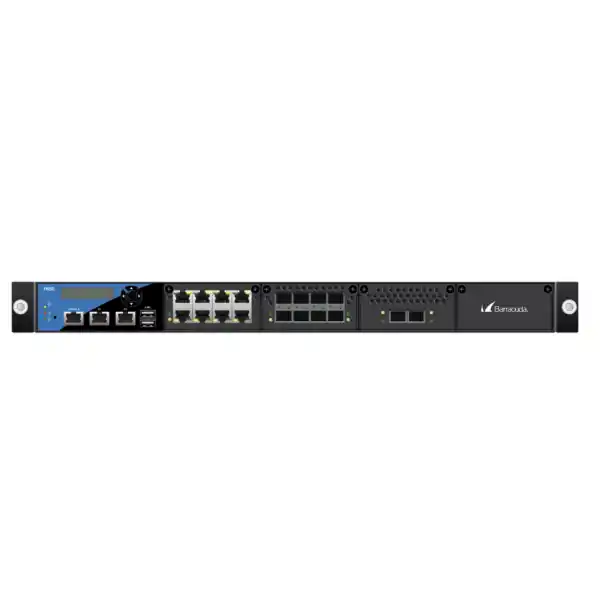
Barracuda CloudGen Firewall F600.E20 Revision D
A high-density 1U CloudGen Firewall configuration combining copper access, 1 GbE fiber, 10 GbE SFP+ uplinks, resilient dual power, advanced VPN, application-aware security, and SD-WAN capabilities for distributed enterprise networks.
Direct answer: what is the Barracuda F600.E20 Revision D?
The Barracuda CloudGen Firewall F600.E20 Revision D is the fiber-rich E20 hardware configuration of Barracuda’s F600 Revision D appliance family. It is built for organizations that need more than a conventional branch firewall: it provides a dense mix of copper and optical Ethernet, dedicated 10 Gigabit Ethernet uplink capability, enterprise routing and VPN functions, security inspection, application-aware policy, and secure SD-WAN functions in a rack-mount platform. The E20 configuration is particularly relevant where a firewall sits between multiple VLAN trunks, distribution switches, WAN carriers, data-center links, DMZ segments, server networks, and site-to-site VPN domains. Instead of forcing an organization to choose only copper or only fiber at the firewall edge, the E20 exposes both media types natively, which can simplify connectivity to access switches, core switches, carrier handoffs, media converters, and optical distribution frames.
For UAE deployments, the practical value of the F600.E20 is not simply the number of ports. The important design question is how those interfaces map to business services and failure domains. A pair of 10 GbE SFP+ interfaces can be used for higher-speed northbound or southbound connectivity, while the eight 1 GbE SFP interfaces can connect fiber-delivered WANs, building links, isolated zones, or distribution switches. The ten 1 GbE RJ45 interfaces support copper-connected management, LAN, DMZ, service, or transitional networks. Barracuda identifies port 1 as the management port in the Revision D E20 port map, while the remaining ports can be allocated through the appliance configuration according to the target topology. There are also two additional RJ45 Ethernet interfaces labeled E1 and E2 in Barracuda’s hardware documentation, along with two USB 2.0 ports and one RJ45 serial console connection.
The appliance is designed as a 1U rack-mount system measuring approximately 440 × 480 × 44 mm, with an appliance weight documented at about 10 kg. It uses an Intel Core i3 four-core CPU, 16 GB of RAM, and SSD mass storage of 240 GB or higher. The E20 configuration uses dual internal hot-swap power supplies, an important operational characteristic for sites where the firewall is part of an availability-sensitive edge design. Barracuda documents the F600 Revision D platform with CloudGen Firewall firmware 8.0.1 or higher as the minimum generation requirement; actual software selection should be based on the support status, feature requirements, licensing, approved upgrade path, and lifecycle position of the individual appliance.
FourTeck positions this model for engineered deployments rather than simple box replacement. The same physical appliance can behave very differently depending on inspection policy, TLS decryption, IPS enablement, VPN encryption, application control, logging, routing scale, concurrent sessions, SD-WAN measurements, and the number of encrypted tunnels. Correct sizing therefore considers the entire traffic path and security profile instead of relying on a single headline throughput number. If your organization is refreshing an installed F600.E20, standardizing branches, extending fiber connectivity, or validating a replacement strategy, FourTeck can map the current interface usage and policy set before proposing a migration. For related firewall design and procurement services, visit FourTeck Firewall Dubai.
Confirmed F600.E20 Revision D hardware specification
| Model | Barracuda CloudGen Firewall F600.E20 Revision D |
| Copper interfaces | 10 × 10/100/1000 Mbps RJ45 Ethernet |
| 1 GbE optical interfaces | 8 × 1 GbE SFP |
| 10 GbE optical interfaces | 2 × 10 GbE SFP+ |
| Management designation | Port 1 is identified as the management port in Barracuda’s E20 port configuration |
| Additional Ethernet | E1 and E2, 10/100/1000 Mbps RJ45 |
| USB | 2 × USB 2.0 |
| Console | 1 × RJ45 serial console |
| Processor | Intel Core i3, 4 cores |
| Memory | 16 GB RAM |
| Storage | SSD, 240 GB or higher |
| Form factor | 1U rack mount |
| Appliance dimensions | 440 × 480 × 44 mm |
| Appliance weight | Approximately 10 kg |
| Cooling | Fan cooled |
| Power supply | Dual internal hot-swap power supplies for the E20 configuration |
| Minimum documented firmware generation | CloudGen Firewall 8.0.1 or higher |
Hardware specifications describe the physical Revision D platform. Transceivers, licenses, support entitlements, rack accessories, regional power components, and current software eligibility should be confirmed for the exact unit and quotation before deployment.
Why the E20 interface layout matters in enterprise networks
Copper access flexibility
Ten 1 GbE RJ45 ports provide convenient attachment for existing copper networks, out-of-band systems, DMZ devices, carrier NIDs, management segments, temporary migration links, or local switch trunks. Copper interfaces are especially useful during firewall replacement projects because they allow old and new routing domains to coexist while policies and VLANs are migrated in controlled phases.
1 GbE fiber density
Eight SFP interfaces make the E20 substantially more adaptable where the firewall must terminate optical connections directly. Fiber can provide electrical isolation, longer reach, compatibility with optical distribution systems, and a cleaner design when WAN or campus connectivity is already delivered through SFP-based switching and carrier equipment.
10 GbE uplink headroom
The two SFP+ ports give architects an option for 10 Gigabit Ethernet attachment where aggregated traffic or core-facing links exceed the comfort zone of multiple 1 GbE connections. These ports can reduce interface bottlenecks between the firewall and a collapsed core, data-center distribution layer, virtualization cluster, or high-capacity WAN handoff, provided the inspection workload and appliance performance are sized accordingly.
Resilient power design
Dual hot-swap internal power supplies allow a more resilient electrical design than a single-supply firewall. In production, the two supplies should normally be connected to separate PDUs or UPS-backed feeds where site infrastructure permits. Redundant power does not replace firewall high availability, but it removes one avoidable single point of failure inside the appliance power path.
Port count should never be mistaken for switching capacity or a recommendation to connect every zone directly to the firewall. In many well-designed enterprise topologies, the F600.E20 uplinks to redundant switches and carries multiple tagged VLANs, while only selected physically isolated services use dedicated firewall ports. This can simplify failover and reduce cabling. In other environments, regulatory or operational requirements justify physically dedicated interfaces for partner networks, industrial systems, management, voice, guest access, payment environments, or internet-facing services. The E20’s combination of media types lets the design reflect those requirements without depending on external media converters for every optical connection.
The SFP and SFP+ interfaces also introduce transceiver-planning requirements. Optical wavelength, fiber type, connector standard, reach, switch-side optic compatibility, and supported module selection should be validated before installation. A 1 GbE SX link over multimode fiber is a different engineering choice from a long-reach single-mode connection, and a 10 GbE SR uplink has different optical characteristics from LR. Procurement should therefore include a port-by-port optic schedule rather than a generic line item for “SFP modules.” Where cabling and structured network upgrades are part of a wider project, FourTeck’s UAE IT services team can align firewall connectivity with switching, rack, cabling, migration, and operational handover requirements.
CloudGen Firewall security architecture and policy control
The value of the F600.E20 comes from the CloudGen Firewall software stack that runs on the hardware. A next-generation firewall deployment is expected to make decisions using more context than source IP, destination IP, protocol, and destination port. Barracuda Application Control can extend firewall policy with application identification, allowing administrators to control traffic according to recognized applications and sub-applications. This matters because modern SaaS platforms, collaboration tools, social media, remote-access applications, storage services, and web applications often share TCP 443. A firewall that treats every encrypted session as identical HTTPS traffic provides limited control. Application-aware processing makes it possible to build policies around business intent, user behavior, risk, bandwidth use, and service identity rather than only conventional Layer 3 and Layer 4 tuples.
TLS inspection is an important design consideration because application recognition and threat inspection can be limited when traffic remains encrypted end to end. Where lawful, operationally appropriate, and supported by the organization’s security policy, TLS inspection can decrypt selected sessions, apply security functions, and re-encrypt the traffic. This approach requires careful certificate deployment, endpoint trust, exception handling, performance sizing, privacy controls, application testing, and change management. Financial services, healthcare, government, educational institutions, hospitality groups, and multinational enterprises may each have different policy boundaries for decryption. FourTeck therefore treats TLS inspection as an architectural workstream rather than a checkbox. High traffic volumes, large file transfers, content scanning, and encrypted SaaS usage can all influence the real inspection load on the firewall.
Intrusion prevention is another major inspection layer. IPS examines traffic for patterns and behaviors associated with vulnerabilities, exploits, protocol abuse, and malicious activity. Effective IPS policy requires more than enabling every signature at maximum sensitivity. Administrators should consider protected operating systems, exposed services, application stacks, internet-facing servers, false-positive tolerance, change windows, and logging strategy. Rules for a public web application DMZ can be tuned differently from rules for a corporate user network, a server backup VLAN, or a site-to-site VPN. Segmented policies help improve signal quality and make incident analysis more useful.
Barracuda’s licensing model can add security services such as Energize Updates, Malware Protection, Advanced Threat Protection, and Advanced Remote Access depending on the hardware, software generation, subscription, and commercial bundle. Application definitions and security updates are tied to appropriate active subscriptions. Malware scanning and advanced threat analysis should be evaluated according to the organization’s exposure, file-transfer patterns, endpoint security posture, and acceptable inspection latency. Cloud-assisted advanced threat analysis can provide an additional control layer against previously unseen or evasive files, while local or integrated malware scanning can help block known malicious content in supported traffic flows.
Policy quality remains more important than the number of licensed features. A firewall with powerful services but weak rule design can still expose unnecessary risk. A robust implementation normally starts with network object normalization, zone definition, explicit service objects, least-privilege forwarding rules, controlled administrative access, logging requirements, NAT mapping review, VPN identity mapping, and documented exceptions. Broad “any-to-any” permissions should be reduced wherever business workflows allow. In migration projects, legacy rules should not simply be copied without review; obsolete objects, duplicate rules, expired partner tunnels, abandoned public NATs, and temporary troubleshooting allowances often accumulate over time.
The F600.E20 is therefore best viewed as a policy enforcement platform whose hardware determines connectivity and processing boundaries. The design objective is to convert business segmentation requirements into deterministic network behavior: user zones reach only approved applications, servers expose only required services, guest traffic cannot traverse corporate networks, remote sites use controlled VPN paths, internet breakout follows the appropriate inspection stack, and administrators retain secure access for monitoring and change control. FourTeck UAE can support this process from discovery and rule review through implementation, validation, and operational documentation via FourTeck UAE.
Secure SD-WAN, TINA VPN, and multi-link WAN design
Barracuda CloudGen Firewall is well known for combining firewall policy with secure SD-WAN functions. Its TINA, or Transport Independent Network Architecture, VPN technology is designed for site-to-site connectivity between CloudGen Firewalls and supports multiple transport types. In practical network design, TINA can be used to build resilient encrypted connectivity across more than one WAN path, and Barracuda’s SD-WAN policies can select transports according to performance and application requirements. This is valuable for organizations that are reducing dependence on a single MPLS circuit, connecting branches to cloud applications, aggregating multiple broadband providers, or seeking better path diversity between Dubai, Abu Dhabi, other Emirates, international offices, and cloud regions.
The design principle is application-aware path selection rather than indiscriminate load balancing. Voice, interactive virtual desktop traffic, ERP sessions, backups, software distribution, web browsing, and bulk replication have different latency, jitter, loss, and bandwidth characteristics. A high-quality SD-WAN policy can reserve the best-performing path for delay-sensitive applications while steering bulk or noncritical sessions to alternate circuits. If a preferred link degrades beyond configured thresholds, traffic can be moved according to policy. The firewall can measure transport characteristics between VPN endpoints and use those measurements in forwarding decisions. This allows the WAN to respond to actual path quality rather than only interface-up or interface-down state.
For the F600.E20, interface diversity can support several WAN architectures. A carrier may deliver Ethernet over copper, while another provides a fiber handoff through SFP. A 10 GbE SFP+ port may connect the firewall to a core or aggregation switch that carries multiple routed WAN VLANs. Direct fiber WAN termination may simplify the path, but it should be evaluated against carrier demarcation requirements and operational responsibilities. Some service providers require their own managed router or NID; others can hand off tagged Ethernet. The firewall design should document who owns the routing edge, where BGP or static routes terminate, how public IP ranges are allocated, and how failover affects source NAT and inbound services.
TINA does not eliminate the need for IPsec interoperability. Enterprises often have third-party firewalls, partner networks, cloud VPN gateways, customer tunnels, or vendor-managed devices that require standards-based IPsec. The F600.E20 can therefore sit in a mixed VPN environment where TINA is used for Barracuda-to-Barracuda connectivity and IPsec serves external peers. Each tunnel should be documented with encryption parameters, peer identities, local and remote prefixes, routing behavior, failover expectations, monitoring, and ownership. Certificate-based authentication can improve manageability and identity assurance for certain designs, while pre-shared keys may still exist in legacy integrations. The migration plan should identify which tunnels can be modernized and which must remain compatible with partner constraints.
Direct internet breakout is another common SD-WAN objective. Historically, branch traffic was often backhauled to a central data center before reaching the internet. As organizations adopt Microsoft 365, SaaS CRM, cloud ERP, collaboration platforms, and public-cloud workloads, backhaul can add latency and consume expensive private-WAN capacity. A CloudGen Firewall at a branch or regional site can enforce local security controls while allowing selected internet traffic to exit locally. The correct policy depends on DNS architecture, identity services, logging, security subscriptions, TLS inspection policy, and the company’s incident-response model. Central visibility is essential so distributed breakouts do not become unmanaged security islands.
A well-engineered SD-WAN rollout also includes failure testing. It is not enough to see two green WAN links in a dashboard. Engineers should test hard carrier failure, packet loss, high latency, asymmetric routing, DNS reachability, VPN transport loss, upstream gateway failure, and planned maintenance. Business-critical applications should be observed during path transition. Stateful sessions may behave differently depending on the failure mode, NAT, remote service expectations, and selected transport. FourTeck can create a test matrix that translates technical failover events into business outcomes, such as whether calls remain usable, ERP reconnects within an acceptable window, remote branches retain access to identity services, and inbound published services stay reachable.
Performance and sizing: how to interpret F600 figures correctly
Firewall sizing should distinguish between raw forwarding throughput and inspected application throughput. Barracuda has published multiple generations of F600 performance material, and the reported figures vary with datasheet generation, software, test profile, and submodel context. Some F600 family literature has referenced approximately 16.3 Gbps firewall throughput, 2.3 Gbps VPN throughput, 5.0 Gbps IPS throughput, 4.6 Gbps NGFW throughput, around 2.1 million concurrent sessions, and approximately 115,000 new sessions per second. Other Barracuda comparison material has shown higher figures for the E20 configuration. For procurement and capacity planning, these numbers should be treated as “up to” laboratory references rather than an unconditional production guarantee. The exact quoted appliance, active software level, enabled inspection features, traffic mix, packet size, tunnel load, and subscription set should be validated before a design is approved.
The first sizing input is peak traffic, not the contracted ISP rate alone. A company may have two 1 Gbps internet connections yet use only a fraction of that bandwidth, or it may regularly saturate links during backup windows. Conversely, a 500 Mbps circuit serving thousands of employees can create a much heavier session and inspection workload than a lightly used 2 Gbps data-center link. Gather at least several weeks of utilization data where possible, including 95th percentile throughput, short peaks, inbound versus outbound balance, packet-per-second behavior, and traffic by application category.
Second, identify the inspection profile. Basic stateful forwarding is significantly less demanding than a policy set that applies intrusion prevention, application detection, malware scanning, TLS decryption, URL filtering, advanced threat analysis, and detailed logging to a large portion of traffic. Encrypted traffic is especially important because TLS inspection requires cryptographic processing and deeper content handling. Modern enterprise traffic is heavily encrypted, so a sizing exercise based on old HTTP-era assumptions can understate the real load. Exemptions for certificate-pinned applications, privacy-sensitive destinations, banking, healthcare portals, or unsupported protocols change the effective inspected percentage and should be measured rather than guessed.
Third, count sessions and connection churn. User browsing, microservices, collaboration applications, endpoint agents, software updaters, mobile devices, IoT systems, DNS services, and SaaS platforms can create many short-lived connections. A firewall can encounter session pressure even when aggregate bandwidth looks moderate. Data centers and shared-service environments may generate large east-west or north-south connection counts. New sessions per second matter during traffic bursts, service restarts, NAT-heavy workloads, and large user populations beginning work at similar times.
Fourth, analyze VPN encryption. Site-to-site tunnels, remote-access users, and SD-WAN transports introduce cryptographic processing. The relevant question is not simply “how many tunnels?” but how much encrypted traffic they carry, which algorithms are negotiated, how many active transports exist, and whether the firewall is terminating VPN for the majority of corporate WAN traffic. If a regional hub terminates dozens of branch tunnels, its VPN throughput can be the dominant sizing factor even if local internet breakout is modest.
Fifth, leave operational headroom. A firewall should not be selected to run continuously at the edge of a benchmark. Headroom absorbs traffic growth, emergency rerouting, temporary carrier imbalance, future security services, logging increases, software behavior changes, and incident conditions. During a WAN failure, traffic that is normally split across two paths may converge onto one. During a high-availability failover, the surviving node must process the whole protected workload. Future SaaS adoption, backup modernization, cloud migration, and additional branches may increase traffic before the next hardware refresh.
FourTeck’s sizing approach uses the current network as evidence. We map link rates, observed utilization, inspection policies, VPN volumes, application criticality, growth expectations, and high-availability behavior. If the F600.E20 Revision D is an existing appliance, the exercise can determine whether it still matches the workload or whether a newer platform should be considered. If the unit is being sourced for a legacy standardization or replacement requirement, the same analysis helps avoid installing hardware that meets interface requirements but lacks the desired lifecycle runway. The result should be a design decision supported by measurable assumptions rather than a single marketing throughput line.
High availability, power resilience, and failure-domain engineering
The F600.E20’s dual hot-swap power supplies improve appliance-level resilience, but enterprise availability requires a broader failure-domain design. A firewall can remain powered and still become unreachable if both uplinks terminate on one switch, both WAN circuits share the same carrier duct, the management network depends on a failed core, or a routing neighbor is incorrectly configured. Availability planning therefore starts with a diagram of dependencies from user VLANs through access and core switching, firewall interfaces, carrier demarcations, upstream routers, DNS, identity systems, VPN peers, and internet services.
Where two F600.E20 appliances are deployed as a high-availability pair, physical symmetry makes operations easier. Equivalent ports should connect to equivalent switch domains, optics should match in type and reach, VLAN tagging should be consistent, and both firewalls should receive independent power. If the site uses redundant core switches, each firewall should have connectivity designed so that a single core failure does not isolate the active node. The precise cabling depends on the supported HA architecture, switching platform, spanning-tree or MLAG design, routed versus switched handoffs, and whether WAN providers offer redundant demarcations.
Power architecture deserves explicit documentation. Dual supplies are most useful when each PSU is connected to a separate protected feed. Connecting both supplies to the same PDU reduces protection against PDU failure. Connecting both PDUs to the same UPS reduces protection against UPS failure. In facilities with A/B power, the preferred design normally maps one PSU to each independent side, subject to electrical standards and local facility policy. Maintenance procedures should identify which supply can be removed while preserving operation and how alarms are monitored. Replacement of a hot-swap PSU should follow vendor safety instructions and support guidance; opening the appliance chassis outside approved procedures can affect warranty or support eligibility.
High availability also has a software and state dimension. Security policies, routing configuration, VPN definitions, certificates, license state, software versions, and object databases must be consistent with the chosen HA mechanism. Changes should follow a controlled process so both nodes remain compatible. Upgrade planning is particularly important for legacy hardware: administrators need a validated upgrade path, current backups, rollback planning, console access, maintenance windows, and awareness of release-specific changes. An HA pair does not eliminate change risk if both members are upgraded without a recovery plan.
The most useful HA test is not simply unplugging a power cord. A production acceptance plan can include PSU failure, firewall node shutdown, core-switch failure, WAN circuit failure, VPN transport failure, upstream next-hop failure, and management-plane loss. Engineers should monitor routing convergence, NAT behavior, VPN re-establishment, session continuity, application recovery, and logging. Where public services are hosted behind the firewall, inbound reachability must be tested from an external network. Where remote branches depend on hub services, branch-side monitoring should confirm that failover works from the user’s perspective.
Operational resilience continues after go-live. Hardware alarms, interface errors, optic levels where supported, VPN status, CPU and memory utilization, session counts, security events, license expiry, and configuration changes should feed an appropriate monitoring workflow. A fault that remains invisible until users complain is not an effective HA strategy. FourTeck can include monitoring integration, escalation procedures, configuration backup, and documented recovery steps as part of a managed deployment or support engagement.
Routing, segmentation, NAT, and data-center edge use cases
A firewall at the enterprise edge is simultaneously a security device and a routing boundary. The F600.E20 can participate in designs that use static routes or dynamic routing, depending on the software configuration and network requirements. Routing architecture should make security policy predictable. A common mistake is to let routing and firewall rules evolve independently until traffic reaches unexpected interfaces or bypasses intended inspection paths. FourTeck starts by mapping route ownership, default gateways, transit networks, VRF or segmentation boundaries where applicable, advertised prefixes, WAN failover behavior, and NAT requirements.
In a campus or headquarters design, the core switch may remain the default gateway for internal VLANs while the firewall protects north-south traffic. This minimizes the volume of purely internal switching traffic sent through the firewall. In a stronger segmentation model, selected VLAN gateways may terminate on the firewall so east-west access between sensitive zones is explicitly controlled. The right model depends on throughput, security policy, broadcast domain design, troubleshooting practices, redundancy, and compliance requirements. The E20’s 10 GbE SFP+ ports can be useful when segmented VLAN trunks carry substantial aggregate traffic to the firewall.
DMZ design benefits from explicit trust boundaries. Internet-facing web servers, reverse proxies, VPN gateways, mail relays, application delivery controllers, and partner services should not share unrestricted access to internal user or server networks. Inbound NAT should publish only required services, ideally to hardened front-end systems. Egress from the DMZ should also be constrained. Compromised public servers often become launch points for lateral movement when outbound and internal rules are overly broad. Logging should capture both allowed and denied activity relevant to incident investigation.
NAT planning becomes more complex when multiple ISPs are present. Source NAT may need to follow the selected egress provider so return traffic is symmetric. Public server NAT may depend on provider-specific address ranges, DNS failover, BGP, or parallel publishing. Some SaaS providers whitelist customer source addresses, which means WAN failover can break applications even when the firewall itself successfully moves traffic to a backup circuit. The migration workbook should therefore list every known IP-based external dependency, including payment gateways, partner VPNs, API allowlists, remote support portals, hosted PBX trunks, and cloud security services.
The F600.E20 can also support data-center edge roles where fiber is preferred between network layers. In such designs, the firewall may separate server networks from internet or WAN zones, terminate site-to-site VPNs, publish applications, and enforce inter-zone policy. Engineers should assess whether the platform’s actual inspected throughput, session scale, and lifecycle fit the target data-center workload. High interface speed does not automatically mean high security-service throughput; a 10 GbE physical port can carry traffic faster than the appliance can inspect under every feature combination. Sizing must therefore focus on the security workload, not only link negotiation speed.
When organizations operate across the Middle East and Africa, the same segmentation model may need to accommodate different carriers, branch sizes, cloud regions, and local support conditions. Standard objects, naming, logging, and policy templates help make distributed estates more consistent. FourTeck’s regional capabilities can support multi-country design discussions, and organizations planning broader deployments can review FourTeck Africa for regional technology engagement beyond the UAE.
Licensing and subscriptions: what buyers should specify
A Barracuda CloudGen Firewall quote should describe more than the chassis. Firewall software capabilities and update services are associated with licensing and subscriptions, and the correct bundle depends on the required feature set. Barracuda documentation identifies Base licensing and Energize Updates as core elements, with optional or additional services that can include Malware Protection, Advanced Threat Protection, Advanced Remote Access, support enhancements, and hardware-related services. Exact availability, naming, term lengths, and eligibility can change over a product lifecycle, so procurement should request the current part numbers and entitlement descriptions for the specific serialised appliance or replacement platform.
Energize Updates are operationally significant because modern firewall protection depends on maintained application definitions and security intelligence. A firewall whose subscription status prevents updates may continue forwarding traffic but provide materially reduced value as a next-generation security control. The procurement conversation should therefore include renewal strategy and ownership. Who receives expiry notifications? Which team holds the Barracuda account? Is renewal budget assigned centrally or per site? What happens when a branch is absorbed, decommissioned, or replaced? These lifecycle questions are easier to solve before deployment than during an urgent renewal incident.
Malware Protection should be evaluated where the firewall is expected to inspect web, file-transfer, or other supported content streams. It complements endpoint protection by adding a network control point, but it is not a substitute for endpoint detection and response, email security, backup, vulnerability management, or user awareness. The best architecture assumes multiple layers and defines what each layer is responsible for detecting or blocking. If TLS inspection is required for encrypted web content, certificate deployment and privacy exceptions become part of the project scope.
Advanced Threat Protection is relevant where organizations want an additional analysis layer for suspicious or unknown files that are not reliably classified by traditional signatures. The security team should decide which file types and traffic paths are subject to advanced analysis, what user experience is acceptable while a file is evaluated, how detected threats are reported, and how alerts integrate with incident response. Licensing should be matched to that policy rather than purchased without an operational plan.
Advanced Remote Access, SSL VPN capabilities, and remote-user design require separate attention. Remote access has changed significantly as organizations adopt identity providers, MFA, zero-trust access patterns, managed endpoints, SaaS, and cloud applications. If the F600.E20 will terminate remote users, the project should define authentication, certificate requirements, MFA integration, user group mapping, split tunneling, DNS, endpoint posture expectations, logging, and concurrent-user assumptions. A product selected mainly for site-to-site SD-WAN may have a different subscription and sizing profile from one that also serves as the remote-access concentrator for a large workforce.
Support level is equally important for production systems. A firewall can be technically correct but operationally risky if replacement logistics or escalation procedures do not match business requirements. Clarify warranty status, hardware replacement entitlement, support response expectations, local spares strategy, maintenance ownership, and who is authorised to open vendor cases. For legacy or phased-out hardware generations, replacement entitlement and software support status require especially careful validation. Organizations should not assume that a chassis available in inventory automatically carries the same support options as a currently sold platform.
FourTeck can structure a bill of materials that separates appliance hardware, transceivers, subscriptions, support, professional services, and optional spares. This makes comparison easier and prevents critical items from being hidden inside a generic “firewall solution” line. The final quote should state whether the requirement is a new deployment, installed-base replacement, expansion, lab unit, spare, or migration project, because lifecycle and entitlement decisions can differ for each scenario.
Migration methodology for an existing firewall environment
Replacing a production firewall is a data migration project as much as a hardware installation. The existing configuration contains years of operational knowledge: public IP mappings, partner tunnel details, forgotten static routes, monitoring exceptions, NAT behavior, special DNS paths, application-specific timeouts, management ACLs, and temporary policies that may have become permanent. A successful migration extracts that knowledge, decides what remains valid, and transforms it into a cleaner target configuration.
Discovery begins with inventory. Record the current firewall model and software, interface assignments, link speeds, optics, VLANs, IP addressing, routing tables, dynamic routing neighbors, DHCP or relay functions, NAT rules, security policies, VPN tunnels, certificates, remote-access users, authentication integration, logging destinations, SNMP or API monitoring, NTP, DNS dependencies, administrator accounts, and license status. Physical rack details matter too: available rack units, cable lengths, PDU outlets, power connector type, fiber patching, airflow, and console access.
The rulebase should be normalized before conversion. Duplicate objects can be merged where safe, unused rules identified, temporary access reviewed, overly broad services narrowed, and obsolete public mappings removed. Rule hit counts and traffic logs can help, but low usage does not automatically mean a rule is unnecessary; some disaster-recovery, monthly finance, vendor maintenance, or emergency-management workflows are intentionally infrequent. Owners should confirm business purpose before removal.
VPN migration deserves its own worksheet. For every tunnel, capture peer address, authentication method, IKE settings, encryption, integrity algorithm, Diffie-Hellman group, local and remote networks, NAT exemption, tunnel monitoring, routing, failover behavior, and technical contact. Site-to-site peers may belong to customers or suppliers who require advance notice and coordinated testing. Certificates must be checked for validity and exportability. Where Barracuda TINA connects CloudGen sites, transports and SD-WAN policy should be documented alongside conventional IPsec tunnels.
Cutover planning should define a reversible sequence. Typical steps include configuration backup, target staging, software and license verification, interface labeling, optic validation, preloading policies, scheduling the change, confirming remote hands or console access, moving one link group at a time where feasible, validating routing, testing DNS and authentication, checking VPNs, confirming inbound NAT, validating business applications, and monitoring logs. A rollback trigger and rollback procedure should be agreed before the change starts. Engineers should avoid inventing the rollback plan after users are already affected.
Testing should use an application matrix, not only ping. ICMP reachability can succeed while DNS, HTTPS inspection, ERP, VoIP, remote access, payment processing, or partner VPN traffic fails. Business owners can identify critical workflows that must be validated. For internet-facing services, testing must originate from outside the protected network. For remote branches, testing should include at least one representative site. For dual-WAN environments, failover should be tested after the primary path is proven stable.
Post-cutover monitoring is essential because some issues appear only under normal user volume. Track CPU, memory, sessions, interface errors, link utilization, VPN state, denied traffic, application-control events, IPS triggers, DNS behavior, and user reports. Compare performance with the baseline collected before migration. Any temporary diagnostic policy introduced during troubleshooting should have an owner and removal time.
FourTeck can provide deployment support ranging from configuration review to full migration execution. The engagement can include discovery workshops, low-level design, configuration staging, rack-and-stack coordination, ISP handoff verification, VPN conversion, change-window assistance, and handover documentation. This is especially useful when the F600.E20 is part of a broader network refresh involving switches, servers, Wi-Fi, structured cabling, or multi-site connectivity rather than a standalone appliance swap.
UAE deployment considerations for Dubai, Abu Dhabi, and multi-site organizations
Network security projects in the UAE often combine high-capacity internet, private WAN, cloud connectivity, IP telephony, surveillance, guest access, and regional branch connectivity in the same physical site. Dubai headquarters may serve as the internet and VPN hub for multiple offices, while another organization may use independent breakout at every branch. The F600.E20’s mixed interface set can fit either pattern, but the physical port layout should be aligned to the carrier and switching architecture before equipment reaches site.
Carrier handoff type is one of the first questions. Some circuits terminate as copper Ethernet, others as optical Ethernet, and some arrive through managed provider equipment that presents a customer-facing RJ45 or SFP interface. The firewall team needs the handoff speed, duplex expectations, VLAN tagging, static IP or routing details, provider gateway, MTU requirements, and whether the circuit includes managed CPE. Where redundant providers are used, confirm that they are physically diverse where business continuity depends on them. Two logical circuits can still share a building entry path or upstream infrastructure.
Data-center and server-room conditions also matter. The F600.E20 is a fan-cooled 1U appliance, so airflow, rack depth, temperature, and power distribution should meet the vendor’s operating requirements. Barracuda documentation lists an operating temperature range beginning at 0°C and extending to 40°C for this hardware family. UAE external climate makes facility cooling particularly important, although the firewall should of course operate in a controlled indoor equipment environment rather than ambient outdoor conditions. Rack planning should leave adequate cable management and service access for both power supplies and optical patching.
Remote administration must be secured from the start. Management interfaces should not be exposed broadly to the internet. Administrative access should originate from trusted networks or controlled remote-access paths, use strong authentication, and be logged. Emergency console procedures should be documented because a routing or firewall policy mistake can remove network-based management. In co-location facilities, confirm who can provide remote hands and how identity is verified before cables or power feeds are changed.
Time synchronization and logging are frequently underestimated. Security events are much easier to investigate when firewalls, servers, identity systems, endpoints, and SIEM platforms share accurate time. Define NTP sources, log destinations, retention requirements, and timezone handling. If logs are forwarded to a central SOC, verify reachability through normal and failover WAN paths. If the organization has regulatory retention or audit requirements, ensure the firewall’s local SSD is not treated as the only log archive.
Multi-site organizations should standardize naming and documentation. A policy object named “Server_Net” is ambiguous when dozens of sites exist. Site codes, VLAN purpose, environment labels, and ownership should be built into object names. The same applies to VPN tunnel names, SD-WAN transports, interfaces, NAT rules, and monitoring alerts. Consistent naming reduces troubleshooting time and makes centralized management safer because engineers can understand whether a change applies to Dubai HQ, Abu Dhabi branch, a warehouse, a DR site, or an overseas office.
Procurement should include the complete deployment package: appliance, correct power components, rack hardware where required, supported SFP/SFP+ optics, patch leads, subscriptions, support, configuration services, and migration scope. FourTeck can coordinate this as part of a UAE infrastructure project. For organizations combining security with broader systems integration, the main FourTeck UAE portfolio provides a route to related networking and enterprise IT services.
Recommended deployment patterns
Regional headquarters edge
Use the F600.E20 as the internet and private-WAN security gateway for a medium-to-large headquarters, with 10 GbE connectivity toward the core, 1 GbE SFP for optical carrier or zone links, and copper ports for management or legacy handoffs. Combine with high availability where business continuity requires node redundancy.
Secure SD-WAN hub
Terminate encrypted branch connectivity and apply application-aware path selection across multiple WAN transports. This pattern suits organizations replacing rigid hub-and-spoke WANs with broadband, internet VPN, and cloud-connected architectures while retaining central policy and operational visibility.
Data-center perimeter
Connect the appliance to distribution or core switching through SFP+ while isolating internet-facing, server, partner, and management zones. Validate inspected throughput and session scale against real application demand before using high-speed physical interfaces as the basis for capacity assumptions.
Legacy installed-base replacement
Source the same or compatible platform where an organization must maintain an established hardware standard, preserve interface media, or replace a failed unit. Verify serial-specific support, license transferability, software eligibility, hardware condition, and replacement strategy before treating legacy inventory as production-ready.
These patterns are design starting points, not fixed prescriptions. A firewall should be placed according to traffic flows and trust boundaries. For example, a branch with two 500 Mbps ISPs and modest inspection demand may not need 10 GbE core links, while a data-center edge with only 1 Gbps internet could still benefit from 10 GbE internal connectivity if significant inter-zone traffic is inspected. Conversely, if most internal routing occurs on a core switch and the firewall sees only internet traffic, its north-south workload may be much lower than the aggregate LAN switching capacity. FourTeck designs around measured flows rather than assuming that the fastest interface defines the required appliance class.
Operational management, logging, and change control
Enterprise firewalls are long-lived control points, and operational discipline determines how safely they evolve. Configuration changes should be attributable, reviewed, documented, and recoverable. A useful operating model defines who can create network objects, who can approve policy changes, who manages certificates, who handles subscription renewal, who performs firmware upgrades, and who responds to security alerts. Shared administrator credentials should be avoided where the platform and organization support individual accounts and centralized authentication.
Logging should be purposeful. Enabling every possible event without a retention or analysis plan can create noise and storage pressure; logging too little undermines troubleshooting and incident response. High-value events generally include administrative changes, authentication failures, VPN state, interface state, routing changes, security blocks, IPS events, malware or ATP detections, important allowed connections, and system health alarms. Traffic logging policy may vary by zone. A highly regulated server segment may require greater detail than a guest internet network.
Centralized management becomes increasingly important as the firewall count grows. Barracuda’s Firewall Control Center is designed for managing multiple CloudGen Firewall systems, helping organizations apply consistent configuration and oversight across distributed networks. Central management does not mean every site must be identical. The useful goal is controlled inheritance: global policies for common security requirements, site-specific objects for local networks, and a change process that can identify where exceptions exist. This reduces configuration drift without erasing legitimate branch differences.
Firmware management should follow tested stages. Production estates often contain appliances serving different criticality levels, so upgrades can begin in a lab or low-risk site before reaching headquarters. Read release notes, verify the supported upgrade path, back up configurations, confirm available disk space and license state, plan maintenance windows, and validate VPN compatibility where peers run different versions. The F600 Revision D platform has a minimum documented software generation, but that minimum is not itself a recommendation to run an old release. Current support eligibility and vendor guidance should determine the chosen version.
Configuration backups should be stored outside the firewall in a controlled repository. The backup process should include enough information to rebuild service after hardware loss, including certificates and keys where policy allows secure export, license documentation, interface maps, ISP details, and contact information. A backup that has never been tested is only an assumption. Recovery exercises can validate that administrators know how to access the appliance, load configuration, restore connectivity, and re-establish monitoring.
FourTeck can deliver documentation as part of deployment handover: physical port map, IP addressing table, VLAN map, routing summary, NAT register, rulebase notes, VPN inventory, subscription list, monitoring endpoints, backup procedure, failover test results, and escalation contacts. This converts a firewall installation into an operationally maintainable service. The same documentation later reduces risk during renewal, troubleshooting, audit, or replacement.
Technical FAQ for the Barracuda CloudGen Firewall F600.E20 Revision D
How many Ethernet interfaces does the E20 have?
The documented E20 configuration includes 10 × 1 GbE RJ45 ports, 8 × 1 GbE SFP ports, and 2 × 10 GbE SFP+ ports. Barracuda’s port map also shows E1 and E2 as 10/100/1000 Mbps RJ45 interfaces. Port 1 is identified as the management port.
Does it have redundant power?
Yes. Barracuda documents dual internal hot-swap power supplies for the F600 Revision D E20. For meaningful resilience, connect the two supplies to independent protected power feeds where the facility design allows.
Can it be used for 10 GbE networks?
It has two 10 GbE SFP+ interfaces, so it can attach to 10 Gigabit Ethernet infrastructure. However, physical port speed is not the same as fully inspected security throughput. Size the appliance according to the enabled security services and traffic profile.
Does it support SD-WAN?
CloudGen Firewall supports secure SD-WAN functions, including performance-aware transport selection and Barracuda TINA VPN capabilities. The final design depends on software, licensing, peer topology, transport availability, and business application requirements.
Is the firewall suitable for HA?
The platform can be used in enterprise high-availability designs, but HA is more than dual power. Node redundancy, switching, carrier diversity, routing convergence, configuration synchronization, power separation, and failover testing all need to be engineered.
Which transceivers should be ordered?
Choose transceivers according to the exact SFP or SFP+ port, switch-side compatibility, fiber type, wavelength, connector, and distance. Confirm supported optics for the target appliance and software before purchase rather than ordering generic modules.
Decision recap: when the F600.E20 Revision D is a strong fit
Good fit
The platform is attractive when a site requires a mixed copper/fiber firewall, two 10 GbE uplinks, dual hot-swap power, substantial interface density, CloudGen policy features, secure SD-WAN, site-to-site VPN, application control, and centralized enterprise operations. It can also be relevant to installed-base environments that need an exact Revision D E20 replacement or a compatibility-preserving spare.
Validate before purchase
Confirm lifecycle and support status, exact license entitlement, software version eligibility, transceiver support, required inspected throughput, VPN load, session demand, rack conditions, power design, and future growth. If a newer Barracuda platform provides a longer support horizon, a migration comparison may be preferable to sourcing legacy hardware solely because the interface layout matches.
A correct decision is often based on constraints that are not visible in a product datasheet. Existing fiber plant, WAN carrier interfaces, partner VPNs, public IP addresses, rack depth, HA cabling, compliance policy, and migration windows can make one hardware configuration significantly easier to deploy than another. Conversely, an exact hardware match can be the wrong choice if software lifecycle or support requirements conflict with the organization’s security policy. FourTeck can evaluate both dimensions: technical fit today and operational sustainability over the intended service period.
Quotation input checklist
For an accurate Barracuda F600.E20 Revision D quotation or migration proposal in Dubai and the UAE, provide the information below. The more complete the input, the easier it is to separate mandatory hardware from optional services and to identify any lifecycle or compatibility risk before procurement.
Existing firewall model and revision, current software version, active subscriptions, HA or standalone mode, number of sites, current WAN circuits, peak traffic, user count, and expected growth.
Required RJ45, SFP, and SFP+ ports; copper versus fiber handoffs; optic type and distance; VLAN trunks; core-switch model; WAN demarcation; and any dedicated DMZ or management interfaces.
Application Control, IPS, URL filtering, TLS inspection, malware scanning, Advanced Threat Protection, remote access, logging, SIEM integration, and any compliance-driven inspection requirements.
Number of site-to-site tunnels, TINA peers, third-party IPsec peers, remote-access users, encrypted traffic volume, WAN transports per site, failover requirements, and cloud connectivity.
Required support term, replacement SLA expectations, on-site assistance, maintenance windows, spares policy, configuration backup ownership, and escalation contacts.
Supply only, configuration, rack installation, migration, policy conversion, ISP coordination, HA implementation, VPN cutover, testing, documentation, training, or ongoing managed support.
Consult FourTeck for Barracuda firewall planning in the UAE
FourTeck can help determine whether the Barracuda CloudGen Firewall F600.E20 Revision D is the correct target for your project, whether you are replacing an installed appliance, building a resilient SD-WAN edge, adding 10 GbE firewall connectivity, or planning a broader network refresh. The engagement can include technical discovery, bill-of-material validation, licensing alignment, optics selection, migration design, HA planning, VPN conversion, policy cleanup, testing, and post-cutover documentation.
For legacy hardware, our recommendation is to verify lifecycle, support, and software eligibility at quotation time rather than assuming that physical availability equals production suitability. Where a newer firewall offers stronger lifecycle runway, we can compare migration impact against the benefit of retaining the exact F600.E20 platform. This gives procurement, network, and security teams one decision package instead of separate hardware and architecture conversations.
FourTeck engagement scope
• UAE supply and technical validation
• Firewall migration and rule review
• SD-WAN and VPN architecture
• HA and resilient power planning
• SFP/SFP+ optics and port mapping
• Testing, handover, and support coordination
Technical note: interface counts, chassis characteristics, CPU, memory, storage, power configuration, and minimum firmware generation are based on Barracuda documentation for the F600 Revision D E20 hardware. Performance values published for F600 appliances have varied across Barracuda datasheet generations and test methods. Final capacity, subscription availability, support status, transceiver compatibility, firmware eligibility, and lifecycle suitability should be confirmed for the exact appliance and commercial quotation before production deployment.

Reviews
There are no reviews yet.