
Barracuda CloudGen Firewall F800.CCE Revision D
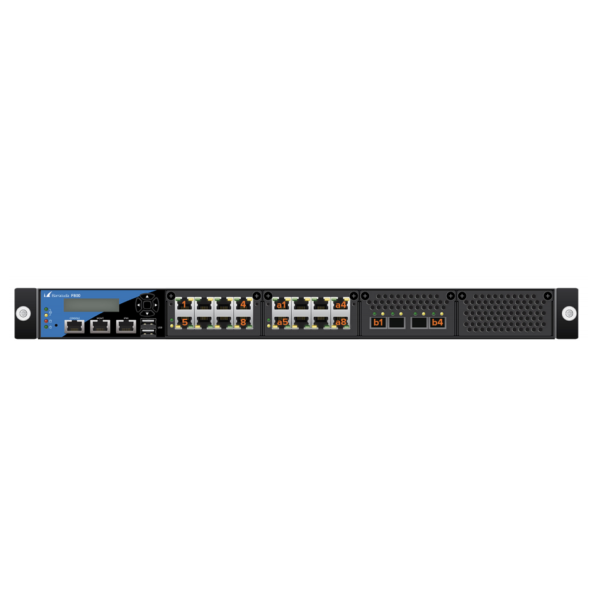
The Barracuda CloudGen Firewall F800.CCE Revision D is a 1U high-end security and SD-WAN platform built for organizations that need dense 1 GbE access connectivity, 10 GbE optical uplinks, large session capacity, strong encrypted-traffic performance and centralized policy control. In the CCE interface configuration, the appliance provides sixteen 1 GbE RJ45 Ethernet interfaces and four 10 GbE SFP+ interfaces, making it particularly suitable for headquarters, data-center internet edges, service aggregation zones, large branch hubs and regional security gateways where copper distribution and high-speed fiber coexist.
FourTeck positions the F800.CCE Revision D as an engineered platform rather than a simple port-count purchase. A successful deployment depends on validating real traffic mix, TLS inspection ratio, security services, VPN encryption, application concurrency, HA behavior, carrier handoffs, VLAN design, optics, routing scale and licensing. This page explains the hardware, performance figures, CloudGen security functions, Secure SD-WAN design, operational architecture and UAE procurement considerations in enough depth for technical teams to create a defensible bill of materials and rollout plan.
Current Barracuda published figures for the F800D family list up to 42.0 Gbps firewall throughput, 11.5 Gbps SD-WAN throughput, 12.9 Gbps IPS throughput, 9.7 Gbps NGFW throughput, 9.3 Gbps threat-protection throughput, 3,000,000 concurrent sessions and 220,000 new sessions per second. These are optimized laboratory values and should be treated as sizing ceilings, not guaranteed production throughput.
F800.CCE Revision D at a Glance
Why the F800.CCE Revision D Fits Large UAE Networks
The defining characteristic of the F800.CCE is not any single security feature. It is the combination of high-end processing headroom, dense copper interfaces and 10 GbE fiber uplinks in a compact 1U chassis. Large UAE organizations often have mixed physical handoffs: carrier routers or optical NTEs provide fiber, campus distribution may still present copper, DMZ services may terminate on separate VLANs, and secondary providers can arrive through different media. The CCE profile lets the firewall sit at the intersection of those networks without forcing every adjacent system into the same physical interface type.
At the logical layer, CloudGen Firewall is designed to combine stateful firewalling, dynamic routing, intrusion prevention, application control, web security, TLS inspection, VPN, remote access and Secure SD-WAN functions. This consolidation is useful when a network team wants fewer policy silos. A single traffic flow can be evaluated not only by source and destination, but also by identity, application, route, provider condition and security service requirements. That matters in environments where Microsoft 365, public cloud workloads, SaaS applications, branch traffic and private data-center services share the same physical edge but require different routing and inspection treatment.
The high session figures also make the platform relevant beyond traditional office user counts. A campus may have thousands of employees but many more active endpoints once IP phones, wireless clients, IoT devices, guest networks, building systems, backup traffic and server connections are included. Session-rate behavior is equally important for public-facing services and environments that create large numbers of short-lived connections. The published 3 million concurrent session and 220,000 new sessions-per-second figures provide useful scale indicators, although production sizing must still account for inspection policies, packet size, TLS decryption, logging, VPN use and traffic asymmetry.
For procurement and implementation in Dubai, Abu Dhabi and the wider UAE, FourTeck can align the appliance with rack power, fiber optics, ISP circuits, HA requirements, migration windows and support expectations. Customers that need broader security architecture guidance can also review FourTeck Firewall Dubai solutions, while organizations planning adjacent switching, infrastructure or enterprise IT work can use the broader FourTeck UAE portfolio as part of a combined project scope.
Revision D Hardware Architecture and Physical Engineering
Barracuda documents the F800 Revision D platform with a 24-core Intel Xeon CPU, 32 GB RAM and SSD mass storage of 430 GB or higher. Those specifications place the appliance firmly in the high-end enterprise class. The processor core count is important because modern firewall workloads are not limited to simple forwarding. Stateful connection tracking, application identification, signature matching, TLS inspection, VPN cryptography, traffic shaping, routing, telemetry and administrative services all compete for processing resources. Real utilization therefore depends on which services are activated and how traffic is distributed across flows.
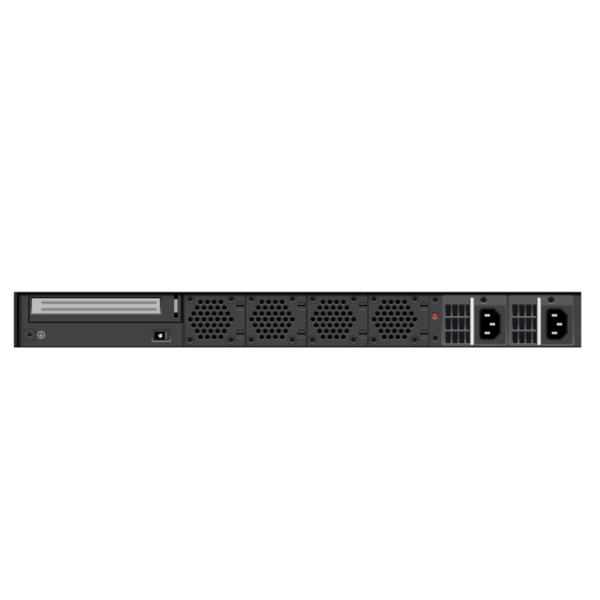
The 1U chassis is approximately 440 mm wide, 550 mm deep and 44 mm high, with an appliance weight of about 10.9 kg. These dimensions matter during site surveys because high-density security racks can have restricted depth, cable-management arms, rear PDUs or airflow constraints. The F800D uses active fan cooling, so front-to-rear clearance and equipment-room ventilation should be validated rather than treating rack-unit availability as the only physical requirement. Barracuda specifies operation from 0°C to 40°C and non-condensing humidity from 10% to 85%, making environmental control a design requirement in hot-climate deployments.
Power is built around dual hot-swap internal AC supplies with 100–240 V, 50–60 Hz autosensing input. Barracuda lists maximum power draw at 550 W and estimated consumption around 322 W for the Revision D hardware specification. The value of dual PSUs is realized only when they are connected to independent power paths. For a production HA design, FourTeck normally recommends mapping PSU-A and PSU-B to separate rack PDUs or UPS-backed circuits wherever the facility supports it. Connecting both supplies to a single PDU protects against a PSU module failure but not against upstream power-path failure.
Physical planning checklist
Port Map: 16×1GbE RJ45, 4×10GbE SFP+, Management and IPMI
The CCE suffix identifies the data-interface mix of this F800 Revision D model. Barracuda lists sixteen 1 GbE RJ45 Ethernet interfaces and four 10 GbE SFP+ interfaces. In addition, the Revision D chassis provides dedicated 10/100/1000 Mb/s RJ45 management and IPMI interfaces, two USB 2.0 ports and an RJ45 serial console. This combination allows the production data plane to remain separate from out-of-band or administrative access when the network architecture supports that separation.
| Interface group | Quantity / speed | Typical enterprise role | Design note |
|---|---|---|---|
| Copper data | 16 × 1 GbE RJ45 | ISP handoff, DMZ, LAN transit, service networks | Useful where adjacent devices present copper; verify VLAN and LACP design. |
| Fiber data | 4 × 10 GbE SFP+ | Core uplinks, data-center switching, high-speed WAN | Select supported optics, fiber type and wavelength for peer equipment. |
| MGMT | 1 × 1 GbE RJ45 | Firewall administration | Place on a protected management segment with restrictive ACLs. |
| IPMI | 1 × 1 GbE RJ45 | Out-of-band hardware management | Treat as privileged infrastructure; do not expose directly to untrusted networks. |
| Console / USB | RJ45 serial + 2 × USB 2.0 | Local recovery and maintenance | Preserve physical access controls and documented recovery procedures. |
Port count should not be confused with switching architecture. A firewall is normally used to enforce policy between security zones, route networks, terminate tunnels, perform NAT or inspect traffic. Even when several physical interfaces attach to the same logical environment, the design should be built around failure domains and security boundaries rather than simply consuming available ports. For example, two 10 GbE links may be configured toward a redundant core pair, while the remaining 10 GbE interfaces are reserved for data-center transit or provider handoff. Copper interfaces can support lower-speed WANs, dedicated DMZs, management transit, partner circuits or isolated service segments.
Optics deserve their own bill-of-materials line. The SFP+ cages do not remove the need to confirm supported transceivers, multimode versus single-mode fiber, LC patching, link distance and the capabilities of the peer switch or carrier NTE. For very short in-rack links, a compatible direct-attach solution may be appropriate; for building or data-hall links, optical modules and fiber plant typically govern the design. FourTeck can review these details as part of deployment engineering through its UAE IT services practice.
Performance: How to Read the Barracuda Numbers Correctly
Barracuda’s current high-end appliance datasheet lists the F800D family at up to 42.0 Gbps firewall throughput, 11.5 Gbps SD-WAN throughput, 12.9 Gbps IPS throughput, 9.7 Gbps NGFW throughput and 9.3 Gbps threat-protection throughput. It also lists 3,000,000 concurrent sessions and 220,000 new sessions per second. These values are significant because they show how performance changes as security processing becomes more intensive. A plain forwarding test is not equivalent to a production policy with intrusion prevention, application control, antivirus, web filtering and TLS inspection enabled.
The first sizing principle is to start with inspected throughput, not ISP speed. A company with two 5 Gbps internet links does not automatically need only 10 Gbps of firewall capacity, because traffic may cross the appliance several times through different zones, SD-WAN overlays may add encryption cost, and internal east-west flows can exceed internet utilization. Conversely, a 10 Gbps physical interface does not mean every security service can process 10 Gbps under every packet size and policy mix. The relevant figure is the throughput mode closest to the intended production policy.
The second principle is to model peaks, not averages. WAN dashboards frequently show low daily averages while backup windows, software distribution, cloud synchronization, branch convergence, remote-access bursts or public-service demand create short periods of intense load. Headroom is necessary for HA events as well. If two firewalls are deployed active-passive, the surviving unit must handle the whole production load after failover. Capacity planning should therefore include growth and failure conditions rather than sizing each node to half the current average.
The third principle is to count sessions and connection rate where workloads are session-heavy. Web portals, proxies, APIs, IoT systems and large guest Wi-Fi environments can create many short-lived connections even when aggregate bandwidth is moderate. A firewall that looks comfortable from a Gbps perspective may still face session-table or connection-rate pressure. The F800D’s published session scale gives substantial room, but implementation teams should collect current session telemetry where possible and apply growth multipliers rather than relying only on user population.
Finally, treat all manufacturer throughput values as ‘up to’ figures. Barracuda explicitly states that performance measurements are obtained under optimized conditions and vary with configuration and infrastructure. Packet size, cipher choice, policy complexity, logging, signature set, decryption ratio, interface utilization and firmware can all influence results. A technical quotation should therefore state the expected security services and peak traffic assumptions so the appliance is chosen for the real workload rather than for a marketing headline.
Next-Generation Security Stack
CloudGen Firewall combines core firewall functions with intrusion prevention, application control, URL and web filtering, malware protection options, advanced threat protection options and TLS inspection. This integrated model is useful because a policy decision can be tied to application and security context instead of relying solely on traditional five-tuple information. In practice, security teams can segment users, servers, partner networks, cloud workloads and internet services while applying different inspection depth to each traffic category.
Stateful firewall and policy
Stateful packet inspection, NAT, PAT, routed and bridged designs, identity-aware rules and dynamic policies form the foundation. The objective is to create explicit zone-to-zone intent rather than a collection of broad any-to-any rules. Policy design should include objects, services, application context, logging requirements and change ownership.
Intrusion prevention
IPS is intended to detect and prevent exploit traffic, packet anomalies, evasion attempts and known vulnerability patterns using continuously updated signatures. A rollout should tune inspection by zone and application so high-value services receive appropriate protection without generating unnecessary operational noise.
Application control
Application-aware enforcement distinguishes traffic that may share common ports. This enables policies for SaaS, collaboration, streaming, remote tools and business applications, and also feeds SD-WAN decisions so important traffic can prefer the best-performing transport rather than following a static route only.
TLS inspection
Encrypted traffic can conceal threats and unwanted applications, so TLS interception may be required for selected flows. Decryption is resource-intensive and introduces certificate, privacy and application-compatibility considerations. It should be deployed with a documented bypass policy for sensitive or technically incompatible destinations.
Web and malware controls
URL filtering, DNS reputation, gateway malware inspection and related protections help reduce exposure to malicious or inappropriate destinations. Exact availability can depend on subscriptions, so procurement should tie desired controls to the license package rather than assuming every optional service is included with the appliance hardware.
Advanced Threat Protection
Barracuda offers cloud-assisted sandboxing and advanced malware analysis as an optional capability. This is particularly relevant for organizations that need an additional analysis layer for suspicious files, zero-day behavior and targeted threats. Licensing and policy scope should be confirmed during quotation.
A mature deployment does not enable every inspection feature on every packet without design. Security policy should reflect business risk. Internet-bound user traffic may require URL filtering, application control, IPS, malware scanning and selected TLS inspection. A server-to-backup-network flow may need only stateful segmentation and logging. A partner VPN may require strict application and destination controls but no decryption. Public services may need carefully tuned IPS profiles and anti-spoofing protections. This risk-based segmentation approach improves both performance predictability and change control.
Logging strategy matters as much as enforcement. Teams should decide which sessions need connection logs, threat events, administrative audit trails or centralized reporting. Excessive logging can create storage and analysis overhead, while insufficient logging weakens incident response. The F800.CCE should therefore be integrated into an operational model that defines log retention, alert ownership, severity thresholds and escalation paths before the system becomes the production enforcement point.
Secure SD-WAN and Multi-Provider Connectivity
One of CloudGen Firewall’s strongest architectural themes is Secure SD-WAN. Instead of treating WAN connectivity as a static primary link with a basic backup route, CloudGen can evaluate multiple transports and select paths based on application requirements and measured link conditions. Barracuda documents optimized direct-internet uplink selection, performance-based transport selection, application-aware traffic routing, adaptive session balancing, traffic shaping, forward error correction and the ability to use multiple uplinks within an SD-WAN connection.
For UAE headquarters and regional hubs, this can support combinations such as DIA plus broadband, two independent business internet providers, internet plus private WAN, or multiple circuits feeding branch connectivity. The design objective is not merely to make a link fail over. It is to use the available transports intelligently. Real-time collaboration may prefer a lower-latency circuit, bulk backup traffic may be moved to a lower-cost path, SaaS access can break out locally, and critical branch applications can use encrypted overlays with policy-driven path choice.
Application-aware path selection
Different application classes can follow different path logic. Business-critical SaaS, voice, video, ERP, backups and general web traffic need not share the same preference hierarchy.
Encrypted overlays
Secure tunnels allow branch, data-center and cloud environments to communicate across commodity internet transports while retaining centralized policy and route control.
Resilient link behavior
Dynamic bandwidth and path-quality awareness help the design respond to degraded links, not only complete circuit outages. This matters when packet loss or latency makes an application unusable before the ISP circuit is technically down.
Direct cloud access
Local internet breakout can reduce the inefficiency of backhauling SaaS traffic through a central data center. Security policy remains central to the architecture even when traffic paths become distributed.
SD-WAN sizing should use encrypted throughput and the actual tunnel design. The current Barracuda datasheet shows up to 11.5 Gbps SD-WAN throughput with AES-128 under its defined benchmark for the F800D family. If an organization requires AES-256, extensive inspection inside tunnels, many simultaneous branch overlays or heavy east-west hub traffic, the project team should reserve additional headroom. WAN architecture can also create concentration points: a headquarters firewall may process traffic for hundreds of branches, while each branch device handles only local users.
Carrier diversity should be physical as well as contractual where possible. Two circuits from different providers can still share the same building entry path, duct or upstream exchange. An SD-WAN firewall cannot compensate for common physical failure if both circuits disappear together. Procurement should therefore document provider, circuit type, handoff, bandwidth, public IP allocation, BGP requirement, last-mile route and demarcation point. The F800.CCE’s mixed copper and 10 GbE interfaces are helpful because they can accept a variety of handoff designs without external media conversion in many scenarios.
For organizations using the UAE as a hub for African operations, FourTeck can also coordinate broader regional infrastructure discussions through FourTeck Africa. That can be useful where the F800.CCE sits in a central UAE site while smaller CloudGen platforms or virtual firewalls serve distributed country offices.
Routing, VLANs, NAT and Network Services
A high-end firewall is often a routing device as much as a security device. CloudGen Firewall supports IPv4 and IPv6, static and dynamic routing functions including BGP, OSPF and RIP, multicast capabilities, 802.1Q VLANs, NAT/PAT and a range of infrastructure services. These features allow the F800.CCE to operate at a simple internet edge, between campus and data-center zones, as an SD-WAN hub or within more complex multi-provider routing designs.
BGP is particularly relevant when a UAE enterprise has provider-independent address space, multiple carriers, cloud connectivity or a need to control inbound and outbound path selection. However, a four-port 10 GbE appliance should not automatically be turned into the routing core for every network. The architecture should separate security policy responsibilities from pure high-speed switching where appropriate. Large east-west flows that do not require firewall inspection may belong on the core, while traffic crossing trust boundaries should pass through the enforcement point.
VLAN design determines how efficiently the physical interfaces are used. A single 10 GbE trunk can carry multiple security zones toward a data-center switch, but trunking also concentrates failure and change risk. Separate physical interfaces may be justified for critical external zones, HA synchronization or carrier handoffs. The right choice depends on redundancy, switch topology, maintenance procedures and whether the organization uses virtual routing instances or segmented administrative domains.
NAT policy should be documented alongside routing rather than after it. Public services may require destination NAT, internet-bound users may share source-NAT pools, partner connections may need no-NAT exemptions, and multi-ISP environments may require provider-specific translation rules. Incorrect NAT is a common cause of asymmetric routing and failed application sessions during firewall migrations. A pre-deployment rulebase review should therefore map source zone, destination zone, route, translation, inspection profile and logging outcome for every major traffic class.
High Availability, Power and Failure-Domain Design
Barracuda supports active-passive high availability for CloudGen Firewall, including encrypted HA communication and transparent failover capabilities. In a production F800.CCE deployment, HA should be designed as an end-to-end system rather than as two appliances mounted side by side. True resilience requires diversity through firewall nodes, power paths, switch ports, carrier circuits, transceivers and cabling. Otherwise, a redundant appliance pair can still fail because both units depend on one upstream device or one rack PDU.
A common design uses two F800.CCE appliances connected to redundant core or aggregation switches, with each firewall supplied from separate A/B power sources. WAN providers are presented to both nodes through resilient handoff switches or suitable carrier equipment, and HA control or synchronization traffic uses dedicated connectivity where supported by the design. Logical interfaces and routes are then configured so the secondary can assume production service when the primary becomes unavailable. Exact cabling depends on whether the adjacent network uses stacked switches, MLAG, independent switches or routed point-to-point links.
Failover testing is mandatory. A commissioning plan should simulate loss of the active firewall, loss of a single PSU, loss of one upstream switch path, loss of individual WAN links and, where operationally acceptable, a maintenance reboot. The team should observe session continuity, routing reconvergence, VPN behavior, SD-WAN path changes, logging and management reachability. Testing only a manual appliance failover does not validate the many other failure modes that can interrupt service.
Capacity planning for HA is straightforward in principle: each node must be able to carry the required production load alone. If normal operation distributes traffic indirectly across diverse paths, the surviving firewall still needs enough inspected throughput and session headroom after an outage. This is why FourTeck recommends sizing against peak failure-state demand, not half the normal load. The same principle applies to 10 GbE links—aggregate physical bandwidth can exceed the throughput available when advanced inspection services are active.
Centralized Management, Zero-Touch Deployment and Operations
CloudGen Firewall can operate as a standalone appliance or as part of a centrally managed environment using Barracuda Firewall Control Center. For a single headquarters firewall, local administration may be sufficient. For tens or hundreds of branches, centralized management becomes strategically important because it standardizes policy objects, templates, software updates, multi-administrator workflows and deployment processes across the estate.
Control Center supports centralized administration of large firewall populations and is designed for multi-tenancy and structured configuration management. A distributed enterprise can create reusable templates for interfaces, VPN settings, security policies, DNS, logging and administrative controls, then apply variations at range, cluster or device level. This reduces drift compared with individually configuring every branch firewall. It also creates a clearer governance model because changes can be planned centrally and rolled out in controlled stages.
Zero-touch deployment is useful when appliances are shipped to branch locations that do not have specialist network staff. A centrally prepared device can establish management connectivity and receive configuration after basic network access is available. This approach does not remove the need for local installation planning: someone still needs to rack or position the unit, connect correct WAN and LAN interfaces, provide power and verify carrier handoffs. The benefit is that detailed firewall configuration does not need to be recreated manually at every site.
Operationally, the F800.CCE should be integrated with role-based administrative procedures, configuration backup, change tickets, firmware lifecycle management and centralized monitoring. Management and IPMI interfaces deserve explicit network segmentation because they provide privileged access to the platform. Administrative access should be limited to trusted management networks or secure jump hosts, protected with strong authentication and logged for audit purposes.
Monitoring should include more than CPU and interface utilization. Useful baselines include concurrent sessions, new-session rate, packet loss, VPN tunnel health, SD-WAN path quality, dropped traffic, threat events, interface errors, HA state, storage utilization, license status and update status. Trending these metrics helps teams distinguish capacity issues from carrier problems or policy changes and provides evidence when future bandwidth upgrades are considered.
Licensing and Subscription Planning
The hardware model is only one part of a Barracuda CloudGen Firewall procurement. Licensing determines which software services, updates and support entitlements are available. Barracuda documents base licensing as well as subscriptions such as Energize Updates, Malware Protection, Advanced Threat Protection, Advanced Remote Access and Firewall Insights. The exact combination should be selected from the required security outcomes rather than from a generic bundle assumption.
Energize Updates is important for maintaining the security platform because it covers technical support and updates such as firmware, IPS signatures, application-control definitions and web-filter data according to Barracuda’s published support model. Malware Protection adds gateway-based malware scanning capabilities for supported protocols, while Advanced Threat Protection extends analysis with cloud-based sandboxing for suspicious content. Advanced Remote Access supports browser-based remote access and network-access-control features, and Firewall Insights provides consolidated reporting across distributed firewall environments.
Large enterprises using Firewall Control Center may use enterprise or pool licensing. Barracuda’s current licensing documentation explains that pool licenses can be dynamically assigned to managed firewalls and that hardware appliances can participate in central licensing models depending on software generation and license type. This can simplify operations when many sites are managed as one estate, but it also means the commercial design must match the management architecture. A standalone F800.CCE quotation and a centrally managed multi-country deployment can therefore have different licensing structures even when the hardware model is the same.
High availability requires its own licensing review. Procurement should explicitly identify whether the project needs one appliance or an HA pair, and whether support and subscription entitlements apply to both nodes under the selected commercial model. Cold-spare strategies are different from active-passive HA and should not be treated interchangeably. A cold spare can shorten hardware replacement recovery, but it does not provide immediate failover for a live production service.
State the desired features—IPS, web filtering, malware scanning, ATP, remote access, central management, reporting, HA and support term—before selecting the final subscription set. Hardware alone does not prove that every optional service is licensed.
Deployment Topologies for the F800.CCE Revision D
The same appliance can serve very different roles, but each role changes which interfaces, performance metrics and licenses matter most. The following architectures illustrate where the F800.CCE is commonly a strong fit.
1. Large headquarters internet edge
Two or more internet providers terminate on the firewall, while 10 GbE links connect to redundant campus or data-center cores. User internet traffic, public services, VPN and SaaS traffic share the platform. This design emphasizes NGFW throughput, session rate, BGP or provider routing, TLS inspection and HA. Copper interfaces can accommodate smaller carrier handoffs or dedicated DMZ segments, while 10 GbE ports carry high-capacity inside and outside transit.
2. Regional SD-WAN hub
The appliance terminates encrypted overlays from many branches and routes traffic toward SaaS, private data centers and shared services. Here, SD-WAN throughput, VPN cryptography, tunnel count, routing convergence and peak hub traffic matter more than raw firewall throughput. Centralized management can standardize branch policies and simplify staged changes across the estate.
3. Data-center security gateway
The F800.CCE separates server zones, partner connections, internet-facing services and selected east-west segments. The design should avoid sending every internal packet through the firewall unless inspection is actually required. Ten-gigabit trunks can aggregate multiple VLANs, while high-risk public or partner segments can use dedicated physical links when stronger failure isolation is desired.
4. Multi-cloud connectivity edge
A UAE data center connects to Azure, AWS, Google Cloud or hosted environments through encrypted tunnels, provider interconnects or SD-WAN. Routing and application-aware path selection can steer workloads toward appropriate connections. Public-cloud virtual CloudGen Firewalls can extend the same security architecture into cloud networks when the broader design calls for consistent policy across physical and virtual locations.
5. Segmented enterprise campus
The firewall separates corporate users, guest wireless, OT or IoT zones, management networks and server services. The dense copper port set can support dedicated physical zones, but VLAN trunks typically provide greater scale. Policy design should define which inter-zone flows require IPS, application control or TLS inspection to avoid unnecessary inspection of trusted high-volume traffic.
6. Managed multi-site enterprise
The F800.CCE acts as the largest node in an estate of smaller hardware or virtual CloudGen Firewalls managed by Firewall Control Center. Templates, policy repositories, centralized licensing and software rollout reduce operational inconsistency. The design should include management-tunnel resilience and governance for administrators across regions.
Sizing Methodology: From Traffic Measurements to a Defensible BOM
Firewall sizing should be an engineering exercise with measurable inputs. The most common mistake is selecting an appliance only from internet bandwidth. A better approach models traffic, security services, sessions, interfaces, failure state and growth together. The F800.CCE has substantial capacity, but correct sizing still determines whether that capacity aligns with the specific enterprise workload.
Measure peak throughput
Collect 95th percentile and true peak values from WAN routers, existing firewalls and core links. Separate internet, site-to-site, remote access and inter-zone traffic. Identify simultaneous peaks rather than adding unrelated maxima blindly.
Define inspection depth
Estimate the percentage of traffic that will use IPS, application control, antivirus, web filtering and TLS decryption. Use NGFW or threat-protection performance as the relevant baseline where those services are enabled.
Count sessions and CPS
Record concurrent sessions and new connections per second during business peaks. Public APIs, guest Wi-Fi, proxies and cloud-native applications can be session-heavy without consuming extreme bandwidth.
Model VPN and SD-WAN
List encrypted branch tunnels, remote-access users, cloud tunnels and expected hub concentration. Cipher choice and overlay design influence throughput, so do not use raw firewall numbers for encrypted workloads.
Map physical interfaces
Document every WAN, LAN, DMZ, HA and management handoff with media type and speed. Confirm whether four 10 GbE SFP+ ports are enough once redundant connections are counted.
Apply growth and failure headroom
Plan for contract upgrades, user growth, new cloud workloads and full-load HA failover. A platform that is already close to inspection limits on day one leaves little operational flexibility.
A practical example illustrates the method. Suppose a headquarters has two 5 Gbps internet links, 4 Gbps of encrypted branch traffic during peak periods and 2 Gbps of inter-zone data-center traffic that must be inspected. Simply adding those values produces 16 Gbps, but that number is not yet sufficient for sizing. The project must determine how much of the internet traffic will be TLS-decrypted, whether branch traffic is simultaneously inspected, whether the two internet links ever run near maximum together, and what happens when one firewall in an HA pair is unavailable. The 42 Gbps raw firewall headline is therefore less relevant than the 9.7 Gbps NGFW and 9.3 Gbps threat-protection values if most traffic uses those services.
If the real security-policy mix approaches the platform’s advanced-inspection benchmark, the correct answer may be to reduce inspection scope based on risk, separate workloads, choose a higher model or redesign traffic paths. Sizing should never assume that security services can be disabled later just to recover performance unless that trade-off is explicitly accepted by the security owner. The BOM should also include an HA peer where required, optics, rack accessories, appropriate subscription terms, management components and professional services for migration.
FourTeck’s role is to turn these inputs into an implementation-ready bill of materials. The result should state assumptions in writing: expected peak inspected throughput, TLS inspection percentage, concurrent sessions, SD-WAN or VPN load, number and type of physical interfaces, HA design, license features and support term. This makes future capacity reviews easier because the organization can compare actual telemetry against the original design basis instead of guessing why a model was selected.
UAE Deployment and Procurement Considerations
Deploying an enterprise firewall in the UAE involves more than importing an appliance and assigning an IP address. Project planning should account for carrier lead times, fiber handoff type, rack space, dual power, transceiver availability, software subscriptions, support coverage, change-control windows and on-site access. Organizations operating from free zones, business parks, colocation facilities and private data centers may each face different cross-connect and maintenance procedures.
Carrier circuits should be documented before the firewall arrives. Confirm whether the provider presents copper, single-mode fiber or multimode fiber; whether BGP is required; whether public IP blocks are routed or directly connected; whether the handoff is tagged; and whether a carrier router or NTE remains in the path. For dual-provider designs, record the provider demarcation and physical diversity. These details determine which F800.CCE interfaces and optics are consumed and whether external switching is necessary.
The data-center environment should be checked against the appliance’s 0°C to 40°C operating range and rack-depth requirements. Although enterprise facilities are climate controlled, hot-aisle conditions, blocked airflow or overloaded racks can still affect reliability. Dual PSUs should be connected to separate supported power paths. A high-end firewall is a critical infrastructure device, so its cabling, labeling, port allocation and replacement access should be documented at installation.
Support planning is equally important. Define who owns Barracuda support cases, who is authorized to change configuration, where backups are stored and how emergency maintenance is approved. If the firewall protects 24×7 services, subscription and replacement options should match that criticality. FourTeck can coordinate pre-sales design, deployment assistance and broader enterprise infrastructure services so procurement and implementation stay aligned rather than becoming separate projects.
Migration from an Existing Firewall
Migrating to the F800.CCE is not a direct copy-and-paste exercise even when the existing firewall supports similar functions. Every platform models objects, NAT, zones, VPNs, application controls and routing differently. A reliable migration starts with traffic discovery and policy normalization. Old rulebases often contain disabled rules, expired partner networks, shadowed entries, duplicated objects and broad temporary exceptions that should not be carried into a new architecture automatically.
Special attention is required for NAT and asymmetric routing. The new firewall may have different interface addressing, gateway behavior or route preference, and upstream devices may cache ARP or retain sessions during cutover. Public DNS TTLs, static routes on adjacent routers and BGP advertisements can all affect migration timing. Rollback should therefore be defined in network terms: which cables or routes are restored, which ARP tables need clearing, which public addresses return to the original appliance and how VPN peers are switched back.
A staged approach is often preferable for large sites. Management and monitoring can be validated first, then non-critical zones or test VPNs can move before the main internet edge. Where a big-bang cutover is unavoidable, configuration review and application owner participation become even more important. The goal is not merely to make pings work; it is to preserve business application behavior, security policy, logging and resilience under the new platform.
Day-2 Operations: Monitoring, Updates and Lifecycle Discipline
A firewall deployment is successful only if it remains maintainable after handover. Day-2 operations should define routine health checks, firmware policy, signature updates, certificate management, backup verification, administrator review and capacity trending. CloudGen Firewall provides the telemetry, but the organization still needs ownership for acting on it.
Firmware upgrades should be planned, tested and documented. The F800 Revision D requires a supported CloudGen Firewall software generation; Barracuda’s current hardware model documentation lists 9.0.4 or higher for the F800D family. That does not mean every future release should be installed immediately in production. Security teams should track vendor advisories, review release notes, validate compatibility with critical VPNs and management components, and maintain a rollback or recovery plan. HA pairs can reduce outage risk, but upgrades still require careful sequencing.
Capacity trending should compare actual values with the sizing assumptions used for procurement. Watch peak inspected throughput, CPU utilization, memory behavior, concurrent sessions, connections per second, interface utilization and tunnel counts. If traffic grows because of a new cloud project or ISP upgrade, the team can determine whether there is enough headroom before the change rather than discovering a limitation after production traffic increases.
Configuration hygiene also deserves scheduled review. Objects for departed partners, temporary troubleshooting rules, old VPNs and expired public services should be removed through change control. Security policy tends to accumulate complexity over time, and unnecessary rules create both risk and operational confusion. A quarterly or semiannual rule review with application owners is often more effective than waiting for a major audit or migration to discover years of unused configuration.
Decision Recap: Is the F800.CCE Revision D the Right Model?
Strong fit when
You need a 1U enterprise firewall with a mixed 16-port 1 GbE copper and 4-port 10 GbE SFP+ interface profile; multi-gigabit NGFW or SD-WAN performance; millions of sessions; dual hot-swap power; centralized security and routing functions; large-site VPN aggregation; or a high-capacity node in a distributed CloudGen environment. The model is especially compelling where 10 GbE uplinks are required but numerous 1 GbE physical zones or carrier handoffs must remain available.
Re-evaluate when
Your threat-protection or TLS-inspected traffic is expected to approach the platform’s published advanced-security limits; you need more than four 10 GbE interfaces after HA cabling is counted; the site requires 40/100 GbE connectivity; the workload creates unusually high session or tunnel concentration; or your growth plan could move beyond the F800D class during the expected hardware lifecycle. In those cases, a larger model or a different traffic architecture may provide more durable headroom.
Choose the appliance from the heaviest realistic production state: advanced inspection enabled where required, VPN or SD-WAN encryption active, one HA node carrying the complete service, and expected growth included. That basis is more reliable than selecting from raw firewall throughput alone.
Quotation Input Checklist for FourTeck
Provide the following information with your enquiry so FourTeck can confirm hardware quantity, optics, licensing, HA and implementation scope without unnecessary quotation revisions.
Plan the F800.CCE Revision D with FourTeck UAE
FourTeck can help turn the Barracuda F800.CCE Revision D from a hardware line item into a complete deployment plan. The consultation can cover interface mapping, 10 GbE optics, ISP handoffs, routing, BGP, SD-WAN, HA, subscription selection, Control Center integration, migration and post-cutover support. This is especially useful for sites where a firewall change affects multiple carriers, public services, cloud connections and branch VPNs at the same time.
For a precise quotation, share your traffic profile and architecture rather than only the user count. FourTeck can then validate whether the F800.CCE has the correct inspected-throughput headroom and interface density, and identify the optics, licenses and services that belong in the same BOM. Where the project spans additional enterprise systems, FourTeck can coordinate adjacent infrastructure work instead of leaving firewall integration to a later stage.
Before you request pricing
✓ List 1 GbE and 10 GbE connections
✓ State peak inspected traffic
✓ Specify VPN / SD-WAN usage
✓ Choose required security subscriptions
✓ Provide preferred support term
✓ Identify migration and installation scope

Reviews
There are no reviews yet.