
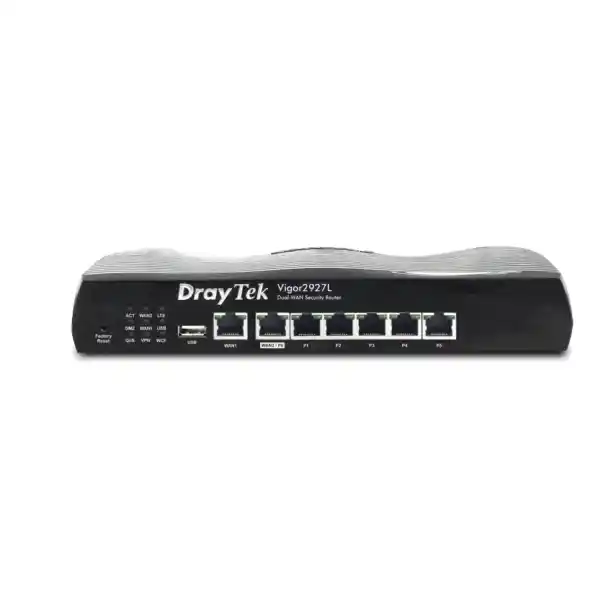
DrayTek Vigor2927Lax in UAE
A technically capable edge router platform for organizations that want Ethernet WAN performance, cellular resilience, secure site-to-site connectivity, granular routing policy and centrally managed LAN services in one compact appliance. For Dubai and wider UAE deployments, the Vigor2927Lax can be positioned as an Internet edge, branch VPN gateway, failover router, segmented office gateway or managed connectivity platform, subject to verification of the exact regional hardware revision supplied.
What the DrayTek Vigor2927Lax is designed to do
The Vigor2927 platform is built for the point in a network where Internet connectivity, security policy, traffic steering and remote access converge. DrayTek documents the Vigor2927 LTE family as a dual-Ethernet-WAN firewall router with embedded cellular connectivity, two SIM slots with one SIM online at a time, multi-WAN load balancing and failover, VPN services, QoS, route policy, firewalling, content filtering, bandwidth controls and hotspot functionality. Those capabilities make the platform attractive when a business does not want separate appliances for basic routing, cellular backup, VPN termination and branch traffic management. Instead, the router becomes a policy-enforcement and resiliency point that can sit between ISP handoffs, internal VLANs, wireless clients, servers, voice systems and remote offices.
For the UAE, that architecture is especially useful in branches where Internet downtime has an immediate operational cost. Retail payment terminals, cloud ERP sessions, Microsoft 365, hosted PBX, remote desktop, CCTV access, building systems, guest Wi-Fi and SaaS applications can all depend on a single WAN path if the network is designed too simply. A Vigor2927-family deployment allows an engineer to establish primary and secondary Internet paths and then decide whether the secondary link is used only when the primary path fails, actively participates in load balancing, or serves selected applications under route policy. Cellular can be reserved for continuity, used as temporary service before a fixed circuit is delivered, or assigned to specific traffic classes with data-budget controls.
The exact Vigor2927Lax designation deserves careful procurement handling. DrayTek compliance documentation identifies Vigor2927Lax as a model code, while current public product matrices more prominently document the Vigor2927L, Vigor2927Lac, Vigor2927ax and Vigor2927Lax-5G variants. Accordingly, FourTeck treats the quoted Vigor2927Lax as a regional hardware configuration that must be matched to the requested cellular and wireless requirements before supply. This avoids a common mistake in enterprise procurement: assuming that similar model suffixes always represent identical radio modules, SIM formats or band support in every market.
Core capabilities at a glance
Multi-WAN edge
One fixed Gigabit Ethernet WAN and a second Gigabit port that can be used as WAN or LAN in the documented Vigor2927 LTE hardware layout. This supports resilient Ethernet uplinks, policy routing and load-balancing designs.
Cellular resilience
The LTE family uses an embedded cellular modem and dual SIM slots with a single active SIM at a time. Published L-series specifications identify LTE Category 6 with theoretical rates up to 300 Mbps down and 50 Mbps up.
Enterprise VPN
Up to 50 VPN tunnels are documented for the Vigor2927 family, with support across IPsec, SSL VPN, OpenVPN, WireGuard and other protocols depending on firmware. Hardware-accelerated IPsec is documented up to 800 Mbps under test conditions.
Policy firewall
Stateful firewall policy, NAT functions, application layer gateways, attack defense, spoofing defense, URL and application controls, category-based web filtering options and IP reputation capabilities provide layered control at the branch perimeter.
Segmentation
The family supports multiple LAN subnets, 802.1Q VLANs, inter-VLAN routing, DHCP services, port-based VLAN options and policy controls suitable for separating staff, voice, guest, CCTV, IoT and management networks.
Central operations
DrayTek management options include local web administration, SNMP, Syslog, NetFlow/IPFIX, TR-069, configuration backup, firmware management, AP and switch management, and integration with VigorACS for multi-site operations.
Hardware architecture and port planning
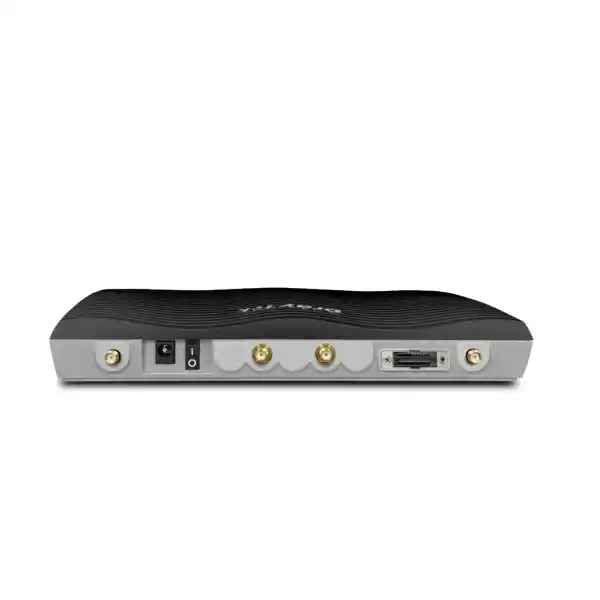
The physical network design around the Vigor2927 family is straightforward enough for a small branch yet flexible enough to support meaningful segmentation. DrayTek’s LTE-series documentation identifies one fixed Gigabit Ethernet WAN port, one switchable Gigabit Ethernet WAN/LAN port and five fixed Gigabit Ethernet LAN ports. A USB 2.0 port is also present in the documented chassis, while the cellular models add external antenna connections and dual SIM slots. This layout means an engineer can dedicate WAN1 to the primary fixed ISP circuit, configure the switchable port as WAN2 for a second fiber, broadband or upstream Ethernet handoff, and retain five copper Gigabit LAN ports for downstream switches, servers, access points or special-purpose network zones. If a second Ethernet WAN is not required, the switchable port can be returned to LAN duty and used to increase local port availability.
The port count should not be interpreted as a replacement for a managed access switch in an office of any size. The router is the Layer-3 and policy edge; a managed switch remains the better location for fan-out, PoE delivery, access VLAN membership and edge device connectivity. A well-designed deployment therefore connects one or more 802.1Q trunks from the router to managed switching, carries multiple VLANs over those uplinks, and places endpoint ports into appropriate access VLANs at the switch. This keeps the router focused on inter-VLAN routing, WAN policy, security enforcement and services instead of using every physical port as an isolated endpoint connection.
DrayTek’s published Vigor2927 LTE specifications list up to 16 VLANs and multiple LAN subnet capability, giving a useful framework for small and mid-sized environments. A UAE professional office might define separate networks for corporate users, VoIP phones, guest access, printers, CCTV, building controls, infrastructure management and servers. A clinic could split staff systems, medical devices, guest Wi-Fi and administration. A retail site could separate point-of-sale, back-office users, CCTV and customer Wi-Fi. The security value comes not simply from creating VLANs but from controlling the routes between them. The router should only permit the inter-zone traffic that the application design requires.
For rack and cabinet planning, the documented enclosure size for Vigor2927 family units is approximately 241 × 165 × 44 mm, with model-dependent power draw and adapter rating. Because Dubai network rooms can vary substantially in temperature, airflow and dust exposure, installation should avoid sealed shelves with poor convection. The published operating range for the family extends to 45°C, but reliable infrastructure design still benefits from keeping the router, switches, ONTs and UPS equipment in a controlled, ventilated environment with sufficient service clearance around antenna and cable connections.
WAN performance, hardware acceleration and realistic sizing
Performance numbers are useful only when they are read in context. DrayTek publishes accelerated NAT figures for the Vigor2927 platform of up to 940 Mbps on a single WAN and up to approximately 1.8 Gbps combined across two WAN paths under optimal internal test conditions. The platform also uses a hardware acceleration path for routing and NAT, and DrayTek states that its accelerator can maintain high throughput while retaining important traffic-control functions such as QoS, bandwidth limits, WAN budget, traffic graphs and data-flow monitoring. This is a practical advantage for branches where the router must do more than simple forwarding.
The combined dual-WAN number should not be mistaken for a single-flow Internet speed. A single client session normally follows one selected path unless the application itself opens multiple independent flows and the routing policy distributes them. Load balancing improves aggregate utilization by placing different sessions on different WANs; it does not magically bond two unrelated ISP circuits into one larger pipe for every connection. When a branch has two 1 Gbps circuits, the value of dual-WAN is therefore resilience and aggregate session distribution rather than a guarantee that one download will run at the mathematical sum of both links.
Session scale matters as much as raw throughput. DrayTek documents approximately 60,000 NAT sessions for the series and positions it around networks of roughly 50 hosts in its published material. Host count is only a planning shorthand. Fifty office users doing email and browser work produce a different state-table and bandwidth profile from thirty users running heavy cloud synchronization, CCTV remote viewing, large file transfers, video meetings and many IoT devices. FourTeck sizing therefore considers concurrent users, endpoint count, WAN speed, expected encrypted traffic, VPN load, application mix, number of VLANs, logging requirements and growth margin rather than relying on a single headline number.
Security and inspection features can also change practical throughput. Content categorization, VPN encryption, deep application classification, logging, QoS, policy routing and complex firewall rules all consume processing resources. The published maximums are not contractual line-rate figures for every feature combination. The correct way to design a site is to identify the most demanding simultaneous workload, retain engineering headroom, and then select a router class that does not operate near saturation during normal business peaks.
For a typical Dubai branch with sub-gigabit primary Internet, a secondary Ethernet service or LTE backup, tens of users and a moderate set of security policies, the Vigor2927 class can provide a balanced edge. For multi-gigabit fiber, very large user populations, high-volume east-west inter-VLAN traffic, extensive security inspection or hundreds of always-on VPN users, a larger router or firewall platform should be considered instead of forcing a branch-class appliance beyond its intended operating envelope.
4G LTE, dual SIM and business continuity in the UAE
The integrated cellular capability is one of the main reasons to choose a Vigor2927 L-series model instead of a wired-only router. DrayTek’s published LTE specifications for the L model identify Category 6 service with theoretical maximum link rates of 300 Mbps download and 50 Mbps upload. Published bands for the standard L-series module include FDD B1, B3, B7, B8, B20 and B28 plus TDD B38 and B40, with WCDMA B1 and B8. Cellular hardware can be region-specific, however, and supported bands should always be matched against the actual UAE unit and the operator service intended for deployment. FourTeck therefore treats band verification as part of the quotation process rather than assuming that every globally listed modem revision is identical.
Dual SIM does not mean two cellular links operate concurrently. DrayTek describes the LTE family as having two embedded SIM slots with one SIM online at a time. The business benefit is operator or subscription redundancy. An organization can install a primary SIM and an alternate SIM, then define switching behavior so that a problem with the active cellular service does not require a technician to visit the branch merely to exchange cards. This is valuable for unattended kiosks, warehouses, construction offices, clinics, retail outlets and remote facilities where dispatch time matters.
LTE failover design should include more than simply inserting a SIM. The engineer must define how the router determines that the fixed WAN is truly unusable. A physical Ethernet link can remain up even when the provider has lost upstream routing, DNS reachability or Internet transit. The Vigor platform provides connection detection mechanisms so failover can be based on useful reachability criteria instead of only electrical link state. Sensible configurations test multiple targets, avoid overly aggressive timers that cause route flapping, and provide a clear recovery policy for returning to the primary link.
A second consideration is mobile data consumption. Video backup, cloud synchronization, operating-system updates and camera uploads can consume a cellular quota rapidly if every workload is allowed to continue unchanged during failover. The Vigor2927 family supports WAN data-budget controls and policy routing. A robust continuity profile can preserve ERP, POS, DNS, VPN, voice and essential cloud traffic while rate-limiting or blocking bulk transfers until the fixed circuit is restored. This turns LTE from a best-effort emergency path into a controlled continuity service.
Cellular placement is equally important. Signal quality inside concrete buildings, metal warehouses and equipment rooms can differ sharply from signal at a window or rooftop. External antennas should be positioned with appropriate cable planning and without unnecessarily long lossy coax runs. For difficult sites, a pre-install signal survey and test SIMs from the intended operator are more reliable than selecting a carrier based only on general coverage maps.
WiFi 6 planning for the Vigor2927Lax model designation
Within DrayTek naming, the “ax” suffix is associated with 802.11ax, commonly known as WiFi 6. DrayTek’s current public specifications directly document AX3000-class wireless on Vigor2927ax and Vigor2927Lax-5G models, using 2×2 MIMO on both 2.4 GHz and 5 GHz, with published link rates up to 574 Mbps on 2.4 GHz and 2402 Mbps on 5 GHz for the documented ax hardware. The exact non-5G Vigor2927Lax regional unit should therefore be checked against its UAE datasheet and firmware before those radio figures are treated as a contractual specification. FourTeck can validate the actual wireless hardware offered in the quotation.
WiFi 6 is not simply a higher number on a speed test. Its real value in business networks appears when multiple compatible clients contend for airtime. Technologies such as OFDMA and multi-user scheduling can improve efficiency, particularly in environments where many devices exchange smaller bursts of data rather than one device continuously consuming the channel. Modern WPA3 support, where available in the supplied radio and client mix, can also improve wireless security posture. Even so, good Wi-Fi design remains primarily a radio-frequency engineering problem: placement, channel reuse, interference, client density, wall construction, power levels and roaming behavior still matter.
An integrated router radio is suitable for compact offices, temporary sites and branches where one centrally located access point can cover the required area. Larger offices should not be designed around a single router simply because its wireless data sheet shows a high aggregate PHY rate. Concrete walls, meeting rooms, metal shelving, server rooms and corridor geometry can reduce usable signal and capacity. In those environments, it is normally better to disable or carefully coordinate the router radio and deploy multiple business access points connected through PoE switching.
DrayTek’s ecosystem supports centralized access-point management from compatible routers and broader cloud or server-based management through VigorACS. That can make the Vigor2927 platform useful as the policy center of a branch even when Wi-Fi is delivered by separate VigorAP units. SSIDs can be mapped to VLANs so that corporate users, guests, voice handsets, scanners and IoT equipment enter the correct security zone as soon as they associate.
For UAE projects that require predictable wireless performance, FourTeck recommends treating the built-in WiFi 6 function as one component of the overall LAN design rather than the entire wireless strategy. The quotation should state expected client count, coverage area, wall construction, critical applications and whether seamless roaming is required. That information determines whether the integrated radio is sufficient or whether dedicated managed APs are the better engineering choice.
VPN architecture for branches, remote users and partner connectivity
The Vigor2927 family is designed to terminate business VPNs rather than relying on consumer-grade remote-access features. DrayTek publishes support for up to 50 VPN tunnels and up to 25 combined OpenVPN plus SSL VPN tunnels in the series. Supported protocol options listed for the platform include IPsec, IKEv2, SSL VPN, OpenVPN, WireGuard, GRE, L2TP and other legacy mechanisms depending on firmware. For a modern deployment, IPsec/IKEv2 and WireGuard or OpenVPN are generally more relevant than older protocols, while exact interoperability requirements should be tested against the peer firewall or client platform.
DrayTek documents IPsec throughput figures including an accelerated value up to 800 Mbps under favorable test conditions, with the accelerator automatically handling a subset of active tunnels. The published SSL VPN figure is lower, which is expected because VPN technologies and processing paths differ. These values should be used for sizing, not as guaranteed real-world results. Encryption algorithm, packet size, number of concurrent tunnels, routing policy, logging, WAN latency and other active features all affect measured throughput.
For site-to-site design, each branch can be assigned one or more protected internal subnets and connected to headquarters, a data center or a cloud security gateway. Route policy then determines whether selected traffic enters the tunnel, exits directly to the Internet, or uses an alternate WAN. VPN trunk functions can provide redundancy so a tunnel can re-establish over another WAN when the preferred path fails. In multi-site UAE deployments, this is useful when the head office uses fiber but branches may use different combinations of broadband and cellular connectivity.
Remote user VPN requires a separate security conversation. A tunnel protects transport, but user identity and endpoint hygiene still matter. The platform supports multiple authentication approaches and can integrate with directory or RADIUS-based services depending on deployment. Multi-factor authentication should be used where supported and practical, administrative access should be restricted to trusted networks, and the VPN address pool should be governed by firewall rules rather than granted unrestricted access to every internal segment.
FourTeck can design the VPN topology as part of a wider UAE IT services engagement, including addressing plans, tunnel naming, encryption profiles, failover behavior, split-tunnel decisions, DNS handling, monitoring and documentation. The goal is not merely to establish a green VPN status icon; it is to create predictable routing and least-privilege access that remains understandable to the operations team after handover.
Firewall, NAT and security policy design
A business router becomes meaningfully secure only when its rule base reflects the network architecture. The Vigor2927 platform provides stateful IP-based firewall policy, NAT services, application layer gateways, VPN pass-through controls, DoS defense, spoofing defense and multiple content-control functions. These features allow the appliance to enforce boundaries between the Internet and LAN as well as between internal zones. The default objective should be to permit required flows, block unnecessary exposure and make exceptions explicit enough that an administrator can later understand why they exist.
Inbound publishing should be minimized. If an on-premises service must be reachable from the Internet, port redirection or open-port rules can be created, but a VPN or reverse proxy is usually preferable for administrative access. Direct exposure of management interfaces, RDP, database ports or device web consoles creates avoidable risk. Where port forwarding is necessary, restrict source addresses when possible, use strong application-level authentication, maintain current software and log the connection. A DMZ host feature exists for special scenarios but should not be treated as a convenient shortcut for exposing a general-purpose workstation or server.
Outbound policy also deserves attention. Many small-business networks allow every VLAN to reach every Internet destination. A more mature design applies different rules to different zones. Guest Wi-Fi may need only DNS and web access. CCTV cameras may need NTP, cloud relay endpoints and management access from a dedicated administrator subnet but no general browsing. Voice phones may need SIP/RTP paths to the PBX or provider with QoS marking. Infrastructure management interfaces can be reachable only from an IT VLAN. These controls reduce the blast radius if an endpoint is compromised.
Content filtering can add another layer, but it should be deployed with clear expectations. DrayTek supports URL, keyword, application and web-feature controls, while category-based filtering may depend on subscription services. Content filtering is not a substitute for endpoint protection, DNS security, patching or user awareness. Instead, it contributes to a defense-in-depth model in which the router can block known classes of unwanted traffic while endpoint and identity systems provide additional context.
FourTeck’s Firewall Dubai practice can translate an application inventory into firewall objects, service groups, VLAN rules and WAN exposure policies. For long-term maintainability, the rule set should use meaningful object names, document exceptions and avoid overlapping policies that make troubleshooting unpredictable.
QoS, bandwidth control and voice readiness
Quality of Service is important when a branch has enough bandwidth to run normally but still experiences short periods of contention. A speed upgrade is not always the only answer. The Vigor2927 family includes IP-based bandwidth limits, session limits, QoS classification, VoIP prioritization and application-aware QoS options. DrayTek also describes hardware QoS integration alongside its acceleration engine, allowing traffic control to remain practical at higher WAN rates than would be possible if every packet had to follow a purely software forwarding path.
For voice, the design objective is low latency, low jitter and low packet loss, not simply high throughput. A call may use relatively little bandwidth but still sound poor if large uploads build deep queues on the WAN. QoS can classify voice signaling and media, reserve priority for real-time traffic and permit unused reserved capacity to be consumed by lower-priority classes when the network is quiet. DrayTek provides VoIP-friendly behaviors and application prioritization; the configuration should still be aligned with the actual PBX or SIP provider rather than assuming one default port covers every environment.
A common UAE branch pattern is a hosted IP-PBX service combined with Microsoft Teams or Zoom, cloud file synchronization, CCTV and guest Wi-Fi. All of these compete for the same uplink during busy periods. The router can prioritize real-time services, cap guest bandwidth and prevent a single endpoint from consuming excessive sessions or throughput. When a failover to LTE occurs, a second policy profile can become even more restrictive so business-critical traffic remains usable within the smaller mobile uplink.
For organizations integrating desk phones, SIP trunks or on-premises PBX systems, FourTeck can coordinate router policy with its IP PBX Dubai solutions. That coordination is valuable because voice issues often span multiple layers: DHCP options, VLAN tagging, DNS, NAT behavior, SIP ALG settings, firewall policy, WAN loss, provider routing and handset configuration. Treating the router and telephony system as separate projects can leave gaps that only appear under failover or peak load.
QoS should be measured after deployment. Interface utilization, latency under load and application performance should be observed during real business peaks. Policies can then be adjusted using evidence rather than intuition. Overly complex QoS rules can be as harmful as having none, so FourTeck normally starts with a small number of meaningful traffic classes, explicit business priorities and clear bandwidth assumptions.
VLANs, DHCP and inter-VLAN routing
Segmentation is one of the most important capabilities in a modern branch router. The Vigor2927 family supports 802.1Q tag-based VLANs, port-based VLAN behavior, multiple LAN subnets, custom DHCP options, bind-IP-to-MAC functions, local DNS services and inter-VLAN routing. DrayTek’s published specification for the LTE family identifies up to 16 VLANs. This is enough for many SMB and branch designs, provided the network zones are chosen for security and operational purpose rather than creating a separate VLAN for every small device category.
A practical office might use VLAN 10 for corporate users, VLAN 20 for voice, VLAN 30 for guest Wi-Fi, VLAN 40 for CCTV, VLAN 50 for servers, VLAN 60 for IoT or building management and VLAN 99 for infrastructure management. Each VLAN receives its own IP subnet and DHCP scope. Switch access ports are assigned to the relevant VLAN, while trunk links carry multiple tags between router, switches and access points. Wireless SSIDs are mapped to those same VLANs so that a guest connecting over Wi-Fi lands in the guest security zone without requiring a physically separate access point.
Inter-VLAN routing should be controlled by firewall policy. The fact that the router can route between all directly connected networks does not mean it should allow unrestricted communication. Corporate users may reach printers and selected server ports. Guest users should normally reach the Internet only. CCTV cameras may send video to an NVR but not initiate sessions toward the staff network. IP phones may reach call-control systems, DNS and NTP. The management VLAN may reach switches, access points and the router itself but should be accessible only to authorized administrators.
DHCP options can support phones, controllers and specialized equipment, while IP/MAC binding can create stable addressing where static configuration is inconvenient. Local DNS and conditional forwarding are useful when branches must resolve internal domains over VPN while public names continue to use external resolvers. These services reduce the number of separate infrastructure components required at a small site, though larger networks may still centralize DHCP and DNS in directory or server platforms.
The network plan should be documented before configuration starts. A simple table containing VLAN ID, subnet, gateway, DHCP range, DNS source, SSID mapping, switch port role and permitted inter-zone flows prevents many deployment errors. FourTeck can include this addressing and segmentation schedule in the project handover so future changes remain consistent with the original architecture.
Advanced routing, failover and SD-WAN-style policy control
The Vigor2927 platform offers more routing flexibility than a basic broadband gateway. DrayTek lists IPv4 and IPv6 static routing, inter-VLAN routing, policy-based routing and dynamic routing functions including RIP and BGP in the platform specification. The router can make WAN-selection decisions using criteria such as protocol, IP address, port, domain and country, depending on the available firmware feature set. This allows traffic engineering that is based on business logic rather than a single default route.
A branch with two Ethernet WANs and LTE can, for example, send voice and ERP traffic over the lower-latency primary circuit, place guest Wi-Fi and software updates on the secondary circuit, and hold LTE as a failover path for approved services. Another design can distribute general user traffic across two wired links while forcing banking portals or services that dislike changing source IP addresses to a single preferred WAN. Cloud applications can be matched by destination domain or application classification where supported, while internal VPN traffic can be pinned to the WAN that provides the most stable path to headquarters.
DrayTek also promotes VigorACS features such as interface quality and SLA monitoring, application visibility and application-based SD-WAN policy across supported models. This makes the platform relevant to distributed organizations that need to operate many branches from a central console. The important design principle is to define what happens when quality degrades, not just when a link becomes completely unavailable. A circuit with 20 percent packet loss may still show “up” while being unusable for voice or interactive applications. Policy based on health and application priority can move critical traffic before users begin reporting failures.
BGP support can be useful in specialized branch or service-provider handoff scenarios, but it should not be enabled simply because the feature exists. Dynamic routing introduces operational complexity and must be planned with route filters, prefix control and failure behavior. Most SMB sites are better served by static routes and well-structured policy routing. The right feature set is the smallest one that solves the connectivity requirement cleanly.
For multi-site organizations, FourTeck can combine local routing policy with standardized templates, naming and monitoring. A consistent branch design reduces troubleshooting time because engineers know where voice traffic should exit, how LTE failover is supposed to behave, which subnets are advertised over VPN and which logs should be checked first. That operational consistency is often more valuable than adding another feature to an already complex configuration.
Hotspot, guest access and controlled Internet services
Guest Internet access creates a special security requirement because the organization wants to provide connectivity without extending trust. The Vigor2927 family includes a hotspot web portal with multiple authentication approaches such as click-through access, social login, SMS PIN, voucher PIN, RADIUS and external portal options in the documented platform. That makes the router suitable for reception areas, small hospitality sites, training centers, clinics, showrooms and retail environments where visitor access must be separated from business systems.
The first design rule is isolation. Guest users should be placed in a dedicated VLAN and SSID with client isolation where appropriate. The firewall should prevent access to corporate subnets, device management interfaces, printers, cameras and voice systems. Only the Internet services required by the guest policy should be allowed. The second rule is resource control. Per-user or per-network bandwidth limits can prevent a small number of visitors from consuming the full WAN capacity, and session limits can reduce excessive connection counts from misbehaving devices.
Captive portal authentication is not the same thing as enterprise identity control. A click-through page may be appropriate for a showroom, while a business center may prefer vouchers or RADIUS-backed credentials. The organization should define retention, privacy and acceptable-use requirements appropriate to its sector and jurisdiction. Router configuration should support that policy rather than attempting to create a legal or compliance framework by itself.
Guest services also need continuity planning. If the branch fails over to a metered LTE link, guest traffic may be the first category to restrict. Policy routing and WAN budget functions can keep core staff applications available while temporarily limiting or disabling guest Internet. This is an example of why network segmentation and multi-WAN policy should be designed together rather than as independent features.
Where a larger venue requires multiple access points, the router can remain the VLAN, DHCP and firewall edge while compatible APs provide distributed radio coverage. That division keeps user policy centralized and wireless coverage scalable. FourTeck can integrate the Vigor2927Lax with switching and wireless infrastructure available through the FourTeck UAE portfolio so the guest service is engineered as part of the whole branch network.
Monitoring, logging and centralized management
A router that cannot be observed is difficult to operate reliably. The Vigor2927 family supports a broad set of management and telemetry functions including HTTPS administration, SSH, configuration backup and restore, firmware upgrade tools, SNMP, Syslog, NetFlow v5/v9, IPFIX, email or SMS alerts and TR-069. These tools can be used to build an operational picture of WAN state, client activity, traffic volumes, interface performance and security events.
For a single branch, the local dashboard is often enough for day-to-day checks, but important logs should still be exported. If the router fails, reboots or is replaced, local logs may not preserve the history needed to understand the event. Sending Syslog to a central server and monitoring SNMP counters allows support teams to correlate packet loss, interface errors, WAN transitions and VPN events with user reports. NetFlow or IPFIX can reveal which hosts and applications are consuming bandwidth, which is especially helpful when an LTE backup link unexpectedly reaches its data allowance.
Configuration backups should be taken after meaningful changes and stored securely. A branch edge is not a device that should be rebuilt from memory during an outage. The backup process should be paired with a short configuration register recording firmware version, WAN addressing, SIM/operator details, VPN peers, VLAN subnets, administrator access method and any unusual policy exceptions. This dramatically reduces recovery time when hardware replacement is required.
For organizations with many DrayTek devices, VigorACS provides centralized provisioning, monitoring and policy capabilities. DrayTek highlights zero-touch deployment, Auto VPN, interface quality monitoring, application visibility and hotspot analytics among supported VigorACS functions. Central management is particularly useful in distributed retail or branch deployments because standardized templates can be applied consistently instead of configuring every router independently.
Management exposure must still be hardened. Administrative interfaces should use HTTPS, strong unique credentials, restricted source networks and multi-factor methods where supported. Legacy services such as Telnet or FTP should remain disabled unless a specific operational requirement justifies them. Remote administration is best provided over VPN or tightly restricted management paths instead of exposing the web interface broadly to the Internet.
High availability and failure-domain thinking
The Vigor2927 platform supports DrayTek high-availability functions, but resilient network design requires looking beyond the router. A second WAN does not create true continuity if both services enter the building through the same provider cabinet, share the same upstream fiber path or depend on the same ONT. LTE does not provide meaningful diversity if the router is installed in a basement with poor signal. A router connected to a UPS can still be useless if the switch, access points or provider modem lose power. Each dependency should be considered as a separate failure domain.
For a business where Internet access is operationally critical, a good architecture may use a primary fixed fiber circuit, a secondary service from a different carrier or access technology, and cellular as an additional emergency path. The router handles policy and failover while the cabling and carrier selection provide physical diversity. Critical LAN components are protected by UPS. DNS, VPN and application design are then tested during failover, because a route change that looks correct at the router may still break a service that depends on source IP whitelisting or a persistent session.
High availability between routers can reduce the appliance itself as a single point of failure, but it increases design complexity and should be justified by business impact. Configuration synchronization, virtual addressing, cabling topology and downstream switch behavior must all be understood. Small offices may decide that keeping a preconfigured spare router and current backup is more economical. A larger branch, healthcare site or revenue-critical retail location may prefer active standby hardware with tested recovery procedures.
Cellular dual-SIM functionality addresses another failure domain: operator service. If the active SIM loses usable service, an alternate operator profile can provide a path without manual card replacement, subject to the configured failover logic and local network availability. The SIMs should ideally come from independent carrier services when resilience is the objective.
FourTeck designs continuity around business recovery targets rather than feature checklists. The key questions are how long the site can tolerate loss of Internet, which applications must survive, what reduced-service mode is acceptable on LTE, whether public IP dependencies exist, and how the network will be restored after the primary circuit returns. The router is then configured to enforce that recovery model.
UAE deployment scenarios
Retail branch
Primary fiber or broadband, LTE failover, isolated POS VLAN, guest Wi-Fi, CCTV zone and VPN back to headquarters. LTE policy preserves payment, ERP and voice while restricting guest traffic during outages.
Professional office
Dual WAN for cloud applications and meetings, corporate and guest Wi-Fi separation, remote user VPN, QoS for voice and centralized logs. The router becomes the branch security and traffic-management edge.
Warehouse
Internet continuity for scanners, cloud inventory, cameras and VoIP. VLANs separate operational technology from staff devices while external antennas improve cellular placement in challenging RF environments.
Temporary site
LTE can provide immediate connectivity while waiting for a fixed circuit. When fiber arrives, cellular is retained as a backup path and the same firewall, VPN and VLAN policies remain in service.
Clinic or service center
Staff, guest, IoT and administrative systems are segmented. VPN links selected applications to centralized resources while failover protects appointment, voice and business systems from single-circuit failure.
Distributed enterprise
Standardized branch templates, VigorACS monitoring, VPN topology and consistent VLAN plans support repeatable rollout across multiple UAE sites with centralized operational visibility.
These scenarios share a common pattern: the Vigor2927Lax is most valuable when it is used as a network control point rather than merely a device that translates private addresses to the Internet. Multi-WAN logic, segmentation, VPN and monitoring should be designed around application behavior. A retail site cares about payment continuity. A clinic may prioritize secure access to central applications. A warehouse may care most about scanner and inventory uptime. An office may emphasize meetings, hosted voice and remote access. The router has the tools to support each model, but the configuration must reflect the business requirement.
FourTeck can supply the router as a standalone hardware item or deliver it as part of a configured branch package including managed switches, wireless access points, UPS protection, IP telephony and support services. This is useful when customers want a single network design rather than separate quotations that later have to be made interoperable onsite.
Procurement notes for Dubai and the wider UAE
Network hardware procurement should identify the exact revision being purchased. With cellular and wireless products, the suffix can affect modem generation, supported bands, antenna kit, SIM format, radio capability and firmware image. For the Vigor2927Lax specifically, DrayTek compliance documents list the model designation, but current global marketing matrices place more emphasis on Vigor2927L/Vigor2927Lac for LTE and Vigor2927Lax-5G for 5G with WiFi 6. A quotation should therefore state whether the proposed unit is the non-5G LTE Lax regional configuration, a current 5G Lax-5G alternative, or another member of the family.
Cellular bands should be matched to the intended UAE operator before purchase. Published L-series documentation lists LTE Category 6 and a broad set of FDD/TDD bands, but regional radio modules can differ. Likewise, the physical SIM format should be confirmed from the exact shipment. This matters in projects where SIMs are procured separately by a telecom team and must be ready before installation day.
Firmware status is another procurement factor. Security routers should be delivered with a currently supported firmware branch and updated according to vendor guidance. DrayTek continues to publish firmware for the Vigor2927 family, and organizations should include periodic firmware review in maintenance procedures. Updates should be backed by configuration exports, release-note review and a rollback plan rather than installed casually during business hours.
Licensing expectations should be clarified. Core routing, firewall, VPN, VLAN and management features are part of the platform, while some content-category services can require subscriptions. If web-category filtering is part of the security requirement, the quote should identify any applicable service term. If the router will be managed through VigorACS, the required management licensing and hosting model should also be confirmed.
Finally, decide whether the project requires hardware-only supply, staging, remote configuration or full onsite implementation. FourTeck can provide staged configuration so WAN settings, VLANs, VPNs and security policies are prepared before deployment. This reduces onsite work and allows branch cutovers to focus on cabling, carrier validation, functional testing and user acceptance rather than building policy from scratch at the site.
How FourTeck sizes the Vigor2927Lax for a project
A useful router recommendation starts with workload rather than model preference. FourTeck first identifies Internet circuit speeds and handoff types, then maps the number of users, endpoint count, cloud applications, VPN requirements, security zones, wireless coverage expectations and continuity targets. A 200 Mbps office with forty users and several VLANs may be an excellent fit for a Vigor2927-class edge. A gigabit-heavy production environment with hundreds of users and deep security inspection may require a more powerful platform even if the basic feature list looks similar.
WAN design is assessed next. If the customer has one fixed circuit, we determine whether LTE is intended as backup, temporary primary service or an active traffic path. If two fixed circuits exist, we identify whether they are genuinely diverse and which applications should prefer each path. Public IP requirements are recorded because some VPNs, inbound services and provider whitelists depend on stable source addresses. Cellular carrier NAT behavior is also considered; inbound access over mobile service may not be available unless the operator offers an appropriate APN or addressing service.
LAN design includes subnet count, VLAN IDs, DHCP strategy, switch uplinks, PoE requirements and wireless SSID mapping. If the site has IP phones, cameras or building systems, those are included as distinct traffic classes and security zones where appropriate. If the built-in wireless radio will be used, coverage and density are reviewed. If dedicated access points are needed, the router can remain the gateway and controller component while wireless capacity is scaled independently.
Security design translates business services into rule requirements. We record which internal systems must be reachable over VPN, which services require Internet publishing, which VLANs may communicate, and whether category filtering or application control is required. Administrative access paths are defined separately from user traffic. Logging and monitoring destinations are chosen so future incidents can be investigated with evidence rather than guesswork.
Finally, the design is tested against failure. What happens if WAN1 fails? What happens if the provider circuit stays electrically up but cannot reach the Internet? Which traffic is allowed on LTE? How does a site-to-site VPN recover? Do hosted voice sessions re-register? Does the customer have an alternate path to manage the router remotely? These questions turn a collection of features into an operational continuity plan.
Customers can also review FourTeck’s broader regional networking and infrastructure capabilities through FourTeck Global. For UAE projects, the final bill of materials can combine routing, switching, wireless, security and support under one technical scope.
Technical reference table
| Area | Published Vigor2927 family capability | Deployment note |
|---|---|---|
| Ethernet WAN | 1 × fixed GbE WAN plus 1 × switchable GbE WAN/LAN | Suitable for dual fixed-line design or extra LAN use when WAN2 is unnecessary. |
| LAN | 5 × fixed GbE LAN ports | Use managed switches for expansion, PoE and access-layer VLAN delivery. |
| Cellular | L-series published as LTE Cat 6, up to 300/50 Mbps | Verify exact UAE module, bands and SIM format before order. |
| SIM | Dual SIM, one active at a time | Useful for carrier redundancy, not simultaneous dual-cellular aggregation. |
| NAT sessions | Approx. 60,000 | Size by workload, application mix and growth margin, not host count alone. |
| NAT throughput | Up to 940 Mbps single WAN; about 1.8 Gbps combined dual WAN with hardware acceleration | Maximum internal-test values; actual throughput varies with features and traffic. |
| VPN scale | Up to 50 tunnels; up to 25 OpenVPN + SSL VPN tunnels | Use protocol, authentication and routing policy appropriate to the peer design. |
| IPsec | Hardware-accelerated figure up to 800 Mbps | Encryption profile, packet size and concurrent workloads affect real results. |
| VLAN | 802.1Q and port-based VLAN, up to 16 VLANs in published LTE specification | Ideal for staff, voice, guest, CCTV, IoT and management segmentation. |
| Routing | Static, inter-VLAN, policy routes, RIP, BGP | Use the simplest routing method that satisfies the operational requirement. |
| Monitoring | SNMP, Syslog, NetFlow v5/v9, IPFIX, alerts, TR-069 | Export logs and telemetry for supportability and incident analysis. |
| Wireless | “ax” family variants are WiFi 6 class; current public documents directly specify AX3000 for Vigor2927ax and Vigor2927Lax-5G | Confirm the exact non-5G Vigor2927Lax UAE radio specification in the supplied hardware revision. |
Performance values are vendor maximums under test conditions and are not guaranteed application throughput. Firmware, hardware revision, enabled services, WAN characteristics and traffic mix can materially change results.
Installation methodology for a stable branch rollout
A production installation should begin before the router is powered on. The first step is to collect ISP details, WAN handoff type, static addressing, PPPoE credentials where applicable, DNS requirements, public IP allocations and any upstream modem or ONT information. For cellular service, record the operator, APN, SIM PIN status, data plan and supported bands. For VPN, collect peer addresses, protected subnets, authentication material and encryption requirements. For the LAN, finalize VLANs, subnet sizes, DHCP scopes and switch trunk ports.
Staging is then performed on an isolated bench network. The router firmware is checked, administrative credentials are secured and unused remote management methods are disabled. LAN subnets and VLAN interfaces are created before switch integration. DHCP, DNS forwarding and NTP behavior are verified. Firewall policy is built from zone requirements, and NAT or inbound publishing is added only where documented. WAN links are tested individually before load balancing or failover is enabled. This avoids troubleshooting several layers at once.
VPN tunnels are brought up after basic routing is stable. Engineers verify not just tunnel status but bidirectional reachability to the expected subnets, DNS resolution across the tunnel where required, and policy behavior during WAN failover. If the peer side uses source-IP restrictions or asymmetric routing, those conditions are tested explicitly. Remote-user VPN is validated from an external network, not only from inside the branch.
Wireless configuration, when used, follows after the wired VLAN design is operational. SSIDs are mapped to intended VLANs, WPA security is configured, guest isolation is verified and coverage is tested from user locations. If the branch uses managed access points, controller or VigorACS enrollment is completed and configuration templates are applied. Voice and real-time applications are then tested with QoS active while background traffic is introduced to simulate contention.
Failover testing is mandatory. The primary WAN is disconnected physically and upstream reachability is also interrupted while Ethernet remains linked, because those failures exercise different detection mechanisms. Engineers confirm route transition, VPN recovery, LTE data use and application behavior. The link is restored and failback is observed to ensure the router returns to the preferred state without oscillation. If dual SIM is part of the requirement, SIM failover is tested as a separate event.
After acceptance, a configuration backup and network summary are captured. The customer receives the addressing plan, device details, WAN policy, VPN list, VLAN map and support notes. This disciplined deployment process is more valuable than a fast installation that leaves undocumented settings and untested recovery paths.
Security hardening checklist for production use
The first hardening task is administrative identity. Default credentials must be replaced with strong unique values, and named administrative accounts should be used where supported. Management access should be restricted by source network and protocol. HTTPS and SSH are preferable to older clear-text management services. If remote management is necessary, it should ideally be reached through VPN or a dedicated management path rather than being exposed openly on every WAN interface.
The second task is firmware governance. Router firmware is security-sensitive software and should be monitored for vendor advisories and maintenance releases. Updates should be evaluated, backed up and scheduled. The router configuration should be exported before significant upgrades, and a recovery procedure should be available. Where a fleet of routers is deployed, centralized management can help identify devices that have drifted from the approved version.
The third task is rule hygiene. Remove unused port forwards, disable broad “any-to-any” exceptions, document intentional exposure and restrict management interfaces. Use network objects to make policies readable. A rule named for the service and destination is easier to audit than an unexplained collection of IP addresses. Periodic rule review should remove temporary access that outlived the project that created it.
The fourth task is segmentation. Guest, IoT, CCTV, voice and management networks should not automatically inherit corporate-user trust. Inter-VLAN access should be explicit and tested. If a device category needs only Internet access, there is rarely a reason to permit connections from that category toward file servers or administrator workstations. This approach limits lateral movement without requiring a complex security platform.
The fifth task is observability. Export Syslog, monitor WAN and VPN status, retain configuration backups and generate alerts for meaningful failures. Logs are most useful when they contain accurate timestamps, so NTP should be configured correctly. Support teams should know where logs are stored and how long they are retained.
Finally, hardening should include the physical environment. The router, SIMs, cabling and reset controls should not be readily accessible to visitors. Power should be protected by a UPS where continuity matters. Network cabinets should have airflow, and antenna cables should be routed without sharp bends or unnecessary length. Security is a combination of software policy, operational control and physical reliability.
Important model-verification note
The requested product name is DrayTek Vigor2927Lax. DrayTek documentation includes this model code in compliance material, but the manufacturer’s current globally visible commercial product pages more consistently show Vigor2927L and Vigor2927Lac as LTE models and Vigor2927Lax-5G as the WiFi 6 cellular model. That discrepancy does not automatically mean the requested product is invalid; manufacturers often have region-specific, transitional or limited-distribution SKUs. It does mean that the exact offered hardware should be confirmed before a purchase order is issued.
FourTeck will therefore verify the device label, cellular technology, supported bands, SIM format, wireless standard, antenna set, power adapter, firmware branch and warranty source for the UAE quotation. If the requirement is specifically 4G LTE Category 6 plus integrated WiFi 6, the quotation will state that combination explicitly. If only a 5G Lax-5G unit is currently available through the intended supply channel, that alternative will be identified rather than silently substituted. If a Vigor2927Lac is offered instead, the difference between WiFi 5 and WiFi 6 will also be made clear.
This verification protects both technical design and procurement. Cellular band support affects network registration. Wireless generation affects client capacity and expected PHY rate. SIM format affects installation readiness. Firmware family affects feature availability and support. A precise SKU confirmation is therefore a normal part of enterprise networking, not an administrative detail.
Frequently asked technical questions
Can the Vigor2927Lax use two SIMs at the same time?
The documented Vigor2927 LTE architecture uses two SIM slots with one SIM online at a time. The purpose is redundancy and operator switching rather than concurrent dual-cellular aggregation. If simultaneous cellular links are required, the design should use a platform that explicitly supports that architecture or an additional external modem/router.
Can LTE be used only as backup?
Yes. The cellular path can be reserved for failover, while one or two Ethernet WANs carry normal traffic. The router can use connection-detection logic to identify failure and move approved traffic to LTE. Data-budget and policy controls can limit nonessential traffic when the branch is operating on mobile service.
Does dual WAN double the speed of one download?
Normally no. Load balancing distributes independent sessions across available WANs. A single flow usually stays on one path. The benefit is aggregate capacity across many users and improved resilience, not automatic packet-level bonding of unrelated ISP circuits.
Is the router suitable for IP telephony?
Yes, the platform includes QoS and VoIP-friendly traffic controls. A good deployment separates voice into its own VLAN, applies suitable prioritization, validates SIP/NAT behavior with the chosen PBX or provider, and tests failover so phones recover predictably when the WAN changes.
Can it manage multiple VLANs and guest Wi-Fi?
Yes. The family supports multiple LAN subnets, 802.1Q VLANs, DHCP services, inter-VLAN routing and hotspot features. Guest access should be isolated by firewall policy, and larger wireless deployments should use managed access points connected through VLAN-aware switching.
Is 800 Mbps VPN throughput guaranteed?
No. DrayTek publishes an accelerated IPsec maximum under test conditions. Real throughput depends on algorithms, packet size, active features, CPU load, tunnel count, Internet latency and peer performance. It is a sizing reference, not a contractual application benchmark.
Does it replace a managed firewall?
It is itself a business routing and firewall platform and can meet many SMB branch requirements. Organizations needing advanced sandboxing, full TLS inspection, very high throughput, large identity-policy environments or specialized compliance tooling may require a higher-end next-generation firewall. The correct choice depends on the security requirement, not the product category label alone.
Can it be centrally monitored?
Yes. The platform supports SNMP, Syslog, NetFlow/IPFIX and DrayTek management mechanisms, while supported deployments can use VigorACS for centralized provisioning, monitoring and branch operations. Central logging is recommended even for sites that primarily use local administration.
Decision recap: where the Vigor2927Lax fits best
The DrayTek Vigor2927Lax is best considered when the project needs more than an ordinary broadband router but does not require a large enterprise firewall chassis. Its strongest design role is a resilient branch edge: dual Ethernet WAN options, integrated cellular backup, multiple VPN technologies, strong routing policy, VLAN segmentation, QoS, guest access, management telemetry and the possibility of integrated WiFi 6 in the requested Lax configuration. This combination can reduce appliance count while still giving network administrators meaningful control over how applications use each path.
It is particularly appropriate where continuity has clear business value. A site with only one Internet circuit can use LTE as a recovery path. A site with two fixed circuits can use LTE as an additional contingency. A branch connected to headquarters can keep VPN routing under the same policy engine that controls Internet traffic. A small office can use the integrated wireless function where coverage permits, while a larger site can attach managed switches and access points without replacing the router.
The platform is less suitable when the main requirement is multi-gigabit single-flow Internet performance, very high user counts, extensive next-generation threat inspection, hundreds of simultaneous encrypted remote users or a large campus routing role. In those cases, the project should move to a more powerful firewall or routing platform rather than relying on maximum lab figures.
For UAE procurement, the one additional decision point is exact model verification. Because the non-5G Vigor2927Lax appears less prominently in current public product matrices than other family members, FourTeck will confirm the radio, cellular module and firmware of the supplied SKU. That confirmation allows the rest of the design to proceed with clear expectations and avoids substituting a superficially similar model that changes the wireless or cellular capability.
Quotation input checklist
Providing the following information allows FourTeck to quote the correct Vigor2927Lax configuration and reduce post-order changes. Exact answers are not required for every item, but the more that is known, the more accurately the router, accessories and implementation scope can be sized.
WAN & Carrier
Primary ISP speed and handoff; secondary ISP details; static public IP requirements; PPPoE or DHCP; UAE mobile operator; APN; preferred LTE use as primary, backup or load-balanced path.
Users & Applications
Approximate users and endpoints; Microsoft 365 or Google Workspace; ERP/CRM; cloud storage; video meetings; CCTV; hosted voice; POS; servers; any bandwidth-intensive backup or replication workloads.
VPN
Number of site-to-site tunnels; remote users; peer firewall brands; protected subnets; public IPs; required authentication; expected encrypted bandwidth; cloud or data-center destinations.
LAN & VLAN
Existing IP ranges; required VLANs; managed switch models; PoE needs; voice, CCTV, guest and IoT separation; DHCP ownership; internal DNS; any static routes to server or building networks.
Wireless
Coverage area; approximate concurrent Wi-Fi clients; wall construction; existing APs; required SSIDs; guest portal needs; WiFi 6 requirement; whether integrated router Wi-Fi is expected to cover the whole site.
Operations
Need for staging, onsite installation, remote support, VigorACS, Syslog, SNMP, monitoring, configuration backup, documentation, UPS, rack placement and after-hours cutover.
Request a UAE technical consultation
FourTeck can confirm the exact DrayTek Vigor2927Lax regional specification, verify LTE compatibility, size WAN and VPN requirements, design VLAN and QoS policy, and prepare the router for deployment in Dubai or elsewhere in the UAE. The consultation can cover hardware-only supply, staged configuration, branch migration or a complete managed network package.
Share the current ISP services, expected user count, VPN requirement and whether cellular is intended for primary or backup use. FourTeck will map those requirements to the correct model and implementation scope before the order is finalized.


Reviews
There are no reviews yet.