
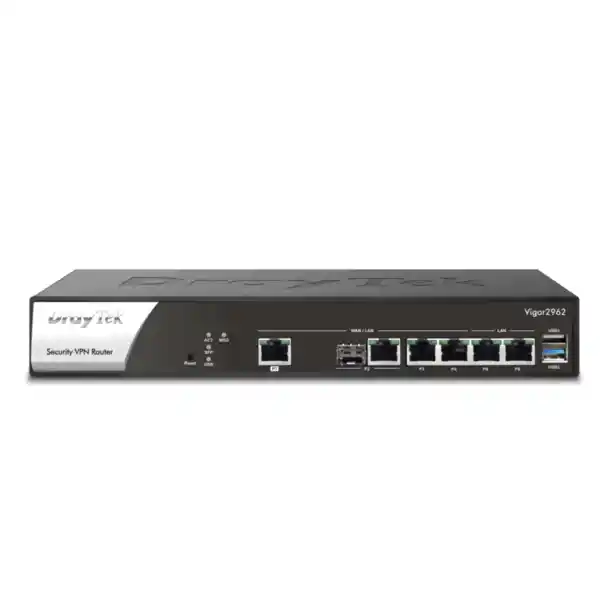
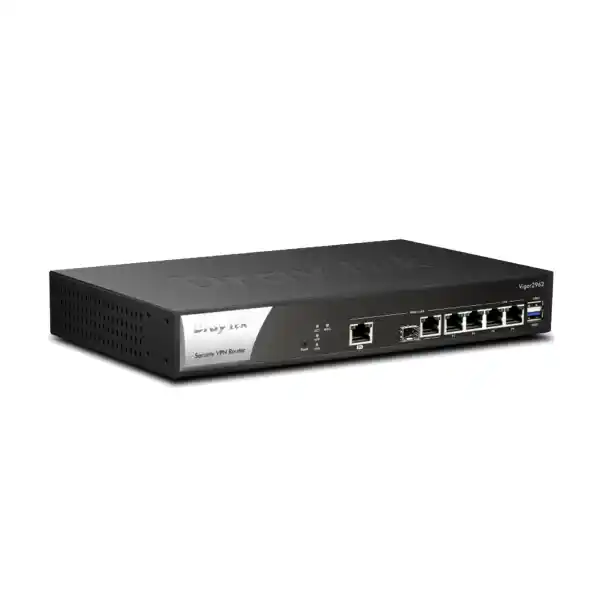
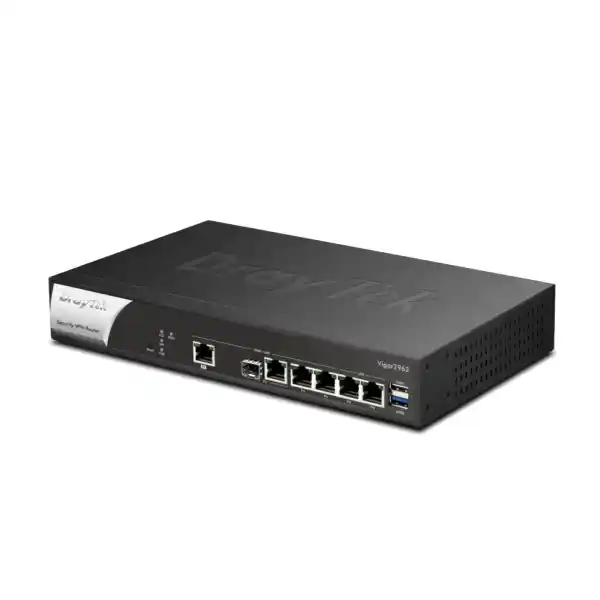
DrayTek Vigor2962
A high-capacity DrayOS routing platform for organizations that need faster Internet edge performance, resilient multi-WAN connectivity, secure branch-to-head-office VPN, granular traffic control, VLAN segmentation and centralized visibility across compatible DrayTek switching and wireless infrastructure.
2.5GbE RJ-45A faster-than-Gigabit interface for modern Internet services, core uplinks or high-throughput LAN use according to the selected WAN/LAN role.
1G SFP / GbE ComboProvides deployment flexibility where a fiber handoff or conventional copper Ethernet presentation is required at the network edge.
Up to 1 Gbps IPsecBuilt for encrypted branch, cloud and remote-access traffic, with protocol choices for multiple deployment and compatibility requirements.
Multi-WAN & FailoverDistribute traffic across available circuits and maintain connectivity when a preferred upstream path becomes unavailable.
What the DrayTek Vigor2962 Is Designed to Do
The DrayTek Vigor2962 is positioned above ordinary small-office broadband routers because it is engineered to act as the controlled boundary between multiple Internet services and a larger business LAN. In a typical Dubai deployment, that means the appliance may sit between one or more carrier handoffs and the organization’s switching fabric, applying routing policy, NAT, firewall rules, quality-of-service controls, segmentation, VPN encryption and resilience logic before traffic reaches servers, user VLANs, voice systems, wireless networks or cloud services. Its value is therefore not simply the headline forwarding rate. The larger operational advantage is the ability to combine Internet edge functions that would otherwise be distributed across several basic devices.
The platform uses DrayOS, DrayTek’s purpose-built router operating system, and exposes controls intended for network administrators rather than consumer users. Policy routing can direct selected traffic through a specified uplink. WAN load balancing can spread eligible sessions across more than one circuit. Failover mechanisms can move traffic away from an unavailable or degraded path. Firewall policies can restrict traffic by address, service or other configured criteria. VLAN and subnet controls can separate departments, guests, servers, voice endpoints and management systems. VPN profiles can protect site-to-site and remote connectivity. These functions matter for UAE organizations that increasingly rely on SaaS, cloud telephony, hosted ERP, remote administration and inter-branch connectivity at the same time.
DrayTek currently specifies a maximum NAT throughput of 2.2 Gbps for the Vigor2962, up to 300,000 NAT sessions and up to 200 concurrent VPN tunnels. DrayTek also states IPsec VPN throughput of up to 1 Gbps and SSL VPN performance of up to 800 Mbps under its laboratory conditions. Actual performance depends on packet size, encryption method, enabled inspection and filtering functions, firmware, topology and the traffic mix. Those caveats are important in professional sizing: a router should be chosen for the workload it must sustain with the required services enabled, not by treating a maximum laboratory forwarding figure as an unconditional production guarantee.
Port Architecture and Physical Connectivity
The Vigor2962 combines one 2.5 Gigabit Ethernet RJ-45 interface, a Gigabit Ethernet/SFP combo position, two additional Gigabit Ethernet RJ-45 interfaces that can participate in WAN/LAN role assignment, and two fixed Gigabit LAN interfaces. It also provides USB connectivity, including USB 2.0 and USB 3.0. This mix is useful where the upstream service is not presented in exactly the same way at every site. A branch may receive an Ethernet handoff from a carrier router, another location may use a 1G optical module, and a headquarters site may want to reserve the 2.5GbE interface for the fastest circuit or for a higher-speed connection toward the internal core.
The configurable port design should be planned carefully before installation because a physical interface does not inherently need to remain a WAN or a LAN forever. That flexibility can simplify migrations. For example, an organization can introduce a second ISP, move the primary circuit to the 2.5GbE interface, or dedicate a configurable port to a routed DMZ without replacing the router. The current DrayTek product page promotes up to four configurable WAN interfaces, while some earlier manuals and solution references describe lower simultaneous-WAN counts. For procurement and change-control purposes, the exact number of active WAN roles required should therefore be validated against the firmware version and regional feature set that will be deployed. FourTeck can scope the required interface assignment before the device is staged.
The SFP/GbE combo concept also deserves attention. A combo interface generally means the copper and SFP presentation share a logical port resource rather than operating as two fully independent ports at the same time. This is valuable because it provides media choice without consuming extra chassis space, but it must be represented correctly in a port map. During design, document the service type, carrier demarcation, transceiver requirements, speed, duplex expectations, VLAN tags and public IP addressing for every upstream link. That avoids a common deployment problem in which the correct router is purchased but the required optical module, patch lead, copper handoff or carrier VLAN information is not available during commissioning.
Performance: How to Interpret 2.2 Gbps NAT and 300,000 Sessions
Routing performance is frequently misunderstood because bandwidth and connection scale describe different stress points. The 2.2 Gbps maximum NAT figure indicates the platform’s peak forwarding capability under DrayTek’s defined test conditions with acceleration where applicable. The 300,000-session specification describes the scale of simultaneous translated connections the platform is designed to maintain. A business can hit a session limit long before saturating its Internet link if many users, cloud applications, mobile devices, collaboration platforms and web services create large numbers of short-lived connections. Conversely, a smaller office transferring large files can consume high bandwidth while maintaining a relatively modest session count.
For practical sizing in Dubai, estimate both dimensions. Start with contracted Internet bandwidth and expected near-term upgrades. Then consider the number of users, devices per user, servers, IP cameras, guest clients, VoIP endpoints, wireless access points, cloud synchronization agents, remote workers and branch tunnels. Add the operational effect of security services, traffic classification, VPN encryption and logging. If the site has a 1 Gbps primary circuit and a 1 Gbps secondary circuit, the router must not only forward traffic at the combined rate in ideal conditions; it must also perform the policy decisions that determine which sessions use each path. A design that leaves headroom is more resilient to bursts and future service upgrades.
DrayTek identifies the Vigor2962 as suitable for networks around 250 hosts in its product positioning, but host count should be treated as a planning reference, not as an absolute limit. Two organizations with 250 endpoints can generate radically different workloads. A professional services office using browser-based applications and email may be lighter than a media, engineering or surveillance environment moving large files continuously. The correct approach is to size by concurrent traffic, VPN use, security policy, session behavior and business criticality. Where a customer is uncertain, FourTeck can develop a traffic and topology profile through the FourTeck UAE IT services team before finalizing the edge design.
Hardware Acceleration Without Unverified Silicon Claims
DrayTek notes that its stated throughput results are obtained under optimal internal test conditions and that hardware acceleration is enabled where available. That distinction matters because accelerated forwarding can move eligible traffic through a faster processing path than fully software-handled traffic. It is useful to describe the operational result—higher routing throughput under supported conditions—without inventing details about a proprietary ASIC, processor model, packet engine or internal silicon architecture that DrayTek does not publicly specify for this model.
Acceleration is also not the same as saying every packet receives identical treatment. In real networks, certain features may require deeper inspection, classification, encryption or policy evaluation, and those workflows can change achievable throughput. Site-to-site IPsec, SSL VPN, heavy QoS classification, content filtering, detailed logging and complicated routing policies each impose different processing requirements. That is why the most defensible technical design separates raw NAT forwarding from encrypted throughput and from service-rich production throughput.
For procurement teams, the key question is not “Which unnamed chip is inside?” but “Can the platform sustain our required traffic mix with the policies we intend to enable?” A staging plan should therefore reproduce representative traffic, the expected WAN interfaces, VLAN count, VPN profiles and failover behavior. This approach produces a useful acceptance test and avoids relying on speculative component descriptions. FourTeck’s recommendation is to keep hardware documentation aligned with the manufacturer’s published capabilities and validate application-specific performance in a configuration that resembles the target deployment.
Multi-WAN Load Balancing for UAE Business Connectivity
A second Internet circuit only creates resilience when routing policy can detect failure and move traffic appropriately. The Vigor2962 is designed for multi-WAN operation with load balancing and failover, allowing administrators to use more than one upstream path instead of leaving a backup line idle. Session-based or policy-driven distribution can reduce dependence on a single carrier, while health checks can be used to determine whether a path is actually usable. This is particularly relevant for Dubai offices where Internet access may support Microsoft 365, cloud-hosted applications, payment systems, SIP services, customer portals, site-to-site VPN and remote support simultaneously.
Load balancing should not be confused with bonding. A single ordinary Internet session does not automatically combine two unrelated circuits into one faster pipe. Rather, traffic can be distributed so that different sessions use different links according to rules and measured conditions. Policy routing can keep latency-sensitive or source-specific traffic on a preferred provider, while general web traffic can be shared across available capacity. Organizations can also preserve a secondary circuit for failover or use it selectively for critical applications. The correct design depends on public IP requirements, inbound services, VPN peers and whether cloud systems restrict connections by source address.
Failure detection deserves careful configuration. A physical Ethernet link can remain “up” even when the provider cannot reach the Internet. Effective monitoring therefore needs a suitable target and method so the router can distinguish an operational service from a dead upstream beyond the local handoff. When failover occurs, existing sessions that were translated through the failed public IP may need to reconnect on the alternate link. That behavior is normal for independent WAN services and should be included in business-continuity expectations.
For high-availability planning, document which applications must survive a carrier fault, how long reconnection can take, whether inbound services need DNS or provider-side changes, and whether branch VPNs should redial automatically. The Firewall Dubai network security portfolio can be used as a broader reference point when the design requires comparison between routing-focused platforms and more inspection-intensive next-generation firewall architectures.
VPN Concentration: Site-to-Site, Remote Access and Modern Protocol Choices
VPN is one of the Vigor2962’s strongest business roles. DrayTek specifies support for up to 200 concurrent VPN tunnels and advertises IPsec performance up to 1 Gbps. The platform supports a range of VPN technologies including IPsec, IKEv2, L2TP over IPsec, SSL VPN, OpenVPN, WireGuard and GRE in the current feature matrix, giving administrators options for branch interconnection, host-to-LAN access and compatibility with third-party peers. Not every protocol should be enabled simply because it exists; secure design means selecting the smallest set that satisfies operational and compatibility needs.
For permanent branch connectivity, route-based or policy-based IPsec commonly provides predictable interoperability and strong encryption. IKEv2 is useful where modern negotiation and reliable re-establishment are required. WireGuard can be attractive for efficient remote or site connectivity where endpoint and policy requirements align. OpenVPN and SSL-based remote access can support users in environments where conventional IPsec traversal is difficult. Legacy protocols should be reviewed critically and disabled when they are not required by a supported business use case.
Encryption throughput must be sized independently from raw NAT performance. DrayTek’s current specifications state up to 1 Gbps for IPsec and up to 800 Mbps for SSL VPN, but those are maximum test values rather than guaranteed application throughput. Cipher selection, packet size, tunnel count, simultaneous user activity and routing or filtering performed before and after encryption all affect the result. If a head office expects many branches to backhaul cloud traffic through one hub, aggregate VPN bandwidth is usually more important than the nominal bandwidth of a single tunnel.
Authentication design is equally important. DrayOS supports local authentication options and integration methods including RADIUS, LDAP, TACACS+ and one-time-password mechanisms in its feature set. For organizations with centralized identity services, remote-access VPN should be aligned with account lifecycle, multi-factor authentication strategy, logging and least-privilege access. A user connecting successfully should not automatically receive access to every subnet. Firewall rules between VPN address pools and internal VLANs should permit only the services needed for that role.
For a multi-site organization, the final VPN design should define peer addresses, protected subnets, encryption domains, rekey settings, DNS behavior, routing preference, failover paths and monitoring. This creates a configuration that is auditable rather than a collection of ad-hoc tunnels added over time.
Firewall Policy, NAT and Exposure Control
At the perimeter, the Vigor2962 provides stateful firewall functions that allow traffic to be controlled between WAN, LAN, VPN and routed internal segments. A sensible rule base begins with business flows rather than ports in isolation. Administrators should identify which internal services need Internet access, which networks require communication with each other, which VPN users need specific applications and whether any public-facing systems must accept inbound connections. Rules can then be built with clear sources, destinations and service definitions instead of broad “allow any” statements.
NAT features support common edge requirements such as port redirection, open ports, DMZ host configuration and port triggering, while UPnP is available for environments that deliberately require it. In managed business networks, automatic exposure mechanisms should be treated cautiously. Public services should preferably use explicit mappings and firewall rules so every exposed application is documented. A DMZ host option should not be confused with a properly segmented DMZ network: forwarding broad inbound traffic to one internal host may be operationally convenient but does not create the isolation normally expected from a security zone.
Port knocking is another available control. It can reduce casual exposure by requiring a defined sequence before a protected service becomes reachable. It should be viewed as an additional obscurity and access-control layer rather than a replacement for strong authentication, patching or encrypted management. The strongest perimeter design minimizes exposed services, restricts administrator access to known sources or management VPNs, and logs changes so exceptions can be reviewed later.
The Vigor2962 also supports content and URL-oriented controls, including URL keyword, DNS keyword, application or web features and web-category functionality where applicable subscriptions are required. These capabilities can help enforce acceptable-use rules, but customers seeking advanced malware sandboxing, deep TLS inspection or large commercial threat-intelligence stacks should compare the Vigor2962’s routing/firewall role with dedicated next-generation firewall platforms. The product is best selected for the combination of robust routing, VPN, segmentation, management and perimeter policy that its documented feature set provides.
VLAN Segmentation and Multi-Subnet LAN Design
A business router becomes substantially more useful when the LAN is segmented instead of treated as one flat broadcast domain. The Vigor2962 supports IEEE 802.1Q tag-based VLANs, port-based VLAN functions, multiple IP subnets and inter-VLAN routing. These functions allow a single physical switching infrastructure to carry logically separated networks for employees, guests, IP phones, servers, CCTV, building systems, wireless management and network administration. Segmentation can improve security, simplify policy and reduce the impact of broadcast or misconfigured endpoint behavior.
A typical UAE office might place corporate computers on one VLAN, voice devices on another, guest wireless on an Internet-only subnet and cameras on a restricted surveillance VLAN. The router can serve as the Layer 3 boundary between these networks when the performance and topology fit the design. Firewall rules should then define precisely which flows are allowed. For example, guest users may require DNS and Internet access but no access to RFC1918 internal networks. Cameras may communicate with a recorder and NTP source but not general user workstations. Management interfaces may be reachable only from an administrator VLAN or VPN.
Tagging must be coordinated end to end. The VLAN IDs and native or untagged behavior configured on the Vigor2962 need to match the trunk ports on connected switches and the SSID-to-VLAN mappings on wireless access points. DHCP scopes must also align with the correct subnet, gateway and DNS policy. If voice devices use automatic provisioning or a dedicated DHCP option, those values need to be included in the design. The Vigor2962 supports custom DHCP options and address-binding capabilities that can help with controlled endpoint deployment.
Segmentation is most successful when the design remains understandable. Avoid creating dozens of VLANs without a policy reason. A smaller number of clearly documented security zones usually produces a rule base that administrators can maintain. FourTeck can map VLANs to compatible managed switching and wireless products through the FourTeck UAE infrastructure portfolio, ensuring that trunks, access ports, SSIDs and routing rules are defined as one system rather than configured independently.
Dynamic Routing, Policy Routing and Multi-Site Topologies
The Vigor2962 includes routing capabilities that extend beyond simple default-gateway operation. DrayTek lists IPv4 and IPv6 static routing, policy routing, inter-VLAN routing, RIP, OSPF and BGP support for the model. This makes it suitable for environments where the router participates in a more structured network rather than merely translating private addresses to the Internet. Dynamic routing can be useful at headquarters, in multi-branch designs, or where private circuits, data centers and VPN paths create multiple routes to the same destinations.
Static routes remain appropriate when the topology is small and predictable. They are easy to understand and create little protocol overhead, but every path change must be maintained manually. OSPF is useful when internal routers need to exchange reachability and automatically adapt to topology changes. BGP can be relevant where policy-based route exchange is required between autonomous routing domains or in more specialized carrier and multi-homing designs. The presence of BGP support does not mean every dual-ISP office needs BGP; most broadband deployments use NAT and policy-based multi-WAN without receiving full routing tables from providers.
Policy routing can solve a different class of problem. Instead of choosing a path only from the destination route table, administrators can steer traffic according to source, service or other policy criteria. A voice VLAN can prefer one circuit. A server subnet can be forced through a link with a required public IP. Guest traffic can use a lower-cost connection. Backup or replication flows can avoid business-critical bandwidth during working hours. These examples become especially valuable where different WANs have different latency, capacity, usage policies or public address characteristics.
Routing changes should be introduced with monitoring and rollback plans because a technically valid route can still create asymmetric traffic, unreachable management paths or VPN conflicts. Before enabling dynamic routing, define which prefixes may be advertised, which should never leave the local site, how default routes are originated and how redistribution between VPN, static and dynamic routes will be controlled. This is standard enterprise routing discipline and becomes more important as the branch network grows.
Bandwidth Management, QoS and Session Governance
A fast Internet circuit can still feel slow when a few devices or applications consume disproportionate capacity. The Vigor2962 includes bandwidth management tools such as bandwidth limits, session limits and quality-of-service classification. These controls can protect shared links from large transfers, uncontrolled updates, guest activity or excessive connection creation while preserving capacity for applications with a business priority.
QoS works best when it is tied to a measurable objective. For voice traffic, the objective may be consistent latency and low packet loss. For business-critical SaaS, it may be protecting interactive sessions when backup traffic is active. For guests, the objective may simply be preventing a small number of users from exhausting the link. Classification can use criteria such as IP address, service type, DSCP or 802.1p markings depending on the traffic and network design. The router’s policy must also match the capacity of the actual bottleneck. Shaping a 1 Gbps policy on a 300 Mbps circuit does not create useful prioritization.
Session limits are a different control. They can prevent a host from opening an excessive number of simultaneous connections, which may protect the router and shared service from misbehaving applications or peer-to-peer traffic. Limits should be tested because modern browsers and cloud platforms legitimately open many sessions. Overly aggressive caps can create intermittent application failures that appear unrelated to the router.
Bandwidth rules should therefore be introduced incrementally. Measure utilization, identify recurring congestion, prioritize only what needs protection and monitor the result. This keeps QoS from becoming a maze of overlapping rules. In most business networks, a few clear classes—real-time traffic, critical applications, standard traffic and restricted or guest usage—are easier to operate than dozens of narrow classifications.
Central Management of Compatible DrayTek Access Points and Switches
One reason businesses standardize on an ecosystem is to reduce the number of separate management interfaces required for routine operations. The Vigor2962 includes central management functions for compatible DrayTek VigorAP wireless access points and VigorSwitch devices. Depending on the supported model and firmware, administrators can discover devices, view hierarchy information, provision selected settings, monitor status and simplify VLAN deployment from the router’s management environment.
This does not turn the router into an unlimited cloud controller, but it can be valuable in small and medium business networks where a dedicated management appliance would add unnecessary complexity. A branch with several managed switches and access points can gain a consolidated operational view. VLAN changes are also less error-prone when administrators can see the relationship between router interfaces, managed switches and wireless infrastructure rather than logging into every device without a topology reference.
For larger deployments, DrayTek VigorACS provides centralized lifecycle functions across supported devices, including provisioning and monitoring capabilities. That becomes relevant to managed service providers or organizations with many branches because configuration templates, firmware processes and health visibility can be handled at a broader scale. The choice between local router-based management and VigorACS should be based on the number of sites, administrative ownership and the need for centralized reporting.
When planning central management, confirm the exact switch and access-point models on the compatibility list for the firmware release that will be used. Mixed-vendor environments can still operate normally at the protocol level—VLAN tagging, routing and Ethernet standards remain interoperable—but vendor-specific discovery and provisioning functions naturally apply only where they are supported.
High Availability, VRRP and Router-Level Resilience
Multiple Internet links protect against carrier failure, but they do not protect against the edge router itself becoming unavailable. The Vigor2962 supports VRRP and DrayTek high-availability functionality, enabling designs in which a secondary router can provide gateway continuity if the primary unit fails. This is an important distinction: WAN failover and router high availability address different failure domains, and critical sites may need both.
A redundant design requires more than buying two routers. Both devices need appropriate physical connectivity to the WAN services and internal switching environment. The virtual gateway address, synchronization behavior, monitoring logic and administrative access paths must be planned. Where upstream providers bind service to a MAC address or CPE port, failover behavior should be confirmed with the carrier. Where inbound services use public IP addresses, the design must also ensure that those addresses remain available when traffic moves between routers.
Operational procedures matter just as much as protocol capability. Configuration backups should be current and stored securely. Firmware upgrades should be staged with a rollback plan. Administrators should test failover during a maintenance window instead of assuming redundancy will work during an outage. Monitoring should alert on a failed member even when users remain online through the surviving router; otherwise a redundant pair can silently operate as a single point of failure for months.
For many branches, a single Vigor2962 with dual providers may be the right balance of cost and availability. For headquarters, hospitality, logistics, healthcare, call-center or transaction-heavy environments, a paired-router design may be justified. Availability architecture should follow the business impact of downtime, not simply the maximum feature list of the appliance.
IPv6 Readiness and Dual-Stack Planning
The Vigor2962 supports IPv6 WAN and routing functions in addition to conventional IPv4. This allows organizations to prepare for dual-stack operation as providers and cloud services continue to expand IPv6 availability. IPv6 should not be enabled casually without security policy, however. Because IPv6 commonly avoids the address translation behavior administrators associate with IPv4 NAT, every routed subnet and firewall rule needs to be understood explicitly.
A dual-stack design begins with the prefix delegated or assigned by the ISP, the internal addressing plan, router advertisements or DHCPv6 behavior, DNS strategy and firewall policy. Applications should be tested over both protocol families because some failures appear only when an endpoint prefers IPv6 but the upstream path is incomplete. Monitoring systems also need to record IPv6 addresses and events, otherwise troubleshooting can become confusing when a client uses a path that administrators are not watching.
For VPN and multi-WAN environments, confirm how each provider handles IPv6 and whether remote sites require routed IPv6 prefixes through the tunnel. Static and policy routing choices should be made deliberately rather than allowing IPv6 to use a completely different availability model from IPv4. If one provider supports IPv6 and the backup does not, failover expectations must reflect that difference.
Organizations that are not ready to deploy IPv6 immediately can still benefit from choosing an edge platform that supports it. The key is controlled adoption: document the current state, disable unneeded services, and introduce IPv6 when addressing, security and monitoring teams can support it as a first-class protocol rather than as an experimental add-on.
Secure Administration and Management Plane Design
A router controls the traffic of many other systems, so its own management plane deserves stricter protection than ordinary endpoints. The Vigor2962 supports web management, SSH and other administration mechanisms, together with access lists and brute-force protection features. In production, administrators should prefer encrypted management, restrict source networks, disable unnecessary services and avoid exposing management directly to the public Internet when a secure VPN alternative is available.
Administrator credentials should be unique, stored in an enterprise password system and changed when staff responsibilities change. Where centralized authentication is suitable, RADIUS or TACACS+ can improve account governance. Time synchronization should be correct so audit logs can be correlated with switch, server, firewall and identity events. SNMP should use a secure version and restricted management sources if it is required for monitoring. Configuration export files can contain sensitive addressing and credential-related material, so backups should be encrypted or stored in a controlled repository.
Remote administration should be designed around least privilege. A managed service provider may require access from fixed support addresses or through a dedicated management VPN, while an internal administrator may connect from a management VLAN. Emergency access should be documented but not left broadly enabled. Logging and alerting should capture interface failures, VPN status, authentication events and configuration changes that affect availability or security.
Firmware is part of the security posture. Before deployment, the router should be updated to a supported release after compatibility checks, and organizations should subscribe to vendor advisories. Upgrades need configuration backups, maintenance windows and verification steps. Good router security is therefore an operating process, not a one-time checklist completed on installation day.
Deployment Scenario 1: Dubai Head Office with Dual Internet Links
Consider a head office with several departments, a managed switch stack, IP telephony, corporate Wi-Fi, guest Wi-Fi, cloud ERP, Microsoft 365 and a backup Internet connection. The Vigor2962 can terminate the primary and secondary WAN circuits, route VLANs, apply Internet access policies and maintain site-to-site VPNs to branches. The 2.5GbE interface can be assigned where the higher-capacity handoff benefits most, while Gigabit interfaces can serve additional WAN or LAN roles according to the finalized port map.
Corporate clients can occupy one or more staff VLANs, voice endpoints another, servers a restricted server VLAN, and guests an Internet-only network. QoS can protect voice and interactive applications during peak utilization. Policy routing can keep selected services on the primary carrier or distribute general browsing across available links. If the primary Internet service fails, health-check logic can move eligible outbound sessions to the secondary service. Persistent public services may require additional planning because source addresses change when independent circuits fail over.
The IT team can manage compatible VigorSwitch and VigorAP devices through the DrayTek management ecosystem, reducing routine operational overhead. VPN profiles can provide encrypted access for remote administrators and branch offices. A network monitoring system can poll router status and alert on WAN faults, tunnel drops or other defined conditions. Configuration backups should be taken after each approved change.
This scenario illustrates why the Vigor2962 is more than a fast NAT router. It becomes a policy and resilience point that coordinates how multiple network zones reach external services. The design remains manageable because routing, segmentation, WAN selection and VPN termination are concentrated at a known edge layer.
Deployment Scenario 2: Multi-Branch Retail, Logistics or Professional Services
A multi-branch organization introduces different challenges. Each branch needs local Internet access, secure connectivity to headquarters and consistent configuration standards, but traffic patterns may be smaller than at the central site. The Vigor2962 can operate as the VPN concentration point at headquarters, terminating numerous site-to-site tunnels while routing selected branch traffic to shared services. With up to 200 concurrent VPN tunnels supported by the platform, there is substantial room for branch and remote-access profiles, provided aggregate encrypted throughput is sized realistically.
Branches may connect through fixed broadband, dedicated Internet or other compatible CPE, while the head office uses higher-capacity circuits. The VPN design can advertise or statically route branch subnets so users reach ERP, file, voice or management services without exposing them publicly. Where cloud applications do not need headquarters inspection, local breakout can avoid unnecessary backhaul. Where security or compliance requires centralized egress, selected traffic can be routed through the VPN, but this increases head-office bandwidth and VPN processing requirements.
Address planning becomes critical as the number of locations grows. Each branch should have unique LAN prefixes so tunnels do not overlap. Naming conventions should identify site, tunnel, WAN and VLAN purpose. A configuration template can standardize encryption, monitoring, DNS and management access while still allowing site-specific addressing. Centralized management through VigorACS may also be appropriate when the device estate becomes large enough that manual per-site maintenance is inefficient.
For businesses expanding outside the UAE, the same design discipline can be extended to regional locations while local carrier, power and support conditions are assessed separately. FourTeck’s broader global technology portfolio can support projects that need procurement coordination across more than one market.
Deployment Scenario 3: Hospitality, Education and Shared-User Networks
Hospitality, education and shared-user environments often create many short-lived sessions and need stronger separation between user groups than a conventional office. The Vigor2962’s high NAT session capacity, VLAN support, bandwidth controls and multi-WAN features can be useful where hundreds of client devices may appear over the course of a day. The design should distinguish administrative traffic from guest or student access and ensure that user-facing networks cannot reach management interfaces or sensitive internal services.
Guest access can be placed on dedicated VLANs and subnets, with Internet-only firewall policies. Bandwidth limits can prevent a small number of clients from monopolizing shared Internet capacity. Where multiple providers are available, general guest traffic can be distributed differently from operational traffic. Staff systems, point-of-sale devices, building management and CCTV should each be evaluated for separate security zones based on business risk and communication needs.
DrayOS includes hotspot and authentication-related functionality, but the exact guest experience, portal requirements and licensing should be confirmed during solution design. If the environment requires advanced captive portal analytics, identity integrations or large-scale Wi-Fi roaming, the router should be evaluated together with the selected wireless platform rather than treated as the only component. Likewise, PoE for access points is not a standard feature of the Vigor2962 itself; the Vigor2962P is the related model with PoE capabilities. The non-P model described on this page should therefore be paired with appropriate PoE switching or injectors where powered devices are required.
The practical strength of the Vigor2962 in these environments is its ability to coordinate segmentation, routing and WAN behavior at the wired edge while leaving radio capacity, roaming and access-point placement to the wireless design. That separation keeps responsibilities clear and makes troubleshooting faster.
Sizing Methodology: Choose by Workload, Not Only by User Count
A reliable Vigor2962 deployment starts with a structured sizing exercise. First record each WAN service: provider, physical handoff, contracted speed, public IP allocation, VLAN tag if any, and whether the service must support inbound traffic. Second, count the major internal traffic groups: staff, servers, voice, wireless guests, cameras, branch tunnels and remote users. Third, identify which security and routing services will be enabled, because encrypted and policy-rich traffic consumes more processing than simple forwarding.
Next estimate peak bandwidth rather than average bandwidth. Backups, operating-system updates, cloud sync, large media transfers and video meetings can coincide. For VPN, estimate aggregate tunnel throughput at the busiest period and whether traffic will be hub-and-spoke or directly routed between sites. For sessions, consider how many devices create Internet connections even when users are not actively browsing. Cloud agents, phones, smart displays and security tools may maintain persistent connections throughout the day.
Then reserve growth headroom. Internet services in the UAE continue to increase in speed, and organizations frequently add cloud applications after a router is installed. A design that runs near its maximum from day one has little room for change. The 2.5GbE interface gives the Vigor2962 a useful path above conventional Gigabit Ethernet at one port, but the overall architecture still needs to account for 1G interfaces, VPN ceilings and enabled features.
Finally, define availability requirements. If one hour of outage is acceptable, a single router with dual ISPs may be sufficient. If downtime immediately affects transactions, call handling or operations, consider router redundancy, dual power paths where practical, monitored UPS capacity and tested failover. The sizing process should end with a written acceptance criterion: expected throughput, tunnel count, VLAN count, failover behavior, management access and monitoring. That gives procurement, engineering and the customer a shared definition of success.
FourTeck can use this method to determine whether the Vigor2962 is appropriately sized or whether the project should move to a different platform class before hardware is ordered.
Licensing and Subscription Considerations
The core routing, firewall, VPN and management capabilities of a business router should be separated from optional subscription-backed services during budgeting. DrayTek’s feature matrix identifies web-category functionality as subscription dependent, while many routing, VLAN, VPN and bandwidth-management functions are part of the platform feature set. Because licensing packages, service names and regional availability can change, procurement documentation should identify which optional services are required rather than assuming every security category is permanently included.
The same principle applies to centralized management. A local deployment can use the router’s built-in management functions for compatible devices, while broader lifecycle management through VigorACS may involve separate infrastructure or licensing depending on the chosen delivery model. The project bill of materials should distinguish hardware, support, subscriptions, cloud or ACS services, SFP modules, rack accessories, UPS capacity and any implementation labor.
VPN client software and authentication dependencies should also be documented. If remote workers rely on certificates, token systems or directory integration, those supporting components may have their own operational requirements even when the router itself supports the protocol. Certificate expiry, identity server availability and endpoint configuration can all interrupt remote access independently of the WAN.
A clear licensing schedule prevents surprises after installation. FourTeck can quote the Vigor2962 with the required accessories and identify any optional services separately so the customer can distinguish one-time hardware cost from recurring services. This is particularly useful for projects that need multi-year budgeting or compare different firewall and router vendors on total cost rather than purchase price alone.
Physical Installation, Rack Planning and Environmental Factors in the UAE
DrayTek lists the Vigor2962 chassis at approximately 273 × 171 × 45 mm and specifies AC input in the 110–220V class for the published model information, with maximum power consumption around 15 watts for the non-P unit. The operating temperature specification is listed from 0 to 45°C with non-condensing humidity from 10 to 90 percent. A rack-mount kit is included according to the manufacturer’s product information, allowing the appliance to be integrated into a structured communications cabinet.
Dubai and wider UAE installations require particular attention to heat, dust and power quality. The router should be placed in an air-conditioned, ventilated rack rather than in an exposed storeroom or ceiling void where ambient temperature can exceed equipment limits. Cable management should avoid blocking ventilation. Fiber patch leads need bend-radius protection, and copper patching should be labeled to identify WAN handoffs, LAN trunks and management connections.
A UPS is strongly recommended for business deployments because brief power interruptions can cause avoidable outages even when the ISP service remains available. For dual-router or dual-ISP designs, consider whether both routers and carrier ONTs are connected to the same power strip; if so, a single local power fault can defeat network redundancy. Where availability is important, distribute power sensibly and include provider equipment in the runtime calculation.
Rack documentation should show the router position, patch-panel ports, switch uplinks, SFP type and cable identifiers. This may seem minor compared with routing configuration, but clear physical labeling reduces outage time when a technician needs to replace a circuit or trace a fault. A complete handover should include photographs or rack diagrams, configuration backups, firmware version, administrator access procedure and the ISP escalation information.
For procurement outside the UAE, environmental and power assumptions should be revisited for the target country rather than copied automatically. Local installation conditions can be as important as router specifications in determining long-term reliability.
Vigor2962 Versus Vigor2962P: Avoid Ordering the Wrong Variant
The Vigor2962 and Vigor2962P share the same overall platform family, but the “P” variant adds Power over Ethernet support on selected ports. DrayTek states that the Vigor2962P supports IEEE 802.3af/at and a PoE budget up to 65 watts across specified PoE-capable ports. The standard Vigor2962 described here should not be assumed to provide PoE output. This distinction matters when the router will be connected directly to access points, IP cameras or other powered devices.
In many professional networks, PoE is provided by managed access switches rather than by the router. That approach can be preferable when there are numerous phones, cameras and access points because switch PoE budgets scale more naturally and can be distributed around the building. In a small branch with only a few powered devices, the Vigor2962P may reduce hardware count. The right variant therefore depends on the topology, not on the assumption that PoE is always better.
The quotation should state the exact model number, not only “Vigor2962 series.” It should also identify any SFP module, rack kit, power accessories and support or subscription items. This prevents a common procurement error in which a customer expects PoE capability because they reviewed information for the P model while the purchase order references the non-P model.
If PoE is not required at the router, the standard Vigor2962 remains a strong fit for a design where switching infrastructure already powers edge devices. FourTeck can provide a bill of materials that separates router, switch and wireless roles so each device is selected for the function it must perform.
Migration from an Existing Router or Firewall
Replacing an edge router affects more than Internet access. Before migration, export the existing configuration and document public IP addresses, NAT rules, VPN peers, VLAN interfaces, DHCP scopes, reservations, DNS settings, static routes, policy routes, QoS rules, administrative access restrictions and monitoring destinations. If the old device also terminates voice, remote access or dynamic routing, those functions must be included in the cutover plan.
The new Vigor2962 should be staged offline with its management address, firmware, administrator security and core LAN design before the maintenance window. WAN configuration can be prepared using the provider details, but avoid connecting a duplicate public IP to a live segment before the cutover. Site-to-site VPN profiles should be created with matching peer parameters, and remote sites may need changes if the public IP or encryption settings are changing.
During cutover, verify one function at a time. Confirm WAN reachability, DNS, NAT, critical outbound services, inbound mappings, VPN tunnels, inter-VLAN routing and failover. Validate that source addresses on key SaaS applications are expected after multi-WAN policies take effect. Test remote management from the approved path and make sure local console or direct LAN access is available in case a firewall rule blocks administration.
Rollback should be possible without reconstructing the old environment from memory. Keep the previous router and patching available until acceptance testing is complete. Record any carrier MAC-binding or ARP behavior that may delay a return to the original device. After the new router is stable, take a fresh configuration backup and update network diagrams.
A migration service can be arranged through FourTeck for customers who want configuration preparation, change-window support and post-cutover validation rather than hardware supply only.
Monitoring, Logging and Troubleshooting Discipline
A router should produce enough operational evidence that faults can be diagnosed without guesswork. The Vigor2962 supports SNMP and logging/notification capabilities that can feed broader monitoring processes. At minimum, administrators should watch WAN link status, reachability, interface utilization, VPN tunnel state and significant authentication or configuration events. Historical graphs help distinguish a temporary outage from chronic congestion.
Troubleshooting multi-WAN networks requires knowing which path a session used. When users report that a cloud service is intermittent, the cause may be a provider fault, source-IP change, DNS result, policy route or VPN path rather than the application itself. Logs and route tables can show whether traffic followed the expected WAN. When failover is involved, capture the time of the event and correlate it with provider status and internal monitoring.
VPN troubleshooting should separate negotiation from data-plane problems. A tunnel can be established while protected subnets, firewall rules or return routes remain incorrect. Verify phase or handshake status, local and remote networks, routing, NAT exemptions where required and whether the far side has a symmetric return path. For remote-access users, also check identity, client route injection, DNS and endpoint firewall behavior.
Configuration changes should be logged in an operational record with the reason, date and rollback plan. This is particularly important for policy routing and firewall changes because one small rule can affect many applications. Backup before substantial edits, and avoid making multiple unrelated changes during the same troubleshooting session.
These practices turn the Vigor2962 from a black box into a manageable network component. The product’s feature set is valuable, but disciplined monitoring and documentation are what make those features reliable in day-to-day operations.
Security Hardening Checklist for Production Deployment
Before the Vigor2962 is placed into production, change all default administrative credentials and confirm that only required management protocols are enabled. Restrict management access to defined administrator networks or a secure VPN. Use HTTPS and SSH rather than unencrypted alternatives wherever possible. Apply a supported firmware release after reviewing vendor release notes and back up the known-good configuration.
Review every WAN-facing rule. Remove temporary port forwards created for testing, disable broad DMZ host settings unless they are an explicit design requirement, and document the owner of each public service. Restrict inbound management rather than allowing global sources. If UPnP is not needed, keep it disabled in business networks. Use port knocking only as a supplementary technique, not as the sole protection for a sensitive service.
Segment the LAN according to risk. Guest, IoT, camera and management systems should not share unrestricted access with core business endpoints. Configure inter-VLAN firewall rules from least privilege, then add required services. Protect DNS and DHCP infrastructure, and use address bindings where they provide operational value. Limit who can change VLAN, route and VPN configurations.
For VPN, prefer modern encryption and disable unused legacy profiles. Use certificates or strong pre-shared keys as appropriate, and add centralized or multi-factor authentication for remote users when the identity architecture supports it. Remove accounts promptly when staff or contractors no longer require access. Monitor repeated authentication failures.
Finally, establish a maintenance process. Security hardening degrades when nobody owns firmware review, account audits and rule cleanup. A quarterly review of administrators, exposed services, VPN profiles and configuration backups is a practical baseline for many organizations, with a faster response cycle for critical vendor advisories.
Why the Vigor2962 Fits Many Dubai SMB and Mid-Market Networks
The Vigor2962 occupies a useful position between entry-level dual-WAN routers and much larger enterprise edge platforms. Its 2.5GbE capability, high NAT session scale, substantial VPN tunnel count, dynamic routing support and management integration make it capable of supporting a serious branch or head-office role without forcing every customer into a more complex security appliance category. This is attractive for organizations whose main requirements are resilient connectivity, segmentation, VPN, policy routing and operational control.
It is especially suitable where a business has outgrown a basic ISP router. Carrier-supplied devices often provide simple NAT and Wi-Fi but limited VLAN design, multi-WAN policy, VPN scale or centralized management. Moving the edge function to a dedicated business router allows the carrier equipment to act as a service handoff while the organization controls its own routing and security policy.
The platform is also attractive to organizations already using DrayTek switches or access points because the ecosystem can reduce management fragmentation. That benefit should not override technical fit, however. If the requirement includes advanced endpoint identity enforcement, large-scale threat prevention, sandboxing, heavy TLS inspection or specialized data-center routing, a different product class may be more appropriate. The best architecture is the one that meets the actual control requirements, not the one with the longest generic feature list.
For customers comparing options, FourTeck can evaluate the Vigor2962 alongside alternative edge devices and provide a topology-driven recommendation based on circuit speeds, user count, application mix, VPN demand and availability goals. This keeps the purchase tied to measurable network requirements.
Key Technical Specification Summary
Frequently Asked Technical Questions
Is the DrayTek Vigor2962 a firewall or only a router?
It is a business routing platform with stateful firewall, NAT, content-control, VPN, segmentation and policy functions. It can serve as the Internet security gateway for many SMB and mid-market networks. Organizations that specifically require advanced next-generation threat inspection should compare those requirements with dedicated NGFW products before selection.
Does the Vigor2962 include Wi-Fi?
The Vigor2962 is a wired router and does not rely on an integrated wireless radio for its core role. It can centrally manage compatible DrayTek access points, allowing Wi-Fi coverage to be designed using appropriately placed APs rather than forcing wireless placement to match the router cabinet.
Can it use fiber Internet?
It includes a 1G SFP/Gigabit Ethernet combo interface, so a compatible 1G SFP can be used where the provider presents a supported optical Ethernet handoff. Carrier compatibility, module type, wavelength and any VLAN requirements must be confirmed. Many providers instead terminate fiber in an ONT and present copper Ethernet to the router.
Can it handle two Internet providers?
Yes. Multi-WAN load balancing and failover are core use cases for the platform. The exact interface assignment and number of simultaneously active WAN ports should be validated against the firmware and regional configuration because product materials across different publication dates describe different maximum WAN counts.
Does it provide 2.5 Gbps Internet speed to every port?
No. The chassis includes one 2.5GbE RJ-45 interface and other interfaces are Gigabit-class. Overall routing, security functions, traffic direction and client path determine realized throughput. A device connected through a 1GbE port cannot exceed that physical link rate.
How many VPN tunnels can it support?
DrayTek specifies up to 200 concurrent VPN tunnels. The maximum count is not the same as maximum encrypted throughput. Aggregate bandwidth and chosen encryption methods should be included in sizing.
Is it suitable for approximately 250 users?
DrayTek references approximately 250 hosts in its positioning, but the correct design depends on sessions, bandwidth, VPN use and enabled services. A high-activity 100-user media office can be more demanding than a low-activity 250-user professional office.
Does it support OSPF and BGP?
Yes. The current manufacturer feature matrix lists OSPF and BGP along with RIP, static and policy routing. Use them only where the topology requires dynamic routing and define prefix filters carefully.
Does the standard Vigor2962 provide PoE?
No PoE output should be assumed for the standard Vigor2962. Customers who specifically need router-integrated PoE should evaluate the Vigor2962P variant or use a managed PoE switch.
Can FourTeck preconfigure the router?
A deployment can be scoped to include WAN settings, VLANs, DHCP, VPN, routing policy, firewall rules, failover, management access and acceptance testing based on the customer’s network information. Final configuration depends on service-provider details and the approved security policy.
Procurement Notes for Dubai and UAE Buyers
When requesting a quotation, provide the exact model name “DrayTek Vigor2962” and state whether the standard non-P model is required. Include the number and type of ISP circuits, whether any provider handoff is fiber, expected VPN tunnel count, current or planned Internet speed, and whether the router will participate in dynamic routing. If SFP connectivity is required, specify the carrier’s optical standard rather than ordering a generic module.
For installation services, include a simple topology or existing router configuration where possible. Public IP allocations, VLAN IDs, DHCP ranges and VPN peer information make staging much faster. Sensitive credentials should be exchanged through an approved secure method rather than ordinary email text. If the project is a migration, identify the acceptable downtime window and whether FourTeck is expected to coordinate directly with the ISP.
Customers should also decide whether they need hardware supply only, preconfiguration, onsite installation, remote commissioning, support coverage or a managed service. These are different deliverables and should be quoted separately for transparency. For businesses with multiple sites, standardizing the bill of materials can simplify spares and support, but site-specific circuit details should still be verified.
FourTeck can support UAE procurement and implementation from a single project scope, while cross-border requests can be coordinated according to destination requirements and local availability.
Decision Recap: When the DrayTek Vigor2962 Is a Strong Match
Quotation Input Checklist
Providing the following information allows FourTeck to quote the correct Vigor2962 variant, accessories and implementation scope without relying on assumptions.
Provider name, bandwidth, handoff type, public IP details and VLAN tag if applicable.
Which circuit needs 2.5GbE, copper Gigabit or 1G SFP presentation.
Staff, servers, phones, access points, cameras, guests and other always-connected endpoints.
Number of branches, remote users, expected aggregate bandwidth and third-party peers.
Existing or planned VLANs, subnets, DHCP ranges and inter-zone access requirements.
Single router, dual ISP, router HA, UPS expectations and acceptable outage duration.
Static routes, policy routes, OSPF, BGP or private circuit integration.
Supply only, staging, onsite installation, migration, monitoring or managed support.
FourTeck Consultation for DrayTek Vigor2962 Dubai Deployments
FourTeck can supply the DrayTek Vigor2962 for UAE projects and scope the surrounding network design, including WAN handoffs, SFP requirements, VLANs, routing policy, site-to-site VPN, remote access, failover, compatible switching and wireless integration. For complex migrations, the engagement can include configuration preparation, cutover support and validation against the agreed acceptance criteria.
A correct quotation starts with the topology. Share the circuit speeds, provider handoffs, approximate endpoint count, VPN needs and any existing router configuration. The engineering team can then determine whether the Vigor2962 is appropriately sized and identify accessories or implementation services before the hardware reaches site.

Reviews
There are no reviews yet.