
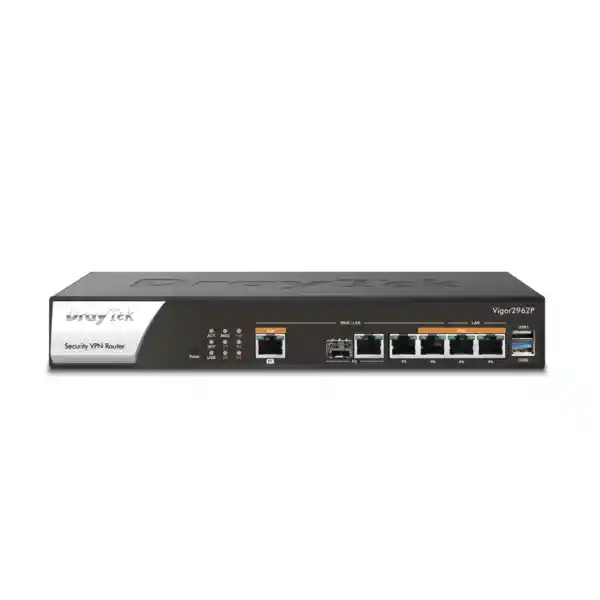
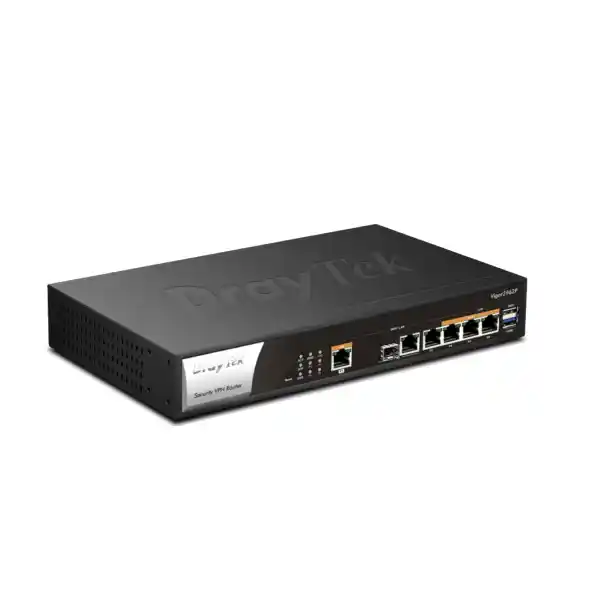
DrayTek Vigor2962P in Dubai, UAE
The DrayTek Vigor2962P is a high-performance business firewall router built for organizations that need dependable multi-WAN access, strong VPN capacity, flexible copper and fiber uplinks, segmented LAN design, policy routing, quality of service, and Power over Ethernet from the same edge platform. It is particularly relevant to UAE sites that have multiple ISP circuits, branch-to-head-office tunnels, IP cameras, Vigor access points, VoIP endpoints, guest networks, operational technology segments, or workloads that cannot tolerate a single Internet path.
What the Vigor2962P is designed to solve
A business edge router is useful only when its architecture matches the traffic, resilience and security requirements of the site. The Vigor2962P is not positioned as a basic small-office Internet gateway. Its value is in combining multiple WAN choices, enterprise routing functions, high tunnel counts, central management for DrayTek switches and access points, and PoE-capable Ethernet ports in one rack-mountable appliance. That combination reduces the number of independent devices needed at a branch edge and gives an administrator a single policy point for Internet access, inter-VLAN routing, VPN, failover decisions, QoS and selected PoE operations.
For a Dubai office, the practical use case might involve a primary fiber Internet circuit, a second ISP for resilience, several segmented VLANs for corporate users, IP phones, CCTV, guests and building systems, plus an IPsec tunnel to another UAE location or an overseas data center. For a retail group, the same platform can separate point-of-sale traffic from guest Wi-Fi and management devices while maintaining backup WAN connectivity. For a school, clinic or professional services office, it can provide policy-based routing, traffic prioritization and remote user VPN without turning the WAN edge into an unnecessarily complex collection of appliances.
The platform is also useful where the IT team wants to manage compatible Vigor access points and switches from the router itself. DrayTek lists management capacity for up to 50 VigorAPs and 30 VigorSwitches. That does not replace a full-scale enterprise controller in every environment, but for many distributed branches it creates a sensible operational model: the branch router becomes the local control point for discovery, provisioning, monitoring, firmware-oriented maintenance and common network settings. For wider service delivery across the UAE, FourTeck can combine the router with structured network planning through FourTeck UAE and broader implementation support through FourTeck IT Services UAE.
The central design question is therefore not simply whether the Vigor2962P is fast. The more useful question is whether its interface mix, tunnel scale, routing features, PoE allocation and management model fit the branch. The sections below translate the specification into deployment decisions so an IT manager can size the router against real traffic rather than relying on a headline throughput number alone.
Technical specification summary
Performance figures are vendor laboratory maxima and should be treated as sizing references rather than guaranteed application throughput. Enabled services, packet size, traffic direction, VPN encryption, session churn and policy complexity can change real-world results.
Interface architecture: 2.5GbE, SFP and configurable WAN/LAN roles
The physical interface design is one of the strongest reasons to choose the Vigor2962P over a conventional gigabit-only branch router. The front-panel arrangement combines a 2.5 Gigabit Ethernet RJ-45 interface, a Gigabit SFP/GbE combo interface, two additional Gigabit Ethernet configurable interfaces, and two fixed Gigabit Ethernet LAN ports. This gives architects several ways to map carrier handoffs and internal uplinks without adding a separate media converter for every fiber scenario.
A 2.5GbE interface is useful when the ISP delivers service above 1 Gbps or when a high-speed LAN trunk is needed toward a capable core switch. It also gives design headroom when the aggregate traffic of multiple internal networks would otherwise press against a 1GbE uplink. The SFP/GbE combo position is equally practical in buildings where the network edge is presented as optical Ethernet or where the router and aggregation switch are separated by a fiber run. Because it is a combo interface, the copper and SFP side are not separate simultaneous ports; the administrator should treat the combo position as one logical interface with alternative media choices.
The configurable ports are intentionally flexible. They can be allocated as WAN or LAN according to the software design. This matters in UAE deployments because branch connectivity is not uniform: one site may receive a direct Ethernet handoff, another may use an ISP CPE device with RJ-45, and another may need to connect an optical module. The Vigor2962P can be adapted to several of those conditions while keeping the same branch template. Standardizing one router family across branches simplifies configuration standards, spares planning, monitoring, operator training and change control.
There is a firmware consideration around maximum simultaneous WAN roles. DrayTek documentation has evolved: some regional material describes two simultaneous WAN links, while newer regional releases document support for more WAN roles on later firmware. For a production design, the safe engineering practice is to define the intended firmware train first, confirm which configurable ports can be active as WAN on that release, and then build the load-balancing or failover policy. This avoids designing a four-circuit architecture around a behavior that may depend on firmware version or regional software branch.
The port map also affects PoE planning. On the P model, DrayTek identifies selected configurable and fixed LAN interfaces as PoE-out capable. That allows the router to power compatible access points, IP cameras, phones or other IEEE 802.3af/at powered devices. The advantage is operational: a small branch can connect a few critical devices directly to the router and manage power cycles without deploying a separate PoE switch solely for those endpoints. For larger sites, however, a managed PoE switch remains the better distribution architecture because it offers higher port density, larger power budgets and clearer access-layer scaling.
2.5GbE edge flexibility
Useful for Internet services above 1 Gbps, higher-speed LAN trunks, or designs where multiple VLANs share a faster aggregate uplink.
Fiber-ready combo port
The Gigabit SFP/GbE combo interface helps accommodate optical or copper handoffs without changing the router platform.
PoE at the router edge
Selected ports can power standards-compliant endpoints, reducing hardware count in compact branches and simplifying remote power control.
Rack-mount deployment
The chassis suits communications racks and structured branch cabinets, supporting cleaner cabling, UPS integration and physical access control.
Multi-WAN load balancing, failover and policy routing
A second Internet circuit only improves resilience when the router makes predictable decisions about detection, failover and recovery. The Vigor2962P supports multi-WAN behavior intended for load balancing and failover. In practical terms, an administrator can use multiple uplinks to distribute sessions, reserve one circuit for backup, direct selected applications to a preferred provider, or combine these approaches. The design should be based on service requirements rather than simply enabling load balancing across every connection.
Session-based or IP-based balancing can help distribute general Internet traffic, but stateful applications may need persistence. Banking portals, SaaS platforms, SIP services, remote management portals and applications with strict source-IP controls can behave poorly if related sessions leave through different public addresses. Policy-based routing gives the engineer more control. A voice VLAN can be pinned to the provider with the best latency and jitter profile, guest browsing can use the lower-cost circuit, corporate SaaS traffic can prefer the higher-quality link, and backup traffic can be restricted to off-peak periods or to a dedicated WAN.
Failover detection is equally important. The router can use connectivity tests to decide whether a WAN remains usable. A cable being electrically up does not guarantee that the Internet beyond the first hop is reachable, so monitoring should be configured against reliable targets that represent actual upstream service. Failure criteria should avoid flapping during short transient events but still respond quickly enough for the applications being protected. If the branch supports real-time voice, payment terminals or VPN-based line-of-business systems, the acceptable failover interval may be much lower than for a site that only needs web browsing.
Recovery behavior should also be deliberate. When the primary circuit returns, immediately forcing every new session back to it can create churn. A better design may allow established sessions to expire naturally while new flows gradually return to the preferred path. The exact behavior depends on the application and business risk. For branches with static public services, inbound NAT, site-to-site VPN or allow-listed cloud systems, public IP address changes during failover must be considered as part of the application architecture.
The Vigor2962P also supports routing features beyond default-route Internet access. Static IPv4 and IPv6 routes, inter-VLAN routing, RIP, OSPF and BGP are listed in DrayTek specifications. This enables the router to participate in a more structured routed campus or branch design. OSPF can be useful when multiple internal routers exchange reachability, while BGP may be relevant in selected service-provider or multi-site scenarios. These protocols should not be enabled simply because they exist; route control, redistribution boundaries, authentication, convergence expectations and failure domains must be planned.
For Dubai and UAE businesses connecting to cloud workloads, headquarters, regional branches and third-party services, the most effective design is usually a combination of simple default routing for ordinary Internet traffic and explicit policies for applications that require predictable egress. FourTeck’s firewall-focused deployment resources at Firewall Dubai can be used alongside a site survey and WAN inventory to turn those requirements into an implementable rule set.
VPN architecture for branches, remote users and service networks
The Vigor2962P is designed to act as a substantial VPN gateway rather than a token remote-access endpoint. DrayTek publishes support for up to 200 concurrent VPN tunnels and up to 50 concurrent OpenVPN/SSL VPN tunnels. Published IPsec throughput reaches up to 1 Gbps and current global material lists SSL VPN throughput up to 800 Mbps under vendor test conditions. These figures make the router suitable for distributed organizations where multiple branches, cloud networks, remote administrators and mobile users need encrypted access through one edge device.
For site-to-site networking, IPsec is the usual foundation. A branch can establish a tunnel to headquarters, a co-location rack, another branch or a cloud VPN endpoint. When designing the tunnel, engineers should define local and remote prefixes, encryption domains, IKE version, authentication method, cipher suite, rekey behavior, dead-peer detection, NAT traversal requirements and route ownership. The Vigor platform supports common VPN protocols including IPsec, IKEv2, L2TP over IPsec, SSL-based access, OpenVPN and WireGuard on current firmware families, but the exact protocol mix available to a specific deployed firmware should be confirmed during commissioning.
Tunnel quantity and tunnel throughput are different sizing dimensions. A router can support many configured or established tunnels while the aggregate encrypted traffic remains limited by packet processing. A business with 100 low-bandwidth branch tunnels may consume less crypto throughput than a single backup job replicating hundreds of megabits per second. Conversely, a small number of tunnels carrying voice, database transactions and interactive applications may have low total bandwidth but very strict latency and packet-loss requirements. This is why VPN sizing should start with application flows rather than tunnel count alone.
Remote-user VPN adds a different set of concerns. Authentication, endpoint posture, user lifecycle, split tunneling and access control become more important than raw branch-to-branch throughput. DrayTek supports local and directory-oriented authentication options across its business router software. An enterprise should align authentication with its identity architecture and avoid broad remote-user access to entire internal networks. A better pattern is to place VPN users into controlled address pools and apply specific policies toward management systems, file services or application servers.
Multi-WAN adds resilience to VPN design. Where possible, site-to-site tunnels can be built with primary and secondary paths so loss of one ISP does not isolate the branch. The remote peer must also understand the backup addressing or dynamic endpoint behavior. For cloud VPNs, a second tunnel or gateway may be needed. For branch pairs using DrayTek equipment, tunnel failover and VPN trunk features can simplify the design. The business requirement should define whether the secondary path is active/standby, load shared or reserved for emergency use.
Encryption throughput should be validated with the actual cipher set and traffic profile before a high-bandwidth production migration. Vendor test figures are useful upper bounds, but real packets include bidirectional flows, mixed frame sizes, multiple policies and concurrent services. If a branch expects near-gigabit sustained encrypted transfers plus significant local Internet traffic, a pilot test is the correct approach. The same applies when security inspection, QoS and many VLAN policies are enabled at the same time.
Firewall policy, segmentation and content control
The router’s firewall is most effective when it is used as part of a segmented network rather than as a single perimeter filter protecting one flat LAN. The Vigor2962P supports up to 20 VLANs and 20 LAN subnets, allowing organizations to separate systems according to trust and function. A common branch design might create dedicated networks for corporate workstations, servers, voice, printers, CCTV, building-management systems, guest Wi-Fi, network management and contractor access. Inter-VLAN communication can then be restricted to the specific flows required by business applications.
Segmentation reduces the blast radius of an endpoint compromise. A guest device should not be able to reach a camera recorder; a camera should not initiate sessions toward finance systems; an IP phone normally needs access to call-control and time services rather than every internal subnet. The Vigor2962P provides IP-based firewall rules and object-oriented policy concepts that can be used to express these boundaries. Administrators should name objects and groups according to business function, because a policy set built from meaningful names is easier to audit than one consisting only of raw IP addresses.
The platform also provides DoS defense, spoofing defense, application-layer gateway functions, NAT controls, URL and keyword-oriented content filtering, and web-category options where the relevant subscription service is used. Content filtering should be treated as one control layer, not as a substitute for endpoint protection, secure DNS, browser security and user awareness. Web categories can help reduce exposure to undesirable or risky destinations, but no category database should be assumed to identify every malicious site in real time.
DNS security and reputation functions are useful when combined with explicit policy. If the branch permits unrestricted outbound DNS to arbitrary external resolvers, a local filtering strategy can be bypassed. A cleaner design allows approved DNS paths, logs anomalous behavior and separates infrastructure resolution from guest use. Where encrypted DNS is permitted, policy should be intentional. The objective is not to block modern protocols indiscriminately; it is to preserve the organization’s visibility and control model.
Firewall changes should follow change-control practice. Every rule should have an owner, a purpose, a defined source and destination, required services, logging behavior and review date. Temporary rules should expire. Broad any-to-any policies should be removed after migration. Management interfaces should be reachable only from trusted administration networks or secure VPN paths. These practices matter more to long-term security than simply owning a router with many available security features.
QoS and bandwidth management
Bandwidth management is essential when a branch has shared Internet connectivity and mixed application priorities. The Vigor2962P supports IP-based bandwidth limits, session limits and QoS mechanisms using traffic characteristics such as IP address, service type, DSCP and 802.1p markings. This allows administrators to protect voice, ERP, remote desktop or video conferencing from large software downloads, guest traffic or uncontrolled cloud synchronization.
A good QoS policy begins with congestion points. If the ISP circuit is 500 Mbps, shaping and prioritization should be designed around the usable service rate rather than the router’s maximum 2.2 Gbps NAT figure. Upstream bandwidth often requires more attention than downstream because business circuits can be asymmetric and cloud backup or surveillance uploads may saturate the smaller direction. QoS is most effective when the router controls the queue before packets reach the ISP bottleneck.
Session limits can also protect the branch from devices that create excessive concurrent connections. This is useful for guest networks and misbehaving endpoints, but limits should be tuned so legitimate collaboration and browser workloads are not constrained. Monitoring real session behavior before setting thresholds is preferable to arbitrary values.
PoE design and power budgeting
The P suffix distinguishes this model by adding PoE capability on selected Ethernet ports. DrayTek series documentation lists four PoE-capable ports and a 65 W total PoE budget, supporting standards-based 802.3af/at powered devices. That is sufficient for several typical access points, IP cameras or phones, but the total budget must be calculated from the maximum negotiated power of every connected endpoint.
Do not size PoE from average consumption alone. Wireless access points can draw more power when radios are active, cameras can increase draw when infrared illuminators switch on, and some devices negotiate a higher power class than their ordinary operating level. The engineering worksheet should record each device model, PoE standard, maximum wattage and port assignment, then preserve margin below the router’s total budget.
For larger access layers, use a dedicated managed PoE switch and reserve router PoE for critical or compact deployments. A separate switch improves port density, cabling layout, power headroom and fault isolation. Router-based PoE is most valuable when it removes an otherwise unnecessary switch or when remote reboot capability for a few essential devices has clear operational benefit.
Centralized management for VigorAP and VigorSwitch environments
The Vigor2962P can operate as more than a perimeter router when the branch also uses compatible DrayTek access points and switches. DrayTek’s integrated AP Management and Switch Management functions allow the router to discover supported devices, present centralized status, provision common settings and perform selected maintenance operations. Published limits list management of up to 50 Vigor access points and 30 Vigor switches. Those numbers describe platform capacity, but the operational suitability depends on how complex the wireless and switching environment becomes.
Automatic discovery reduces the time needed to identify devices on branch networks. Provisioning can help standardize SSIDs, VLAN mappings and selected switch settings. Central status simplifies first-line troubleshooting because an administrator can see whether a managed device is online before logging directly into it. Remote reboot functions are particularly valuable for distributed sites with no dedicated IT staff, as they can resolve certain edge failures without sending an engineer immediately.
For organizations with many branches, VigorACS provides a broader central-management model. Zero-touch provisioning, configuration control, monitoring and VPN-oriented automation can reduce the overhead of maintaining numerous independent routers. A branch template can define WAN expectations, VLAN numbering, DHCP scopes, VPN peer configuration, management access and monitoring settings. The template approach is more important than the management product itself: consistency reduces configuration drift and makes incident response easier.
Monitoring should include more than device uptime. WAN latency, packet loss, interface errors, CPU or resource pressure, NAT session counts, VPN status, DHCP utilization and PoE behavior can all indicate developing problems. Syslog and SNMP support allow the router to feed existing monitoring systems. Alert thresholds should be chosen to identify real service risk without overwhelming the operations team with noise.
A centralized router does not remove the need for configuration backups. Administrators should back up known-good configurations after controlled changes, document firmware versions, record module types in the SFP slot, and maintain recovery instructions. The branch should also have console or local access procedures for cases where remote management is unavailable.
Performance engineering: interpreting 2.2 Gbps NAT and VPN figures correctly
Headline throughput numbers are useful only when they are translated into the packet-processing conditions of the real network. DrayTek publishes a maximum NAT throughput of 2.2 Gbps for the Vigor2962P series. That number indicates that the platform can serve multi-gigabit-class aggregate routing workloads under vendor test conditions, but it does not mean every combination of services will sustain 2.2 Gbps simultaneously. Firewall rules, VPN encryption, QoS, session creation, packet size and bidirectional traffic all influence measured performance.
Packet size is especially important. Large sequential transfers are easier for many routers to process at high bit rates because fewer packets are handled per second. Voice, DNS, transactional traffic and mixed web sessions can create much higher packets-per-second pressure at a lower overall bandwidth. A network with thousands of clients opening short-lived connections can stress session tables and state processing differently from a site transferring a few large files.
The published 300,000 NAT-session capability gives substantial concurrency for a branch appliance. However, the number of users that can be supported is not determined by dividing 300,000 by an arbitrary session-per-user assumption. Modern browsers, cloud collaboration platforms and mobile devices can each open many parallel connections. Guest networks and IoT devices behave differently from managed desktops. A pilot or monitoring sample from the existing gateway is a much stronger sizing input than a generic user count.
VPN sizing should use encrypted throughput figures rather than NAT throughput. The current product material lists IPsec performance up to 1 Gbps and SSL VPN performance up to 800 Mbps. Those results are strong for a branch platform, but site-to-site replication, cloud backup and remote-user access can coincide. If the branch has a 1 Gbps Internet service and expects to encrypt nearly the entire circuit at peak, that leaves little safety margin. Engineering practice should reserve headroom for bursts, protocol overhead, control traffic and future growth.
Security features also interact. Adding complex content controls or extensive logging can change the processing path. The correct method is to define the enabled feature set first, then validate throughput with that feature set. If performance is mission-critical, generate representative traffic in both directions, include real policy rules and measure latency as well as throughput. A router that delivers the target bandwidth but adds excessive latency under load may still be unsuitable for voice or interactive applications.
DrayTek does not need to disclose a specific packet-processing ASIC model for engineers to size the appliance responsibly. Public vendor performance data, interface speeds, session limits and workload testing are the relevant inputs. Avoid assumptions about undocumented silicon. The deployable question is whether the configured Vigor2962P meets the organization’s service-level targets with measurable headroom.
Recommended deployment topologies
Dual-ISP branch edge
Use one wired or fiber handoff as the primary Internet path and a second provider as backup or load-sharing capacity. Place business-critical VLANs under explicit routing policy, configure reliable WAN health checks, and document what happens to VPN and inbound services when the public IP changes.
PoE micro-branch
Power a small number of access points, cameras or phones directly from the router while using the fixed LAN ports for a server, NVR or compact switch. This minimizes equipment count, but total PoE draw and cabling distances must remain within specification.
Segmented office gateway
Create separate VLANs for staff, voice, printers, guest Wi-Fi, cameras and management. Trunk those VLANs to a managed switch and allow inter-VLAN flows only where applications require them. Use QoS to protect delay-sensitive services.
VPN hub for distributed sites
Terminate multiple branch IPsec tunnels on the Vigor2962P when tunnel count and aggregate encrypted traffic fit its limits. Build clear route ownership and backup-path logic so failover does not create asymmetric routing.
Managed Wi-Fi branch
Use the router to coordinate compatible VigorAPs and VigorSwitches, standardizing VLANs, SSIDs and monitoring. This is attractive for chains with repeatable branch templates and limited local IT support.
Fiber handoff branch
Use the SFP side of the combo interface where a supported optical module and carrier handoff make fiber termination practical. Confirm optical type, wavelength, connector, distance and module compatibility before procurement.
UAE deployment considerations: ISP handoff, racks, cooling, power and support
A technically correct router configuration can still fail operationally if the site environment is ignored. UAE projects should begin by documenting the exact ISP handoff for every circuit. Record whether the provider presents copper Ethernet, optical Ethernet or a managed CPE device; whether addressing is static, dynamic or PPPoE; whether VLAN tagging is required; whether public IP addresses are routed or directly assigned; and whether the provider has restrictions affecting VPN, inbound services or bridge mode. The router port selection follows from those facts.
For fiber connectivity, SFP procurement must match the optical service. A generic statement such as “1G SFP” is not enough. The engineer needs single-mode versus multimode, wavelength, connector, distance, transmit power and receiver sensitivity. If the carrier terminates into its own ONT or NTE, the Vigor2962P may simply receive copper Ethernet and no router-side optical module is needed. Confirming this before quotation avoids purchasing unnecessary transceivers or arriving on site without the required interface.
The published operating temperature range reaches 45°C, but network racks should be maintained well below the maximum. Communications rooms in Dubai can experience high ambient temperature if cooling fails, and enclosed cabinets accumulate heat from switches, UPS systems, NVRs and PoE loads. Rack ventilation, cable management and equipment spacing should therefore be treated as part of the deployment. A router that is technically within its temperature specification may still experience reduced long-term reliability if operated continuously near environmental limits.
Power design should include an appropriately sized UPS, surge protection appropriate to the facility, and enough runtime for the organization’s continuity target. If the router powers access points or cameras directly, the UPS is indirectly supporting those endpoints as well. The load calculation should include the router’s own maximum draw, PoE load, ISP equipment, switches and any other devices sharing the UPS. A branch continuity plan is incomplete if the router remains powered but the carrier ONT or access switch does not.
Firmware should be standardized before rollout. Do not assume every unit arrives with the same version. Record the approved release, review relevant release notes, back up the configuration before upgrades, and test critical functions such as VPN, WAN failover, VLAN tagging and PoE after changes. The WAN-role behavior is particularly important because newer firmware may expose capabilities not present in earlier documentation.
Procurement teams should also verify regional lifecycle, warranty and support status. DrayTek product availability can differ between regions even when a global product page remains accessible. For UAE projects, the quotation should explicitly state supply status, included accessories, rack-mount hardware, power cable or adapter details, warranty route and expected firmware support. This prevents technical assumptions from becoming commercial surprises after purchase.
Organizations with projects spanning beyond the UAE can also coordinate consistent branch standards through FourTeck Africa where regional rollouts require compatible network architecture, documentation and procurement planning across multiple countries.
Sizing methodology for a DrayTek Vigor2962P project
Selecting a router by employee count alone is unreliable. Two 100-user offices can have completely different traffic patterns: one may run local applications with light Internet use, while another relies on cloud desktops, video meetings, off-site backup and continuous SaaS traffic. A proper sizing exercise evaluates bandwidth, session concurrency, encryption, packet rate, availability targets, segmentation and growth.
Start with WAN services. Record the committed and burst speeds of every circuit in both directions. If the site has 1 Gbps primary fiber and 500 Mbps secondary broadband, decide whether both will carry traffic concurrently or whether one is standby. Multi-WAN aggregate bandwidth can approach the router’s processing ceiling even when each individual circuit appears modest. Include planned upgrades; replacing a router shortly after moving from 500 Mbps to 2 Gbps service is avoidable when growth is known.
Measure current sessions. Existing firewall or router logs can reveal peak concurrent sessions, new connections per second and top talkers. Compare business hours with backup windows and guest peaks. The Vigor2962P’s published 300,000-session scale is substantial, but the important question is how much headroom remains during unusual events such as operating-system updates, conference days or large guest populations.
Separate encrypted and unencrypted traffic. Build a worksheet showing which flows traverse IPsec, SSL VPN, OpenVPN or WireGuard, and estimate peak concurrent bandwidth for each. A branch with 900 Mbps of ordinary Internet browsing and 100 Mbps of VPN traffic is different from one that replicates 800 Mbps through IPsec while remote users simultaneously connect through SSL VPN. Use the relevant encrypted performance figure for those workloads.
Count VLANs and routed segments. The router supports up to 20 VLANs and subnets in published specifications. List current and future segments, including management and quarantine networks that may not exist yet. Reserve IDs and IP addressing logically. Avoid consuming all available VLAN capacity on day one if the organization expects acquisitions, new departments, IoT systems or tenant separation.
Map PoE demand. List every device that could connect directly to PoE-capable router ports. Record the maximum device draw and required standard. Compare the total with the 65 W published budget and leave engineering margin. If the count or total power is close to the limit, select a managed PoE switch instead of forcing the router to act as the primary access switch.
Define failure behavior. Write down what must happen if WAN1 fails, WAN2 fails, an SFP fails, the router reboots or a VPN peer becomes unreachable. Decide which applications should stop, which should fail over, which should keep the same public IP through upstream design, and how users will be informed. A resilience design is only complete when the failure path is known before the failure occurs.
Apply growth and feature headroom. A new router should not operate at its ceiling on day one. Reserve capacity for higher ISP speeds, more users, additional tunnels, security policies and traffic bursts. The amount of headroom depends on business criticality, but a design with measurable margin is always preferable to one that depends on perfect laboratory conditions.
This methodology turns the procurement conversation from “Is 2.2 Gbps enough?” into a set of verifiable engineering questions. It also produces better documentation for future upgrades because the assumptions behind the original purchase are explicit.
Implementation workflow: from box to production
A structured implementation reduces downtime and avoids building the final configuration while users are waiting. The process should start off-network. Inventory the appliance, power supply or cord, rack kit and any SFP modules. Record serial numbers and support details. Upgrade to the approved firmware release if required, then reset or baseline the configuration so every branch starts from a known state.
Next, configure administrative access. Change default credentials, restrict management to trusted source networks, disable unnecessary local services, define secure HTTPS and SSH behavior where used, configure time synchronization and create backup or recovery procedures. If centralized authentication or monitoring will be used, test those integrations before the router reaches the production edge. Management should never depend solely on the same public path being changed during cutover.
Build LAN structure before WAN cutover. Create VLANs and subnets, define DHCP scopes and reservations, set DNS behavior, apply inter-VLAN policy, configure switch trunks and test local routing. Verify that guest or IoT segments cannot access protected networks. If existing subnets are being preserved, compare DHCP lease times and gateway addresses so client migration can occur predictably.
Then configure WAN links individually. Test addressing, DNS, MTU, VLAN tags, PPP credentials if applicable and raw Internet reachability. Measure latency and packet loss. After each WAN is stable, configure failover and load-balancing policies. Simulate loss by disconnecting the upstream path, not merely disabling a software interface, because the goal is to verify the actual detection chain. Confirm recovery behavior when the circuit returns.
VPN tunnels should be added after basic routing is proven. Bring up one tunnel at a time, validate phase-one and phase-two negotiation where IPsec is used, confirm routes in both directions and test allowed applications rather than only ping. If overlapping subnets exist between sites, resolve them deliberately; do not hide architecture conflicts behind broad NAT unless that is the chosen long-term design.
QoS and bandwidth controls should follow measurement. Set realistic WAN rates, classify essential applications, protect voice or real-time traffic, then test under artificial congestion if possible. Overly aggressive shaping can create performance problems that look like WAN faults. Logging should make policy decisions observable so engineers can see which class or rule affects a flow.
PoE devices can be introduced last, once the data-plane ports are confirmed. Check negotiated speed, PoE state and actual endpoint stability. For access points, verify VLAN trunking and SSID mapping. For cameras, confirm video traffic does not overwhelm the WAN or management path. For phones, validate call quality during WAN stress and failover scenarios.
Before sign-off, export a final configuration backup, capture screenshots or configuration records for critical settings, document the physical port map, record ISP support contacts and label cables. A clean handover is part of the technical solution because future troubleshooting depends on knowing what was intentionally deployed.
Security hardening checklist for production use
A new business router should not be considered production-ready immediately after Internet access begins working. Hardening must cover the management plane, WAN exposure, LAN segmentation, VPN identity, logging and configuration lifecycle. The first priority is administrative access. Use strong unique credentials, restrict management by source network, avoid exposing management services directly to the public Internet unless there is a documented requirement, and prefer VPN-protected administration for remote access.
Disable services that are not required. Legacy protocols create unnecessary attack surface. If Telnet or FTP management is not needed, do not leave it enabled. If SNMP is used, prefer secure versions and limit queries to monitoring systems. Syslog should be sent to a central collector where practical so evidence survives a local device reboot or failure. Time synchronization is essential because logs without reliable timestamps are difficult to correlate.
Firewall policy should default toward explicit need. Inbound port forwards must be documented and limited. Where a public service can instead be reached through VPN or a reverse proxy, avoid exposing it directly. UPnP should be disabled in business networks unless there is a specific, accepted use case. Guest networks should not inherit access to management or infrastructure subnets. Network devices should use a dedicated administration segment separated from ordinary user traffic.
VPN cryptography should use current protocols and strong algorithms supported by both peers. Legacy compatibility may be necessary during migration, but it should not become the permanent baseline. Pre-shared keys must be long and unique; certificate-based authentication can improve large-scale operations. Remote-user VPN accounts should be tied to individual identities rather than shared credentials. Where supported by the selected access method, multifactor authentication should be enabled.
Firmware maintenance is part of security. Subscribe to vendor advisories, keep an inventory of deployed versions and schedule upgrades with rollback plans. Do not automatically deploy a new release to every branch without validation. A representative test site can confirm WAN, VPN, VLAN, PoE and management behavior before broad rollout. Configuration backups should be stored securely because they may contain sensitive network information.
Finally, hardening should be auditable. Maintain a baseline stating which management services are allowed, which subnets may administer the router, which WAN services are exposed, which VPN protocols are approved and how often configuration and firmware are reviewed. Security is easier to maintain when the intended state is written down.
Who should choose the Vigor2962P — and when to consider a different class
The Vigor2962P is a strong fit for small and mid-sized organizations that need more than a basic dual-WAN router but do not require the scale of a large next-generation firewall cluster. It is especially attractive when the site benefits from 2.5GbE, SFP flexibility, numerous VPN tunnels, built-in PoE on a few ports and integrated management of DrayTek access points and switches. Branches with 100–250 active hosts can be realistic candidates when traffic patterns and enabled services remain within the platform’s performance envelope.
It is also suitable for organizations standardizing a repeatable branch design. A chain of clinics, retail outlets, schools, warehouses or professional offices can use the same VLAN numbering, WAN failover model, VPN template and monitoring approach across locations. Central management then becomes more valuable because configuration consistency reduces the probability of branch-specific mistakes.
A different platform should be considered when requirements exceed the Vigor2962P’s role. Examples include sustained multi-gigabit encrypted traffic beyond its VPN capacity, very high east-west routing throughput, hundreds of PoE access ports, advanced intrusion prevention with heavy inspection, large-scale application identification, integrated secure web gateway requirements, or data-center routing with extensive dynamic-routing policy. In those cases, the correct comparison may be against higher-performance DrayTek models or enterprise firewall platforms rather than stretching the Vigor2962P beyond its intended branch profile.
Likewise, if the environment requires a large wireless controller architecture, the built-in management limits should be treated as a boundary. Fifty managed access points is substantial for a branch or campus segment, but large hospitality or education deployments can require dedicated controller capabilities, RF analytics and redundancy beyond what a branch router is designed to provide.
The purchasing decision should therefore combine technical fit, lifecycle status, regional support and commercial availability. The Vigor2962P remains a technically capable design for many multi-WAN and VPN use cases, but the quotation stage should confirm current UAE stock, warranty path and the firmware feature set required by the project.
Decision recap for UAE IT teams
Use the following recap as a technical decision aid before requesting a quotation. The Vigor2962P is most compelling when several requirements align: resilient WAN access, strong IPsec throughput, many concurrent tunnels, segmented LAN architecture, mixed copper/fiber connectivity, and a small amount of directly powered PoE equipment. It becomes less compelling when the site’s dominant requirement is advanced security inspection at multi-gigabit speeds or high-density PoE switching.
Choose for WAN resilience
The configurable 2.5GbE, SFP/GbE and Gigabit interfaces support flexible carrier designs. Confirm simultaneous WAN behavior on the intended firmware, then build explicit failover and policy-routing logic.
Choose for VPN-heavy branches
Up to 200 VPN tunnels, 50 OpenVPN/SSL VPN tunnels and published IPsec throughput up to 1 Gbps provide useful scale for branch connectivity and remote access.
Choose for segmented LANs
Up to 20 VLANs and subnets allow separation of users, voice, guest, CCTV, IoT and management traffic with inter-VLAN policy at the edge.
Choose for compact PoE sites
Four PoE-capable ports and a published 65 W budget can remove the need for a separate PoE switch in small branches. Larger sites should use a dedicated access-layer switch.
Validate high-throughput security needs
Do not equate NAT throughput with full-feature security throughput. Test the exact mix of firewall, QoS, VPN and content controls required by the production policy.
Validate regional lifecycle
Confirm UAE availability, warranty, supported firmware and replacement options at quotation time because product lifecycle status can differ between DrayTek regions.
Quotation input checklist
Providing these details before quotation allows the router, optics, PoE design and implementation scope to be sized correctly rather than priced as an isolated appliance.
Final consultation panel: designing the Vigor2962P as part of the network
A production router should be quoted as part of a topology, not as an isolated box. The Vigor2962P can combine WAN resilience, VPN, segmentation, QoS, PoE and centralized management very effectively when those functions are mapped to a clear branch design. The best result comes from confirming the carrier handoffs, firmware requirements, security boundaries, VPN peers, PoE loads and monitoring model before deployment.
FourTeck can use the quotation checklist above to determine whether the Vigor2962P is appropriately sized, whether a separate PoE switch is advisable, whether SFP optics are required, how the VLAN and VPN plan should be structured, and what implementation work is needed for the Dubai or UAE site. The same information also makes it easier to identify when a higher-capacity platform would be more appropriate.
For procurement, request the router together with the intended firmware baseline, support expectations, required optics, rack accessories and implementation scope. This creates a complete deliverable and avoids last-minute changes during cutover.
Before approval, confirm
• WAN count and handoff media
• Required firmware and WAN-role behavior
• Peak Internet and encrypted traffic
• VLAN and inter-VLAN policy
• PoE device wattage and quantity
• Remote management and monitoring
• UAE warranty and lifecycle availability
Technical specifications and feature availability can change with firmware, region and product lifecycle. Throughput values referenced on this page are maximum vendor test results under controlled conditions and should be validated against the intended configuration. SFP compatibility, PoE budget, simultaneous WAN behavior, subscription-dependent filtering services and UAE supply status should be confirmed as part of the final quotation and deployment review.

Reviews
There are no reviews yet.