
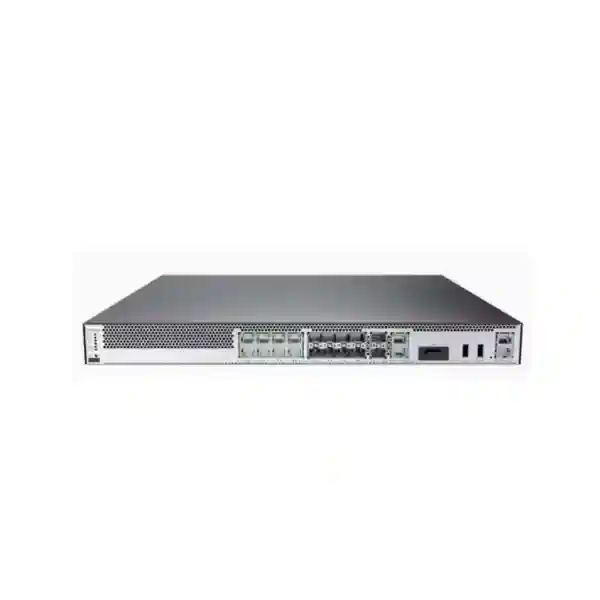
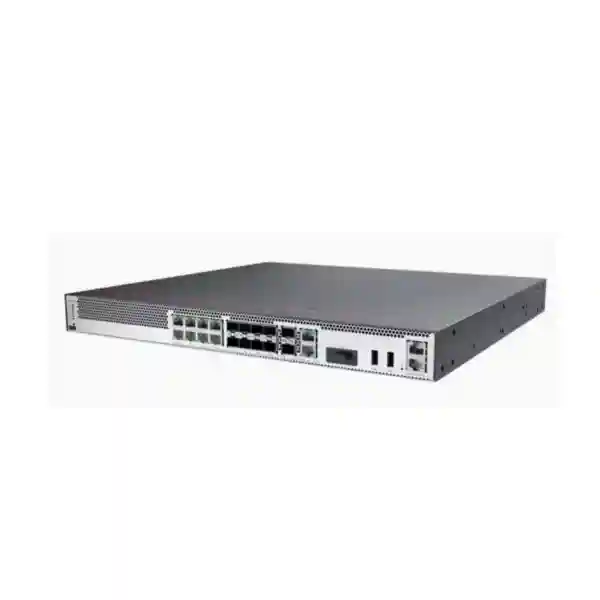
Huawei HiSecEngine USG6000F-E07
A high-density 1U security gateway for enterprise internet edges, distributed organizations and security-consolidation projects that need copper, fiber and 10 Gigabit Ethernet connectivity in one platform.
The USG6000F-E07 brings firewall, intrusion prevention, antivirus, application control, URL filtering, Anti-DDoS, bandwidth management, VPN and routing functions into a unified security appliance. Its fixed interface set is particularly useful for UAE organizations that want direct connectivity to mixed access switches, carrier handoffs, server or aggregation uplinks, and resilient ISP circuits without adding unnecessary interface modules.
Verified platform highlights
32 fixed service ports: 16 × GE RJ45, 12 × GE SFP and 4 × 10GE SFP+.
1U chassis: compact rack deployment with front-to-rear airflow.
Optional storage: 2.5-inch SATA capacities for local logging and operational requirements.
Integrated security: NGFW, IPS, antivirus, URL filtering, VPN, Anti-DDoS and application-aware policy.
GE copper, GE SFP and 10GE SFP+ service interfaces support practical mixed-media edge designs.
442 × 420 × 43.6 mm chassis dimensions suit standard enterprise and data-room racks.
Huawei documents recognition of more than 6000 applications with application-aware access control.
Optional redundant AC power is available for deployments that require stronger edge availability.
What the Huawei HiSecEngine USG6000F-E07 is designed to do
The Huawei HiSecEngine USG6000F-E07 is part of Huawei’s USG6000F-E family of fixed-form-factor enterprise firewalls. The platform is intended to sit at the boundary between trusted enterprise networks and untrusted or differently trusted networks such as internet service-provider circuits, partner networks, cloud interconnects, guest environments, branch WANs, public service zones and other routed domains. In practical terms, the appliance becomes a policy enforcement, inspection, routing and VPN termination point through which organizations can control how applications and users communicate.
For an enterprise in Dubai, Abu Dhabi, Sharjah or another UAE location, the E07 can be considered when the edge must handle several different physical media types. Sixteen Gigabit Ethernet RJ45 interfaces provide direct copper connectivity for devices, switch uplinks, handoffs and management-oriented designs. Twelve Gigabit Ethernet SFP interfaces are useful where fiber is preferred for carrier presentation, inter-building links, distribution switching or electrically isolated connections. Four 10GE SFP+ interfaces provide higher-speed uplink options for aggregation, server-facing security zones or high-bandwidth WAN and core connections. The important engineering benefit is not simply the number of ports; it is the ability to create a security architecture without forcing every segment through the same media converter or access switch.
The platform also integrates multiple security engines so that a single policy path can apply traditional stateful firewall decisions alongside application identification, intrusion prevention, malware inspection, URL controls, bandwidth management and Anti-DDoS functions. Consolidation can reduce the operational friction of maintaining separate point products, but the design should still be based on the organization’s risk model. For example, a company may use the firewall as its primary inline enforcement device while retaining separate sandboxing, endpoint security, email security, DNS security or security-information-and-event-management platforms. The USG6000F-E07 should therefore be viewed as a security control point within a broader architecture rather than as a substitute for every other defensive layer.
FourTeck’s role in a deployment is to translate the product’s capabilities into a bill of materials and implementation plan. That means validating service bandwidth, expected concurrent users and sessions, internet uplink speeds, VPN topology, encrypted-traffic percentage, application mix, inspection services, high-availability requirements, routing complexity, transceiver types, storage needs, log-retention policy and support expectations. A useful quotation is not just a firewall part number; it is a complete edge design with the correct subscriptions, optics, accessories, power model and implementation scope.
USG6000F-E07 hardware and environmental specification
Performance values should be validated against the exact Huawei software release, license bundle, enabled inspection features and traffic profile used for the project. FourTeck recommends sizing from the required security-service throughput rather than relying only on raw forwarding capacity.
Port architecture: how to use 16 GE RJ45, 12 GE SFP and 4 10GE SFP+
The fixed port mix is one of the most useful characteristics of the USG6000F-E07. A firewall rarely operates as a simple two-port device in a modern enterprise. Internet-edge designs commonly need separate interfaces for primary and backup carriers, a dedicated DMZ, one or more internal security zones, management connectivity, partner networks, guest traffic, site-to-site VPN underlays, cloud cross-connects, high-availability links and sometimes dedicated monitoring or service networks. With thirty-two fixed service interfaces across copper and optical media, the E07 can accommodate these segmentation patterns without immediately consuming an external aggregation layer solely to create physical separation.
The sixteen GE RJ45 ports are appropriate for standard 1000BASE-T connectivity when the connected equipment presents copper. Typical examples include ISP CPE handoffs, access or distribution switches, out-of-band management networks, local servers, network-service appliances or temporary migration circuits. Physical copper separation can be useful in phased projects where existing infrastructure cannot yet be redesigned. The twelve GE SFP ports add flexibility for 1G optical circuits and longer-distance campus links. Fiber interfaces are valuable in electrically noisy environments, between buildings, across structured fiber plants, or when carriers deliver Ethernet on optical transceivers. Optics must be matched on wavelength, fiber type, distance, connector and supported module type.
The four 10GE SFP+ interfaces can be assigned to higher-throughput trust, untrust, DMZ or aggregation paths. In a dual-core environment, two 10G links may face redundant core switches while the remaining 10G ports connect high-speed internet handoffs, a data-center distribution layer or a large server segment. In an HA pair, interface planning must consider how the second firewall will connect to the same switching and carrier infrastructure. Physical diversity is only useful when the upstream and downstream topology is equally resilient; connecting two firewall members to one switch, one PDU and one ISP may leave several unaddressed single points of failure.
Port density also affects policy design. Every physical interface should map to a logical role rather than becoming an unstructured collection of links. A clean design typically defines zones by trust level and business function, uses clear interface descriptions, assigns addresses from documented network ranges, enables only required management protocols, and keeps unused ports administratively disabled. VLAN subinterfaces can create additional logical segmentation where appropriate, but physical interfaces can still be preferable for higher-risk boundaries or when operational teams need a visibly separate path.
Before procurement, FourTeck can produce a port map that lists interface number, media type, speed, transceiver, connected device, VLAN or routed network, security zone, IP addressing and redundancy role. This port map becomes a practical bridge between the bill of materials and the implementation configuration, reducing the chance of discovering during installation that an ISP presents fiber while only copper accessories were ordered, that a 10G optic is incompatible with the switch-side optic, or that the HA design requires more dedicated interfaces than originally assumed.
Integrated security controls on the USG6000F-E07
Stateful firewall & policy
Security policy can be built from network and transport attributes, security zones, applications and time conditions. This allows internet access, server publishing and inter-zone traffic to be controlled with context rather than broad source-to-destination rules alone.
Intrusion prevention
Huawei documents IPS coverage for vulnerability exploitation, web attacks such as SQL injection and cross-site scripting, botnet or remote-control traffic, Trojans and brute-force behavior, with support for custom signatures and behavior-oriented controls.
Antivirus
The platform provides intelligent antivirus inspection for malicious content. In deployment, antivirus policy should be aligned with traffic type, acceptable latency, privacy requirements and the endpoint-security stack rather than enabled indiscriminately on every flow.
URL filtering
URL controls can classify and regulate browsing by category, user or group, time period and security zone. This is useful for reducing exposure, applying acceptable-use policy and limiting high-risk categories at the network edge.
Application control
Recognition of more than 6000 applications gives administrators an application-aware policy layer. Controls can be designed around business intent—for example, allowing a collaboration platform while applying different treatment to non-business file transfer or entertainment traffic.
Anti-DDoS
The firewall supports protection against common flood patterns including SYN and UDP floods. Edge controls should complement, not replace, upstream carrier or cloud scrubbing for volumetric attacks that can saturate the internet circuit before traffic reaches the appliance.
Bandwidth management
Application awareness can be combined with bandwidth controls, minimum guarantees and forwarding priorities. This helps protect business-critical applications when internet or WAN circuits are congested and gives network teams a deterministic method for managing competing traffic classes.
Security virtualization
The platform supports virtualized security services so separate tenants or administrative domains can operate isolated firewall, IPS, antivirus or VPN contexts on the same physical system where the design and license model permit.
Application visibility and policy design
Traditional firewall rules that rely only on source IP, destination IP and TCP or UDP port numbers are increasingly insufficient. Many modern applications use shared web ports, dynamic endpoints, content-delivery networks and encrypted sessions. Huawei positions the USG6000F-E family with application identification so traffic can be classified at an application layer and then associated with security policy. For an enterprise security team, this can make policies more meaningful: a rule can reflect an approved business application rather than simply allowing all outbound TCP 443 traffic because the application happens to use HTTPS.
Application control should begin with discovery. During migration, administrators can observe which applications are used, which business units depend on them, where they connect, and what volume they generate. The next step is classification: critical business applications, sanctioned productivity platforms, infrastructure services, tolerated applications, high-risk categories and explicitly prohibited traffic. Policies can then be built to allow, shape, inspect, log or deny traffic according to business need. This is safer than beginning with aggressive blocking before dependencies are understood.
The same principle applies to URL filtering. Category-based restrictions are effective only when exceptions, authentication, remote users and business workflows are considered. Finance, HR, marketing, engineering and operations teams often require access to very different destinations. A broad policy may cause unnecessary support tickets, while an overly permissive policy can defeat the purpose of web controls. User- or group-aware rules, when integrated correctly, can provide more precise enforcement than source IP alone, particularly in environments where DHCP, Wi-Fi mobility or shared subnets change endpoint addresses frequently.
Logging is equally important. An application-aware rule that is never reviewed provides little operational value. Security teams should decide which events require local logs, centralized logs, email notifications, dashboards or escalation into a SIEM. High-volume permitted traffic may need summary logging, while denied connections to protected services or IPS detections may deserve higher retention and alert priority. Optional local storage on the E07 can be part of the logging strategy, but retention calculations should account for log rate, event verbosity, traffic volume and compliance requirements.
A well-designed policy base is also maintainable. FourTeck recommends descriptive rule names, explicit business owners, ticket or change references, comments that explain purpose, and periodic rule recertification. Temporary rules should have expiry dates. Broad any-to-any access should be exceptional and justified. When the firewall is deployed as an HA pair, both members should be managed through the intended synchronized configuration model so policy consistency is preserved during failover.
Intrusion prevention, malware controls and web-attack defense
Huawei documents the USG6000F-E family with intrusion-prevention capabilities for known vulnerability attacks, web attacks and other malicious traffic patterns, along with custom signatures and brute-force detection. For security architects, the key design question is where IPS should be applied. Inspection can be placed on internet-to-DMZ flows, outbound user traffic, partner links, inter-zone communications and selected server segments. Applying the highest inspection level to every packet may be unnecessary, while restricting IPS only to inbound internet traffic can miss lateral or outbound attack paths.
Policy tuning is essential because signatures vary in relevance. An IPS profile protecting a Windows server segment should prioritize applicable operating-system, middleware and application vulnerabilities. A profile for general outbound users can focus on exploit kits, command-and-control indicators, browser-related attacks and common protocol abuse. False positives should be investigated rather than simply ignored. If a legitimate application triggers a signature, the preferred response is to understand why, verify whether the behavior is expected, and make the narrowest exception possible.
Antivirus inspection adds another control layer by checking supported content flows for malicious files or patterns. Network antivirus complements endpoint detection and response; it does not eliminate the need for endpoint controls. The firewall may detect malicious content before it reaches a host, while endpoint security can observe process execution, memory behavior and local persistence that a network appliance cannot see. In mature environments, both layers contribute telemetry to incident response.
Encrypted traffic introduces an important architectural consideration. When payloads are protected by TLS, an inline device cannot inspect content it cannot decrypt. Organizations therefore need an explicit strategy for permitted encrypted-traffic inspection, certificate distribution, privacy exceptions, regulated applications and sensitive categories. Inspection can materially change firewall resource requirements, so encrypted-traffic percentages should be part of sizing. The design should also consider applications that use certificate pinning or protocols that do not tolerate decryption proxies.
For internet-facing web services, the E07’s IPS and Anti-DDoS capabilities can reduce risk, but organizations should still consider dedicated web application firewalls, cloud DDoS scrubbing, CDN protection and secure coding controls when exposure warrants them. Network security works best as overlapping layers: the edge firewall blocks unauthorized network access and known malicious patterns; application-specific controls understand HTTP or API semantics in more depth; endpoint and server security protect workloads; and monitoring systems correlate events across all layers.
VPN architecture: IPsec, SSL VPN, GRE and secure branch connectivity
The USG6000F-E family supports multiple VPN technologies, including IPsec VPN, SSL VPN and GRE. These options allow the E07 to serve as more than an internet security gateway: it can become a secure WAN hub for branches, data centers, cloud networks, project offices and third-party connections. The right VPN design depends on who is connecting, which networks must communicate, how routes are exchanged, the required cryptographic policy and whether traffic should use one or multiple internet service providers.
Site-to-site IPsec is a common choice for permanent branch or partner connectivity. The design should define tunnel endpoints, protected subnets, internet underlay addresses, IKE and IPsec parameters, authentication method, encryption algorithms, lifetimes, dead-peer detection and routing behavior. Static routes can be adequate for a small number of tunnels, while larger topologies may benefit from dynamic routing over secure tunnels or from a more structured hub-and-spoke architecture. Redundant ISPs create additional decisions: should each branch form tunnels to both circuits, should failover be route-driven, and how should asymmetric paths be handled?
SSL VPN can provide controlled remote access for users when supported by the chosen software and license package. Remote-access design must include identity, multi-factor authentication where available, authorization groups, endpoint posture requirements, DNS behavior, split-tunnel versus full-tunnel policy and logging. Full tunneling sends all user traffic through the corporate security edge and can improve inspection consistency, but it increases bandwidth and firewall load. Split tunneling conserves resources but creates a path where some traffic bypasses the enterprise edge. The correct approach depends on risk tolerance and workforce requirements.
GRE is useful for encapsulation and routing scenarios but does not provide confidentiality by itself. When encryption is required, GRE can be combined with an appropriate secure transport design. Huawei documentation also lists multiple cryptographic algorithms. The project should follow the organization’s current security standard rather than enabling legacy algorithms merely because they are technically supported. Procurement and implementation teams should confirm the exact feature and algorithm support in the selected software release.
VPN throughput is not the same as plain firewall throughput, and real traffic rarely resembles a single synthetic benchmark. Packet size, encryption algorithm, tunnel count, session behavior, security inspection and routing all affect practical capacity. FourTeck therefore sizes remote-access and site-to-site VPN projects from expected peak encrypted bandwidth, user concurrency, branch count, resiliency objectives and future growth instead of treating the physical WAN port speed as the only sizing input.
High availability and resilient edge design
Huawei documentation for the USG6000F-E family lists active/standby and active/active high-availability capabilities, along with transparent, routing and hybrid deployment modes. In a production UAE enterprise, an HA pair is often preferred when the firewall is a critical internet, VPN or inter-zone control point. The objective is to prevent failure of one chassis from causing a prolonged outage, but true resilience requires more than buying two firewalls.
The design should include separate power feeds where possible, redundant upstream and downstream switches, diverse carrier circuits, documented HA links, consistent interface media, synchronized configuration, resilient routing and tested failover procedures. Optional dual power supplies on each appliance can reduce the risk of a single PSU or feed issue, particularly when each PSU connects to a different UPS or PDU. In a single-rack design, power diversity should be checked end to end: separate PSUs connected to the same failed PDU do not provide meaningful independence.
Routing convergence is another factor. If the active firewall changes, upstream and downstream devices need to forward traffic correctly to the new active path. Static routing may work in straightforward topologies; dynamic routing can improve convergence in larger environments, but it also increases design complexity. Huawei documents support for IPv4 and IPv6 routing protocols including RIP, OSPF, BGP and IS-IS families, so the firewall can participate in sophisticated routed edges when that is operationally appropriate.
Failover should be tested under controlled conditions before the service is considered production-ready. Test cases should include firewall member failure, interface failure, primary ISP outage, upstream-switch failure, downstream-switch failure, power-source failure and recovery. Application owners should validate that sensitive sessions behave acceptably. Some connections may need to re-establish after path changes even if the network itself converges quickly. A runbook should explain how to determine the active member, identify a failed component, safely restore service and avoid split-brain or routing loops.
Routing, multi-WAN and business-aware path selection
The E07 can perform more than static default routing. Huawei documents support for multiple IPv4 and IPv6 routing protocols as well as business-aware policy routing and intelligent path selection based on factors such as bandwidth proportion and link health. This matters when an enterprise has two or more internet carriers, private WAN services, cloud connectivity or separate routes for different application classes.
A basic dual-ISP design may use a preferred default route through the primary provider and a backup default through the secondary. This is simple but can waste available bandwidth. A more advanced design can distribute traffic according to link quality, bandwidth, application or business priority. For example, corporate SaaS and voice traffic might prefer the lowest-latency stable path, bulk backups may use a higher-capacity but less expensive circuit, and guest internet traffic may be steered away from a business-critical WAN. The firewall’s policy and path-selection capabilities can enforce this logic when configured carefully.
Dynamic routing is appropriate where route scale or topology changes justify it. OSPF can integrate the firewall into an enterprise IGP, while BGP can be used with service providers, data centers or large multi-site architectures. The exact design depends on prefix ownership, ASN strategy, failover objectives, route filtering and operational competence. A firewall participating in BGP should have tightly defined import and export policies; accidental route propagation can create serious outages or security exposure.
IPv6 should also be planned explicitly. Deployments that enable IPv6 at the carrier edge without equivalent IPv6 firewall policy, logging and monitoring can create a parallel security path that receives less scrutiny than IPv4. Huawei documentation lists IPv6 routing support, so dual-stack environments can apply a structured approach. Addressing, neighbor discovery, route advertisements, DNS, VPN interactions and security zones should all be included in the design rather than treating IPv6 as an afterthought.
FourTeck can align routing policy with the organization’s actual circuit inventory and switch architecture. During discovery, we typically collect ISP handoff details, public address blocks, provider gateway information, BGP parameters where applicable, private WAN routes, branch subnets, cloud prefixes and failover expectations. This information determines whether the E07 will operate primarily as a security gateway, as an edge router and firewall combined, or as one component in a routed architecture with dedicated routers.
Sizing the Huawei USG6000F-E07 correctly
Firewall sizing is one of the most important parts of procurement. A model that looks adequate from interface speed alone can become constrained when security inspection, VPN encryption, high connection rates and future bandwidth growth are added. Conversely, oversizing without a requirement can waste budget and complicate justification. The correct approach is to define workload first and choose the appliance second.
Start with internet and WAN bandwidth. Record the contracted speed of every circuit and the realistic aggregate peak. If there are two 1 Gbps providers, determine whether both can carry traffic simultaneously or whether one is standby. If a 10 Gbps handoff is installed, ask whether actual traffic is near 10 Gbps or whether the physical interface is simply the carrier standard. Then estimate growth over the expected firewall lifecycle. Bandwidth demand often increases faster than headcount because cloud applications, video, backups, software distribution and remote work can change traffic patterns substantially.
Next, define security-service usage. Stateful firewalling is less computationally intensive than deep content inspection. IPS, antivirus, application control, URL filtering and encrypted-traffic inspection can all affect usable capacity. A project that needs the complete security stack should be sized against the relevant inspected-traffic requirement, not only a headline firewall number. The same principle applies to VPN. Encryption and decryption consume resources and can interact with inspection depending on traffic flow.
Connection behavior matters as well. A network with thousands of users, IoT devices, public web services or heavily microservice-oriented applications may create far more concurrent sessions and new connections per second than a conventional office with the same bandwidth. NAT can add state requirements, while large guest networks may produce short-lived sessions at high rates. Peak events—such as software updates after patch Tuesday, a company-wide video meeting, cloud backup windows or online sales campaigns—should be considered rather than sizing only from daily averages.
High availability usually means each member should be able to carry the required load after failover. It is risky to size a pair under the assumption that both appliances will always share traffic if the failure mode requires one remaining member to support most or all services. The resilience target must be reflected in capacity planning. Similarly, future enablement of additional inspection services should be considered if subscriptions are likely to expand later.
For a precise quotation, FourTeck can work from a sizing worksheet that captures WAN speeds, peak utilization, user count, device count, branch count, VPN bandwidth, remote users, application categories, public services, security profiles, log rate, retention, routing protocols, HA mode and growth horizon. The outcome may confirm the USG6000F-E07 as the right platform or identify a need to move to another model. This requirement-led method avoids selecting a firewall solely from price or port count.
Storage, logging and security operations
The USG6000F-E07 supports optional 2.5-inch SATA storage in several capacities. Local storage can be useful for log collection, reporting or operational functions supported by the chosen software release, but storage should be selected from a retention requirement rather than simply choosing the largest drive. Security logs can grow quickly, especially when detailed traffic events, IPS detections, URL access, application records and system events are enabled.
A logging plan should identify what must be retained, for how long, and where the authoritative copy resides. Local firewall logs are convenient for troubleshooting and short-term visibility, while centralized log platforms provide longer retention, cross-device search, correlation and protection against data loss if the appliance fails. Larger organizations often forward logs to a SIEM, security analytics platform or centralized Huawei management environment. The firewall remains the event source, but long-term investigations benefit from data being stored outside the same device that enforces policy.
Log quality is more important than volume. If every permitted connection is logged without context, analysts may be overwhelmed. High-value events include administrative changes, authentication failures, VPN events, security-policy denies, IPS and malware detections, HA state changes, interface transitions, routing changes and other conditions that indicate security or availability impact. For accepted user traffic, organizations can choose a level of detail that balances troubleshooting needs, privacy and storage capacity.
Time synchronization is a foundational requirement. Firewalls, switches, servers, endpoints and log collectors should use reliable NTP sources so events can be correlated accurately. A five-minute clock difference can make an incident timeline difficult to reconstruct. Administrative authentication and role separation should also be planned. Security administrators may need full policy privileges, while operations teams may require read-only access or limited network functions. Shared administrator accounts should be avoided where individual accountability is required.
Operational reporting can support capacity management as well as security. Trends in application usage, WAN utilization, blocked attacks, VPN consumption and user behavior can show whether policy is effective and when additional capacity is needed. FourTeck can include logging and monitoring requirements in the implementation scope and can also integrate broader UAE infrastructure services through FourTeck IT Services UAE when the project includes server, monitoring, migration or managed infrastructure components.
Deployment modes for different network designs
Huawei documents transparent, routing and hybrid deployment modes for the USG6000F-E family. The choice affects how the firewall integrates with the existing network and how disruptive a migration will be. Routed mode is common when the firewall becomes a Layer 3 gateway between security zones. Interfaces or subinterfaces receive IP addresses, routes are installed, and the appliance makes forwarding decisions. This provides clear control and supports sophisticated routing, NAT and VPN designs.
Transparent mode can be attractive when an organization needs inline security inspection without immediately changing the IP addressing or default gateways of surrounding devices. The firewall sits logically between Layer 2 segments and enforces policy while preserving much of the existing routing architecture. This can reduce migration complexity, although transparent designs still require careful planning for management, HA, failure behavior and loop prevention.
Hybrid designs combine characteristics where different interfaces serve different functions. This may be useful during staged migrations or in organizations with legacy networks that cannot be redesigned simultaneously. For example, one set of interfaces may operate in a routed internet-edge role while another path provides transparent inspection between existing segments. Hybrid flexibility is valuable, but it increases operational complexity, so documentation becomes especially important.
Network Address Translation is typically part of routed internet-edge deployments. Source NAT allows private internal addresses to access external networks using approved public addresses, while destination NAT or server publishing makes selected internal services reachable from outside. NAT rules should be tightly associated with security policy. Publishing a server is not just an address-translation task; the corresponding inbound policy should permit only required ports from appropriate sources, apply IPS where suitable, and log relevant events.
Migration sequencing should minimize downtime. FourTeck commonly recommends documenting the current firewall rules, NAT objects, routes, VPNs, interfaces and dependencies before conversion. Rules can then be normalized and translated into the new policy structure, unused objects removed after validation, and a rollback plan prepared. Testing should cover internet access, DNS, email, cloud applications, published services, site-to-site VPNs, remote access, monitoring and routing failover. The final configuration should represent the intended security architecture rather than being a one-to-one copy of years of legacy exceptions.
UAE deployment considerations: racks, power, heat and cabling
The USG6000F-E07 is a 1U appliance with documented dimensions of 442 × 420 × 43.6 mm and front-to-rear airflow. Those figures should be checked against the actual rack before delivery. A cabinet must provide adequate depth not only for the chassis but also for power connectors, fiber bend radius, copper patch leads and service access. Dense racks can become difficult to maintain when cables block the rear exhaust or when patching is stretched tightly across neighboring equipment.
The maximum documented power consumption is 123 W, and the appliance supports optional redundant AC power. UPS sizing should include the firewall plus connected network equipment and the desired runtime. If two power supplies are installed, connecting them to separate protected feeds provides greater resilience than connecting both to the same source. In data centers, confirm available plug types and PDU outlet capacity. In office server rooms, verify that the electrical circuit and UPS are maintained and that the rack is properly earthed.
Environmental control is especially important in the UAE. Huawei specifies a 0°C to 45°C operating range and non-condensing 5% to 95% relative humidity. These values are equipment limits, not an invitation to operate continuously at the upper boundary. Stable conditioned airflow improves reliability and gives operational margin if the room cooling system degrades. The firewall should not be installed in a sealed cabinet, near an uncontrolled heat source or where recirculated hot exhaust enters the front intake.
Fiber planning should specify the exact optics and patch cords for every SFP or SFP+ link. Multimode versus single-mode fiber, wavelength, reach and connector type must match both ends. For copper, use structured cabling that supports the required Ethernet speed and maintain clear labeling. Each patch lead should correspond to the port map, with labels at both ends. This is particularly valuable during emergency maintenance, when engineers need to identify the ISP, core, DMZ or HA link without tracing an unmarked bundle.
For projects that also include server or rack modernization, FourTeck Server Dubai can be used as a reference point for the broader infrastructure scope, while FourTeck UAE covers enterprise networking and technology requirements beyond the firewall itself.
Use case 1: primary internet edge for a Dubai headquarters
A common deployment places an HA pair of USG6000F-E07 firewalls between redundant internet providers and redundant core or distribution switches. The 10GE SFP+ ports can be assigned to higher-speed carrier and core connections, while 1G copper or fiber ports serve DMZs, management networks and secondary circuits. Security zones separate internal users, public services, guest networks and infrastructure management. Outbound policies use application and URL controls, inbound server publishing uses tightly scoped rules with IPS, and VPN services terminate on dedicated interfaces or logical zones.
The edge can also perform intelligent path selection across the two ISPs. Critical SaaS and business traffic can prefer the better-performing circuit, while less sensitive categories can use available secondary capacity. If one provider fails, link-health tracking and routing policy can move traffic to the surviving path. For reliable failover, public services may require DNS, BGP or provider-specific design considerations; a second ISP does not automatically make an internet-facing application reachable on the same public IP addresses.
The security policy should start from explicit business flows. Users need access to approved internet applications and cloud services. Public web servers may need inbound HTTPS from the internet and controlled outbound access for updates or APIs. DNS, NTP and management services need their own rules. Guest networks should be isolated from internal corporate networks. Infrastructure management should originate only from dedicated administrator subnets. Each of these flows can use a separate zone and policy so logs and troubleshooting remain clear.
This design suits organizations that want a consolidated control point at headquarters while retaining room for future 10G connectivity. The exact appliance sizing still depends on inspected traffic rather than topology alone. A headquarters with modest user traffic but many encrypted site-to-site VPNs can have different requirements from a similarly sized office hosting public services and heavy web inspection.
Use case 2: hub firewall for a multi-branch enterprise
Organizations with branches across the UAE, GCC or Africa can use the E07 as a central VPN and policy hub where the capacity and license package match the requirement. Branch devices establish secure tunnels to the hub, and routing determines whether branch internet traffic exits locally or is backhauled to the data center. Centralized internet breakout provides consistent security inspection but consumes WAN capacity. Local breakout reduces backhaul but requires suitable branch security. Many enterprises therefore use a hybrid model based on application and branch size.
Hub designs should avoid tunnel sprawl. A documented addressing plan, standardized IKE/IPsec policy, consistent branch naming and structured route advertisement make operations much easier than independently built tunnels. Branch subnets should be unique to prevent overlap. Dynamic routing can simplify reachability when many sites are added, but route filters are needed to stop accidental propagation. Monitoring should identify tunnel status, packet loss, latency and ISP conditions so a branch outage can be distinguished from a VPN configuration problem.
For international organizations, procurement may also involve regional deployments. FourTeck maintains country-specific resources, including FourTeck Africa, which can be relevant when firewall projects extend from a UAE headquarters into African offices. The technical architecture should remain standardized even when local internet services, import timelines and support logistics differ by country.
The hub’s failure domain deserves special attention because many branches depend on it. An HA pair, dual power, redundant switching, multiple internet paths and centralized monitoring are strongly recommended for critical networks. Configuration backups and tested disaster-recovery procedures should be maintained outside the appliance. If an entire data center becomes unavailable, the organization should know whether branches have local internet continuity, whether VPNs can terminate at a secondary site, and how DNS and cloud applications behave during the outage.
Use case 3: segmented campus or data-room security gateway
The USG6000F-E07 can also be deployed between internal network zones rather than only at the internet edge. A campus may need to isolate user networks from servers, OT or IoT devices, building-management systems, CCTV infrastructure, guest networks, laboratories or third-party equipment. Internal segmentation reduces the assumption that everything behind the perimeter is trusted. If an endpoint is compromised, inter-zone policy can restrict lateral movement and generate logs when unexpected connections are attempted.
The dense interface set allows some high-risk systems to be placed on physically distinct links while other segments use VLAN subinterfaces. Policies can be application-aware and can apply IPS or antivirus selectively. For example, traffic from an IoT network to business servers may be limited to only the required protocols and destinations, while management access is restricted to an administrative jump host. Guest traffic can be permitted to the internet but denied to all private corporate ranges.
Internal segmentation requires careful performance analysis because east-west traffic volumes can be larger than internet traffic. Backups, virtualization traffic, file services and database replication may create sustained high bandwidth. Not every internal flow needs deep security inspection; the architecture should determine which trust boundaries provide the most value and which flows should remain on high-speed switching paths. The firewall should be inserted where policy enforcement justifies the processing path.
A staged approach is often effective. Start with monitoring and a small number of high-value zones, validate application dependencies, then tighten policy over time. Moving directly from a flat network to hundreds of restrictive rules can create operational disruption if undocumented dependencies exist. Application owners should participate in rule validation, and change windows should include rollback options.
Licensing and subscription planning
A production firewall quotation must identify not only the hardware but also the software and security services required for the intended feature set. Capabilities such as signature updates, threat intelligence, antivirus, URL categorization, cloud-delivered services, support and centralized management may depend on the selected commercial package. Licensing structures can change across software releases and markets, so a procurement team should validate current Huawei ordering information rather than relying on an old bill of materials or internet listing.
The first licensing question is which security controls will actually be used. An organization that needs only stateful firewalling and site-to-site VPN has a different subscription profile from one that wants IPS, antivirus, URL filtering, application intelligence and cloud-linked threat response. The second question is term length. Multi-year terms can align support with the expected lifecycle, while shorter terms can fit project budgeting but require more frequent renewal administration. Expiry dates should be monitored well in advance to avoid losing update entitlement or support coverage.
High availability must also be reflected in licensing. An HA pair contains two physical appliances, and ordering requirements may vary by feature. Similarly, central management, analytics or cloud operations may introduce separate entitlements. Remote access can involve user-based limits or client considerations depending on the implementation. The quotation should therefore list every license and subscription line explicitly rather than using a vague phrase such as “full security license” without part numbers or term details.
FourTeck can prepare the bill of materials after a requirement review and can source the appropriate UAE commercial package through the project procurement process. The objective is to provide a configuration that is deployable on arrival: chassis, required power option, storage if needed, optics, cables, licenses, subscriptions, support and implementation services. For a broader view of firewall projects and related security offerings, visit Firewall Dubai by FourTeck.
Security policy migration from an existing firewall
Replacing an existing firewall is a data-migration and risk-reduction exercise, not just a rack-and-cable task. The old configuration often contains years of accumulated objects, temporary rules, duplicate networks, disabled entries, legacy VPNs and undocumented NAT. Migrating every line without review can transfer technical debt to the new platform. A better process inventories the current configuration, identifies active flows, maps applications to business owners and rebuilds the intended policy on the USG6000F-E07.
The migration workbook should list interfaces, zones, VLANs, addresses, services, groups, source NAT, destination NAT, routes, VPNs, authentication dependencies, administrative access, logging and monitoring. Each security rule should have a disposition: migrate, modify, merge, retire or investigate. Hit-count data from the existing firewall can help identify stale policies, but a rule with no recent hits should not be deleted blindly if it supports a quarterly process or disaster-recovery function.
Objects should be normalized. Duplicate host objects with different names create confusion. Network groups should use business-relevant names. Service objects should reflect actual ports and protocols. Comments should explain purpose. NAT rules should be paired with the corresponding security intent. VPN definitions should document peer ownership and contact details. These practices make the new firewall easier to operate long after the migration project ends.
Cutover plans should define a freeze window, configuration backup, cabling sequence, ISP coordination, test script, rollback triggers and named decision-makers. Tests should cover internet access from representative user networks, DNS resolution, email, SaaS, public websites, inbound services, branch VPNs, remote access, monitoring, NTP, logging, routing and failover. Application owners should be available during the change if critical systems are involved.
After cutover, the team should review logs for unexpected denies, monitor CPU and memory trends, verify subscription updates, confirm HA state and validate that backup configurations are being stored. Temporary migration rules should be removed once dependencies are understood. A formal handover should include the final network diagram, port map, IP plan, policy baseline, administrator access procedure, license details and support information.
Operational hardening after installation
A firewall’s security depends on how it is administered as much as on its inspection engines. Management access should be restricted to dedicated networks or trusted administrator addresses. Internet-facing management should be avoided unless there is a carefully justified, secured requirement. Use individual administrator accounts, strong authentication, role separation and secure management protocols. Default or unused accounts should be disabled according to the organization’s policy.
Configuration backups should be created after major changes and stored securely outside the appliance. Backup procedures should be tested by confirming that files are complete and retrievable. Software maintenance must be planned as an ongoing process: review Huawei release notes, security advisories and compatibility information; test updates when appropriate; and schedule upgrades with rollback procedures. An HA pair can reduce service interruption during some maintenance operations, but it does not remove the need for change control.
Unused interfaces, services and management protocols should be disabled. Security policies should follow least privilege. Objects and rules should be reviewed regularly for stale entries. Certificates should be monitored for expiry. VPN pre-shared keys or credentials should follow rotation policy. NTP, DNS and logging destinations should be redundant where practical. Alerts should be configured for hardware, interface, HA and security events that require action rather than generating indiscriminate noise.
A periodic firewall review can combine configuration assurance with traffic analysis. The team can examine top applications, blocked categories, IPS events, failed VPNs, unusual outbound destinations, bandwidth pressure and rules that have not been used. These reviews help keep the firewall aligned with the business rather than allowing the rule base to become a historical record of every exception ever requested.
Procurement checklist for Huawei HiSecEngine USG6000F-E07 in Dubai
A complete quotation should begin with the business and technical requirement, then map to part numbers. Procurement teams can speed up the process by providing the current firewall model, number of sites, internet circuit speeds, ISP handoff media, number of users, expected VPN count, remote-access users, security services required, HA requirement, rack location and desired support term. Even approximate values are useful for an initial design, provided they are confirmed before final ordering.
Optics are a common source of delays. If the carrier presents single-mode fiber, specify wavelength and connector. If the core switch uses multimode SFP+, identify the required reach. If DAC cables are planned for short 10G links, confirm support and length. Copper handoffs should specify whether the carrier CPE is in the same rack or whether structured cabling is needed. Every interface in the port map should have a corresponding physical-media decision.
Power should be equally explicit. Decide whether one or two AC power modules are required, where they will connect, and whether the UPS has sufficient capacity and outlets. If the firewall pair is split across racks, verify cross-connects and HA cabling. If both appliances are in one rack, consider whether the rack itself is a single point of failure. For critical services, resilience should be designed across the entire path, not only at the firewall layer.
Storage should be included only after defining its purpose. If centralized logging is the primary retention platform, local storage requirements may differ from an environment that depends heavily on onboard reporting. Subscription terms should be aligned with budget and lifecycle. Support coverage should match service criticality; an internet edge supporting core business operations usually warrants a more structured support plan than a lab appliance.
Finally, include professional services where the internal team needs design, migration, policy cleanup, HA configuration, VPN conversion, routing integration or testing assistance. Hardware delivery without implementation planning can shift risk into the cutover window. A clear statement of work should identify responsibilities, prerequisites, change windows, acceptance tests and documentation deliverables.
Frequently asked technical questions
Does the USG6000F-E07 support 10 Gigabit Ethernet?
Yes. Huawei documents four fixed 10GE SFP+ service interfaces, in addition to twelve GE SFP and sixteen GE RJ45 interfaces. The optics or cables must be selected to match the connected equipment and link type.
Can it be deployed as an HA pair?
Huawei lists active/standby and active/active high-availability capabilities for the family. The actual design should include resilient upstream and downstream connectivity, power and routing—not only two firewall chassis.
Does it support VPN?
Yes. Huawei documents IPsec VPN, SSL VPN and GRE among the supported VPN capabilities. Exact licensing, client, scale and software-release details should be checked for the selected configuration.
Can it protect against DDoS attacks?
The platform supports Anti-DDoS controls for common flood types. Large volumetric attacks may still require upstream ISP mitigation or cloud scrubbing because traffic that saturates the WAN circuit cannot be solved solely by an on-premises firewall.
Is local storage available?
Yes. Huawei specifies optional 2.5-inch SATA storage with 240GB, 480GB, 960GB, 1920GB and 3840GB capacities. The appropriate size depends on logging and operational requirements.
What is the operating temperature range?
Huawei lists 0°C to 45°C with 5% RH to 95% RH non-condensing. UAE installations should use stable conditioned rack environments with unobstructed front-to-rear airflow.
Decision recap: when the USG6000F-E07 fits the project
The Huawei HiSecEngine USG6000F-E07 is a strong candidate when an enterprise needs a 1U fixed firewall with a diverse interface set, integrated NGFW security controls, multiple VPN technologies, application-aware policy, IPv4/IPv6 routing capability, optional local storage and high-availability options. Its sixteen GE copper, twelve GE fiber and four 10GE SFP+ service ports make it especially relevant to mixed-media edge designs where several security zones, carrier circuits or aggregation paths must terminate directly on the firewall.
The model should not be selected from port count alone. The decisive factors are inspected throughput requirements, encryption load, session behavior, application mix, security-service profile, HA architecture and future growth. A well-sized firewall gives the organization enough headroom for failover and expansion without paying for unused capacity. A poorly sized firewall can create performance constraints precisely when additional security services are enabled.
Quotation input checklist for FourTeck
Providing the following information allows the sales and engineering team to build a more accurate Huawei USG6000F-E07 proposal for Dubai or another UAE location. Exact values can be confirmed during technical discovery.
Plan the Huawei USG6000F-E07 around your real traffic, not a generic template
FourTeck can prepare a Dubai/UAE proposal covering the firewall hardware, licenses, security subscriptions, storage, optics, redundant power, installation, HA configuration, VPN migration, routing integration, security-policy conversion and acceptance testing. The process starts with a short technical discovery so the bill of materials matches the network rather than forcing the network to match an incomplete bill of materials.
For enterprise procurement and security architecture, document the target bandwidth, inspection profile, failover requirement and growth horizon first. That information provides the strongest basis for confirming whether the USG6000F-E07 is the correct platform and what supporting components are required.


Reviews
There are no reviews yet.