
Huawei Enterprise Security • Dubai • UAE
Huawei HiSecEngine USG6525F AI Firewall
A high-density 1U next-generation firewall for UAE branch networks, distributed enterprises, retail chains, professional offices, schools, clinics, warehouses and Internet-edge environments that need multi-gigabit stateful security, 10GE uplinks, encrypted VPN connectivity and intelligent threat defense without moving to a large data-center appliance.
3.75 Mpps
3,000,000 sessions
2×10GE SFP+
IPsec • SSL VPN • SD-WAN
Direct answer: what is the Huawei HiSecEngine USG6525F?
The Huawei HiSecEngine USG6525F is a compact rack-mount AI firewall in Huawei’s USG6500F family, positioned for small and midsize enterprises, industry branches and chain-business organizations. It combines traditional stateful firewalling with next-generation functions such as intrusion prevention, antivirus, URL filtering, application identification, bandwidth management, anti-DDoS capabilities, VPN termination, encrypted-traffic inspection, SD-WAN functions and asset-oriented threat visibility. For organizations in Dubai and across the UAE, the important design advantage is that the appliance brings these services together in a 1U chassis while still providing 10GE-capable uplinks and a session scale that is significantly larger than the bandwidth headline alone might suggest.
Huawei specifies 2.5 Gbps IPv4 and IPv6 firewall throughput for the USG6525F across the tested packet sizes in its current product material, with firewall packet processing rated at 3.75 million packets per second. The platform supports up to 3,000,000 concurrent sessions and 80,000 new HTTP 1.1 sessions per second. Those figures matter in modern office and branch environments because a modest number of users can create very large session counts through SaaS applications, web browsing, mobile devices, collaboration clients, software updates, cloud storage synchronization, video conferencing and machine-to-machine services.
The USG6525F should therefore be evaluated as a security platform rather than as a simple router with firewall rules. Its fit depends on the services you intend to enable, the inspected traffic mix, the percentage of encrypted traffic, the number of sites and VPN tunnels, the expected growth of Internet bandwidth and the operational model your IT team prefers. FourTeck can supply the appliance as part of a wider UAE security project through Firewall Dubai, with related enterprise infrastructure and integration capabilities available from FourTeck UAE.
Huawei USG6525F key specifications at a glance
Firewall performance
IPv4 firewall throughput: 2.5/2.5/2.5 Gbps for 1518/512/64-byte UDP testing. IPv6 firewall throughput: 2.5/2.5/2.5 Gbps for 1518/512/84-byte UDP testing. Packet processing: up to 3.75 Mpps.
Session scale
Up to 3,000,000 concurrent IPv4 sessions and 3,000,000 concurrent IPv6 sessions, with up to 80,000 new sessions per second for the published HTTP 1.1 test profile.
NGFW performance
Published NGFW throughput reaches 1.8 Gbps in the HTTP 100K profile and 1.2 Gbps in Huawei’s enterprise-mix profile. Threat-protection throughput is listed at 1.5 Gbps HTTP 100K and 1 Gbps enterprise mix.
VPN performance
IPsec VPN throughput is rated at 2.5 Gbps using AES-256 + SHA256 with 1420-byte packets. The platform supports up to 4,000 gateway/client-to-gateway IPsec VPN tunnels.
SSL inspection
Huawei’s current R25C10 data lists SSL inspection throughput at 1.5 Gbps for the USG6525F. SSL VPN throughput is listed separately, and remote-access user entitlements depend on the selected license.
Fixed interfaces
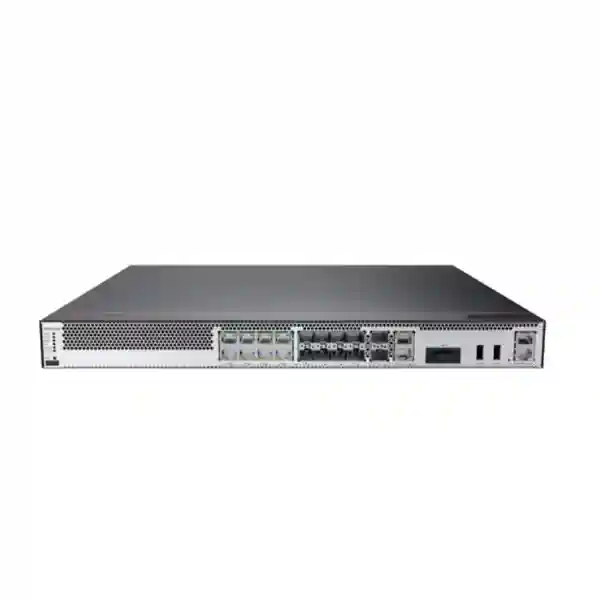
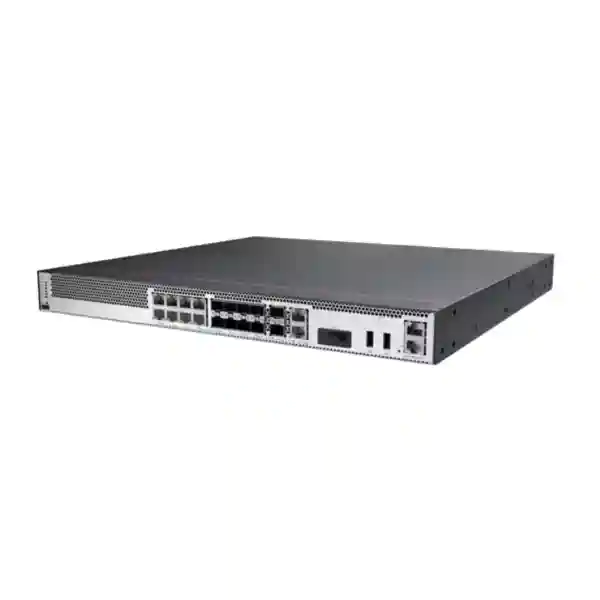
2×GE RJ45, 8×GE combo interfaces and 2×10GE SFP+ interfaces, providing copper and optical flexibility for WAN, LAN, DMZ, aggregation and high-speed switch or server uplinks.
Performance architecture: understanding the numbers before sizing
Firewall purchasing decisions often fail because the buyer compares only the largest throughput number on two product pages. That approach is risky for any next-generation firewall and especially misleading in environments where SSL inspection, intrusion prevention, antivirus, application control and traffic logging are enabled at the same time. The USG6525F’s 2.5 Gbps stateful firewall figure represents basic forwarding and state tracking under Huawei’s stated laboratory conditions. It demonstrates the underlying forwarding capacity, but it does not mean every advanced inspection stack will sustain 2.5 Gbps under every workload.
Huawei therefore publishes additional profiles. The NGFW figure is up to 1.8 Gbps using the HTTP 100K methodology, while the enterprise-mix NGFW figure is 1.2 Gbps. Threat-protection performance is published at up to 1.5 Gbps for the HTTP 100K profile and 1 Gbps for the enterprise mix. These lower figures are not a weakness or contradiction; they are more useful planning metrics because content inspection consumes compute resources and real enterprise traffic consists of many application types, packet sizes and security decisions. A project that expects a sustained 1.5 Gbps Internet circuit with full threat prevention and comprehensive TLS decryption should not simply assume the appliance has 1 Gbps of spare capacity because its stateful firewall number is 2.5 Gbps.
Packet rate is also important. A firewall can reach a bandwidth target with large packets yet become constrained when traffic shifts toward smaller packets. The USG6525F is specified at 3.75 Mpps. That makes the model suitable for many enterprise branch scenarios, but packet behavior should be reviewed for voice, high-volume DNS, IoT, telemetry, retail transaction traffic or environments with many east-west flows crossing security zones. Session creation is another dimension. With up to 80,000 new sessions per second and a 3,000,000-session table, the appliance has substantial concurrency headroom for branch environments, but designers should still reserve capacity for bursts, scanning events, software distribution, guest networks and unexpected traffic spikes.
For a UAE project, practical sizing should start with measured peak traffic, not contracted ISP speed alone. Collect at least a week of interface, flow or NetFlow-like statistics if available. Identify the 95th percentile, the peak burst, the percentage of encrypted traffic, the proportion that will be decrypted, the number of users and devices, expected cloud usage, site-to-site VPN load and likely growth over three to five years. Then select a target operating margin so the firewall does not live at saturation. FourTeck’s IT Services UAE team can incorporate that sizing process into an implementation or migration scope.
Interface design and physical connectivity
The physical interface layout is one of the strongest reasons to consider the Huawei HiSecEngine USG6525F for a modern branch or small enterprise edge. The appliance provides 2 Gigabit Ethernet RJ45 interfaces, 8 Gigabit Ethernet combo interfaces and 2 10 Gigabit Ethernet SFP+ interfaces. A combo interface gives deployment flexibility because the logical interface can be presented through either a copper or optical physical medium according to the supported hardware configuration. This is useful in UAE offices where the firewall may need to connect simultaneously to copper ISP handoffs, fibre aggregation switches, a DMZ switch, an access-switch stack and a secondary carrier.
The two 10GE SFP+ ports are particularly valuable even when Internet access is below 1 Gbps. A firewall is often a choke point between internal security zones, data-center segments or switch stacks. If both the LAN core and a server or DMZ aggregation tier support 10GE, using SFP+ uplinks avoids forcing all inter-zone traffic through a 1GE physical link. This can be important when internal applications, backups, CCTV recording systems, virtualized servers, NAS devices or private-cloud workloads generate traffic that never traverses the public Internet but still must cross the firewall for segmentation and policy enforcement.
Port assignment should be planned before installation. A robust design usually reserves separate interfaces or logical subinterfaces for primary WAN, secondary WAN, LAN/core, DMZ, management, guest access, voice, CCTV/IoT and partner or extranet traffic. VLAN trunking can reduce physical-port consumption, but it should be used deliberately. The design objective is not to create the largest possible number of zones; it is to establish trust boundaries that map to real business risks and can be managed consistently. Highly regulated workloads, payment networks, building-management systems and guest Wi-Fi should not be mixed merely because a switch has spare capacity.
Optics, DAC cables and transceiver compatibility must be matched to the switch, fibre type, connector type and distance. The firewall’s SFP+ capability does not by itself define the complete optical bill of materials. During quotation, specify whether each 10GE connection uses short-range multimode fibre, long-range single-mode fibre or a direct-attach copper cable. For combo GE links, identify whether the intended medium is RJ45 copper or SFP fibre. This simple step prevents one of the most common deployment-day problems: the firewall arrives correctly, but the required optics or patching components do not.
1U hardware platform, power and environmental planning
Huawei specifies the USG6525F in a 1U chassis measuring approximately 442 × 420 × 43.6 mm and weighing about 5.46 kg. The depth is modest for a rack appliance, but cabinet planning should still account for rail or shelf method, front-to-back airflow, cable bend radius and service access. In smaller Dubai offices, firewalls are often installed in wall-mounted cabinets that were originally selected for patch panels and access switches. Those cabinets can be too shallow for enterprise security appliances or can lack sufficient ventilation, so physical validation should happen before delivery.
The current platform specification lists 100 V to 240 V, 50/60 Hz input and maximum appliance power consumption of 36.8 W for the USG6525F-class chassis in the cited hardware table. Optional dual power modules can provide 1+1 redundancy. That capability should be matched to the site’s actual electrical topology. Installing two power modules but connecting both to the same PDU and the same UPS circuit improves power-supply resilience but does not protect against a PDU or upstream circuit failure. For higher-availability sites, connect redundant power inputs to separate protected distribution paths where the facility permits it.
Huawei lists an operating range of 0°C to 45°C with 5% to 95% non-condensing humidity, and a non-operating/storage temperature range from -40°C to +70°C with the same humidity limits. UAE ambient outdoor temperatures are not the relevant number for an air-conditioned server room, but they matter indirectly because cooling systems work harder during summer and small communications rooms can heat rapidly if air conditioning fails. The firewall should never be positioned where hot exhaust from another appliance is drawn directly into its intake.
An optional hot-swappable M.2 SSD is listed in 64 GB, 240 GB and 960 GB capacities in Huawei’s platform material. Storage selection should reflect the intended logging and local-data strategy, not simply the largest available option. Where logs are forwarded to a SIEM, syslog platform or centralized security manager, local storage can be treated differently from a branch that requires longer on-box retention. The final bill of materials should therefore confirm whether an SSD is required, which capacity applies to the chosen software and logging design, and how long locally stored records need to remain available.
Integrated security services: more than packet filtering
At its core, the USG6525F enforces stateful network policy: traffic is allowed, denied or handled according to source, destination, service, zone, identity or other policy criteria, while the device tracks the state of permitted connections. That is foundational, but modern perimeter defense requires more context than IP address and TCP/UDP port. SaaS applications commonly share cloud infrastructure, encrypted sessions can hide application details, and malicious activity can appear inside traffic that would be allowed by a traditional port-based rule.
Huawei therefore integrates application identification and control, intrusion prevention, antivirus, URL filtering, data filtering, bandwidth management and anti-DDoS capabilities into the USG6500F platform. Huawei states that the series can identify more than 6,000 applications and can apply access-control granularity to application functions. The operational value is that policy can be expressed in business terms. For example, an organization may permit a collaboration service while constraining specific file-transfer behavior, or permit web access for a department while applying tighter filtering to risky categories and newly observed destinations.
Intrusion prevention adds another inspection layer. Instead of merely deciding whether a TCP session is permitted, the firewall evaluates traffic patterns and content against threat intelligence and signatures designed to detect exploitation attempts, malicious payload behavior and known attack techniques. Huawei’s product information describes coverage for tens of thousands of CVEs and support for a large IPS signature set, together with custom-signature capability. The practical outcome depends heavily on policy tuning. Enabling every signature in the most aggressive mode without understanding the environment can increase false positives, while running an overly permissive profile can reduce protective value.
Antivirus inspection is intended to detect malicious files and content moving through inspected protocols. URL and DNS-related controls can reduce exposure to phishing, malware distribution, command-and-control infrastructure and inappropriate categories. Anti-DDoS functions can help identify and mitigate selected attack patterns, but no branch firewall should be treated as a replacement for upstream carrier-scale volumetric DDoS protection when the attack can saturate the Internet circuit before packets reach the appliance. Security architecture must distinguish on-box protection from upstream scrubbing and ISP services.
The most effective deployment combines these features into a coherent policy. Internet browsing may receive URL filtering, antivirus, IPS and selected TLS inspection; server-publishing rules may use strict IPS and source controls; inter-branch traffic may use IPsec with segmentation; administrative access may require restricted management networks; and guest traffic may be isolated from all internal resources. A security feature only contributes value when it is placed in the correct traffic path, licensed, updated, monitored and tuned.
Content Detection Engine and AI-oriented threat defense
Huawei positions the USG6500F family around a Content Detection Engine, or CDE, and AI-assisted security functions designed to improve the identification of malicious content and unknown threats. One of the published capabilities is detection of viruses hidden through more than 100 layers of compression and multi-layer concealment. This matters because attackers often use packing, archive nesting and format manipulation to evade simple scanners. A content engine that can continue analyzing deeply nested objects can reduce the chance that malicious code passes through simply because it is hidden inside an unusual archive structure.
The AI label should still be interpreted carefully. Artificial intelligence does not eliminate the need for signatures, policy design, segmentation or skilled administration. In practical firewall architecture, AI-oriented functions supplement deterministic controls by helping classify traffic, correlate events or detect anomalies and previously unseen malicious patterns. The firewall remains one layer within a broader security program that includes secure endpoint configuration, identity management, multifactor authentication, backups, email security, vulnerability management and incident response.
Asset-oriented threat visualization is another useful operational capability. Huawei describes the platform as able to associate IPS and antivirus threat logs with user assets and present risk assessment information. For an IT team managing several UAE branches, this can make security operations more actionable. A raw alert that says an exploit signature triggered on an IP address has limited value unless the administrator can quickly understand what that address represents, whether the host is business-critical, whether the event is repeated and what containment action is appropriate.
The best use of intelligent detection is therefore to shorten the distance between an event and a decision. Security teams should define alert severity, log forwarding, escalation ownership, incident-retention periods and blocking workflows before go-live. The firewall can generate rich telemetry, but the business benefit appears only when someone is responsible for reviewing it and when automated actions are bounded by change-control and service-availability requirements.
SSL/TLS inspection: why 1.5 Gbps matters
Most modern web and SaaS traffic is encrypted. Without TLS inspection, a next-generation firewall can still make useful decisions from IP addresses, certificate metadata, DNS, server names and other observable characteristics, but it cannot inspect all application content hidden inside the encrypted payload. TLS inspection decrypts selected sessions, applies security engines and then re-encrypts the traffic toward the destination. That process is computationally expensive because the firewall participates in cryptographic operations and content scanning at the same time.
Huawei’s current R25C10 data lists SSL inspection throughput of 1.5 Gbps for the USG6525F. This is an important planning figure for organizations that expect deep inspection of web traffic. It should not be treated as an absolute production guarantee because real performance depends on cipher suites, TLS versions, certificate behavior, session reuse, object sizes, enabled security engines, logging and the mix of bypassed versus decrypted categories. Nevertheless, it provides a more relevant upper-bound reference than basic firewall throughput for a security policy that performs substantial decryption.
A sound UAE deployment usually applies selective inspection rather than blindly decrypting everything. Banking, healthcare, personal privacy services and applications that use certificate pinning may require exclusions based on legal, privacy, contractual or technical considerations. Corporate SaaS, general web browsing and higher-risk categories may be candidates for inspection depending on company policy. The certificate authority used for outbound decryption must be distributed securely to managed endpoints; unmanaged guest devices should typically follow a separate policy path.
Sizing also needs to consider handshake intensity. A 500 Mbps workload made of many short-lived encrypted sessions can be more demanding than a 500 Mbps workload composed of a small number of long downloads. This is one reason the USG6525F’s new-session scale is relevant alongside its SSL inspection figure. Before enabling decryption widely, deploy it in phases, monitor CPU and session behavior, measure user experience and validate critical applications. Controlled rollout is far safer than switching an entire company to full inspection in one change window.
IPsec VPN for site-to-site and hybrid connectivity
The USG6525F is well suited to encrypted branch connectivity because Huawei publishes IPsec VPN throughput of up to 2.5 Gbps using AES-256 + SHA256 and 1420-byte packets, with support for up to 4,000 IPsec VPN tunnels in the gateway/client-to-gateway metric. The tunnel scale is far beyond what many single-branch deployments need, but it provides architectural flexibility for hub-and-spoke networks, partner connections, segmented tunnels and large distributed estates.
For a UAE company with headquarters in Dubai and branches in Abu Dhabi, Sharjah, Ras Al Khaimah or other emirates, IPsec can create private encrypted overlays across commodity Internet links. It can also connect offices to cloud virtual networks, hosted environments or data-center firewalls when compatible standards and crypto parameters are available. The 10GE interfaces are useful if the firewall is installed at a head office that aggregates many tunnels, because encrypted traffic can be delivered to the internal core at higher physical link speeds even when each individual WAN circuit is slower.
VPN design should specify IKE version, encryption algorithms, integrity algorithms, Diffie-Hellman or elliptic-curve groups where supported, lifetime values, route behavior, dead-peer detection and failover. Use modern algorithms appropriate to the interoperability requirements of both endpoints. Legacy cryptography may remain available for compatibility, but new deployments should avoid weak algorithms unless a documented third-party limitation forces their use and risk is accepted.
Routing over VPN also deserves attention. Static routes are simple for a few sites, while dynamic routing or SD-WAN-based path control is often easier to operate at scale. Overlapping IP addressing is a common merger, partner or multi-tenant problem and can complicate tunnel design. Network address translation can solve some overlaps but increases operational complexity, so address planning should be handled before configuration work begins.
High availability must be considered at both device and circuit layers. A single firewall with two ISP links protects against one carrier failure but not appliance failure. Two firewalls with one shared ISP remove appliance risk but still leave a carrier dependency. Critical sites may require redundant firewalls, independent ISPs, diverse last-mile paths and redundant power. The USG6525F can participate in a layered resilience design, but the final availability level depends on the whole topology.
SSL VPN and remote-access planning
Remote-access VPN provides secure connectivity for users working from home, customer sites, hotels or temporary locations. Huawei’s published material lists 300 Mbps SSL VPN throughput for the USG6525F in the referenced generation of the datasheet, with 100 concurrent SSL VPN users as the default entitlement and up to 1,000 supported through applicable licensing. Licensing details can change by software release, region and commercial bundle, so the quotation should explicitly state the required number of concurrent users rather than assuming the base appliance includes the final entitlement.
Concurrent user count is not the same as named employee count. A company with 500 employees might need only 120 concurrent remote users if most staff work on-site, while a 250-person organization could need almost 250 concurrent users during a continuity event. Capacity planning should examine the maximum simultaneous population, not just directory size. Remote-access workloads also vary. Email and ticketing consume far less bandwidth than VDI, large engineering files, ERP exports or high-resolution remote desktop sessions.
Authentication should use the organization’s identity platform where technically supported, with multifactor authentication for privileged or external access. Split tunneling versus full tunneling should be chosen according to security policy and application needs. Full tunneling gives the organization visibility and policy control over Internet traffic from remote devices but increases firewall and WAN load. Split tunneling can improve performance and reduce bandwidth consumption, but it changes the threat model because some traffic leaves the endpoint without traversing the corporate firewall.
Remote access should also be segmented after authentication. A VPN user should not automatically receive broad access to every internal subnet. Map users or groups to the applications they actually need, restrict administrative protocols, log sensitive access and review dormant accounts. The firewall is a strong enforcement point for this least-privilege model when identity, group and network design are aligned.
Secure SD-WAN capabilities for multi-link branches
The USG6525F is not limited to conventional active/backup WAN failover. Huawei lists secure SD-WAN throughput of 2.5 Gbps for the model and up to 200 SD-WAN EVPN tunnels. The platform supports service-specific policy-based routing and intelligent uplink selection using multiple load-balancing methods, including decisions based on bandwidth ratio and link-health status. In practical terms, the firewall can make forwarding decisions according to application or service requirements rather than relying only on destination prefixes.
Consider a Dubai branch with a primary fibre service and a secondary broadband circuit. A basic router may prefer fibre until it fails completely. An SD-WAN policy can be more nuanced: voice and video can prefer the link with better latency and packet loss, ordinary web traffic can use both circuits according to bandwidth policy, and critical ERP traffic can move to the healthier path when service-level thresholds are violated. This improves user experience during degraded conditions that would not trigger a traditional interface-down event.
SD-WAN does not create bandwidth that the carriers do not provide, and it cannot overcome severe last-mile congestion without an alternative path. The design should measure latency, jitter, packet loss and reachability toward meaningful targets. Health checks should not be so sensitive that routes flap constantly, and failover timers must balance rapid response against false positives. Applications that are sensitive to source-IP changes may also require special handling when traffic moves between carriers.
For multi-site organizations, centralized orchestration can reduce the effort required to maintain consistent network and security policy. Huawei emphasizes unified network-and-security control within the family. The exact management components and licenses should be confirmed for the project, especially if the design includes dozens of sites, templates, automated provisioning or coordinated security response. SD-WAN is most valuable when operational standardization accompanies path intelligence.
Application identification, URL filtering and bandwidth control
Traditional firewalls identify services largely by port numbers. That model is no longer sufficient because many applications use HTTPS over TCP 443, tunnel traffic through web protocols or dynamically select endpoints in public cloud infrastructure. Huawei states that the USG6500F series can identify more than 6,000 applications and apply control at application-function granularity. This creates a stronger basis for policy because rules can align with what users are doing rather than merely which port they are using.
Application control should be designed around business categories. Core productivity services, sanctioned collaboration platforms, approved remote-support tools and ERP traffic can be placed in higher-trust or higher-priority groups. Unsanctioned file-sharing, anonymizers, peer-to-peer tools or high-risk applications can be blocked or constrained. The policy should avoid unnecessary micromanagement; if hundreds of application rules are created without a clear governance model, the configuration becomes harder to audit and may accumulate exceptions over time.
URL filtering adds a web destination layer. Huawei describes more than 130 URL categories and a cloud URL database containing hundreds of millions of entries in its product material. Categories can help restrict phishing, malware, adult content, gambling, anonymization and other destinations according to company policy. Cloud categorization still requires operational judgment because newly registered domains, uncategorized sites and misclassifications can occur. A support process should exist for legitimate business sites that are blocked unexpectedly.
Bandwidth management can protect important services from recreational or bulk traffic. For example, a branch may reserve capacity for cloud ERP, VoIP and payment systems while limiting large personal downloads or software traffic during business hours. This is especially useful on backup circuits, where available bandwidth may be significantly lower than on the primary WAN. When the primary link fails, a policy can prioritize essential services instead of allowing every application to compete equally for a smaller pipe.
These controls become more accurate when identity is integrated. If the firewall can associate traffic with users or groups, the same destination can receive different treatment for finance, engineering, guests or administrators. Identity-aware policy should complement—not replace—network segmentation. A compromised account inside a flat network remains dangerous, while layered identity and zone controls reduce the blast radius.
Intrusion prevention and web-application threat controls
Intrusion prevention is one of the most resource-intensive and valuable next-generation firewall functions. The IPS engine inspects permitted traffic for exploit behavior and known malicious patterns. Huawei’s USG6500F material describes broad CVE coverage, a large IPS signature library and detection for web attacks such as SQL injection and cross-site scripting, along with malicious traffic associated with bots, remote-control tools, Trojans and brute-force activity. Custom signatures can extend detection for specific local requirements.
IPS profiles should be applied by traffic type. A public web server requires a different protection profile from outbound office browsing, and an industrial or legacy application may have protocol characteristics that trigger signatures irrelevant to normal desktop traffic. Default profiles are a starting point, not a finished policy. During deployment, review detected events, validate affected applications and tune actions from alert to block according to confidence and business impact.
Signature updates are essential because vulnerabilities and exploit techniques evolve. The firewall’s security subscriptions and update services should therefore be treated as operational dependencies rather than optional extras. A firewall purchased without current threat-intelligence services may continue to route traffic and enforce basic policy, but the value of advanced protection can decline as signatures and reputation data age. Procurement should include the desired term and renewal ownership from the beginning.
For Internet-facing applications, network IPS is only one layer. Secure coding, application patching, hardened web servers, identity controls, web application firewall functions where required, DDoS protection and vulnerability management remain necessary. The USG6525F can reduce risk and block many attack patterns at the network edge, but it should not be used as justification to delay critical server remediation.
Segmentation strategy for UAE enterprises
One of the highest-value uses of a next-generation firewall is internal segmentation. Perimeter security alone assumes that once traffic enters the office network it can be trusted. That assumption is unsafe in environments with laptops, mobile devices, printers, cameras, access-control systems, building-management devices, servers, Wi-Fi guests and third-party support connections. The USG6525F can enforce policy between these trust zones when the network topology places the firewall in the required path.
A practical branch design might separate corporate users, servers, voice, CCTV, IoT, guest Wi-Fi, management and DMZ resources. Corporate users may access selected servers and the Internet; guest Wi-Fi may access only the Internet; cameras may reach the recorder and time/DNS services but not user laptops; management interfaces may be reachable only from an administrator VLAN; and DMZ servers may accept tightly defined inbound services while having minimal access toward internal systems.
Inter-VLAN routing can occur on a core switch or on the firewall. If the switch routes locally, traffic between VLANs may bypass security inspection unless the topology intentionally redirects it. If the firewall performs all inter-VLAN routing, security policy is centralized but throughput and interface design must support the internal traffic load. Hybrid designs are common: high-volume trusted application traffic may stay on the core, while higher-risk boundaries are forced through the firewall.
The correct choice depends on risk, performance and manageability. FourTeck can incorporate firewall segmentation with switching, server and endpoint requirements in a broader UAE infrastructure design. Organizations with cross-border or African branch requirements can also review regional coverage through FourTeck Africa, while keeping the USG6525F configuration standardized across locations where the model and support services are appropriate.
Logging, visibility and the optional M.2 SSD
A security device is only as operationally useful as the visibility it provides. The USG6525F can generate logs for policy actions, threats, VPN events, system activity and other security functions. Huawei also emphasizes threat visualization and asset-aware presentation within the family. Good logging allows administrators to answer practical questions: which host contacted a malicious domain, which user generated excessive bandwidth, why an application was blocked, when a VPN tunnel failed, whether a scan was internal or external, and what rule permitted the traffic.
The optional hot-swappable M.2 SSD can support local storage requirements depending on configuration and software capabilities, with listed capacities of 64 GB, 240 GB and 960 GB. Local storage is valuable when WAN connectivity to a central log platform is interrupted or when administrators need immediate on-box history. It should not automatically be treated as the organization’s only security archive. A firewall can be damaged, replaced, reset or compromised; centralized log retention creates a more durable audit trail.
For larger environments, send logs to a SIEM, security-management platform or syslog service. Time synchronization is critical because incident investigation depends on accurate timestamps across firewalls, servers, identity systems and endpoints. Define NTP sources, time zone handling and retention policy during implementation. Also decide which event classes need real-time alerts, which require daily review and which are retained only for forensic use. Sending every debug message indefinitely can create noise and storage cost without improving security.
Visibility should be tied to ownership. Firewall alerts can route to an internal SOC, managed security provider or IT operations team, but the responsible party must be clear. For smaller businesses, a weekly security review plus high-severity real-time alerting may be realistic. For higher-risk organizations, continuous monitoring and formal incident response may be necessary. The device provides data; governance determines whether that data becomes useful action.
High availability and resilience design
A single USG6525F can provide excellent security and multi-WAN failover, but it remains one physical appliance. Sites that cannot tolerate firewall downtime should consider a high-availability pair where supported by the intended software and licensing design. HA planning is broader than buying two units. Interface mapping, heartbeat or synchronization links, switch connectivity, routing, NAT state, VPN behavior, session synchronization and management access all need to be designed so that failure of one unit results in predictable service continuity.
Redundant power modules add another layer. If the appliance is ordered with dual power capability, connect the supplies to independent protected power paths when possible. If both feeds use the same UPS and PDU, there is still value because a power-module failure is covered, but site-level power diversity is limited. For a true resilience objective, trace the electrical dependency from the firewall all the way to UPS, PDU and building distribution.
Switch design matters as well. Two firewalls connected to one access switch still depend on that switch. HA pairs often connect redundantly to a switch stack or two independent aggregation devices. WAN handoff design can be more difficult because some ISPs provide a single CPE port or use MAC-address restrictions. Confirm the carrier’s supported topology before assuming both firewalls can connect directly to the same service.
Resilience should be tested, not merely configured. A proper handover includes controlled failure tests for firewall power, WAN loss, switch path loss and tunnel failover. Record expected recovery behavior and compare it with actual application impact. Some sessions may reset during failover even if the network returns quickly, and certain VPN or NAT flows may behave differently from simple browsing. Testing converts theoretical redundancy into verified continuity.
Management, APIs and integration with enterprise operations
Huawei’s firewall platform supports standard management and integration approaches such as SNMP, SSH, Syslog and NETCONF-oriented interfaces in its published ecosystem information. This allows the USG6525F to participate in broader monitoring and automation workflows instead of operating as an isolated box. A network management system can monitor interface state and resource utilization, a SIEM can ingest security events, and automation tools can use supported interfaces for controlled configuration tasks.
Management access should be separated from ordinary user traffic. Place administrative interfaces or management IPs in a restricted network, permit access only from approved jump hosts or administrator ranges and use strong authentication. Avoid exposing the management plane directly to the public Internet unless a documented, hardened remote-management design requires it. Out-of-band access, where available in the broader topology, can be valuable during routing or policy failures.
Configuration governance is equally important. Establish naming conventions for address objects, services, security zones, policies and VPNs. Use comments and change references so future administrators can understand why a rule exists. Review expired temporary rules and unused objects periodically. A technically capable firewall can become difficult to operate if hundreds of policies are added without structure.
Back up configurations after approved changes and before upgrades. Maintain a documented software-upgrade procedure with release-note review, compatibility validation, maintenance-window planning and rollback criteria. Security appliances often receive frequent updates because threat intelligence and platform security evolve. Treat lifecycle maintenance as part of the project budget rather than as an afterthought after commissioning.
Licensing and subscription planning for the USG6525F
The hardware chassis is only one part of a complete next-generation firewall solution. Advanced security services, software entitlements, remote-access user counts, support and update subscriptions may be licensed separately or packaged according to Huawei’s commercial program. Huawei’s ordering information identifies Foundation and Advanced license families for the USG6525F and separate SSL VPN concurrent-user licenses in increments such as 100, 200 and 500 users. Exact bundle names, availability and regional terms should be confirmed at quotation because licensing evolves across releases and markets.
The first licensing question is functional: which services will actually be used? A branch needing basic stateful firewalling, IPsec and routing has different requirements from an Internet gateway that must run IPS, antivirus, URL filtering, TLS inspection and advanced threat feeds. Buying too little can prevent the security design from being implemented; buying every available service without an operational plan can increase cost without adding proportional value.
The second question is term. Security subscriptions need renewal if the organization expects continued updates and vendor services. Compare one-year and multi-year options according to procurement policy, project lifecycle and budget. Record renewal dates in the asset-management system. A firewall should never discover at incident time that a threat-intelligence subscription expired months earlier because ownership was unclear.
The third question is support. Define who opens vendor cases, what service level is required, where replacement hardware is delivered and whether on-site engineering is included separately. UAE businesses with 24×7 operations may need a different support model from a small office that can tolerate a scheduled replacement. Support expectations should be written into the quotation rather than assumed.
Finally, license and hardware sizing should be reviewed together. If an organization enables significantly more inspection than originally planned, the correct answer may be a larger firewall rather than additional licensing on an undersized appliance. A technically honest sizing exercise protects both security and user experience.
Where the Huawei USG6525F fits best
Enterprise branch
A branch with hundreds of users, dual ISP circuits, site-to-site VPN, guest Wi-Fi isolation, cloud SaaS traffic and local servers can use the USG6525F as the primary security edge with 10GE connectivity toward the LAN core.
Retail or multi-site hub
Regional retail, restaurant or service chains can terminate large numbers of encrypted tunnels and use SD-WAN path selection to improve branch application performance over mixed carrier services.
Professional office
Law, engineering, consulting and financial-service offices can combine Internet security, remote access, application control and segmentation in a compact 1U platform while retaining growth room for faster uplinks.
Education or clinic branch
Sites with staff, guest and specialized-device networks can enforce distinct policies for users, visitors, lab systems, medical devices or classroom infrastructure while forwarding events to centralized operations.
Warehouse and logistics
Warehouses can separate scanners, IoT devices, cameras, office users and ERP terminals, while maintaining resilient connectivity to head office and cloud services through dual WAN and VPN.
Small headquarters
A growing UAE headquarters can use the model where a branch-class footprint is sufficient but the organization still requires millions of sessions, 10GE LAN attachments and advanced security inspection.
When to consider a larger model instead
The USG6525F is a capable platform, but a correct design must also identify when it is not large enough. If sustained inspected traffic is expected to approach or exceed the model’s enterprise-mix NGFW or threat-protection ratings, choose a larger appliance rather than engineering the network around a bottleneck. The same principle applies when a site expects rapid Internet growth, heavy inter-zone east-west traffic, high-volume TLS decryption or many simultaneous remote-access sessions.
Interface density can also be a reason to move up. The USG6525F’s fixed ports are flexible, but environments requiring many dedicated routed interfaces, higher-speed ports beyond the available SFP+ pair or specialized expansion may be better served by another model. Do not add a forest of external switches simply to compensate for a firewall that does not match the intended physical topology.
High-availability headquarters can place more load on each unit than a single-appliance branch because both firewalls must be capable of carrying the full production workload after failover. Capacity should be calculated for the surviving unit, not the average load across two devices. Maintenance and incident conditions are exactly when spare capacity is most valuable.
If there is uncertainty, use measured traffic and a written security feature set to compare the USG6525F with adjacent Huawei models. The objective is not to purchase the largest firewall; it is to select the smallest model that safely meets security, performance, interface and growth requirements with appropriate operational margin.
UAE deployment considerations: ISP handoff, rack, cooling and support
UAE deployments often combine enterprise fibre, broadband backup and cloud-hosted applications. Before installation, collect the handoff details for every ISP: physical medium, speed/duplex or optical standard, VLAN tagging, static IP block, PPPoE if used, gateway, routing method and any MAC-binding requirement. If a carrier CPE device must remain in place, define whether it operates as a router, bridge or managed demarcation point. Ambiguous WAN ownership is a common cause of delay during firewall cutovers.
Rack and power conditions should be documented with photographs and measurements before delivery. Confirm free rack units, cabinet depth, PDU socket type, UPS capacity, grounding, patch-panel reach and airflow. A 1U firewall is physically compact, but the complete installation also needs fibre patch cords, SFP/SFP+ optics, copper patch leads, console access and possibly a shelf or rail kit depending on the cabinet standard.
Cooling is especially important in small communications rooms. Dubai and other UAE locations can experience extreme external heat, increasing the risk that a marginal air-conditioning system fails during peak season. The firewall’s operating specification is intended for controlled equipment environments; it should not be installed in a sealed cabinet exposed to warehouse heat or direct sunlight. Temperature monitoring and alerting can be inexpensive insurance for critical network rooms.
Support logistics should identify serial-number registration, software entitlement, escalation contacts and replacement procedure. Where business operations depend heavily on the firewall, keep configuration backups and a documented recovery runbook. Some organizations maintain a cold spare; others use an HA pair or vendor replacement SLA. The right choice depends on downtime cost.
For procurement, define whether the requirement is supply only or supply plus configuration, migration, testing, documentation and handover. A lower hardware price can become more expensive if licensing, optics, SSD, redundant power, implementation and support are added later as unplanned items. FourTeck quotes can be structured around the complete deployment scope rather than the chassis alone.
Migration methodology from an existing firewall
Replacing a firewall is not a copy-and-paste exercise. Existing configurations often contain years of temporary rules, obsolete objects, undocumented NAT policies and VPNs whose owners have left the company. A migration to the Huawei HiSecEngine USG6525F is an opportunity to simplify and harden policy rather than reproduce every historical mistake.
Begin by exporting the existing rule base and classifying policies into active, obsolete, temporary and unknown. Match address objects to current IP allocations and confirm public NAT mappings with application owners. Inventory all VPN peers, encryption settings, routes and remote networks. Identify services that depend on source NAT, inbound port forwarding, policy-based routing or unusual MTU settings. Many migration problems come from hidden dependencies that were never documented.
Build the USG6525F configuration in advance. Create zones, interfaces, routes, objects and policies using consistent naming. Where practical, pre-stage IPsec tunnels with remote peers and schedule the final activation for cutover. Validate management access through a non-production interface before changing the WAN path. Maintain a rollback configuration for the existing firewall and define the exact point at which the team will revert if critical applications fail.
During the cutover, test in layers: basic Internet reachability, DNS, critical SaaS, published services, site-to-site VPNs, remote access, voice, payment or ERP systems, guest Wi-Fi, monitoring and log forwarding. Check for asymmetric routing and unexpected NAT. Review firewall logs while application owners test; an explicit deny event is far easier to troubleshoot than a generic report that an application is slow.
After stabilization, do not immediately delete the old configuration backups. Keep them according to the change-management policy, but remove the old appliance from active network paths and revoke any stale credentials or management access. Complete the project with an as-built document, interface map, IP addressing, license record, support contacts and backup location. Good documentation turns a successful cutover into a maintainable environment.
Security policy design example
A clean policy for a midsize UAE branch might start with a corporate-user zone that is allowed to reach approved SaaS, DNS and business applications through application-aware rules. Web traffic can receive URL filtering, antivirus, IPS and selective TLS inspection. High-risk categories can be blocked, while approved productivity categories are permitted. Bandwidth controls can protect voice, ERP and video conferencing during congestion.
A server zone can accept only required connections from user networks. Administrative protocols such as SSH, RDP or database management should be limited to an IT administration zone rather than all employee devices. Outbound server Internet access should be minimized to software updates, cloud APIs and required destinations. Servers rarely need unrestricted browsing access.
A guest zone should reach the Internet and essential infrastructure services while being blocked from private corporate subnets. Captive portal or wireless-controller policy can operate alongside the firewall, but network isolation should not depend solely on the Wi-Fi system. CCTV and IoT zones can be even more restrictive, often allowing only management, NTP, DNS and specific recorder or cloud destinations.
A DMZ zone can host public-facing services with destination NAT and strict inbound policy. Where the server initiates connections toward internal databases or application tiers, allow only specific flows. Apply IPS profiles relevant to the exposed service and log both allowed and denied inbound attempts at a level suitable for investigation. External vulnerability scanning should confirm the intended exposure.
Finally, include explicit cleanup rules and logging strategy. Policies should be ordered from specific to general, and broad allow rules should be avoided unless justified. The result is a configuration that can be audited by another engineer without relying on tribal knowledge. Security policy quality is one of the largest determinants of real-world firewall effectiveness.
Performance sizing methodology for a quotation
A proper USG6525F quotation should be based on a short sizing worksheet. Start with current WAN bandwidth for every circuit, then capture the highest measured utilization during business peaks. Add expected growth for the next three to five years. If an organization is moving workloads to Microsoft 365, cloud ERP, hosted backup or video collaboration, historical traffic may underestimate future demand.
Next define the security stack. Will IPS be enabled on all outbound traffic? Will antivirus scan web downloads? Will URL filtering and application control apply to all users? What percentage of HTTPS traffic will be decrypted? Will the firewall inspect traffic between internal zones? These decisions determine whether the relevant sizing reference is basic firewall throughput, NGFW throughput, threat-protection throughput, SSL inspection throughput or a combination.
Then count users and devices. An office with 150 employees can easily have 500 endpoints once phones, tablets, printers, cameras and IoT devices are included. Session count depends more on active devices and applications than on payroll headcount. Record expected remote-access users separately, including the maximum simultaneous number during emergency work-from-home conditions.
Document VPN topology: number of branches, cloud tunnels, partner tunnels, dynamic routing requirements and aggregate encrypted throughput. If the USG6525F is the hub for dozens of branches, the total traffic arriving over tunnels may be much larger than local-user traffic. Similarly, if SD-WAN uses two circuits actively, peak aggregate traffic can exceed the speed of either individual line.
Finally choose headroom. A firewall normally should not be purchased to operate continuously at the edge of its rated inspected capacity. Headroom absorbs traffic bursts, signature updates, policy growth, new applications and failure scenarios. The exact margin depends on risk and budget, but the principle is universal: spare capacity is a design feature, not wasted performance.
Frequently asked technical questions
Does the USG6525F support 10 Gigabit Ethernet?
Yes. The fixed-interface configuration includes two 10GE SFP+ ports in addition to two GE RJ45 and eight GE combo interfaces. The 10GE ports are useful for LAN core, aggregation, server or high-speed uplink connections.
What is the firewall throughput?
Huawei publishes 2.5 Gbps IPv4 and IPv6 firewall throughput for the USG6525F in its stated UDP packet-size tests. Advanced inspection throughput is lower and should be used for sizing when NGFW, threat protection or TLS decryption is enabled.
How many sessions can it handle?
The published scale is up to 3,000,000 concurrent sessions and up to 80,000 new sessions per second for the stated HTTP 1.1 profile, providing substantial capacity for branch and midsize enterprise traffic.
Is it suitable for IPsec VPN?
Yes. Huawei lists 2.5 Gbps IPsec VPN throughput using AES-256 + SHA256 with 1420-byte packets and up to 4,000 IPsec tunnels in the published gateway/client-to-gateway metric.
Does it support SSL inspection?
Yes. Current Huawei R25C10 data lists 1.5 Gbps SSL inspection throughput. Real production performance varies according to TLS behavior, enabled security services, session mix and policy.
Can it be installed as an HA pair?
The USG6500F platform supports enterprise resilience designs, and the hardware can be ordered with optional redundant power. The exact HA feature set, licenses and recommended topology should be validated for the software release and implementation scope.
Does it include all security subscriptions by default?
Do not assume so. Advanced threat services, update subscriptions, support terms and remote-access user entitlements depend on the selected commercial package. The quotation should list every required license and term explicitly.
Is it appropriate for a 1 Gbps Internet connection?
It can be, but suitability depends on how much of that 1 Gbps will receive NGFW inspection, threat protection and TLS decryption. Use the enterprise-mix and SSL-inspection metrics, expected peak load and growth headroom rather than the basic 2.5 Gbps firewall number alone.
Procurement details to include in an RFQ
A precise RFQ speeds quotation and reduces the risk of missing components. State the exact model, Huawei HiSecEngine USG6525F, and whether a single appliance or HA pair is required. Specify AC or DC power preference where applicable, whether redundant power modules are required and whether the site has separate power feeds. State the number and type of optical transceivers, fibre patch cords or DAC cables needed for the 10GE SFP+ and combo interfaces.
List the security functions expected from day one: IPS, antivirus, URL filtering, application control, SSL inspection, advanced threat services, SD-WAN and central management. Ask the supplier to identify every subscription and the term of each service. If SSL VPN is required, specify the maximum concurrent user count so the correct entitlement is included.
If local logging is required, state the preferred SSD capacity or ask for a recommendation based on retention. If centralized logging is available, include the destination platform and integration expectations. For project services, specify whether configuration migration, site survey, installation, cutover, after-hours work, HA testing, VPN setup, documentation and administrator training are included.
Finally, provide location and support expectations. A supply-only price and a fully managed deployment are different scopes. State the UAE emirate, site access restrictions, target implementation date, required vendor support level and whether on-site response is needed. These details allow FourTeck to prepare a technically complete bill of materials instead of a chassis-only estimate.
Decision recap: what the USG6525F brings to a Dubai deployment
Strong branch performance
2.5 Gbps stateful firewall performance, 3.75 Mpps, 3 million concurrent sessions and 80,000 new sessions per second provide a substantial foundation for a modern branch or compact headquarters.
Useful inspected-traffic metrics
Huawei publishes NGFW, threat-protection and SSL-inspection figures separately, allowing responsible sizing for real security services instead of relying on a single headline throughput number.
Flexible 10GE connectivity
Two SFP+ ports plus GE copper and combo interfaces support dual WAN, LAN core, DMZ and aggregation designs without forcing every security boundary onto 1GE physical uplinks.
Integrated security stack
Firewall, VPN, IPS, antivirus, URL filtering, application control, bandwidth management, SD-WAN and threat-visibility functions can be integrated into a unified branch security architecture.
The model is most compelling when a project needs enterprise session scale, flexible interfaces and advanced inspection in a small 1U footprint. The final decision should be based on inspected throughput, TLS decryption scope, VPN aggregation, remote-access concurrency and three-to-five-year growth rather than on current Internet bandwidth alone.
Quotation input checklist
Primary and backup bandwidth, handoff type, public IP details, ISP CPE and expected future upgrade.
Employees, phones, guest devices, cameras, IoT, printers, servers and expected three-year growth.
IPS, antivirus, URL filtering, application control, TLS inspection, anti-DDoS, logging and update subscriptions.
Branch count, cloud tunnels, partner tunnels, aggregate throughput and maximum concurrent SSL VPN users.
Copper versus fibre, required SFP/SFP+ optics, switch models, rack depth, power feeds and UPS information.
Single firewall, HA pair, dual power, dual ISP, redundant switching and acceptable outage duration.
Plan a Huawei USG6525F deployment with FourTeck UAE
For a useful quotation, send the current Internet bandwidth, expected user/device count, number of branches, required security subscriptions, VPN requirements and whether the deployment is a new installation or a migration from an existing firewall. FourTeck can then map the Huawei HiSecEngine USG6525F hardware, licenses, optics, storage, redundant power and professional services to a complete UAE bill of materials.
Where the appliance will sit behind an existing router, connect directly to an ISP, terminate multiple WAN circuits or act as an internal segmentation firewall, include a simple network diagram. Even a rough diagram showing ISP, firewall, core switch, server VLANs and branches can reveal interface, routing and availability requirements that are not obvious from a product-only RFQ.
The result should be a security design that is fast enough under real inspection load, easy to operate, resilient enough for the business and licensed for the features the organization actually intends to use. That is the standard FourTeck targets for firewall projects in Dubai and across the UAE.

Reviews
There are no reviews yet.