
Enterprise Perimeter Security • Dubai • UAE
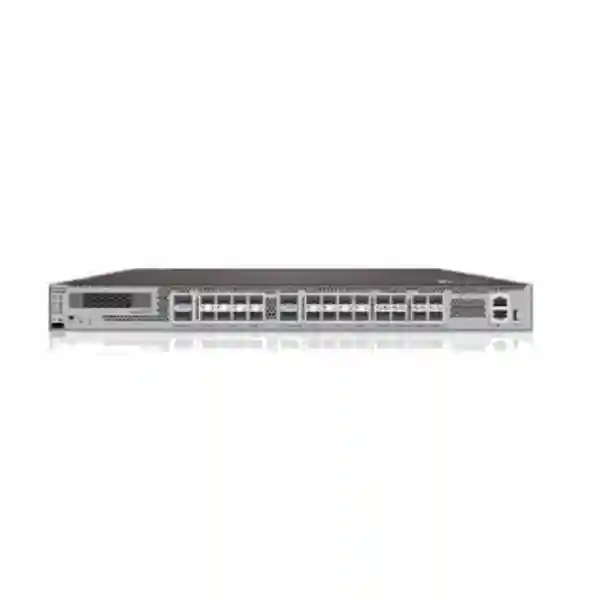
Huawei HiSecEngine USG6716F AI Firewall
The Huawei HiSecEngine USG6716F is intended for organizations that need a high-capacity security gateway at the boundary between users, branches, data-center services, private cloud resources, internet uplinks and partner networks. In a properly engineered design, the platform can consolidate stateful firewalling, application-aware access control, intrusion prevention, anti-malware functions, URL and content policy, encrypted VPN connectivity, traffic visibility and high-availability services while preserving a clean operational model for large enterprise networks.
Direct answer
Choose this class of Huawei firewall when your security edge must accommodate dense 10/40/100 Gigabit-class connectivity, large session populations, multiple protected zones, VPN services, encrypted applications and a structured HA design. Final selection must be based on enabled security services and real traffic mix rather than headline firewall throughput alone.
Best fit
Large campuses, enterprise headquarters, data-center internet edges, shared-services hubs, multi-site VPN aggregation and regulated networks that require layered security controls.
Design priority
Size against NGFW, IPS, antivirus, SSL inspection and VPN workloads under realistic packet sizes, concurrency, session churn and east-west or north-south traffic patterns.
UAE procurement
Validate exact chassis code, hardware revision, software version, subscriptions, power option, storage, optics, support term and HA quantity before issuing a purchase order.
FourTeck scope
Architecture, sizing, migration, policy conversion, VPN design, cutover planning, documentation and operational handover can be aligned with your wider UAE infrastructure program.
Important model-identification note for USG6716F quotations
Public channel listings use the USG6716F designation, but current publicly accessible Huawei USG6600F/USG6700F documentation commonly presents nearby fixed-configuration models such as USG6710F, USG6715F and USG6725F. Some reseller material also combines the USG6716F label with specifications otherwise associated with the USG6716E family. This creates a genuine procurement risk: a customer can receive a technically different port map, capacity profile, license bundle or lifecycle status if the model string is accepted without checking the manufacturer ordering code.
For that reason, FourTeck treats the requested name Huawei HiSecEngine USG6716F as the commercial reference supplied by the customer and validates the exact bill of materials before order placement. The quotation should identify the vendor part number, country eligibility, hardware version, included power supplies, optional storage, software release, required feature licenses, security-subscription term, support entitlement and transceiver requirements. This model-verification step is especially important for enterprise firewall purchases because software subscriptions and support status can be as operationally significant as the chassis itself.
What the Huawei HiSecEngine platform is designed to do
A modern enterprise firewall is no longer just an access-control device sitting between a trusted LAN and an untrusted WAN. In large UAE environments the security edge often has to terminate internet circuits, secure remote offices, protect public-facing services, inspect SaaS traffic, separate user and server segments, enforce partner access, provide route control, support encrypted tunnels and generate useful telemetry for the security operations team. A platform in the HiSecEngine USG6700 class is designed around this consolidated role.
The firewall policy engine evaluates connections using more context than source address, destination address and port. Depending on the licensed feature set and software release, policy can incorporate application identification, user or group context, URL category, threat intelligence, intrusion-prevention signatures, antivirus inspection, content controls and security zones. This richer context matters because many business applications share TCP 443, cloud services change addresses dynamically, users roam between network segments, and malicious activity increasingly attempts to hide inside otherwise normal encrypted sessions.
For an enterprise architect, the practical value is consolidation. Instead of operating separate appliances for firewalling, remote-access security, IPS, URL controls and selected threat-prevention functions, the organization can centralize enforcement and logging. Consolidation can reduce policy inconsistency and simplify incident investigation, but only when the chosen firewall has enough processing headroom for the entire enabled feature set. That is why FourTeck does not size a USG6716F-class solution using raw layer-3 firewall throughput alone.
The right design starts with the traffic that will actually cross the device. Internet egress is only one component. Internal segmentation, data-center service publishing, branch aggregation, private-cloud interconnects, management traffic and backup or replication flows can also consume capacity. Traffic may be asymmetric, bursty or heavily encrypted. A useful design therefore maps zones, interfaces, routing domains, security services, user populations, applications, VPNs and expected growth before selecting the final hardware and licenses.
Hardware architecture and high-speed interface planning
Huawei positions the USG6700 family for high-performance enterprise and data-center roles, and public material for closely related platforms shows a 1U form factor with high-speed optical interfaces using QSFP28, QSFP+ and SFP+ form factors. Channel listings associated with the USG6716F designation commonly describe a dense fixed interface map in the 10/40/100 Gigabit range plus dedicated high-availability connectivity and USB management or service access. Because public references are inconsistent for the exact USG6716F label, the physical port count must be confirmed against the quoted part number rather than copied from a generic family table.
From a network-design perspective, interface density is not just a cabling question. Each high-speed port may represent an independent security zone, aggregated uplink, routed point-to-point connection, inter-firewall HA link, internet carrier handoff, core-switch connection or data-center fabric attachment. The design should state whether each link operates as a routed interface, VLAN trunk, Eth-Trunk member or dedicated management path. It should also identify the expected optical standard, cable reach, connector type, switch-side module and any breakout requirement.
At 40G and 100G speeds, transceiver mistakes are expensive and can delay a deployment even when the firewall chassis is available. FourTeck therefore recommends a port-and-optics matrix in the bill of materials. For every planned connection, record local firewall port type, remote device model, speed, fiber type, approximate distance, transceiver SKU on both ends, patch-cord requirement, redundancy role and whether link aggregation is used. This creates a deployable BOM rather than a chassis-only quote.
Closely related Huawei fixed-configuration firewalls also support optional local storage in a 2.5-inch form factor, with capacity choices varying by model and release. Local storage can be relevant for logs, reporting or operational retention, but it should not be confused with a full security information and event management platform. Enterprises with regulatory, audit or incident-response requirements should still forward security logs to a centralized analytics or SIEM environment and define retention, integrity and access-control policies there.
Firewall performance: why the smallest number matters more than the largest
Firewall datasheets typically contain several throughput figures because different security functions consume different amounts of processing. Raw IPv4 or IPv6 forwarding measured with large packets is useful for understanding the forwarding ceiling, but it does not represent a production perimeter where application identification, IPS, antivirus, URL filtering or encrypted traffic inspection are active. An enterprise design should therefore locate the performance metric that most closely resembles the intended configuration and treat that number as the starting point for sizing.
Packet size matters because a 10 Gbps stream made of 64-byte packets demands much more packet processing than the same bandwidth carried in 1518-byte frames. Session count matters because every stateful connection consumes resources. New sessions per second matter for busy web environments, e-commerce, DNS-heavy services, load-balanced applications or large user populations where thousands of short-lived connections appear continuously. TLS inspection matters because decryption, certificate handling, content inspection and re-encryption add computational work. VPN throughput matters because encryption and hashing are applied to each protected packet.
A defensible sizing exercise therefore captures at least six dimensions: peak and sustained bandwidth, expected packet-size distribution, concurrent sessions, session setup rate, percentage of encrypted traffic that will be inspected, and the security services enabled on that traffic. A seventh dimension is growth. A firewall installed with only ten percent spare capacity on day one can become the performance bottleneck when cloud usage, video collaboration, backup traffic or new branches are added.
For high-availability designs, do not assume two appliances automatically provide double production throughput. In an active/standby design the surviving unit must normally carry the entire workload during a failure, so each node should be sized for the required service level on its own. Active/active or load-sharing topologies introduce additional design considerations around session ownership, asymmetric routing, application behavior and failure convergence. Capacity planning must follow the intended HA mode.
FourTeck can align firewall sizing with the wider network architecture through the FourTeck UAE IT services practice, where WAN circuits, switching, routing, server workloads, cloud connectivity and migration dependencies can be reviewed as one solution rather than as independent hardware purchases.
Stateful firewalling
Tracks connection state and enforces zone-to-zone policy. Good designs use explicit objects, readable naming, least-privilege rules, controlled administrative access and clear logging instead of broad any-to-any policies.
Application awareness
Identifies applications beyond simple port numbers so policy can distinguish business use from risky or unnecessary application behavior even when multiple services share common encrypted ports.
Threat prevention
Adds IPS, anti-malware and related inspection layers to detect known attack techniques, malicious payloads and exploit patterns. Signature freshness and subscription status are operational requirements, not optional paperwork.
VPN services
Supports encrypted site-to-site and remote connectivity designs. Tunnel count, cipher choice, authentication, routing, failover and address planning must be engineered together.
Visibility and logging
Provides security and network telemetry that can be sent to centralized monitoring platforms. Logging should be sized around event volume, retention needs and incident-response workflows.
High availability
Reduces single-device risk when paired appliances, redundant power, duplicated links, synchronized configuration and tested failover procedures are implemented as one resilience design.
Next-generation security services in real enterprise traffic
The most useful way to evaluate the USG6716F is to consider how multiple inspection engines work together on a production flow. A user in a corporate VLAN may open an HTTPS connection to a cloud application. The firewall first applies routing and stateful policy, then identifies the application, associates the session with policy context, applies URL or content controls, and may inspect the encrypted stream if SSL decryption is configured. Intrusion-prevention and anti-malware logic can then examine the revealed payload before the session is allowed to continue. The resulting logs can be exported to monitoring systems for correlation and investigation.
This sequence explains why encrypted-traffic strategy is a design decision. Decrypting every TLS flow is neither always technically appropriate nor always operationally desirable. Some categories may be exempted because of privacy, legal, application compatibility or certificate-pinning constraints. Other high-risk categories may require inspection precisely because otherwise the content is invisible to security controls. The policy should define what is decrypted, what is exempted, what certificate authority is used, how endpoint trust is deployed and how exceptions are governed.
Intrusion prevention should also be tuned rather than simply enabled with every possible signature in block mode. A mature rollout establishes a baseline, enables relevant protections, observes false positives, applies exceptions narrowly and documents the business owner of each exception. This is especially important for industrial applications, specialized financial systems, legacy web platforms and custom APIs where generic signatures may match unusual but legitimate traffic patterns.
Application control is most valuable when linked to business intent. Instead of a generic rule such as “allow web,” administrators can permit approved SaaS services, block known high-risk categories, throttle non-business traffic or route selected application classes over different WAN paths. Policy objects should be organized so administrators can understand the intent months later. Descriptive names, comments, ticket references and owner information reduce operational risk during changes and audits.
Anti-malware and reputation services depend on current security intelligence. A firewall with expired subscriptions may continue forwarding traffic but lose access to critical updates or cloud lookups depending on the feature. Procurement must therefore include the required subscription term and a renewal plan. FourTeck recommends documenting license expiry dates in the same asset-management process used for vendor support and software maintenance.
IPS, antivirus, URL filtering and advanced-threat workflow
Intrusion prevention is intended to identify exploit traffic, protocol abuse and attack techniques using signatures and contextual inspection. The quality of an IPS deployment depends on three things: visibility into the traffic, current signature intelligence and a policy that balances prevention with application availability. If most user traffic is encrypted and never decrypted, the IPS can inspect only what remains observable at the network layer. If signatures are stale, newly disclosed attack patterns may not be recognized. If every detection blocks immediately without tuning, false positives can create service incidents.
Antivirus or malicious-file inspection complements IPS by focusing on content. At the gateway this can stop some known malicious payloads before they reach endpoints, but it should be part of a layered defense that also includes endpoint security, secure email, identity controls, patching and backups. Network firewalls are especially valuable for controlling lateral movement and enforcing segmentation when an endpoint is already compromised.
URL filtering provides policy based on categories and reputation. In a UAE enterprise, typical policies may separate business applications, general browsing, high-risk sites, newly registered domains, uncategorized destinations and categories restricted by corporate policy. The exact category database and cloud service availability should be confirmed under the selected Huawei subscription. Administrators should also define a process for recategorization requests and business exceptions so users do not bypass security controls informally.
Advanced-threat defense often relies on integration. Suspicious objects can be submitted to sandbox or analysis services, while security events can be forwarded to centralized analytics. Huawei ecosystems can integrate firewall telemetry with broader security platforms. The architecture question is not merely whether an integration exists but how alerts are triaged: who receives them, how severity is assigned, what data is retained, how incidents are escalated, and which response actions can be automated safely.
For organizations building a complete UAE security perimeter, the FourTeck Firewall Dubai platform can be used as the local solution entry point for firewall procurement, architecture and deployment discussions across enterprise branches, headquarters and data-center environments.
IPsec VPN design for branches, partners and hybrid infrastructure
IPsec is a core use case for a high-capacity perimeter firewall. A central UAE headquarters may terminate tunnels from dozens or hundreds of branches, cloud environments, disaster-recovery facilities, partners and remote infrastructure sites. The tunnel configuration itself is only a small part of the design. Engineers must decide which traffic enters each tunnel, how routes are exchanged, how overlapping subnets are handled, which cryptographic suites are permitted, how dead-peer detection and rekeying are configured, and how the path fails over when a carrier link or firewall node fails.
Dynamic routing over VPN can simplify large deployments but increases the importance of route policy. A firewall must not accidentally learn an internal default route from a branch or advertise sensitive prefixes to the wrong peer. Prefix filters, route preferences, metrics and summarized address plans should be documented. Where multiple WAN links exist, route tracking and failover behavior should be tested under real tunnel conditions rather than assumed from a diagram.
Cryptographic performance must be evaluated using the algorithms the organization actually plans to deploy. Stronger or more modern ciphers may have different acceleration characteristics. Packet size also affects encrypted throughput. The datasheet IPsec number should therefore be treated as a controlled benchmark, not a promise that every production tunnel topology will reproduce the same figure.
A migration project should inventory every existing peer: public IP, remote device vendor, IKE version, encryption and integrity settings, pre-shared key or certificate method, local and remote selectors, lifetime values, NAT behavior, static routes, dynamic routing protocol, monitoring method and business owner. This prevents a common cutover problem where an old firewall contains years of undocumented exceptions that were never captured in the architecture documentation.
When partner networks are involved, FourTeck recommends a staged migration plan with a parallel communication window. Each third party should receive the new peer details and test schedule in advance. The old tunnel should remain available until the new path passes routing, application and monitoring validation, provided that temporary dual operation does not violate the organization’s security policy.
SSL VPN and remote-access considerations
Remote-access VPN requirements have changed as organizations adopt cloud applications, zero-trust principles and identity-centric controls, but many enterprises still need a secure tunnel for administrators, contractors, emergency support or access to private applications. The firewall can form part of that architecture, provided identity, endpoint trust and least-privilege controls are handled carefully.
The design should start with user groups and application needs rather than creating one large remote-access network. Finance users, system administrators, vendors and general staff may need different reachable subnets and different authentication strength. Multi-factor authentication should be integrated where supported by the chosen identity design. Administrative users should receive narrower access than ordinary business users, not broader access by default.
Address pools must be large enough for peak concurrency and must not overlap with branch, cloud or home networks likely to be encountered. Split tunneling requires a deliberate policy: sending only corporate destinations through the VPN can reduce bandwidth and latency, while full tunneling can simplify security enforcement and logging. The correct choice depends on risk, remote-user geography, application type and the organization’s security model.
Certificate lifecycle is another operational concern. Server certificates must be renewed before expiry, trusted correctly by clients and installed consistently across HA peers. If client certificates are used, enrollment, revocation and device replacement procedures are required. A technically secure VPN can still become an operational outage if certificate ownership is unclear.
Remote-access capacity should be sized using concurrent users and their application behavior, not total employee count alone. A thousand users checking a lightweight intranet is different from a thousand users running video, remote desktop, software repositories and data-heavy engineering systems through the tunnel. Concurrency, average throughput, peak throughput and session duration all influence the effective load.
North-south security
Traffic entering or leaving the organization typically passes between trusted networks and the internet, cloud, partner or carrier domains. Policy focuses on threat prevention, application control, NAT, VPN and exposed services.
A USG6716F-class firewall can be positioned at this boundary when interfaces, routing and security capacity are sized for the aggregate traffic and full inspection stack.
East-west segmentation
Traffic moving between internal security zones can also require inspection, especially between users and servers, production and development, office and OT networks, or shared services and sensitive applications.
Internal segmentation can generate far more throughput than internet access, so it must be included explicitly in capacity planning rather than treated as free traffic.
Routing, VLANs and segmentation architecture
An enterprise firewall often sits directly in the routed path, which means routing design is inseparable from security design. The platform may participate in static routing, dynamic routing, multiple VLAN interfaces, aggregated links and redundant upstream or downstream paths. The exact protocol support depends on software and licensing, but the architectural principles remain consistent: keep routing deterministic, avoid accidental transit paths, document redistribution points and ensure failover convergence matches the application recovery objective.
Segmentation begins with zones. A practical UAE enterprise might define user, server, DMZ, internet, management, guest, voice, IoT, OT, backup, cloud and partner zones. The purpose is not to create as many zones as possible; it is to create boundaries with meaningful security policy. Each boundary should answer which applications are allowed, which direction initiates connections, what inspection is required, what logging is retained and who owns the rule set.
VLAN trunks can reduce physical port consumption, but they also concentrate many security zones on a smaller number of links. The switch and firewall configurations must match exactly for VLAN tagging, native VLAN behavior, MTU and link aggregation. Where critical services share a trunk, a trunk failure may impact multiple zones simultaneously, so physical redundancy and diverse link paths are important.
Dynamic routing can improve resilience when there are multiple cores, carriers or data centers. However, firewall routing policy must not become so complex that an incident responder cannot predict where a flow should go. Route maps, prefix lists, preferred paths, failover metrics and route summaries should be included in the as-built documentation. During acceptance testing, engineers should disconnect links and devices intentionally to verify convergence instead of validating only the healthy state.
For large designs, it is useful to create a traffic-flow matrix before firewall rules are written. Each row identifies source zone, destination zone, application, ports or application identity, expected direction, NAT behavior, security profile, logging requirement and business owner. This matrix becomes the authoritative input for policy implementation and future audits.
High availability: design the whole path, not only the firewall pair
Buying two firewalls does not automatically create a resilient service. High availability requires redundant power feeds, separate upstream and downstream links, synchronized configuration, predictable routing, heartbeat or HA connectivity, state synchronization where supported, matching licenses and tested failover procedures. A firewall pair connected to one switch, one carrier or one power distribution unit still contains a major single point of failure.
The physical design should map each node to independent switch ports and, where possible, independent switch members in a stack, chassis pair or MLAG domain. Internet connectivity should identify what happens when one carrier circuit fails, when one customer-edge device fails and when one firewall fails. If public IP addressing changes between providers, DNS, NAT and inbound service failover need separate treatment.
State synchronization is particularly important for long-lived applications. Without state preservation, a firewall failover can drop existing sessions even if routing converges quickly. Whether session state is synchronized for a given feature should be validated against the software release. Some specialized sessions or VPN conditions may behave differently during failover and need application-level testing.
Maintenance behavior should be tested too. The operations team needs a documented procedure for upgrading one node, checking synchronization, failing traffic over, upgrading the peer and restoring the preferred state. A scheduled software upgrade should not be the first time the organization discovers that an HA cable is connected incorrectly or a route depends on one firewall-specific address.
FourTeck recommends at least four resilience tests during acceptance: firewall-node failure, upstream-link failure, downstream-link failure and power-supply or power-feed failure. For internet-facing services, add carrier failure. For VPN hubs, test tunnel recovery. Record actual convergence time and application impact instead of simply noting that the standby appliance became active.
Security policy engineering and rulebase quality
The quality of a firewall deployment is visible in its rulebase. A poorly governed high-end appliance can be less secure than a smaller firewall with disciplined policies. Rules should be based on business flows, not on temporary troubleshooting shortcuts that become permanent. Broad source or destination objects should be minimized, unused rules removed, shadowed rules investigated and administrative services restricted to dedicated management networks.
Naming standards reduce errors. Address objects should reveal location and purpose. Service objects should identify the application rather than only a port number. Rule names can include system owner or ticket reference. Descriptions should state why the rule exists, not simply repeat its source and destination. When an auditor or incident responder reviews the configuration a year later, the business intent should still be understandable.
Logging strategy also matters. Logging every event at maximum detail may generate excessive storage and noise, while logging too little removes evidence required for troubleshooting and investigations. High-risk denied traffic, administrative access, VPN events, security detections and changes should be handled with suitable priority. Allowed-traffic logging can be adjusted based on regulatory, troubleshooting and analytics requirements.
Change control should require a source, destination, service, owner, justification, duration and rollback plan. Temporary vendor or project access should have an expiry date. Emergency changes should be reviewed after the incident. These operational controls are independent of firewall brand, but a deployment project is the best time to establish them because the rulebase is being rebuilt or migrated anyway.
For customers modernizing a broader infrastructure estate, FourTeck UAE can align security policy migration with switching, routing, wireless, server, voice and managed IT requirements so network dependencies are considered before the cutover window.
Encrypted traffic inspection and certificate strategy
Most modern application traffic is encrypted, which creates a visibility challenge. Without decryption, a firewall can still observe endpoints, addresses, ports and some protocol metadata, but it cannot fully inspect application payloads protected inside TLS. SSL inspection addresses that limitation by decrypting selected sessions, applying security controls and re-encrypting the traffic. This improves visibility but adds performance, privacy and operational considerations.
The first design task is to classify traffic. Corporate web browsing, approved SaaS applications, financial services, healthcare portals, personal communications, certificate-pinned applications and mutual-TLS systems may require different treatment. The organization’s legal, compliance and HR policies should determine which categories are eligible for decryption. Technical teams should not make privacy decisions solely through firewall configuration.
The second task is certificate trust. For outbound forward-proxy inspection, managed endpoints must trust the enterprise certificate authority used by the firewall. Certificate deployment should be handled through endpoint management so users do not see warnings. The CA private key must be protected carefully because compromise would undermine the trust model. Separate inspection certificates may be appropriate across environments or security domains.
The third task is exception handling. Some applications fail under interception because they pin certificates or use non-standard TLS behavior. Exceptions should be based on a defined object or application, not a broad bypass of an entire network. Each exception should have an owner and review date. Monitoring should distinguish traffic that was inspected from traffic that was exempted so the security team understands visibility gaps.
Finally, SSL inspection must be part of capacity sizing. The maximum forwarding capability of the appliance is not the relevant figure when a large percentage of traffic is decrypted. Use the vendor’s SSL inspection benchmark as a reference, then apply headroom for packet size, concurrent sessions, certificate operations, enabled IPS and real application mix. This is one of the most common places where undersized firewall projects encounter unexpected CPU pressure.
SD-WAN and application-aware path control
Many enterprises expect the perimeter firewall to participate in WAN path selection as well as security. Application-aware routing can steer traffic across MPLS, internet, leased line or other links according to business policy and measured path quality. This can improve resilience and reduce dependency on a single carrier, but it requires clear rules for which traffic is allowed to move between paths.
A voice or video application may prefer the link with the lowest latency and packet loss, while large backups may be directed to a lower-cost path. Cloud SaaS traffic may use local internet breakout, while sensitive private applications remain on a protected private network. The firewall can enforce security consistently while also influencing path selection, provided the routing and application-identification capabilities are designed together.
Monitoring thresholds must be realistic. If a path-selection rule changes routes every time latency fluctuates by a few milliseconds, applications may experience unnecessary instability. Health checks should use suitable targets, probe intervals and thresholds. Where the carrier supplies SLA metrics, compare those with observed firewall measurements but avoid assuming they are identical because the measurement points differ.
Dual-carrier designs should account for public addressing and inbound services. Outbound sessions can often fail over more easily than inbound published applications that depend on a provider-assigned IP range. DNS failover, BGP, portable address space, application delivery controllers or cloud front ends may be needed depending on the architecture. The firewall is one element in the end-to-end failover plan.
When SD-WAN functions are in scope, the quotation should identify any license requirement and the exact supported feature set for the selected Huawei release. It should also define whether centralized management is required across branches and how templates, policy objects and software versions will be governed across the estate.
Management, API integration and security operations
Large environments need repeatable administration. Huawei enterprise firewalls can expose management capabilities through standard operational interfaces and, depending on release and platform, API or NETCONF-based integration. The goal is not automation for its own sake; it is controlled, auditable change. Routine tasks such as object creation, policy deployment, configuration backup, inventory collection and compliance checks can benefit from automation when inputs are validated and changes are reviewed.
Administrative access should use a dedicated management network wherever possible. Management interfaces should not be exposed directly to the internet. Accounts should be individual, role based and integrated with centralized authentication where supported. Privileged access should require stronger controls and should be logged. Configuration backups should be encrypted or otherwise protected and stored outside the appliance so recovery is possible after hardware failure or a major misconfiguration.
For security operations, the firewall should forward events to a central logging or analytics system. Useful data includes allowed and denied connections, IPS detections, malware events, URL-filtering actions, VPN authentication, administrator logins, configuration changes and system-health alerts. Time synchronization is essential because incident correlation becomes difficult when timestamps differ across firewalls, servers, identity systems and endpoints.
Alerting should focus on actionable conditions. Interface flaps, HA state changes, power-supply failures, storage issues, subscription expiry, repeated administrator failures, unusually high session creation, critical threat detections and VPN instability are typical examples. The monitoring platform should distinguish between an informational event and a condition requiring immediate response.
Operational documentation should include management IPs, DNS and NTP settings, authentication method, logging destinations, monitoring checks, backup process, support contacts, license details and renewal dates. These items are often omitted from network diagrams but are essential for day-two operations.
UAE data-center and campus deployment patterns
A Dubai headquarters can deploy a USG6716F-class firewall pair between the campus core and multiple internet or WAN circuits. User VLANs remain on the core while default or selected traffic is routed through the firewall. DMZ services can terminate on dedicated firewall zones. Separate management, guest and server networks can receive independent policy. This design is straightforward to operate and works well when internet traffic represents the main security boundary.
A data-center edge uses the firewall closer to public-facing or private application tiers. High-speed links connect to redundant data-center switches, and the firewall controls traffic between external networks, DMZs and internal application segments. In such a design, east-west traffic between application tiers may also cross the firewall. That can multiply required throughput and session scale compared with a simple internet gateway.
A branch-aggregation hub terminates IPsec tunnels from regional offices. The firewall must handle encrypted throughput, route scale, tunnel monitoring and potentially overlapping networks from acquired companies or partners. If the hub also provides internet breakout for branches, inspection demand increases further. HA testing must include tunnel recovery and route reconvergence because branch availability depends on the central pair.
A hybrid-cloud gateway protects connectivity between on-premises networks and cloud environments. The firewall may terminate VPNs to cloud virtual networks, apply policy to private connectivity or secure internet-based cloud access. Cloud route tables, overlapping CIDR blocks, NAT and MTU values need close attention. The security architecture should also define which controls remain in the cloud and which are centralized on the physical firewall.
For multinational customers, a UAE security hub may exchange traffic with offices in Africa, Asia or Europe. In that case, latency and carrier design can matter as much as firewall capacity. FourTeck’s broader regional capability can be referenced through FourTeck Global when a project requires consistent network and security planning across multiple countries.
Sizing methodology for a Huawei HiSecEngine USG6716F project
Start with measured traffic. Collect at least several weeks of interface utilization from the existing firewall, routers or core switches. Record average, 95th percentile and peak bandwidth in each direction. If traffic is expected to move onto the new firewall that does not currently cross the old one, such as internal segmentation or a new cloud connection, add that separately. Avoid sizing from internet circuit speed alone because an organization can have substantial internal or VPN traffic that never uses the public link.
Next, capture session metrics. Concurrent sessions reveal state-table demand, while new sessions per second indicate transaction intensity. Web applications, DNS services, busy reverse proxies and microservice environments can create large numbers of short connections even when bandwidth is moderate. Conversely, backup replication may consume huge bandwidth with relatively few sessions. Both patterns must be considered.
Third, define the security profile by traffic class. What percentage receives basic stateful inspection only? What percentage uses IPS? What percentage needs antivirus or content scanning? How much TLS traffic will be decrypted? How much traffic is carried inside IPsec? Which applications are exempted from SSL inspection? A single average percentage is less useful than a workload map because the most demanding security stack often determines the practical capacity limit.
Fourth, apply growth and failure headroom. For an HA pair, size one node to handle the target traffic during a peer failure unless the selected architecture explicitly distributes capacity differently. Add growth for new users, sites, cloud applications and WAN upgrades. Avoid operating a security gateway continuously near saturation; burst capacity is required for attack traffic, backups, patch events and unexpected demand.
Fifth, validate ports. A firewall can be powerful enough computationally but still be wrong for the topology if the required media, port density or breakout options do not match. Build a connection matrix with current and future links. Reserve ports for HA, management and expansion. Confirm transceiver compatibility on both ends of each connection.
Finally, align licenses and support. Security features, cloud reputation, signature updates, centralized management and vendor support may have separate entitlements. The deployment plan should state what happens when each subscription expires and who owns the renewal. A technically correct chassis without the required licenses is not a complete solution.
Migration from an existing firewall
Firewall migration is an opportunity to improve security policy rather than blindly reproduce years of accumulated configuration. The first phase is discovery. Export the existing rulebase, address objects, service objects, NAT rules, VPNs, routes, interfaces, VLANs, certificates, authentication settings, logging destinations and administrative accounts. Identify unused or duplicate objects and rules before translating them.
The second phase is normalization. Different firewall vendors express policy in different ways. Zone models, NAT order, application definitions, service groups and routing behavior may not map one-to-one. The migration workbook should record the intended business behavior independently of the old vendor syntax. This avoids carrying platform-specific workarounds into the new design.
The third phase is build and validation. Configure interfaces, zones, routes, objects, policies, NAT, VPNs, security profiles, authentication, logging and monitoring in a controlled sequence. Review the rule order carefully. Validate HA synchronization before production traffic is introduced. Confirm that management access works through the intended secure path and that configuration backups can be restored.
The fourth phase is cutover planning. A successful runbook specifies exact cable moves or routing changes, who performs each step, the expected verification after each action and the rollback trigger. Pre-change tests should include reachability to critical services, VPN status, public service access, DNS, authentication, logging and monitoring. During the change, capture timestamps so any application issue can be correlated with firewall logs.
Post-cutover validation should test real business applications, not only ping. Confirm ERP, email, web portals, VoIP dependencies, remote access, cloud services, partner links, backups and monitoring. Review deny logs for legitimate traffic that was omitted from the migration. Keep a controlled observation window before decommissioning the previous firewall.
Finally, remove temporary migration rules. Emergency any-to-any rules added during troubleshooting can become permanent security gaps if they are not tracked. Every temporary exception should have an owner and expiry time in the change record.
UAE operational considerations: power, racks, optics and support
Enterprise firewalls should be treated as data-center infrastructure, not desktop security devices. Confirm rack depth, rail or mounting requirements, airflow direction, power connector type and redundant power-feed availability. Related Huawei fixed-configuration platforms use 1U chassis designs with dual power options, but the quoted USG6716F part number must be checked for its exact electrical specification. Each PSU should ideally connect to a separate PDU backed by the facility’s UPS and generator design.
Cooling is equally important. High-speed security appliances can dissipate significant heat under load. The rack position should follow facility hot-aisle/cold-aisle standards, and front or rear clearance should not be obstructed by cable bundles. Environmental monitoring should alert when temperature or power conditions move outside policy thresholds.
Optics procurement should be synchronized with the firewall order. If the device uses QSFP28, QSFP+ or SFP+ interfaces, the customer must know whether modules are included or ordered separately. Third-party optics policies, vendor support implications and switch-side compatibility should be agreed in advance. For short in-rack distances, direct-attach cables may be an option where both devices support them; for longer distances, select the correct single-mode or multimode optics and fiber plant.
Spare strategy depends on business criticality. A mission-critical environment may keep spare optics, patch leads, power supplies and even a cold-spare appliance or rapid replacement agreement. The cost should be compared with the business impact of waiting for replacement hardware after a failure. If the firewall is the single internet and VPN hub for many sites, replacement-time objectives are especially important.
Support entitlement should be linked to an escalation procedure. Operations teams need the device serial numbers, support contract identifiers, authorized contacts, log-collection procedure and vendor escalation path before a problem occurs. Firmware images and release notes should be obtained through authorized channels, and production upgrades should follow tested maintenance windows.
Licensing and subscription planning
The security value of a next-generation firewall depends heavily on active services. A base firewall license may provide stateful security and networking, while advanced functions such as updated IPS intelligence, URL categorization, antivirus, cloud reputation or centralized management can require separate subscriptions or bundles. Exact packaging changes over time, so the quote must specify entitlements by name and term rather than relying on generic labels like “full license.”
A useful license schedule lists each feature, license SKU, quantity, start date, end date and associated device serial number. For HA pairs, confirm whether subscriptions are required on both nodes. For centralized managers or analyzers, confirm device-count or capacity limits. If cloud services are involved, verify regional service availability and account-registration requirements.
Renewal ownership should be assigned during procurement. The operations team needs advance notice before expiration, while procurement needs enough lead time to obtain quotes and approvals. Security subscriptions should not expire unexpectedly because the result may be loss of updates, reduced cloud intelligence or unsupported operation. Many organizations set reminders at 120, 90, 60 and 30 days before expiry.
Firmware entitlement also matters. Some vendors tie software downloads and support to active maintenance. The organization should confirm which release train is recommended for the selected hardware, whether upgrades require intermediate versions and how long the platform is expected to remain supported. A multi-year firewall purchase should include lifecycle planning from the beginning.
When comparing quotations, do not compare chassis price only. A complete five-year ownership view can include appliances, security subscriptions, vendor support, management software, optics, implementation, migration, training, spares and renewal costs. The lowest initial hardware price can be misleading if essential services are excluded.
Large enterprise campus
Use the firewall pair at the campus internet and WAN edge, integrate with redundant cores, segment sensitive services, inspect business traffic and aggregate branch VPNs while preserving failover capacity.
Data-center perimeter
Protect published services, private application tiers and cloud interconnects. Include internal east-west flows in sizing because server-to-server throughput can exceed internet bandwidth significantly.
Regional VPN hub
Terminate encrypted tunnels from branches and partners, exchange routes safely, monitor tunnel health and design each HA node to support the aggregate branch load during failure.
Hybrid cloud gateway
Enforce policy between on-premises and cloud networks, coordinate route tables and overlapping address space, and decide which security controls remain local versus cloud-native.
Security architecture for regulated and high-availability environments
Financial, healthcare, government, education, hospitality and large commercial organizations often require a firewall design that supports formal audit. The appliance alone does not create compliance. Controls must be connected to documented policies: who can administer the device, how changes are approved, how logs are retained, how privileged access is reviewed, how signatures are updated, how vulnerabilities are remediated and how incidents are handled.
Network segmentation can support compliance by reducing the number of systems that share a trust boundary. Payment systems, sensitive databases, administration networks, backup infrastructure and guest Wi-Fi should not automatically belong to the same security zone. The firewall can enforce controlled paths between those segments, but the underlying addressing and routing must make the boundaries technically meaningful.
Administrative separation is equally important. A network operator may need read access without permission to alter security policy. A security engineer may manage rules but not authentication infrastructure. A third-party support account may be enabled only during an approved maintenance window. Role-based access and centralized authentication can support this separation when properly configured.
Configuration backups, rule reviews and software upgrades should be scheduled. A quarterly policy review can identify expired project rules, unused objects and unnecessarily broad access. A monthly or automated backup routine ensures the latest known-good configuration is available. Firmware review should consider both security advisories and application compatibility rather than upgrading solely because a new release exists.
For audit evidence, retain change tickets, configuration snapshots, rule-review records, subscription status, software versions, support cases and HA test results. These artifacts demonstrate that the firewall is operated as a controlled security system rather than merely installed hardware.
Performance testing and acceptance criteria
A deployment should have measurable acceptance criteria. Begin with physical checks: both power supplies healthy, expected fans operational, all links at the correct speed, no optical errors, HA peers synchronized and management reachable only from approved networks. Verify software version and license status against the design document.
Then test routing. Confirm every expected prefix is present and the preferred path is correct. Verify default-route behavior, dynamic routing adjacencies and route filters. Fail individual uplinks and observe convergence. Check that no unexpected route is learned from a partner or branch. For multi-carrier internet designs, test outbound and inbound behavior separately.
Next test security policy. Use representative source systems in each major zone and validate allowed and denied applications. Confirm that blocked traffic is logged with enough context for troubleshooting. Test NAT translations, published services and application-specific rules. Validate URL categories and security profiles with safe test methods appropriate to the organization.
VPN acceptance should include tunnel establishment, routed reachability, application access, failover and rekeying. For remote access, test authentication, address assignment, split-tunnel or full-tunnel behavior, DNS resolution and access boundaries. For site-to-site tunnels, verify route symmetry and monitor recovery after a peer or path failure.
Finally, perform controlled load observation during a busy period. Capture CPU, memory, session count, session-setup rate, interface utilization and security-engine health. The goal is not to force the firewall to its laboratory limit but to verify that the production workload leaves the expected headroom. Keep these baseline metrics for future capacity reviews.
Acceptance documentation should list every test, expected result, actual result, date, engineer and evidence location. This turns the handover into a repeatable operational reference rather than a verbal confirmation that “the firewall is working.”
Troubleshooting methodology for production firewall incidents
When an application fails after a security change, troubleshooting should follow the packet path. First confirm the source IP, destination IP, destination service, time of test and expected security zone. Check whether the firewall receives the traffic on the expected interface. Then confirm routing, policy match, NAT behavior, security-profile result and return path. This systematic approach is faster than disabling protections randomly.
Session tables are valuable because they show whether the firewall has created state and how the flow is being handled. Packet captures can confirm whether the application reaches the firewall and whether responses return. Logs reveal policy actions and security detections. Interface counters can expose drops, errors or speed mismatches. Routing tables identify unexpected next hops.
For SSL inspection issues, check certificate trust, TLS version, cipher compatibility and whether the application pins certificates. Do not solve one application by globally disabling decryption. Create a narrow documented exception if policy permits. For IPS false positives, confirm the exact signature, affected application and software version, then tune only the necessary rule or scope.
For VPN problems, compare both peers. IKE failures can result from mismatched authentication, proposals, identities or reachability. IPsec may establish while application traffic still fails because selectors, routes, NAT or security policies are wrong. When dynamic routing runs through the tunnel, verify the routing adjacency independently from IPsec status.
For HA events, establish a timeline. Determine whether the peer failed, an interface monitor triggered, a heartbeat was lost or a software process changed state. Correlate firewall logs with switch, power and carrier events. The root cause may be external to the firewall even though the visible symptom was an HA switchover.
Lifecycle operations and upgrade governance
Security appliances require continuous lifecycle management. Signature updates, subscription renewals, configuration reviews, certificate renewals, firmware maintenance and capacity checks should be assigned to named owners. A firewall that is correctly implemented on day one can become risky over time if these operational tasks are ignored.
Firmware upgrades should begin with release-note review and compatibility checks. Confirm supported upgrade paths, known issues, feature changes, HA behavior and management-platform compatibility. Back up the current configuration before the change. If the environment uses automation or APIs, test those integrations against the target release in advance where possible.
In an HA pair, upgrade procedures usually allow staged maintenance, but the exact workflow depends on the vendor release. Validate synchronization and health before moving traffic. Monitor critical applications during the failover. After upgrading the first node, verify stability before proceeding to the second. Maintain a rollback plan that considers configuration-format changes and vendor-supported downgrade paths.
Capacity should be reviewed whenever WAN bandwidth increases, new branches are added, internal segmentation expands or SSL inspection coverage changes. Keep historical CPU, memory, sessions and throughput metrics. Trends are more useful than a single snapshot because they show whether the platform is gradually approaching its operating limit.
Lifecycle planning should also track end-of-sale and end-of-support milestones. Once the vendor announces a final support date, the organization needs enough budget cycle and project time to design a replacement, migrate policies and test the new environment without an emergency purchase.
What to request in a Huawei HiSecEngine USG6716F quotation
A professional quotation should begin with the exact Huawei orderable part number rather than only the marketing name. Because the USG6716F designation is inconsistent across public sources, this is the first mandatory check. The quote should then state chassis quantity, hardware revision where applicable, power supplies, rack accessories, storage option, software version or supported release family, feature licenses, security subscriptions, vendor support term and delivery region.
For HA, request two identically entitled units unless Huawei licensing rules for the selected package specify another arrangement. List interconnect requirements and any dedicated HA cables or optics. Confirm whether both units include the same power modules and storage. Avoid mixing hardware revisions unless explicitly supported for the intended HA mode.
For interfaces, attach the port-and-optics matrix. List every SFP+, QSFP+ or QSFP28 transceiver, direct-attach cable and fiber patch lead required. Confirm switch-side optics separately. If 100G ports will break out into lower-speed links, identify the cable and supported breakout mode. Do not assume that a physical cage supports every transceiver type.
For licenses, identify which functions are included on day one: IPS, antivirus, URL filtering, application control, threat intelligence, SSL inspection capability, remote access, SD-WAN and centralized management where required. Some capabilities may exist technically but still depend on subscription data or license entitlement for useful production operation.
For services, define whether the quote includes installation only or full migration. A migration scope can include discovery workshop, high-level design, low-level design, configuration build, policy conversion, VPN migration, HA setup, change plan, cutover support, post-change validation, documentation and knowledge transfer. Be explicit so commercial comparisons are meaningful.
For multi-location customers, include delivery site, rack location, maintenance-window restrictions, remote-site dependencies and required engineer access. These details can influence logistics and project planning even when the hardware configuration is identical.
Frequently asked technical questions
Is the USG6716F suitable for a 10G internet connection?
Potentially, but internet circuit speed alone is not enough to answer. The correct choice depends on security services, SSL inspection percentage, packet size, session scale, VPN load, internal segmentation traffic, HA design and growth. The deployment should be sized using the applicable NGFW or threat-protection workload rather than raw firewall forwarding.
Can it be used as a VPN concentrator?
This product class is appropriate for site-to-site IPsec and enterprise remote-access use cases, but tunnel scale, encrypted throughput, routing design and license requirements must be validated against the exact ordered model and software release.
Does it support high availability?
Huawei enterprise firewalls support HA architectures, but the complete design includes two appliances, redundant power, independent network links, synchronization, route failover and tested operational procedures. HA should be specified in the low-level design rather than treated as a checkbox.
Should SSL inspection be enabled for all traffic?
Not automatically. Decryption policy should consider security benefit, privacy, legal requirements, application compatibility and performance. Business-approved exceptions should be narrow and documented. Endpoints must trust the inspection certificate authority for forward-proxy inspection.
Can it replace separate IPS and URL-filtering appliances?
A next-generation firewall can consolidate many of these functions, but the final security architecture depends on performance, feature depth, operational requirements and existing tools. Consolidation should be validated against the organization’s threat model and monitoring workflow.
Why is the exact part number important?
Because public references for “USG6716F” are not fully consistent. The part number determines the actual hardware, supported release, port map, regional availability and entitlement. FourTeck recommends written BOM validation before purchase.
Can the firewall segment internal server networks?
Yes, a high-capacity firewall can enforce east-west policy between internal zones. However, internal traffic volumes can be much higher than internet traffic. Include that load in sizing and ensure the topology does not create unnecessary hairpin paths.
What information is needed before FourTeck can size it?
Provide current and future WAN bandwidth, traffic peaks, concurrent sessions if known, new sessions per second if available, branch count, VPN count, number of users, security features, TLS inspection percentage, interface requirements, HA expectations, routing protocols, existing firewall model and a five-year growth estimate.
Why use a structured pre-sales design instead of a chassis-only purchase
Enterprise firewalls touch almost every important network dependency. A chassis-only purchase may appear simple, but the deployment still needs IP addressing, routes, VLANs, NAT, VPNs, certificate strategy, security subscriptions, optical modules, HA links, logging, authentication and monitoring. If these are discovered after delivery, the project can be delayed by missing licenses or incompatible transceivers even when the appliance itself is correct.
A structured pre-sales design converts business needs into a bill of materials and implementation plan. It identifies which links connect where, which applications need access, what performance metric matters, how failover works and what operations teams need after handover. This reduces change-window risk and makes vendor quotations easier to compare.
The same process improves security. Policy requirements are reviewed before migration, outdated rules can be removed, management access can be tightened and logging can be standardized. VPN parameters can be modernized rather than copied without review. Subscription renewals and support terms can be documented from the start.
FourTeck can support this lifecycle from procurement through implementation. The goal is not simply to deliver a Huawei appliance; it is to ensure the deployed firewall fits the actual WAN, campus, data-center and security architecture in which it will operate.
Deployment preparation checklist
Network inputs
Interface map, IP plan, VLANs, routing protocols, carrier handoffs, public address blocks, NAT requirements, core-switch design, MTU, DNS and NTP.
Security inputs
Zone model, rule matrix, application list, IPS policy, malware controls, URL policy, SSL inspection categories, logging and retention requirements.
VPN inputs
Peer addresses, IKE/IPsec settings, certificates or PSKs, local and remote prefixes, routing method, failover behavior and partner contacts.
Physical inputs
Rack location, power feeds, PDU outlets, optics, fiber type, patching, cable distances, management port and out-of-band access.
Operational inputs
Admin roles, AAA, backup method, SIEM destination, monitoring platform, syslog, SNMP, alert contacts, maintenance windows and support escalation.
Commercial inputs
Exact Huawei part number, quantity, subscriptions, term, support SLA, storage option, transceivers, services, delivery address and required project dates.
Regional deployment considerations for Dubai and the UAE
UAE enterprises often operate across headquarters, warehouses, retail sites, hotels, clinics, schools, industrial facilities, data centers and cloud environments. A central firewall may therefore become the security and connectivity hub for a diverse set of applications. The design must account for different branch access methods, carrier SLAs, public cloud regions, remote users and third-party connections while maintaining consistent policy.
Carrier diversity is important for critical sites. Two circuits from different providers do not necessarily create physical diversity if they share ducts, building entry points or upstream infrastructure. The network team should ask carriers about path diversity where required and ensure firewall failover logic matches the actual service arrangement.
Public cloud connectivity may involve internet VPN, private circuits or both. Route design should ensure cloud traffic does not hairpin unnecessarily through distant sites. Security policy should remain consistent across on-premises and cloud boundaries, but duplication of inspection layers should be intentional rather than accidental.
For branch networks outside the UAE, latency can affect centralized inspection. Backhauling all internet traffic to Dubai may simplify policy but degrade SaaS performance for distant offices. Local breakout with centralized management can be preferable in some designs. The correct model depends on security controls, application location, WAN cost and operational maturity.
Documentation should reflect local operational realities: site access procedures, approved maintenance windows, remote hands availability, rack ownership, carrier contacts and escalation numbers. These practical details often determine how quickly a real outage can be restored.
Decision recap: where the USG6716F-class platform makes sense
The strongest fit is an organization that needs high-speed optical connectivity, enterprise-scale stateful inspection, application-aware controls, IPS and malware defenses, VPN aggregation, routing flexibility, centralized logging and a resilient HA design in a compact data-center form factor. It is particularly relevant when the firewall must protect more than a single internet link and will carry traffic between multiple security zones, branches, cloud environments or application tiers.
The purchase should not be based on the product name alone. Because the USG6716F label is not consistently represented in current public Huawei material, FourTeck recommends treating the exact manufacturer part number as a mandatory commercial field. Validate ports, performance class, software, licensing, support and lifecycle status before issuing the PO.
The technical selection should be based on the most demanding enabled workload: NGFW inspection, threat protection, SSL decryption, encrypted VPN or internal segmentation. Add realistic growth and ensure one HA node can support the required load during failover. Confirm interfaces and transceivers against the actual switch and carrier handoffs.
If these inputs are documented, the firewall becomes a predictable infrastructure component rather than a performance or licensing uncertainty. That is the objective of FourTeck’s pre-sales and implementation approach.
Quotation input checklist for Huawei HiSecEngine USG6716F Dubai
To receive a technically complete quotation, provide the information below. If some figures are unavailable, FourTeck can work from existing firewall monitoring, network diagrams or carrier details and identify the assumptions that require confirmation.
FourTeck consultation and implementation scope
FourTeck can support the Huawei HiSecEngine USG6716F opportunity from technical validation through production handover. The engagement can start with a short discovery call or a detailed design workshop depending on project complexity. The objective is to confirm the exact Huawei BOM, eliminate interface and license gaps, create a realistic performance model and produce a cutover approach aligned with business availability requirements.
For migration projects, the scope can include existing-firewall discovery, policy review, object and NAT mapping, VPN inventory, routing design, HA configuration, security-profile setup, centralized logging integration, acceptance testing, rollback planning and as-built documentation. Where the firewall is part of a larger refresh, switching, WAN, Wi-Fi, server and cloud dependencies can be coordinated through the same project structure.
A validated quotation is especially important for the USG6716F designation because public references are inconsistent. FourTeck will therefore confirm the orderable model, interface specification, software support, licenses and service term before treating the BOM as final.
Before approval
1. Confirm exact Huawei part number.
2. Validate security-service licenses.
3. Confirm interface and optic BOM.
4. Size for inspected traffic, not raw forwarding.
5. Define HA and failure testing.
6. Approve migration and rollback plan.
For additional enterprise networking and security information, visit the approved FourTeck resources linked throughout this page. Product availability, exact specifications, licensing, support terms and regional orderability are subject to the final validated manufacturer BOM and commercial quotation.

Reviews
There are no reviews yet.