
Huawei HiSecEngine USG6580E
The Huawei HiSecEngine USG6580E is a rack-mount enterprise firewall built for organizations that need dense Gigabit connectivity, 10 Gigabit uplinks, high session capacity, advanced threat controls, site-to-site VPN, remote-access VPN, application-aware policy, and resilient edge security in a compact 1U appliance. It is particularly well suited to UAE headquarters, large branches, campus internet edges, branch aggregation points, and security zones where predictable routing, inspection, availability, and operational control matter more than headline throughput alone.
For procurement in Dubai, the correct sizing process is to start with inspected application traffic, encrypted traffic ratio, session growth, VPN requirements, interface topology, high-availability design, and licensing scope. FourTeck can align the appliance specification, software subscriptions, optics, redundant power requirements, migration plan, and acceptance testing with the customer’s actual network rather than treating the firewall as a simple bandwidth box.
What the Huawei HiSecEngine USG6580E is designed to do
The USG6580E belongs to Huawei’s USG6000E enterprise firewall family and combines conventional stateful firewalling with application identification, intrusion prevention, antivirus, data filtering, URL controls, VPN services, anti-DDoS functions, authentication, routing, security virtualization, centralized management integration, and high-availability options. That combination matters in modern UAE environments because a perimeter device is rarely asked to perform only one task. A typical Dubai headquarters firewall may simultaneously terminate internet circuits, inspect north-south user traffic, enforce SaaS access policy, host dozens or hundreds of IPsec tunnels, publish selected internal services, provide remote-access connectivity, route between security zones, and preserve service during a carrier or device failure.
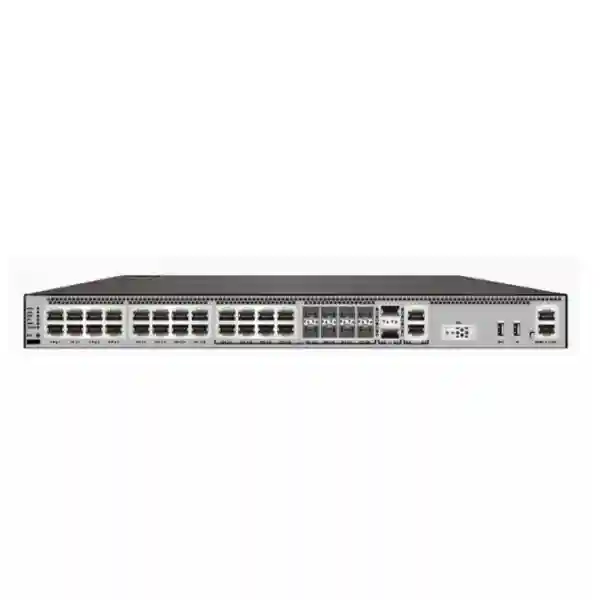
The model’s fixed-port density gives designers flexibility without requiring a separate access switch for every firewall-facing segment. Huawei lists two 10GE SFP+ interfaces, eight GE Combo interfaces, sixteen GE Ethernet interfaces, and two GE WAN interfaces, along with a dedicated management interface, console access, USB ports, and an SSD slot. In practical terms, the appliance can connect directly to multiple ISP handoffs, LAN cores, DMZ switches, server zones, partner networks, management networks, and redundant upstream devices. The 10GE interfaces are valuable when firewall inspection requirements are lower than aggregate LAN-side bandwidth, or when the appliance must connect to a core switch stack using optical uplinks while the WAN side remains at one or several Gigabit-class circuits.
The right interpretation is not that every listed interface can always be driven at line rate with every security feature enabled. Security appliances must be sized using the intended inspection stack. Huawei’s published figures differentiate raw firewall forwarding from service-aware processing, IPS, antivirus, full-protection modes, SSL inspection, and VPN. FourTeck therefore treats the USG6580E as an integrated security platform whose usable capacity depends on policy depth, traffic mix, packet size, encryption, logging, session behavior, and deployment architecture.
Published performance figures
For the USG6580E, published USG6000E data lists IPv4 firewall throughput of 8 Gbit/s for 1518-byte packets, 8 Gbit/s for 512-byte packets, and 1.5 Gbit/s for 64-byte packets. IPv6 figures are published at 8/8/1.6 Gbit/s for 1518/512/84-byte UDP. The listed firewall forwarding rate is 2.25 million packets per second, while 64-byte UDP latency is stated at 50 microseconds under the manufacturer’s test conditions.
Service-aware firewall throughput is listed at 3 Gbit/s. Firewall plus service awareness plus IPS is listed at 2.2 Gbit/s, and the figure remains 2.2 Gbit/s when antivirus is added in the published 100 KB HTTP test profile. Full-protection throughput is listed at 1.8 Gbit/s, while Huawei’s published real-world enterprise mix figure is 1 Gbit/s. These lower protected-throughput figures are often more useful for capacity planning than the larger raw firewall number.
Session and encrypted-traffic capacity
The published session scale is up to 4 million concurrent HTTP 1.1 sessions with up to 80,000 new sessions per second. These numbers are important for internet edges serving many users, guest networks, application environments, NAT-heavy networks, or branches that produce short-lived cloud connections at high rates.
Huawei lists IPsec VPN throughput at 3 Gbit/s using AES-256 with SHA256 and 1420-byte packets, with up to 4,000 gateway-to-gateway and 4,000 client-to-gateway IPsec tunnels. SSL inspection is listed at 550 Mbit/s under the stated TLS 1.2 and IPS test profile, while SSL VPN throughput is listed at 500 Mbit/s. Concurrent SSL VPN users are published as 100 by default and up to 1,000 with the appropriate entitlement.
Why protected throughput matters more than a headline firewall number
A firewall can forward packets far faster when it is performing basic stateful inspection than when it is decoding applications, matching IPS signatures, checking files, inspecting encrypted sessions, applying URL reputation, logging policy events, and maintaining large session tables. That distinction is central to USG6580E sizing. If a site has a 1 Gbit/s internet circuit but intends to enable IPS, antivirus, application control, URL filtering, and extensive logging for most outbound traffic, a planning target based on the 1 Gbit/s real-world full-protection figure is more meaningful than a calculation based on the 8 Gbit/s large-packet firewall figure.
Encrypted traffic is especially important. Modern web and SaaS use means a large percentage of enterprise traffic is TLS encrypted. When the firewall decrypts and inspects that traffic, cryptographic operations and content scanning increase resource consumption. Huawei’s published SSL inspection figure for this model is 550 Mbit/s under a specific TLS 1.2 and IPS-enabled test method. Real deployments can differ because cipher selection, certificate handling, application behavior, object sizes, concurrent handshakes, bypass policies, and inspection exceptions all change the load. A company expecting hundreds of megabits of sustained decrypt-and-inspect traffic should therefore model SSL inspection separately instead of assuming the general full-protection number applies automatically.
FourTeck’s sizing approach for Dubai deployments normally records peak and 95th-percentile WAN use, expected three-year growth, east-west versus north-south traffic, TLS percentage, inspection coverage, remote-access population, IPsec topology, concurrent sessions, new-session bursts, NAT requirements, number of security zones, number of policies, logging destination, and high-availability design. This turns a product selection into a network engineering decision rather than a catalogue comparison.
Interface architecture and practical port planning
The USG6580E fixed-interface layout is one of its strongest practical advantages. Two 10GE SFP+ interfaces provide high-speed optical or direct-attach connectivity for core switches, aggregation switches, or high-bandwidth server-side networks. Eight GE Combo interfaces allow flexible use of copper or optical media depending on the transceiver and cabling design. Sixteen additional GE interfaces can be allocated across trusted LAN, DMZ, partner, voice, management, guest, server, OT, or special-purpose zones. Two dedicated GE WAN interfaces are convenient for internet edge deployments with dual carriers or a primary/backup topology.
A common design in Dubai is to reserve the 10GE SFP+ pair for redundant core-switch uplinks, use the WAN interfaces for two ISP circuits, and use selected GE ports for DMZ switches, out-of-band services, or direct handoffs. In a branch aggregation role, the combination can instead be used to terminate multiple provider or MPLS connections while preserving separate interfaces for internet breakout and data-center transit. The exact mapping should be designed before installation because a clean zone-to-interface plan simplifies policy review, troubleshooting, HA synchronization, monitoring, and future expansion.
Combo interfaces require particular attention: a combo port represents paired media options rather than two independently usable interfaces. Procurement teams should also distinguish between interface presence and transceiver inclusion. SFP or SFP+ optics, DAC cables, fiber patch cords, and compatible modules may need to be quoted separately depending on the BOM. For 10GE design, the engineer should document optical standard, fiber type, distance, connector type, peer interface, and whether the link is intended as routed, switched, HA-related, or part of an aggregate.
The appliance also includes a dedicated management port, console access, USB connectivity, and support for optional local SSD storage. Management-plane separation is recommended when possible: placing firewall administration on a controlled management network limits exposure and makes it easier to enforce access through jump hosts, AAA systems, or privileged administration workstations.
Application identification and policy control
Huawei positions the platform around application-aware security rather than port-only filtering. The USG6000E feature set identifies thousands of applications and can combine application information with intrusion prevention, antivirus, data filtering, URL policy, users, regions, zones, time ranges, and traditional source/destination/service conditions.
For operations teams, this allows policies to follow business intent more closely. A rule can be designed around sanctioned collaboration tools, administrative protocols, cloud storage, streaming categories, remote administration, or business applications instead of assuming that TCP/443 means a single trusted service. That granularity should be introduced carefully with logging and staged enforcement so that legitimate business traffic is not disrupted.
Intrusion prevention and malware controls
The platform integrates IPS and antivirus functions with update services. IPS is used to detect traffic patterns associated with vulnerability exploitation and malicious behavior, while antivirus scanning evaluates supported content against security intelligence and signature sets. These services are most effective when policy design, update status, logging, exception handling, and incident workflows are managed as an operating process rather than simply enabled once during installation.
In a production UAE deployment, FourTeck normally recommends baseline enforcement profiles, staged tuning, review of false positives, explicit exceptions for sensitive applications, and monitoring of CPU, memory, session load, and security event volume after activation. Security efficacy and network stability both depend on disciplined tuning.
URL filtering, DNS controls, SafeSearch and acceptable-use enforcement
The USG6000E feature set includes URL filtering with cloud category intelligence, DNS-based filtering, and SafeSearch-related controls. Huawei’s published material for this generation references more than 130 URL categories and access to a cloud database containing more than 120 million URLs. The practical value is that web access policy can be expressed using categories and risk context instead of maintaining large manual URL lists. This supports acceptable-use requirements, helps reduce exposure to known malicious or unsuitable destinations, and gives administrators more consistent control across large user populations.
Category filtering should still be treated as policy engineering. Business units may require access to social networks, code repositories, file sharing, remote support platforms, generative services, streaming, personal email, or cloud drives that a strict default profile might block. The recommended process is to map categories to business roles, collect logs during an observation period where possible, create explicit exceptions with owners and review dates, and then enforce the required controls. User identity integration can make the same category behave differently for finance, marketing, IT, guest, contractor, or executive groups.
DNS controls are useful because domain queries can provide an early policy point before the browser or application establishes the full session. They are not a substitute for endpoint security, secure DNS architecture, EDR, email security, or user awareness, but they add another enforcement layer at the network edge. When combined with application policy and IPS, they can reduce the number of risky connections that reach more computationally intensive inspection stages.
SSL inspection and encrypted traffic design
Encrypted traffic inspection is one of the most important design decisions for an enterprise firewall. Without decryption, a firewall can still use metadata, reputation, IP information, certificate data, and other observable characteristics, but it cannot always inspect the full application payload. With decryption enabled, supported HTTPS flows can be examined by IPS, antivirus, URL, application, and data controls, but the firewall must perform additional cryptographic processing and the organization must manage certificates, endpoint trust, application compatibility, and privacy exclusions.
For the USG6580E, the published SSL inspection benchmark is 550 Mbit/s using a specified TLS 1.2 profile with IPS enabled. This figure should not be converted directly into a guaranteed production rate. Modern applications vary widely in object size, handshake frequency, cipher suite, use of certificate pinning, QUIC or HTTP/3 behavior, mutual TLS, and sensitivity to middlebox inspection. Some traffic categories may need bypass rules for legal, privacy, technical, or application-compatibility reasons. The net inspection load therefore depends on both policy coverage and application mix.
A strong rollout starts with an inventory of browsers, operating systems, mobile platforms, managed and unmanaged endpoints, SaaS services, business-critical applications, APIs, payment services, software-update systems, health or financial applications, and certificate-pinned clients. The enterprise CA or inspection certificate must be distributed securely to managed endpoints. Testing should validate web browsing, SSO, collaboration tools, ERP, CRM, banking portals, endpoint update services, developer tooling, mobile apps, and any custom applications that use TLS.
For Dubai organizations subject to internal governance or sector-specific controls, privacy and data-handling rules should be reviewed before decrypting categories that may contain personal or sensitive information. The firewall provides the technical capability; the customer’s security, legal, privacy, and compliance teams define where inspection is appropriate.
IPsec VPN for branches, data centers and partner connectivity
Huawei publishes 3 Gbit/s IPsec VPN throughput for the USG6580E using AES-256 and SHA256 with 1420-byte packets, together with a maximum of 4,000 gateway-to-gateway and 4,000 client-to-gateway IPsec tunnels. These capacities make the model suitable not only for a simple headquarters tunnel but also for environments that aggregate many branches, partner connections, cloud edge tunnels, or segmented VPN communities.
The first design question is topology. A hub-and-spoke model is operationally simple and keeps policy enforcement centralized, but it can create hairpin traffic and increase load at headquarters. Full mesh improves direct branch-to-branch paths but becomes difficult to manage as the site count grows. Dynamic VPN technologies can reduce manual tunnel construction in larger branch estates. The correct model depends on application location, voice and video patterns, cloud usage, branch autonomy, redundancy, and the customer’s operational maturity.
The second question is routing. Static routes may be sufficient for a small number of tunnels, while dynamic routing can be preferable when there are many prefixes, redundant hubs, dual carriers, or frequent topology changes. Route design should prevent asymmetric paths, accidental backhaul, and conflicts between internet routes and private WAN routes. For high availability, the interaction between VPN tunnel monitoring, IKE timers, routing convergence, firewall state synchronization, carrier failover, and application reconnection should be tested together rather than individually.
The third question is cryptographic policy. Customers should standardize IKE versions, encryption algorithms, integrity settings, Diffie-Hellman groups, lifetimes, PFS requirements, authentication methods, peer identities, NAT traversal, dead-peer detection, and certificate use where applicable. Interoperability testing is especially important for partner tunnels because the remote endpoint may be a different vendor or a cloud-native VPN gateway.
FourTeck can prepare a tunnel matrix covering site names, public addresses, peer types, local and remote prefixes, routing method, encryption domain, phase-one and phase-two settings, redundancy, monitoring, ownership, and change windows. This turns VPN migration into a controlled project and reduces the risk of missing hidden dependencies.
SSL VPN and remote access
The USG6580E published SSL VPN throughput is 500 Mbit/s. The platform is listed with 100 concurrent SSL VPN users by default and a maximum of 1,000 with appropriate licensing. For organizations with hybrid work, remote support teams, vendors, administrators, or emergency access requirements, that provides a substantial remote-access role when correctly sized.
Remote-access design should include identity source, MFA strategy where available in the surrounding solution, user group mapping, split versus full tunnel decisions, DNS behavior, endpoint routes, address pools, session timeouts, idle timeouts, portal or client workflows, privileged access separation, and logging. The VPN user count is only one capacity measure; help-desk workflows and identity resilience are equally important to user experience.
Authentication and identity-aware control
Huawei’s published feature set for the platform includes local authentication, RADIUS, HWTACACS, Active Directory and LDAP options, along with portal functions and integration possibilities. Identity enables security policy to be written around users and groups instead of only addresses, which is particularly helpful on shared subnets, wireless networks, VPN services, and environments with role-based internet policy.
The identity architecture should remain resilient if an external directory or AAA server is temporarily unavailable. Administrators should keep tightly controlled emergency access, synchronize time correctly for authentication and certificate services, restrict management access by source and role, and document which authentication dependency is required for every critical administrative workflow.
Routing capabilities and multi-WAN deployment
The USG6000E feature set includes support for enterprise routing protocols and IPv6 routing, including RIP, OSPF, BGP, IS-IS, RIPng, OSPFv3, BGP4+, and IPv6 IS-IS in the published product material. This is valuable when the firewall is not merely an internet appliance but a routed security boundary between core networks, WANs, DMZs, private clouds, or multiple autonomous routing domains.
A two-ISP Dubai edge can be designed in several ways. Small environments may use default routes with health checks and policy-based forwarding. Larger organizations may receive provider-independent address space and use BGP. Some deployments keep internet routing on upstream routers and present default paths to the firewall, while others terminate carrier Ethernet directly on the security appliance. Each design has different implications for NAT, asymmetric routing, DDoS handling, route convergence, troubleshooting, and change responsibility.
Huawei’s intelligent uplink selection and policy-based routing functions can steer traffic according to service requirements, link health, or configured balancing logic. This can be useful for separating business-critical SaaS, voice traffic, guest internet, backup traffic, or selected VPN destinations across available carriers. The engineer must avoid creating routing behavior that is opaque to operations teams; every exception should be documented with the reason, health condition, expected failover path, and rollback procedure.
For organizations migrating from a router plus firewall design to a firewall-led edge, route ownership should be reviewed carefully. Dynamic routing adjacency, redistribution, default route origination, summarization, ECMP behavior, BFD or tracking mechanisms, NAT, and policy order can all affect cutover. A pre-migration route table capture and a post-cutover validation set are essential.
High availability: Active/Standby and Active/Active planning
Huawei lists both Active/Standby and Active/Active high-availability configurations for the platform. The correct choice depends on the surrounding network, state synchronization requirements, traffic symmetry, routing design, and operational preferences. Active/Standby is often easier to reason about because one device is the normal forwarding unit and the peer is prepared to take over. Active/Active can use both devices but usually demands more careful traffic-engineering and failure-mode analysis.
High availability is more than purchasing a second firewall. The pair should have a clear interface mapping, redundant upstream and downstream links, synchronized software and licenses as required, HA heartbeat connectivity, management access to each member, consistent transceivers, and independent power feeds where facility design permits. Switch-side configurations must also support the planned failure behavior. A dual-firewall design connected to only one core switch or one PDU still contains obvious single points of failure.
Acceptance testing should simulate failures rather than merely showing that both appliances are online. Tests can include primary firewall shutdown, selected interface loss, ISP circuit loss, upstream switch failure, downstream switch failure, HA-link interruption, route withdrawal, VPN peer failover, and restoration to normal service. During each test, the team should measure traffic interruption, session preservation where applicable, routing convergence, VPN renegotiation, monitoring alerts, and whether management access remains available.
For critical sites, FourTeck can build an HA runbook covering expected state, trigger conditions, operator commands, verification points, escalation contacts, and failback procedure. This is particularly important when internet access, ERP, remote access, cloud applications, payment services, or branch connectivity depend on the firewall pair.
Security virtualization and segmentation
The USG6580E is published with support for up to 100 virtual firewalls, subject to licensing and software capability. Security virtualization can be useful for managed environments, large enterprises, shared infrastructure, business units requiring administrative separation, or networks that must isolate policy domains while using a common physical platform. It can provide cleaner administrative boundaries than a single very large rule base when organizational ownership is genuinely separate.
Virtualization is not automatically the best segmentation method. Many customers can achieve the required security separation with zones, VLANs, VRFs or routing instances where supported, and carefully designed policy. Introducing many virtual systems increases operational complexity: administrators must understand inter-vsys traffic, shared interfaces, route leaking or transit, resource allocation, logging, backups, software upgrades, and incident ownership. The design should therefore begin with the governance requirement rather than the maximum number of virtual instances the appliance can create.
For multi-tenant or departmental use, a useful design document specifies tenant name, assigned interfaces or VLANs, address spaces, routing ownership, administrator roles, logging destination, VPN requirements, internet egress model, shared services, inter-tenant policy, resource expectations, and change-control boundaries. That makes the security model auditable and prevents virtual firewall sprawl.
Anti-DDoS and edge hardening
The USG6000E feature set includes protection against common denial-of-service patterns such as SYN floods and UDP floods. These controls can help protect the firewall and downstream services from malformed or excessive traffic patterns within the processing capacity of the appliance and the connected circuits. They should not be confused with upstream volumetric DDoS scrubbing. If an attack saturates a carrier link before traffic reaches the firewall, an on-premises appliance cannot recover the bandwidth that has already been consumed.
A comprehensive Dubai edge design should therefore separate several layers: carrier-side DDoS options where needed, firewall DoS protection, strict exposure of public services, geo or reputation policy where appropriate, reverse proxy or WAF functions for web applications when required, secure DNS architecture, patching of internet-facing systems, and monitoring that can distinguish application failure from network saturation. Public services should be placed in deliberate DMZ zones rather than directly inside trusted user networks.
Hardening also includes the firewall itself. Management services should be limited to trusted interfaces and sources, administrative access should use secure protocols, default credentials must not remain, time synchronization and logging should be configured, unused services should be disabled, backups should be protected, software lifecycle status should be reviewed, and change events should be auditable. The strongest security feature set can be undermined by weak device administration.
Centralized management, logs and operational visibility
Huawei’s published material describes centralized configuration, monitoring, logging and reporting through its management ecosystem, together with support for common interfaces such as SNMP, SSH, Syslog, RESTful and NETCONF integrations. This matters because a firewall that cannot be monitored and audited consistently becomes an operational risk. Security teams need visibility into interface status, routing changes, HA state, VPN health, resource use, session behavior, policy matches, threat events, licensing, update status, and administrative changes.
Logging design should begin with retention and use cases. Sending every informational event to a SIEM without filtering can create noise and cost, while logging too little can leave major gaps during incident response. Critical policy denies, administrative activity, VPN events, malware and IPS detections, system health, HA changes, routing changes, and public-service access typically deserve particular attention. Log clocks should be synchronized across firewall, switches, servers, identity systems, endpoints, and monitoring tools so that events can be correlated accurately.
If optional local SSD storage is used, its role should be documented. Local storage can improve on-box retention and troubleshooting, but it should not become the only copy of security logs if compliance, forensic, or long-term reporting requirements exist. External syslog, SIEM, or centralized management can provide independent retention and search capabilities.
FourTeck can integrate firewall deployment with broader UAE infrastructure services through FourTeck IT Services UAE, including monitoring, network hardening, migration support, structured acceptance testing, and documentation. Customers who need broader network and infrastructure procurement can also work through FourTeck UAE.
Hardware profile
Form factor: 1U rack mount.
Dimensions: approximately 44 × 442 × 420 mm in the published series data.
Weight: approximately 5.8 kg at full configuration in the published hardware specification.
Power input: 100–240 V AC, 50/60 Hz.
Maximum power consumption: published at approximately 55.16 W.
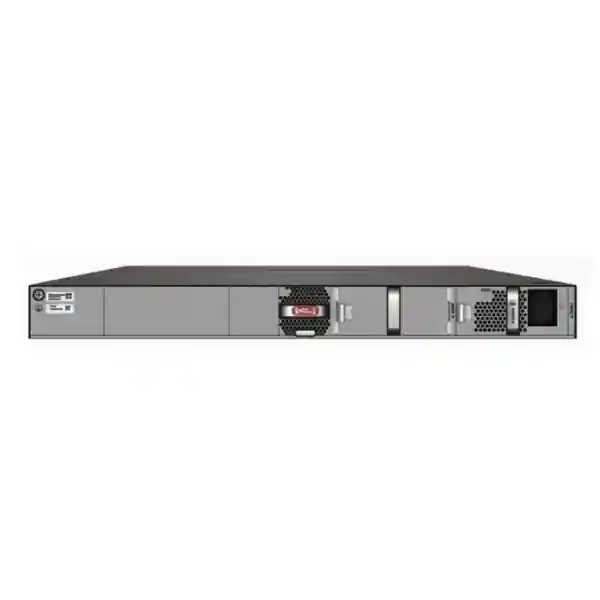
Power redundancy: single AC power supply as standard in the referenced configuration, with optional dual AC power-supply capability.
Environmental profile
Operating temperature: 0°C to 45°C.
Operating humidity: 5% to 95%, non-condensing.
Non-operating temperature: -40°C to +70°C.
Operating altitude: published maximum 5,000 m.
Noise: published as below 55 dBA at room temperature, with a higher maximum value under other conditions.
Local storage: optional M.2 SSD support is listed in the hardware specification.
UAE data-room and rack deployment considerations
Although the USG6580E’s published operating range reaches 45°C, enterprise firewalls should be installed in properly cooled, clean, controlled racks rather than treated as equipment intended for continuously hot environments. UAE data rooms can experience elevated ambient temperatures if cooling is undersized, airflow is blocked, doors remain open, or rack hot spots are not managed. Sustained thermal stress can reduce component life and trigger fan speeds that increase noise. The rack design should provide front-to-rear airflow compatibility, space for cabling, secure power, and clear service access.
For high-availability pairs, distribute power across independent PDUs or UPS paths where the facility supports them. A dual-power firewall connected to a single PDU does not provide full power-path resilience. Label every power feed, HA link, WAN circuit, 10GE uplink, management interface, and DMZ connection. Photographs and front/rear port maps should be included in the handover pack so that an engineer can identify the correct cable during an outage without tracing it manually.
Optical links should be matched to the correct fiber type and distance. Keep spare compatible optics for critical links if replacement lead time is a concern. Cable-management arms or over-tight bundles should not obstruct airflow. Management and console access should remain reachable even when the production network is degraded, which may justify a dedicated out-of-band management network for larger sites.
Customers refreshing a firewall as part of a broader rack or server-room project can coordinate related infrastructure through FourTeck Server Dubai. For firewall-focused consultation, design and procurement, FourTeck Firewall Dubai provides the specialist security channel.
How to size the USG6580E for a Dubai organization
Sizing should start with measured demand, not the nominal speed of the ISP circuit. A 1 Gbit/s internet service that averages 120 Mbit/s but bursts to 650 Mbit/s has a different profile from a 500 Mbit/s service that runs at 450 Mbit/s for most of the working day. The firewall must also accommodate future growth, backup jobs, cloud migrations, software updates, video meetings, guest traffic, and seasonal peaks. If the device is part of a multi-year investment, capacity should be evaluated against a realistic growth window.
Next, classify traffic by security treatment. Estimate what percentage receives stateful inspection only, application control, IPS, antivirus, URL filtering, full content security, or SSL decryption. The USG6580E’s published 1 Gbit/s real-world full-protection figure is a useful reference for heavy inspection, while SSL inspection has a separate published benchmark of 550 Mbit/s under the manufacturer’s stated profile. If the expected decrypted traffic alone approaches that level during busy periods, the design should be reviewed carefully rather than assuming spare capacity from the raw firewall benchmark.
Then review sessions. User count is an imperfect proxy because modern devices open many concurrent connections. A campus with thousands of mobile devices, browsers, collaboration clients, endpoint agents, cloud storage tools, and background services can generate large session tables even at moderate bandwidth. The 4 million published concurrent session capacity and 80,000 new sessions per second provide significant headroom, but the actual requirement should be estimated from current firewall telemetry if available.
VPN sizing must include both throughput and tunnel count. A headquarters with 200 branches sending modest traffic may use many tunnels but limited bandwidth, while a data-replication link may consume high throughput with only a few tunnels. Remote-access planning should similarly consider concurrent users, not total registered users. If 700 employees are enabled for VPN but only 120 are expected simultaneously, concurrent licensing can be sized differently from a scenario in which most staff work remotely at the same time.
Finally, include resilience headroom. In an HA pair, each unit should normally be capable of carrying the intended production load when its peer is unavailable. Designing the pair so that both devices are required simply to meet normal peak demand creates a risk during maintenance or failure. Capacity planning should preserve enough margin for failover, updates, traffic anomalies, and growth.
Licensing and subscription planning
A complete USG6580E quotation should separate hardware from the security and capacity entitlements needed for the intended deployment. Huawei’s published ordering information for the generation includes SSL VPN concurrent-user licenses and IPS update service subscriptions specific to the model. Security subscription structures, availability, support terms, and current commercial SKUs can change over time, so the final bill of materials should be verified against current distribution and vendor information at the time of purchase.
For remote access, confirm the number of simultaneous SSL VPN users required. The platform is published with 100 default users and a maximum of 1,000 for this model. Do not equate named employees with concurrent sessions; use actual working patterns, disaster-recovery assumptions, contractor access, and emergency remote-work scenarios. If remote access is business critical, also check identity dependencies, client compatibility, certificate requirements, support coverage, and whether the organization requires MFA through the surrounding identity stack.
For IPS, antivirus, URL intelligence, or other update-driven functions, the value of the control depends on valid and current threat content. Subscription expiry is therefore both a commercial and a security-operational issue. Renewal dates should be monitored well in advance. Change-control documentation should record which security features rely on active subscriptions so that management understands the effect of an expired service.
Support coverage should match the role of the firewall. An internet-edge or branch-hub appliance with no alternate path may justify more aggressive support and spares planning than a lab device. When the model is deployed as an HA pair, confirm that entitlement, hardware support, software rights, and replacement processes are appropriate for both serial numbers.
Migration from an existing firewall
A firewall migration is rarely a direct copy of rules from one appliance to another. Existing rule bases often contain years of temporary objects, expired vendors, duplicate addresses, shadowed rules, broad any-to-any exceptions, obsolete NAT entries, unused VPNs, and naming inconsistencies. Recreating all of that faithfully transfers old risk into a new platform. The migration should preserve valid business flows while using the refresh as an opportunity to simplify and document policy.
The discovery stage should export current interfaces, VLANs, IP addresses, routes, dynamic routing configuration, NAT policies, security rules, objects, service groups, VPN settings, authentication settings, certificates, public-service mappings, DHCP or relay functions, DNS-related configuration, HA settings, admin accounts, logging, and monitoring integrations. Current traffic logs are useful for identifying policies that actually match traffic and for discovering undocumented dependencies.
During translation, each policy should have an owner or purpose where possible. Object names should follow a consistent standard. Public NAT rules need special care because a missing service or incorrect source restriction can either break an application or expose it too broadly. IPsec tunnels should be validated with the remote peer owners before the cutover, especially when pre-shared keys, public IPs, or encryption parameters will change.
The cutover plan should define a freeze window, configuration backup, cable map, rollback trigger, rollback procedure, DNS considerations, ISP coordination, remote-access communication, test owners, and escalation contacts. A dry run or lab validation is recommended for complex environments. The team should know in advance which applications prove success: internet browsing alone is not enough.
Post-cutover, validate routing, internet access, inbound services, branch VPNs, remote access, DNS, NTP, email flow, identity services, ERP, voice, cloud applications, monitoring, SIEM logging, backups, management access, HA state, and business-critical workflows. Keep the old firewall configuration and evidence pack until the new environment has completed the agreed stabilization period.
Deployment topology examples
1. Dual-ISP headquarters edge
Two WAN circuits terminate on the firewall pair. 10GE uplinks connect to redundant core switches. Separate zones serve corporate users, guest Wi-Fi, DMZ servers, management, and partner links. IPsec tunnels connect branches. Application control, IPS, URL policy, and selected SSL inspection are enabled. This topology uses the platform as the primary security and routing edge.
2. Branch aggregation hub
The USG6580E terminates many site-to-site tunnels from retail, office, warehouse, or service locations. Private application traffic is routed toward the campus or data center, while selected branches may receive centralized internet breakout. Dynamic routing and standardized VPN templates reduce manual route management as the site count grows.
3. Internal segmentation firewall
Instead of sitting directly on the internet, the appliance separates user, server, OT, guest, partner, or development networks. 10GE links provide high-capacity core connectivity while security policies control lateral movement. Internet security may remain on another platform, allowing the USG6580E to concentrate on zone-to-zone enforcement.
4. DMZ and published-services gateway
The firewall protects internet-facing services and separates DMZ networks from internal applications. NAT, routing, IPS, anti-DDoS controls, server access policy, and logging are carefully tuned. For high-risk web applications, the design can be complemented by upstream DDoS services, reverse proxy, or dedicated web-application security as required.
Policy architecture for maintainable security
A technically capable firewall can still become difficult to operate if the policy structure is poor. Rules should be grouped by security zone and business purpose, use specific address and service objects, avoid unnecessary duplication, and include descriptions. Temporary rules need expiry dates or review reminders. Administrative policies should be separated from user internet rules, public-service rules, partner access, and VPN flows so that changes can be reviewed quickly.
The order of policy evaluation should be deliberate. Broad permit rules placed above restrictive rules can silently bypass intended security. Application controls and URL policies should align with security rules rather than producing conflicting logic. Logging should be enabled where it supports troubleshooting, security monitoring, compliance, and policy optimization, but log volume should be sized for the external collector and retention period.
Object hygiene is equally important. Use naming standards that reveal type and purpose, such as HOST, NET, FQDN, SVC, GRP, VPN, or PUB, together with environment or site tags. Avoid creating multiple objects for the same IP address under different names. When a server is decommissioned, remove its stale NAT, address, policy, and monitoring entries through a controlled cleanup process.
Quarterly or scheduled rule review can identify policies with no matches, broad source ranges, obsolete services, expired vendors, and emergency exceptions that were never removed. The USG6580E’s capacity of up to 15,000 security policies is generous for many organizations, but the goal should not be to fill the table. A smaller, well-structured rule base is safer and easier to troubleshoot than a large undocumented one.
Bandwidth management and application experience
Huawei’s feature set includes bandwidth management by user, IP, and application, with mechanisms for maximum limits, minimum guarantees, and forwarding priorities. This can help when a site has constrained WAN capacity or must protect critical business applications from bulk downloads, guest usage, backups, streaming, or software distribution. Bandwidth policy is most effective when it is based on measured congestion and business priority rather than used as a substitute for adequate circuit capacity.
For example, a 500 Mbit/s branch or campus edge may reserve capacity for voice, ERP, remote desktop, and business SaaS while limiting guest traffic during busy periods. Backup replication can be scheduled or shaped outside core hours. Application identification can distinguish classes that share common ports, allowing more precise QoS than traditional service-based rules alone.
Traffic shaping should be coordinated with upstream routers and carrier services. If the true bottleneck is an ISP link outside the firewall, shaping slightly below the provider rate can keep queues under local control and improve predictability. However, QoS cannot create bandwidth that does not exist. Persistent saturation is a capacity-planning problem and may require circuit upgrades, local internet breakout, WAN optimization, or application scheduling.
IPv6 readiness
The platform’s published specifications include IPv6 firewall performance and IPv6-capable routing protocols. Even organizations that do not intentionally use IPv6 should understand its presence on endpoints and networks. Modern operating systems enable IPv6 by default, and unmanaged IPv6 can create visibility gaps if security policy, monitoring, DNS, and routing are designed only around IPv4.
An IPv6 readiness assessment should determine whether the ISP provides native IPv6, whether internal networks use SLAAC or DHCPv6, how addresses are allocated, what security zones apply, how DNS records are managed, whether remote access supports the required IPv6 behavior, and whether logging tools can store and search IPv6 addresses effectively. Security policy should not simply mirror IPv4 rules without considering the different addressing and neighbor-discovery model.
For organizations planning a phased dual-stack rollout, the firewall can act as a controlled boundary while the team updates monitoring, asset management, identity, endpoint security, and application dependencies. The project should include explicit testing of internet access, published services, VPN, DNS, management systems, and incident-response workflows under both address families.
Operations after go-live
A firewall project is successful only if the appliance remains healthy, updated, understandable, and supportable after handover. Day-two operations should include configuration backups, software lifecycle review, subscription monitoring, security signature updates, log monitoring, capacity trending, certificate expiry tracking, administrator review, VPN health checks, and periodic HA tests. Changes should be recorded with business justification and rollback information.
Capacity should be trended rather than checked only during incidents. Monitor CPU, memory, session count, new sessions per second, interface throughput, dropped packets, SSL inspection load, VPN utilization, log rates, storage use, and HA state. Comparing busy-hour trends month by month provides early warning when growth is consuming headroom. It is easier to upgrade circuits or appliances in a planned maintenance window than during a performance crisis.
Security events also need an owner. IPS and malware alerts should feed a process for triage, endpoint investigation, account review, containment, and remediation. Repeated blocks from the same internal device may indicate an infected host, misconfiguration, or vulnerable application. Repeated public scans may be normal internet noise, but spikes or targeted attempts may justify additional controls. Firewall telemetry becomes valuable when it is connected to incident response rather than stored passively.
At least annually, review whether the current policy matches the organization’s network. New SaaS platforms, cloud migrations, mergers, branch closures, new remote-access practices, and changes in public applications can make an initially clean firewall design obsolete. A structured review keeps the USG6580E aligned with the business instead of allowing configuration drift to accumulate.
Procurement guidance for Dubai and the UAE
A firewall quotation should identify more than the base chassis. Confirm exact model, AC power configuration, secondary power supply if required, rack accessories, compatible optics, fiber or DAC requirements, security subscriptions, SSL VPN user entitlement, support duration, software rights, local storage requirements, and any centralized-management components. For an HA pair, duplicate or pair the necessary items correctly and ensure the planned licenses support the required state.
Lead time matters when the purchase is tied to an office move, contract renewal, ISP migration, audit deadline, or expiring firewall support. If optics or licenses are sourced separately, confirm compatibility before shipment. Serial numbers and support entitlements should be recorded during receiving. The implementation team should have access to software, license files or activation workflows, and vendor support before the maintenance window begins.
Customers should also distinguish new, officially sourced equipment from grey-market, used, or unsupported stock. Enterprise security devices require confidence in supportability, software entitlement, subscription activation, and replacement processes. A lower chassis price can become expensive if the device cannot receive the required security updates or support.
FourTeck can prepare a UAE quotation that maps each line item to the deployment design: firewall unit, redundancy, optics, subscriptions, remote-access user count, implementation, migration, testing, documentation, and ongoing support. This helps procurement compare complete solutions rather than incomplete base-hardware prices.
Recommended implementation phases
Phase 1 — Discovery
Collect topology, circuits, addresses, VLANs, routing, VPNs, NAT, existing policies, public services, user groups, security requirements, peak traffic, session statistics, logging integrations, rack details, power, optics, and migration constraints.
Phase 2 — Low-level design
Define interface mapping, zones, IP plan, routing, HA, NAT, VPN, security profiles, management, AAA, monitoring, logging, certificate approach, SSL inspection policy, naming standards, and rollback strategy.
Phase 3 — Build and validation
Configure the appliance or pair, apply licensing, update software and security content, load objects and rules, establish test VPNs, validate routing, test admin access, configure monitoring, and verify backups before production cutover.
Phase 4 — Cutover
Execute the approved change plan, move circuits and LAN links, verify HA, test applications and tunnels, confirm public services, validate logs, monitor resource use, and keep the rollback path available until acceptance criteria are met.
Phase 5 — Stabilization
Review alerts, tune IPS and application controls, resolve SSL inspection exceptions, validate user experience, confirm monitoring thresholds, reconcile the final rule set, and document any approved deviations from the design.
Phase 6 — Handover
Deliver as-built topology, port maps, IP plan, route summary, VPN matrix, policy standards, administrator procedures, backup process, license details, support contacts, HA test results, and an agreed operations checklist.
Frequently asked technical questions
Is the USG6580E suitable for a 1 Gbit/s internet connection?
Potentially, yes, but the answer depends on the inspection stack. Huawei publishes 8 Gbit/s large-packet firewall throughput, 1.8 Gbit/s full-protection throughput, 1 Gbit/s real-world full-protection throughput, and 550 Mbit/s SSL inspection under the stated test profile. A 1 Gbit/s circuit with extensive TLS decryption may need more careful analysis than a 1 Gbit/s circuit using selective inspection.
How many SSL VPN users can it support?
The published figure is 100 concurrent SSL VPN users by default and up to 1,000 with the appropriate entitlement. Size against simultaneous users, not the total employee population, and include disaster-recovery or remote-work scenarios.
Can it be deployed as an HA pair?
Yes. Huawei publishes Active/Active and Active/Standby HA support. The surrounding switch, carrier, routing and power design must also be redundant for the pair to deliver meaningful service resilience.
Does it support 10 Gigabit Ethernet?
Yes. The fixed-port specification includes two 10GE SFP+ interfaces. Optics or DACs should be selected to match the peer device, fiber type, distance and topology.
Can it handle many branch VPNs?
Huawei publishes up to 4,000 gateway-to-gateway IPsec tunnels and 3 Gbit/s IPsec VPN throughput under the stated cryptographic test profile. Actual branch design should consider routing, tunnel monitoring, bandwidth, encryption settings and hub redundancy.
Is SSL inspection included in the raw firewall throughput figure?
No. SSL inspection is a separate workload with its own published benchmark. It should be capacity-planned independently because TLS handshakes, cipher suites, object sizes, inspection coverage and application compatibility affect real performance.
Does the appliance support dynamic routing?
The published platform feature set includes enterprise routing protocols such as OSPF, BGP and IS-IS, together with IPv6 equivalents. Exact software-version behavior should be verified during design for any feature that is critical to the topology.
Should we use all security features on every flow?
Not necessarily. Security controls should follow risk and business need. Some traffic may require full inspection, while trusted infrastructure or certificate-pinned services may need different treatment. Selective policy can improve performance and reduce operational issues while maintaining strong protection where it matters.
Decision recap: when the USG6580E fits well
Good fit indicators
The requirement calls for a 1U enterprise firewall with 10GE uplinks, dense GE connectivity, millions of sessions, high new-session rates, up to several gigabits of IPsec capacity, sophisticated application and content controls, branch aggregation, remote access, dynamic routing, and HA support.
Review carefully when
The environment expects sustained multi-gigabit full inspection, very high TLS decryption volume, more than the model’s maximum SSL VPN users, larger policy or virtualization scale, data-center east-west traffic substantially above the published security throughput, or future internet growth likely to exceed the platform’s protected-traffic headroom.
The decisive metric is the workload after security services are applied. A USG6580E can be an excellent fit for many headquarters and campus edges, but a larger model may be justified when encrypted inspection, full-protection throughput, growth, or redundancy headroom approaches the published limits. Conversely, a smaller model may be more economical if the real requirement is modest. FourTeck’s role is to map the firewall to the traffic and operating model instead of oversizing or undersizing based only on raw bandwidth.
Quotation input checklist
Providing the information below allows a more accurate USG6580E bill of materials and deployment estimate. Exact values are preferred, but approximate values are sufficient for an initial sizing discussion.
Carrier names, circuit bandwidths, handoff media, public IP ranges, BGP requirements, backup links, MPLS or SD-WAN dependencies.
Current peak throughput, expected three-year growth, user count, device count, session statistics, high-bandwidth applications and cloud usage.
IPS, antivirus, URL filtering, application control, SSL inspection, DLP, anti-DDoS, public service protection and logging requirements.
Number of site-to-site tunnels, remote-access concurrent users, cryptographic standards, branch growth, partner VPNs and cloud tunnels.
Number of copper and fiber connections, 1GE/10GE requirements, fiber type, distances, core switch models and redundancy design.
Monitoring, syslog or SIEM, AAA, backup, centralized management, admin access, support SLA, documentation and maintenance-window expectations.
FourTeck consultation for Huawei HiSecEngine USG6580E in Dubai
FourTeck can support the USG6580E across the full deployment lifecycle: requirement discovery, technical sizing, BOM preparation, optics selection, licensing review, rack and power planning, policy design, HA architecture, IPsec and SSL VPN planning, migration from the existing firewall, staged cutover, acceptance testing, documentation, and post-deployment support.
A useful pre-sales session should answer five questions: what traffic must be protected, which security services are required, how much encrypted inspection is expected, what failure scenarios the design must survive, and how the environment is expected to grow. Once those inputs are known, the USG6580E can be evaluated against measurable requirements rather than assumptions.
For a quotation, provide the current firewall model, internet bandwidth, number of WAN circuits, approximate user count, branch count, remote-access concurrency, whether SSL inspection is planned, and whether a single appliance or HA pair is required. FourTeck can then recommend the hardware, subscriptions, optics, and implementation scope required for the UAE deployment.
• Validated model sizing
• UAE BOM and licensing scope
• HA and port-map recommendation
• VPN and inspection capacity review
• Migration and cutover outline
• Support and lifecycle planning
Technical note on published specifications
Performance values referenced on this page are based on published USG6000E information for the USG6580E and are test-condition figures, not guaranteed production results. Actual throughput and latency vary with software release, policy complexity, packet size, application mix, enabled security services, TLS parameters, logging, VPN configuration, session behavior, interface design, updates, and surrounding network conditions. Final architecture, licensing, software compatibility, support status, current part numbers, and feature availability should be verified against the applicable Huawei documentation and commercial channel at the time of deployment.

Reviews
There are no reviews yet.