
Enterprise Next-Generation Firewall • Dubai & UAE
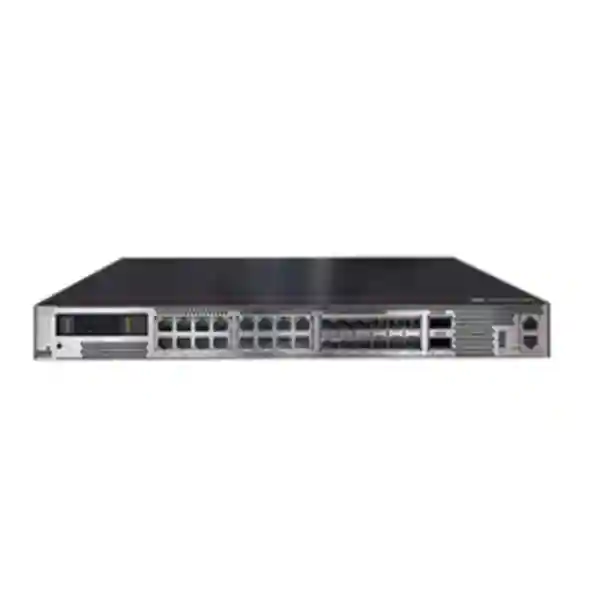
Huawei HiSecEngine USG6620E Firewall
A high-capacity 1U security platform for enterprise Internet edges, data-center boundaries, VPN aggregation, segmented environments and multi-service perimeter protection. The USG6620E combines stateful firewalling, application awareness, intrusion prevention, antivirus, URL controls, DLP, encrypted-traffic inspection, VPN services, routing and high availability in a single appliance.
Choose the USG6620E when a UAE deployment needs multi-gigabit threat inspection, up to 20 Gbit/s stateful firewall performance under Huawei’s published test conditions, large session capacity, 10GE uplinks, strong VPN throughput and enterprise-class HA without moving to a larger modular chassis.
Huawei lists 20/20/20 Gbit/s for 1518/512/64-byte UDP packets under the stated lab methodology.
Designed for high-connection-density networks, shared Internet egress and consolidated enterprise services.
Useful for high-churn web, SaaS, guest access, proxy, application and data-center traffic patterns.
Published with AES-256 plus SHA-256 and a 1420-byte packet profile under Huawei test conditions.
12×GE RJ45, 8×GE SFP and 4×10GE SFP+ provide flexible access, WAN and aggregation connectivity.
Fits standard enterprise racks and supports redundant design approaches for critical UAE network edges.
What the Huawei HiSecEngine USG6620E Is Designed to Do
The Huawei HiSecEngine USG6620E sits in the higher-performance portion of Huawei’s fixed-configuration USG6600E firewall family. Its role is not simply to pass packets between a trusted and untrusted interface. It is built to enforce a security policy across applications, users, destinations, encrypted sessions and routed network segments while maintaining the throughput and session scale expected at a modern enterprise border. In practical UAE deployments, that means the same appliance can be used as an Internet edge firewall, a data-center segmentation gateway, a VPN termination hub, a security boundary for cloud-connected services, or a consolidated gateway between office, server, guest, partner and external zones.
The architecture combines traditional stateful inspection with deeper application and content security functions. Huawei documents integrated firewall, VPN, intrusion prevention, antivirus, data leak prevention, bandwidth management, anti-DDoS, URL filtering and anti-spam capabilities. The security policy engine can make decisions using network and service context such as source and destination, security zone, application, URL category and time range. This matters because a simple port-based rule set is no longer sufficient for environments where many SaaS services share HTTPS, users work from multiple locations, and branch traffic is concentrated through central gateways.
For a Dubai business, the most important design question is therefore not whether the platform can act as a firewall; it can. The important question is how much inspected throughput, session concurrency, remote-access scale, interface density, storage, redundancy and subscription coverage the intended deployment requires. FourTeck approaches USG6620E projects as sizing exercises rather than as box-selection exercises. That approach helps avoid two common outcomes: purchasing a firewall based only on an optimistic raw throughput number, or oversizing an appliance without understanding which security services, encrypted flows and routing roles will actually be enabled.
Performance Architecture and Published Capacity
Huawei’s published system-performance figures give a useful baseline for architecture planning, provided they are read together with the vendor’s test notes. For the USG6620E, IPv4 firewall throughput is listed as 20/20/20 Gbit/s using 1518-, 512- and 64-byte UDP frames. IPv6 throughput is listed as 20/20/8 Gbit/s for 1518-, 512- and 84-byte UDP frames. Packet forwarding is listed at 30 million packets per second, with a stated 64-byte UDP firewall latency of 15 microseconds under the test environment. These are laboratory values and should not be treated as guaranteed application throughput in every production design.
The more useful numbers for security sizing appear when additional inspection services are activated. Huawei lists FW plus service awareness throughput at 12 Gbit/s, FW plus service awareness plus IPS at 10 Gbit/s, and FW plus service awareness plus IPS plus antivirus at 10 Gbit/s under the vendor’s documented 100 KB HTTP-file methodology. Full-protection throughput is listed at 7.2 Gbit/s under one test profile and 4.8 Gbit/s using Huawei’s enterprise-mix real-world traffic model with firewall, service awareness, IPS and antivirus enabled. Those figures illustrate why raw firewall throughput should never be used alone for procurement sizing.
Session scale is equally important. The USG6620E is published with support for up to 8,000,000 concurrent TCP sessions and 200,000 new TCP sessions per second. A network with thousands of users can consume many times more sessions than its user count suggests because browsers, collaboration platforms, cloud storage tools, endpoint agents, DNS resolvers, mobile applications and embedded devices maintain many simultaneous connections. High session capacity gives the design more headroom during traffic bursts, patch windows, large meetings, software distribution events and failover situations where traffic that normally traverses two gateways is temporarily concentrated on one.
FourTeck therefore sizes the USG6620E around the expected inspected bandwidth during busy hour, encrypted-traffic percentage, session concurrency, connection creation rate, VPN load, routing role and growth horizon. A 5 Gbit/s Internet circuit does not automatically mean a 5 Gbit/s firewall requirement. If the organization expects to inspect most HTTPS traffic, apply IPS and antivirus policies broadly, terminate site-to-site VPNs, run multiple security zones and retain substantial growth margin, the effective security workload can be meaningfully heavier than the nominal WAN speed suggests.
Interface Layout: Why 12×GE Copper, 8×GE SFP and 4×10GE SFP+ Matter
The USG6620E’s interface mix is practical for enterprise edge designs because it avoids forcing every connection into the same media type. Twelve Gigabit Ethernet RJ45 ports can serve management networks, copper ISP handoffs, internal service networks, dedicated DMZs, out-of-band paths or low-bandwidth routed segments. Eight Gigabit Ethernet SFP interfaces allow optical or specialized transceiver connectivity for buildings, provider handoffs or longer-distance links. Four 10 Gigabit Ethernet SFP+ ports provide the capacity required for data-center aggregation, high-speed campus cores, dual high-throughput Internet circuits or redundant east-west links.
A good physical design maps interfaces to failure domains before configuration starts. Rather than assigning ports ad hoc during installation, FourTeck typically defines a port plan that identifies the primary Internet circuit, secondary Internet or MPLS circuit, core-switch links, HA-related connectivity, DMZ trunks, server segments, management/O&M access and any dedicated inspection or monitoring path. This makes cabling, naming, policy review and future troubleshooting easier. It also prevents a common operational problem where an uplink is moved later and the associated security-zone, routing and monitoring assumptions are not updated consistently.
The four 10GE SFP+ interfaces deserve specific attention. If the firewall is inserted between a 10GE distribution layer and a 10GE Internet or data-center aggregation layer, designers should account for both traffic directions and for HA failover. A nominal 10GE link does not necessarily represent 10GE of security traffic in one direction only; backup flows, internal-to-DMZ traffic, asymmetric routing and inter-zone traffic can all consume processing capacity. Likewise, the choice of SR, LR or other optical modules should be based on fiber type, distance, switch compatibility, rack topology and link budget rather than price alone.
Huawei’s ordering information also identifies the USG6620E-AC host and USB 3.0 connectivity. Power, rack space, airflow direction, cable-management clearance and serviceability should be reviewed as part of the rack design. The family datasheet lists a 1U chassis and front-to-rear operational considerations common to data-center deployments. For UAE server rooms, adequate cooling and clean airflow are important because firewall performance and service life depend on operating inside supported environmental conditions, particularly when optional storage is installed.
Integrated Security Services for a Modern Enterprise Perimeter
The USG6620E is designed as an integrated security gateway rather than a simple packet filter. Huawei’s software feature set combines stateful firewall policy, VPN, intrusion prevention, antivirus, data leak prevention, bandwidth management, anti-DDoS controls, URL filtering and anti-spam capabilities. The practical value of integration is policy context: traffic can be permitted by network identity and simultaneously subjected to application identification, intrusion prevention, malware inspection, URL category rules or data controls depending on the organization’s policy.
This integrated model supports different enforcement levels for different zones. A public web DMZ may require narrow inbound rules, IPS profiles and server protection. Employee Internet access may require application control, URL filtering, DNS filtering and bandwidth shaping. Partner links may need strict IP and application allowlists. Guest Wi-Fi may use broad Internet access with aggressive isolation and usage controls but no reachability to internal networks. Server-to-server traffic may need segmentation policies designed around workload function rather than user browsing behavior. The platform gives security architects the ability to build these controls within one policy framework.
The advantage, however, is realized only when features are deliberately mapped to risks. Enabling every available inspection function on every rule without testing can consume unnecessary resources, create troubleshooting complexity and increase the chance of application compatibility issues. FourTeck therefore recommends a policy architecture that separates trust boundaries, identifies high-value services, assigns inspection profiles based on traffic type, and validates the impact of encrypted-traffic inspection before broad rollout. That approach produces better security and more predictable performance than applying one generic profile to all traffic.
Security subscriptions should also be treated as operating requirements, not optional paperwork. Signature-based IPS, antivirus, URL intelligence and cloud-assisted services derive value from current intelligence. A procurement list that includes hardware but omits the necessary subscription term may leave an otherwise capable firewall unable to deliver the intended level of protection. This is why FourTeck’s quotations separate chassis, support, threat-protection services, VPN-user expansion, storage, optics and any additional licensing so technical teams can understand exactly what is being purchased.
Application Identification, User Context and Bandwidth Governance
Huawei documents application identification for more than 6,000 applications, with granularity that can extend to functions inside an application. This allows policy to move beyond the assumption that TCP port 443 represents one uniform risk. In a typical office network, web conferencing, consumer storage, enterprise SaaS, remote administration, messaging, social media, streaming and software updates may all use HTTPS. Application-aware control can distinguish these traffic classes and apply different actions, logging or bandwidth policies.
Bandwidth management adds a second control plane to security policy. The firewall can manage bandwidth per user or IP and can allocate minimum or maximum bandwidth or change forwarding priority. This is relevant in Dubai offices where voice, video meetings, ERP access and customer-facing cloud applications share the same circuits as software downloads, personal streaming and bulk synchronization. A bandwidth policy can protect the user experience of critical applications without relying solely on upstream provider shaping.
User authentication options documented by Huawei include local authentication, RADIUS, HWTACACS, Active Directory and LDAP, along with portal capabilities. Identity-aware policy can help security teams express rules in business terms. For example, finance users may be given access to a specific application service, contractors may be restricted to approved destinations, and administrative users may be required to traverse controlled management paths. Identity mapping also improves audit readability because logs can show a user context instead of only an IP address that may change over time.
Policy design should still preserve network-level controls. User identity does not replace segmentation, and application awareness does not replace route security. The strongest architecture combines user context, security zones, subnet controls, service definitions, application recognition, content inspection and logging. That layered model is especially useful in organizations with hybrid work, branch connectivity, outsourced operations or shared infrastructure, where any one identity source or network attribute may be incomplete.
Intrusion Prevention, Web Protection, Antivirus and Anti-APT Workflows
The intrusion-prevention capability is intended to identify and block network attacks by comparing traffic behavior and content against security intelligence and detection logic. Huawei specifically describes protection against vulnerability-oriented attacks and web-specific threats such as SQL injection and cross-site scripting. For Internet-facing services, an IPS profile can add an important control between exposed applications and attackers, but it should complement secure application development, patching, web-server hardening and dedicated application-security controls where appropriate.
Antivirus inspection provides malware detection at the gateway for supported traffic types. The value of gateway antivirus is broad visibility: a file can be evaluated before it reaches many endpoints. It does not replace endpoint protection, EDR or email-security layers, because encrypted content, unsupported protocols, password-protected archives and endpoint-local execution paths can limit what a network gateway sees. In a layered architecture, the firewall contributes one inspection point while endpoint, identity and workload controls provide additional enforcement.
Huawei also documents integration with local or cloud sandbox functions for anti-APT workflows. Suspicious files can be submitted for deeper behavior-based analysis, which can help detect threats that are not yet represented by a simple signature. The USG6600E family can also cooperate with Huawei HiSec Insight for traffic-analysis use cases. Organizations considering these integrations should confirm licensing, management architecture, data-location expectations, traffic volumes and operational ownership before deployment.
A successful threat-protection rollout needs tuning. IPS rules should be aligned to the operating systems and applications actually in use. Malware controls should be tested against business file-transfer workflows. Exceptions should be documented with an owner and review date. High-severity events should feed an incident-response process rather than remain as dashboard alerts. FourTeck can integrate firewall log output into a wider monitoring architecture using supported methods such as syslog and SNMP, while organizations with centralized security platforms can use appropriate APIs and management integrations documented by Huawei.
URL Filtering, DNS Controls and Data Leak Prevention
URL filtering is useful when an organization wants web-access policy to follow categories or business purpose rather than maintain long manual domain lists. Huawei documents access to a cloud URL database containing more than 120 million URLs and over 130 URL categories in the published USG6600E material. The platform can apply category controls, DNS filtering and SafeSearch-related policy functions. In practice, this supports controls for high-risk or non-business categories while allowing approved sites without building thousands of individual address objects.
DNS filtering adds an earlier decision point. Because many user sessions begin with name resolution, filtering known undesirable domains at the DNS-related policy layer can reduce exposure before a full application session is established. However, encrypted DNS, hard-coded IP addresses and local resolvers can affect visibility, so DNS controls should be part of a broader architecture that includes endpoint configuration, recursive-resolver policy and application-layer inspection where appropriate.
Data leak prevention capabilities are designed to inspect file content and identify supported file types based on content rather than relying only on filename extensions. Huawei cites common business document types such as Word, Excel, PowerPoint and PDF. DLP policy can help prevent sensitive information from leaving through controlled channels, but it should be introduced carefully because false positives can interrupt legitimate business processes. The best implementation starts with discovery and logging, identifies the actual patterns of sensitive data, and then moves selected high-confidence cases to blocking.
Organizations in regulated industries should align firewall DLP with their broader information-governance framework. The firewall sees network traffic, while data-classification tools, endpoint DLP, SaaS controls and document-rights systems may see additional context. A well-designed policy therefore states what the firewall is expected to detect, what is enforced elsewhere, how exceptions are approved and where incidents are investigated. The USG6620E provides a network enforcement point within that larger control model.
IPsec VPN: High-Capacity Site Connectivity and Secure Branch Aggregation
For IPsec VPN, Huawei publishes 20 Gbit/s throughput for the USG6620E using AES-256 plus SHA-256 and a 1420-byte test packet. The platform is also listed for up to 15,000 gateway-to-gateway tunnels and up to 15,000 client-to-gateway IPsec tunnels. These limits are substantially higher than most single-office requirements, making the appliance suitable as a central VPN aggregation point where many sites or partner connections terminate on a shared edge.
VPN design is not simply a throughput calculation. Each tunnel adds routing, key management, monitoring and operational dependencies. Large branch deployments need a consistent addressing plan, standardized encryption proposals, clear failover logic and defined procedures for key rotation or certificate renewal. Where branch public addresses are dynamic, Huawei’s DSVPN functionality can support more flexible connectivity patterns. The vendor also documents standard VPN technologies including IPsec, SSL VPN, L2TP, MPLS VPN and GRE, allowing the firewall to participate in multiple secure-connectivity architectures.
For business continuity, dual Internet providers can be combined with policy-based routing or intelligent uplink selection so traffic can use links according to health, bandwidth or service policy. When VPNs are involved, the failover plan should be tested from both directions. Remote branches may keep old security associations longer than expected, cloud peers may use fixed tunnel endpoints, and route preference can produce asymmetry. A documented test plan is therefore essential before declaring a dual-WAN VPN design production-ready.
FourTeck can also coordinate the firewall design with switching, server and wider infrastructure work. UAE customers building a complete rack or data-center edge can reference FourTeck Server Dubai for adjacent compute and server-platform requirements while keeping network security sizing tied to the real application and traffic architecture.
SSL VPN and Remote Access Planning
Huawei lists 2 Gbit/s SSL VPN throughput for the USG6620E under its documented TLS 1.2 test profile. The platform provides 100 concurrent SSL VPN users by default and can scale to 2,000 concurrent users with applicable licenses. This licensing model is important during procurement because an organization planning hundreds of remote workers needs the correct user entitlement in addition to the appliance itself.
Remote access should be designed around identity and least privilege rather than treating VPN connectivity as a full extension of the internal LAN. User groups can be mapped to specific resources, administrative access can be separated from business-user access, and sensitive applications can require additional authentication or jump-host controls. The remote-access address pool should be unique and included in firewall policy, routing, DNS, logging and endpoint-management plans.
Performance expectations must also consider the endpoint and Internet path. A published 2 Gbit/s SSL VPN number does not mean every remote user will experience a proportional share of 2 Gbit/s. Home broadband, Wi-Fi conditions, public Internet latency, encryption overhead, endpoint CPU, authentication workflows, SaaS routing and central Internet breakout all affect user experience. Capacity planning should use the expected concurrent-user count, typical per-user application demand and peak synchronization or software-update behavior.
Operational controls should include account lifecycle, MFA where supported in the chosen identity design, log retention, certificate management, client-version governance and an emergency process for terminating compromised sessions. The firewall provides the remote-access gateway, but strong remote access depends on the combined identity, endpoint and network-security system.
Encrypted-Traffic Inspection: Capacity, Privacy and Compatibility
Encryption has changed firewall sizing because a large share of enterprise traffic is now HTTPS or otherwise encrypted. Huawei publishes 3 Gbit/s SSL inspection throughput for the USG6620E using IPS-enabled HTTPS traffic with TLS 1.2 and AES128-GCM-SHA256 in the vendor test profile. This number is materially lower than the 20 Gbit/s raw IPv4 firewall figure and demonstrates why HTTPS inspection plans must be included in capacity calculations from the beginning.
Decryption is computationally intensive and operationally sensitive. The firewall must establish trust with managed endpoints, handle certificate presentation, decrypt eligible sessions, inspect content and then re-encrypt traffic. Some applications use certificate pinning or other controls that can fail when traffic is intercepted. Financial services, healthcare portals and privacy-sensitive categories may require explicit bypass policies based on organizational policy and applicable requirements. Testing should therefore begin with controlled user groups and well-understood applications before broad enforcement.
Huawei also describes a traffic-probe approach in the wider USG6600E architecture that can cooperate with HiSec Insight for threat analysis without necessarily decrypting all traffic. This can complement direct SSL inspection where full decryption is not appropriate. The correct architecture depends on the threat model, available Huawei security components, licensing and operational capability.
For sizing, FourTeck asks how much of the busy-hour traffic is encrypted, what percentage is intended for decryption, which applications are bypassed, which inspection engines run after decryption, and what growth is expected during the hardware lifecycle. A business with a 3 Gbit/s Internet link that intends to decrypt nearly all user HTTPS traffic may be closer to the USG6620E’s SSL-inspection envelope than a business with a 5 Gbit/s link that decrypts only a narrow set of traffic. That distinction is more useful than choosing a firewall solely from circuit speed.
High Availability for Critical UAE Network Edges
Huawei documents both Active/Active and Active/Standby high-availability modes for the USG6600E family. In a typical enterprise Internet-edge deployment, two USG6620E appliances can be used so a single appliance failure does not remove the organization’s perimeter security function. The selected HA mode should be based on network topology, state synchronization requirements, traffic symmetry, switch architecture and operational preference rather than on an assumption that one mode is always superior.
Redundancy must extend beyond the firewalls themselves. If both appliances connect to one core switch, one power feed and one ISP termination device, those components remain single points of failure. A resilient design considers dual upstream and downstream switching, redundant power sources, multiple carrier paths where required, diverse optics or patching, and out-of-band management access. Physical rack placement can also matter if two security appliances are installed in the same cabinet and share environmental dependencies.
Failover testing should verify stateful traffic behavior, routing convergence, VPN continuity, NAT, dynamic routing adjacencies, monitoring alerts and management access. A pair that shows “healthy” in the GUI may still have a hidden dependency on a failed upstream device or a route that is not propagated correctly after role change. FourTeck recommends documenting expected failover times and acceptable service impact for critical applications, then testing against those objectives during commissioning.
The platform’s optional dual AC power-supply support can further reduce hardware-level power risk. The rack power design should place redundant supplies on independent PDUs or UPS-backed feeds where possible. In UAE server rooms, power quality, UPS runtime and cooling resilience should be reviewed together because a firewall pair cannot provide availability if the entire rack loses power or exceeds environmental limits.
Routing, Link Selection and Multi-Egress Design
The USG6600E software set supports routing protocols and features including RIP, OSPF, BGP, IS-IS and IPv6 equivalents. This allows the firewall to participate directly in routed enterprise architectures rather than operating only as a transparent security bridge. Dynamic routing can simplify failover between data-center cores, WAN routers and multiple upstream providers, but it also increases the importance of route-policy governance. A security gateway should advertise and accept only the prefixes appropriate to its role.
Huawei also documents service-specific policy-based routing and intelligent uplink selection based on conditions such as bandwidth ratio and link health. These capabilities are useful in multi-ISP environments where business traffic should prefer one circuit while backup or lower-priority traffic uses another. When combined with NAT, VPN and security policies, the route logic should be documented in a single architecture map so engineers can understand why a given session uses a particular egress.
Transparent, routed and hybrid deployment modes give designers flexibility during migration. A transparent insertion can reduce addressing changes for some legacy environments, while routed mode provides clearer Layer-3 boundaries and control. Hybrid designs can be useful during phased projects. The best choice depends on the existing topology, maintenance window, routing ownership and whether the firewall must participate in dynamic routing.
For organizations consolidating broader UAE infrastructure operations, FourTeck’s IT Services UAE team can align firewall deployment with switching, structured network changes, server-room work and ongoing support processes so that perimeter-security configuration is not isolated from the rest of the production environment.
Security Virtualization and Segmented Operations
The USG6620E supports security virtualization, with Huawei publishing a maximum of 500 virtual firewalls for the model subject to the applicable license and software capabilities. Virtualization can divide one physical platform into logically separated security contexts. This is useful for managed-service environments, business units, lab and production separation, tenant segmentation or organizations that require independent administration and policy domains on shared hardware.
Virtual firewalls do not create unlimited physical capacity. All contexts still share appliance CPU, memory, interfaces and inspection resources, so a multi-tenant design needs resource governance. High-volume tenants or aggressive inspection profiles can influence the platform as a whole if capacity is not planned correctly. Change control also becomes important because shared interfaces, routing domains or management services can create dependencies across virtual systems.
A clear virtual-system design specifies ownership, address space, interface or VLAN assignment, route separation, log destination, administrative roles and policy boundaries. If the use case requires hard physical separation for regulatory or risk reasons, multiple physical firewalls may be more appropriate than virtualization. If the goal is operational consolidation with logical isolation, virtual firewalls can provide significant efficiency.
For procurement, virtual-firewall licensing should be included from the start. Huawei’s ordering guide lists multiple virtual-system license increments. FourTeck can map the intended number of isolated contexts to the correct entitlement and leave planned growth headroom so the architecture does not immediately require a license change after deployment.
Centralized Management, Logging and Operations
Huawei documents centralized configuration, logging, monitoring and reporting through its management ecosystem, with eSight referenced in the USG6600E datasheet. The firewall also supports integration methods including SNMP, SSH, syslog, RESTful interfaces and NETCONF in the published material. These capabilities allow the appliance to become part of a broader network-operations and security-monitoring architecture instead of being managed only through an individual device interface.
Operational visibility should be designed before go-live. Critical events include HA state changes, interface failures, route changes, blocked threats, administrator logins, configuration changes, license status, subscription-update failures, VPN tunnel changes, unusual session spikes and resource warnings. Logs should have reliable time synchronization and should be forwarded to a platform with enough retention for troubleshooting, audit and incident-response needs.
Configuration backup is equally important. A firewall replacement is much faster when current configuration, license information, interface maps, IP addressing, routing design, certificates and change history are available. FourTeck recommends maintaining both device-native backups and human-readable implementation records. The human-readable record should explain why major rules exist, which business owner approved them and which upstream or downstream systems depend on each critical interface.
For organizations with an existing SIEM or NMS, integration requirements should be part of the project scope. Some teams want only device health in the NMS and security events in the SIEM; others collect all logs centrally. Either approach can work if responsibilities are clear. What should be avoided is leaving important alerts only on the firewall where nobody is watching them.
Licensing and Subscription Planning for the USG6620E
Huawei’s ordering guide separates hardware from several security and expansion licenses. For the USG6620E, published license options include IPS update services, URL-filtering update services, antivirus update services, bundled threat-protection subscriptions, cloud-sandbox inspection, flow-probe functionality, SSL VPN concurrent-user expansion and virtual-firewall capacity. Subscription terms in the referenced guide include 12-month and 36-month options for several security services.
A correct quotation therefore starts with the intended security profile. If the firewall will provide stateful routing and basic policy only, the subscription requirement differs from a deployment that depends on current IPS signatures, malware inspection, URL intelligence and cloud sandboxing. Remote access adds another dimension because the default SSL VPN user count may be lower than the project requirement. Virtualized environments may need additional virtual-system licenses. Optional local storage may also be included where the architecture benefits from on-device storage functions.
Organizations should also decide whether they prefer one-year subscriptions for budget flexibility or multi-year terms for lifecycle alignment. A three-year bundle can reduce renewal administration, while shorter terms can make sense when the environment is expected to change. The correct choice is commercial and operational, but the technical team should understand the expiry impact of every subscribed service before procurement approval.
FourTeck’s UAE team can structure the bill of materials with chassis, subscriptions, optics, power, support and implementation separated clearly. General company and enterprise infrastructure information is available through FourTeck UAE, while firewall-focused project discussions and related security solutions are available through Firewall Dubai.
Sizing Methodology: How to Decide Whether the USG6620E Has Enough Headroom
Firewall sizing should be performed against the production traffic profile, not the ISP contract alone. Start with measured peak throughput on each security boundary. Then determine how much of that traffic is north-south Internet access, site-to-site VPN, remote-access VPN, DMZ traffic, inter-zone server traffic and internal segmentation. Each category may activate a different set of inspection engines. A traffic flow that requires only stateful filtering consumes a different level of processing from a decrypted HTTPS flow that passes through application identification, IPS and antivirus.
Next, estimate the security-service mix. If most Internet traffic is inspected with IPS and antivirus, use the vendor’s protected-throughput figures as a reference rather than the raw 20 Gbit/s firewall number. If extensive SSL decryption is planned, compare expected decrypted throughput with the 3 Gbit/s SSL-inspection figure and leave operational margin. If the firewall will terminate heavy IPsec traffic, compare the VPN requirement against the 20 Gbit/s test value while remembering that mixed services share the same appliance resources.
Session behavior is the third dimension. Measure or estimate current concurrent sessions and peak connections per second. Large web applications, public services and guest networks can create disproportionately high connection rates. A migration from one large NAT gateway to a more segmented design can change session distribution. Likewise, failover can temporarily double the workload on the surviving node. The USG6620E’s 8 million concurrent-session and 200,000-new-session-per-second specifications provide substantial capacity, but the design should still include headroom.
Growth planning should cover the expected hardware lifecycle. If the organization expects a new office, cloud migration, 10GE ISP upgrade, increased encrypted inspection, expanded remote work or additional public applications within two or three years, that load belongs in today’s sizing model. A firewall that is already near its full-protection or SSL-inspection limit at commissioning leaves little flexibility for future security improvements.
Finally, validate assumptions with a test plan. Use representative applications, realistic packet sizes, encryption settings and concurrent users where possible. Vendor laboratory numbers are useful for comparison, but Huawei explicitly states that actual results can vary with deployment environment. The goal is not to reproduce a synthetic benchmark; it is to confirm that the intended policy set delivers acceptable throughput, latency and stability for the business workload.
Dubai and UAE Deployment Considerations
UAE deployments often combine high-speed Internet, cloud services, remote branches, managed data centers and hybrid work. The firewall therefore becomes a convergence point for multiple business services. During design, FourTeck typically asks for carrier details, handoff media, public-address assignments, routing method, existing VPN peers, DMZ applications, internal VLANs, core-switch topology, authentication sources and monitoring requirements. Collecting this information before staging reduces onsite changes and maintenance-window risk.
Physical installation should account for local server-room conditions. Huawei’s family datasheet lists an operating range of 0°C to 45°C without the optional HDD and 5°C to 40°C with optional HDD, with 5% to 95% non-condensing humidity. While most professional UAE server rooms operate well inside those limits, inadequate rack airflow, dust ingress, overloaded cooling or placement near hot exhaust paths can reduce reliability. A 1U firewall should have clear front-to-rear airflow and should not be treated as a low-importance accessory simply because it is physically small.
Power resilience is another consideration. If the deployment uses dual power supplies, each should ideally connect to a separate protected feed or PDU. UPS runtime should be sized for the firewall, switches, provider equipment and any management platform required during an outage. When two firewall nodes are installed for HA, power diversity should be preserved across both devices. Otherwise a single electrical event can defeat the purpose of the HA pair.
Support processes should reflect local operating hours and business criticality. A retailer, hotel, logistics company or healthcare environment may require 24-hour response, while an office with a defined maintenance window may have different support needs. Spare optics, console cables, configuration backups, escalation contacts and circuit-provider references should be documented. The objective is not only to deploy the firewall successfully but to ensure the operations team can recover quickly from hardware, carrier or configuration incidents.
For organizations with operations beyond the UAE, wider FourTeck coverage and infrastructure capabilities are also available through FourTeck Global. This can be useful when a central firewall architecture in Dubai must align with offices or data-center services in other countries.
Deployment Pattern 1: Enterprise Internet Edge
At an enterprise Internet edge, the USG6620E can sit between one or more ISP circuits and the campus or data-center core. The firewall provides NAT where required, inbound and outbound security policy, application control, threat inspection, URL governance, VPN termination and routing. The 10GE interfaces make it practical for organizations whose internal core and carrier handoffs exceed 1 Gbit/s, while the GE copper and SFP ports can serve management, DMZ or secondary networks.
A dual-ISP design can use dynamic routing, policy-based routing or intelligent link selection depending on provider capabilities. Public services in DMZs should use narrowly scoped inbound policies and should not share broad trust with internal user networks. Outbound policies can be divided by user, application or destination type so business-critical SaaS receives different treatment from general browsing. Logging should be enabled at a level that supports troubleshooting and threat investigation without overwhelming the log platform.
If HTTPS decryption is enabled for employee browsing, the certificate deployment and bypass list should be prepared before cutover. Endpoint trust must be validated, critical SaaS platforms tested and privacy-sensitive categories handled according to company policy. Because SSL inspection has a separate throughput ceiling, the decryption percentage should be included in the design calculation.
For HA, the upstream and downstream network should support the selected redundancy model. The firewall pair should be tested under ISP loss, internal-switch loss, firewall-node failure and planned maintenance conditions. A successful design makes the failure mode predictable rather than relying on manual cable changes during an incident.
Deployment Pattern 2: Data-Center Border and Segmentation
In a data-center role, the USG6620E can control traffic between server zones, external networks and shared services. The 10GE SFP+ interfaces allow attachment to data-center switches at speeds appropriate for consolidated server traffic, while virtual firewalls can create separated policy domains when multiple environments share the same physical appliance. The security policy can then distinguish production applications, management networks, database zones, backup systems, development environments and Internet-facing services.
Segmentation policies should be application-driven. Rather than permitting large subnet-to-subnet ranges, define the service flows actually required between tiers. Web servers may need specific connections to application servers; application servers may need limited database ports; administrators may use controlled management protocols from dedicated networks. The firewall’s large policy capacity supports granular rules, but rule quality remains more important than rule count.
East-west traffic can be very different from Internet browsing. Large database transfers, backups and replication flows may not benefit from the same inspection profiles used for user web traffic. Applying inappropriate content inspection to high-volume internal data movement can consume resources without adding proportional security value. A segmentation project should therefore identify traffic classes and select relevant controls for each class.
Data-center maintenance also requires careful routing and HA design. If the firewall participates in OSPF or BGP, route metrics should support graceful maintenance. If transparent mode is used during a migration, the eventual target architecture should still be documented. The goal is to give security teams policy control without turning the firewall into an opaque dependency that makes every network change difficult.
Deployment Pattern 3: VPN Hub for Branches and Remote Users
The combination of 20 Gbit/s published IPsec VPN throughput, large tunnel scale and SSL VPN capability makes the USG6620E suitable as a central secure-connectivity hub. Branch sites can establish IPsec tunnels to the Dubai data center or headquarters, while remote users connect through SSL VPN according to the selected identity design. Centralized security policy can then control branch-to-data-center, branch-to-Internet and remote-user access.
A hub architecture benefits from standardized templates. Branch tunnels should use consistent encryption settings, addressing conventions, routing logic and monitoring thresholds. The central firewall should have clearly separated tunnel groups or security zones so one partner or branch cannot automatically reach another. Route summarization can reduce complexity when address planning permits it.
Capacity planning should consider simultaneous branch backup traffic, software distribution and user access. A VPN hub may appear lightly loaded during normal office browsing but experience large bursts when many branches synchronize data or fail over to the central Internet exit. The new-session rate and concurrent-session headroom become important during these events. If the firewall pair uses HA, the surviving node must be able to carry the whole hub workload during maintenance or failure.
Operational documentation should list every tunnel owner, peer address, protected subnet, routing method and escalation contact. Tunnels that are no longer required should be removed rather than left indefinitely. This keeps the VPN configuration understandable as the branch estate grows.
Policy Engineering: Building a Maintainable Rule Base
The USG6620E supports a very large policy count, but a large rule base is not automatically a good rule base. Maintainability comes from structure. FourTeck recommends organizing objects and rules around business services and trust boundaries, using meaningful names, documenting owners and avoiding broad “any-to-any” exceptions. Temporary rules should have expiration dates and change references so they do not become permanent by accident.
Policy should be reviewed in traffic order. Frequently matched, low-risk business rules can be placed where appropriate for efficient processing, while explicit deny rules can protect sensitive zones. Redundant and shadowed rules should be removed. Address groups and service groups can reduce repetition, but over-nested groups should be avoided because they make troubleshooting difficult. Every rule should answer a clear question: who needs to connect, from where, to what destination, using which application or service, and under which inspection profile?
Logging strategy should also be deliberate. Logging every allowed packet is rarely useful, while logging rule hits, session events or security actions at the correct granularity can support audit and incident response. High-volume rules may require tuning to prevent unnecessary SIEM cost. Denied administrative access, policy violations, malware detections and VPN authentication failures often deserve higher operational attention than routine permitted browsing.
Policy reviews should be scheduled. Organizations change staff, applications, vendors and cloud services continuously, so the rule base should not be treated as a one-time installation artifact. Quarterly or semiannual review can identify unused objects, expired partner access, duplicated rules and inspection gaps. A maintainable rule set improves both security and troubleshooting speed.
Performance Testing and the Meaning of Huawei’s Published Numbers
Huawei states that performance results are measured under ideal conditions using standardized methods such as RFC 2544 and RFC 3511 and that actual results can vary with deployment environment. This is a crucial qualification. Packet size, protocol mix, concurrent connections, enabled features, logging, encryption and application behavior all influence production performance. A firewall processing large UDP frames under a benchmark behaves differently from one handling millions of short-lived encrypted web sessions with multiple inspection engines enabled.
The vendor also states that antivirus, IPS and service-awareness figures use 100 KB HTTP files in the relevant tests. Full-protection throughput is published under more than one profile, including an enterprise-mix model. SSL inspection is measured with IPS enabled and TLS 1.2 using a specified cipher, while SSL VPN throughput uses another documented TLS 1.2 profile. These details explain why two published throughput numbers for the same appliance can differ substantially without being contradictory.
When comparing the USG6620E with another firewall, compare like with like. Raw UDP firewall throughput should be compared with raw firewall throughput, protected throughput with a similarly defined protected workload, and SSL inspection with equivalent decryption conditions where possible. Marketing labels such as “NGFW throughput” may use different feature sets between vendors, so the underlying test definition matters more than the label.
FourTeck uses published figures as engineering inputs and then adds margin for real traffic, future growth and failover. The safest project does not depend on reproducing a laboratory maximum in daily operation. It leaves enough headroom that software updates, traffic peaks and additional security controls do not push the firewall into sustained resource saturation.
Hardware, Storage, Environment and Rack Planning
The USG6620E is a 1U appliance, which makes it straightforward to include in standard 19-inch enterprise racks. Huawei’s family documentation lists chassis dimensions of approximately 44 × 442 × 420 mm for the applicable 1U platform. Rack depth, front and rear clearance, cable bend radius and transceiver access should still be checked before installation. Dense racks can create difficult service conditions even when the device itself occupies only one rack unit.
Optional local storage is supported in 2.5-inch form factor, with Huawei listing 240 GB SSD and 1 TB HDD options for the family. The decision to install local storage should follow the intended logging and feature design. Storage also affects the supported operating-temperature range in the vendor documentation, so it should be part of the physical design rather than added as an afterthought.
Environmental specifications should be respected. The published operating range is 0°C to 45°C without the optional HDD and 5°C to 40°C with optional HDD, with non-condensing humidity from 5% to 95%. The datasheet also lists altitude limits and a maximum noise specification for the platform family. In UAE deployments, the practical focus is stable air conditioning, clean airflow, dust management and adequate UPS-backed power.
Before onsite installation, confirm rack units, grounding, power socket type, PDU capacity, switch-port availability, fiber type, optic compatibility, patch lead lengths and console access. Many “firewall problems” during a cutover are actually cabling, optics, addressing or upstream routing problems. A complete staging checklist reduces those risks.
Implementation Workflow for a Production USG6620E Project
A production deployment should begin with discovery. Capture current topology, IP addressing, VLANs, routing protocols, ISP details, NAT rules, VPN peers, public services, authentication sources, existing firewall rules and monitoring destinations. Identify business-critical applications and maintenance windows. If replacing another firewall, export the existing configuration and rule usage data rather than translating the rule set blindly.
The second phase is design. Define the target security zones, interface map, route architecture, HA model, NAT policy, application controls, inspection profiles, VPN settings and logging destinations. Decide whether the migration is routed, transparent or hybrid. Identify which legacy rules can be removed. Create an acceptance-test plan covering Internet access, inbound services, branch connectivity, remote access, DNS, key SaaS platforms and failover.
The third phase is staging. Configure system settings, management access, time synchronization, administrator roles, interfaces, routing, policy objects, NAT, VPNs and threat profiles in a controlled environment. Validate software and license status. If HA is used, build and test the pair before it enters production. Where possible, connect representative test hosts and upstream devices to verify behavior.
The fourth phase is migration. Use a change plan with clearly sequenced cabling and routing steps, assigned engineers, rollback criteria and communication contacts. Verify link state and routing before testing applications. Do not treat a successful ping as proof that the migration is complete; validate DNS, web access, business applications, public services, VPNs and monitoring.
The final phase is stabilization. Review logs for unexpected blocks, update documentation, capture a post-cutover configuration backup, confirm subscription updates, test failover and transfer knowledge to the operations team. A firewall project is complete only when the support team can understand and operate the resulting architecture.
Migration from an Existing Firewall
Replacing an existing firewall requires more than copying IP addresses and rules. Different vendors express NAT, objects, service groups, application controls and VPN parameters differently. A one-to-one conversion can preserve years of obsolete policy and can also change behavior where rule-order or NAT processing models differ. The migration should be treated as a policy-normalization opportunity.
Start by classifying existing rules as active, unused, temporary, redundant or unknown. Compare rule-hit information with application-owner confirmation. Identify hidden dependencies such as hard-coded source addresses, old VPN peers, printer gateways, monitoring probes and backup servers. Confirm whether the old firewall provided DHCP, DNS proxy, authentication or routing services that must be reproduced or moved elsewhere.
NAT deserves special attention because public services may depend on exact translation behavior. Verify source NAT for outbound traffic, destination NAT for published servers, hairpin access where applicable, overlapping partner networks and policy-based translations. During the cutover, upstream ARP or routing state may need to clear before new translations become reachable.
VPN migration should include certificate or pre-shared-key transfer, proposal compatibility, routing and tunnel monitoring. Remote-access users may need a new client or profile. A phased migration can reduce risk where both old and new platforms can temporarily coexist, but coexistence itself must be designed to prevent asymmetric paths and duplicated NAT.
How the USG6620E Fits Within the USG6600E Family
Within the published USG6600E range, the USG6620E sits above the USG6610E in raw firewall and session capacity and below higher models such as the USG6630E, USG6650E and USG6680E. Huawei lists 20 Gbit/s raw IPv4 firewall throughput for the USG6620E, compared with 12 Gbit/s for the USG6610E and 30 Gbit/s for the USG6630E. Full-protection enterprise-mix throughput is published at 4.8 Gbit/s for the USG6620E and 6 Gbit/s for the USG6630E in the referenced datasheet.
The USG6620E’s 8 million concurrent TCP sessions also place it between smaller and larger family members. The higher models offer additional interface density and higher protected throughput, while the USG6620E retains a compact 1U profile and a practical mix of GE and 10GE ports. This makes it a sensible candidate where the security workload is beyond branch-class appliances but does not require the very highest capacity of the family.
Selection should not be made solely on the raw throughput step between models. If SSL inspection is a major requirement, compare the SSL-inspection figures. If the design needs many 10GE or 40GE ports, interface density may determine the model before firewall throughput does. If the project requires large virtual-firewall counts, remote-access users or extensive subscriptions, license capacity also matters.
FourTeck can size the exact model using measured traffic and planned services, which is more reliable than choosing the next larger appliance without a workload model. The result may confirm the USG6620E, justify a higher model, or show that a smaller platform meets the requirement with adequate headroom.
Security Operations After Go-Live
A next-generation firewall provides continuous value only when it is maintained. Security signatures and subscribed intelligence should update successfully, firmware should be reviewed against vendor advisories and change policy, certificates should be renewed before expiry, and administrators should monitor capacity trends. A static firewall configuration gradually becomes less effective as applications, threats and business processes change.
Operational dashboards should focus on actionable metrics: top threats, blocked critical events, application distribution, VPN status, interface utilization, resource use, session count, connection rate and HA health. Sudden changes can indicate either a security issue or a business event. For example, a large increase in sessions may result from malware, a software update or a legitimate campaign. Context determines the response.
Configuration changes should use named administrator accounts and an approval process. Emergency changes can be necessary, but they should still be documented afterward. Where API or centralized management is used, automation credentials should follow least-privilege principles. Unused administrator accounts and old certificates should be removed.
Periodic recovery testing is also important. Verify that configuration backups can be restored, that the team knows how to access the console, that the HA peer can carry production traffic and that circuit-provider contacts are current. These operational disciplines turn the USG6620E from a one-time installation into a reliable security service.
Common Sizing Mistakes to Avoid
Using only the ISP speed. A 5 Gbit/s circuit does not equal a 5 Gbit/s security workload. Internal segmentation, VPN traffic, decrypted sessions and dual-provider paths can raise the processing requirement. Conversely, not every packet may need full content inspection.
Using raw firewall throughput as the protected throughput. Huawei’s own figures show the difference: 20 Gbit/s raw IPv4 firewall throughput versus 4.8 Gbit/s real-world full-protection throughput and 3 Gbit/s SSL inspection under the cited test profiles.
Ignoring session behavior. Cloud applications can create many sessions even when bandwidth use looks moderate. High session churn can be important for public applications, guest Wi-Fi and large user populations.
Forgetting licensing. IPS, antivirus, URL intelligence, cloud sandbox, virtual firewalls and SSL VPN expansion may require specific subscriptions or entitlements. A technically correct chassis without the required licenses does not deliver the intended design.
Building HA around single points of failure. Two firewalls connected to one switch, one ISP device or one PDU are not a complete high-availability solution.
Skipping acceptance testing. Production success should be defined by application behavior, VPN continuity, failover and monitoring—not only by interface LEDs or ICMP reachability.
Procurement Checklist for a Complete USG6620E Solution
A complete firewall bill of materials should reflect the deployment rather than list only the appliance SKU. Start with the USG6620E chassis and confirm whether one unit or an HA pair is required. Then include the correct AC power arrangement, rack accessories, optical transceivers, DACs or fiber patch leads, and any optional local storage. Validate switch-side optic compatibility so the firewall can connect at the intended speed without last-minute media changes.
Next, add security subscriptions. Determine whether IPS, antivirus, URL filtering, threat-protection bundles or cloud sandboxing are required and select the subscription term. If remote users exceed the default SSL VPN entitlement, add the necessary user license. If the architecture uses multiple virtual firewalls, include the appropriate virtual-system license. If Huawei security analytics or centralized management is part of the solution, scope those components as separate design items.
Services should cover design, staging, migration, testing and documentation according to project complexity. A basic single-firewall installation is different from a high-availability migration with dual ISPs, multiple BGP peers, dozens of VPNs and SSL inspection. The project scope should state what is included so both technical teams know who owns cabling, carrier coordination, address changes, certificate deployment, endpoint changes and application testing.
Finally, decide the support model. Consider hardware replacement expectations, software support, remote troubleshooting, onsite escalation and response requirements. A firewall is often an organization-wide dependency, so support should match the business impact of downtime.
Why FourTeck for Huawei Firewall Projects in Dubai
FourTeck combines firewall procurement with network design, implementation and infrastructure coordination. That matters because the USG6620E normally touches ISP handoffs, core switches, VLAN design, server networks, VPN peers, identity platforms and monitoring systems. Treating the project as an integrated network change reduces the risk of a well-configured firewall being blocked by an undocumented upstream or downstream dependency.
The engineering process can include current-state discovery, target topology design, model sizing, bill-of-material preparation, staged configuration, migration support, HA testing, VPN setup, routing integration, logging, documentation and handover. The scope can be adapted for a new deployment or a migration from another firewall platform.
For organizations that need broader connectivity and security planning, the same engagement can cover adjacent LAN, WAN, server-room and managed IT requirements. The objective is a security architecture that performs predictably, can be operated by the customer’s team and has clear capacity for growth.
USG6620E Frequently Asked Technical Questions
Is 20 Gbit/s the throughput with all security services enabled?
No. The 20 Gbit/s figure is the published IPv4 firewall throughput under Huawei’s stated UDP benchmark. The same datasheet lists 10 Gbit/s for firewall plus service awareness plus IPS, 10 Gbit/s for firewall plus service awareness plus IPS plus antivirus, 7.2 Gbit/s for one full-protection profile and 4.8 Gbit/s for the enterprise-mix real-world full-protection profile.
Can the USG6620E handle 10GE network links?
Yes. The model includes four fixed 10GE SFP+ interfaces in addition to eight GE SFP and twelve GE RJ45 ports. The final port plan should consider redundancy, traffic direction and whether multiple 10GE links can concentrate traffic onto the firewall simultaneously.
How many sessions does it support?
Huawei publishes up to 8 million concurrent TCP sessions and up to 200,000 new TCP sessions per second for the USG6620E. Production usage depends on the configured services, software version and traffic behavior.
What is the IPsec VPN performance?
The published figure is 20 Gbit/s using AES-256 plus SHA-256 with a 1420-byte test packet. Actual VPN performance depends on packet size, concurrent security services, routing, tunnel count and peer behavior.
Does it support high availability?
Yes. Huawei documents Active/Active and Active/Standby modes. A resilient production design should also include redundant switching, power and carrier architecture so the firewall pair is not connected through common single points of failure.
Does it support SSL inspection?
Yes. Huawei publishes 3 Gbit/s SSL inspection throughput under an IPS-enabled TLS 1.2 test profile. SSL inspection should be sized separately from raw firewall throughput and tested for application compatibility.
How many SSL VPN users are supported?
The published default is 100 concurrent SSL VPN users, with expansion up to 2,000 using the applicable license. Remote-access licensing should therefore be part of the initial bill of materials.
Can it be used for virtual firewall environments?
Yes. Huawei lists up to 500 virtual firewalls for the USG6620E, subject to software and licensing. Resource planning remains necessary because virtual systems share the physical appliance.
Decision Recap: When the USG6620E Is a Strong Technical Match
Multi-Gigabit Security Edge
The project needs more than branch-class capacity and expects several gigabits of inspected traffic with room for growth, while a compact 1U platform remains desirable.
10GE Uplinks
The network core, ISP or data-center aggregation layer uses 10GE and the firewall must connect without an external interface expansion chassis.
Large Session Scale
The design supports large user populations, public applications or high connection churn and needs multi-million-session capacity.
VPN Aggregation
The firewall will terminate high-throughput IPsec tunnels, many site-to-site connections or an expanded SSL VPN user base.
HA and Segmentation
The environment needs Active/Active or Active/Standby redundancy, multiple security zones and possibly virtual-firewall separation.
Integrated Threat Controls
The security design calls for application control, IPS, antivirus, URL filtering, DLP, encrypted-traffic controls and centralized policy rather than stateful filtering alone.
The final model decision should still be validated against decrypted HTTPS volume, full-protection throughput, VPN load, session behavior, interface requirements and the growth horizon. Where those requirements exceed the USG6620E’s practical envelope, a higher-capacity USG model may be more suitable; where they are lower, FourTeck can avoid unnecessary oversizing.
Quotation Input Checklist
For an accurate Huawei HiSecEngine USG6620E quotation and implementation scope in Dubai, provide the information below. The more complete the inputs, the more precisely the appliance, licenses, optics and services can be sized.
Current and planned circuit speeds, number of ISPs, handoff media, provider routing method, public IP blocks and any MPLS or private-WAN links.
Measured busy-hour throughput, estimated encrypted-traffic percentage, public-service traffic, branch aggregation and expected three-year growth.
Required IPS, antivirus, URL filtering, application control, DLP, anti-DDoS, SSL inspection, sandbox or threat-intelligence services.
Number of site-to-site tunnels, peak VPN throughput, remote-access user count, identity platform, MFA requirements and branch addressing.
Core-switch models, VLANs, 1GE/10GE interfaces, fiber type, routing protocols, server/DMZ zones and any east-west segmentation requirement.
Single appliance or HA pair, power diversity, migration window, staging needs, onsite support, documentation, training and support-response expectations.
Structured Consultation for Huawei USG6620E Dubai Projects
FourTeck can review your present firewall, Internet capacity, VLAN and routing design, VPN estate, expected security services and growth plan, then map those inputs to a practical USG6620E bill of materials. The review can also identify whether SSL-inspection demand, 10GE interface count, protected-throughput expectations or virtual-firewall scale point to another model.
For the fastest technical response, prepare your current topology diagram, circuit details, expected concurrent remote users, required subscriptions and preferred HA design. This allows the engineering team to produce a configuration-aware quotation rather than a generic hardware price.
Model sizing • interface and optic plan • HA topology • subscription matrix • VPN scope • migration approach • acceptance testing • deployment and support scope.
Technical performance figures on this page are based on Huawei’s published USG6600E series documentation and are subject to the vendor’s stated test methods, software version, feature configuration and deployment environment. Actual production performance can vary. Final sizing should be validated against the intended traffic mix and enabled security services.

Reviews
There are no reviews yet.