
Enterprise Firewall for Dubai & UAE Networks
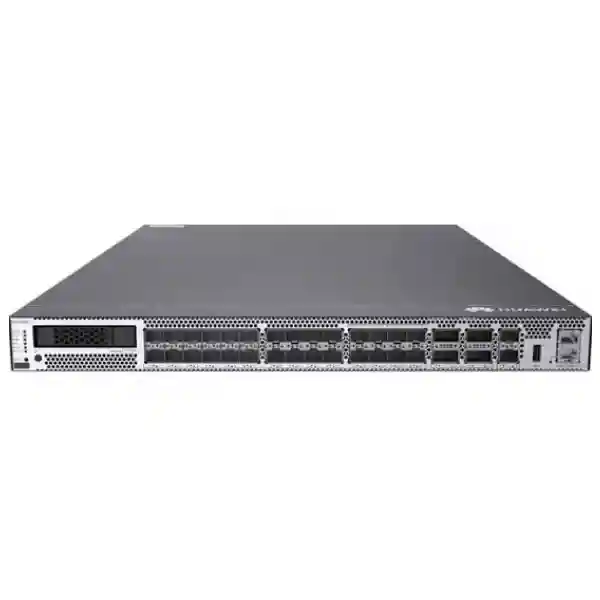
Huawei HiSecEngine USG6680E Next-Generation Firewall
The Huawei HiSecEngine USG6680E is built for organizations that need high firewall capacity, dense high-speed interfaces, large session scale, advanced threat prevention, encrypted-traffic inspection, strong VPN performance, and resilient deployment in a compact 1U platform. For enterprises in Dubai and across the UAE, the appliance is particularly relevant where internet-edge bandwidth, data-center east-west traffic, cloud connectivity, branch VPN aggregation, or multi-tenant security requirements have outgrown midrange firewall platforms.
Direct answer: what is the Huawei HiSecEngine USG6680E?
The Huawei HiSecEngine USG6680E is a high-end fixed-configuration firewall in the USG6600E family. Huawei positions the family for medium and large enterprises, institutions, and next-generation data-center environments. The USG6680E is the highest-capacity model in the referenced USG6600E fixed-platform datasheet, combining strong forwarding performance with integrated next-generation firewall services. Its design focuses on three things that frequently determine whether a firewall remains usable after security services are enabled: packet-processing capacity, content-security acceleration, and encryption/decryption acceleration.
In Huawei’s published performance data, the USG6680E reaches up to 80/80/16 Gbit/s IPv4 firewall throughput for 1518/512/64-byte UDP traffic and the same 80/80/16 Gbit/s profile for IPv6 using 1518/512/84-byte UDP traffic. It supports 25 million concurrent TCP sessions and 800,000 new TCP sessions per second. The platform is also rated for 70 Gbit/s IPsec VPN throughput using AES-256 plus SHA-256 with 1420-byte packets. These figures show why the model is aimed at large aggregation points rather than small office perimeters.
For UAE buyers, raw throughput should not be treated as the only sizing metric. Real deployment capacity depends on the security stack you enable, average packet size, traffic mix, TLS inspection ratio, logging depth, VPN usage, policy complexity, threat-signature updates, and application-control requirements. FourTeck therefore recommends sizing the USG6680E around the protected traffic profile, not only the ISP circuit speed. A 10 Gbit/s internet edge that performs heavy SSL decryption and full threat inspection can have a very different resource profile from a 40 Gbit/s private data-center transit link with limited inspection.
Key performance specifications
| Metric | Huawei USG6680E published value | Deployment meaning |
|---|---|---|
| IPv4 firewall throughput | 80/80/16 Gbit/s for 1518/512/64-byte UDP | High-capacity L3/L4 forwarding; small-packet performance is lower than large-packet headline throughput. |
| IPv6 firewall throughput | 80/80/16 Gbit/s for 1518/512/84-byte UDP | Useful for dual-stack and IPv6-heavy enterprise architectures. |
| Concurrent TCP sessions | 25,000,000 | Supports large user populations, server farms, NAT tables, and aggregation workloads. |
| New TCP sessions per second | 800,000 | Important for busy web platforms, cloud services, large campuses, and bursty internet traffic. |
| IPsec VPN throughput | 70 Gbit/s | Suitable for high-volume site-to-site encryption and regional hub deployments. |
| Maximum IPsec tunnels | 60,000 gateway-to-gateway and 60,000 client-to-gateway | Supports large distributed estates when design and licensing align. |
| SSL inspection throughput | 12 Gbit/s | Critical benchmark for encrypted web traffic; actual results vary with cipher, object size, and policy mix. |
| SSL VPN throughput | 6 Gbit/s | Provides substantial capacity for remote-access workloads. |
| Maximum firewall policies | 60,000 | Supports large rulebases, though policy quality and governance remain more important than raw count. |
Performance figures are vendor test values measured under defined laboratory conditions. Production throughput can differ according to packet size, services enabled, traffic composition, software release, signature set, encryption settings, and deployment topology.
Why the USG6680E matters for high-capacity enterprise security
Large enterprise firewalls are rarely limited by one number. A device may have strong headline forwarding throughput but still become a bottleneck when intrusion prevention, antivirus scanning, application identification, URL filtering, TLS inspection, and VPN encryption are activated simultaneously. Huawei addresses this by accelerating pattern matching and encryption/decryption workloads in the USG6600E architecture. For the USG6680E, the vendor publishes 36 Gbit/s for firewall plus service awareness, 24 Gbit/s for firewall plus service awareness plus IPS, 23 Gbit/s for firewall plus service awareness plus IPS plus antivirus, 22 Gbit/s for the vendor’s full-protection test profile, and 12 Gbit/s for its enterprise-mix real-world full-protection profile.
Those layered figures are important for procurement teams because they show the difference between pure stateful forwarding and traffic subjected to multiple security engines. In a Dubai headquarters, for example, a 20 Gbit/s internet design may appear comfortably below the 80 Gbit/s stateful-firewall rating, yet the relevant sizing reference could be closer to the security-services figures if most traffic is inspected. The same applies to data centers where north-south sessions include APIs, SaaS access, software repositories, employee browsing, remote access, and application-to-cloud communication.
A practical design should therefore classify traffic into security zones and inspection classes. Trusted replication traffic may require stateful control but not every content-security function. User internet browsing may require URL filtering, IPS, antivirus, application control, and selective TLS inspection. Public application publishing may need focused IPS profiles, anti-DDoS controls, server load balancing, and detailed logging. Site-to-site WAN traffic may prioritize VPN capacity and routing convergence. Mapping these flows before deployment produces a more defensible appliance size and reduces the risk of enabling every feature globally without regard to business value.
High-density 40GE and 10GE connectivity
Interface architecture
The USG6680E hardware specification provides a high-density interface mix based on 40GE QSFP+ and 10GE SFP+ connectivity, including dedicated 10GE HA interfaces. Huawei’s published hardware table lists 4 × 40GE QSFP+ plus 28 × 10GE SFP+ plus 2 × 10GE SFP+ HA for the model, with an important note that some 10G and 40G ports are mutually exclusive. The supported combinations therefore need to be checked carefully during bill-of-material design rather than simply adding every physical connector as simultaneously usable bandwidth.
This density is useful for collapsed enterprise edges, data-center border segmentation, multiple ISP handoffs, core-switch uplinks, DMZ fabrics, security-service zones, and HA interconnects. It also reduces the need for external media conversion or additional interface cards in many deployments.
Optics and cabling planning
A high-speed firewall project should include optics planning from the beginning. The required transceiver type depends on fiber distance, multimode or single-mode plant, switch-side compatibility, link speed, redundancy design, and data-center cabling standards. DAC or AOC connectivity may be appropriate for short rack or row distances, while optical modules are typically chosen for longer runs. The firewall interface may support a speed mechanically, but the complete link still depends on compatible optics at both ends.
FourTeck recommends documenting every firewall port before installation: interface number, media type, connected device, VLAN or routed subnet, security zone, HA role, expected bandwidth, optic SKU, cable path, and spare strategy. This avoids last-minute deployment delays caused by missing optics or unsupported port combinations.
Threat prevention and integrated security services
The USG6600E family integrates traditional firewalling with VPN, intrusion prevention, antivirus, data leak prevention, bandwidth management, anti-DDoS capabilities, URL filtering, anti-spam functions, application identification, user authentication, and centralized policy management. On the USG6680E, these services are relevant because the hardware has enough scale to act as a consolidated security enforcement point for large environments rather than as a basic perimeter packet filter.
Application identification allows policy decisions to be based on recognized applications instead of relying only on ports and IP addresses. Huawei’s datasheet states that the platform can identify more than 6,000 applications and apply control at application-function granularity. This is valuable in enterprise networks because modern applications frequently use common web ports, dynamic infrastructure, CDNs, and encrypted sessions. A rule that simply permits TCP 443 does not provide the same governance as a policy that understands application context and combines that identity with user, zone, time, URL category, IPS profile, and data-control settings.
Intrusion prevention is used to detect and block exploit attempts and suspicious traffic based on continuously updated threat intelligence and signatures. Antivirus scanning adds file-oriented malware inspection. URL filtering can enforce web-category policies, while DNS filtering adds domain-based control. Anti-DDoS functions provide protection against common attack patterns such as SYN floods and UDP floods. These services should be deployed using profiles matched to each traffic class. A public web server, an employee internet segment, a backup network, and a partner VPN should not automatically receive identical inspection settings.
For organizations operating regulated, confidential, or high-value systems, integrated controls simplify policy enforcement but do not eliminate the need for layered security. Endpoint protection, email security, identity controls, vulnerability management, SIEM or SOC monitoring, secure configuration, backups, segmentation, and application hardening remain necessary. The firewall is strongest when used as one control plane within a broader defense architecture.
SSL inspection and encrypted traffic strategy
Encrypted traffic is now the default for most enterprise and internet applications, which means a firewall that cannot inspect selected TLS sessions may lose visibility into threats delivered over HTTPS. Huawei publishes 12 Gbit/s SSL inspection throughput for the USG6680E under the stated test methodology. That value is significantly below the 80 Gbit/s stateful firewall figure, illustrating why SSL inspection must be included explicitly in capacity planning.
A sound TLS inspection design starts with policy rather than a blanket decrypt-everything approach. Organizations normally define categories that must be inspected, categories that should bypass decryption for privacy, legal, technical, or compatibility reasons, and high-risk categories that may be blocked outright. Banking, healthcare, government identity portals, certificate-pinned applications, mutual-TLS services, and certain software update mechanisms may require special handling. The organization should also establish certificate distribution, endpoint trust, exception workflows, logging requirements, and change governance before enforcing decryption at scale.
Cipher choice, TLS version, object size, session reuse, certificate validation, traffic concurrency, and content-security profiles all influence real throughput. It is therefore better to model a peak-hour encrypted-traffic percentage and test representative applications than to divide the internet circuit by a single benchmark number. A proof of concept can reveal application incompatibilities, latency sensitivity, certificate issues, and resource utilization before the policy is rolled across the entire workforce.
Huawei also documents an approach in which firewall traffic probes can cooperate with HiSec Insight for analysis of encrypted traffic without requiring every flow to be decrypted. Whether that architecture is suitable depends on the licensed solution, software compatibility, telemetry design, and the organization’s monitoring requirements. FourTeck can help translate the intended security outcome into a deployment architecture rather than treating SSL inspection as a checkbox.
VPN scale for branches, remote access, and regional hubs
The USG6680E is well suited to organizations that need a central VPN aggregation point. Huawei lists 70 Gbit/s IPsec throughput for AES-256 plus SHA-256 with 1420-byte packets, up to 60,000 gateway-to-gateway IPsec tunnels, and up to 60,000 client-to-gateway IPsec tunnels. It also supports multiple VPN technologies including IPsec VPN, SSL VPN, L2TP VPN, MPLS VPN, GRE, and DSVPN. The exact protocol selected should follow the network architecture, endpoint type, security requirements, routing model, and operational model.
For multi-branch organizations, hub-and-spoke VPN design can centralize security and simplify internet breakout policy, but it can also create path inefficiency if every branch-to-cloud or branch-to-branch flow hairpins through Dubai. DSVPN or other dynamic architectures can reduce unnecessary hub transit in appropriate designs. Large enterprises may instead combine private WAN, SD-WAN, internet VPN, and cloud connectivity, with the USG6680E protecting the primary data-center or headquarters edge.
Remote-access VPN sizing is different from site-to-site sizing because user behavior is bursty and depends heavily on application mix. Video conferencing, virtual desktop, file transfer, SaaS, source-code repositories, and administrative sessions have different bandwidth and latency profiles. Huawei publishes 6 Gbit/s SSL VPN throughput and a default/maximum concurrent SSL VPN user figure of 100/15,000 for the USG6680E, but additional licensing is required to scale concurrent users beyond default entitlement. The procurement list must therefore include both appliance capability and the required SSL VPN user license.
A resilient VPN deployment should also consider dual ISPs, dynamic routing, tunnel monitoring, certificate lifecycle, authentication integration, MFA strategy, split-tunnel policy, DNS behavior, endpoint posture, logging, and failover testing. The goal is not only to establish tunnels but to preserve user access and security policy during carrier or firewall failures.
High availability for business-critical networks
Active/Standby
Active/Standby HA is often selected when the main objective is deterministic failover, straightforward operations, and a clear primary/secondary role. A well-designed pair synchronizes relevant state and configuration so that failure of the active unit can move traffic to the standby unit with limited disruption. The surrounding switches, routers, carriers, VLANs, routing protocols, and first-hop design must also support the failover path.
The HA pair should be tested for device failure, power-supply failure, uplink failure, core-switch failure, and upstream carrier failure. A firewall pair alone does not create end-to-end resilience if both appliances depend on the same switch, PDU, fiber path, or ISP handoff.
Active/Active
Huawei also lists Active/Active high availability for the USG6600E series. Active/Active can be attractive when the design requires both appliances to carry traffic, but it introduces additional architecture considerations around session symmetry, routing, service distribution, failure domains, and operational troubleshooting. It should be selected because the traffic design benefits from it, not merely because two appliances are available.
For either mode, dedicated HA links, synchronized configuration, software consistency, planned maintenance procedures, and periodic failover drills are essential. Change windows should include a rollback plan and confirmation that session synchronization behaves as expected for critical applications.
Security virtualization and multi-tenant segmentation
The USG6680E supports security virtualization, allowing multiple virtual firewall contexts on the same physical platform. Huawei’s datasheet lists a maximum of 1,000 virtual firewalls for the model, with license options available in different quantities. This capability can be valuable for large enterprises, service providers, shared data centers, holding companies, managed environments, and internal IT organizations that need logical separation between departments or business units.
Virtualization can separate policy administration and security domains without requiring a dedicated physical appliance for every tenant. However, virtual contexts still share the underlying hardware platform, interfaces, power, environmental resources, and aggregate performance. The design must therefore include resource governance. A noisy tenant or unusually high session load should not be allowed to affect a critical production tenant unexpectedly. Capacity planning should consider aggregate throughput, concurrent sessions, new-session rates, logging volume, VPN use, and security-services consumption across all virtual systems.
Segmentation also depends on how traffic reaches each virtual firewall. VLANs, VRFs, routed links, subinterfaces, dedicated physical ports, and upstream switch design may all be used depending on the architecture. Administrative separation should extend to management access, logging, backup, naming conventions, and change control. If the appliance is used in a managed-services context, customer-level reporting and clear responsibility boundaries become equally important.
Virtual firewalls are not a substitute for a strong physical failure-domain strategy. If multiple critical tenants share one chassis, an HA pair becomes especially important because a single physical failure can otherwise affect every hosted context. The procurement decision should therefore evaluate the consolidated cost benefit together with the blast radius of platform outages.
Routing, link selection, and network integration
The USG6600E family supports enterprise routing protocols including RIP, OSPF, BGP, IS-IS and their IPv6 counterparts such as RIPng, OSPFv3, BGP4+, and IPv6 IS-IS. That matters in large deployments because a firewall positioned at a data-center or internet edge often participates directly in routing rather than sitting behind static routes. Dynamic routing can accelerate convergence, simplify multi-carrier designs, and allow the security layer to exchange prefixes with core, WAN, or service-provider infrastructure.
Policy-based routing and intelligent uplink selection can also support multi-egress architectures. In practice, an enterprise may have one carrier optimized for regional internet traffic, another for international reach, a private WAN circuit, and one or more cloud interconnects. Different application classes can be steered according to business priorities, path health, bandwidth, or policy. The firewall can contribute to this decision, but route design should avoid unnecessary complexity. Every exception increases troubleshooting effort during incidents.
When BGP is used at an internet edge, prefix filtering, maximum-prefix controls, route policy, authentication, next-hop behavior, and failover logic should be documented. When OSPF is used internally, area design, redistribution, default-route origination, and metric strategy should be reviewed. If the firewall is in transparent mode, the surrounding network may retain routing responsibility while the appliance focuses on security inspection.
Huawei supports transparent, routing, and hybrid working modes, so the migration method can be selected according to the existing topology. A transparent deployment can reduce addressing changes in some brownfield projects, while routed mode generally provides clearer L3 ownership. Hybrid designs can serve special segmentation requirements. The preferred option depends on current addressing, change tolerance, routing ownership, HA behavior, and future growth.
Hardware platform, rack, power, and environmental planning
The USG6680E is a 1U appliance with published dimensions of 44 × 442 × 420 mm. Huawei lists a full-configuration weight of approximately 12 kg for the upper models represented in the hardware table. The platform supports optional local storage using a 2.5-inch SSD or HDD, with published capacities of 240 GB SSD or 1 TB HDD in the referenced datasheet. Local storage may be relevant for logs or features that depend on disk resources, but organizations should still design centralized log retention according to compliance and forensic requirements.
For power, the model supports 100–240 V AC at 50/60 Hz and dual AC power supplies. Redundant PSUs are only useful when connected to genuinely independent power paths. In a data center, each PSU should normally be connected to a different PDU backed by the intended UPS and generator design. Cable labeling, PDU capacity, breaker allocation, rack grounding, airflow, and service clearance should be included in the installation plan.
Huawei specifies an operating temperature range of 0°C to 45°C without the optional HDD and 5°C to 40°C with the optional HDD, with 5% to 95% non-condensing humidity. These limits matter in the Gulf climate because data-center cooling failure can raise rack intake temperatures rapidly. The firewall should be deployed in a controlled environment with proper front-to-back airflow and hot-aisle/cold-aisle discipline where applicable. Outdoor cabinets or poorly conditioned communications rooms require particular attention.
Environmental resilience is not only about the firewall’s rated maximum. Optical modules, adjacent switches, UPS batteries, cabling, and storage components may have their own limits. Monitoring should include inlet temperature, fan state, PSU state, interface errors, and system alarms so facilities or IT teams can react before thermal or power conditions become service-impacting.
Licensing and subscription planning
A firewall procurement is incomplete if the appliance is ordered without the licenses required by the security design. Huawei’s ordering information for the USG6680E includes separate subscription options for services such as IPS, URL filtering, and antivirus updates, with one-year and three-year terms shown in the referenced datasheet. SSL VPN concurrent-user expansion and virtual-firewall quantities also use function licenses. Buyers should confirm the current commercial bundle and entitlement structure at quotation time because licensing catalogs can change across software releases and sales programs.
The first step is to list every intended function: stateful firewall, application control, IPS, antivirus, URL filtering, SSL inspection, remote-access VPN, site-to-site VPN, virtual firewalls, sandbox integration, centralized management, logging, reporting, and support. Each function should then be mapped to its required license, subscription, external platform, or support contract. This prevents a common project problem where the hardware arrives on time but the required service entitlement is missing or starts on the wrong date.
Subscription duration should also align with procurement and lifecycle policy. A three-year term can reduce annual renewal administration, while a shorter term may suit a staged migration or budget cycle. Whatever term is selected, renewal ownership must be explicit. Security subscriptions are operational dependencies; allowing IPS or antivirus update entitlement to expire can reduce protection even if basic firewall forwarding continues.
For enterprise governance, maintain a license register containing device serial numbers, support identifiers, subscription start and end dates, responsible owner, renewal lead time, software entitlement, HA pairing information, and vendor or partner contacts. That register becomes especially valuable when dozens of appliances are distributed across branches or regional data centers.
How to size the USG6680E correctly
Sizing should begin with measured traffic, not an arbitrary multiplier. Collect at least peak and 95th-percentile internet utilization, internal routed traffic crossing the security boundary, average and minimum packet sizes, session counts, new sessions per second, encrypted-traffic percentage, VPN traffic, top applications, east-west flows, and expected growth. If the firewall will replace an existing platform, export real counters from that device and from upstream switches or NetFlow/IPFIX tooling where available.
Next, identify which security services apply to each traffic class. Full IPS and antivirus inspection on employee internet traffic may be appropriate, while storage replication may use a different profile. TLS decryption may be enabled for selected web categories but bypassed for applications that are privacy-sensitive or technically incompatible. Remote-access users may generate different inspection demand from site-to-site VPN users. Public services may require strong IPS but not URL filtering. This service map converts raw bandwidth into a realistic inspection workload.
Then apply growth and failure scenarios. An HA pair should be able to carry the required traffic after one unit fails. A dual-ISP environment may need the surviving carrier and firewall path to absorb traffic normally split across two links. Planned business expansion, cloud migrations, new branches, backup replication, remote-work growth, and upcoming application launches should be included. Avoid sizing a three-to-five-year security platform only for today’s average utilization.
Session scale deserves separate treatment. A 5 Gbit/s environment with millions of short-lived connections can stress a firewall differently from a 20 Gbit/s environment dominated by a smaller number of long-lived flows. Web portals, carrier-grade NAT-like workloads, API gateways, DNS services, cloud-native applications, and large VDI estates can all create high session churn. Compare measured peaks with the 25 million concurrent-session and 800,000 new-session-per-second ratings, then leave operational headroom.
Finally, validate the design with a proof of concept if the deployment is business critical. Test representative traffic, policy sets, VPN encryption, TLS decryption, routing failover, logging, HA state synchronization, monitoring integration, and operational workflows. A successful firewall selection is one that remains stable and manageable under the organization’s real peak conditions, not merely one that meets a spreadsheet line item.
Deployment scenario 1: Dubai enterprise internet edge
At a large headquarters or campus, the USG6680E can sit between the internal core and redundant internet routers or carrier handoffs. The firewall can terminate or inspect multiple ISP paths, enforce outbound access policy, protect inbound published services, provide site-to-site VPN, support remote users, and export logs to a centralized security platform. High-density 10GE and 40GE interfaces allow separation of internet, DMZ, core, management, HA, and service networks without forcing every connection through an external aggregation switch solely for port availability.
A typical design would use separate security zones for corporate users, guest access, server segments, DMZ services, management, partner networks, and internet. Policies should be built from business application requirements rather than broad any-to-any rules. User internet access can combine application identification, URL filtering, IPS, antivirus, and selective TLS inspection. Published services can receive narrower destination-based rules with server-specific IPS profiles and detailed logging. Administrative access to the firewall should be restricted to dedicated management networks and authenticated administrators.
Redundancy should extend beyond two firewall appliances. Dual core switches, dual upstream routers where practical, diverse carrier paths, separate PDUs, redundant optics or links, and monitored routing convergence reduce single points of failure. The HA design should specify which failure events trigger firewall role changes and which are handled by routing or link monitoring. A planned failover test should verify real applications, not only ping reachability.
For organizations seeking local design and implementation support, FourTeck’s Firewall Dubai practice can help align appliance sizing, subscriptions, optics, migration sequencing, and security policy with the target architecture.
Deployment scenario 2: data-center border protection
The USG6680E can protect a data-center boundary where traffic enters from enterprise WANs, internet circuits, partner networks, cloud connections, or campus cores. Its 40GE/10GE interface density is particularly useful when the firewall must connect to high-capacity switching fabrics. Security virtualization can provide separate logical firewalls for production, development, subsidiaries, customers, or regulated environments while preserving central hardware operations.
Data-center traffic patterns differ from user-edge traffic. Large file transfers, storage replication, API calls, east-west service communication, backup traffic, and distributed application sessions can create sustained throughput and very high connection counts. Inspection profiles should therefore reflect application risk. For example, a backup replication flow between tightly controlled systems may not need the same URL filtering profile as employee internet traffic, while a public API zone may require strong IPS, bot-related controls, strict source policy, and detailed event logging.
Routing integration is often more complex in the data center. BGP or OSPF may exchange routes with leaf-spine or core infrastructure, and asymmetric routing can break stateful inspection if paths are not engineered carefully. Load balancers, reverse proxies, application delivery controllers, NAT, and service chains also affect session visibility. The firewall design should document exact traffic paths in both directions for normal and failure states.
Logging architecture is equally important. Data-center firewalls can generate a large volume of traffic, threat, and system logs. Sending every event synchronously to an undersized collector can create operational issues. Retention periods, event filtering, SIEM ingestion rates, time synchronization, storage growth, and alerting rules should be sized alongside the firewall. Optional local storage can support device needs, but centralized logs are usually required for cross-system correlation and incident response.
Where firewall deployment is part of a broader compute or data-center refresh, FourTeck can coordinate network security with infrastructure requirements through Server Dubai and related enterprise integration services.
Deployment scenario 3: regional VPN and branch aggregation
A UAE-based organization with branches across the GCC, Africa, South Asia, or Europe may use the USG6680E as a central VPN hub. The 70 Gbit/s published IPsec throughput and large tunnel scale provide room for significant site-to-site connectivity. Branches can use internet VPNs as primary links, backup links to MPLS or SD-WAN, or encrypted paths to centralized services. Dynamic routing over the tunnels can simplify reachability and failover compared with large static-route deployments.
The hub design should classify branch types. A small retail site with a few users has different tunnel and bandwidth requirements from a warehouse, call center, branch office, or disaster-recovery site. Some locations may need local internet breakout while others send internet traffic through the central firewall for inspection. Voice and video may require QoS and low-latency paths. Critical application traffic may need dual tunnels over different carriers. A standard branch template can reduce deployment variation while allowing controlled exceptions.
Authentication and key management are important at scale. Certificate-based VPN authentication can simplify lifecycle control for large estates but requires a dependable PKI process. Pre-shared keys are simpler for small deployments but become harder to rotate securely across hundreds of sites. Tunnel naming, peer inventory, public-address tracking, routing policies, monitoring, and change ownership should all be standardized.
If remote users also connect to the same platform, their SSL VPN capacity and licensing should be modeled separately from site-to-site IPsec. Remote users generate application-level behavior that can vary dramatically by role. Developers, contact-center agents, finance users, and administrators may have very different bandwidth and security needs. Identity integration and MFA should be considered mandatory design topics rather than post-deployment additions.
FourTeck’s wider UAE technology portfolio at FourTeck UAE can support coordinated branch connectivity, firewall deployment, switching, wireless, compute, and operational integration when the project extends beyond the security appliance itself.
Policy architecture and rulebase engineering
A powerful firewall can still become difficult to operate if the rulebase grows without structure. The USG6680E supports up to 60,000 firewall policies, but that number should be considered an upper technical capacity rather than a target. Well-governed environments aim for the smallest rulebase that accurately expresses business requirements. Each rule should have an owner, purpose, source, destination, service or application, security profile, logging behavior, review date, and change reference where practical.
Policy order matters. Specific rules should be placed intentionally relative to broader rules so traffic is matched by the expected control. Temporary migration rules should have expiration dates. Disabled policies should be reviewed and removed after validation. Object naming conventions should identify environment, function, location, and role. Address groups and service groups reduce repeated configuration, while application-aware rules can avoid overreliance on generic port-based access.
Security profiles should be reusable but not universal. User web traffic, server publishing, DNS, email, partner integration, database access, backups, and administration should each receive controls suited to the threat model. Enabling the strictest possible profile on every flow can cause unnecessary latency, false positives, or application breakage. Conversely, bypassing inspection broadly for convenience creates blind spots. A tiered policy model provides a practical middle ground.
Change management is especially important in HA and data-center deployments. Before a rule is added, confirm that the network route exists in both directions and that NAT behavior is understood. After implementation, verify hit counts, logs, application behavior, and security events. If a change fails, rollback should restore the previous known-good state quickly. Regular rule recertification prevents legacy access from accumulating indefinitely.
For organizations that need ongoing configuration assistance, monitoring, optimization, or multi-vendor infrastructure support, FourTeck IT Services UAE can be integrated into the operating model.
Logging, monitoring, and operational visibility
Firewall operations depend on visibility. The USG6600E family provides reporting across users, applications, content, time, traffic, threats, and URLs, and it can integrate with centralized Huawei management as well as third-party tools through interfaces such as SNMP, SSH, Syslog, RESTful APIs, and NETCONF. The exact integration set used in a project should match the organization’s NOC and SOC tooling.
At minimum, monitoring should cover interface state, bandwidth utilization, packet drops, CPU and memory, session utilization, new-session rate, HA state, power supplies, fans, temperature, VPN tunnel status, routing neighbors, signature-update state, license status, storage health where applicable, and system alarms. Security monitoring should add IPS events, malware detections, URL violations, application anomalies, authentication failures, policy denies, suspicious outbound connections, and administrator changes.
Log retention must be designed deliberately. High-volume firewalls can produce large daily data sets, especially when session-start and session-end logs are enabled broadly. Estimate events per second and storage requirements before commissioning. Use consistent NTP across firewalls, SIEM systems, domain controllers, servers, and network devices so incident timelines can be reconstructed accurately. If logs cross security zones or WAN links, protect the transport and account for bandwidth.
Alert quality matters more than alert quantity. A SOC that receives thousands of low-value notifications may miss a high-impact event. Use severity, asset criticality, threat confidence, repeated behavior, and business context to prioritize alerts. For example, repeated exploit attempts against a public test system may be lower priority than a successful outbound C&C indicator from a finance workstation. Firewall telemetry becomes more useful when correlated with endpoint, identity, DNS, email, and vulnerability data.
Operational dashboards should therefore be built around decisions: Is the platform approaching capacity? Are subscriptions current? Are critical tunnels up? Is HA healthy? Are new threats being blocked? Did a policy change cause unexpected denies? Can the team identify the affected user or application quickly? Those questions guide monitoring design better than collecting every available metric without an action plan.
Migration methodology for replacing an existing firewall
Firewall migration is primarily a policy and dependency project, not a hardware swap. Begin by exporting the current rulebase, NAT configuration, objects, interfaces, routes, VPNs, authentication settings, security profiles, certificates, logging destinations, management access, and HA behavior. Identify unused objects and rules before converting them. Migrating years of obsolete configuration into a new platform preserves technical debt and increases risk.
Build a traffic dependency matrix for critical systems. Record source, destination, protocol, application, owner, required inspection, NAT behavior, DNS dependency, authentication dependency, and business test procedure. Public services should include external test points. VPNs should include peer contacts and rollback plans. Dynamic-routing neighbors should include expected prefixes, timers, and policy. This matrix becomes the acceptance checklist during cutover.
The new USG6680E configuration should be staged and reviewed before the maintenance window. Interfaces can be prebuilt, objects standardized, licenses activated, software aligned, signatures updated, HA tested, and management integration validated in advance. Where architecture permits, a parallel or phased migration reduces risk. In other environments, a hard cutover may be necessary, making console access, spare optics, known-good backups, and a timed rollback decision essential.
During cutover, validate in layers. First confirm physical links, VLANs, LACP if used, HA state, and management reachability. Next validate routing and ARP/ND. Then test DNS, internet access, published services, site-to-site VPNs, remote access, core applications, and security logging. Check that traffic is matched by intended policies and that NAT behaves correctly. Finally confirm performance and error counters under real load.
After migration, keep the previous platform available according to the rollback plan until the new firewall has passed operational acceptance. Review denied traffic, IPS events, CPU, memory, sessions, interface utilization, and user tickets over the first business cycles. Fine-tune policies based on evidence, not by broadly disabling security controls in response to isolated issues.
UAE procurement and deployment considerations
For Dubai and UAE projects, procurement should account for more than the appliance chassis. A complete bill of materials may include two USG6680E units for HA, appropriate AC power supplies, required 40GE and 10GE optics, fiber patch cords or DAC/AOC assemblies, optional storage, security subscriptions, SSL VPN user licenses, virtual-firewall licenses, vendor support, rack accessories, management or logging components, and professional services. Missing a small component such as an optic can delay an otherwise complete project.
Lead time should be validated before the change window is committed. Enterprise security hardware, optics, and licenses may have different fulfillment timelines. If the firewall is part of a data-center move or carrier upgrade, align delivery dates with rack readiness, power, cross-connects, ISP handoffs, switch ports, and change approvals. Keeping the implementation schedule dependent on a single unverified delivery date creates unnecessary risk.
Support coverage should match business criticality. A 24×7 environment may require a higher support tier, spare strategy, and escalation procedure than an office edge that can tolerate a longer outage. Define who opens vendor cases, where serial numbers and entitlement details are stored, who has administrative access, and how replacement hardware would be configured if an RMA occurs. Maintaining encrypted configuration backups and an accurate network diagram can reduce recovery time substantially.
Compliance and internal governance may also influence logging, administrator access, data handling, and inspection policy. Organizations in financial services, healthcare, government, education, retail, and critical infrastructure often have sector-specific requirements. The firewall configuration should be mapped to the organization’s applicable policies and regulatory obligations rather than using a generic template.
A local deployment partner can help coordinate these technical and logistical dependencies. FourTeck can provide product sourcing, pre-sales design, implementation planning, rack and connectivity coordination, policy migration, high-availability configuration, VPN setup, logging integration, and post-deployment support according to the project scope.
Performance interpretation: what the numbers actually mean
Vendor firewall specifications are measured under defined laboratory conditions. They are useful for comparing architectural capability, but they should not be interpreted as guaranteed production throughput under every security policy. The Huawei datasheet explicitly notes that performance is tested under ideal conditions using standard methodologies and that actual results may vary by deployment environment. It also defines different test conditions for antivirus, IPS, service awareness, full protection, SSL inspection, and SSL VPN.
Packet size is one major variable. Processing 80 Gbit/s of large packets requires far fewer packets per second than processing the same bit rate with minimum-size packets. Huawei lists 24 Mpps firewall throughput for the USG6680E and 80 microseconds latency for 64-byte UDP in the referenced data. Environments with many small transactions, VoIP signaling, DNS, or certain data-center workloads should pay attention to packets per second and session setup, not just gigabits per second.
Security depth is another variable. The USG6680E’s published 80 Gbit/s stateful firewall figure reduces to lower numbers as additional services are applied, including 24 Gbit/s for firewall plus service awareness plus IPS, 23 Gbit/s when antivirus is added to that profile, 22 Gbit/s for one full-protection test, and 12 Gbit/s in the vendor’s enterprise-mix real-world full-protection profile. This is normal for security appliances because deeper inspection consumes more processing resources.
TLS inspection is computationally intensive. The published 12 Gbit/s SSL inspection figure is measured under specified cipher and traffic conditions. A production mix with different TLS versions, certificates, handshake rates, object sizes, and inspection profiles may behave differently. VPN throughput similarly depends on encryption suite, packet size, tunnel count, and traffic distribution.
The correct way to use these figures is to identify the closest benchmark to the intended workload, apply design headroom, account for HA failure states and future growth, then validate important assumptions. A firewall should not be selected because one maximum number exceeds the WAN speed; it should be selected because the complete protected workload remains inside an acceptable operating envelope.
Security operations lifecycle after deployment
The firewall’s security posture changes over time as new applications, users, branches, threats, and cloud services are introduced. An operational lifecycle should include daily or automated health monitoring, regular signature updates, license monitoring, configuration backup, policy review, vulnerability advisories, software maintenance, certificate renewal, access review, and periodic failover testing. Without this discipline, even a correctly deployed firewall can accumulate risk.
Administrative access should follow least privilege. Separate read-only monitoring roles, security-policy administrators, network administrators, and full system administrators where the platform and organization support that model. Use named accounts rather than shared credentials, integrate centralized authentication where appropriate, restrict management protocols to dedicated networks, and log administrative changes. Emergency access procedures should be documented and tested.
Policy recertification can be performed quarterly, semiannually, or according to organizational policy. Review unused rules, expired temporary access, overly broad source or destination ranges, disabled security profiles, shadowed rules, obsolete VPN peers, old administrator accounts, and objects that no longer resolve to active systems. Coordinate with application owners before removal so cleanup improves security without creating avoidable outages.
Software upgrades should be treated as controlled changes. Review release notes, supported upgrade paths, feature behavior, known issues, signature compatibility, HA requirements, and rollback options. Back up the configuration before the upgrade and confirm console access. In an HA pair, follow the vendor-supported sequence and verify synchronization before and after each step. Maintenance should include application testing, not only system status.
Incident response procedures should define how firewall evidence is collected and preserved. Relevant data may include session logs, threat events, administrator actions, VPN authentication, routing state, policy hits, system alarms, packet captures, and timestamps. Integrating the firewall with SIEM, endpoint, identity, DNS, and vulnerability systems can significantly improve investigation context.
Architecture checklist before requesting a quote
Traffic
Document current and projected peak bandwidth, packet rate, concurrent sessions, new sessions per second, encrypted-traffic percentage, VPN volume, and top applications. Include failure-state bandwidth when one ISP or one firewall is unavailable.
Security
Define IPS, antivirus, application control, URL filtering, anti-DDoS, TLS inspection, DLP, sandbox, logging, and threat-intelligence requirements by traffic class rather than applying one profile globally.
Connectivity
List every required 40GE and 10GE port, optic, fiber type, peer device, VLAN, routed subnet, HA link, management interface, carrier handoff, and spare requirement. Validate mutually exclusive port combinations.
VPN & identity
Count site-to-site tunnels, remote users, expected concurrency, authentication sources, MFA requirements, certificate dependencies, branch routing, remote-access applications, and split-tunnel policy.
Resilience
Decide Active/Standby or Active/Active HA, dual-power design, switch redundancy, carrier diversity, routing failover, monitoring, spare optics, rollback procedure, and required support response time.
Licensing
Specify IPS, antivirus, URL filtering, SSL VPN user count, virtual firewall quantity, centralized management, support duration, software entitlement, and any external security platform integration.
Frequently asked technical questions
Is 80 Gbit/s the throughput I should expect with every security feature enabled?
No. The 80 Gbit/s figure is the published stateful firewall result for large and medium packet sizes in the specified test. Huawei publishes lower figures for combinations that include service awareness, IPS, antivirus, full protection, and SSL inspection. For a security-heavy deployment, use the benchmark closest to the intended service mix and validate with headroom.
Can the USG6680E be deployed as an HA pair?
Yes. Huawei lists Active/Active and Active/Standby high-availability configurations for the USG6600E series. The complete design should also provide redundant upstream and downstream connectivity, independent power, routing convergence, and tested failure procedures.
Does the firewall support 40GE interfaces?
Yes. The USG6680E hardware table lists 40GE QSFP+ and 10GE SFP+ interfaces, with some 10G and 40G ports mutually exclusive. The exact usable port combination and optics should be confirmed during design.
How many concurrent sessions can it handle?
Huawei publishes a maximum of 25 million concurrent TCP sessions and 800,000 new TCP sessions per second for the USG6680E under the referenced test methodology.
What is the IPsec VPN performance?
The published IPsec VPN throughput is 70 Gbit/s using AES-256 plus SHA-256 with 1420-byte packets. Huawei lists up to 60,000 gateway-to-gateway and 60,000 client-to-gateway tunnels. Real performance depends on encryption settings, packet sizes, and topology.
Does it support SSL VPN users?
Yes. Huawei publishes 6 Gbit/s SSL VPN throughput and a default/maximum user count of 100/15,000 for the model. Expansion beyond the included user entitlement requires the appropriate license.
Can it run multiple virtual firewalls?
Yes. Security virtualization is supported, and Huawei lists up to 1,000 virtual firewalls for the USG6680E. The required license quantity and total resource allocation must be planned according to the intended tenant design.
Is the appliance suitable for data-center use?
It is designed for large enterprise and data-center border scenarios, with high-speed interfaces, large session scale, dynamic routing, security virtualization, VPN, threat prevention, and high availability. Suitability for a specific data center depends on the actual throughput and inspection workload.
Decision recap for Huawei HiSecEngine USG6680E in Dubai
The USG6680E is most relevant when the network requires high stateful firewall capacity, large session tables, substantial IPsec performance, dense 40GE/10GE connectivity, advanced threat prevention, TLS inspection, routing integration, and enterprise HA. Its published 80 Gbit/s firewall throughput, 25 million concurrent sessions, 800,000 new TCP sessions per second, 70 Gbit/s IPsec throughput, 12 Gbit/s SSL inspection throughput, and support for up to 1,000 virtual firewalls place it in a class intended for demanding aggregation points rather than small office deployments.
The key purchasing question is not whether the platform has a high maximum throughput number. The key question is whether the complete target workload—including IPS, antivirus, application control, URL filtering, SSL inspection, VPN encryption, logging, and HA failure-state traffic—fits comfortably within the appliance’s service-specific performance envelope. That requires measured traffic data and a clear inspection policy.
For UAE projects, also verify optics, mutually exclusive high-speed port combinations, rack power, software version, security subscriptions, SSL VPN user entitlement, virtual-system licensing, management integration, local support, and delivery lead time. A correct bill of materials should be complete enough that installation can proceed without discovering missing transceivers, licenses, or HA components during the change window.
Quotation input checklist
To prepare an accurate Huawei HiSecEngine USG6680E quotation and deployment scope, provide the following information. Even approximate values are useful during the first sizing stage, but final design should use measured production data wherever possible.
Plan your Huawei USG6680E deployment with FourTeck UAE
A successful USG6680E project combines appliance selection with architecture, licensing, optics, routing, security policy, VPN design, HA, logging, migration, and operational handover. FourTeck can support the process from initial sizing through implementation and ongoing infrastructure services. The recommended starting point is a technical discovery session covering traffic volume, security services, interface requirements, branch or remote-access VPN, redundancy, existing firewall configuration, and growth expectations.
Where the project includes adjacent network or IT requirements, FourTeck can coordinate the firewall with switching, servers, connectivity, and managed services. This reduces the risk of separate teams making incompatible assumptions about VLANs, optics, routing, addressing, rack resources, and change windows.
The result should be a deployment that is sized for protected throughput, designed for failure conditions, licensed for the intended feature set, integrated with monitoring, and documented well enough for the operations team to maintain confidently after handover.


Reviews
There are no reviews yet.