
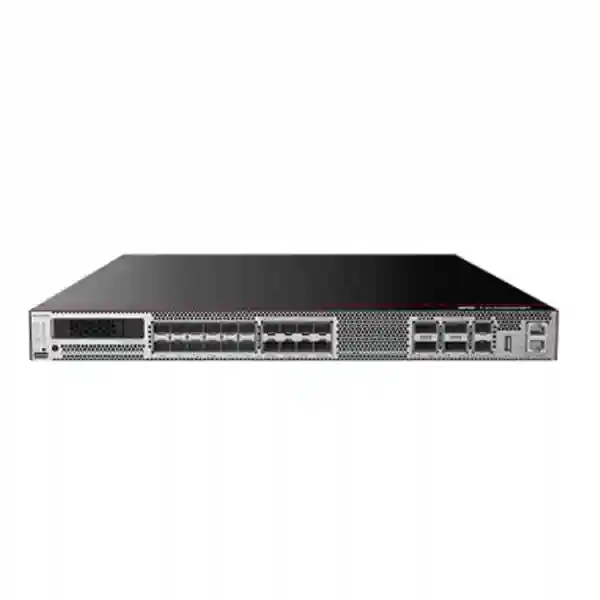
Huawei HiSecEngine USG6712E Next-Generation Firewall
The Huawei HiSecEngine USG6712E is a high-density 1U enterprise firewall built for organizations that need multi-10-gigabit threat prevention, 100-gigabit-class packet forwarding, large session scale, high-speed IPsec VPN, and resilient edge security without moving to a large modular chassis. It is especially relevant to UAE enterprises consolidating Internet edge, data-center border, inter-site VPN, cloud connectivity, and security segmentation functions into a compact appliance.
FourTeck supports architecture review, bill-of-materials validation, transceiver planning, HA topology design, licensing, migration, deployment, and support through Firewall Dubai and wider UAE infrastructure services.
Direct answer: what is the Huawei HiSecEngine USG6712E?
The Huawei HiSecEngine USG6712E is a fixed-configuration, high-performance next-generation firewall in the USG6700E family. It is designed for enterprise perimeter security, data-center border protection, large campus egress, high-speed VPN concentration, security-zone segmentation, and environments where 10GE, 40GE, or 100GE connectivity is required. In practical terms, it sits above branch-class firewalls and is aimed at networks where traffic volume, concurrent sessions, application inspection, encrypted flows, and failover requirements would overwhelm smaller security appliances.
Huawei combines traditional stateful firewalling with application identification, IPS, antivirus, URL filtering, anti-DDoS, data filtering, VPN, routing, link load balancing, bandwidth control, user authentication, security virtualization, and centralized management. The platform can operate in routed, transparent, or hybrid designs and supports Active/Standby as well as Active/Active high-availability models. This flexibility makes it suitable for brownfield UAE environments where a firewall may need to be inserted between existing switching layers without immediate IP re-addressing, as well as greenfield architectures where the firewall becomes the routed security boundary.
For procurement, the most important point is that published headline throughput should never be treated as the only sizing metric. A correct design should consider real traffic mix, SSL inspection percentage, enabled security services, average packet size, session creation rate, total concurrent sessions, east-west versus north-south traffic, HA behavior, optics, routing scale, log retention, VPN encryption requirements, and at least three years of growth. FourTeck can combine the firewall with UAE network, server, and operational support capabilities available through FourTeck UAE.
Why the USG6712E is relevant to high-capacity UAE networks
Dense high-speed interfaces
The appliance provides a fixed high-density mix of 100GE, 40GE, and 10GE interfaces. This matters in data centers and large headquarters where a firewall needs to connect directly to core switches, spine/leaf fabrics, high-capacity WAN routers, Internet edge routers, or server aggregation blocks without relying on low-speed copper handoffs.
Large session scale
Huawei publishes support for tens of millions of concurrent TCP sessions and a high new-session rate. That is important for service-provider-like enterprise edges, large customer portals, universities, airports, hospitality groups, e-commerce platforms, SaaS environments, and data centers where connection volume may be a bigger constraint than raw bandwidth.
Security-service acceleration
The platform is designed to accelerate functions such as pattern matching and encryption/decryption. This is critical because enterprise security performance depends on inspection engines, not merely L3/L4 forwarding. The USG6712E is intended to sustain materially higher protected throughput than branch appliances.
Compact data-center footprint
A 1U footprint allows high-capacity security to be deployed in racks where space is constrained. A redundant HA pair can be accommodated in 2U of device height, leaving room for adjacent switching, routing, packet-broker, load-balancer, or management infrastructure.
Interface architecture and port planning
A major reason to consider the USG6712E is its interface density. Huawei describes the platform with 100GE QSFP28, 40GE QSFP+, multiple 10GE SFP+ service interfaces, dedicated 10GE HA interfaces, USB 3.0, a GE management port, and console access. This gives network designers a flexible physical layer for high-capacity northbound and southbound links. However, port planning must be done carefully because some high-speed interfaces can be mutually exclusive depending on how the hardware lanes are configured. Older Huawei hardware documentation describes supported combinations in which the 100GE ports and a subset of 10GE/40GE ports share resources. Therefore a bill of materials should be validated against the exact software release, intended interface mode, and Huawei ordering information before optics are purchased.
In a typical Dubai data-center deployment, a 100GE link may connect the firewall to a core or leaf switch, while 10GE interfaces handle Internet routers, DMZ aggregation, management security zones, dedicated partner networks, or server segments. Another design could use multiple 40GE connections instead of 100GE, especially where the existing switching estate has QSFP+ ports and the organization wants to avoid immediate migration to QSFP28. Because the appliance is fixed-configuration, the advantage is simplicity: there is no need to select modular interface cards. The trade-off is that interface demand must be understood in advance because future expansion relies on the available built-in ports rather than adding a new line card.
Optics selection should consider more than connector type. Confirm fiber mode, reach, wavelength, transceiver coding, break-out support, switch-side compatibility, and environmental operating range. For HA links, use dedicated and well-documented cabling paths. For Internet handoffs, confirm whether the service provider presents 1G, 10G, 40G, or 100G Ethernet, whether an intermediate router is required, and whether the firewall will terminate dynamic routing directly. When connecting to data-center fabrics, define whether LACP, routed point-to-point links, VLAN trunks, or transparent bridging will be used.
For customers modernizing switching and compute at the same time as firewall deployment, FourTeck can coordinate the security appliance with adjacent infrastructure and rack design through Server Dubai, reducing the risk of mismatched optics, insufficient rack depth, or incomplete power planning.
Hardware platform, rack, power, thermal, and storage considerations
Physical format
Huawei’s published hardware documentation lists a 1U chassis measuring approximately 44 x 442 x 600 mm. The depth is material: verify the usable depth of the target rack, front-to-rear rail clearance, cable-management radius, power-distribution placement, and airflow. Shallow wall-mount cabinets used for access equipment may not be suitable.
Power resilience
The platform is documented with dual AC power supplies, allowing connection to separate PDUs or UPS feeds. For enterprise HA, each firewall should ideally connect to independent power paths so a single UPS, PDU, breaker, or maintenance event does not remove both nodes.
Power and heat
Huawei documentation for the platform lists average and maximum power figures in the several-hundred-watt range and significant heat output. Data-center teams should reserve adequate cooling capacity and avoid assuming that a compact 1U firewall has branch-appliance thermal characteristics.
Local storage
The product family supports optional 2.5-inch local storage. Huawei’s current family page references optional SSD or HDD configurations, while earlier datasheets list different SSD capacities for older releases. Treat capacity as order-code and software-release dependent and confirm the currently supported option before purchase.
Environmental planning is especially important in UAE deployments. A firewall installed in a properly conditioned data center has very different risk exposure from an appliance mounted in a telecom room near an external wall or in a lightly cooled branch facility. Vendor operating-temperature limits should be treated as boundaries, not normal targets. Maintain clean airflow, monitored room temperature, adequate humidity control, dust management, reliable grounding, surge protection, and sufficient UPS runtime. If optional HDD storage is used, note that published operating temperature and altitude limits can differ from configurations without a mechanical drive.
Security inspection stack: beyond basic stateful firewalling
The USG6712E is intended to do more than accept or deny traffic by IP address and port. Modern enterprise policy needs to answer who is generating the traffic, which application is actually in use, whether the content contains known malicious patterns, whether the destination belongs to an undesirable category, whether an exploit targets a vulnerable service, and whether encrypted sessions require controlled decryption for inspection. Huawei integrates these controls into one policy environment so that security decisions can be tied to zones, users, applications, URL categories, service objects, time ranges, and other context.
Application identification is important because TCP/443 no longer means one application. Collaboration tools, webmail, cloud storage, social media, SaaS platforms, remote-control utilities, file-transfer services, and business applications can all use HTTPS. Huawei states that the USG6700E family can identify thousands of applications and apply control with application-function granularity in supported scenarios. This allows administrators to separate business-critical use from non-business traffic without relying only on port-based rules.
Intrusion prevention adds vulnerability-focused detection and blocking. A well-designed IPS policy should be tuned rather than enabled indiscriminately. Start by mapping protected systems, operating systems, exposed services, and business risk. Apply stricter inspection to Internet-facing servers and critical workloads, then monitor false positives. Signature updates must be included in the subscription plan, and operational responsibility for reviewing severe events should be defined before go-live. An IPS that generates alerts without an owner is not an effective control.
Antivirus and file inspection add another security layer for supported traffic types. This can help detect known malicious payloads at the gateway, but it should complement endpoint and server protection rather than replace them. For advanced malware, sandbox integration can provide additional analysis of suspicious files. Huawei also describes collaboration with security analytics systems and sandbox services for identifying advanced threats, which can be valuable in environments with mature SOC processes.
URL filtering can enforce acceptable-use policies and reduce exposure to known malicious or high-risk destinations. The platform can use a large cloud URL database and supports category-based controls. In production, organizations should define exception workflows because business departments occasionally need access to categories that are blocked by default. Logging should capture enough context for help-desk and SOC teams to distinguish policy enforcement from network failure.
SSL inspection: the sizing factor that changes firewall projects
Encrypted traffic is now dominant in most enterprise networks, so a firewall project that ignores SSL/TLS inspection can substantially overestimate usable security capacity. Huawei publishes an SSL inspection benchmark for the USG6712E, but real performance depends on connection rate, TLS version, cipher suites, certificate sizes, session reuse, payload profile, inspection policy, and which security engines are enabled after decryption. A design supporting 10 Gbit/s of predominantly large-file HTTPS traffic behaves differently from one supporting millions of short API transactions.
There are also policy and privacy considerations. Decrypting outbound employee traffic normally requires an enterprise certificate authority, trusted certificates on managed endpoints, browser and application compatibility testing, and an exclusion policy for sensitive categories or applications. Some certificate-pinned mobile apps, financial services, update systems, and mutually authenticated applications may fail or behave unpredictably under decryption. Therefore the deployment should include a staged inspection policy and a documented bypass process.
For inbound inspection of published applications, certificate and private-key management must be handled securely. The firewall may terminate or inspect encrypted sessions, but the architecture should account for existing reverse proxies, application delivery controllers, WAFs, and load balancers. Duplicating TLS termination at multiple layers without clear responsibility can complicate troubleshooting and certificate renewal.
A practical sizing process calculates the percentage of traffic that will be decrypted, peak and sustained encrypted throughput, connection creation rate, security profiles applied post-decryption, and growth. If the organization has a zero-trust program or plans to inspect substantially more encrypted traffic over the next three years, that expected future state should drive appliance selection rather than today’s lighter policy.
IPsec VPN, SSL VPN, and secure multi-site connectivity
The USG6712E can serve as a powerful VPN aggregation platform. Huawei publishes up to 100 Gbit/s of IPsec throughput under a specific AES-256 and SHA256 benchmark and very large maximum tunnel counts. This makes the appliance relevant to organizations consolidating branch VPNs, data-center interconnect encryption, partner tunnels, disaster-recovery connectivity, cloud VPN links, and secure connections between UAE and international sites.
Real IPsec sizing should include encryption algorithm, packet size, anti-replay settings, tunnel count, route count, dynamic routing over tunnels, fragmentation behavior, NAT traversal, Internet circuit latency, and whether traffic is inspected before or after encryption. A firewall can have sufficient crypto throughput yet still encounter design limits if route convergence, tunnel establishment bursts, policy scale, or upstream Internet capacity is overlooked.
For remote users, Huawei supports SSL VPN capabilities and SecoClient in supported software environments. Published concurrent-user licensing starts at a base allocation and can be expanded through license options. Procurement teams should separate the appliance’s technical maximum from the number of licensed users actually required. They should also confirm endpoint OS support, MFA integration, identity source, split-tunnel policy, DNS behavior, endpoint posture requirements, and whether remote access should instead be delivered by another zero-trust or SASE platform.
Dynamic Smart VPN, GRE, L2TP, and other routing/VPN features can support more specialized designs. For example, DSVPN can reduce configuration complexity in topologies with many branches whose public addresses change. However, not every available protocol should be enabled simply because it exists. Standardize on the smallest set that meets business requirements, is supportable by the operations team, and aligns with security policy.
For UAE organizations connecting branches, warehouses, retail sites, and remote offices, FourTeck can combine firewall deployment with WAN, switching, endpoint, and operational support through IT Services UAE.
High availability: Active/Standby and Active/Active design
A firewall protecting a major enterprise edge should normally be deployed as an HA pair. The USG6712E supports Active/Standby and Active/Active approaches. The appropriate mode depends on routing design, asymmetric traffic risk, operational familiarity, upstream and downstream device behavior, and whether the objective is simple device resilience or active use of both appliances. Active/Standby is often easier to reason about and troubleshoot. Active/Active can make better use of hardware but requires more careful traffic engineering and state synchronization planning.
HA is not just two firewalls connected together. The complete design must remove single points of failure around the pair. Each firewall should have independent power feeds where possible. Upstream Internet or WAN connectivity should use redundant routers or circuits if the business requires provider resilience. Downstream switching should provide dual paths. Routing protocols, link aggregation, VLAN design, and first-hop behavior must all be tested during failover. If both firewall nodes depend on one access switch or one PDU, the firewall pair alone does not create end-to-end resilience.
Session synchronization determines how visible a failover is to users. Test representative applications rather than relying only on pings. Long-lived database sessions, VoIP signalling, video calls, SSL VPN users, IPsec tunnels, large downloads, BGP sessions, and NAT-heavy applications may react differently. Maintenance testing should include node reboot, interface failure, power failure, upstream path failure, downstream path failure, and loss of the HA heartbeat link.
Change management also matters. Define a procedure for software upgrades, configuration synchronization, rollback, and emergency replacement. Keep documented interface maps and cable labels. Maintain spare optics appropriate to the critical links. Ensure the operations team knows which node is active, how to confirm sync state, and how to interpret split-brain or heartbeat alarms before an incident occurs.
Routing, segmentation, and integration with enterprise networks
The USG6712E supports enterprise routing protocols including OSPF, BGP, IS-IS, and IPv6 equivalents in supported software releases. This allows the firewall to participate directly in routed cores, data-center border designs, dual-ISP architectures, MPLS transitions, and dynamic WAN environments. Whether the firewall should run dynamic routing is an architectural decision. Direct participation can simplify convergence and path selection, but it also means routing changes and security changes interact on the same platform.
For a dual-ISP Internet edge, BGP may be used between the firewall and service-provider routers, or the firewall may sit behind dedicated edge routers that handle full routing tables. The correct model depends on route scale, DDoS strategy, provider handoff, policy control, and the team’s preferred operational boundaries. When the firewall receives only default routes, configuration is simpler. When it participates in more complex BGP policy, routing governance and monitoring become more important.
Security zones provide logical separation between trusted user networks, server zones, DMZs, partner segments, guest environments, management networks, and Internet-facing links. A migration project should avoid translating old ACLs line-for-line without review. Instead, identify business flows, owners, source and destination zones, applications, ports, authentication context, and inspection needs. Remove obsolete rules, consolidate duplicates, and assign expiration dates to temporary access.
Security virtualization allows multiple logical firewall contexts or virtual systems on one physical appliance, subject to licensing and platform limits. This can be useful for managed-service environments, large groups with semi-independent business units, multi-tenant data centers, or strict administrative separation. The design should still consider shared hardware capacity. Virtualization separates policy and administration but does not create independent physical processors for every tenant. Aggregate throughput, sessions, logging, and interface resources remain finite.
Huawei documentation also lists support for thousands of VLANs and more than a thousand VLAN interfaces at the platform level. These are generous limits for many enterprise scenarios, but design quality remains more important than maximum scale. Use summarization, structured IP addressing, and clean zone boundaries rather than creating unnecessary VLAN sprawl simply because the platform can accommodate it.
Application control, bandwidth management, and user experience
Security policy and network experience are increasingly linked. An organization may have enough aggregate Internet bandwidth but still experience poor performance because backup traffic, software updates, consumer streaming, large cloud synchronization jobs, or uncontrolled file transfers crowd out latency-sensitive business applications. The USG6712E can identify applications and apply bandwidth controls per application, user, or IP in supported scenarios.
Useful policy objectives include guaranteeing minimum bandwidth for ERP, voice, VDI, or critical SaaS applications; limiting non-business traffic; prioritizing executive or contact-center services; and steering selected applications over preferred uplinks. Policy-based routing and intelligent uplink selection can be used in multi-egress designs, but the routing and security teams should agree on ownership. An application policy that silently moves traffic to another ISP can change public IP addresses, affect SaaS allowlists, or alter latency.
Bandwidth management should be based on measured traffic. Before deployment, collect at least several weeks of utilization data where possible. Identify peak-hour usage, protocol distribution, business-critical applications, backup windows, and growth. After deployment, compare observed application categories with expectations. Unknown or newly identified traffic should be investigated instead of automatically blocked.
User identification adds useful context but depends on reliable identity integration. Huawei supports local authentication and external services such as RADIUS, HWTACACS, AD, and LDAP in supported designs. For policy based on user or group, test login/logout events, shared workstations, service accounts, remote users, and failover behavior of identity services. A policy is only as accurate as the identity source feeding it.
Threat intelligence, anti-APT, sandbox, and ecosystem integration
Perimeter security increasingly depends on context outside the appliance. Signatures, URL reputation, malware intelligence, vulnerability information, and sandbox analysis all change over time. Huawei supports automated threat-feed and IPS signature updates when the relevant services are licensed and active. Procurement therefore needs to consider subscription lifecycle, not only appliance cost. A powerful firewall with expired security feeds gradually loses effectiveness against newly discovered threats.
For suspicious files and advanced malware, the firewall can work with local or cloud sandbox capabilities. In an advanced deployment, a file that cannot be confidently categorized by local controls may be submitted for deeper execution analysis. The decision to use cloud sandboxing should account for data-handling policy, file types, privacy, bandwidth, geographic restrictions, and whether certain sensitive documents must never leave the organization.
Huawei also describes integration with broader security analytics and centralized management systems. Traffic-probe data, logs, alerts, and threat events can feed security operations workflows. For organizations with a SIEM or SOC, confirm supported log formats, event fields, time synchronization, retention, parsing, and correlation before deployment. Security tools are most valuable when their events can be consumed consistently by the incident-response process.
Third-party management integrations may include SNMP, SSH, Syslog, RESTful APIs, NETCONF, and security-policy management ecosystems depending on software support. API availability enables automation of reporting, inventory, or controlled change workflows. However, API credentials are privileged assets and should be protected with least privilege, network restrictions, secret management, and audit logging.
For a mature SOC design, define the full event lifecycle: what the firewall detects, which events create tickets, which severity triggers immediate escalation, how false positives are tuned, who owns signature policy, how indicators of compromise are distributed, and how evidence is retained. Purchasing a firewall is only the first step; operationalizing it determines long-term security value.
Licensing and subscription planning for USG6712E
Huawei offers firewall functions through a combination of base capabilities, feature licenses, user-count licenses, and security-update subscriptions. The exact bundle and order codes should be confirmed for the current sales region and software release, but common planning categories include IPS update service, URL filtering update service, antivirus update service, threat-protection bundles, cloud sandbox inspection, flow-probe functions, SSL VPN concurrent-user expansion, and virtual-system capacity.
The licensing conversation should begin with required outcomes. If the appliance will only enforce stateful segmentation between internal zones, the subscription profile differs from an Internet edge that requires full IPS, antivirus, URL filtering, and sandbox integration. If the firewall is a remote-access concentrator, SSL VPN user licensing becomes central. If it hosts many administrative tenants or logical security domains, virtual firewall licensing may matter more.
Subscription length affects total cost of ownership and renewal risk. Multi-year security subscriptions can simplify budgeting and reduce the chance of an accidental lapse, while shorter terms can offer flexibility when architecture changes quickly. Regardless of term, record renewal dates, contract identifiers, support entitlement, and responsible owners in the organization’s asset-management system.
Support contracts are separate from security efficacy but equally important to operations. Confirm access to software downloads, technical support, hardware replacement, and escalation paths. For critical UAE environments, understand replacement SLA, local stock expectations, shipment cut-off times, and whether a spare strategy is justified. HA protects against many hardware failures, but a prolonged replacement delay leaves the service running without redundancy.
A FourTeck quotation can be built around the required security services rather than a generic appliance-only line item, helping procurement compare like-for-like options and avoid discovering after purchase that essential update services or VPN capacity were omitted.
Sizing methodology: how to decide whether the USG6712E is the right model
Firewall sizing should start with measured workload and future policy. The first number to capture is peak aggregate throughput in both directions, not the average circuit utilization shown on a monthly ISP bill. Record short-duration peaks, backup periods, cloud synchronization, software distribution, and seasonal events. Then estimate expected growth for the planned service life. A common mistake is sizing exactly for today’s bandwidth while ignoring that Internet circuits, private cloud links, and SaaS usage often increase substantially during a three-to-five-year hardware lifecycle.
Next, define which inspection services will actually be enabled. A firewall forwarding permitted traffic at L3/L4 operates under a lighter workload than one applying application identification, IPS, antivirus, URL filtering, file inspection, and SSL decryption. Use the vendor’s multi-service or real-world benchmark as the starting point when the design enables multiple engines. Do not quote basic firewall throughput as the expected protected throughput.
Session scale is the next dimension. Count users, servers, NATed clients, IoT devices, guest networks, VDI endpoints, APIs, and Internet-facing services. A few thousand users can create millions of sessions when browsers, collaboration tools, telemetry agents, and cloud services open many parallel connections. Also measure new-session rate during login storms, shift changes, software updates, or high-volume API events.
Encrypted traffic deserves a separate line in the worksheet. Estimate what percentage of outbound HTTPS will be decrypted, what percentage of inbound applications will be inspected, and whether TLS usage will rise. If 80% of traffic is encrypted but only 10% will initially be decrypted, decide whether policy is expected to become more aggressive later. Buying only for initial decryption can create a bottleneck when the security team expands coverage.
VPN workload should distinguish site-to-site from remote access. For IPsec, record number of tunnels, aggregate encrypted bandwidth, route count, dynamic-routing sessions, and packet sizes. For SSL VPN, record named users, concurrent users, authentication method, MFA, split tunnel requirements, and client platforms. For both, include disaster-recovery scenarios where traffic may suddenly shift to the firewall during an outage.
Finally, apply resilience headroom. In an HA pair, decide whether one node must carry the full workload if the other fails. For most Active/Standby designs the answer is yes, so each appliance must be sized for 100% of the expected peak, not 50%. Add engineering margin so a failover during an unusually busy period does not force the surviving unit to run at saturation.
Recommended deployment topology 1: enterprise Internet edge
A common deployment places two USG6712E appliances between redundant Internet edge routers and a redundant campus or data-center core. The upstream routers terminate ISP circuits and optionally eBGP. The firewalls enforce NAT, application policy, threat prevention, URL filtering, SSL inspection, and remote-access VPN. Downstream, the core routes internal networks and directs Internet-bound traffic through the active security path.
This model keeps provider routing and security policy separated, which many operations teams prefer. It also allows the edge routers to absorb provider-specific requirements and implement controls that should remain outside the stateful firewall. The firewall can still run OSPF or BGP toward internal and external routing layers for fast convergence. If the organization has only one provider, the architecture may be simplified, but the firewall pair should not be mistaken for ISP redundancy.
DMZ services can connect through dedicated firewall interfaces or through VLAN trunks to redundant switches. Public web servers, reverse proxies, email gateways, DNS services, VPN portals, and partner services should be separated from user networks. Inbound NAT rules should be paired with least-privilege security policy and intrusion-prevention profiles appropriate to the exposed application.
Logging should flow to centralized collectors over a management network that does not depend on the same path being monitored. NTP, DNS, authentication, monitoring, and backup services need defined reachability. Out-of-band management is preferable for critical environments because it gives administrators a recovery path if production routing or policy fails.
Recommended deployment topology 2: data-center border and segmentation
In a data-center role, the USG6712E can secure north-south traffic between internal application networks and external networks, or it can enforce selected east-west boundaries between major security zones. The high-speed interfaces are valuable where server aggregation operates at 10G, 40G, or 100G. Transparent mode can be considered when existing subnets must be preserved, while routed mode gives cleaner Layer 3 boundaries and generally provides more explicit control over path selection.
The most important design question is not where the firewall can be inserted, but which traffic truly needs stateful inspection. Sending every storage replication flow, backup stream, or trusted cluster heartbeat through a security device can consume capacity without providing proportional risk reduction. Segment by business risk and attack path. Protect boundaries between user networks and server zones, between application tiers where justified, and between tenant environments, while keeping extremely high-volume trusted infrastructure flows on appropriate dedicated paths if policy allows.
Virtual firewalls can provide administrative separation for business units or tenants. Each virtual context can have its own security policy, but physical interface, CPU, memory, session, and throughput resources remain shared. Capacity governance should therefore accompany tenant onboarding. A managed environment should define per-tenant policy limits, change procedures, logging ownership, and acceptable use.
Data-center migration should be staged. Start with route and connectivity validation, then introduce security policies, then advanced inspection. Use packet captures, session tables, routing diagnostics, and application-owner testing to confirm behavior. Large cutovers fail more often from incomplete application dependency mapping than from insufficient firewall features.
Recommended deployment topology 3: VPN aggregation and branch hub
For organizations with many branches, the USG6712E can operate as a central IPsec hub in a headquarters or data center. Branch firewalls establish encrypted tunnels to the hub, and dynamic routing distributes prefixes. This centralizes policy and can simplify Internet-based WAN designs. A second USG6712E provides HA at the hub so a single appliance failure does not disconnect the branch estate.
The hub must be sized for aggregate traffic during normal and failover conditions. If branches normally split between two data centers, verify what happens when one hub site is unavailable. The surviving site may receive nearly double its normal tunnels and bandwidth. Route metrics, tunnel priorities, DNS, and application dependencies should all be tested under disaster-recovery conditions.
Branch designs should avoid tunnel sprawl where every branch needs a full mesh with every other branch. Huawei’s dynamic VPN features may help in certain topologies, or SD-WAN/SASE architecture may be preferable depending on the broader network strategy. The firewall’s capability should be evaluated as part of the whole WAN, not in isolation.
Monitoring should include tunnel state, latency, packet loss, rekey failures, route adjacency, and ISP performance. Security teams should also inspect branch-originated traffic according to risk, since a compromised branch should not automatically become trusted simply because traffic arrives over an encrypted tunnel.
Migration planning from an existing firewall
A successful migration begins with discovery. Export the existing rule base, NAT rules, object database, routes, VPN configuration, authentication integrations, certificates, address groups, service groups, URL exceptions, security profiles, and logging destinations. Then classify each item as active, obsolete, temporary, duplicated, or unknown. Migration is an opportunity to reduce technical debt rather than reproduce years of accumulated exceptions on a new platform.
Policy conversion requires semantic review. Different firewall vendors handle application identification, NAT order, security zones, implicit rules, address objects, routing lookup, VPN selectors, and session helpers differently. An automatic conversion tool can accelerate the first draft but should not be treated as final validation. For critical applications, document source, destination, protocol, business owner, and expected path independently of the old configuration.
Certificates and VPNs deserve early attention because they often contain dependencies that are discovered late. Inventory public certificates, private CA chains, remote-access certificates, IPsec pre-shared keys, IKE versions, proposals, peer IDs, and route-based versus policy-based tunnel behavior. Coordinate changes with third parties well before the cutover window.
Build a test plan that covers DNS, DHCP dependencies, Internet access, SaaS, email, ERP, voice, remote access, site-to-site VPN, public services, monitoring, backup, authentication, NTP, and management. Define rollback triggers before maintenance starts. The cutover team should know which symptoms justify rollback and who has authority to make that decision.
After migration, review logs for denied traffic, unexpected application classifications, asymmetric sessions, interface errors, routing changes, and security alerts. Keep the old firewall configuration archived even after decommissioning. It remains a useful reference when a rarely used application is discovered weeks later.
Operational management, logging, and monitoring
A high-performance firewall produces a large amount of operational and security data. Logging architecture should be defined before the unit enters production. Decide which traffic events are logged, where logs are stored, how long they are retained, and which systems consume them. Logging every allowed session on a high-volume Internet edge may create significant storage and SIEM licensing costs, so retention and event selection should match compliance and investigative needs.
Centralized management can simplify policy consistency across multiple Huawei devices. Huawei documentation references centralized monitoring, logging, configuration, and reporting platforms in its ecosystem. Whether an organization uses Huawei management, a third-party SIEM, or both, the key is consistent time synchronization and event identity. All security devices should use trusted NTP sources so events can be correlated during investigations.
Monitoring should cover device CPU, memory, session usage, session-creation rate, interface bandwidth, errors, drops, power-supply health, HA state, storage health, VPN tunnels, routing neighbors, subscription status, and license consumption. Alert thresholds should provide early warning rather than only report outages. For example, sustained session use above a chosen percentage may indicate growth or an attack before the platform actually reaches its limit.
Configuration backup should be automated and stored securely. Back up before and after significant changes. Restrict management access to dedicated admin networks or VPN paths and use role-based accounts rather than shared credentials. Administrative actions should be logged. Where API automation is used, service accounts should have only the permissions necessary for the workflow.
Operations teams also need a maintenance calendar. Track security-signature updates, software advisories, certificate expiry, subscription renewal, hardware support status, and planned firmware upgrades. A firewall should be treated as a continuously maintained security service, not a one-time network appliance installation.
UAE procurement and deployment considerations
For Dubai and wider UAE deployments, procurement should align technical selection with local operational realities. Confirm the exact appliance model, AC power configuration, rack kit, optics, DAC/AOC cables if used, local storage option, security subscriptions, support entitlement, SSL VPN user count, virtual-system requirements, and spare components. A firewall quote that omits optics or licensing may look inexpensive but can delay deployment when the missing items are discovered during staging.
Lead time matters for high-end security hardware. If a project has a fixed go-live date, reserve enough time for order processing, shipping, import, licensing registration, staging, firmware alignment, burn-in testing, configuration, and change-control approval. Emergency purchases are more likely to result in compromise on optics, support level, or architecture.
Data-center access processes should also be planned. Arrange rack units, power outlets, patch panels, cross-connects, remote hands, and maintenance-window approval before installation. For colocation environments, verify whether provider cross-connects terminate as single-mode or multimode fiber and which connector types are presented. A 100GE design can be delayed by a simple mismatch in optic reach or fiber type.
Compliance requirements vary by industry. Financial, healthcare, government, education, hospitality, and critical-infrastructure organizations may each have different log retention, segmentation, encryption, data-handling, and incident-reporting obligations. The firewall supports controls that can contribute to compliance, but compliance comes from the end-to-end governance process rather than a product feature list.
FourTeck can assist UAE customers with solution design, staging, implementation, integration, testing, and support. For organizations with regional operations beyond the UAE, broader infrastructure sourcing and technical coordination can also be aligned through FourTeck Global.
USG6712E technical specification summary
| Specification area | Huawei HiSecEngine USG6712E summary |
|---|---|
| Form factor | 1U fixed-configuration enterprise firewall |
| High-speed interfaces | 100GE QSFP28, 40GE QSFP+, multiple 10GE SFP+ service ports, plus dedicated HA interfaces; exact usable combinations should be validated for the intended configuration. |
| Management | GE management port, console, USB 3.0, plus network management protocols and APIs in supported software. |
| Security functions | Stateful firewall, application control, IPS, antivirus, URL filtering, anti-DDoS, data filtering/DLP functions, VPN, user authentication, bandwidth management, and advanced threat integration. |
| Published IPv4 firewall throughput | Up to 120 Gbit/s for larger benchmark packet sizes, with 100 Gbit/s published at 64-byte UDP in the cited test profile. |
| Published full-protection reference | 33 Gbit/s in one published profile; 16 Gbit/s in Huawei’s enterprise-mix real-world protection profile from the referenced software generation. |
| Published concurrent TCP sessions | 35 million |
| Published new TCP sessions | 1.4 million sessions per second |
| Published IPsec throughput | 100 Gbit/s under Huawei’s stated AES-256 + SHA256 1420-byte test profile |
| Published SSL inspection | 18 Gbit/s under Huawei’s stated TLS and IPS benchmark conditions |
| HA | Active/Standby and Active/Active |
| Routing | RIP, OSPF, BGP, IS-IS and IPv6 routing equivalents in supported releases |
| Virtual firewalls | Platform supports security virtualization with license-dependent scaling; published maximum reaches 1,000 virtual firewalls. |
| Power | Dual AC power supplies; validate PDU, UPS, plug type, and rack power budget for the selected order code. |
Note: published figures depend on software version and test methodology. Confirm current Huawei datasheets, release notes, ordering guides, and support matrices for the exact production software and license bundle before final design approval.
Security policy design recommendations
Begin with a default-deny model between security zones and create explicit access for known business flows. Each rule should have a meaningful name, owner, purpose, source, destination, service or application, logging requirement, and review date. Avoid broad rules such as any-to-any unless they are temporary, approved, monitored, and time-limited. Group related objects logically but do not create nested object structures so complex that operators cannot determine what a rule actually matches.
Separate infrastructure access from user access. DNS, NTP, Active Directory, backup, monitoring, management, and software distribution often need predictable flows. Give these services their own rule sets so operational changes do not accidentally weaken general user policy. Apply security profiles based on risk. An Internet-facing server policy may require aggressive IPS and bot protection, while a trusted management protocol between dedicated admin zones may require different controls.
Use application controls to enhance, not replace, network architecture. If a sensitive database should never be reachable from general user networks, block it at the zone and service level even if application identification is available. Layered controls are easier to reason about during failures or classification changes.
Review rules periodically. Remove expired temporary access, unused NAT entries, old VPN peers, former supplier ranges, and duplicate policies. Enable logging where investigative value justifies it, and ensure logs are actually retained. A clean policy base improves security, troubleshooting, performance predictability, and auditability.
Finally, use change-control discipline. Even a technically correct policy can create an outage if implemented at the wrong time or in the wrong order. Document pre-checks, commands or GUI steps, expected results, validation, rollback, and approvers. For major changes, test on the standby path or in a lab where possible.
Performance tuning and troubleshooting approach
When a high-capacity firewall appears slow, start with evidence. Measure interface utilization, errors, drops, CPU, memory, session counts, new-session rate, and policy hit counts. Determine whether the issue affects all traffic or only one application, one source, one destination, one interface, or one security profile. Compare latency and throughput before and after the firewall only when the test path is controlled.
Do not disable security features globally as the first troubleshooting step. Instead, create a narrow test policy or temporary exception for a controlled flow and compare results. This preserves protection for the rest of the network and gives clearer evidence. For SSL-related problems, examine certificate validation, TLS version, unsupported ciphers, certificate pinning, and bypass categories. For IPS-related problems, identify the specific signature or profile generating the block.
Routing asymmetry is another common cause of firewall issues. Stateful devices expect to observe both directions of a session unless the design explicitly supports asymmetric handling. Dual cores, multiple WAN links, ECMP, server load balancers, or policy-based routing can cause forward and return traffic to take different paths. Trace both directions and inspect routing tables on every hop.
For VPN problems, check IKE negotiation, proposal match, authentication, selectors, routes, NAT exemption, MTU, fragmentation, and anti-replay counters. A tunnel can show as established while application traffic still fails due to routing or policy. For remote access, also verify client version, DNS, split-tunnel routes, endpoint firewall, and identity authentication.
Capacity issues should be solved through policy optimization, traffic engineering, or platform scaling based on the bottleneck. If the appliance is close to sustained full-protection or SSL-inspection limits, moving to a larger model is usually preferable to weakening security policy merely to recover throughput.
Common design mistakes to avoid
Sizing from firewall throughput only
Use the security-service profile that matches the intended configuration. IPS, antivirus, application control, and SSL inspection materially change available throughput.
Ignoring packet rate and sessions
Two networks with the same Gbit/s can place very different load on a firewall. Small packets, APIs, NAT, and large user populations can drive session and packet-processing requirements.
Buying optics late
High-speed links depend on correct QSFP28, QSFP+, SFP+, fiber type, and reach. Include optics, patching, and compatibility checks in the original BOM.
Treating HA as device-only redundancy
Dual firewalls do not protect against a single upstream router, switch, PDU, or ISP. Design the full service path for resilience.
Migrating every legacy rule
Old configurations contain expired access and technical debt. Review business requirements instead of blindly cloning the historical rule base.
No renewal ownership
Threat signatures, support, certificates, and subscriptions expire. Assign owners and reminders before go-live so security services do not lapse unnoticed.
Frequently asked technical questions
Is the USG6712E suitable for a 100GbE network?
Yes, it provides 100GE QSFP28 connectivity and published firewall throughput in the 100G-class range. However, a 100GE interface does not mean every security feature can inspect a full 100 Gbit/s simultaneously. Size according to full-protection and SSL-inspection requirements.
Can the USG6712E be deployed as an HA pair?
Yes. Huawei supports Active/Standby and Active/Active high availability. The full network path, including switches, routers, power, and circuits, should also be designed for redundancy.
Does it support IPS and antivirus?
Yes. The platform integrates intrusion prevention and antivirus with other security functions. Update subscriptions and the correct security bundle are required for current threat intelligence and should be included in the quotation.
Can it inspect encrypted SSL/TLS traffic?
Yes, the platform supports SSL-encrypted traffic inspection in supported configurations. Deployment requires certificate planning, application compatibility testing, privacy policy, exclusions, and capacity sizing.
How many sessions can it handle?
Huawei publishes a maximum of 35 million concurrent TCP sessions and 1.4 million new TCP sessions per second for the USG6712E in the referenced benchmark generation. Production capacity varies with enabled services and traffic characteristics.
Does it support BGP and OSPF?
Yes, Huawei lists routing support including OSPF, BGP, IS-IS, RIP and IPv6 equivalents. Exact feature behavior and scale should be validated against the intended software release.
Is local storage mandatory?
No. Local 2.5-inch storage is optional. Capacity options have varied by product documentation and software generation, so confirm the currently supported SSD or HDD order code if local storage is required.
Can it be used for remote-access VPN?
Yes, SSL VPN is supported, with concurrent-user licensing that can be expanded. Confirm current client compatibility, MFA integration, and user-count requirements as part of design.
Decision recap: where the USG6712E fits best
The Huawei HiSecEngine USG6712E is best evaluated as a compact high-capacity enterprise security platform rather than a simple perimeter firewall. Its 1U form factor, dense 10GE/40GE/100GE interface options, high session scale, strong IPsec capability, application-aware control, threat prevention, SSL inspection, HA, routing, and virtualization make it suitable for demanding enterprise and data-center projects.
It is particularly compelling when the network needs more than branch-level throughput but does not require a large modular firewall chassis. Typical projects include enterprise Internet edges with multi-gigabit circuits, data-center borders, high-capacity VPN hubs, large campus egress, multi-zone segmentation, and environments consolidating several security functions onto one appliance.
The platform should not be selected from headline throughput alone. Buyers should validate full-protection performance, encrypted inspection, session behavior, interface lane requirements, optics, subscriptions, HA design, rack depth, power, and support lifecycle. A structured pre-sales assessment converts those factors into a complete bill of materials and avoids expensive corrections after delivery.
Where uncertainty remains, provide traffic measurements, current firewall model, Internet/WAN circuit sizes, enabled security services, user count, VPN count, SSL-decryption policy, interface requirements, and growth forecast. Those inputs are enough to determine whether the USG6712E offers appropriate headroom or whether another model should be considered.
Quotation input checklist
Traffic and capacity
- Current and planned Internet/WAN bandwidth
- Peak measured throughput, not only average
- Estimated concurrent sessions and users
- Expected three-to-five-year growth
- Percentage of encrypted traffic to inspect
Security services
- IPS requirement
- Antivirus/file inspection requirement
- URL filtering requirement
- SSL/TLS decryption policy
- Sandbox or advanced threat integration
Connectivity
- Required 10G, 40G, and 100G port counts
- Fiber type and optic reach
- ISP handoff type
- Core-switch models and available ports
- Rack depth and redundant power availability
VPN and HA
- Site-to-site IPsec tunnel count
- Remote-access concurrent users
- Active/Standby or Active/Active preference
- Dual-ISP or single-ISP topology
- Dynamic routing requirements
Consult FourTeck for Huawei USG6712E sizing, supply, and deployment in Dubai
A production firewall project should include the appliance, correct subscriptions, optics, rack and power planning, HA design, migration, validation, documentation, and ongoing support. FourTeck can build the quotation around your real traffic and security policy rather than supplying a generic hardware-only configuration.
Share your current firewall model, circuit speeds, user count, VPN requirements, security services, interface needs, and preferred support term. The resulting design can then be reviewed against capacity, resiliency, and future growth before ordering.

Reviews
There are no reviews yet.