
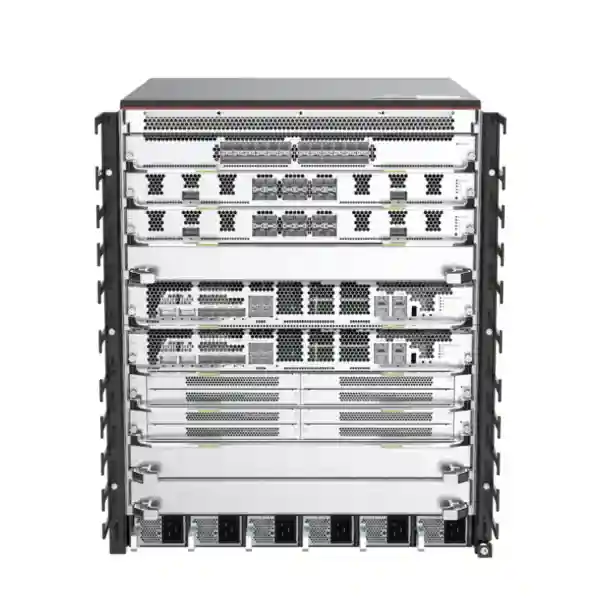
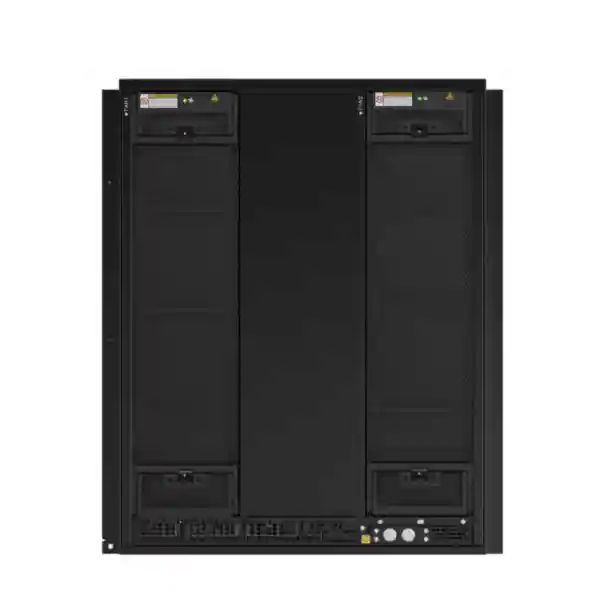
Huawei HiSecEngine USG12008-F
The Huawei HiSecEngine USG12008-F is designed for security boundaries where ordinary appliance firewalls become a throughput, session-scale, interface-density, or resilience bottleneck. It combines a modular chassis, distributed service processing, high-speed interfaces, dedicated acceleration resources, comprehensive threat prevention, centralized operations, and carrier-class redundancy for large data centers, service-provider environments, headquarters campuses, government estates, finance networks, universities, healthcare groups, and other organizations that cannot treat the firewall as a simple edge box.
For UAE projects, FourTeck focuses on sizing the complete security system rather than quoting a chassis in isolation. The correct design considers expected firewall throughput, real enterprise-mix inspection, SSL decryption, VPN load, session concurrency, new-session rate, interface requirements, redundancy, power feeds, rack space, subscriptions, management, logging, and phased growth.
Direct answer
Choose the USG12008-F when the security gateway must sustain very large traffic volumes, millions of sessions, heavy east-west or north-south inspection, multiple high-speed uplinks, and enterprise-grade high availability while retaining room for modular expansion.
Huawei publishes up to 800/800/260 Gbps IPv4 firewall throughput for 1518/512/64-byte UDP frames, up to 360 million concurrent IPv4 connections, and up to 9 million new IPv4 connections per second under the stated test conditions. Security-service throughput is lower and must be sized using the enabled feature set and actual traffic model.
What the USG12008-F is built to solve
Large enterprise and carrier security designs have a different problem set from branch firewalls. The requirement is not merely to pass traffic at line rate; the platform must inspect large numbers of simultaneous flows, sustain bursts of new connections, protect encrypted services, support complex segmentation, provide high-speed VPN connectivity, maintain service continuity during component or link failure, and remain operationally manageable as policies and threat intelligence change. A high-end chassis firewall must therefore be evaluated as a system consisting of processing capacity, interface capacity, redundancy, security subscriptions, management, power, cooling, cabling, optics, and deployment architecture.
The Huawei HiSecEngine USG12008-F sits in this high-capacity category. Huawei describes the USG12000-F family as using a forwarding-and-control separated architecture with adaptive service resource allocation, network-processor resources for forwarding, pattern-matching engines for content inspection, and encryption/decryption acceleration for IPsec and related cryptographic workloads. The intention is to prevent a single service function from becoming the limiting factor when traffic consists of many different packet sizes, applications, users, tunnels, and threat-inspection profiles.
In a UAE data center, this matters when internet edge traffic, cloud connectivity, partner extranet connections, remote-access VPN, public applications, branch aggregation, and internal segmentation converge onto the same security tier. The platform can be designed as a consolidated high-performance enforcement point, but consolidation should be deliberate. FourTeck normally separates the questions of raw forwarding, inspected traffic, encrypted traffic, VPN traffic, and session behavior so that the bill of materials reflects the real workload rather than a headline number.
USG12008-F technical snapshot
A modular chassis intended for data-center racks where service capacity, redundancy, and board-level expansion are planned together.
The larger USG12008-F chassis provides eight service-board slots, giving architects room to balance service processing and interface requirements.
Dual management and control-plane slot design supports resilient operation and maintenance planning for mission-critical environments.
Huawei-published IPv4 firewall throughput for 1518/512/64-byte UDP traffic. This is not the same as full threat-protection performance.
A very large session table helps address internet gateways, data-center service farms, and aggregated user estates with heavy concurrency.
Published HTTP/1.1 new-connection capability is valuable when short-lived sessions, APIs, web farms, NAT, and user traffic create rapid churn.
Hardware architecture and modular chassis design
The central advantage of a chassis firewall is architectural separation. Instead of forcing all interface, security-processing, management, and expansion decisions into one fixed appliance, the USG12008-F allows the design team to build an appropriate combination of processing and connectivity modules. Huawei documentation describes service processing units for security services and line processing units for network connectivity, with modules selected according to interface and capacity requirements. This permits a design to prioritize deep security inspection, high-speed connectivity, or a balanced mixture depending on the role of the firewall.
The USG12008-F chassis provides eight service-board slots and two MPU slots. This slot count matters because real high-end deployments rarely remain static. An organization may initially deploy the firewall at an internet edge with 10GE and 100GE links, then later add a data-center interconnect, additional tenant zones, cloud on-ramps, more VPN termination, or internal segmentation. A modular platform allows these changes to be engineered with greater granularity than a fixed port-density appliance, subject to supported board combinations, software releases, power budgets, and chassis rules.
The chassis height is 13U. Huawei lists dimensions without packaging of 575 mm × 442 mm × 515.5 mm without cable-management frames and 575 mm × 442 mm × 585.5 mm with cable-management frames. Rack planning therefore needs more than an available U count. The design should verify cabinet depth, front and rear clearance, cable bend radius, fiber management, service access, power-distribution placement, airflow path, and whether adjacent equipment creates recirculation or obstructs maintenance.
The platform uses pluggable fan modules, and Huawei lists two fan modules for the USG12008-F. A production bill of materials should confirm the exact fan, power, control, service, and interface components required for the selected redundancy model. FourTeck treats the chassis as the beginning of the solution, not the complete solution, because an under-specified chassis can create delivery delays, unplanned licensing gaps, or a second implementation window later.
Published performance and capacity
| Metric | Huawei HiSecEngine USG12008-F | Sizing meaning |
|---|---|---|
| IPv4 firewall throughput | 800/800/260 Gbps at 1518/512/64-byte UDP | Baseline forwarding capacity under the published packet-size tests. |
| IPv6 firewall throughput | 800/800/260 Gbps at 1518/512/84-byte UDP | Important for dual-stack data-center and service-provider designs. |
| IPv4 concurrent connections | 360 million | Shows session-table scale for aggregated estates and large application environments. |
| IPv4 new connections/sec | 9 million | Relevant for high session churn, web/API workloads, NAT, and very large user populations. |
| FW + SA throughput | 450 Gbps, HTTP 100 KB test | Represents firewall plus service/application awareness under the stated test profile. |
| NGFW throughput | 216 Gbps, HTTP 100 KB; 96 Gbps Enterprise Mix | Enterprise Mix is often a more useful starting point than large-file laboratory traffic. |
| Threat protection | 194.4 Gbps, HTTP 100 KB; 84 Gbps Enterprise Mix | Published with firewall, service awareness, IPS, and antivirus enabled for the stated tests. |
| IPsec VPN throughput | 441 Gbps with AES-256 + SHA256, 1420-byte | Useful for high-speed site-to-site encryption and large VPN aggregation designs. |
| Maximum IPsec VPN tunnels | 1,000,000 | Supports very large encrypted topologies when the architecture and licenses are correctly planned. |
| SSL inspection throughput | 48 Gbps under Huawei’s stated TLS 1.2 + IPS test | A crucial capacity figure because encrypted traffic inspection is much more demanding than basic forwarding. |
| SSL VPN throughput | 105 Gbps under Huawei’s stated TLS test | Relevant where remote access is centralized at very large scale. |
| Firewall policies | Up to 300,000 | Provides room for highly segmented environments, though policy quality matters more than raw rule count. |
Published performance values are test-condition results, not a guarantee of identical production performance. Packet size, application mix, enabled services, TLS versions and ciphers, logging, NAT, routing, VPN profiles, policy complexity, session distribution, software release, and deployment topology all influence real throughput. Sizing should therefore start from the security-service profile that will actually be enabled.
Why firewall throughput is not the procurement number
A common design error is to take the largest firewall-throughput number and compare it directly with the ISP circuit size. That approach is insufficient for a high-end security gateway. The 800 Gbps large-packet firewall figure indicates the platform’s forwarding capability in a defined test, while real production traffic may require intrusion prevention, antivirus, application identification, URL controls, DNS security, decryption, threat intelligence, logging, routing, NAT, VPN, and segmentation simultaneously. Every enabled feature consumes processing resources in a different way.
Huawei publishes a 96 Gbps NGFW Enterprise Mix figure and an 84 Gbps Threat Protection Enterprise Mix figure for the USG12008-F. These figures are particularly important because enterprise traffic includes a mixture of applications, transaction sizes, packet sizes, and connection behavior rather than a single synthetic flow. For an internet gateway expected to inspect 40 Gbps today and perhaps 70 Gbps after two years, an Enterprise Mix security figure with operational headroom is a better planning basis than an 800 Gbps forwarding number.
SSL decryption deserves separate treatment. Huawei lists 48 Gbps SSL inspection throughput under a specific TLS 1.2 and IPS test. Encrypted-traffic inspection can become the limiting factor long before plain firewall forwarding. The design team should estimate what percentage of traffic will be decrypted, which destinations or application categories will be exempted, what certificate and privacy policies apply, which TLS versions and ciphers dominate, and whether decryption will be performed on both inbound and outbound traffic.
FourTeck’s sizing approach is therefore to identify independent capacity domains: plain firewall traffic, full threat-protection traffic, decrypted traffic, IPsec traffic, SSL VPN traffic, concurrent sessions, connection creation rate, and high-speed interfaces. A safe design also reserves growth and failure-mode capacity so that a high-availability peer can carry the required workload when one device or path is unavailable.
Interface strategy: 10GE, 40GE, and 100GE for real data-center topologies
Huawei positions the USG12000-F family for multiple interface types, including GE, 10GE, 40GE, and 100GE, with line processing units selected according to deployment requirements. The practical question is not only how many interfaces can be inserted, but how each interface maps to upstream routers, leaf or spine switches, server-farm aggregation, MPLS or SD-WAN handoffs, internet providers, cloud connectivity, and dedicated management or HA networks.
For a UAE enterprise data center, 100GE may be used between the firewall tier and core or spine switches while 10GE or 40GE connectivity serves smaller zones, partner links, service networks, or phased migrations. A service provider may require larger numbers of high-speed links and more strict separation between customer, peering, internet, and management planes. In both cases, optics and cabling should be treated as part of the solution. Fiber type, reach, connector type, transceiver compatibility, breakout requirements, spare optics, patch-panel design, and labeling can become implementation-critical details.
Interface density must also be considered together with security processing. Adding more high-speed ports does not automatically increase inspected throughput. The correct design aligns line-side capacity with service processing capacity so that traffic does not create an internal bottleneck. If multiple 100GE links are installed for resilience or aggregation, the expected simultaneous load, ECMP behavior, LAG design, routing convergence, and failure scenarios should be modeled.
During pre-sales design, FourTeck can map every proposed firewall interface to a peer device, VLAN or routed domain, media type, optical requirement, logical zone, and redundancy function. This produces a port map that is useful to both procurement and implementation teams and reduces the risk of discovering missing interfaces or optics during the maintenance window.
Security services available on the platform
Application identification and control
The platform identifies applications using signatures, correlation, and behavior rather than relying only on ports. Huawei documents more than 6,000 preset applications, user-defined applications, categories, and risk labels. This allows security rules and traffic controls to be expressed in business-service terms instead of broad TCP or UDP port permissions.
Intrusion prevention
IPS inspection is designed to detect vulnerability exploitation, web attacks, botnets, command-and-control behavior, brute-force activity, and other malicious patterns. Huawei documents more than 25,000 predefined signatures and automatic signature updates, with support for custom signatures where required.
Antivirus and advanced malware defense
File inspection covers multiple common protocols and file types. Huawei describes heuristic, semantic, emulation, reputation, and sandbox-assisted methods for identifying known and unknown malware, including packed or embedded content and suspicious files that require deeper analysis.
URL and web security
Cloud URL classification can be used to control browsing by category, user or group, time range, and security zone. Huawei’s published database exceeds 560 million URLs across more than 130 categories. HTTPS, HTTP/2, and QUIC-related controls are part of modern web-policy planning.
DNS security
DNS controls can help detect or block malicious domains, command-and-control destinations, domain-generation algorithms, compromised sites, phishing infrastructure, and related threats. DNS category filtering, safe-search functions, and sinkholing can be incorporated into security policy.
Anti-DDoS and traffic controls
Source validation, fingerprinting, traffic limiting, and behavior-oriented protection can help mitigate a range of denial-of-service conditions. At a large internet edge, these controls should complement upstream provider protection and a documented incident-response process.
Application-aware policy design
A high-end firewall becomes significantly more useful when policies describe applications, users, zones, and business intent rather than a collection of ports. The USG12008-F supports policy conditions that can include VLAN identifiers, 5-tuples, security zones, regions, applications, and time ranges. This allows a security team to translate a segmentation model into policy with more context than traditional packet-filter rules.
For example, a finance application may need access from specific user networks to a database tier, while internet browsing from the same users may follow a separate application-control and URL-filtering profile. A public web tier may accept inbound traffic from the internet but only initiate tightly defined connections toward application services. A backup network may require large throughput but only between known systems and scheduled periods. Expressing these flows in context makes rule review more meaningful and can reduce broad any-any permissions.
Policy scale is also relevant. Huawei lists up to 300,000 firewall policies. This number provides capacity for highly segmented environments, but architecture should not aim to maximize rule count. Excessive policy sprawl increases operational risk. A better approach uses consistent objects, naming standards, service groups, application groups, reusable profiles, change control, rule-expiry processes, and periodic cleanup. The firewall’s policy capacity gives the design room to grow, while operational discipline keeps the policy base understandable.
When FourTeck assists with migration, existing rules can be classified as required, obsolete, duplicate, overly broad, shadowed, or needing application-level refinement. This reduces the chance that a new high-capacity firewall inherits years of policy debt unchanged.
Intrusion prevention, malware defense, and threat intelligence
Huawei’s security stack combines local inspection engines with continuously updated intelligence. The intrusion-prevention system is designed to identify vulnerability exploitation across operating systems, databases, web servers, middleware, and web applications, as well as attack patterns such as SQL injection, cross-site scripting, remote code execution, botnet activity, remote control, and Trojan behavior. In a large enterprise, the value is not simply the number of signatures; it is the ability to apply the right inspection profile to the right network segment without creating unacceptable latency or false-positive operational burden.
Antivirus inspection extends security beyond connection metadata into transferred content. Huawei documents inspection for protocols such as HTTP, FTP, SMTP, POP3, IMAP4, NFS, and SMB, covering file classes that include office documents, executables, scripts, PDFs, archives, and web content. Archive inspection supports nested compression to a high depth, which is useful when attackers attempt to hide payloads inside layered containers. Actions can be selected according to risk and business context, including alerting, blocking, or removing attachments where supported.
Advanced malware defense incorporates heuristic analysis, AI-assisted techniques, semantic analysis, emulation, reputation information, and sandbox integration. This is relevant because signature-only protection is weakest against new or modified malware. Suspicious files can be escalated for deeper analysis, while known indicators can be blocked using threat intelligence. The architecture should define what traffic is inspected locally, what files are submitted to a sandbox, what data-handling rules apply, and how verdicts are consumed by the firewall and SOC.
Threat intelligence is most useful when it is operationalized. The firewall can receive updated information about malicious IP addresses, domains, URLs, and files, but the security team still needs clear processes for severity, escalation, blocking, exception handling, false-positive review, and incident investigation. Large platforms such as the USG12008-F provide the inspection capacity; the SOC workflow determines whether that capacity becomes measurable risk reduction.
Encrypted traffic and SSL inspection planning
Most modern application traffic is encrypted, which means a firewall that cannot inspect TLS effectively may see session metadata while missing content-based threats. The USG12008-F supports SSL inspection, and Huawei publishes 48 Gbps under a defined TLS 1.2, IPS-enabled benchmark. This number should be treated as its own sizing domain because decryption, inspection, and re-encryption impose significant computational work.
An SSL inspection design begins with policy, not technology. The organization should define which user groups and network segments are subject to outbound inspection, which applications require exclusions, how financial, healthcare, personal, or regulated categories are handled, and whether the organization’s internal public-key infrastructure can support enterprise certificate deployment. For inbound inspection of published services, private keys, certificate rotation, load balancers, web application firewalls, and application ownership must be coordinated.
Traffic profiling is equally important. A 20 Gbps internet connection does not necessarily mean 20 Gbps of decryptable traffic. Some traffic may be excluded, some may use protocols or cipher suites that require different handling, and some may be terminated elsewhere. Conversely, peak encrypted traffic may be higher than an average bandwidth graph suggests. FourTeck recommends collecting percentile-based traffic data and, where possible, application and TLS statistics before sizing.
Operationally, decryption can reveal issues that were previously hidden, such as outdated endpoints, certificate errors, applications with certificate pinning, or services that do not tolerate interception. A phased rollout with monitoring, exception categories, and a clear rollback plan is safer than enabling decryption globally in one change window.
VPN and encrypted WAN aggregation
The USG12008-F is also suited to environments where the firewall is an encryption hub. Huawei lists up to 441 Gbps IPsec VPN throughput using AES-256 with SHA256 and 1420-byte packets, together with support for up to 1,000,000 IPsec VPN tunnels. These published figures indicate the scale of the platform, but the deployed design must consider tunnel type, routing model, key exchange, packet size, fragmentation, replay protection, NAT traversal, logging, resiliency, and traffic distribution.
A large organization may use the platform to aggregate branches, cloud networks, partner sites, disaster-recovery locations, or third-party service connections. Service providers may require far larger tunnel counts than enterprises, while an enterprise may prioritize fewer very high-bandwidth tunnels. Both scenarios should reserve enough processing headroom for failover and security inspection on decrypted traffic after it enters the protected network.
Remote-access SSL VPN sizing is a separate exercise. Huawei publishes up to 105 Gbps SSL VPN throughput and a default/maximum concurrent user figure of 100/60,000, indicating that entitlement and configuration matter as much as chassis capacity. A quotation should therefore confirm required concurrent remote users, authentication method, MFA integration, endpoint posture requirements, split-tunnel policy, application access, and license quantities.
High availability for security that cannot become a single point of failure
Huawei documents active/active and active/standby high-availability configurations for the USG12008-F. Choosing between them requires more than a preference for utilization. Active/standby is often operationally simpler because one peer carries the production role while the second is prepared to take over. Active/active can use both systems during normal operation, but traffic symmetry, state synchronization, routing, link design, and failure behavior require more detailed engineering.
The key sizing principle is failure-mode capacity. If two firewalls share traffic, the design must determine whether one unit can carry the required load when its peer is offline. The same logic applies to uplinks, downstream links, service modules, power feeds, and upstream providers. A topology that is redundant on paper can still fail if the surviving path is under-sized or if routing convergence sends flows asymmetrically through stateful inspection points.
Huawei’s chassis architecture includes redundant components and dual MPU slots, while fan modules are pluggable. The broader system should also use independent power feeds where the facility supports them, separate PDUs, resilient switching or routing pairs, diverse provider paths, and physically sensible cabling. HA heartbeat and synchronization links should be included in the port design and documented separately from production traffic links.
For critical UAE environments, FourTeck can design and document failure tests covering peer failure, link failure, upstream route loss, downstream switch failure, power-feed failure, interface-module failure, and software maintenance. A maintenance window is much safer when success criteria and rollback conditions are defined before the first cable is moved.
Centralized management, logging, and SOC integration
Huawei states that centralized configuration, logging, monitoring, and reporting can be performed through SecoManager. For a large firewall deployment, centralized operations reduce the risk of configuration drift and provide a better view of policy changes, alarms, traffic trends, and threat events than device-by-device administration. The design should define where management systems are hosted, how administrators authenticate, how privileged access is controlled, and how the management plane is isolated from production user traffic.
The USG12008-F also supports integration methods including RESTful APIs, NETCONF, SNMP, SSH, and syslog. This matters in mixed-vendor environments where firewall events must flow into SIEM, SOAR, NMS, ticketing, CMDB, or automation platforms. Integration should be designed with explicit ownership: which system is authoritative for configuration, which receives telemetry, which raises incidents, and which retains logs for audit requirements.
Logging can materially affect storage and operational workflows. A platform capable of millions of new sessions per second can generate a very large volume of events if every session is logged indiscriminately. Security teams should classify which traffic requires session logs, which events require alerting, which logs need long retention, and which can be summarized. Central log collectors or SIEM systems should be sized for peak event rates, not just daily averages.
FourTeck’s broader UAE integration capability can also align firewall deployment with network and infrastructure services available through FourTeck IT Services UAE, particularly where the project includes switching, routing, server connectivity, migration support, monitoring, or ongoing operational assistance.
Deployment topology 1: UAE internet edge and public services
At an internet edge, the USG12008-F can sit between one or more upstream providers and internal core or data-center switches. Typical requirements include BGP or static routing, NAT, public application publishing, outbound user internet access, SSL inspection, IPS, antivirus, URL controls, DNS security, DDoS protection, partner connectivity, and logging. Public-facing applications may also use load balancers or web application firewalls, so packet ownership and TLS termination must be defined clearly.
A dual-ISP design should consider provider diversity, route preference, prefix advertisement, default-route behavior, anti-spoofing, asymmetric return paths, and what happens when one carrier fails. Stateful firewalls depend on traffic symmetry unless the HA and routing design explicitly handles state distribution. The architecture should therefore be validated with real failure scenarios rather than assuming dynamic routing alone guarantees resilience.
Organizations looking specifically for perimeter-firewall expertise in Dubai can also review FourTeck Firewall Dubai for related firewall design and deployment services. The USG12008-F is particularly appropriate when the perimeter has outgrown mid-range appliances or when multiple security roles are being consolidated into a resilient high-capacity tier.
Deployment topology 2: data-center north-south and segmentation firewall
In a data center, the firewall may protect traffic entering and leaving server farms, or it may also segment internal zones such as web, application, database, management, backup, security-tooling, virtualization, and shared-services networks. North-south protection generally focuses on internet, WAN, branch, partner, or user access to applications. East-west segmentation focuses on reducing lateral movement between internal systems and limiting the blast radius of compromised credentials or workloads.
The USG12008-F’s high session scale is useful when thousands of servers, virtual machines, containers, APIs, and user sessions create a large number of simultaneous flows. New-connection performance becomes important for microservices and web architectures with frequent short-lived connections. Application-aware controls and IPS can add context to segmentation rules, but the processing impact of these services must be included in capacity planning.
A data-center design should avoid forcing every internal packet through a single security path without considering latency, bandwidth, and failure domains. Segmentation may be implemented selectively at trust boundaries, application tiers, tenant edges, or shared-service zones. The firewall’s modular interface and processing design provides flexibility, but network architecture should still minimize unnecessary hairpinning.
Where the firewall project is being coordinated with compute infrastructure, customers can also reference FourTeck Server Dubai for related server and data-center infrastructure requirements. Coordinating firewall ports, VLANs, routing, and server uplinks early can eliminate avoidable change requests during implementation.
Deployment topology 3: service-provider and large campus core security
The USG12008-F is also relevant to service providers, managed-service environments, large universities, government networks, and multi-building enterprise campuses where the security tier aggregates extremely large user and device populations. These deployments emphasize session scale, connection creation rate, high-speed uplinks, tenant or department segmentation, policy scale, and automation. The firewall may protect internet access, inter-campus traffic, data-center services, guest networks, IoT zones, or hosted customer services.
Service-provider designs need particularly careful separation between subscriber or tenant traffic and management systems. Virtual-firewall capability can be used where logical separation is required, but the design should confirm the maximum supported virtual-firewall count, required license model, routing boundaries, shared services, logging separation, and administrative delegation. Huawei lists 10 default and up to 2047 virtual firewalls for the USG12008-F in the referenced product documentation, subject to the applicable software and entitlement conditions.
Organizations with regional expansion requirements can coordinate broader infrastructure through FourTeck Africa where appropriate. This is useful for groups that want a consistent security architecture across UAE headquarters and African branches while adapting circuits, local support, regulatory requirements, and hardware logistics by country.
OT and IoT security use cases
Huawei documents support for industrial protocols such as Modbus, S7, Profinet, and OPC, together with identification and control capabilities for IoT devices such as cameras. This makes the USG12008-F relevant to large organizations where IT and operational technology networks intersect, including utilities, manufacturing, transportation, oil and gas support environments, building systems, and smart-campus infrastructure.
OT security requires a different operating philosophy from user internet security. Industrial systems may run old operating systems, have strict latency requirements, communicate in predictable patterns, and be difficult to patch. A firewall can therefore provide compensating controls: restrict which engineering workstations reach controllers, limit remote vendor access, monitor industrial protocol behavior, separate safety and business zones, and block unnecessary lateral movement. Policy changes should be tested carefully because availability can be more critical than aggressive blocking.
For IoT environments, the challenge is often device scale and weak endpoint control. Cameras, access-control systems, sensors, controllers, printers, and building systems can create thousands of persistent connections. Segmentation, DNS controls, reputation-based blocking, vulnerability-aware inspection, and strict outbound policies can reduce exposure. The USG12008-F’s session scale makes it suitable for consolidated estates, but capacity should still be based on observed device behavior.
FourTeck can help build a zone-and-conduit model that identifies asset groups, allowed communications, management paths, internet dependencies, update servers, logging destinations, and emergency-access procedures before firewall rules are written.
UAE power, heat, and rack planning
Huawei lists maximum power consumption of 2914 W for the USG12008-F and maximum heat dissipation of 9942.98 BTU/hour. These maximum values matter in Dubai and UAE data centers where rack power density, cooling allocation, and PDU capacity must be planned in advance. A chassis with available rack space can still be unsuitable if the cabinet does not have enough power headroom or cooling capacity.
The platform supports AC, high-voltage DC, and DC power modes. Huawei specifies rated AC input of 110 V AC/220 V at 50/60 Hz, high-voltage DC at 240 V, and DC options including -48 V DC, -60 V DC, and 48 V DC, with published operating ranges for each. The selected configuration should match the site electrical design and the required redundancy model. Production deployments should use the correct approved power modules, cords, feeds, breakers, and PDU outlets for the installation environment.
Huawei’s published long-term operating temperature range is -5°C to 45°C, relative humidity is 5% to 95% non-condensing, and long-term operating altitude is up to 5000 m. These environmental limits do not remove the need for proper data-center engineering. Hot-aisle containment, cold-air delivery, cable obstructions, rack blanking, and neighboring equipment all influence inlet temperature.
A FourTeck site-readiness checklist can capture rack unit position, cabinet depth, front and rear clearance, power-feed identification, PDU sockets, grounding, airflow direction, optical patching, cable routes, management connectivity, OOB access, and delivery-path constraints before installation day.
Reliability, maintenance, and service continuity
Huawei publishes an MTBF of 27.18 years, MTTR of one hour, and availability figure of 0.9999958 for the USG12008-F under its stated methodology. These figures indicate the platform’s carrier-class design intent, but real service availability depends on the entire system. A highly reliable chassis can still experience an outage if it depends on one upstream switch, one power feed, one optical path, one management system, or a single change window without rollback.
Operational resilience therefore requires component redundancy, topology redundancy, configuration backup, spare strategy, maintenance procedures, software lifecycle management, and tested failover. The organization should decide which components are held as on-site spares, which rely on vendor or distributor replacement SLAs, and which failure scenarios can be tolerated until the next maintenance window.
Software upgrades are another availability event. A high-end firewall should have a documented upgrade path, configuration backup, compatibility review, rollback plan, traffic-drain procedure where required, and post-change validation. HA may allow traffic to move between peers during maintenance, but that capability must be tested before it is relied on for a major upgrade.
FourTeck can incorporate operational acceptance into the project rather than treating it as an afterthought. This includes baseline configuration export, interface status, routing-neighbor status, HA health, session synchronization, security-license status, management reachability, log forwarding, NTP, DNS, authentication, and failover verification.
A practical sizing methodology for the USG12008-F
The most reliable sizing process begins with measured traffic. Collect at least several weeks of data where possible, including average bandwidth, 95th percentile, known peak periods, packet-size distribution if available, connection concurrency, connection-creation rates, application categories, encrypted traffic percentage, VPN traffic, and growth expectations. A single speed-test result or internet circuit size is not enough.
Next, map security services to each traffic class. User internet traffic may require IPS, antivirus, application control, URL filtering, DNS protection, and SSL decryption. Public application traffic may require inbound IPS and selective decryption. Data-center segmentation may require application control and IPS but no URL filtering. VPN traffic must account for cryptographic capacity before and after decryption. This service map allows different traffic categories to be sized against the relevant published performance domain.
Then apply growth and failure headroom. A three-year forecast may include new sites, cloud adoption, higher internet speed, more users, additional public services, increased SaaS use, more encryption, and new segmentation requirements. If an HA peer must carry the full production load during failure, each unit needs sufficient capacity under the selected inspection profile. The same reasoning applies to interfaces: a pair of 100GE links may be installed not because current traffic is 200 Gbps, but to provide path resilience and future expansion.
Finally, verify the design against the exact software release, service boards, line cards, licenses, optics, and supported combinations. Headline product-family values can depend on specific module configurations. A formal bill of materials should therefore list every required hardware and license item instead of using a single chassis part number as a proxy for the complete system.
FourTeck can produce a sizing worksheet that records current traffic, growth factor, security-service mix, SSL inspection ratio, VPN requirements, session requirements, interface map, HA mode, power design, and management integration. This creates a defensible procurement basis and makes later capacity reviews easier.
Licensing and subscription planning
High-end firewall procurement is incomplete without licenses and security subscriptions. Hardware capacity determines what the platform can process, while entitlements determine which security functions, updates, services, remote-access quantities, virtual instances, management capabilities, or support levels are available. The exact licensing model can change by software version, commercial bundle, and contract term, so the quotation should identify every required entitlement explicitly.
Security subscriptions commonly influence access to threat-intelligence feeds, IPS updates, antivirus signatures, URL categorization, advanced malware functions, cloud-based services, or support. The customer should decide whether all features are required from day one or whether the deployment will be phased. However, sizing should still account for future services if the hardware is expected to serve for several years.
Support entitlement is also a design decision. A mission-critical internet edge may require a stronger response and replacement commitment than a lab or secondary environment. The support plan should align with business impact, spare strategy, remote-site logistics, maintenance windows, and internal engineering coverage. For a UAE production environment, the response model should be documented before go-live so that incident ownership is clear.
FourTeck’s quotation process can separate base chassis hardware, processing modules, interface modules, transceivers, accessories, subscriptions, management components, support, and implementation services. This makes it easier for procurement teams to compare complete solutions rather than incomplete chassis-only prices.
Migration from an existing firewall
A migration to the USG12008-F should begin with discovery. Export the existing policy, address objects, service objects, NAT rules, routing, VPN definitions, interfaces, VLANs, security profiles, authentication settings, management services, certificates, logging destinations, and monitoring dependencies. Identify which functions are implemented on the firewall versus routers, load balancers, WAFs, proxies, VPN concentrators, or cloud gateways.
Policy conversion should not be treated as a simple syntax translation. Rule ordering, implicit behavior, object semantics, NAT precedence, application identification, zone logic, and security profiles can differ between vendors. Obsolete or unused rules should be removed where evidence supports removal. Critical rules should be validated against application owners. Broad rules should be candidates for tightening after traffic analysis.
The cutover plan should specify physical cabling, logical interfaces, routing neighbor changes, NAT ownership, DNS changes if any, VPN peer updates, certificate handling, rollback triggers, validation tests, and contact responsibilities. A pre-staged firewall should be tested in a lab or maintenance network where possible. Configuration backups and console or out-of-band access should be available before production traffic is moved.
Post-cutover validation should cover internet access, public services, site-to-site VPNs, remote access, critical applications, routing, NAT, DNS, authentication, security logging, SIEM visibility, monitoring, HA state, link utilization, CPU or service-resource health, and application-owner acceptance. The migration is complete only when technical and business validation both succeed.
Policy cleanup and security hardening after go-live
The first weeks after a firewall migration provide valuable evidence. Logs reveal unused rules, unexpected applications, unmanaged destinations, asymmetric paths, certificate problems, blocked legacy traffic, and services that were not documented before cutover. Rather than freezing the configuration indefinitely after go-live, organizations should schedule a stabilization review.
A good hardening cycle reviews administrative access, password and MFA policy, management-source restrictions, role-based permissions, unused services, SNMP settings, SSH algorithms, NTP, DNS, certificate validity, syslog destinations, backup procedures, security profiles, default actions, rule logging, object naming, and stale temporary rules. HA health, synchronization, and failover should also be re-tested after the production configuration has settled.
Security-profile tuning is equally important. IPS and antivirus profiles should be reviewed for false positives and high-severity events. URL categories and application controls should reflect business policy rather than vendor defaults alone. SSL decryption exceptions should be documented and periodically reviewed. Threat-intelligence blocks should feed incident workflows rather than becoming isolated firewall events.
FourTeck can deliver the platform as part of a broader UAE network-security engagement available through FourTeck UAE, including design validation, configuration, migration planning, implementation, and post-deployment review.
Monitoring capacity and detecting when to scale
A high-capacity firewall should be monitored as a dynamic system. Traffic growth is rarely uniform: bandwidth may rise slowly while session count rises rapidly, or SSL inspection may grow much faster than plain forwarding because more applications move to HTTPS. VPN traffic may spike after a business change, and new cloud services may create many more short-lived API sessions than legacy applications.
Capacity monitoring should therefore include interface utilization, packet rates, concurrent sessions, session creation rate, security-service utilization, SSL inspection load, VPN throughput, dropped packets, CPU or processing-resource indicators, memory or table utilization, log rate, and HA synchronization health. Trending these metrics over months allows the organization to expand before users experience degradation.
Thresholds should be based on sustained utilization and failure-mode requirements, not only peak alarms. If an HA pair runs comfortably at 55% each, but one unit would exceed safe capacity during a peer outage, the environment may already be under-provisioned for its availability objective. Likewise, a 100GE interface at 40% utilization may appear healthy until another link fails and redirects traffic.
The modular nature of the USG12008-F provides upgrade options, but expansion should be planned against supported board combinations, chassis power, software compatibility, and maintenance requirements. Capacity reviews should therefore be part of the annual infrastructure planning cycle rather than an emergency response to congestion.
USG12008-F versus USG12004-F within the same family
The USG12004-F and USG12008-F share the same architectural family, but the larger chassis substantially increases scale. Huawei lists four service-board slots for the USG12004-F and eight for the USG12008-F. The USG12004-F is 8U while the USG12008-F is 13U. Maximum power consumption is listed as 1560 W and 2914 W respectively. These differences affect rack design, expansion headroom, processing scale, and the number of modules that can be accommodated.
Published IPv4 firewall throughput doubles from 400/400/130 Gbps on the USG12004-F to 800/800/260 Gbps on the USG12008-F. Concurrent IPv4 connections increase from 180 million to 360 million, and new IPv4 connections per second increase from 4.5 million to 9 million. NGFW throughput for 100 KB HTTP traffic increases from 108 Gbps to 216 Gbps, while Enterprise Mix NGFW throughput increases from 48 Gbps to 96 Gbps. Threat Protection Enterprise Mix rises from 42 Gbps to 84 Gbps.
The decision between models should therefore be based on required throughput, session scale, board count, interface strategy, growth, and failure-mode capacity rather than chassis size alone. A customer whose current traffic fits comfortably on the smaller model may still select the USG12008-F when the roadmap includes substantial expansion or consolidation. Conversely, over-sizing hardware without a realistic growth case can waste rack space, power, and budget.
FourTeck can model both options against the same workload assumptions so stakeholders can see which requirements are driving the chassis choice.
Procurement factors for UAE projects
High-end firewall procurement should include commercial and operational details alongside specifications. The project should confirm lead time, country-specific availability, exact part numbers, support entitlement, subscription duration, optics, cable kits, power modules, rack accessories, licenses, management components, professional services, training, and warranty or support start dates. Chassis platforms have many more configurable components than fixed appliances, so a clear bill of materials is essential.
Delivery logistics can also affect timing. A 13U chassis and its modules may require coordinated data-center access, loading procedures, secure storage, rack reservation, and implementation scheduling. If the project is tied to a data-center migration, ISP upgrade, new building opening, cloud cutover, or compliance deadline, lead time should be validated early enough to protect the overall program schedule.
Commercial comparison should be performed on a complete system basis. A lower chassis price may be misleading if required processing boards, line cards, subscriptions, support, or transceivers are missing. Conversely, an over-complete bundle can include capacity or licenses that are not needed. The quotation should link every item to a requirement so that procurement understands why it is included.
For multinational customers, FourTeck can also coordinate regional sourcing and support models where appropriate, while the UAE design remains aligned to the local data-center, carrier, and operational environment.
Security design questions to answer before requesting a quote
The quality of a USG12008-F quotation depends on the quality of the input. Start with topology: where will the firewall sit, what devices connect on each side, what routing protocols are used, and whether the design is internet edge, data-center segmentation, VPN aggregation, service-provider edge, or a combination. Then quantify current and future traffic under normal and failure conditions.
Define the security stack. Will IPS, antivirus, URL filtering, DNS security, application control, SSL decryption, sandboxing, DDoS controls, and threat intelligence be enabled? Are services applied globally or only to selected zones? What percentage of traffic will be decrypted? How many remote users and site-to-site tunnels are required? Are there privacy, compliance, or application exceptions?
Document interfaces. Count required 10GE, 40GE, and 100GE connections, include HA and management, record fiber types and distances, and identify whether LAG, ECMP, or breakout connectivity is required. Note the upstream and downstream device models so optic and interoperability considerations can be checked.
Finally, define operations. Who will manage the firewall, where logs will be stored, which SIEM or NMS systems must integrate, what retention is required, whether centralized management is needed, what maintenance windows exist, and what support response is expected. These details convert a product quote into an implementable security design.
If some information is unavailable, FourTeck can help collect it through discovery sessions, traffic reports, existing configuration reviews, and network diagrams before final sizing.
Frequently asked technical questions
Is the 800 Gbps number the expected threat-protection throughput?
No. Huawei’s 800/800/260 Gbps figure is the published IPv4 firewall throughput for specified packet sizes. Huawei separately publishes 96 Gbps NGFW Enterprise Mix throughput and 84 Gbps Threat Protection Enterprise Mix throughput for the USG12008-F. SSL inspection is also published separately at 48 Gbps under a defined TLS 1.2 test. Use the metric that matches the enabled services and traffic model.
Can the USG12008-F be used in active/active?
Yes. Huawei lists both active/active and active/standby high-availability configurations. The correct mode depends on routing, traffic symmetry, capacity, state synchronization, maintenance strategy, and operational preference.
How many service-board slots does the chassis have?
The USG12008-F has eight service-board slots and two MPU slots. Module selection should be validated against the required service processing, interfaces, software release, power, and supported chassis combinations.
Does it support centralized management and third-party integration?
Huawei documents centralized configuration, logging, monitoring, and reporting through SecoManager, plus integration through RESTful APIs, NETCONF, SNMP, SSH, and syslog. Integration design should specify which system is authoritative for configuration and which consumes telemetry.
Is it appropriate for SSL inspection?
Yes, but SSL inspection should be sized separately because cryptographic processing is more demanding than plain firewall forwarding. Huawei publishes 48 Gbps under its stated TLS 1.2 and IPS-enabled benchmark. Real performance depends on ciphers, applications, certificates, packet sizes, and inspection policy.
Can it secure OT networks?
Huawei documents support for industrial protocols including Modbus, S7, Profinet, and OPC, as well as IoT device identification and related security functions. OT policy should be designed conservatively around availability requirements and validated with asset owners.
Decision recap: when the USG12008-F fits
Strong fit when
- The firewall tier must handle very high traffic and session scale.
- 100GE-class connectivity and modular expansion are required.
- Inspection must include IPS, malware controls, applications, web security, or decryption.
- The environment requires active/active or active/standby resilience.
- The organization expects growth, consolidation, or new data-center security zones.
Validate carefully when
- Most traffic will be SSL decrypted, making cryptographic capacity the primary constraint.
- The project has limited rack, power, or cooling capacity.
- The interface requirement is highly specialized and needs exact board validation.
- The current traffic level is modest and a smaller platform may meet the full lifecycle requirement.
- Licensing, subscriptions, or support entitlements have not yet been defined.
Quotation input checklist
Traffic and growth
Current internet/WAN/data-center bandwidth, 95th percentile, expected three-year growth, peak traffic, concurrent sessions, connection rate, and failure-mode traffic.
Security services
IPS, antivirus, application control, URL filtering, DNS security, SSL decryption, sandboxing, DDoS controls, logging depth, and required subscription term.
Interfaces
Required 10GE/40GE/100GE ports, fiber type, optics, distances, HA links, management ports, peer-device models, LAG, ECMP, and breakout needs.
VPN and users
Number of IPsec tunnels, expected encrypted throughput, remote SSL VPN users, MFA method, authentication source, and split-tunnel or full-tunnel policy.
HA and facility
Active/active or active/standby target, rack U availability, cabinet depth, power feeds, PDU sockets, cooling headroom, delivery constraints, and maintenance windows.
Operations
Central management, SIEM, syslog, NMS, API/NETCONF integration, admin authentication, backup procedures, log retention, support SLA, and implementation assistance.
Plan the complete Huawei HiSecEngine USG12008-F solution with FourTeck UAE
A production-ready design requires more than the firewall model. FourTeck can help determine service-processing capacity, interface modules, optics, HA mode, power and rack requirements, subscriptions, management, migration approach, and support. The goal is to deliver a bill of materials and implementation plan that can handle today’s inspected traffic and the expected growth of the security boundary.
Share a network diagram, current firewall model, interface list, bandwidth figures, enabled security services, VPN counts, expected SSL inspection percentage, and preferred support term. From that information, the design can be refined into an exact UAE quotation.
Suitable for new data centers, firewall refresh, capacity expansion, internet-edge consolidation, VPN aggregation, segmentation, and high-availability redesign.

Reviews
There are no reviews yet.