
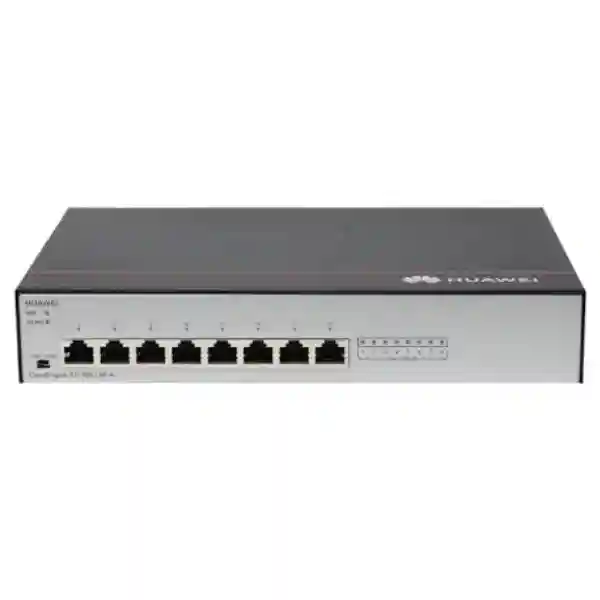
Huawei CloudEngine S1730S-L48P-A
The Huawei CloudEngine S1730S-L48P-A is a 48-port Gigabit Ethernet PoE access switch intended for organizations that need dense edge connectivity without moving immediately to a premium campus-switch platform. It fits offices, CCTV networks, wireless-access deployments, retail branches, schools, hospitality properties, warehouses, clinics, and mixed endpoint environments where one rack-mounted access layer must aggregate a large number of powered and non-powered Ethernet devices.
FourTeck positions this model for projects where port density, centralized endpoint power, simple operations, and predictable procurement matter more than advanced core-routing or data-center features. Because S1730S hardware can appear in market-specific revisions, the exact supplied part number, PoE power budget, uplink interface mix, supported software release, mounting accessories, and warranty entitlement should be confirmed against the quotation before order placement.
At-a-glance fit
What the S1730S-L48P-A is designed to do
In a typical enterprise network, the access switch is the point where user devices and operational technology physically enter the LAN. The Huawei CloudEngine S1730S-L48P-A targets that exact role. Its value proposition is not built around sophisticated data-center fabrics or high-scale routing. Instead, it concentrates a large number of Gigabit copper edge connections into a single platform and adds Power over Ethernet so compatible endpoints can receive data and electrical power through the same structured-cabling run. That combination reduces the number of local power adapters required at desks, ceilings, camera poles, corridors, and retail positions, while simplifying centralized shutdown and UPS-backed power strategies.
For planners in Dubai and across the UAE, a 48-port PoE switch can be especially useful when the network design needs to support several endpoint categories at once. A single wiring-closet switch may serve VoIP handsets, IP cameras, Wi-Fi access points, biometric readers, small IoT gateways, conference-room devices, printers, and standard employee workstations. The practical design task is therefore not merely to count ports. Engineers must also account for total PoE demand, uplink oversubscription, VLAN separation, endpoint criticality, UPS runtime, thermal load, rack depth, optical-transceiver compatibility, cable quality, and growth capacity.
The S1730S-L48P-A is most attractive when those requirements remain within a conventional Gigabit access-layer profile. Organizations that need multi-gigabit access, high-speed 10/25/40/100 GbE aggregation, advanced campus fabric automation, redundant hot-swappable power systems, or extensive Layer 3 control should compare higher CloudEngine families before standardizing. FourTeck can align the switch choice with the overall network design through the FourTeck UAE networking portfolio, rather than treating the access switch as an isolated purchase.
Core technical profile and revision-sensitive specifications
| Design item | S1730S-L48P-A planning position | What to confirm on the quote |
|---|---|---|
| Access density | 48 Gigabit Ethernet copper access ports | Exact port labeling and hardware revision |
| Endpoint power | PoE-capable access design for powered endpoints | Total PoE budget, supported per-port class and full-load limits |
| Management scope | Basic managed access-switch functions appropriate to S1730S family positioning | Software release and feature availability |
| Uplink design | Used to connect the access block toward distribution, firewall or router layers | Exact uplink quantity, media type and supported optics for the supplied revision |
| Rack integration | Enterprise wiring-closet deployment | Chassis dimensions, mounting ears, airflow clearance and supplied power lead |
| Lifecycle planning | Procurement should be tied to verified orderable inventory and support status | Regional warranty, current supply status and replacement path |
This approach matters because channel listings may combine different suffixes, regional bundles, and near-identical S1730S variants under shortened names. FourTeck therefore treats the published model name as the starting point for design and validates the exact deliverable hardware before commercial commitment.
48-port density without unnecessary complexity
A forty-eight-port switch is the natural building block for full-size patch panels and high-density wiring closets. It lets an engineer map structured cabling in an orderly way, usually with one or two patch panels per access switch, while reserving selected ports for wireless, cameras, building systems, or spare capacity. Compared with deploying multiple small switches, a single dense switch normally improves rack organization, reduces the number of power cords and management points, and makes UPS sizing easier. It also gives operations teams one device to label, monitor, back up, and troubleshoot for that access block.
PoE as an infrastructure feature
PoE should be planned as part of the electrical and availability design, not as a convenience checkbox. A PoE switch can centralize power for ceiling-mounted access points, IP handsets, cameras, door controllers, and similar endpoints. When that switch is protected by a correctly sized UPS, many endpoints can continue operating through short utility interruptions even if they have no local UPS of their own. The design benefit is strongest when the project also documents endpoint wattage, priority, cable length, restart behavior, and the acceptable runtime during a power event.
How to size PoE correctly on a 48-port switch
PoE sizing is the most important engineering step for a product such as the S1730S-L48P-A. The fact that a switch has forty-eight PoE-capable access interfaces does not automatically mean all forty-eight ports can simultaneously deliver the maximum possible wattage of the highest endpoint class. Every PoE switch has a finite internal or power-supply budget. The total budget must be compared with the connected-device requirement, and that calculation needs realistic numbers rather than marketing maximums.
A good method is to build a port-by-port load sheet. Record every planned powered device, its normal draw, its manufacturer-rated maximum draw, whether it uses standards-based PoE, and whether it has a local power option. Cameras with heaters, infrared illuminators, PTZ motors, speakers, or analytics hardware can have materially different power behavior from simple fixed cameras. Wireless access points may draw more power when all radios and USB or IoT interfaces are active. Video phones and conferencing endpoints can also exceed the consumption of basic handsets. Engineers should therefore avoid multiplying the lowest observed idle wattage by the number of endpoints.
After establishing the worst credible endpoint load, add design reserve. The reserve absorbs future device replacements, seasonal thermal behavior, endpoint startup peaks, and incremental additions. In practical campus and surveillance networks, preserving a meaningful margin is preferable to running a PoE supply continuously at its limit. If the required load exceeds the validated S1730S-L48P-A budget, the clean solution may be to split endpoints across two switches, move the heaviest devices to local injectors or midspans, or select a higher-capacity PoE platform. The right answer depends on availability, rack space, cabling topology, and lifecycle strategy.
FourTeck can review a proposed endpoint schedule as part of quotation preparation. That is particularly useful for projects mixing Wi-Fi, CCTV, telephony, access control, and general user ports because each category has different utilization and resilience priorities. It also prevents a common procurement mistake: buying enough Ethernet ports but not enough electrical capacity to use those ports as intended.
Port mapping and structured-cabling design
Ports 1–16: business endpoints
A branch office can reserve an initial block for user workstations, multifunction printers, docking stations, desk phones, and meeting-room devices. Grouping similar endpoints makes troubleshooting and VLAN assignment easier because port labels, switch configuration, patch-panel positions, and floor plans follow the same pattern.
Ports 17–32: cameras and security
Surveillance devices benefit from a clearly separated patching block because cameras may belong to a dedicated security VLAN, use different QoS treatment, and require special maintenance access. Numbering camera ports sequentially also makes it simpler to match switch interfaces to camera names, physical zones, recording-server channels, and incident documentation.
Ports 33–48: wireless, voice and growth
The final block can support ceiling access points, reception phones, controllers, room systems, or unassigned growth. Leaving documented spare interfaces avoids emergency additions being patched into random ports and provides flexibility when a device must be temporarily moved during maintenance.
The exact port plan should be adapted to the site, but the principle is universal: physical labeling and logical segmentation should reinforce each other. The switch-port description, patch-panel label, wall outlet, endpoint hostname, VLAN assignment, and monitoring-system record should all refer to the same identifier. This turns a 48-port access switch from a dense collection of cables into an auditable part of the network infrastructure.
VLAN segmentation: the foundation of a clean access layer
A dense access switch should rarely be operated as one flat broadcast domain when it supports multiple business functions. VLAN segmentation allows a single physical switch to carry logically separated endpoint communities. A practical branch design might include a corporate-user VLAN, a voice VLAN, a CCTV VLAN, a guest or wireless VLAN, a facilities/IoT VLAN, and a switch-management VLAN. The firewall or Layer 3 gateway can then control traffic between those segments using explicit security policy.
This separation matters even in smaller environments. Cameras do not normally need unrestricted access to employee computers. Guest wireless clients should not sit in the same trust zone as accounting systems. Building-control devices may have long support lifecycles and weaker endpoint security than modern laptops. Voice systems may need predictable QoS and limited access to call-management services. By assigning ports and trunks deliberately, the S1730S-L48P-A can serve as the physical access edge while policy enforcement remains upstream.
The design should document which interfaces are access ports, which interfaces carry tagged VLANs, the native or untagged behavior expected by connected equipment, and where spanning-tree boundaries exist. For access points that broadcast multiple SSIDs, the switch-facing interface may need to transport several VLANs. For desk phones with a PC pass-through port, the phone and workstation may use separate logical networks on one physical cable. Those decisions should be tested during staging instead of being improvised after installation.
When a project also requires firewall segmentation, remote-access security, or inter-VLAN policy design, the switch can be integrated with solutions covered by FourTeck Firewall Dubai. The objective is a coordinated architecture in which access switching, gateway controls, and endpoint roles align from the first configuration backup.
QoS for voice, video and operational traffic
Quality of Service is not a way to create bandwidth; it is a way to decide how congestion is handled. On a Gigabit access switch, individual endpoint links may have plenty of local capacity, yet multiple ports can converge toward one or more uplinks. When cameras, large file transfers, cloud backups, VoIP calls, video conferencing, and wireless clients become active at the same time, traffic can queue. The network should therefore identify which applications are delay-sensitive and which can tolerate waiting.
Voice traffic is the classic example. Good call quality depends on low latency, low jitter, and minimal packet loss. A correctly designed access layer trusts markings only where appropriate, applies consistent policy boundaries, and ensures that higher-priority traffic cannot be abused to starve normal business applications. CCTV can also benefit from structured treatment, especially where many cameras transmit continuously toward a recorder through a shared aggregation path. However, prioritizing every video packet indiscriminately can simply move congestion elsewhere.
For the S1730S-L48P-A, the important procurement question is whether the exact firmware and hardware revision supports the QoS controls required by the intended deployment. FourTeck can validate this during design review. If the project requires advanced hierarchical queuing, complex policy maps, large-scale telemetry, or application-aware control, a more capable switch family may be more appropriate than forcing an entry access platform into an advanced role.
Three common UAE deployment patterns
Office access closet
In an office, the switch can aggregate workstations, IP phones, printers, meeting-room systems, access points, and small building-control devices. The strongest design is one where every floor or zone has documented patching, spare capacity, a protected uplink, and UPS-backed switching.
This pattern favors organized VLANs, voice QoS, endpoint labeling, and clear change control. The 48-port density is useful when a floor has enough users to justify a dedicated access layer but not enough complexity to warrant a high-end modular switch.
CCTV and security network
A surveillance deployment uses PoE to power fixed cameras, selected PTZ cameras, intercom units, and related devices from a secured equipment room. Traffic typically flows toward an NVR, VMS server, or central security network, so uplink capacity and recording architecture must be calculated alongside PoE power.
For critical cameras, engineers should document what happens during UPS events and switch reboots. A camera network can have enough ports yet still be operationally fragile if power reserve, thermal management, storage throughput, or recovery sequencing is overlooked.
Retail, hospitality or branch edge
A branch may need point-of-sale terminals, IP phones, ceiling Wi-Fi, cameras, digital signage controllers, back-office PCs, and facility sensors on one compact access layer. Centralized PoE reduces adapters in public areas and lets key devices benefit from a rack UPS.
The network should still separate payment, guest, operational, surveillance, and staff traffic according to policy. A simple physical topology does not have to mean a flat or weakly controlled logical topology.
CCTV engineering: bandwidth, PoE and recorder paths
A 48-port PoE switch can appear ideal for video surveillance because the port count matches the scale of many camera projects. The engineering challenge is that camera traffic behaves differently from typical office traffic. Most cameras transmit continuously, often twenty-four hours a day. Their bit rate depends on resolution, frame rate, codec, scene complexity, analytics, variable-bit-rate configuration, and low-light conditions. The aggregate upstream bandwidth therefore needs to be calculated using realistic camera settings, not only the nominal line rate of each Ethernet port.
Consider a site with dozens of cameras that individually average several megabits per second. The resulting aggregate can still fit comfortably within a Gigabit uplink under many conditions, but design reserve is essential. Firmware upgrades, camera reconfiguration, live multi-view sessions, video export, failover recording, and temporary traffic bursts can all change usage. If the switch also serves non-camera devices, the uplink must accommodate both traffic classes. In larger properties, designers may split cameras between access switches and aggregate them through resilient distribution switching instead of concentrating the entire surveillance system on a single edge path.
PoE calculations for cameras deserve equal attention. Basic fixed cameras often draw modest power, whereas PTZ models, integrated heaters, IR arrays, illuminators, speakers, edge-compute modules, or environmental accessories can raise demand substantially. The switch power budget should be assessed against the maximum credible combination. For outdoor UAE installations, designers must also consider that endpoint thermal behavior and enclosure cooling may differ from air-conditioned indoor assumptions.
Operationally, map each camera name to a switch port and patch-panel position. This makes it possible to disable, cycle, or troubleshoot a device without guessing. If the camera estate is security-critical, define who is permitted to alter the switch, how configuration backups are stored, and how changes are logged. The access switch is a security-system dependency and should be managed accordingly.
Wi-Fi access-point deployment on the S1730S-L48P-A
For wireless networks, PoE simplifies ceiling deployment by allowing each access point to use a single structured-cabling run back to the communications room. The S1730S-L48P-A can therefore be useful in projects where the access points use Gigabit Ethernet and their power draw fits the verified PoE budget. The switch should not, however, be selected based on port count alone. Modern wireless designs increasingly use multi-gigabit access links on higher-performance APs, and those devices may be constrained if connected to a 1 GbE-only edge. Before standardizing, compare the AP Ethernet interface, expected client density, radio capabilities, power requirement, and uplink design.
VLAN planning is also important. An access point may broadcast several SSIDs representing corporate, guest, voice, or IoT services. The switch-facing AP port may therefore need to carry multiple tagged VLANs plus a management network, depending on the WLAN architecture. The upstream firewall or gateway must then enforce policy between those zones. This is especially relevant in hospitality and education, where user populations and device trust levels vary widely.
For sites requiring design, implementation, rack integration, structured troubleshooting, or post-deployment optimization beyond the hardware supply itself, FourTeck can coordinate related work through FourTeck IT Services UAE. The objective is to validate the switch as one component of a complete access network rather than assume every Wi-Fi performance problem is solved by replacing the radio.
Voice and IP telephony considerations
Power continuity
One of the most useful benefits of PoE for telephony is centralized backup power. Instead of relying on a separate adapter at every phone, the switch and upstream communications equipment can be protected by a rack UPS. If call control, WAN connectivity, firewall, router, and switching remain available, phones can continue operating during short utility disturbances. UPS design should account for switch base consumption, PoE endpoint load, desired runtime, battery aging, and any other rack equipment sharing the same UPS.
Voice VLAN and QoS
A managed access layer can separate handsets from general workstation traffic using a voice VLAN or equivalent segmentation model. This makes IP addressing, policy, DHCP options, troubleshooting, and QoS more predictable. Where a phone provides a downstream PC port, the network design should clearly define how voice and data are separated across the same physical switch interface and how the endpoint is authenticated or identified.
For telephony-heavy deployments, check the exact S1730S software behavior needed for the proposed handset fleet before purchase. A product that is entirely adequate for simple voice segmentation may not support every automation or discovery mechanism expected in a complex campus. Quote-stage validation prevents assumptions based on other Huawei switch families from being carried over to this model.
Uplink design and oversubscription
An access switch aggregates many edge interfaces into fewer upstream links. That means the theoretical sum of all user-facing Gigabit ports can be much larger than the available uplink bandwidth. This is normal in campus networking because endpoint traffic is rarely synchronized at maximum line rate, but the oversubscription ratio should still be deliberate. The right ratio depends on application behavior. Forty-eight office desktops with bursty cloud and web traffic place different demands on the uplink than forty-eight continuous video streams or a lab moving large datasets.
The exact uplink ports and supported optics of the supplied S1730S-L48P-A revision should be confirmed on the quotation. Once known, engineers should choose media and topology based on distance, electromagnetic environment, pathway availability, and resilience. Copper uplinks can be appropriate for short in-rack or nearby connections. Fiber is often preferable between floors, buildings, or electrically noisy zones because it supports longer distances and provides galvanic isolation. Optical module compatibility must be validated rather than assumed from connector shape alone.
Where the design requires more than one uplink, confirm whether the exact software supports the desired link aggregation and spanning-tree behavior. Redundancy only works when both ends are engineered consistently. Two cables connected without a correct logical design can create a loop instead of resilience. Conversely, a properly configured aggregated or protected path can improve availability and maintenance flexibility.
For branch deployments that connect directly toward a firewall, ensure the firewall interface capacity, VLAN model, and security policy can handle the aggregate traffic. The switch should not be blamed for congestion created by an undersized upstream appliance or internet circuit. End-to-end sizing is the correct method.
Layer 2 resilience and loop prevention
Ethernet loops are among the fastest ways to destabilize an access network. A loop can occur through incorrectly patched wall outlets, unmanaged desktop switches, redundant uplinks, misconfigured wireless bridges, or accidental cabling changes. In a flat Layer 2 domain, a broadcast storm can consume bandwidth and switch resources across a large area. The access-layer design should therefore use the loop-prevention and spanning-tree capabilities supported by the exact firmware revision, with clear root-bridge placement and edge-port behavior.
Edge ports connected to normal endpoints should be treated differently from infrastructure links connected to other switches. Where available and appropriate, fast-edge behavior can reduce endpoint startup delay, while protections can help prevent an accidental downstream switch from influencing the spanning-tree topology. The management team should also have a documented response for unusual MAC movement, rapidly changing topology events, and unexpected broadcast levels.
Because the S1730S-L48P-A is intended as an access switch, it should normally sit below a clearly defined distribution or gateway layer. Keeping topology simple is a resilience technique in itself. Do not add unnecessary Layer 2 rings or chained switches merely because ports are available. A well-structured star or hierarchical design is easier to support, easier to document, and less likely to create failure domains that are difficult to isolate.
Security controls at the access edge
A switch is not a firewall, but access-layer controls can reduce exposure and make network policy easier to enforce. The first principle is administrative separation. Management interfaces should not be broadly reachable from ordinary user or guest networks. Use a dedicated management segment where feasible, restrict administrative access to authorized source systems, use strong authentication, disable unused services, and keep configuration backups under change control.
The second principle is unused-port hygiene. Ports that are not required should be administratively disabled or assigned to a non-routable quarantine policy according to the organization’s standards. Labeling an unused wall socket does not prevent unauthorized connection. If the exact software supports relevant access-security features, those can be incorporated into the design; however, required functions must be validated against the shipped firmware rather than assumed from higher-end Huawei platforms.
The third principle is segmentation. A CCTV device, guest access point, staff PC, and door controller have different risk profiles. VLANs alone do not enforce inter-VLAN security, but they create boundaries that the firewall or Layer 3 gateway can govern. This is a better model than placing every device in one trusted subnet simply because all ports terminate on the same switch.
Finally, operations teams should monitor for anomalies. Unexpected port flaps, repeated link renegotiation, rapid MAC-address changes, unusual broadcast rates, or power-cycling endpoints can indicate cabling faults, loops, unstable devices, unauthorized additions, or failing power. Security and reliability often surface through the same operational signals.
Rack, thermal and electrical planning for UAE installations
Rack space and cable management
Plan the switch together with patch panels, horizontal cable managers, fiber trays, PDUs, UPS units, firewall appliances, and any NVR or server equipment. Dense copper cabling can obstruct airflow and make service difficult when patch cords are too long or poorly routed. Leave enough front and rear access for maintenance and avoid blocking vents.
Cooling and ambient conditions
PoE switching converts electrical power and therefore contributes to rack heat. In the UAE, equipment rooms should be engineered for reliable cooling rather than relying on general building air conditioning. Check the manufacturer’s environmental limits for the exact hardware and maintain margin below those limits, especially in closets exposed to solar heat, roof spaces, warehouses, or intermittent HVAC.
UPS and surge strategy
Size the UPS from actual switch-plus-PoE load rather than the switch chassis alone. Include upstream firewall, router, optical equipment, NVR, controller, or modem loads that must stay online at the same time. Consider surge protection and correct earthing as part of the electrical design, particularly where cables extend to outdoor or building-perimeter devices.
Copper cabling, link quality and PoE reliability
The switch can only perform as well as the passive cabling connected to it. Gigabit Ethernet and PoE both depend on correct pair termination, cable quality, connector integrity, pathway design, and standards-compliant installation. Poor copper links can manifest as intermittent negotiation, packet errors, unexplained endpoint reboots, reduced speed, or unstable PoE behavior. These symptoms are often misdiagnosed as switch faults because the active equipment is more visible than the cable inside walls and ceilings.
For new projects, use appropriate structured cabling for the environment and keep permanent-link length within applicable Ethernet limits. Maintain separation from sources of electrical interference where required by installation standards. Outdoor or industrial runs should use cable and protection suitable for the location rather than indoor office cable placed in unsuitable conduit. Patch panels and keystone terminations should be consistent and tested.
PoE adds another reason to care about cabling. Current flows through the copper pairs, so conductor gauge, bundle size, ambient temperature, and termination quality influence thermal behavior and voltage delivery. In dense bundles feeding many powered endpoints, a design should follow recognized cabling practices instead of assuming every generic Ethernet lead is equally suitable.
After installation, retain certification or qualification results with the network documentation. When a device shows intermittent behavior, comparing switch logs with cable-test records can dramatically reduce troubleshooting time. A clean access network is a combination of switch configuration and physical-layer discipline.
Management, monitoring and operational discipline
Even a straightforward access switch should be treated as managed infrastructure. At minimum, the operations team should know the device hostname, management IP address, rack location, software version, configuration-backup location, uplink destination, VLAN purpose, support entitlement, and maintenance owner. If monitoring is available for the exact revision, integrate it into the organization’s network-management workflow so link state, interface errors, resource alarms, and power events are visible without waiting for users to report failures.
Configuration backups are essential. Before a change window, capture the current configuration and record the reason for the proposed change. After the change, verify critical endpoints, uplinks, VLAN reachability, voice service, cameras, and wireless operation. This sounds basic, but many access-layer outages are prolonged because nobody has a known-good baseline or a current port map.
Firmware management should follow a controlled lifecycle. Do not upgrade simply because a newer image exists, and do not remain indefinitely on an old image without reviewing security and bug-fix information. Validate hardware compatibility, release notes, feature behavior, configuration impact, and rollback options. For sites with multiple identical switches, stage changes on a representative unit before wide rollout when possible.
If the organization outsources network operations, provide the support partner with accurate diagrams and credentials through an approved secure process. FourTeck can also support broader lifecycle planning through FourTeck’s global technology portfolio when a deployment spans multiple locations or needs alignment with other infrastructure categories.
Licensing and software expectations
Entry and access-layer switches are often purchased with the expectation that required Layer 2 functions are available without the recurring subscription structures associated with some advanced networking platforms. However, procurement teams should never assume that every capability seen elsewhere in the CloudEngine family is included on every S1730S model or software train. The exact feature set is tied to hardware and firmware, and some functions described in broader Huawei documentation may apply only to different product families.
For this reason, the correct approach is requirement-led validation. If the project needs specific VLAN scales, link aggregation behavior, spanning-tree modes, DHCP-related protections, traffic statistics, SNMP support, web management, CLI functions, QoS classification, access-control features, or centralized management integration, list those requirements before purchase. FourTeck can then match them to the exact orderable unit and software release.
This avoids two opposite mistakes. The first is overbuying a much more expensive switch because the requirement list was never defined. The second is underbuying an economical access switch and later discovering that one mandatory operational function is absent. A short design checklist before procurement is significantly cheaper than replacing an installed access layer after commissioning.
Where this switch fits—and where a higher model may fit better
Strong fit
The S1730S-L48P-A is a sensible candidate when the project needs dense Gigabit copper access, PoE for edge devices, straightforward VLAN-based segmentation, normal branch or campus access-layer behavior, and cost control. It is especially relevant when endpoint bandwidth is predominantly below 1 GbE and the network architecture keeps advanced routing and security functions upstream.
Typical examples include SMB offices, education classrooms, retail branches, standard CCTV zones, hospitality floors, clinics, warehouses, and building-service networks that need many powered Ethernet endpoints but do not require a premium aggregation platform at every closet.
Review alternatives when requirements are higher
A different CloudEngine family may be more appropriate if the design requires multi-gigabit access for Wi-Fi 6E/7 APs, 10 GbE or faster desktop connectivity, large PoE++ budgets, hot-swappable redundant power, advanced Layer 3 routing, extensive automation, campus fabric functions, high-scale telemetry, or unusually demanding environmental specifications.
The goal is not to make the S1730S-L48P-A perform a role outside its intended class. Matching the platform to the requirement produces a network that is easier to support and usually cheaper over its lifecycle.
Example branch topology
This simplified layout keeps routing and security policy at the firewall or upstream Layer 3 device while the S1730S-L48P-A provides endpoint access. VLANs traverse the uplink as required, and the firewall determines which network segments may communicate. In larger sites, a dedicated distribution layer can sit between access switches and the firewall, improving scalability and providing a more structured failure boundary.
The design should also identify management traffic. Ideally, the switch management interface belongs to a restricted administrative network, and normal endpoints cannot reach it directly. Monitoring, backup, and authentication systems can then access that segment through controlled policy.
Pre-deployment staging checklist
1. Validate hardware
Record model, serial number, supplied accessories, power lead, mounting hardware, hardware revision, and any optical modules. Photograph labels for asset records where the organization’s process allows it.
2. Establish software baseline
Confirm software version, management method, default settings, authentication policy, time synchronization, logging destination, and configuration-backup procedure before production use.
3. Build VLAN and port map
Create interface descriptions, access VLAN assignments, trunk definitions, voice settings, management addressing, and any security controls. Match switch ports to patch-panel and room identifiers.
4. Test PoE endpoints
Connect representative cameras, APs, phones, and other powered devices. Verify negotiation, boot behavior, power draw, VLAN membership, and recovery after a controlled switch or port restart.
5. Validate uplink and failover
Confirm link speed, optical compatibility, VLAN transport, aggregation behavior if used, and upstream gateway reachability. If there is a redundant path, test an actual link failure during staging.
6. Save acceptance evidence
Export the final configuration, port map, software version, asset details, test results, and handover notes. This baseline is invaluable when the site is revisited months later.
Commissioning tests that matter
Commissioning should verify the network as a system rather than only proving that the switch powers on. Start with physical checks: rack mounting, cable strain, ventilation clearance, PDU connection, grounding practice, labels, and patch-cord routing. Then verify management access from the approved administrative network and confirm that unauthorized networks cannot reach the device management plane.
Test representative access ports from every logical segment. A user port should obtain the correct addressing and reach only intended services. A camera port should communicate with the surveillance system and not gain unnecessary access to corporate resources. A guest or WLAN path should follow its security policy. Voice ports should register handsets and sustain calls while other traffic is active. These tests validate VLAN and upstream firewall policy together.
PoE testing should include normal device boot and, where operationally acceptable, a controlled power cycle. Some endpoints exhibit high startup draw or take longer to renegotiate after power loss. Documenting this behavior helps the support team distinguish expected recovery from a fault. If UPS runtime is part of the design, perform a realistic controlled test with the planned rack load instead of relying only on a calculator.
Finally, create an acceptance record with date, installer, software version, key configuration parameters, test outcomes, and known exceptions. A professional handover converts the switch from an installed box into a maintainable infrastructure asset.
Troubleshooting framework
When an endpoint connected to the S1730S-L48P-A fails, troubleshoot from the physical layer upward. Check whether the port has link, whether the negotiated speed is expected, whether errors are incrementing, and whether PoE power is being delivered. Swap the patch lead, test the structured cable, and, when appropriate, move the endpoint to a known-good port. This separates device, cable, and switch-interface faults quickly.
If physical connectivity is stable, check the logical configuration. Confirm access VLAN, trunk tagging where applicable, MAC-address learning, DHCP behavior, gateway reachability, and upstream firewall policy. For voice or WLAN endpoints, verify that any special VLAN tagging expected by the device matches the switch configuration. For cameras, confirm that the recorder path and routing policy are correct.
For intermittent issues, look for patterns: does the port flap at certain times, does PoE reset under load, do multiple devices fail together, or does the problem coincide with utility power events? Correlated symptoms often point to shared causes such as a cable bundle, PDU, UPS, uplink, loop, overheating condition, or upstream gateway rather than forty-eight independent endpoint failures.
Good documentation shortens every troubleshooting cycle. Port descriptions, rack diagrams, cable certification, endpoint inventory, configuration backups, and monitoring history let engineers compare the current state with a known baseline instead of rediscovering the network during an outage.
Procurement guidance for Dubai and the UAE
Network-switch procurement should start with the exact model and end with a deliverable bill of materials. For the Huawei CloudEngine S1730S-L48P-A, the bill should identify the exact orderable unit, regional power configuration, mounting accessories, warranty terms, software entitlement, optics if required, patching accessories, and any spares. If the site uses fiber uplinks, specify connector type, fiber mode, distance, optical module on each end, and patch-cord requirements.
Lead time also matters. If the switch is part of a new office or security-system handover, hardware availability should be checked early enough that an alternative can be engineered if the preferred revision is unavailable. Avoid last-minute substitution with a superficially similar model unless the replacement is reviewed for PoE capacity, uplinks, software functions, rack dimensions, and management compatibility.
For multi-site rollouts, standardization is valuable. A consistent switch model, software baseline, port-labeling method, VLAN template, backup procedure, and spare strategy reduce operational complexity. However, standardization should still allow for sites with different endpoint counts or Wi-Fi performance needs. One hardware model does not have to be forced into every branch if requirements differ materially.
FourTeck can supply the S1730S-L48P-A within a broader project scope that includes requirements review, compatible optics and cabling guidance, rack integration, staging, configuration, and handover. The commercial quote should be used as the authoritative record of the exact hardware revision and inclusions for the UAE order.
Lifecycle planning and spare strategy
The installed cost of a switch is only one part of its lifecycle. Organizations should plan how failures will be handled, how configuration is restored, and what replacement path exists if the exact model later becomes unavailable. For a critical branch or surveillance site, holding a compatible spare can reduce recovery time dramatically. The spare does not necessarily need to be powered continuously, but it should be inventoried, stored correctly, and periodically checked for configuration and firmware compatibility.
Configuration portability also matters. Keep a sanitized template for common settings and a site-specific backup for each installed unit. If a replacement switch is required, engineers should know which settings can be restored directly and which values—such as management IP addresses, unique credentials, certificates, or topology-specific parameters—must be updated.
When planning refresh cycles, look beyond age. Consider support status, security-fix availability, endpoint bandwidth evolution, PoE demand, management-platform compatibility, and business criticality. A stable switch can remain useful for years in a modest access role, but a site may still need an upgrade if new Wi-Fi access points require multi-gigabit links or if new endpoint types exceed the original PoE design.
Frequently asked technical questions
Is the Huawei S1730S-L48P-A a 48-port PoE switch?
Yes. The model is positioned as a 48-port Gigabit Ethernet PoE access switch. The total PoE budget and any per-port or full-load limitations should be confirmed for the exact unit offered in the quotation.
Can it power IP cameras?
It is suitable for standards-based PoE camera deployments when the endpoint requirements fit the switch’s verified power capabilities. Camera quantity alone is not enough; total wattage, startup behavior, cable length, and device class should be checked.
Can it support Wi-Fi access points?
Yes, for APs whose Ethernet speed and PoE demand match the switch. For high-end Wi-Fi 6E or Wi-Fi 7 APs, verify whether 1 GbE access is sufficient; some modern APs benefit from 2.5 GbE or faster switching.
Is it appropriate as a core switch?
It is better understood as an access-layer platform. Core or distribution roles can demand higher throughput, faster uplinks, stronger redundancy, advanced Layer 3 functions, and larger control-plane scale than an entry access model is intended to provide.
Does every PoE port deliver maximum power at the same time?
Not necessarily. The total switch PoE budget is finite. A design must compare the aggregate endpoint requirement with the validated switch budget and preserve reserve for startup peaks and future additions.
Can it be used with a firewall for VLAN segmentation?
Yes, where the required VLAN functions are supported by the exact software. The switch can provide access segmentation while the firewall or Layer 3 gateway enforces policy between VLANs and toward the internet or WAN.
What should be verified before ordering?
Confirm the exact orderable part number, hardware revision, PoE budget, uplink ports, optics compatibility, software features, rack accessories, power lead, warranty, and support status. A written requirement list is the safest basis for validation.
Can FourTeck stage the switch before delivery?
Project scope can include staging, baseline configuration, VLAN and port mapping, testing with representative endpoints, labeling, documentation, and deployment assistance, subject to the commercial quotation.
Engineering decision recap
Choose the Huawei CloudEngine S1730S-L48P-A when the central requirement is a dense 48-port Gigabit PoE access layer and the project’s feature needs remain within the capabilities of the verified hardware and software revision. The strongest use cases are conventional enterprise edge networks: offices, CCTV systems, Wi-Fi access, IP telephony, retail branches, hospitality networks, education environments, and mixed endpoint closets.
Quotation input checklist
Providing the following information allows FourTeck to validate the S1730S-L48P-A more accurately and identify any missing optics, cabling, power, or feature requirements before quotation.
Number of PCs, phones, cameras, APs, controllers, printers, IoT devices and spare ports.
Make, model and maximum power requirement for every powered endpoint category.
Target connection speed, copper or fiber preference, distance, connector and redundant-link requirements.
Required VLANs, voice behavior, QoS, monitoring, access security, aggregation and management methods.
Rack size, cooling, UPS, cable type, patch-panel layout, indoor/outdoor endpoint locations and electrical constraints.
Hardware only, or supply plus configuration, staging, installation, testing, documentation and support.
Consult FourTeck for UAE supply, validation and deployment
The Huawei CloudEngine S1730S-L48P-A can be an efficient access-layer choice when its verified PoE budget, uplink arrangement and software functions match the project. FourTeck can review the intended endpoint load, topology and site constraints before confirming the final bill of materials.
For best results, send the endpoint count, PoE device models, uplink distance, required VLANs, rack/UPS information, and preferred deployment date. The quotation can then identify the exact supplied revision, accessories, compatible optics where needed, and implementation scope without relying on assumptions.
• Endpoint and PoE schedule
• VLAN and security requirements
• Uplink media and distance
• Rack, UPS and cooling details
• Installation and support scope


Reviews
There are no reviews yet.