
Enterprise Campus Switching • UAE
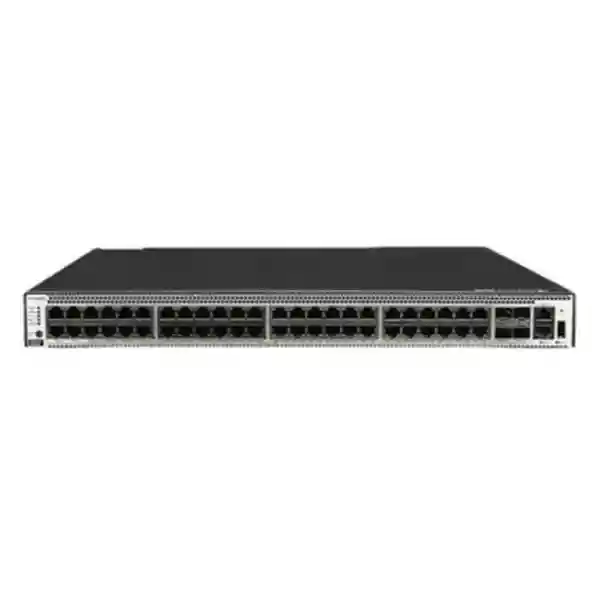
Huawei CloudEngine S5731-S48P4X
A high-density 48-port Gigabit PoE+ access switch with four 10GE SFP+ uplinks, advanced Layer 3 capabilities, iStack resiliency, policy-driven campus services, and flexible pluggable power for modern enterprise edge networks.
Direct answer
Choose the S5731-S48P4X when a floor, office, school, hospitality site, healthcare wing, retail facility, or branch requires a full 48-port Gigabit edge with PoE+ and resilient 10 Gigabit uplinks. The model is especially useful where access points, IP phones, cameras, door controllers, and standard Ethernet endpoints must share one managed switching platform.
High port density for powered and non-powered endpoints across enterprise access networks.
Fiber or direct-attach connectivity toward distribution, aggregation, core, or stack peers.
Designed for sustained enterprise traffic forwarding at the campus access layer.
Huawei specifies device and system switching-capacity values for this platform.
What the Huawei CloudEngine S5731-S48P4X is designed to do
The Huawei CloudEngine S5731-S48P4X is a standard Gigabit enterprise campus switch built for the point where users and devices physically enter the network. Its 48 copper Ethernet ports can connect desktops, IP phones, wireless access points, surveillance cameras, printers, building-management controllers, digital signage, access-control panels, thin clients, and general-purpose network appliances. Because the access interfaces support PoE+, the same horizontal copper cabling can transport both data and electrical power to compatible powered devices, reducing the need for local power adapters and simplifying endpoint deployment.
Four fixed 10GE SFP+ interfaces provide the higher-speed northbound connectivity normally required between the access layer and an aggregation or core layer. The uplinks can be designed as independent routed links, Layer 2 trunks, aggregated links, resilient paths, or stack connectivity depending on the topology, software release, and operational model. This is important in UAE enterprise environments because a 48-port access switch can aggregate substantial traffic from Wi-Fi, unified communications, cameras, and user devices. A Gigabit-only uplink would often create an unnecessary bottleneck; 10GE uplinks give the design more headroom for burst traffic and future growth.
The S5731-S family runs Huawei’s Versatile Routing Platform and supports a broad portfolio of Layer 2, Layer 3, IPv6, security, automation, and operations capabilities. That makes the S5731-S48P4X more than a simple unmanaged edge device. It can participate in engineered enterprise segmentation, dynamic routing, redundant gateway designs, campus virtualization, traffic policy enforcement, and centrally operated networks. For organizations planning a new deployment or a replacement cycle, FourTeck UAE can align the switch configuration with access-point counts, PoE draw, optics, rack power, uplink architecture, VLAN plans, and operational requirements before procurement.
Core hardware specifications
| Parameter | Huawei CloudEngine S5731-S48P4X | Design relevance |
|---|---|---|
| Access interfaces | 48 × 10/100/1000BASE-T Ethernet ports with PoE+ | Dense copper edge for users and powered devices. |
| Uplink interfaces | 4 × 10GE SFP+ | High-speed fiber/DAC connectivity to aggregation or stack peers. |
| Forwarding performance | 125 Mpps | Packet-processing headroom for enterprise access traffic. |
| Switching capacity | 176/672 Gbit/s | Huawei lists device/system capacity values; use current release documentation when validating a project. |
| Chassis format | 1U; approximately 43.6 × 442 × 420 mm | Fits standard enterprise racks with allowance for rear cabling and airflow. |
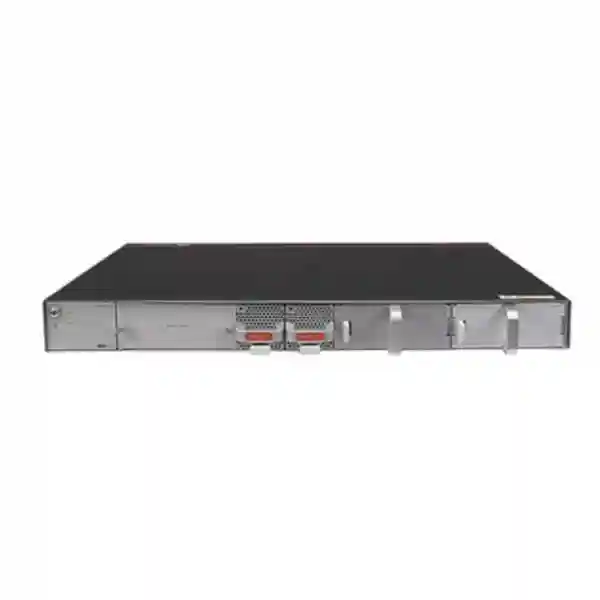
| Power architecture | Pluggable PoE power modules; dual-module configurations can provide redundancy and greater PoE capacity | Power-module selection must be sized against endpoint load and resilience objectives. |
| Stacking | iStack using supported 10GE SFP+ interfaces and approved topology | Lets multiple physical switches operate as a coordinated logical system. |
| MAC scale | Up to 64,000 MAC entries | Suitable for substantial campus Layer 2 populations. |
| VLAN capability | Up to 4094 VLANs plus enterprise VLAN assignment functions | Supports segmentation by user, device, application, tenant, voice, guest, or security zone. |
Exact feature availability, limits, licensing, supported optics, power-module compatibility, and software behavior can vary by VRP release and regional product lifecycle. Project quotations should be checked against the release and bill of materials being supplied.
Access-layer architecture
A well-designed campus access layer must do several jobs at once: provide deterministic Ethernet connectivity, power edge devices, classify traffic, enforce segmentation, protect the control plane, support resilient upstream connectivity, and expose enough telemetry for operations teams to troubleshoot quickly. The S5731-S48P4X addresses these tasks in a compact 1U fixed-form-factor platform. With 48 physical copper ports, one switch can serve a conventional wiring-closet block while reserving multiple 10GE interfaces for northbound paths and resilience.
The switch is particularly appropriate for structured-cabling environments built around Category 5e, Category 6, or better copper runs where endpoints do not require multigigabit access. Each access port can be assigned to a conventional VLAN, voice VLAN, policy-based segment, or other supported service model. Administrators can apply security and quality policies near the endpoint rather than carrying every decision deep into the network. That distributed edge control improves fault isolation and can reduce unnecessary broadcast or policy scope.
Why four 10GE uplinks matter
A 48-port access switch can represent far more than forty-eight low-bandwidth PCs. Modern access ports frequently connect Wi-Fi access points carrying many user sessions, IP cameras generating continuous video streams, phones transporting latency-sensitive voice, and local servers or appliances generating sustained traffic. Four 10GE SFP+ uplinks give designers the freedom to separate roles or combine bandwidth. Two ports can form an aggregated upstream link while the remaining ports support an alternate distribution path or stack connectivity, subject to the selected design.
SFP+ media also provides flexibility over distance. Short intra-rack or adjacent-rack connections may use supported direct-attach cabling, while multimode or single-mode optics can extend uplinks across building floors, campuses, or structured fiber backbones. The correct optical transceiver must match fiber type, distance, wavelength, connector plant, and Huawei compatibility requirements. A quotation should therefore specify optics and patching explicitly rather than listing only the switch chassis.
PoE+ engineering: budget first, port count second
The defining difference between the S5731-S48P4X and a non-PoE access model is its ability to energize compatible endpoints over the Ethernet cable. IEEE 802.3af and 802.3at class devices cover common enterprise equipment such as IP phones, many Wi-Fi access points, fixed cameras, compact intercoms, access-control devices, sensors, and small network appliances. However, a 48-port PoE+ switch should never be sized by the number of RJ45 interfaces alone. The key engineering value is the available PoE power budget after the selected power modules, input voltage, redundancy policy, switch consumption, and expected endpoint draw are considered.
Huawei documentation for the S5731-S48P4X shows that a single 1000 W power module operating at 220 V can provide an available PoE budget around 760 W, enough to supply forty-eight 802.3af devices at 15.4 W class or approximately twenty-five 802.3at devices at 30 W class under the documented sizing assumptions. With two 1000 W modules at 220 V, the available PoE budget can reach approximately 1600 W, allowing all forty-eight access ports to support 802.3at-class loads in the documented fully loaded scenario. Actual powered-device draw may be below the class maximum, but procurement should use conservative planning rather than assuming every device consumes its average laboratory value.
Power resiliency requires an additional decision. A dual-power design can be configured to increase total PoE capacity, provide power-module redundancy, or balance both objectives depending on the load. If the network must keep every camera and access point powered after one module fails, the remaining module must be able to support the required critical load. A design that runs near the combined maximum budget may retain switching function after a module failure but shed PoE load. Therefore the correct question is not simply “Does the switch have two power supplies?” but “What PoE load must survive an individual PSU failure?”
For a UAE site, FourTeck typically recommends building a powered-device inventory with endpoint model, quantity, IEEE power class, expected operational draw, startup or peak draw, criticality, and growth reserve. The result determines whether one or two 1000 W modules are appropriate, whether lower-capacity modules are acceptable, and whether loads should be distributed across more access switches. This approach prevents late-stage surprises when additional cameras or access points are added.
Switching, VLAN, and Ethernet control
At Layer 2, the S5731-S platform provides the functions expected from a managed enterprise campus switch: MAC learning and aging, static and dynamic forwarding entries, VLAN segmentation, link aggregation, loop-prevention mechanisms, traffic classification, multicast controls, and mechanisms for controlling how endpoint traffic is admitted and forwarded. Huawei lists support for up to 64,000 MAC entries and 4094 VLANs on the family. This scale gives network architects enough room to segment multiple departments, floors, device classes, security zones, voice services, guest networks, operations networks, and tenant environments without collapsing everything into a flat broadcast domain.
VLAN assignment can be designed around physical ports where cabling and business roles are stable, but the platform also supports more flexible assignment methods in appropriate releases. Voice VLAN functions can help distinguish IP telephony endpoints, while guest and policy-oriented segmentation can separate unmanaged devices from corporate assets. VLAN mapping functions are useful when service-provider handoffs, legacy numbering, or multi-tenant environments require local tags to be translated across an uplink boundary.
Spanning-tree and related loop-avoidance technologies remain important when the physical topology contains redundant Layer 2 links. In new campus designs, engineers may minimize large Layer 2 fault domains by using routed access or carefully bounded VLANs, but many brownfield sites still depend on VLAN trunks across multiple closets. The switch can participate in standards-based mechanisms and Huawei interoperability functions intended to coexist with heterogeneous environments. Any migration involving another vendor should be tested around spanning-tree mode, native VLAN behavior, LACP timers, voice VLAN discovery, LLDP, DHCP security, and authentication before a mass cutover.
Link aggregation can combine multiple physical uplinks into a logical bundle, increasing available bandwidth and providing path resilience when supported by the upstream design. In a two-switch distribution architecture, the upstream side must be engineered so that the access switch can use redundant links without creating loops or asymmetric failure behavior. Whether the best approach is Eth-Trunk, stacking, a routed design, or another architecture depends on the distribution platform and operational standard.
Layer 3 at the access edge
The CloudEngine S5731-S family includes enhanced Layer 3 functionality, allowing the switch to participate in more advanced designs than a purely Layer 2 access device. Depending on release and licensing, enterprise deployments can use static routing and dynamic routing protocols, first-hop redundancy, IPv4/IPv6 services, and route-policy controls. That makes routed-access architectures possible where VLAN boundaries are terminated closer to users rather than stretched across the campus.
Routed access can reduce broadcast scope and simplify failure domains, but it changes gateway placement, security policy, wireless design, and operational troubleshooting. It should be planned jointly with the core and firewall architecture. For organizations also reviewing perimeter controls, the FourTeck Firewall Dubai practice can coordinate segmentation boundaries between campus switching and firewall enforcement so that routing decisions do not accidentally bypass intended inspection points.
IPv6-ready campus operation
Mature IPv6 capability is relevant even when an organization currently runs IPv4. Modern operating systems, cloud services, service-provider networks, and IoT platforms increasingly use dual-stack behavior. A switch that understands IPv6 control, routing, security, and management functions helps avoid a blind spot where IPv6 traffic is present but unmanaged. The S5731-S series is designed for mature IPv6 networking, which allows architects to introduce IPv6 deliberately rather than discovering it indirectly through endpoints.
A sensible migration begins with addressing, DNS, DHCPv6 or SLAAC policy, first-hop security, access control, routing, monitoring, logging, and application compatibility. Dual-stack networks should apply security policy to both protocol families. Merely enabling IPv6 reachability without equivalent monitoring and filtering can create inconsistent controls.
iStack resilience and operational simplicity
Huawei’s iStack technology allows compatible switches to operate as a logical stack rather than as isolated boxes. In an access-layer context, stacking can simplify management because the stack is administered as one coordinated system with shared topology information. It also enables designs where endpoint connections, uplinks, or aggregated links can be distributed across physical members, reducing the impact of a single chassis or link failure when the surrounding architecture is designed correctly.
The S5731-S48P4X can use supported front-panel 10GE SFP+ ports for stack connections. This has an architectural cost: every interface used for stacking is an interface not available as a conventional 10GE uplink. Designers should therefore reserve sufficient 10GE ports for both stack bandwidth and northbound bandwidth. Stack topology, cable or optic selection, member priorities, software consistency, and split-brain protection should be documented before deployment.
A stack is not automatically a substitute for physical network diversity. If all stack members share one rack PDU, one upstream fiber path, one air-conditioning zone, or one distribution switch, common-mode failures can still interrupt service. High-availability design must look beyond the stack itself and consider separate power feeds, dual upstream devices, diverse fiber pathways, UPS runtime, rack cooling, and operational procedures.
For smaller sites, standalone operation may be simpler and perfectly adequate. For larger campus closets with multiple 48-port switches, stacking can reduce configuration repetition and streamline uplink aggregation. The right choice depends on outage tolerance, port growth, uplink architecture, maintenance practice, and the capability of the upstream network.
Security controls at the access layer
Campus security starts at the first Ethernet port. A compromised laptop, rogue access point, unauthorized camera, incorrectly connected switch, or malicious IoT device can create risk long before traffic reaches a perimeter firewall. The S5731-S family includes multiple security-control mechanisms that can help restrict access, validate traffic behavior, protect infrastructure protocols, and enforce policy close to the endpoint. The exact feature set should be validated against the target software version, but the platform is designed for enterprise access rather than simple plug-and-play forwarding.
Common access-layer protections include controlling source addresses, limiting or learning MAC behavior, applying access control lists, enforcing DHCP-related protections, reducing ARP spoofing risk, restricting management access, separating user and voice services, and rate-limiting unwanted traffic. In authenticated network designs, identity or device posture can be tied to policy so that a user or endpoint receives the correct access rights instead of inheriting unrestricted connectivity simply because a cable is connected.
Management-plane protection deserves equal attention. Administrative access should use secure protocols, centralized authentication where available, role separation, logging, configuration backup, and management-network isolation. Legacy plaintext management should be disabled where operationally possible. SNMP versions, SSH policy, time synchronization, syslog destinations, password standards, AAA integration, and out-of-band recovery procedures should be part of the build template rather than configured ad hoc after installation.
A campus switch does not replace a next-generation firewall, endpoint security, NAC, or SIEM. Its role is complementary: it enforces controls at the physical edge and produces network context. Strong designs layer these controls so that a failure or misconfiguration in one system does not leave the enterprise completely exposed.
Wi-Fi access aggregation
The S5731-S48P4X is well suited to Wi-Fi access-layer deployments where a wiring closet powers and connects multiple wireless access points. PoE+ eliminates local adapters for compatible APs and allows central UPS protection to keep the wireless layer online during brief utility interruptions. The four 10GE uplinks provide sufficient northbound options for aggregating traffic from many APs without forcing every wireless flow through a single Gigabit bottleneck.
The main design check is access-port speed. The S5731-S48P4X provides standard Gigabit copper access ports; it is not a multigigabit access switch. If a new Wi-Fi generation requires 2.5GE, 5GE, or higher wired uplinks per AP to meet performance targets, a multigigabit access model may be more appropriate. For APs designed around 1GE connectivity, however, this switch offers a practical high-density powered edge.
IP voice and unified communications
IP phones are a classic PoE access use case. The switch can power compatible phones, separate voice and data traffic, prioritize latency-sensitive media, and carry phone-plus-PC connections where the handset includes a downstream Ethernet port. Voice VLAN functions, LLDP-based discovery, QoS classification, and resilient uplinks can all be incorporated into the campus template.
Voice quality depends on end-to-end behavior, not only on the access switch. WAN congestion, firewall inspection, call-control capacity, codec selection, jitter, packet loss, and upstream QoS policy must align. The switch should therefore be configured as one part of a complete unified-communications design rather than treated as a standalone voice appliance.
IP surveillance and physical security
Forty-eight PoE+ access ports make the model attractive for CCTV aggregation in office towers, warehouses, schools, hotels, retail facilities, and mixed-use properties. Cameras can receive power from the wiring closet and send traffic over the same link to recording or analytics platforms. The 10GE uplinks help concentrate many continuous video streams toward the server or security network.
Camera deployments require careful power and bandwidth calculations. Resolution, codec, frame rate, motion profile, retention, multicast behavior, and analytics traffic affect bandwidth, while heater/blower assemblies, PTZ motors, infrared illumination, and accessories affect PoE draw. The network team should size for worst credible load and coordinate with video-surveillance engineers instead of multiplying an average bitrate by camera count.
IoT, access control, and building systems
Modern buildings increasingly connect badge readers, intercoms, sensors, clocks, environmental controllers, digital signage, and operational-technology gateways to the enterprise Ethernet fabric. The S5731-S48P4X can consolidate many of these low-to-moderate bandwidth devices, but logical segmentation is essential. Building systems should not automatically share unrestricted access with corporate users.
Dedicated VLANs, ACLs, gateway policy, authentication, and monitoring can isolate device classes while still allowing required management or application flows. PoE makes endpoint installation easier, but centralizing power also increases the importance of UPS sizing and switch-room resilience because a power interruption can affect dozens of physical-security or building devices at once.
Quality of Service for mixed enterprise traffic
A single access switch may carry voice calls, video meetings, surveillance streams, application traffic, cloud synchronization, software updates, backups, guest Wi-Fi, and ordinary web traffic simultaneously. Quality of Service provides a framework for identifying these traffic classes and allocating forwarding priority or bandwidth according to business importance. The objective is not to make every application “faster”; it is to protect delay-sensitive or mission-critical traffic when links become congested.
A practical QoS design begins with trust boundaries. The switch should decide whether markings from endpoints are accepted, rewritten, or ignored. Managed IP phones and enterprise APs may be trusted under controlled conditions, while general user devices should not be permitted to mark arbitrary traffic as highest priority. Classification can use VLAN, interface, protocol, DSCP, ACL, or application context depending on the architecture and supported functions.
Queues, schedulers, policing, shaping, and remarking policies must be consistent with the upstream network. If the access switch prioritizes voice but the WAN edge discards the markings, end-to-end quality will still degrade. FourTeck’s IT Services UAE team can incorporate switch policy into broader LAN, WLAN, firewall, server, and WAN operational standards so that traffic treatment remains predictable across the path.
VXLAN, campus virtualization, and policy-driven networking
Huawei positions the S5731-S series for modern campus networks that can use VXLAN-based virtualization and policy-driven services. VXLAN introduces an overlay abstraction that can separate logical networks from the physical underlay, supporting scalable segmentation and more automated service delivery. Huawei documentation for the family lists VXLAN Layer 2 and Layer 3 gateway functions, centralized and distributed gateway options, BGP-EVPN, and NETCONF-oriented configuration in supported modes and releases.
These features are most valuable when the campus architecture is designed as an integrated system rather than when VXLAN is enabled on a single access switch in isolation. The underlay routing, overlay control plane, gateway placement, authentication model, network controller, addressing plan, and operational tooling all have to fit together. Some advanced functions can require specific software modes or licenses, so they should be identified early in the bill of materials.
For conventional sites, there is no requirement to adopt an overlay merely because the platform supports it. Traditional VLAN and routed campus designs remain appropriate for many organizations. The benefit of selecting a capable access platform is that the hardware can participate in a more automated architecture if the organization later standardizes on Huawei’s campus-management stack, subject to lifecycle and licensing validation.
A sound migration plan separates physical replacement from architectural transformation. Replacing old access switches while simultaneously changing authentication, VLAN structure, routing, Wi-Fi, and overlay technology raises troubleshooting complexity. Large deployments often succeed by establishing a validated reference design, piloting representative sites, automating repeatable configuration, then expanding in controlled waves.
Operations, telemetry, and lifecycle management
The long-term cost of an access switch is driven as much by operations as by purchase price. Enterprise teams need to know which endpoint is connected to which port, whether the link is stable, how much PoE power is being drawn, whether errors are increasing, which VLAN and policy are applied, whether an uplink is congested, and what changed before an incident. The S5731-S family is designed for simplified O&M and can integrate with Huawei management and campus tooling in supported architectures.
Basic operations should include centralized syslog, synchronized NTP, secure SNMP or telemetry, configuration backup, inventory collection, software-version tracking, threshold alerts, and port-description standards. Interfaces should be named according to room, outlet, device, or business function wherever practical. A consistent naming convention can save significant incident time when a user reports an outage and the service desk must map a wall outlet to a physical switch port.
Software maintenance should be governed by a release policy rather than performed opportunistically. Teams should track Huawei advisories, security fixes, supported upgrade paths, feature compatibility, and controller interoperability. A lab or pilot stack can validate upgrades before production rollout. Configuration should be backed up before change windows, and rollback procedures should be known in advance.
Pluggable fans and power modules on applicable S5731-S48P4X configurations also make hardware maintenance more serviceable than an all-fixed design. Spare strategy should consider the installed PSU type, fan type, optics, and stack media so that a failed field-replaceable unit can be restored without waiting for an incompatible part to be sourced.
UAE office and commercial floors
In office towers and commercial buildings, a common topology places one or more 48-port PoE access switches in each telecommunications room. User desks, phones, meeting-room systems, printers, APs, and cameras terminate locally. Dual 10GE uplinks then connect to distribution switches in a main equipment room. The S5731-S48P4X fits this model cleanly because its copper density aligns with structured cabling while PoE reduces local power requirements for many edge devices.
Capacity planning should reserve ports for moves, adds, changes, and growth. Filling all forty-eight ports on day one makes maintenance difficult and encourages unmanaged mini-switches later. A practical design often targets a lower initial utilization and reserves both copper ports and PoE budget for expansion.
Education, hospitality, and healthcare
Schools, hotels, clinics, and healthcare facilities usually have a high mix of powered endpoints: APs, phones, cameras, room systems, access-control devices, kiosks, and specialty terminals. These environments benefit from centralized PoE and resilient uplinks, but they also require stronger segmentation because guest, staff, security, medical, academic, and building-service traffic may share the same physical switch.
The access design should map each endpoint class to defined policy, QoS, management, and support ownership. High-availability requirements may also vary: a classroom AP and a security camera do not necessarily have the same outage tolerance. PoE prioritization and power-resiliency planning can reflect those differences.
UAE environmental, rack, and power considerations
The UAE’s external climate is hot, but enterprise switches should operate in conditioned indoor telecom rooms. Huawei specifies operating limits for the platform, and the S5731-S48P4X uses air cooling with intelligent fan-speed adjustment and pluggable fans in the relevant chassis design. Rack layouts should preserve the intended airflow direction, avoid blocked intake or exhaust areas, and keep cable bundles from pressing against fan modules. Dust management, room filtration, and routine housekeeping are important in technical spaces near construction, warehouses, workshops, or frequently opened service doors.
Rack depth must accommodate the approximately 420 mm chassis plus rear power-module handles, cable bend radius, patch leads, and service clearance. A nominally deep enough cabinet can still be difficult to maintain if vertical PDUs or cable managers obstruct the rear. Before procurement, confirm usable internal rack depth rather than relying only on the cabinet’s external dimension.
Power design should include UPS capacity for the switch itself plus connected powered devices. A PoE switch serving cameras and APs can draw substantially more than a non-PoE access switch. UPS calculations should use realistic peak load, desired runtime, battery aging, efficiency, and redundancy rather than the switch’s idle consumption. Dual PSUs can be fed from separate PDUs or UPS paths where the facility supports it, reducing the chance that one distribution failure disables the entire access layer.
Grounding, surge protection, electrical standards, and structured cabling should follow site requirements and applicable UAE practices. Long outdoor copper runs, inter-building links, or cables exposed to lightning environments deserve special attention; fiber is usually preferable between buildings because it provides distance and electrical-isolation advantages.
Sizing methodology for a 48-port PoE access switch
A reliable quotation should be based on a worksheet rather than on a model number alone. Start with physical port demand. Count current endpoints by type, then add expected additions for the planning horizon. Include APs, phones, cameras, printers, room systems, building devices, spare outlets expected to become active, and uplink or service interfaces. Do not count passive wall outlets as switch ports unless they are expected to be patched; however, maintain sufficient spare capacity so every future change does not require new hardware.
Next calculate PoE. Record each powered device’s standard, maximum draw, and criticality. Compare the total with the budget delivered by the chosen PSU configuration at the local input voltage. Add growth reserve. Then repeat the calculation under the failure condition that matters to the business. If dual PSUs are required for resilience, determine which powered devices must stay online after one module fails. This often leads to a lower permissible steady-state load than the absolute dual-PSU maximum.
Then calculate uplink demand. Consider the aggregate traffic of Wi-Fi, video surveillance, user applications, internet access, backups, cloud synchronization, and east-west flows. Four 10GE interfaces provide flexibility, but some may be consumed by stacking. Decide whether the switch needs one 10GE uplink, an LACP pair, dual-homed routed links, stack links plus uplinks, or another arrangement. Reserve optics and fiber pairs accordingly.
Finally validate feature requirements. Check routing protocols, authentication, ACL scale, multicast behavior, IPv6, automation, management platform integration, VXLAN, controller support, and licensing. A switch can have the correct port count and still be the wrong model if a required software capability is unavailable in the target release or license tier.
This four-part method—ports, power, uplinks, and features—produces a bill of materials that reflects how the network will actually operate. It also gives procurement teams a clear reason for each PSU, optic, cable, and license line item.
Example deployment topologies
Standalone access switch
One S5731-S48P4X connects local users and PoE devices, with one or two 10GE uplinks toward a distribution switch. This is straightforward for small branches, retail sites, compact floors, or locations where a single access chassis has acceptable failure impact.
Stacked wiring closet
Two or more compatible switches operate as an iStack, simplifying management and permitting distributed uplink design. Stack bandwidth, member count, 10GE port consumption, and failure behavior must be validated against the selected release and topology.
Routed access
Layer 3 uplinks terminate local VLAN gateways at or near the access layer, reducing stretched Layer 2 domains. Routing, gateway resilience, security inspection points, and address design become central to the architecture.
Campus virtualization
In supported Huawei campus designs, the switch can participate in controller-driven or VXLAN-based services. This is appropriate when the organization is standardizing on an integrated fabric and automation model rather than managing each switch independently.
Optics and uplink media selection
The four SFP+ uplink cages are only one part of a working fiber connection. Each link also requires a compatible transceiver or cable, matching optics at the far end, the correct fiber type, suitable connectors, and an optical budget appropriate to the distance and loss. Multimode optics are commonly used inside buildings or between nearby telecom rooms where multimode fiber exists. Single-mode optics support longer distances and are often preferred for campus backbones or new inter-building infrastructure. BiDi optics can reduce fiber-pair usage in some designs when supported at both ends.
Optical compatibility should be treated as an engineered BOM item. Mixing unsupported third-party modules may affect supportability or telemetry even when the link appears electrically functional. Verify supported Huawei transceiver part numbers against the exact switch release and interface type. Also confirm whether the upstream switch supports the matching wavelength, speed, FEC behavior if applicable, and optic type.
For short same-rack connections, supported direct-attach copper can reduce cost and complexity, but bend radius and cable thickness matter in dense racks. For longer pathways, fiber normally provides better reach and electrical isolation. Patch-panel labeling and end-to-end fiber testing should be completed before the migration window so that a switch replacement is not delayed by an undocumented polarity or damaged strand.
Licensing and software mode planning
The hardware platform supports a broad feature set, but not every advanced capability should be assumed to be included automatically in every software or commercial package. Huawei documentation lists optional licensing for functions such as VXLAN and MPLS as well as CloudCampus software tiers for S57xx-S platforms. The exact entitlement model, support subscription, and feature availability can change across releases and lifecycle stages.
For a conventional access deployment using VLANs, PoE, standard routing, QoS, and common security controls, the licensing requirement may be simpler than for a controller-driven fabric. For a campus solution using advanced virtualization, automation, or subscription-managed features, licensing should be quoted explicitly per device and matched to the intended software version.
Procurement documentation should identify the base switch, power modules, fan modules if separately supplied, optics, cables, licenses, support coverage, and any management platform components. This avoids a common scenario in which the switch arrives but cannot be deployed because a PSU, optic, or entitlement was assumed rather than ordered.
Interoperability in multi-vendor networks
Many UAE organizations operate mixed estates containing Huawei, Cisco, Aruba, HPE, Fortinet, Juniper, or other infrastructure. The S5731-S48P4X can participate in standards-based Ethernet and IP environments, but successful interoperability depends on configuration details. LACP mode, spanning-tree behavior, LLDP, VLAN tagging, MTU, multicast, routing timers, authentication, transceiver compatibility, and QoS markings should be verified between platforms.
Huawei provides interoperability mechanisms such as VBST and functions described as similar to common proprietary VLAN or trunking behaviors, but a migration should not rely on naming similarity alone. Validate the actual standards, protocol modes, and feature constraints in the release documentation. A lab test with representative upstream switches and endpoints is valuable when replacing a large installed base.
For phased migrations, it is often useful to keep the logical service design stable while changing the access hardware. Reproduce existing VLANs, addressing, routing, QoS, and security behavior first, then introduce architectural improvements after baseline stability is confirmed. This limits the number of variables during the cutover and makes fault isolation easier.
Migration and cutover checklist
1. Discover
Export current configurations, MAC and ARP tables, VLANs, uplinks, port descriptions, PoE usage, spanning-tree state, routing, authentication, DHCP security, QoS, multicast, and management settings. Map critical endpoints to physical ports.
2. Design
Define target VLANs, IP plan, routing, uplink topology, stack roles, PoE budget, optics, security policy, logging, monitoring, software release, and rollback approach. Resolve feature differences before the maintenance window.
3. Stage
Install the approved software, apply the baseline template, set management access, preload interface configuration, test optics, verify PSU and fan health, validate stack formation, and confirm configuration backup.
4. Cut over
Move uplinks and endpoints in a controlled sequence. Check critical services first: gateway reachability, DNS, DHCP, authentication, voice, Wi-Fi, cameras, management, internet access, and application paths. Track unexpected MAC or loop events.
5. Validate
Review interface errors, PoE state, stack status, routing neighbors, spanning tree, logs, CPU/memory trends, optic levels, uplink utilization, and endpoint complaints. Compare results with the pre-change baseline.
6. Document
Update rack elevation, patching records, switch inventory, serial numbers, software versions, port maps, support entitlement, spare holdings, configuration repository, and monitoring platform so operations inherit an accurate environment.
When the S5731-S48P4X is a strong fit
This model is a strong fit when the site needs many standard Gigabit copper access ports, a meaningful amount of PoE+, and 10GE uplinks in a 1U fixed switch. It is particularly practical for established structured-cabling environments where the majority of endpoints are 1GE and the organization wants enterprise routing, security, resiliency, and operations features rather than a basic unmanaged switch.
It is also attractive when a wiring closet contains a mixture of powered and unpowered endpoints. Desktop computers can use ordinary Gigabit Ethernet while phones, cameras, APs, and controllers receive PoE from the same chassis. This reduces the number of different access-switch models an operations team must manage and allows centralized UPS-backed power to protect essential edge devices.
The model should be reconsidered when a large percentage of new access points or high-performance endpoints require 2.5GE or higher copper access speeds, when PoE++ power classes above 802.3at are mandatory, or when the site needs substantially more than four 10GE uplinks. In those cases, a newer multigigabit or higher-power access platform may better match the requirement. Product selection should follow endpoint capability and lifecycle objectives rather than choosing the highest port count available.
Procurement guidance for Dubai and the UAE
A production-ready quote for the Huawei CloudEngine S5731-S48P4X should state more than the base chassis. Confirm whether power modules are included or separate, the number and wattage of modules, input power type, the required airflow/fan configuration, optics, DACs, licenses, support entitlement, rack accessories, and any spare components. Huawei product descriptions for this model may identify the switch as being supplied without a power module, so the PSU line items are especially important.
For an existing rack, confirm available rack units, usable depth, PDU socket type, remaining circuit capacity, UPS headroom, heat load, fiber-patch availability, and cable-management space. For a new site, coordinate switch count with structured cabling and floor layout. A switch placed too far from endpoints can violate copper-channel limits; a switch room without adequate cooling can shorten equipment life even if the network design is otherwise correct.
For warranty and lifecycle planning, verify product status, software-support window, replacement policy, and lead times at quotation. If the network is a business-critical campus, consider keeping compatible optics, PSU modules, and at least one spare access switch or an agreed rapid-replacement process. Hardware redundancy is useful only when failed components can actually be restored within the organization’s recovery objective.
FourTeck can provide UAE-focused product selection and deployment support through its global enterprise technology practice and local engineering resources, helping buyers turn a model request into a complete, deployable bill of materials.
Frequently asked technical questions
Does the S5731-S48P4X support PoE+ on all 48 access ports?
The model provides 48 Gigabit copper ports with PoE+ capability. Whether all forty-eight can deliver the maximum 802.3at class simultaneously depends on the installed PSU configuration and input conditions. Huawei documents dual 1000 W 220 V power modules as supporting a substantially larger PoE budget than a single module.
Can it uplink at 10 Gigabit?
Yes. It has four fixed 10GE SFP+ interfaces. These can be used with supported optics or cabling for connections to aggregation/core switches or, in supported designs, for stack links.
Is it a Layer 3 switch?
Yes. The S5731-S family includes enhanced Layer 3 features and can support enterprise routing functions. The exact protocol set, scale, and licensing should be verified for the target VRP release before the final design is approved.
Can it be stacked?
Yes, compatible S5731-S designs support Huawei iStack. Front-panel 10GE SFP+ interfaces can be used for stack connectivity, so uplink and stack-port allocation should be planned together.
Does it provide multigigabit 2.5GE copper access?
No. The 48 RJ45 access interfaces on the S5731-S48P4X are 10/100/1000BASE-T. If new Wi-Fi APs require 2.5GE or faster wired access, choose a multigigabit-capable access model.
Is one 1000 W PSU enough?
It depends on the endpoint load and resilience target. A single 1000 W module can support a significant PoE budget, but it does not provide PSU redundancy and cannot deliver the same total PoE capacity as a dual-module design. Calculate actual and failure-state loads before deciding.
Can it be used for surveillance cameras?
Yes, provided each camera’s power requirement fits PoE/PoE+ and the aggregate bandwidth and PoE budget are sized correctly. High-power PTZ cameras or accessories should be checked individually.
Can FourTeck configure and install it?
FourTeck can support solution sizing, BOM validation, VLAN and routing design, optics selection, configuration, migration, testing, monitoring integration, and ongoing UAE network operations based on the project scope.
Engineering notes for demanding deployments
High-density access switching becomes more predictable when the design is expressed in failure scenarios. Ask what happens if one uplink fails, one PSU fails, one stack member reboots, one distribution switch is unavailable, one fiber pair is cut, the management platform is unreachable, DHCP is unavailable, or the site loses utility power. Each answer reveals whether the network has genuine resiliency or only redundant components without an end-to-end recovery path.
For example, dual PSUs do not provide full service continuity if both are connected to the same single PDU. Two uplinks do not provide path diversity if both fibers run through the same tray and terminate on the same upstream switch. A stack does not prevent closet-level failure if every member shares one UPS. Redundant design therefore extends from the switch ports through power, cabling, distribution, management, and facility infrastructure.
Capacity should also be evaluated after a failure. If normal traffic uses 60 percent of two aggregated uplinks, losing one may drive the surviving link above its safe operating envelope. If the combined PoE load requires both PSUs, losing one may force the switch to de-energize lower-priority ports. If a stack loses a member, endpoints physically connected to that member still fail unless devices are dual-homed. Resiliency is a service property, not simply a hardware feature.
Documenting these assumptions before purchase makes acceptance testing measurable. The installation team can deliberately remove a PSU, shut an uplink, reboot a member, and confirm whether the observed outcome matches the design. This is more valuable than waiting for a real fault to reveal hidden dependencies.
Configuration baseline recommendations
A production baseline for the S5731-S48P4X should define identity, time, authentication, management, interface defaults, Layer 2 protection, routing policy, logging, telemetry, PoE behavior, QoS, security, and configuration backup. The baseline should be version-controlled so that every access switch follows the same standard unless a documented exception exists. This reduces operational drift and makes troubleshooting easier because engineers know what “normal” looks like.
Unused ports should normally be administratively disabled or placed in a restricted state. Active ports should have descriptions and only the VLANs or services they require. Trunks should use explicit allowed-VLAN lists rather than carrying every VLAN by default. Management access should be limited to trusted networks, and strong AAA should be used where the surrounding systems support it. Logging should include enough context to investigate authentication failures, link flaps, loop events, routing changes, and configuration actions.
PoE settings can be standardized by endpoint type. Critical devices may receive higher power priority, while nonessential devices can be lower priority during a constrained-power event. LLDP and endpoint discovery should be enabled where useful, but edge ports should not indiscriminately trust signaling from unknown devices. Similarly, QoS trust should be aligned with managed endpoint classes.
Before deployment, engineers should validate the baseline in a representative lab or pilot. A template that is syntactically accepted can still cause application problems if it changes native VLAN behavior, authentication timing, DHCP forwarding, multicast, or voice signaling. Testing should include representative phones, APs, cameras, PCs, printers, and any critical building-system devices.
Lifecycle value: standardization, supportability, and spares
The business value of an enterprise switch platform increases when it is standardized across multiple closets and sites. Standardization allows one validated configuration baseline, a smaller spare pool, repeatable monitoring, consistent firmware management, predictable troubleshooting, and simpler staff training. The S5731-S48P4X can serve as a common 48-port PoE edge building block wherever standard Gigabit access is appropriate.
However, standardization should not force the wrong hardware into every location. A small branch may need only 24 ports; a high-density Wi-Fi floor may need multigigabit access; an industrial area may need ruggedized hardware; a server-access role may require many 10GE or 25GE interfaces. Use the S5731-S48P4X as a standard where its capabilities match the endpoint profile, and define companion models for exceptions.
Spare strategy should be based on failure impact and procurement lead time. A large campus with dozens of identical access switches can justify one or more cold spares because a single spare can recover many possible failures. Spare PSUs and optics may resolve common field issues faster than replacing an entire chassis. Inventory records should track compatibility so that a technician does not discover during an outage that the available PSU or optic belongs to a different hardware generation.
Technical comparison: PoE access versus non-PoE access
The S5731-S48P4X should be compared with non-PoE alternatives based on total site architecture, not merely chassis price. A non-PoE switch may cost less and consume less power when most connected devices have independent power supplies. It can be the right choice for desktop-heavy areas, lab benches, server-adjacent management networks, or environments where PoE is not required.
A PoE model becomes more compelling when many edge devices would otherwise need local electrical outlets and adapters. Central PoE simplifies AP, camera, phone, and sensor deployment, enables UPS-backed operation from the network closet, and allows software-controlled power cycling for supported endpoints. The tradeoff is higher PSU capacity, more heat, larger UPS requirements, and the need to engineer power budgets.
Some organizations deploy PoE switches universally to simplify sparing and moves, even on floors with modest current PoE use. Others separate PoE and non-PoE switches to optimize capital and energy. Both strategies can be valid. The deciding factors are endpoint mix, growth expectations, operational standardization, power infrastructure, and the cost of changing hardware later.
Common design mistakes to avoid
Assuming 48 PoE ports means 48 ports at 30 W under every PSU configuration. The available PoE budget is determined by the installed power modules and input conditions. Design from the power table, not the connector count.
Using every 10GE port without reserving stack requirements. If the design uses iStack, some SFP+ interfaces may be dedicated to stack connectivity. Plan stack and uplink bandwidth together.
Ignoring multigigabit requirements for new APs. The S5731-S48P4X is a Gigabit copper access switch. A 2.5GE-capable AP connected at 1GE will operate below its wired potential even if the switch provides enough PoE.
Buying the chassis without power modules or optics. The model can be supplied without a power module in the base product description. A deployable BOM must include the required PSUs and uplink media.
Building redundancy without path diversity. Dual PSUs, dual uplinks, or a stack can still share single points of failure in the PDU, UPS, fiber path, rack, or upstream switch.
Changing too many network functions during one cutover. Hardware replacement, authentication changes, new routing, new VLANs, and wireless redesign are easier to troubleshoot when staged rather than introduced simultaneously.
FourTeck UAE solution scope around the S5731-S48P4X
A switch deployment usually touches several infrastructure domains. FourTeck can scope the Huawei CloudEngine S5731-S48P4X as part of a broader LAN refresh that includes structured-cabling validation, VLAN redesign, core/distribution connectivity, firewall segmentation, wireless access, IP telephony, server connectivity, monitoring, and documentation. This is useful when the access switch is one dependency inside a larger office move, campus expansion, Wi-Fi modernization, CCTV rollout, or security upgrade.
Pre-sales engineering can validate port quantities, uplink topology, optics, PSU selection, PoE headroom, stacking, software release, feature licensing, rack readiness, and support coverage. Deployment services can stage configurations, install equipment, migrate patching, test critical endpoints, verify uplinks, and produce as-built records. Post-deployment support can integrate alerts, backups, lifecycle tracking, and change control.
The objective is to supply a network component that is ready to operate in the customer’s architecture rather than a standalone box with unresolved dependencies. The switch model is the starting point; the deployable solution is the complete combination of hardware, power, optics, software, configuration, cabling, management, and support.
Decision recap
Choose it for
High-density 1GE access, PoE/PoE+ endpoints, 10GE uplinks, enterprise VLAN/routing requirements, IPv6, resilient campus operation, and standardized wiring-closet deployments.
Validate before ordering
PSU quantity and wattage, PoE budget, optics, fiber type, iStack design, software release, advanced licenses, rack depth, UPS capacity, airflow, support entitlement, and lifecycle status.
Consider another model when
The access layer requires 2.5GE/5GE/10GE copper, PoE++ classes above standard PoE+, more uplink bandwidth, ruggedized environmental specifications, or a different port-density profile.
Best procurement approach
Order a complete BOM tied to a validated topology: chassis, PSUs, fans where applicable, optics/DACs, licenses, support, rack accessories, patching, configuration, testing, and operational documentation.
Quotation input checklist
For an accurate Huawei CloudEngine S5731-S48P4X UAE quotation, provide the following information. A complete input set reduces revisions and lets the engineering team select the correct power and uplink components from the start.
Structured consultation panel
Plan the S5731-S48P4X as a complete access-layer solution
For a new UAE deployment, the fastest route to an accurate design is to combine the endpoint schedule, PoE budget, rack power, fiber layout, uplink topology, security policy, and required software features into one bill of materials. FourTeck can review those inputs and map them to the appropriate Huawei switch, PSU, optic, stack, and support components.
For multi-site requirements, standardization can also be planned across branches so that switch templates, spare parts, monitoring, and operational procedures remain consistent. This improves supportability and makes future expansion easier to forecast.

Reviews
There are no reviews yet.