
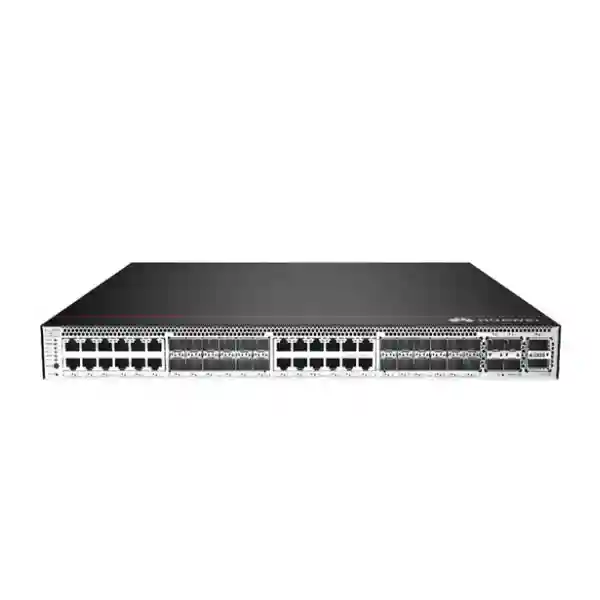
Huawei CloudEngine S5732-H48UM2CC UAE
The Huawei CloudEngine S5732-H48UM2CC is designed for organizations that have outgrown conventional Gigabit access switching and need a practical path to multi-gigabit edge connectivity, higher-power PoE, 25GE and 100GE uplinks, resilient power design, advanced campus control, and dense connectivity in a single rack unit. For Dubai and wider UAE projects, it fits especially well where wireless access points, high-resolution surveillance, rich-media endpoints, engineering workstations, edge servers, or bandwidth-intensive user groups are concentrated on the same floor or access block.
Why the S5732-H48UM2CC matters in a modern UAE campus
Many enterprise networks in the UAE are experiencing a mismatch between edge demand and traditional access-layer design. Wireless access points can aggregate multiple high-speed radios, video platforms produce sustained upstream traffic, high-resolution cameras add both bandwidth and PoE load, and collaboration rooms increasingly combine codecs, controllers, touch panels, displays, room sensors, and wireless presentation systems. At the same time, IT teams are expected to consolidate equipment, reduce rack footprint, preserve structured cabling investments, improve operational visibility, and maintain predictable performance during peak occupancy. The S5732-H48UM2CC addresses these requirements by bringing multi-rate copper, high-speed optical uplinks, high-power PoE support, and enterprise campus software into one access platform.
The biggest architectural advantage is not simply that a port can operate at 10 Gigabit Ethernet. It is that each copper access port can negotiate across 100M, 1G, 2.5G, 5G, and 10G rates, allowing mixed generations of endpoints to share the same switch without forcing an all-at-once migration. A floor can therefore retain conventional 1G endpoints while assigning 2.5G or 5G to wireless access points and 10G to selected workstations, local compute appliances, or specialized devices. This is valuable in real projects because refresh cycles rarely align perfectly. Cabling, endpoints, wireless, cameras, and switches are normally replaced at different times. A multi-rate edge gives architects more freedom to phase the upgrade according to operational priorities rather than a single hardware event.
For customers evaluating an enterprise access refresh, FourTeck can position this model as part of a broader switching, firewall, wireless, and services design rather than as an isolated box purchase. The FourTeck UAE portfolio can support the surrounding LAN and infrastructure scope, while the engineering decision should still start with endpoint count, access speed, PoE demand, uplink oversubscription, resiliency, software feature requirements, optics, and the exact Huawei BOM being quoted.
Multi-rate Base-T connectivity supports gradual migration from legacy access speeds to 2.5G, 5G, and 10G at the edge.
Fixed optical interfaces provide strong aggregation capacity for dense floors, wireless-heavy environments, and resilient dual-uplink designs.
High packet-forwarding performance is aligned with demanding enterprise access and compact aggregation roles.
The modular slot enables additional high-speed optical interfaces for designs that need more uplink or inter-switch flexibility.
48-port Multi-GE access: a flexible edge instead of a fixed-speed edge
The defining capability of the S5732-H48UM2CC is its 48-port Multi-GE copper interface bank. Each access interface is designed to support 100 Mbps, 1 Gbps, 2.5 Gbps, 5 Gbps, and 10 Gbps Ethernet rates. This matters because a real enterprise floor can contain a very wide performance range. Printers, controllers, building-management devices, badge systems, and conventional user endpoints may need only 100M or 1G. Wi-Fi 6 access points can benefit from 2.5G or 5G, and some high-density AP or specialist endpoint scenarios can justify 10G. The switch can host all of these classes while preserving one consistent access architecture.
For design teams, the value is in avoiding unnecessary overbuild. Providing 10G-capable switching does not mean every attached device must immediately run at 10G. Instead, the edge can be segmented according to actual demand. A project might begin with most ports operating at 1G, allocate a set of ports to 2.5G or 5G for access points, and reserve 10G for a small number of high-throughput devices. As application requirements grow, port rates can be increased where licensing, cabling, endpoint NIC capability, and the selected Huawei configuration permit. Huawei documentation notes that certain S5732-H configurations use right-to-use licenses in 12-port groups for higher Multi-GE rates, so the exact ordered BOM and license entitlement must be checked during quotation rather than assumed from the chassis name alone.
Cabling becomes an important part of that planning exercise. Multi-Gigabit Ethernet was created in part to provide higher speeds over installed twisted-pair cabling, but achievable rate and stability still depend on cable category, distance, patching quality, termination, electromagnetic environment, and the endpoint transceiver. A technically sound project therefore validates the horizontal cabling plant before promising a particular access rate. For new premium installations, designers often prefer a cabling specification that provides ample margin for the desired 10G use cases. For brownfield sites, testing representative links before mass deployment can uncover marginal channels, damaged patch panels, excessive bundling, or legacy components that would limit the expected speed.
This ability to mix speeds is especially relevant in hotels, schools, universities, hospitals, logistics facilities, airports, financial offices, large commercial towers, and government environments where endpoint generations are heterogeneous. It is also helpful for phased projects in which one building or floor is refreshed first while the rest of the campus remains on earlier access technology. The S5732-H48UM2CC can become the high-performance edge for the upgraded zone while still interfacing with existing 1G devices, allowing the organization to modernize without replacing every endpoint at once.
25GE and 100GE uplinks for an access layer that can actually breathe
High-speed access ports only deliver value when the upstream path has enough capacity. The S5732-H48UM2CC addresses this with fixed optical uplinks that include four SFP28 interfaces supporting 10GE/25GE and two QSFP28 interfaces supporting 40GE/100GE on current 90 W-oriented configurations. Earlier or alternate BOMs may expose slightly different supported rate combinations, so optics and port-mode verification should always be performed against the exact part number and software release. In practical architecture, these uplinks provide substantially more headroom than traditional 1G or 10G-only access switching and let the designer choose between capacity, resiliency, and link distribution.
A common enterprise design uses two high-speed uplinks from each access switch toward a pair of aggregation or core switches. Depending on the target topology, this can support link aggregation, device redundancy, loop-avoidance designs, or routed access. Another design may use 25G links for general access aggregation and preserve the 100G interfaces for stack-like interconnection, high-bandwidth aggregation, or future growth. The correct approach depends on expected northbound traffic, east-west traffic at the access layer, redundancy model, optic reach, fiber availability, failure-domain strategy, and whether routing occurs at the access, aggregation, or core layer.
Oversubscription should be calculated rather than guessed. Forty-eight 10G-capable access ports represent a very large theoretical edge bandwidth, but enterprise users rarely transmit at line rate simultaneously. Wireless APs are bursty, office endpoints are asymmetric, cameras can be sustained but predictable, and local services may generate traffic that does not all traverse the same uplink. A sensible design estimates busy-hour traffic by endpoint class and then selects a northbound architecture with enough margin for growth and failures. For example, if one uplink fails, the surviving path should still carry priority applications without unacceptable congestion. This makes resiliency calculations just as important as steady-state bandwidth.
Fiber engineering is part of the bill of materials, not an afterthought. The optics must match the required speed, wavelength, fiber type, connector type, reach, and peer interface. Patch panels and existing fiber should be inspected for cleanliness and loss budget, particularly where 25G or 100G services are introduced over older plant. Where breakout operation is used on supported QSFP interfaces, the project must also validate the breakout cable or transceiver type and supported port mode. FourTeck can incorporate these items into the network design so that the switch, transceivers, fiber, patching, and upstream interfaces are specified as a complete channel rather than as unrelated components.
PoE++ for high-power edge devices
The S5732-H48UM2CC supports PoE++ and is available in BOMs associated with different per-port power capabilities. Huawei documentation identifies 60 W variants and newer 90 W variants. That distinction matters for procurement because high-performance wireless access points, pan-tilt-zoom cameras, compact edge devices, displays, and other powered endpoints can have materially different peak power requirements.
The switch should therefore be sized from a PoE worksheet that lists every powered device, its standard, normal draw, maximum draw, quantity, and criticality. A designer should not simply multiply port count by the nominal per-port maximum. The installed power modules, redundancy policy, chassis consumption, expansion card, and desired reserve all influence the usable PoE budget.
1+1 power resilience
Huawei lists 1+1 power backup capability for the S5732-H48UM2CC. This is important in business-critical access designs because a switch can remain operational through a single power-module fault when the overall design is configured appropriately. For higher availability, each power input can be fed from separate rack PDUs or UPS-backed circuits where the site electrical design permits.
Power redundancy and PoE capacity must be evaluated together. A design that can deliver a large PoE budget with two supplies during normal operation may provide a smaller budget after a supply failure. Critical devices should remain within the surviving power envelope, and noncritical loads can be prioritized accordingly.
PoE engineering: budget the switch for failure conditions, not just normal conditions
A common mistake in PoE projects is to validate only the normal operating state. Consider a 48-port access switch serving wireless APs, cameras, door controllers, and room systems. Under normal conditions, two installed power modules may provide ample capacity. During a module failure or planned replacement, however, the remaining supply must support the chassis plus whatever powered-device load is considered essential. If the design assumes every endpoint can stay at maximum draw with only one power module, that requirement must be proven against the selected supply combination. If not, PoE priorities should be configured so that critical endpoints survive and lower-priority devices can be shed gracefully.
The available Huawei power choices include pluggable 600 W and 1000 W PoE modules, with AC and DC options depending on configuration. Current Huawei literature for the 48-port model lists maximum chassis power without powered devices and without an expansion card in the hundreds of watts, while a fully PoE-loaded system can exceed 2 kW depending on the selected BOM and PD load. For UAE installations, that has practical consequences for UPS sizing, branch-circuit planning, rack PDU rating, heat load, and generator-backed runtime. An access switch with dense PoE is not merely a low-power network appliance; it can become a meaningful electrical load when many high-power devices are attached.
A professional quotation should therefore capture three numbers separately: expected steady-state draw, worst-case draw, and required draw after a single power-module or feed failure. This distinction improves the accuracy of electrical and UPS planning and prevents the unrealistic assumption that nameplate maximum power equals typical consumption. It also creates a clear capacity reserve for future AP or camera additions.
Wireless-first campus design and native wireless control
The S5732-H series was developed for high-capacity campus access where wireless traffic is a primary design driver. Huawei positions the family for Wi-Fi 6-era networks and provides native wireless access-controller capabilities. The platform can manage a limited number of APs by default, with licenses available to scale management to as many as 1,024 APs in supported designs. That capability can be useful in distributed branches, smaller campuses, or converged wired-and-wireless architectures where the organization wants to reduce dependence on separate controller appliances.
The benefit is not simply fewer devices in the rack. A converged platform can help unify policy between wired and wireless users. Huawei documentation describes support for unified user management and authentication mechanisms such as 802.1X, MAC authentication, and portal authentication, with policy assignment that can include VLAN, QoS, and access-control behavior. In an enterprise environment, that means identity and endpoint context can play a larger role than the physical wall socket alone. A user moving between wired and wireless access can be governed by a consistent security model when the wider solution is designed and integrated correctly.
The physical access layer also needs to be ready for modern AP uplinks. A high-end AP can aggregate traffic from multiple radios and many concurrent clients, making a single 1G uplink an avoidable bottleneck. Multi-GE connectivity lets the switch use 2.5G, 5G, or 10G on the copper run where the AP and cabling support it. PoE++ can provide the power envelope required by feature-rich APs that might otherwise need a local adapter or reduced operating mode. Together, Multi-GE and PoE++ allow the access switch to support both the data and power requirements of high-capacity wireless without adding extra edge hardware.
For UAE customers planning a wireless refresh, switch sizing should therefore be coordinated with the radio design. The AP model, number of radios, channel width, expected client density, application mix, power mode, uplink PHY, and redundancy requirements all influence the LAN. Treating wireless and switching as separate purchases can create mismatches such as 5G-capable APs connected to 1G access ports or high-power APs constrained by an undersized PoE budget. A combined design avoids those bottlenecks before procurement.
Programmable forwarding and a platform built for evolving campus services
Huawei describes the S5732-H family as using a flexible high-speed processing architecture with programmable forwarding behavior. The practical value of this approach is service longevity. Traditional fixed-function forwarding silicon is optimized for a defined feature set, while a more programmable architecture can accommodate additional behaviors through software and microcode within the boundaries of the platform. For enterprise owners, this supports a longer strategic life for the switch because new campus requirements do not necessarily force an immediate hardware replacement.
That does not mean every future feature is guaranteed. Software release, licensing, hardware revision, resource limits, and Huawei support policy always matter. The correct procurement method is to define the required feature set first, identify the minimum VRP release and entitlement for those features, and then confirm compatibility against the exact chassis and part number. This avoids a frequent enterprise-networking mistake: selecting hardware from headline specifications and discovering later that a required protocol, scale, or automation feature needs a particular software package or license.
For organizations standardizing on Huawei campus infrastructure, a consistent VRP operating environment can also simplify operational processes. Engineers can standardize configuration templates, authentication, routing policy, monitoring, logs, upgrade procedures, and change-management practices across related switch families. In multi-site UAE deployments, that consistency can reduce operational variance between branches while still allowing each site to use a hardware model appropriate for its port density and uplink requirements.
Layer 2 resiliency, routed access, and scalable campus topology
An enterprise switch is valuable only when it participates cleanly in the chosen topology. The S5732-H family supports conventional Ethernet control mechanisms including STP, RSTP, and MSTP, and Huawei documents support for Smart Ethernet Protection and Ethernet Ring Protection Switching. These capabilities make the platform suitable for a range of access, aggregation, and ring designs. In buildings where the access layer is dual-homed to aggregation switches, the network can use a redundancy architecture that matches the existing standard and operational skill set. In industrial or campus ring scenarios, fast protection mechanisms can provide predictable recovery when a link is cut.
The platform also supports Virtual Router Redundancy Protocol and Layer 3 capabilities that allow architects to place the routing boundary according to the larger campus design. Some organizations prefer Layer 2 access with routing centralized at distribution. Others use routed access to reduce spanning-tree domains, localize failure, and create more deterministic paths. The S5732-H48UM2CC has the performance and uplink flexibility to participate in either approach when the required software features and scale are validated.
Huawei also documents MPLS and VPN-related capabilities in the S5732-H family. That can be relevant for advanced enterprise, managed-service, or metro-access use cases, but it should not be treated as a reason to overcomplicate a conventional office LAN. The architecture should follow business requirements. If a customer needs simple VLAN segmentation, redundant gateways, and secure access, the design should remain straightforward. If the customer has multi-tenant segmentation, carrier-style access, virtual networks, or specialized WAN integration, the richer feature set can be evaluated as part of the solution.
The most important principle is to document the failure model. What happens if one access uplink fails? What happens if an aggregation switch fails? Does traffic reconverge without loops? Is voice or real-time traffic preserved during convergence? Are downstream PoE endpoints still powered if one PSU feed fails? These questions turn a feature list into an engineering design and should be answered before the equipment is ordered.
Security at the access edge
Huawei documents 802.1X, MAC, portal, and hybrid authentication options for the S5732-H series, along with policy delivery and access-control capabilities. These functions help an organization treat the access switch as a security enforcement point rather than a passive port concentrator.
Controls for DHCP-related abuse, spoofing, denial-of-service patterns, address binding, port security, and management-plane protection can complement the upstream firewall. The access layer should block or contain local threats where practical, while perimeter and data-center firewalls enforce broader application and zone policy.
Security architecture beyond the switch
A secure campus design needs coordinated switching, NAC or identity services, wireless policy, DNS and DHCP hygiene, endpoint security, segmentation, firewalling, and centralized logging. Customers building that broader stack can review FourTeck Firewall Dubai for security-platform planning around the LAN.
The S5732-H48UM2CC can then enforce access policy close to the user while the firewall controls inter-zone, internet, remote-access, and application traffic. This layered model reduces the chance that one control point becomes the entire security strategy.
Operations, telemetry, fault isolation, and service assurance
Dense enterprise access networks are operationally expensive when troubleshooting depends on manual port-by-port checks. Huawei positions the S5732-H series with telemetry and intelligent operations features designed to provide higher visibility into network behavior. The platform can export real-time device data for analysis by Huawei campus management and analytics systems, helping operations teams identify abnormal behavior and user-experience problems faster than they could with periodic polling alone.
Huawei also documents iPCA, a technology intended to measure packet loss and service quality using actual traffic rather than relying only on synthetic test streams. For critical services, the ability to correlate performance with a specific path can reduce mean time to isolate faults. TWAMP support provides another standards-based mechanism for measuring IP-link performance. These capabilities are particularly relevant in large UAE campuses where application complaints may cross multiple switches, uplinks, WAN circuits, or wireless segments.
Operational design should still begin with fundamentals. Each switch needs a consistent hostname, management IP, NTP, DNS, AAA, logging destination, SNMP or telemetry policy, configuration backup process, software lifecycle plan, and clear rack documentation. Interface descriptions should identify the connected endpoint or patch-panel position. Uplink ports should be labeled physically and logically. PoE-critical devices should have priority documented. Baseline CPU, memory, temperature, fan, power, error-counter, optical-level, and utilization metrics should be captured after handover so that future incidents can be compared with a known-good state.
For customers that need implementation, migration, monitoring, troubleshooting, or broader infrastructure assistance, FourTeck IT Services UAE can be incorporated into the project scope. The objective should be an operationally complete deployment rather than simply a powered-on switch.
Physical design: 1U density, rack depth, airflow, power, and thermal planning
The S5732-H48UM2CC is a 1U switch with a chassis dimension around 43.6 mm high, 442 mm wide, and 420 mm deep before allowing for protruding connectors and module handles. That makes it suitable for standard enterprise racks, but the engineering drawing should consider more than the nominal chassis depth. Space is required for rear power modules, cable bend radius, front patch cords, fiber management, and airflow. A shallow wall cabinet designed for small switches may not be appropriate for a full-featured Multi-GE PoE platform once cabling is included.
Thermal planning is equally important. A densely loaded PoE access switch can consume significantly more power than a conventional non-PoE Gigabit switch, and most of that electrical input eventually becomes heat within the room or powers attached devices elsewhere. UAE equipment rooms can experience high ambient temperatures if HVAC capacity, airflow containment, or maintenance is inadequate. The switch should be deployed within Huawei’s environmental specifications, with unobstructed intake and exhaust paths and enough rack-room cooling for worst-case seasonal conditions.
Power feeds should be coordinated with the redundancy objective. If two PSUs are installed but both connect to the same single PDU, breaker, UPS output, or upstream circuit, the power-module redundancy does not protect against that shared failure. Where business continuity justifies it, the two inputs can be distributed across independent PDUs or feeds. The UPS should be sized for the switch plus PoE load and the required runtime, using realistic steady-state and worst-case figures. For generator-backed facilities, the design should consider transfer time and UPS autonomy so attached phones, APs, cameras, and access-control devices do not reset during a power transition.
Cable organization also affects maintainability. Forty-eight copper patch cords, high-speed fibers, console or management connections, and dual power feeds can quickly create a dense rack front and rear. Horizontal managers, properly sized patch cords, clear labels, protected fiber routing, and a documented port map reduce accidental disconnection during maintenance. This is especially important when the switch supplies power to critical devices because unplugging a single patch cord can remove both network and electrical service from the endpoint.
Expansion slot strategy: when the fixed uplinks are not enough
The chassis includes one extended slot. Huawei documentation lists compatible high-speed interface cards that can add combinations such as multiple 10GE or 25GE optical interfaces and, depending on supported card and software combination, higher-speed QSFP connectivity. This slot is useful when a project needs additional uplinks, inter-switch connectivity, specialized aggregation paths, or a future growth option beyond the fixed front-panel interfaces.
The expansion slot should not automatically be populated. If the fixed four 25GE and two 100GE-class uplinks meet the design requirement, leaving the slot available can preserve future flexibility and reduce cost, power, and complexity. If the switch is expected to aggregate additional edge switches, connect multiple server or appliance links, or use diverse upstream paths, an expansion card can be justified. The required card should be selected only after validating interface type, software support, optics, lane breakout behavior, power draw, and the physical peer ports.
This modularity is particularly helpful in projects where final fiber topology is not fixed at the initial purchase stage. The base switch can be standardized across sites while the expansion card varies by building role. One site may use only fixed uplinks; another may add 25G density; a third may require additional 100G-style connectivity. Standardizing the chassis while varying the interface module can simplify sparing and operations without forcing every site into the highest-cost configuration.
Software, licensing, and BOM control: the part number matters
Enterprise switch procurement should always distinguish between the model family name and the exact bill-of-material identifier. Huawei has released multiple S5732-H48UM2CC part-number variants with differences that can affect PoE characteristics, uplink rate combinations, and device switching capacity. Current Huawei material lists 90 W PoE++ variants with 1.96 Tbps device switching capability, while other documented variants list 60 W PoE++ and 1.76 Tbps device capability. The system switching capability is listed separately. That is why a quotation should identify the full Huawei part number, not only S5732-H48UM2CC.
Port-rate licensing is another important procurement item. Huawei documentation notes RTU licensing in 12-port groups for upgrades from baseline Gigabit operation to higher Multi-GE speeds on applicable configurations. Bundles may be offered with different rate entitlements. A 5G-oriented bundle, for example, may differ from a 10G-oriented bundle even though the physical switch chassis is the same. The project team should state how many access ports require 2.5G, 5G, and 10G at day one and how many should be licensed for future growth. This prevents both under-licensing, which blocks the intended design, and unnecessary licensing, which increases cost without operational benefit.
Wireless-controller scaling can also involve licenses. Huawei documentation states that a base number of APs can be managed by default and additional licenses can expand that capacity, subject to software version and design. If the switch is only providing Ethernet and PoE to APs while a separate controller or cloud platform handles wireless management, those controller licenses may not be needed on the switch. The intended control plane should therefore be decided before the license bill is built.
Finally, software support must be aligned with the selected hardware and feature set. Customers should define the required routing, security, automation, wireless, stacking or virtualization, telemetry, and management capabilities, then validate the minimum supported VRP release. Upgrade planning should consider maintenance windows, configuration compatibility, image storage, rollback, redundancy, and vendor-recommended software. A switch with strong hardware can still become an operational problem if software and licensing are treated as last-minute details.
Sizing methodology for Dubai and UAE enterprise deployments
Selecting the S5732-H48UM2CC should start with an endpoint matrix rather than with a desired brand or port count. List every device expected on the switch: users, access points, cameras, phones, room systems, printers, building controls, servers, appliances, and spare ports. Record the required access speed, PoE class or maximum wattage, VLAN or security zone, and availability requirement for each. This immediately reveals whether a 48-port Multi-GE platform is appropriate and how many ports must be licensed above 1G.
Next, estimate traffic. Wireless AP uplinks may require several gigabits under peak density, while ordinary office endpoints often average far less. Cameras produce sustained streams, but their bitrate can be predicted from codec, resolution, frame rate, and scene complexity. Engineering and media workstations may produce large bursts. Local servers or edge appliances can generate east-west traffic. Summing only theoretical interface speeds will massively overstate real demand; summing only average utilization may understate peak demand. The design should instead use realistic busy-hour assumptions with growth and failure margin.
Then size uplinks. Decide whether the switch connects to one or two aggregation devices, whether the links are 25G, 40G, or 100G, and whether traffic can spread across multiple active links. Verify that the surviving uplink path during failure can support priority services. Consider whether local traffic between devices on the same access switch needs to traverse the upstream network due to firewalling or segmentation. A heavily segmented design may push more traffic northbound than a simple local VLAN design.
After bandwidth comes PoE. Sum expected and maximum power per device, apply a growth factor, decide which devices are critical, and calculate the required budget in both normal and single-PSU states. Validate the rack circuits and UPS. If a switch can theoretically power more high-wattage endpoints than the available electrical infrastructure can support, the electrical limit becomes the real design constraint.
Finally, validate cabling and optics. Copper channels must be suitable for the required Multi-GE rate, and fiber paths must support the intended 25G/100G reach and loss budget. Once these steps are complete, the exact switch BOM, power supplies, licenses, expansion card, optics, patch cords, support, and services can be quoted with much lower risk.
Deployment patterns where the S5732-H48UM2CC fits especially well
High-density Wi-Fi floors
Office towers, campuses, universities, hotels, malls, and public venues with many high-performance APs can use Multi-GE ports for AP uplinks while PoE++ supplies endpoint power. High-speed optical uplinks reduce the chance that the access layer becomes the bottleneck.
Video surveillance aggregation
A mixed camera environment can combine standard PoE cameras, high-resolution models, PTZ units, analytics appliances, and local edge devices. The switch provides dense powered access with uplink capacity appropriate for concentrated video traffic when the PoE budget is engineered correctly.
Premium enterprise user access
Design studios, engineering teams, media users, research labs, and power users can receive higher-speed wired access without moving the entire floor to fiber-to-the-desk. Standard devices can remain at 1G while selected users operate at 2.5G, 5G, or 10G.
Branch core or compact aggregation
In smaller sites, the combination of high-density access, Layer 3 capabilities, resilient power, and fast uplinks can allow the model to perform a compact core or branch aggregation role when scale and software requirements are within platform limits.
Hospitality and smart building networks
Access points, IP phones, room systems, sensors, cameras, IPTV-related equipment, access control, and administrative endpoints can coexist on one switching platform with segmentation, QoS, identity controls, and PoE planning matched to the building design.
Education and healthcare access
Schools, universities, clinics, and hospitals often combine dense Wi-Fi, cameras, collaboration devices, specialized endpoints, and strict segmentation. The switch provides the port and uplink capacity needed to consolidate these services while preserving room for growth.
Migration from 1G access switching: a controlled path instead of a forklift replacement
One of the best uses of a Multi-GE switch is a phased access-layer migration. An organization may have hundreds or thousands of existing 1G ports and only a subset of endpoints that currently require more bandwidth. Replacing every access switch and every endpoint simultaneously is rarely necessary. The S5732-H48UM2CC can be introduced first in high-demand floors, wireless-heavy zones, or new buildings while legacy switching remains elsewhere. Because the ports support 1G alongside higher rates, many existing endpoints can move to the new switch without changing their NICs.
A good migration plan begins with a configuration audit. Export VLANs, trunks, spanning-tree settings, link aggregations, routing, DHCP relay, access controls, authentication, voice settings, QoS, SNMP, logging, NTP, management access, port descriptions, and any specialized features from the existing switch. Do not blindly copy syntax between vendors or software generations. Translate the intended behavior into a clean target configuration, test it in a lab or staging window, and document rollback procedures.
The physical cutover can then be organized by patch-panel range or service group. Critical phones, access points, cameras, and access-control systems should be moved in a controlled sequence and verified immediately. Uplink redundancy should be established before moving large numbers of edge ports. Where 802.1X or NAC is used, test representative endpoint classes in advance because authentication failures can affect a large population even when the Ethernet link itself is healthy.
After migration, confirm negotiated speed, duplex, PoE status, interface errors, VLAN assignment, authentication state, gateway reachability, DNS, application access, monitoring, logs, and expected redundancy. Capture a post-change baseline and update rack diagrams and port maps. The technical objective is not simply to replace a switch; it is to complete the migration with a known operational state and clear documentation.
QoS and application-aware capacity planning
As access speeds rise, Quality of Service remains important because congestion can still occur at uplinks, WAN edges, firewalls, or service-provider circuits. Huawei documents queue scheduling and congestion-control capabilities on the S5732-H family. These can be used to maintain service differentiation between voice, interactive video, critical business applications, management traffic, best-effort user traffic, and lower-priority bulk transfers.
QoS should be designed end to end. Marking traffic on the access switch provides little value if upstream devices ignore or rewrite the markings unpredictably. The project should define a small, understandable class model, trusted marking boundaries, queue behavior, policing or shaping where appropriate, and consistent treatment across switches, firewalls, WAN routers, and wireless systems. Voice and real-time video normally require low latency and jitter, while backups and software distribution can tolerate delay if they receive sufficient throughput over time.
Multi-GE ports can also change traffic patterns. A workstation that previously copied data at 1G may suddenly generate several gigabits when moved to a 5G or 10G access link. If many such endpoints share a 25G uplink, a previously invisible application can become a significant source of congestion. That is not a failure of the switch; it is a normal consequence of removing an edge bottleneck. Capacity planning should therefore include the possibility that faster access reveals bottlenecks further upstream.
Monitoring helps validate the policy. Track interface utilization, queue drops, error counters, burst behavior, and application complaints during peak business periods. If a link consistently operates near capacity or critical queues drop packets, increase uplink capacity or tune the traffic policy based on evidence. The S5732-H48UM2CC provides substantial access and uplink headroom, but disciplined QoS and monitoring are what turn that raw capacity into predictable user experience.
UAE procurement considerations: what should be included in a complete quote
A useful enterprise quotation for the Huawei CloudEngine S5732-H48UM2CC should identify more than one chassis line item. At minimum, it should specify the exact Huawei part number, number and type of power modules, required power cords, software or service entitlement, Multi-GE RTU licensing where applicable, wireless-controller licensing if required, expansion card if used, optical transceivers, breakout assemblies where used, fiber patch cords, rack accessories, and support coverage. If the project includes deployment, the scope should also identify configuration, migration, testing, documentation, and handover responsibilities.
Availability and lead time should be validated against the exact BOM because different part-number variants can have different stock positions. A customer should not approve a quote on the assumption that all units labeled S5732-H48UM2CC are functionally identical. PoE capability, bundled licenses, power modules, and uplink characteristics need to match the design. Serial-number and support-entitlement processes should also be clear so the customer knows how warranty and software support will be handled after delivery.
Regional projects may also involve centralized procurement for multiple countries. FourTeck can support solution planning from the UAE while coordinating broader regional requirements. Customers with projects extending beyond the Gulf can review the FourTeck Africa presence for related infrastructure requirements, while each shipment, support plan, and local compliance obligation should be validated for its destination country.
For local Dubai and UAE deployment, it is also sensible to include spare optics, at least one compatible spare power module for critical estates, labeling, documentation, and a software standardization plan. The cost of these items is small compared with the operational impact of an urgent failure when the required optic or PSU is not immediately available.
Technical specification interpretation
| Item | Huawei CloudEngine S5732-H48UM2CC planning note |
|---|---|
| Access ports | 48 × 100M/1G/2.5G/5G/10G Base-T. Confirm the required RTU rate entitlement for the chosen bundle and number of higher-speed ports. |
| Fixed optical uplinks | Current high-power configurations document 4 × 10/25GE SFP28 and 2 × 40/100GE QSFP28. Validate exact rate support against the part number. |
| Forwarding performance | 490 Mpps, providing high packet-processing capability for dense enterprise access and compact aggregation roles. |
| Switching capacity | Huawei material lists 1.96 Tbps device capability / 2.4 Tbps system capability for newer 90 W variants; other BOMs list 1.76 Tbps / 2.4 Tbps. Quote the exact SKU. |
| PoE | PoE++ supported. Huawei has documented 60 W and 90 W model variants. Engineer the total PoE budget using selected PSUs and failure-state requirements. |
| Expansion | One extended slot supports compatible high-speed optical interface cards. Select only after uplink and interconnect requirements are known. |
| Power architecture | Pluggable power modules with 1+1 backup capability. Separate feeds or PDUs can improve resilience when supported by site electrical design. |
| Chassis | 1U; approximately 43.6 × 442 × 420 mm basic chassis dimensions. Allow extra clearance for connectors, module handles, bend radius, and airflow. |
| Wireless control | Native AC capability with licensing-based scale. Use only if it matches the wireless control architecture. |
| Operations | Telemetry, iPCA, TWAMP, authentication, QoS, resiliency, and broader campus features are available subject to software version and entitlement. |
Operational hardening checklist after installation
Once the switch is physically installed and connectivity is established, the deployment should move through a structured hardening and acceptance process. Management access should be restricted to authorized networks and protected with secure protocols. Administrative authentication should integrate with centralized AAA where appropriate. Default or unused accounts should be reviewed, password and key policies enforced, and remote management exposure minimized. Time synchronization should be configured before relying on logs because accurate timestamps are essential during incident analysis.
At the access layer, unused ports should be administratively disabled or placed in a controlled state. Port security, authentication, DHCP protections, anti-spoofing controls, storm control, loop protection, and BPDU-related protections should be applied according to the endpoint type and network standard. Trunk ports should allow only required VLANs. Native or untagged behavior should be explicit. Voice and AP ports may need different policy from ordinary user ports, and camera or building-control networks should normally be segmented from general user traffic.
Monitoring should be configured before handover. Interface utilization, PoE status, temperature, fan state, power-module state, optical metrics, authentication failures, link changes, and critical system events should reach the organization’s monitoring or logging platform. Alert thresholds should be practical: too many low-value alerts cause operators to ignore important events, while no alerts turn the network into a black box. Backup the approved configuration and record the software version, serial numbers, licenses, and support entitlement.
The acceptance test should include physical redundancy, not just ping tests. Where dual uplinks are used, fail one and measure recovery. Where redundant power is used, remove one feed in a controlled maintenance window and verify that the switch remains stable and critical PoE devices stay powered. Confirm that monitoring receives the failure events. These tests prove that the deployed topology behaves the way the design intended.
Capacity planning example for a 48-port high-density floor
Consider a hypothetical office floor with 16 high-performance wireless access points, 12 IP cameras, 12 user or collaboration endpoints, four high-speed engineering workstations, and four spare ports. The wireless APs may be assigned 2.5G or 5G access depending on radio capability and cabling. Cameras may remain at 1G because their actual stream rates are much lower than line speed. Collaboration endpoints may use 1G, while the engineering workstations could operate at 5G or 10G if the applications justify it. This mixed profile is exactly where Multi-GE access provides value: the switch can allocate capacity to the devices that need it without requiring every port to run at the same rate.
The next step is northbound bandwidth. If peak aggregate floor traffic is estimated at 12 to 18 Gbps under normal conditions, dual 25G uplinks may provide comfortable headroom and resilience, provided the design confirms that one 25G path can carry priority traffic during a failure. If the floor hosts data-intensive local workloads or traffic is expected to grow sharply, 100G uplink options can provide additional margin. The point is not to select the highest available speed automatically; it is to match capacity to measurable demand and failure requirements.
PoE is calculated separately. Suppose the APs have a 35 W planning value and cameras average 18 W with some higher-power units. Add collaboration devices and a growth reserve, then compare that figure with the usable budget of the selected power modules. Repeat the calculation with one PSU unavailable. If the surviving state cannot support all devices, define which ports have priority. Critical wireless, access-control, voice, or security endpoints may receive higher PoE priority than convenience devices.
Finally, validate the rack. The switch, dual power modules, high-speed optics, patch panels, cable managers, and UPS-backed PDU must fit physically and electrically. Cooling should be adequate for the switch and surrounding devices. This example demonstrates why a product page specification is only the starting point; production deployment requires translating the hardware into an end-to-end design.
Comparing design choices: when this model is appropriate and when another switch may be better
The S5732-H48UM2CC is most compelling when a meaningful portion of the access edge benefits from speeds above 1G, when high-power PoE is required, when 25G or 100G uplink capacity is useful, or when the organization wants Huawei’s richer campus features in a dense 1U form factor. If a site has only basic 1G desktops and low-power phones with modest uplink demand, a simpler Gigabit access switch may be more economical. Selecting a premium Multi-GE platform for a low-demand closet can create unnecessary capital and power cost.
Conversely, a site that needs more than 48 high-speed access ports, large modular chassis redundancy, very large route scale, or data-center-specific features may need a different platform. The S5732-H48UM2CC is a high-performance campus switch, not a universal replacement for every network layer. Its best role is defined by port density, endpoint type, failure domain, performance target, software requirement, and operational model.
This distinction is especially important in tenders where specifications can drift toward the highest available numbers without linking them to applications. A good design justifies each requirement. If 100G uplinks are specified, the expected traffic and upstream port availability should support that choice. If 90 W PoE is required, identify the powered devices that need it. If 10G copper is required on all ports, validate cabling and endpoint capability. If native wireless control is required, define the number of APs, licensing, and management architecture.
By grounding the bill of materials in real demand, customers avoid both under-sizing and unnecessary over-engineering. FourTeck can assist with this requirements-to-BOM process so that the ordered S5732-H48UM2CC configuration matches the intended UAE deployment instead of relying on generic model descriptions.
Decision recap: what the S5732-H48UM2CC brings to the project
Dense, adaptable access
Forty-eight copper interfaces supporting 100M through 10G let one switch serve legacy endpoints, Multi-GE APs, cameras, collaboration systems, and selected high-throughput users.
Strong uplink options
25GE and 100GE-class optical interfaces provide the headroom to aggregate a high-performance floor without forcing all traffic through legacy 10G uplinks.
High-power PoE
PoE++ support allows the switch to power modern APs, surveillance, and other edge devices, provided the chosen BOM and power modules are engineered for the required budget.
Enterprise campus software
Huawei VRP features support authentication, resiliency, routing, QoS, telemetry, intelligent operations, and integrated wireless capabilities in supported software and license combinations.
Quotation input checklist
To receive an accurate project quotation instead of a generic chassis price, provide the information below. These inputs determine the exact Huawei BOM, power configuration, licenses, optics, and engineering scope.
Number of switches, buildings, branches, floors, and telecom rooms.
How many ports need 1G, 2.5G, 5G, and 10G on day one and in the next three to five years.
AP, camera, phone, room-system, display, or other PD models with maximum power requirements.
Required 25G/40G/100G speeds, fiber type, distance, aggregation-switch model, and redundancy method.
Routing, authentication, NAC, wireless control, telemetry, MPLS/VPN, QoS, or specialized campus requirements.
Supply only, configuration, migration, rack installation, testing, documentation, handover, support term, and spare strategy.
FourTeck consultation for Huawei CloudEngine S5732-H48UM2CC UAE projects
A successful S5732-H48UM2CC deployment depends on the details around the switch: exact part-number selection, Multi-GE licensing, PoE budget, redundant power, 25G/100G optics, cabling validation, uplink architecture, software release, access security, monitoring, migration, and documentation. FourTeck can structure the requirement into a practical BOM and implementation plan for Dubai and wider UAE environments.
For the fastest technical review, send the endpoint count, AP and camera models, expected high-speed port count, uplink distance, core or aggregation switch model, PoE requirements, number of sites, and whether installation or migration services are required. This allows the engineering team to distinguish the chassis requirement from the licenses, optics, power modules, and services needed to make the switch operational in the intended topology.

Reviews
There are no reviews yet.