
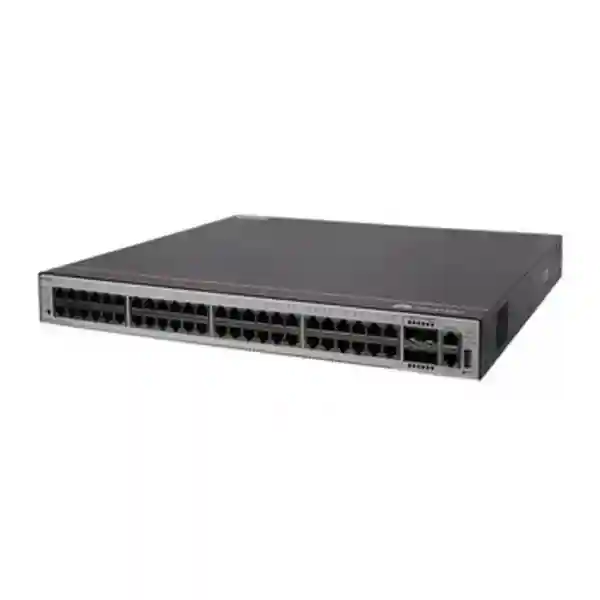
Huawei CloudEngine S5735-S48U4XE-V2
A high-density 48-port Gigabit PoE++ campus switch designed for demanding wired access, Wi-Fi, video surveillance, smart-building and enterprise edge deployments. The S5735-S48U4XE-V2 combines 48 copper access ports, four 10GE SFP+ uplinks, dedicated stacking, 90 W single-port PoE++ capability, advanced Layer 3 routing, strong access security and resilient hot-swappable power options in a compact 1U chassis.
Choose this model when a UAE site needs 48 Gigabit edge ports and unusually high PoE headroom without giving up four dedicated 10GE uplinks or separate stack interfaces.
What the S5735-S48U4XE-V2 is built to solve
Modern access networks in the UAE increasingly place more responsibility at the wiring-closet edge. A single floor switch may have to power Wi-Fi access points, multi-sensor cameras, IP phones, door controllers, digital signage, thin clients and other Ethernet-powered devices while simultaneously enforcing segmentation, maintaining routing adjacency, feeding telemetry to operations platforms and surviving a component failure without taking an entire floor offline. The Huawei CloudEngine S5735-S48U4XE-V2 is engineered for that kind of consolidated edge role. It provides 48 10/100/1000Base-T access interfaces, four 10GE SFP+ uplink interfaces and two dedicated 12GE stack interfaces. That port architecture is important because stacking does not have to consume the four 10GE uplinks, leaving the optical uplinks available for redundant links toward distribution or core switching.
The model sits within Huawei’s CloudEngine S5735-S-V2 family and targets enterprise campus access and aggregation use cases. Its 168 Mpps forwarding performance and published 224 Gbps device switching capacity, with a 520 Gbps system capability reference for the platform, are aligned with a full set of Gigabit edge interfaces and 10 Gigabit upstream connectivity. For design engineers, those numbers describe a switch intended to forward at high rates across all ports rather than a lightly featured unmanaged edge device. For operations teams, the more important distinction is that the platform combines switching, routing, access control, multicast, quality of service, telemetry and resilience features within one managed campus system.
For procurement teams in Dubai, Abu Dhabi, Sharjah and other UAE locations, the practical value is the ability to standardize dense edge cabinets around one switch model while scaling PoE capacity according to the installed power modules and endpoint mix. High-power PoE++ is especially relevant where newer wireless access points, PTZ cameras, video endpoints or building systems require substantially more than conventional 15.4 W or 30 W budgets. The S5735-S48U4XE-V2 can deliver up to 90 W on a single supported PoE++ port, while its total PoE budget depends on the selected power supply combination. A fully engineered deployment therefore treats the switch, power modules, optics, cabling, UPS capacity and endpoint load as one design rather than buying the chassis in isolation.
Core hardware specification at a glance
| Design item | S5735-S48U4XE-V2 engineering detail |
|---|---|
| Access ports | 48 × 10/100/1000Base-T Ethernet ports with PoE++ support |
| Uplinks | 4 × 10GE SFP+ optical uplink interfaces |
| Stacking | 2 × dedicated 12GE stack ports, preserving 10GE uplinks for network connectivity |
| Forwarding performance | 168 Mpps |
| Switching capacity | 224 Gbps device switching capability / 520 Gbps system capability reference |
| PoE capability | PoE++ with up to 90 W delivery on a single supported port; total budget depends on power configuration |
| Maximum documented PoE output | Up to 2,880 W PoE output in the documented three-1000 W AC full-power configuration |
| Power architecture | Three pluggable power positions supporting redundant operation; 600 W AC, 1000 W AC and 1000 W DC module options are documented for the model |
| Processor / memory | 1.1 GHz dual-core CPU and 2 GB RAM |
| Management interfaces | RJ45 console and USB 2.0 |
| Dimensions | 43.6 × 442 × 420 mm (H × W × D), 1U |
| Long-term operating range | −5°C to +50°C, with 5% to 95% non-condensing relative humidity and operating altitude up to 5,000 m |
48-port access architecture and 10GE uplink design
The front-panel architecture is straightforward for structured campus designs: forty-eight copper Gigabit Ethernet access ports terminate users and powered devices, while four SFP+ interfaces provide optical or direct-attach 10 Gigabit uplinks. In a conventional two-tier campus, two 10GE uplinks can be bundled or split toward redundant aggregation switches, leaving two more for additional redundancy, server-facing requirements or alternative topology choices. In a smaller collapsed-core branch, the same uplinks can connect directly to core or security infrastructure. The important design principle is to avoid treating four 10GE ports as a simple aggregate of 40 Gbps without considering traffic direction, LAG hashing, oversubscription and failure behavior. Each application mix has different burst patterns, and a practical design calculates upstream demand from wireless, cameras, client traffic and inter-VLAN routing expectations.
The two dedicated 12GE stack ports materially improve design flexibility. Some access switches require administrators to repurpose uplink interfaces for stacking, reducing the number of usable uplinks. Here, stacking has separate physical interfaces. That lets network teams form a logical stack while keeping all four 10GE SFP+ interfaces available for production uplinks. In high-density floors where one 48-port unit is insufficient, a stacked pair can present a more manageable operational construct, provide larger aggregate port density and simplify cross-member link design. The exact stack topology, software compatibility and member count should always be validated against the deployed Huawei software release and support documentation before commissioning.
Port-planning questions
Before ordering, count active edge devices, not wall outlets alone. Reserve ports for growth, temporary devices and service changes.
Decide whether all four SFP+ uplinks need optics, DACs, or a mix. Verify the far-end interface type and supported transceiver matrix.
If stacking is planned, include the correct stack cabling and rack positioning in the bill of materials rather than adding it after installation.
Map VLANs, Layer 3 gateways and uplink bundles before cutover so the physical design and logical design are aligned from day one.
PoE++ engineering: why the U model matters
The “U” model is differentiated by high-power Power over Ethernet capability. The switch supports PoE++ and Huawei documents up to 90 W power delivery on a single supported port. This is significantly more flexible than a switch limited to standard PoE or PoE+, because it can accommodate endpoint classes that may require high startup or sustained power. Typical candidates include high-performance Wi-Fi access points with multiple radios, pan-tilt-zoom cameras with heaters or illuminators, multi-sensor surveillance devices, advanced video collaboration systems, access-control assemblies, edge computing appliances and smart-building endpoints. A network designer still needs to verify each endpoint’s actual IEEE power class and vendor requirement; “up to 90 W” is a port capability, not a recommendation to allocate 90 W to every connected device.
Total PoE budget is the more important figure for a populated 48-port switch. Huawei’s published hardware data for the S5735-S48U4XE-V2 shows a full PoE configuration with up to 2,880 W available PoE power when three 1000 W AC power modules are used in the documented high-power configuration. That does not mean every site should install the maximum supply set. A typical enterprise floor with phones and mainstream access points may require far less. The right method is to create a device-by-device power schedule: identify each powered device, maximum requested power, expected steady-state draw, power class, redundancy requirement and growth allowance. Sum that demand, then select power modules that provide adequate PoE output and fault tolerance.
Power redundancy and PoE resilience must be designed together. If the switch has enough installed supply capacity to run all endpoints only while every power module is healthy, then the loss of one module may force PoE shedding even though the switch remains logically operational. In environments such as hospitals, hotels, airports, retail sites and surveillance-heavy campuses, engineers should define which endpoints must remain powered during a module or feed failure. Critical devices can then be separated from lower-priority loads, and the supply arrangement can be sized to maintain the required reserve. The three-module architecture provides flexibility for this purpose, but the exact redundancy behavior depends on the installed modules, input feeds and total powered load.
UAE deployments should also consider upstream electrical infrastructure. A high-power PoE switch can draw far more power under load than a conventional access switch. The rack PDU, branch circuit, UPS, generator plan, cable gauge, breaker sizing and thermal design must be matched to the actual configured power modules and realistic maximum load. A switch with a low typical electronics-only consumption can still become a multi-kilowatt load when it is delivering large amounts of PoE. This distinction is essential for data closets where the UPS and cooling system may have been originally sized for legacy 30 W PoE access switches.
Power-module selection and resilience planning
600 W AC option
Useful where the connected PoE population is moderate and the objective is lower installed power capacity. Engineers should calculate the available PoE budget for the chosen number of modules and verify that one-module failure still leaves the required critical endpoint capacity.
1000 W AC option
Designed for denser high-power deployments. Huawei’s documentation lists three 1000 W AC modules as the configuration associated with the maximum 2,880 W PoE output figure for this model under the documented full-load condition.
1000 W DC option
Supports facilities built around compatible −48 V DC infrastructure. DC designs require confirmation of feed polarity, protection, cable sizing, grounding, upstream rectification and site standards before deployment.
Mixed-feed strategy
The platform family supports resilient power arrangements, but a mixed-feed design should be documented carefully. The value comes from reducing common-mode failure, not simply filling every power bay. Feed diversity, UPS diversity and load reserve are the engineering priorities.
Huawei specifies rated AC ranges of 100–130 V AC and 200–240 V AC at 50/60 Hz for the applicable pluggable supplies, with a broad documented maximum range. For UAE commercial facilities, 220–240 V AC operation is generally the relevant design context, but the final electrical design must follow the actual building supply and local electrical requirements. The switch also supports high-voltage DC and −48 V DC module choices through the documented compatible power supplies. Power modules are hot-swappable, which is valuable in maintenance windows because a failed supply can be replaced without powering down the chassis when sufficient remaining capacity is available. Hot swap should not be confused with unlimited live service protection: before removing a module, confirm that remaining supplies can carry both the switch electronics and the live PoE load.
Switching capacity, forwarding rate and real-world oversubscription
The S5735-S48U4XE-V2 is specified at 168 Mpps forwarding performance and 224 Gbps device switching capacity, with Huawei also publishing a 520 Gbps system capability reference for the product family. These values should be interpreted alongside the actual port set. Forty-eight full-duplex 1 Gigabit access interfaces can theoretically generate substantial aggregate traffic, while four 10GE uplinks provide up to 40 Gbps of nominal one-direction uplink bandwidth before accounting for topology and protocol overhead. Campus networks are intentionally designed around statistical multiplexing because most edge clients do not transmit at line rate simultaneously. The goal is not to eliminate all oversubscription; it is to choose an oversubscription ratio that matches the applications.
A surveillance floor behaves differently from an office floor. Cameras create continuous upstream traffic, so uplink demand is relatively predictable and sustained. A user floor creates bursty traffic with long idle periods. Wi-Fi can create concentrated bursts when many users connect through a small number of high-capacity access points. A VoIP deployment has low bandwidth but strict latency, jitter and loss expectations. The S5735-S48U4XE-V2 provides the switching and QoS features needed to serve these patterns, but engineering still requires traffic modelling. When heavy east-west traffic is expected between VLANs, determine whether routing will occur on the access switch, an aggregation layer, a firewall or another gateway and size links accordingly.
For resilient uplinks, a common design uses link aggregation toward two upstream devices where the network architecture supports the required multi-chassis or stack behavior. The exact resiliency method should be selected according to the Huawei topology in use. Merely connecting multiple physical links without a valid loop-free or aggregated design can create a Layer 2 loop. The switch therefore combines uplink capacity with spanning-tree, Smart Link, ERPS, SEP and related loop-protection capabilities that can be used in the appropriate network architecture.
Layer 2 segmentation and campus control
At the access layer, predictable segmentation is often more important than raw throughput. The S5735-S-V2 software feature set supports up to 4K VLANs, with Huawei documenting up to 1K VLANIF interfaces simultaneously for the family. It supports common campus segmentation constructs including Voice VLAN, MUX VLAN, Sub-VLAN and Super-VLAN, along with QinQ, enhanced selective QinQ, VLAN stacking and VLAN mapping. These capabilities allow the switch to serve both conventional enterprise networks and more complex service-provider-style or multi-tenant edge designs. A simple office may only need separate user, voice, guest, IoT and management VLANs, while a hotel, campus landlord or managed service deployment may use additional tagging techniques to preserve tenant or service separation across shared infrastructure.
MAC control is also substantial. Huawei documents up to 32K MAC address entries for the series, with automatic learning and aging plus static, dynamic and blackhole entries. Interface-based MAC learning limits can reduce the risk of one port consuming excessive table resources or connecting unexpected downstream switching. Source-MAC filtering and sticky MAC options can contribute to a layered edge-security design. These controls are not substitutes for identity-based access policy, but they are useful operational guardrails, especially on fixed-function device ports such as cameras, printers, building controllers and point-of-sale terminals.
For voice deployments, LLDP and LLDP-MED support can simplify endpoint discovery and policy coordination. Voice VLAN features help segregate IP telephony traffic from general data traffic, while QoS classification and queueing can preserve call quality under congestion. The exact endpoint interoperability should be validated for the phone vendor and software release in use. FourTeck can integrate Huawei switching with wider voice and IT infrastructure through its UAE IT services practice, allowing VLAN, DHCP, authentication and uplink requirements to be designed as a complete service rather than a collection of unrelated switch settings.
Loop prevention, fast recovery and resilient Ethernet
Enterprise access networks need deliberate protection against accidental or topology-induced loops. The S5735-S-V2 feature set includes STP, RSTP and MSTP, allowing designers to use standard spanning-tree approaches for loop-free Layer 2 connectivity. Huawei also provides BPDU protection, root protection and loop protection. These features are valuable at the edge where a user can accidentally connect two wall ports through an unmanaged device, where a mispatched cable can create a loop in a cabinet, or where a downstream switch can begin participating in spanning tree unexpectedly. Proper edge-port templates, BPDU guard policies and root placement significantly reduce the blast radius of these events.
The platform also supports ERPS based on ITU-T G.8032, Smart Link and Huawei SEP mechanisms. These alternatives can be relevant for ring, industrial campus and service-provider-influenced topologies that require faster recovery than a basic spanning-tree design. The correct mechanism depends on the physical topology, interoperability target and operational skills of the customer. For example, a building ring connecting intermediate distribution points has different failure modes from a star topology where every floor connects directly to a central pair. The protocol should follow the topology, not the other way around.
Dedicated stacking further contributes to resiliency by allowing multiple switches to be managed as a coordinated system in supported designs. Stacking can simplify configuration consistency, link aggregation and operational management, but it also introduces shared control-plane considerations. The stack cabling, member priority, software version, upgrade process and failure testing should be documented before production. A resilient network is not proven when the second cable is installed; it is proven when power, uplink, member and software failure scenarios are tested and the observed convergence meets application requirements.
Layer 3 routing for access and aggregation roles
The S5735-S48U4XE-V2 is more than a Layer 2 access switch. Huawei lists static routing, RIPv1/v2, RIPng, OSPF, OSPFv3, IS-IS, IS-ISv6, BGP, BGP4+, ECMP, VRRP and VRRP6 across the S5735-S-V2 feature set, along with routing policy and policy-based routing functions. Huawei also documents up to 8,192 IPv4 FIB entries and thousands of IPv6 forwarding entries depending on the software specification. This makes the platform suitable for routed access, distribution-lite roles and branch aggregation designs where policy and scale requirements fall within the switch’s supported limits.
Routed access can reduce spanning-tree dependence by moving Layer 3 closer to users, but it changes how segmentation, first-hop redundancy, firewall inspection and troubleshooting are implemented. In a routed access design, engineers decide which VLANs terminate locally, how default routes are advertised, how dynamic routing areas or policies are structured and where security controls are enforced. OSPF is common in enterprise environments, while BGP may be used in more sophisticated campus, data-center-edge or managed-network designs. The presence of protocol support does not imply that every protocol should be enabled; a simpler routing design is generally easier to secure and operate.
VRRP and VRRP6 can provide first-hop redundancy when two Layer 3 devices share gateway responsibility. ECMP can distribute traffic across multiple equal-cost paths where the topology permits. Policy-based routing can direct selected traffic based on defined conditions rather than destination routing alone. These capabilities support advanced use cases, but each introduces operational dependencies that should be captured in the as-built documentation. Route filtering, authentication where supported, passive interfaces, summarization and failure-domain boundaries are as important as enabling the protocol itself.
For UAE customers using centralized firewalls, the access switch can also remain primarily Layer 2 while inter-VLAN gateways live on a security platform. This may simplify security inspection but can increase north-south traffic through the firewall. FourTeck’s Firewall Dubai engineering team can help determine whether routing should be performed on the Huawei access layer, a distribution switch or the firewall based on inspection requirements, throughput, segmentation policy and failure behavior.
IPv6 readiness without abandoning IPv4 operations
Huawei positions the S5735-S-V2 family with mature IPv6 capabilities, and that matters for organizations planning dual-stack operation, provider migrations or long-lived campus refreshes. The routing stack includes IPv6 variants such as OSPFv3, RIPng, IS-ISv6, BGP4+ and VRRP6. Neighbor Discovery, IPv6 troubleshooting functions and IPv6 multicast controls allow the switch to participate in a dual-stack design rather than treating IPv6 as a later overlay. For organizations that are still primarily IPv4, buying infrastructure with production-grade IPv6 support reduces the risk that a future transition becomes a hardware replacement project.
Dual-stack networks need security parity. It is a common mistake to build strong IPv4 ACLs and monitoring while leaving IPv6 comparatively open because it is considered unused. Endpoint operating systems may enable IPv6 by default, and unmanaged IPv6 paths can create blind spots. The campus design should define whether IPv6 is enabled, where router advertisements originate, how DHCPv6 or SLAAC is used, which IPv6 ACLs are enforced and how telemetry captures both protocol families. If IPv6 is intentionally disabled, that decision should also be explicit and validated at the edge.
Troubleshooting processes should include IPv6 from the start. Operations staff need documented gateway addresses, prefix plans, route tables, neighbor states and monitoring thresholds. When IPv4 and IPv6 follow different paths because of routing or DNS behavior, application symptoms can appear intermittent. A switch platform that supports both families provides the control plane tools, but successful deployment still depends on a coherent addressing and security policy.
Security controls at the access edge
A campus access switch is one of the first enforcement points for user and device connectivity. The S5735-S-V2 platform supports hierarchical user management, password protection, IEEE 802.1X authentication, AAA, RADIUS and HWTACACS integration, as well as NAC-related access functions. These capabilities enable identity-aware admission rather than relying only on physical port location. A wired user can be authenticated before receiving normal network access, and device-specific policies can be combined with VLAN assignment or other controls according to the surrounding authentication architecture.
The platform also supports port isolation, port security, sticky MAC and limits on learned MAC addresses. Binding of IP address, MAC address, port and VLAN information can help reduce spoofing and unauthorized movement. Huawei documents defenses against common DoS, ARP and ICMP attack patterns. DHCP snooping and related trust-boundary techniques can be used to limit rogue DHCP behavior and provide a stronger source-of-truth relationship between edge ports and assigned addresses. These functions are most effective when deployed through standardized port profiles rather than configured manually one interface at a time.
ACL capability allows filtering based on Layer 2 through Layer 4 fields such as MAC addresses, IP addresses, protocol type, VLAN information and TCP/UDP ports. Huawei’s S5735-S-V2 documentation describes hardware ACL resources that are shared across ingress and egress. Because hardware tables are finite, complex policy designs should be resource-tested rather than assuming every theoretical rule can be deployed at unlimited scale. The objective should be precise enforcement with manageable policy, not thousands of redundant ACL lines.
Management security is equally important. SSH should be preferred over insecure remote management methods, management interfaces should be restricted to dedicated networks, and AAA should use centralized authentication where practical. SNMP versions, community settings, NTP sources, logging destinations and configuration backup methods should be hardened consistently. A switch with strong endpoint security features can still be compromised operationally if its management plane is exposed or shared credentials are used across the estate.
QoS for voice, video, wireless and business applications
The switch provides eight queues per port and supports scheduling methods including strict priority and deficit round robin combinations. It can classify and remark traffic using 802.1p and DSCP values, police traffic, shape rates and redirect selected flows. These are practical tools when multiple application classes share the same access and uplink interfaces. Voice calls, interactive video, transactional systems, backups, guest internet traffic and camera streams can have very different latency and bandwidth characteristics. QoS allows the network to make deterministic decisions under congestion rather than dropping traffic indiscriminately.
A correct QoS design starts at the trust boundary. Network teams decide which endpoints are allowed to mark traffic and which markings must be rewritten. Managed IP phones may be trusted differently from general user PCs. Wireless controllers or access points may tunnel or remark traffic according to WLAN policy. Cameras often generate persistent upstream flows and may require bandwidth protection without receiving strict priority. The switch can enforce queueing and rate policies, but policy consistency across access, aggregation, firewall and WAN devices is required for end-to-end behavior.
Over-classification should be avoided. If too much traffic is placed in priority queues, priority loses meaning and can starve other applications. A practical enterprise profile usually defines a small number of classes with documented purposes and bandwidth expectations. During commissioning, engineers should generate representative traffic, observe queue counters and verify that important applications remain stable when uplinks are intentionally loaded. This turns QoS from a configuration checklist into a tested service-level mechanism.
Multicast for IPTV, surveillance and enterprise media
The S5735-S-V2 family supports IGMP versions 1, 2 and 3, IGMP snooping, MLD snooping for IPv6 and PIM modes for routed multicast. Multicast features are particularly relevant in hospitality, education, corporate media, IPTV and surveillance environments where the same stream may need to reach many receivers. Without appropriate snooping, multicast can behave like broadcast traffic inside a VLAN and consume bandwidth on ports that do not need the stream. IGMP snooping allows the switch to forward multicast traffic only toward interested receivers while preserving the efficiency advantage of multicast distribution.
For routed multicast, protocols such as PIM-SM and PIM-SSM can support scalable distribution across Layer 3 boundaries. These designs require careful planning of rendezvous points where applicable, source addressing, receiver behavior, VLAN boundaries and uplink capacity. In IPTV systems, channel-change behavior and fast-leave settings can materially affect user experience. In surveillance networks, multicast may be used for monitoring walls or analytics systems, but many camera architectures primarily use unicast. The switch should therefore be configured around the actual application architecture rather than enabling multicast features generically.
Multicast troubleshooting should include group membership, querier placement, VLAN scope and source reachability. A common failure is not a physical link problem but a missing or duplicated querier, an ACL blocking group control traffic, or a Layer 3 path that lacks the expected multicast routing state. Structured monitoring and change documentation make these issues much easier to isolate.
Telemetry and intelligent operations
Huawei emphasizes telemetry-based operations across the CloudEngine campus portfolio. The practical advantage of telemetry is higher-frequency, structured device data that can help operations platforms identify performance changes and faults more quickly than relying only on periodic polling. The S5735-S-V2 family can work with Huawei’s campus operations ecosystem, including iMaster NCE-CampusInsight in supported architectures, to improve visibility into device and user experience. This is useful in larger environments where manually logging into individual switches does not scale.
Telemetry does not eliminate conventional monitoring. SNMP, syslog, NTP, configuration backups, interface counters, LLDP topology, routing state and synthetic tests remain important. A mature operations design collects several signal types and sends them to systems that can correlate power, port, routing and application symptoms. For PoE-heavy deployments, monitoring should include not just interface up/down status but power allocation, remaining PoE capacity and endpoint behavior. A switch may have every data link up while a marginal power budget or failing supply creates endpoint resets.
Operational ownership should be decided before deployment. Define who receives alerts, which events are actionable, how configuration changes are approved, what the rollback process is and where backups are stored. Automation and telemetry produce the greatest benefit when they are part of an operating model rather than added after incidents begin. FourTeck can align the switch rollout with broader monitoring, server and infrastructure practices available through Server Dubai infrastructure services for customers building integrated branch, campus and data-room environments.
Thermal design, airflow and UAE equipment rooms
The S5735-S48U4XE-V2 uses active air-cooled heat dissipation with intelligent fan-speed adjustment and two fan modules. Huawei documents airflow entering from the left, front and right and exhausting to the rear. This airflow pattern must be respected when planning racks and cable management. Dense bundles pressed against side vents, obstructed cabinet doors or equipment installed with conflicting airflow can raise internal temperature even when the room thermostat looks acceptable. Cabinet depth is also important because the switch itself is 420 mm deep before allowing for power connectors, fiber bends, copper patch leads and rear clearance.
Huawei specifies long-term operation from −5°C to +50°C with non-condensing relative humidity from 5% to 95%, and an operating altitude up to 5,000 m. These are equipment limits, not target room conditions. UAE communications rooms should be maintained at stable, conservative temperatures with clean airflow, controlled humidity and appropriate filtration. Ambient heat during summer, especially in poorly conditioned utility rooms or rooftop areas, can reduce thermal margin. PoE-heavy switches also transfer significant power to endpoints and generate additional heat inside the cabinet through switch electronics and power-conversion losses.
At full documented PoE loading, the electrical system can operate in a multi-kilowatt range. HVAC planning should therefore consider the switch configuration and attached powered devices across the entire room, not just the typical 56.23 W electronics-only consumption figure published for the chassis under Huawei’s test conditions. The switch’s full-load input includes power passed through to remote PoE devices, so not all of that becomes heat inside the closet, but UPS and electrical capacity must still be sized for it. Thermal engineering should include other switches, firewalls, UPS losses, servers and environmental margins.
Dust management matters as much as temperature. Construction dust, open ceilings and unsealed utility spaces can contaminate fans and heat sinks, gradually reducing cooling performance. Keep network racks away from water sources, clean filters where present, maintain blanking and cable organization, and include periodic visual inspection in maintenance routines. These basic practices extend hardware reliability more effectively than waiting for fan alarms.
Use case: Wi-Fi access switching
High-density wireless is one of the clearest use cases for this switch. Enterprise access points increasingly combine multiple radios, USB peripherals, IoT functions and high transmit capacity. Some models can operate with a reduced feature set when powered below their preferred PoE class, while others may require high-power PoE to enable all radios. The S5735-S48U4XE-V2’s 90 W single-port capability provides generous power headroom for demanding access points, but bandwidth planning remains important because the copper interfaces are Gigabit Ethernet. If the selected wireless access points require 2.5GE or higher wired uplinks to reach full radio capacity, a multi-Gigabit switch from the Huawei portfolio may be more appropriate.
For Gigabit-connected access points, the model offers strong density and uplink flexibility. A 48-port switch can support a large AP population while four 10GE uplinks provide aggregation capacity toward the campus core. VLAN trunks, QoS, 802.1X, DHCP protection and telemetry can be integrated with the WLAN architecture. During design, calculate the number of access points per closet, expected client concurrency, uplink oversubscription and power draw. Reserve spare switch ports for growth and maintenance rather than designing every cabinet at exactly 100% port occupancy.
Wireless availability depends on more than switch redundancy. If every access point on a floor is connected to one switch, a switch maintenance event affects the entire floor even if upstream links are redundant. Critical environments may distribute APs across two access switches or stacks so adjacent coverage cells remain available during maintenance. The exact strategy should follow RF design, roaming behavior and business continuity requirements.
Use case: IP surveillance and smart-building networks
Surveillance networks often combine large port counts with continuous traffic and a demanding PoE budget. PTZ cameras, multisensor units, IR illuminators and environmental housings can draw substantially more power than fixed indoor cameras. The S5735-S48U4XE-V2’s PoE++ capability lets one access layer support a mixed camera population without forcing every high-power device onto separate injectors. Removing injectors reduces failure points and simplifies UPS protection because power is centralized in the network rack.
Traffic engineering is equally important. Unlike office clients, cameras can transmit sustained video around the clock. Forty-eight high-resolution streams can create significant aggregate uplink demand, especially when multiple recording servers, analytics platforms or monitoring stations consume parallel streams. Engineers should estimate average and peak bitrate per camera, codec behavior, frame rate, retention design and multicast or unicast viewing patterns. Four 10GE uplinks offer substantial headroom, but the uplink topology should be built from measured or vendor-specified video loads rather than a generic user-access oversubscription ratio.
Segmentation can isolate cameras from user networks while allowing controlled access to video management systems. ACLs can restrict cameras from initiating unnecessary traffic, DHCP snooping and port security can reduce unauthorized device substitution, and dedicated management networks can protect the switch control plane. QoS may be used to protect control and voice traffic if surveillance shares a common uplink with other services. In smart buildings, similar principles apply to access control, intercom, digital signage and building-management endpoints.
For physical-security projects, port mapping should be included in handover documentation. Each camera or controller should be associated with a switch, port, VLAN, IP allocation and power requirement. This turns the switch into a manageable operational asset rather than an anonymous patch-panel endpoint and reduces troubleshooting time when field devices fail.
Use case: hospitality, education, healthcare and retail
Hospitality properties need dense, converged edge switching because a guest floor or service zone may combine Wi-Fi, IP telephony, IPTV, cameras, access control, room systems and back-office terminals. The S5735-S48U4XE-V2 can power many of these systems from one rack while separating them into VLANs and applying QoS according to service priority. Hotels should pay particular attention to PoE redundancy because a switch that remains online after a power-module failure may still lose non-prioritized powered devices if reserve capacity is insufficient. Guest-facing services should therefore be grouped by criticality and tested under degraded power conditions.
Education campuses have similar density but different traffic cycles. Classroom Wi-Fi and interactive systems can create sharp peaks at lesson transitions, while CCTV and access control remain continuous. Routing, multicast and telemetry features can help larger campuses build consistent policies across multiple buildings. A standard 48-port platform can simplify spares and operating procedures, provided high-bandwidth labs or multi-gigabit wireless areas are identified separately.
Healthcare networks place greater emphasis on availability, segmentation and change control. A switch refresh should distinguish between general IT devices and systems that support clinical workflows. Redundant power, uplinks and stack members need documented failure testing, while NAC and authentication should be designed around devices that may not support interactive user login. PoE-powered nurse-call, location, surveillance or communication devices require accurate power classification and maintenance planning.
Retail environments often combine point-of-sale, cameras, Wi-Fi, signage and back-office systems in small communications rooms. Here the operational advantage is consolidation: one resilient switch can replace several lightly managed edge devices while providing centralized policy and monitoring. The network should still separate payment, corporate, guest and IoT traffic according to applicable security requirements.
Cabling, optics and rack integration
A switch purchase is only as successful as the passive infrastructure around it. The 48 copper Gigabit interfaces should be connected through certified structured cabling appropriate for the required Ethernet and PoE load. High-power PoE places more emphasis on conductor resistance, bundle heating, connector quality and installation practice. Existing cabling should be assessed before migrating high-power endpoints, particularly in older buildings where cable category, conductor material or termination workmanship may be uncertain. Permanent-link testing and documentation are preferable to discovering marginal links after devices are deployed.
The four SFP+ uplinks require compatible optical modules or direct-attach cables. Selection depends on distance, fiber type, patching architecture and far-end hardware. Short inter-rack links may use DAC where supported; building or campus links typically use optical transceivers matched to multimode or single-mode fiber. Never choose optics by connector shape alone. The wavelength, reach, fiber grade, supported module matrix and far-end compatibility need to match. Spare optics and clean fiber handling are also important operational considerations.
Rack planning must account for the 420 mm switch depth plus cable bend radius and power modules. Leave enough rear clearance to remove hot-swappable power supplies without disturbing neighboring equipment. Keep fiber paths protected from sharp bends and copper bundles away from blocking side airflow. A horizontal patching scheme should minimize cable crossings across fan vents and power bays. The 1U chassis makes dense installation possible, but density should not come at the expense of maintainability.
For broader UAE infrastructure sourcing, FourTeck’s main UAE technology portfolio can be used to coordinate switching, rack, power, server, security and structured-cabling requirements under one project scope. This is particularly useful when the network refresh is tied to a new office, branch relocation, hotel opening or data-room upgrade.
Management, commissioning and configuration standards
A production switch should enter service with a repeatable baseline. The commissioning template should define hostname and device identity, management VLAN or routed management interface, SSH settings, AAA, NTP, DNS where required, SNMP or telemetry destinations, syslog servers, configuration backup, spanning-tree mode, root policy, LLDP, port-security defaults, DHCP snooping trust boundaries and unused-port behavior. Uplink ports, user ports, AP ports, camera ports, phone ports and infrastructure ports should be defined as separate profiles with explicit settings rather than copied manually from old devices.
Firmware and software release selection should be deliberate. The preferred release is not automatically the newest available image; it should be a release supported for the required features, optics and management integrations, with an acceptable maintenance status. Before staging multiple switches, validate the chosen image on representative hardware and test startup, stack formation, PoE behavior, authentication, uplinks and monitoring. Record checksums and maintain a rollback image where appropriate.
Configuration backups should occur after commissioning and after controlled changes. Backups should be stored outside the switch and protected like other infrastructure credentials. An inventory should record serial numbers, switch location, rack unit, installed power modules, optics, software version, management address, stack role and support entitlement. This information dramatically shortens incident handling because teams do not need to discover the hardware state during an outage.
Handover testing should include more than ping. Verify PoE delivery to representative endpoints, uplink failover, power-module failover where safe, stack resilience, VLAN access, inter-VLAN policy, dynamic routing convergence, authentication, syslog, time synchronization and monitoring alarms. For critical environments, document observed recovery time and business impact for each failure test.
Sizing methodology for a 48-port PoE++ access switch
Sizing begins with endpoints, not the switch model. Create a schedule of every device expected in the closet during the design horizon. Include active user ports, access points, phones, cameras, door controllers, signage, IoT gateways and reserved capacity. Mark which devices require PoE and their maximum power request. Then identify which devices are business-critical during a single power-module failure. This produces three separate figures: port count, normal PoE demand and protected PoE demand. The switch must satisfy all three, with reasonable growth margin.
Next, model traffic. Estimate continuous traffic such as camera streams separately from bursty traffic such as users. Add wireless backhaul according to AP capabilities and expected client load. Determine whether local routing creates east-west traffic on the switch or whether most traffic traverses uplinks. From that model, select the number and speed of uplinks and decide whether link aggregation or multiple routed paths are appropriate. Four 10GE interfaces offer flexibility, but topology and redundancy may consume bandwidth differently than a simple four-link total suggests.
Then model failure states. What happens if one uplink fails? What happens if one aggregation device fails? What happens if one power module is removed? What happens if a stack member reboots? A design that works only in the all-components-healthy state is not redundant. The remaining capacity during each credible fault should still support the defined critical services. In PoE environments, this includes electrical power as well as packet forwarding.
Finally, validate environmental capacity. Check rack space, cabinet depth, PDU sockets, circuit load, UPS runtime, generator support, cooling, airflow, grounding and fiber availability. These constraints can change the preferred switch or power configuration even when the network specification fits perfectly. A complete quotation should therefore list the chassis, power modules, optics, stack cables, patching, support and any installation services required for a deployable solution.
How this model compares with adjacent design choices
The S5735-S48U4XE-V2 is most compelling when three requirements occur together: high 48-port copper density, high-power PoE and 10GE uplinks. If the deployment does not require PoE, a non-PoE model can reduce power-system cost. If devices only require conventional PoE+, the S48P variant may be sufficient. If access points need 2.5GE Ethernet to avoid a Gigabit bottleneck, a multi-Gigabit model should be considered instead. Product selection should therefore follow endpoint bandwidth and power requirements rather than assuming the highest-power model is automatically the best fit.
A second decision is access versus aggregation. The switch supports advanced Layer 3 features and can aggregate smaller edge segments, but its port mix remains optimized around Gigabit copper access and 10GE uplinks. If the aggregation layer requires many 25GE, 40GE or 100GE links, larger routing tables or more intensive virtualization capabilities, a higher-tier CloudEngine platform is likely more suitable. Using the S5735-S48U4XE-V2 where it fits and a stronger aggregation platform upstream creates a balanced hierarchy.
A third decision is chassis resilience versus network resilience. Three power-module positions improve power availability, but they do not protect against every failure. A complete availability design may use two switches or a stack, dual upstream paths, diverse power feeds and distributed critical endpoints. The business requirement determines how many layers of redundancy are justified. A standard office may accept a single switch with redundant power; a mission-critical site may need dual switching paths all the way to the endpoint or adjacent coverage redundancy.
FourTeck can provide product and architecture guidance across local and regional projects through its global FourTeck technology platform, helping multinational customers standardize specifications while adapting power, cabling, support and logistics to UAE site conditions.
Procurement and lifecycle planning in the UAE
Enterprise switching procurement should verify the exact model suffix, regional part number, software entitlement, power modules and included accessories. “S5735-S48U4XE-V2” identifies the switch model, but a complete order may require separately selected power supplies, optical transceivers, stack components and support services. Before issuing a purchase order, match the bill of materials to the intended deployment drawing. This avoids receiving a chassis that cannot be commissioned because the required high-power modules or optics were treated as optional afterthoughts.
Lead time should be considered for the complete configuration, not only the base switch. A chassis may be available while a specific optical module or high-power supply has a different delivery profile. For phased projects, reserve configuration consistency so later batches do not introduce unplanned variations. Record hardware revisions and software baselines during acceptance.
Lifecycle planning includes spares. A site with many identical switches can reduce mean time to repair by holding compatible power modules, optics and at least one cold spare switch according to business criticality. A spare is useful only when its software and configuration can be brought into service quickly, so maintain current configuration backups and a documented replacement procedure. For stacked systems, understand how a replacement member joins the stack and whether version alignment is automatic or requires staging.
Support coverage should align with site criticality. A 24×7 operation may require faster replacement and engineering response than a standard office. Clarify warranty, vendor support, local response expectations and escalation paths before deployment. The technical value of redundant hardware is reduced if replacement parts cannot be obtained within the business’s tolerated outage window.
Recommended deployment blueprint
1. Access layer
Connect users and powered devices to standardized port profiles. Reserve spare ports and keep unused interfaces administratively controlled.
2. Resilient uplinks
Use the 10GE SFP+ interfaces toward redundant aggregation or core devices according to the selected LAG or routed topology.
3. Dedicated stacking
Use the dedicated stack interfaces where a multi-member access system is required, preserving all four 10GE ports for production traffic.
4. Protected power
Size installed power modules so critical PoE endpoints survive the agreed failure scenario, and feed supplies from appropriately protected electrical sources.
This blueprint is intentionally technology-neutral at the surrounding layers. The upstream network can be built from Huawei aggregation switching, third-party interoperable infrastructure or security platforms, provided the selected protocols, optics and redundancy methods are validated. The design objective is a stable access edge with clear failure domains and enough operational visibility to diagnose problems quickly.
Frequently asked technical questions
Does every port provide 90 W?
The switch supports up to 90 W PoE++ on a supported single port, but total simultaneous power is limited by the installed power modules and overall PoE budget. Design from the total endpoint power schedule, not from the single-port maximum.
What is the maximum published PoE budget?
Huawei documents up to 2,880 W of PoE output for the S5735-S48U4XE-V2 in the published full-load configuration using three 1000 W AC power modules. Actual available power depends on the supply combination, input conditions and system design.
Can the switch route between VLANs?
Yes. The S5735-S-V2 feature set includes VLANIF interfaces and multiple IPv4/IPv6 routing protocols. Whether routing should occur on the access switch depends on the desired segmentation, firewall inspection and campus architecture.
Are the 10GE uplinks consumed by stacking?
No in the standard architecture: the switch has two dedicated 12GE stack ports in addition to four 10GE SFP+ uplinks, which allows stack connectivity without consuming the four regular uplink interfaces.
Is it suitable for 2.5GE Wi-Fi access points?
The 48 copper access ports on this model are Gigabit Ethernet. A 2.5GE-capable AP may negotiate at 1GE if supported, but that can limit wired backhaul performance. For APs that require multi-gigabit access, evaluate a 2.5GE Huawei switch model instead.
What rack space is required?
The chassis is 1U and measures 43.6 mm high by 442 mm wide by 420 mm deep. Allow additional rear space for power modules, connectors and cable bend radius, plus unobstructed side and front air intake.
Can AC and DC power be used in the platform?
Huawei documents compatible 600 W AC, 1000 W AC and 1000 W DC PoE power modules for the S5735-S48U4XE-V2. Any mixed-feed design should be checked against the exact hardware guide, site electrical system and redundancy target.
Does it support enterprise authentication?
Yes. The series supports functions including IEEE 802.1X, AAA, RADIUS, HWTACACS and NAC-related access control. Deployment should be integrated with the customer’s identity and endpoint policy.
Implementation notes for migration from an older access switch
A migration project should begin with a discovery export from the existing network. Capture VLANs, trunks, native VLAN behavior, STP mode, LAG membership, routing, DHCP relay, ACLs, authentication, voice settings, port descriptions, PoE allocations and monitoring configuration. Do not assume every legacy setting should be copied. Old switches often accumulate temporary exceptions, disabled security features and undocumented workarounds. The refresh is an opportunity to distinguish required behavior from historical residue.
Next, build the Huawei configuration in a staging environment. Map interface naming carefully and validate VLAN tagging toward upstream devices. Where the current network uses another vendor’s proprietary protocol, identify the standards-based equivalent or Huawei interoperability feature. Spanning-tree mode deserves special attention during mixed-vendor migrations because root elections and VLAN mappings can change unexpectedly. Perform packet-level or counter-based verification for critical trunks before moving all users.
For PoE endpoints, record current power draw and endpoint class. Some devices behave differently when moved from 802.3at to an 802.3bt-capable source, and LLDP-based power negotiation may depend on endpoint firmware. Validate representative phones, APs and cameras in staging. When moving high-power devices, confirm cabling quality and patch-panel suitability.
Plan rollback at the physical and configuration layers. Keep the previous switch labeled and intact until acceptance criteria are met, or maintain a tested spare path. Define a cutover window, user communication plan and success checklist. A well-designed migration is intentionally boring: every VLAN, route, endpoint and monitoring signal should behave exactly as expected after the physical change.
Reliability, maintenance and fault isolation
Reliability begins with removing single points of failure that matter to the business. The switch’s pluggable power architecture, dedicated stack links and multiple 10GE uplinks provide building blocks, but network designers decide how those blocks are used. A single uplink from a redundant-power switch is still an uplink single point of failure. Two uplinks into the same upstream chassis may still share one failure domain. Three power modules connected to one unprotected PDU may still fail together. Resilience therefore needs path and feed diversity, not just component count.
Maintenance should include software review, configuration backup verification, fan and power alarm checks, interface error counters, optical diagnostics where supported, PoE headroom and environmental checks. Rising CRC errors can indicate cabling problems before users report outages. Increasing fan speed may indicate blocked airflow or higher room temperature. Repeated PoE renegotiations can identify marginal endpoints or power constraints. Trend data is often more valuable than a one-time healthy status.
When troubleshooting, isolate the problem by layer. Confirm physical link and power first, then VLAN membership and MAC learning, then IP addressing and gateway reachability, then routing and policy. On a PoE endpoint, “link down” may mean no power, failed negotiation, bad cable or endpoint failure. On a routed port, successful local ping does not prove the dynamic route is being advertised. A consistent diagnostic sequence prevents teams from changing unrelated settings under pressure.
For stack faults, collect member state and stack-link status before rebooting. For power faults, confirm actual module status and PoE load before replacing hardware. For uplink faults, verify optics, fiber polarity, LAG state and upstream configuration. Detailed port descriptions and topology diagrams convert these tasks from investigation into procedure.
Decision recap: when the S5735-S48U4XE-V2 is the right fit
Strong fit
48-port Gigabit edge closets with demanding PoE endpoints, multiple 10GE uplinks, enterprise Layer 3 features, stacking and redundant power requirements.
Check first
Sites with multi-gigabit Wi-Fi access requirements, because the copper downlinks are 1GE even though the uplinks are 10GE.
Engineer carefully
High-density PoE environments where the maximum endpoint load approaches the installed supply capacity or where PoE must survive a module failure.
Consider a higher tier
Aggregation layers that require large quantities of 25GE/40GE/100GE interfaces, larger scale tables or advanced data-center virtualization beyond the role of this access-focused model.
In short, the Huawei CloudEngine S5735-S48U4XE-V2 is a particularly capable fit for organizations that want to consolidate high-power edge devices onto a resilient 48-port Gigabit access platform while retaining four 10GE uplinks and sophisticated enterprise control. Its value is strongest when the PoE and redundancy capabilities are actually engineered into the project rather than purchased but left underused.
Quotation input checklist
For an accurate UAE quotation and bill of materials, provide the following project information. A complete input set lets FourTeck size power, optics and accessories correctly instead of quoting only the base chassis.
FourTeck UAE consultation for Huawei S5735-S48U4XE-V2
FourTeck can supply the Huawei CloudEngine S5735-S48U4XE-V2 together with compatible power modules, uplink optics, stack components and deployment services for UAE projects. Share your endpoint count, PoE device list, uplink distances and resilience target so the quotation reflects a deployable architecture rather than only a switch chassis.
For multisite requirements, the design can also be standardized around common configuration templates, documented port roles, consistent power sizing and structured acceptance testing. That approach reduces deployment variation and makes future support easier across branches, hotels, campuses, clinics, retail sites and industrial facilities.
Consultation output
• Model and accessory bill of materials
• PoE budget and redundancy review
• Uplink and optics selection
• Stacking and rack-layout guidance
• Deployment and handover scope

Reviews
There are no reviews yet.