
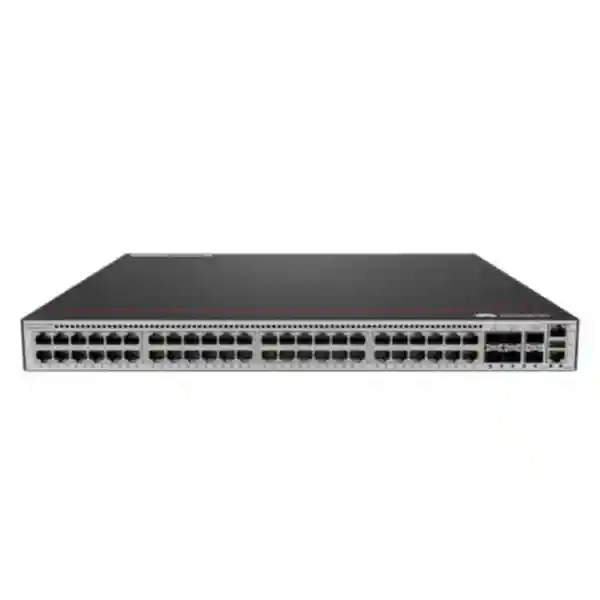
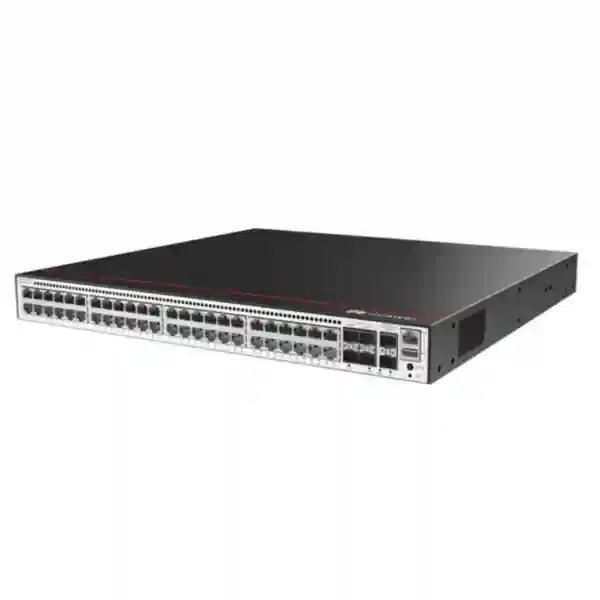
Huawei CloudEngine S5735-S48P4XEZ-V2
A 48-port PoE+ Gigabit access switch with four 10GE SFP+ uplinks, dedicated stacking, one expansion slot, and resilient modular power for demanding enterprise campus deployments.
Core hardware at a glance
Direct answer: where the S5735-S48P4XEZ-V2 fits in a UAE network
The Huawei CloudEngine S5735-S48P4XEZ-V2 is best positioned as a high-density enterprise access switch for floors, departments, branch sites, education blocks, hospitality zones, healthcare wings, retail back offices, surveillance-heavy locations, and other environments that require forty-eight copper Ethernet ports with PoE+ and resilient uplinks. Its four 10GE SFP+ interfaces provide a practical path from Gigabit edge devices into a faster distribution or core layer, while the two dedicated 12GE stack ports preserve the 10GE uplinks for production traffic instead of consuming them for stack formation. The one expansion slot differentiates the XEZ model from fixed-only variants and gives solution architects additional flexibility when building a standardized access platform.
For procurement teams in Dubai, Abu Dhabi, Sharjah, Ajman, Ras Al Khaimah, Fujairah, and other UAE locations, the important design question is not simply whether the switch has enough RJ45 sockets. A correct bill of materials must also account for the expected PoE load, power-supply combination, optical uplink modules, fiber type, rack depth, cooling, stacking requirements, software release, authentication design, monitoring platform, and growth plan. The S5735-S48P4XEZ-V2 is capable enough to consolidate many of these requirements into a single 1U access-layer platform, but the final configuration should still be engineered around the actual endpoint mix.
FourTeck can integrate this switch into wider campus, security, server, and managed-network projects. Customers planning a broader refresh can review FourTeck UAE enterprise technology solutions, while organizations that need rollout, migration, structured configuration, monitoring, or operational support can align the hardware purchase with FourTeck IT Services UAE.
Verified hardware profile
Access interfaces
Forty-eight 10/100/1000Base-T ports form the wired edge. These ports are designed for standard Ethernet endpoints such as PCs, printers, IP phones, wireless access points, badge readers, controllers, building systems, and surveillance devices. The PoE+ capability lets the switch deliver data and electrical power over the same copper run to compatible powered devices, reducing the need for local AC adapters and simplifying ceiling, wall, and desk installations.
Uplink interfaces
Four 10GE SFP+ ports provide higher-bandwidth optical or direct-attach connectivity toward aggregation switches, collapsed cores, server zones, or adjacent network blocks. A four-uplink design gives engineers room for link aggregation, physical path diversity, separate service paths, or staged migration from a single uplink to resilient pairs without replacing the access switch.
Dedicated stacking
Two 12GE stack ports are reserved for stack connectivity. This matters because many lower-cost access designs consume production uplinks to form a stack. Dedicated stack links keep the four 10GE SFP+ ports available for northbound traffic and make it easier to standardize resilient access blocks with predictable cabling and capacity.
Expansion and power
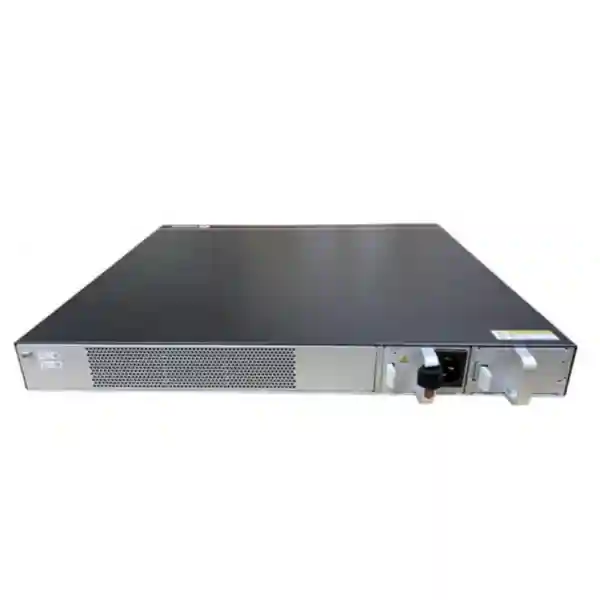
The S5735-S48P4XEZ-V2 includes one expansion slot and three power-supply positions. Huawei specifies N+1 power-supply backup for this PoE+ model. This architecture is valuable in sites where powered endpoints must remain available during a power-module fault or service event, subject to the installed module mix and the active PoE load.
Performance numbers explained without marketing ambiguity
Huawei specifies forwarding performance of 168 Mpps for the S5735-S48P4XEZ-V2. Packet forwarding rate is useful when judging whether a switch can process large volumes of small packets, where packets-per-second capability rather than raw bit rate is often the limiting factor. In a normal campus environment, actual traffic includes a mixture of packet sizes, application flows, broadcasts, multicasts, voice, video, web traffic, cloud sessions, software updates, backups, and control traffic. The practical value of the 168 Mpps figure is that the platform is engineered for wire-speed class access use rather than a lightly provisioned unmanaged edge.
Huawei lists switching capacity as 224 Gbps / 520 Gbps. The first figure represents the device switching capability used for this model, while the second is the broader system switching capability designation used in Huawei documentation. For design work, the model-specific 224 Gbps figure should be used when comparing the access switch against its physical interface mix. It provides the internal bandwidth required for the forty-eight Gigabit downlinks, four 10GE uplinks, and associated switching functions in the intended operating profile.
These values do not mean every deployment will automatically achieve maximum throughput to every endpoint. End-to-end performance depends on cabling quality, transceiver selection, fiber cleanliness, upstream oversubscription, routing design, server capacity, WAN limitations, endpoint NICs, security inspection elsewhere in the path, queue policy, and the application itself. A technically correct deployment treats the switch as one component in a traffic path rather than as an isolated benchmark number.
PoE+ engineering: how to size the powered edge correctly
PoE is usually the most important sizing variable for this model. The S5735-S48P4XEZ-V2 supports PoE+ on its forty-eight copper access ports, and Huawei product portfolio material identifies a PoE budget up to 1680 W with the appropriate power configuration. That figure is large enough to support dense access designs, but the switch should never be ordered by multiplying a generic port count by a generic wattage and assuming the result is automatically available. The selected power modules, redundancy target, endpoint classes, cable losses, and operational reserve all influence the usable design.
Under IEEE 802.3at PoE+, a powered-device allocation can reach approximately 30 W at the power-sourcing side for an individual port. Forty-eight ports multiplied by 30 W equals 1440 W, which sits below the cited 1680 W maximum PoE budget. This makes the platform attractive where many PoE+ devices are expected. However, real estates often contain a mix: desk phones may consume only a few watts, standard access points may sit in the teens, high-radio-count wireless APs may require higher allocations, cameras may increase consumption when infrared illumination or heaters engage, and specialist devices can behave differently during boot. A proper design records the negotiated or specified maximum per endpoint, not only its average consumption.
For a resilient design, engineers should separately calculate normal-state PoE load and failure-state PoE load. If one power module fails, the remaining installed modules must still have enough capacity to keep critical endpoints powered if uninterrupted operation is the objective. This is where N+1 architecture becomes operationally meaningful. A switch can be described as redundant while still being unable to carry the entire PoE demand after a module loss if the initial power design is too tight. FourTeck therefore recommends a power worksheet that lists device type, quantity, worst-case watts, startup behavior, criticality, and expected growth.
Priority policies should also reflect business impact. Wireless APs serving a large floor, emergency phones, security cameras, door controllers, nurse-call adjunct devices, and core operational endpoints may warrant higher PoE priority than convenience endpoints. During an abnormal power condition, the goal is not merely to preserve the highest number of devices; it is to preserve the right devices. Mapping power priority to business function makes the redundancy investment more useful.
Cable plant matters as well. PoE performance depends on standards-compliant copper, correct termination, conductor gauge, bundle size, ambient temperature, and run length. In UAE deployments, ceiling voids, risers, warehouses, and outdoor-adjacent pathways may experience elevated temperatures. Structured cabling should therefore be selected and installed with both data and power delivery in mind. The network switch cannot compensate for poor copper terminations, excessive resistance, or unsuitable cabling.
Uplink design for access-to-distribution connectivity
Single-switch uplink model
A standalone access switch can use one or two of the 10GE SFP+ interfaces for upstream connectivity. Two links can be bundled where the upstream platform and design support link aggregation, providing additional aggregate bandwidth and link resilience. The remaining 10GE interfaces can be reserved for future growth, a secondary distribution path, a local server connection, or a migration project.
When the downstream edge consists mostly of office users, phones, printers, and modest wireless loads, a 10GE uplink can provide a healthy oversubscription ratio. When the access layer serves dense Wi-Fi, cameras, workstation imaging, local storage, or high-volume east-west traffic, multiple 10GE uplinks may be more appropriate.
Stacked access model
The dedicated stack interfaces allow multiple switches to be treated as a more coordinated access block while keeping 10GE uplink resources free. In a resilient architecture, different members can connect northbound to separate aggregation devices or logical aggregation systems, reducing dependence on a single chassis or cable path.
The physical topology should be documented before installation: which stack ports connect, which member carries which uplinks, where the stack begins and ends, what happens when a member is removed, and how management addresses and configuration backups are handled. Stack convenience does not remove the need for change-control discipline.
Layer 2 design capabilities for segmented campus networks
The S5735-S-V2 software family supports the Layer 2 functions expected in a modern managed campus. Huawei documentation lists support for up to 4094 VLANs, giving network architects sufficient logical segmentation for departments, voice, Wi-Fi roles, cameras, building-management systems, printers, guests, infrastructure, lab environments, and other traffic classes. The goal should not be to create the maximum number of VLANs; it should be to create a segmentation model that is understandable, secure, and maintainable.
Voice VLAN capability is useful when IP telephony is deployed on the same physical access ports as user workstations. A typical design can classify the phone into the voice segment while placing the attached PC in a separate data VLAN. This allows different QoS, addressing, security, and monitoring policies to be applied without adding a dedicated cable for every phone. MUX VLAN capability provides additional segmentation options where many edge users need controlled isolation while sharing common upstream services.
Huawei also lists VLAN assignment based on MAC address, protocol, IP subnet, policy, and port. These mechanisms give enterprises several ways to map users and devices into logical networks. Port-based VLANs remain the simplest and most transparent choice for many fixed environments. Dynamic methods can reduce manual port configuration when endpoint mobility is high, but they place greater importance on identity, policy, logging, and troubleshooting procedures.
Loop prevention and deterministic convergence are critical in an access layer. Huawei provides VBST interoperability designed for environments that need compatibility with PVST/PVST+/RPVST behavior, helping mixed-vendor campus networks maintain a controlled spanning-tree topology. Any spanning-tree deployment should define root placement, edge-port behavior, protection mechanisms, and expectations for redundant uplinks rather than relying on default bridge elections.
Link aggregation should be planned around both capacity and failure domains. Combining multiple physical uplinks into a logical bundle can improve bandwidth utilization and protect against a single link failure. Engineers should confirm optic type, fiber polarity, upstream port configuration, member consistency, and the behavior of the aggregation protocol during maintenance. A resilient logical bundle still depends on physical diversity if the two fibers share the same duct, patch panel, or upstream power source.
Layer 3 routing: more than a simple edge switch
Huawei lists static routing, RIPv1/v2, RIPng, OSPF, OSPFv3, ECMP, IS-IS, IS-ISv6, BGP, BGP4+, VRRP, and VRRP6 among the S5735-S-V2 family routing capabilities. This gives architects the option to keep the device as a pure Layer 2 access switch or to move selected routing responsibilities closer to the edge. The correct choice depends on campus size, operational maturity, fault-domain goals, security policy, and the capabilities of the upstream design.
Static routing is suitable for smaller or highly controlled deployments where path changes are infrequent. OSPF is often a better fit when multiple Layer 3 access blocks must exchange routes dynamically inside an enterprise. ECMP can distribute traffic across equivalent paths when the topology and upstream design support it. BGP can be relevant in more advanced campus, data-center-edge, or segmentation designs where policy-driven routing is required. The presence of these protocols does not mean every protocol should be enabled; simpler routing domains are easier to audit and troubleshoot.
VRRP and VRRP6 provide first-hop redundancy mechanisms for IPv4 and IPv6 gateway services. If gateway functions are placed on access or aggregation switches, redundancy should be designed together with uplink routing, spanning-tree behavior, DHCP relay, security policy, and maintenance procedures. A gateway that fails over correctly while its upstream path remains broken does not provide end-to-end resilience.
For UAE enterprises migrating toward IPv6, the availability of RIPng, OSPFv3, IS-ISv6, BGP4+, and VRRP6 means the platform can participate in dual-stack or IPv6-focused architecture rather than forcing an immediate hardware replacement. IPv6 projects should still include address planning, neighbor-discovery protection, RA controls, DNS readiness, logging, monitoring, and application testing. Protocol support on the switch is only one part of an operational IPv6 program.
Access security and identity enforcement
802.1X authentication
802.1X enables port-based network access control using an authentication backend. It is useful when the enterprise needs identity-aware wired access rather than open switch ports. Deployment planning should include supplicant support, certificate handling, fallback behavior, remediation networks, guest handling, and troubleshooting procedures.
MAC and portal authentication
MAC-based and portal authentication options can address devices that cannot run a traditional 802.1X supplicant. Printers, cameras, building systems, scanners, and specialist appliances often fall into this category. These methods should be treated as part of a broader identity policy because a MAC address alone is not a strong identity credential.
DHCP protection
DHCP client, relay, server, snooping, and IPv6 client/relay capabilities support controlled endpoint addressing. DHCP snooping is particularly useful for distinguishing trusted DHCP sources from untrusted access ports, helping reduce the risk of rogue address assignment and supporting other edge-security mechanisms.
Control-plane protection
CPU protection, blacklist/whitelist functions, packet filtering, and managed control-plane policy help preserve switch stability when abnormal or malicious traffic reaches infrastructure services. Security policy should be tested carefully so that protective thresholds do not interfere with legitimate discovery, routing, monitoring, or authentication traffic.
Huawei also documents HTTPS and MACsec among supported security features in the broader S5735-S-V2 software family. Exact availability can depend on software release, license, interface type, and feature combination, so projects that specifically require MACsec or a particular cryptographic profile should validate the chosen release and bill of materials before purchase. This validation step is especially important for regulated environments, inter-building links, and customers with formal encryption requirements.
Operations, telemetry, and troubleshooting
A campus switch is an operational platform, not only a forwarding device. Huawei lists SNMPv1/v2c/v3, RMON, system logging, hierarchical alarms, port mirroring, sFlow, NQA, telemetry, iPCA, IFIT, virtual cable testing, NETCONF/YANG-based management, and Web-based management capabilities across the S5735-S-V2 family. These functions can reduce the time needed to isolate faults when they are integrated into an intentional monitoring architecture.
SNMP remains useful for polling interface state, utilization, errors, CPU load, environmental information, and power data. Where possible, SNMPv3 should be preferred over older community-string models because it provides stronger authentication and privacy options. Syslog should be sent to a centralized collector with consistent timestamps and retention. Events such as link flaps, authentication failures, PoE changes, stack changes, power module alarms, temperature warnings, and routing adjacency changes become significantly more useful when correlated across the network.
Telemetry provides a more modern mechanism for exporting operational data at higher frequency than classic polling can provide. In a large campus, this can help engineers observe user experience, interface behavior, queue conditions, and faults with better granularity. Huawei positions telemetry in conjunction with iMaster NCE-CampusInsight for intelligent fault identification. Organizations considering this workflow should confirm the controller version, licensing model, southbound connectivity, data-retention needs, and operational ownership.
Virtual Cable Test can be valuable when diagnosing copper access problems because it helps distinguish a switch configuration issue from physical-layer faults. Port mirroring allows traffic to be copied to an analyzer or security sensor. NQA can support active performance testing. sFlow can provide sampled traffic visibility. These tools are most effective when the support team has documented procedures for when and how to use them rather than enabling every diagnostic feature continuously without a troubleshooting objective.
For organizations outsourcing part of their network operations, FourTeck can combine hardware deployment with structured monitoring, configuration standards, and maintenance processes through IT Services UAE. This allows the switch configuration, escalation workflow, and observability design to be planned together instead of treating monitoring as an afterthought after installation.
Physical design, rack planning, and environmental considerations
The chassis is a 1U device measuring approximately 43.6 mm high by 442 mm wide by 420 mm deep. That depth should be checked against the usable rail-to-door clearance of the selected rack or cabinet, particularly in compact wall-mount enclosures. Patch-cord bend radius, SFP+ module clearance, front cable managers, rear power cords, and airflow must be included in the mechanical plan. A cabinet that technically accepts a 420 mm chassis can still become impractical if cable management blocks the front door or rear power access.
Huawei documentation for this hardware family specifies air intake from the left, front, and right with exhaust toward the right and rear on comparable S5735-S-V2 PoE models. Rack installation should therefore preserve the required air paths and avoid placing equipment in a way that recirculates hot exhaust into switch intakes. UAE equipment rooms should be designed around controlled temperature and clean airflow rather than assuming the switch will tolerate continuously elevated ambient conditions simply because it is enterprise equipment.
Published environmental values for this model family include long-term operation from approximately -5°C to +50°C at 0–1800 m altitude, with a reduction in maximum operating temperature as altitude increases above 1800 m, and storage from -40°C to +70°C. Relative humidity is specified from 5% to 95% non-condensing, with operating altitude up to 5000 m. The UAE is generally not an altitude-constrained market, but high ambient temperature and dust are practical concerns. Network rooms should have reliable HVAC, filtration, door seals where appropriate, and a preventive cleaning schedule.
The switch itself is only part of the heat load. PoE power conversion, UPS systems, servers, routers, firewalls, optics, and adjacent switches all add heat to the rack. When a PoE switch is heavily loaded, room cooling and UPS sizing should be based on the installed power configuration and expected endpoint load, not on idle or typical switch-only consumption. Huawei portfolio information lists typical device consumption around 72.3 W for the S5735-S48P4XEZ-V2, while actual site draw can be much higher once PoE delivery is included.
For network rooms that also host compute infrastructure, it is useful to coordinate switching, UPS, PDU, rack, and server requirements as one capacity plan. FourTeck’s Server Dubai infrastructure portfolio can be referenced when the access switch is part of a wider server-room, branch-room, or data-room upgrade.
Power architecture and resilience planning
Three power-supply positions
The switch is designed for three pluggable power supplies and N+1 redundancy. Huawei documentation indicates support for compatible AC and DC PoE power-module options, including configurations built around 600 W or 1000 W class modules. The exact combination should be selected from the supported hardware matrix for the software release and regional procurement bundle.
For a high-PoE deployment, module selection should be based on worst-case powered-device demand plus the switch’s own consumption and the desired failure-state reserve. This prevents a scenario in which normal operation is stable but a module failure forces noncritical and critical endpoints to compete for limited remaining power.
UPS and electrical distribution
N+1 inside the switch does not protect against a failed upstream breaker, failed UPS, damaged PDU, or loss of the entire room supply. When uptime matters, redundant switch power modules should be fed from appropriately separated electrical paths where the site design permits. A dual-feed strategy is strongest when the paths do not share the same single point of failure.
UPS sizing should use apparent power, real power, battery runtime targets, PoE load, conversion efficiency, growth, and expected environmental conditions. A switch supporting a large PoE budget can become one of the biggest loads in a small communications room once many endpoints are powered.
Typical UAE deployment scenarios
Corporate office floors
One switch can terminate a dense mix of desks, phones, printers, meeting-room devices, wireless APs, room schedulers, and IoT endpoints. VLAN segmentation separates corporate, voice, guest, and facilities traffic while 10GE uplinks connect the floor to distribution.
Hotels and hospitality
PoE+ is useful for corridor and room-area APs, IP phones, cameras, and selected hospitality endpoints. Stackable access simplifies multi-floor standards, while centralized monitoring helps operations teams isolate link, cabling, and power issues quickly.
Education campuses
Classrooms, labs, administration areas, access points, cameras, phones, and digital signage create a diverse access edge. The switch’s routing and segmentation features support separation of student, staff, guest, infrastructure, and facilities networks.
Healthcare and clinics
Managed access, resilient power, VLAN controls, authentication, and extensive monitoring can support clinical and administrative connectivity. Healthcare designs should additionally follow the organization’s security, medical-device, availability, and compliance requirements.
Retail and distributed branches
Stores and branch offices can consolidate POS support systems, back-office devices, APs, cameras, phones, and local infrastructure on one managed switch while maintaining traffic separation and upstream resilience.
Surveillance-heavy sites
Forty-eight PoE+ ports and a large available PoE budget suit camera-dense access zones. Engineers should size camera startup and night-mode power, recording bandwidth, multicast behavior where used, and uplink capacity before selecting the final power modules.
Wi-Fi access-layer sizing with the S5735-S48P4XEZ-V2
Wireless access points have changed the way wired edge switches should be sized. A modern AP may serve dozens or hundreds of client sessions and can generate far more aggregate traffic than a traditional desk endpoint. Even though the S5735-S48P4XEZ-V2 provides Gigabit copper interfaces rather than multigigabit downlinks, it can be a strong fit where the selected APs operate within Gigabit Ethernet requirements and PoE+ power limits. For higher-speed APs that require 2.5GE, 5GE, or higher PoE classes, a different access model should be considered.
The first planning step is to identify the exact AP model, Ethernet speed, PoE class, maximum consumption, quantity, and expected user density. The second step is to map APs to switch ports so that a single switch or stack member failure does not remove wireless service from an entire critical area. The third step is to calculate uplink oversubscription. Forty-eight one-gigabit access interfaces do not imply that 48 Gbps of sustained client traffic will occur, but high-density wireless, video collaboration, cloud applications, backups, and local content can create significant upstream load.
QoS design becomes important when voice and real-time collaboration run over Wi-Fi. The access switch should preserve validated markings where appropriate, police untrusted markings at the edge, and map traffic into a queueing strategy that aligns with the upstream campus. QoS should be end-to-end; configuring priority on one access switch while the upstream network ignores the markings rarely solves congestion consistently.
AP replacement cycles should also be considered. If today’s APs use 1GE and PoE+, but the organization expects a migration to multigigabit Wi-Fi hardware within the switch depreciation period, procurement teams should compare the savings of the S5735-S48P4XEZ-V2 against the potential cost of an earlier access-layer refresh. The correct decision depends on actual wireless roadmaps rather than generic claims about future proofing.
IP telephony and converged access
IP phones are one of the classic use cases for PoE+ switches because the data network can provide both connectivity and power to the handset. Many deployments also connect a user PC through the phone’s internal switch, allowing one wall outlet to serve two logical endpoints. The S5735-S48P4XEZ-V2 can support this model with voice VLAN separation and policy enforcement at the access edge.
A well-designed voice deployment assigns phones to a dedicated voice VLAN, uses DHCP and provisioning services appropriate to the telephony platform, prioritizes signaling and media according to the organization’s QoS design, and monitors packet loss, latency, jitter, and link errors. Voice VLAN support simplifies segmentation, but it is not a substitute for an end-to-end real-time traffic policy.
Power resilience can directly affect business continuity because a PoE-powered handset may remain operational during a building power disruption if the communications rack is on UPS. This benefit only exists if the switch, upstream network, call-control platform, WAN, and any required firewall or SBC infrastructure are also powered. Therefore, PoE switch redundancy and UPS planning should be part of the telephony continuity design rather than treated as a separate network concern.
When voice is combined with firewall segmentation, remote-site connectivity, and internet security, organizations can coordinate the access layer with broader perimeter design. FourTeck’s Firewall Dubai solutions can be considered for projects where secure WAN, internet breakout, VPN, or policy enforcement must be engineered alongside the campus switch rollout.
CCTV, video, and security-device access
A camera-dense network should be sized differently from an office access layer. Cameras can transmit continuously, often at predictable but persistent bit rates. Forty-eight cameras at 8 Mbps each, for example, produce approximately 384 Mbps before protocol overhead, management traffic, retransmissions, and bursts. Higher-resolution streams, multiple profiles, analytics, or more aggressive frame rates can increase the load considerably. A 10GE uplink provides substantial headroom, but recording architecture and traffic direction still need to be understood.
PoE sizing must use the camera’s maximum operating consumption rather than the daytime average. Infrared LEDs, heaters, PTZ motors, integrated illuminators, or accessories may increase power at night or during specific activity. Outdoor or industrial cameras can have higher startup demand. When dozens of cameras are connected to one switch, a simultaneous transition into night mode can materially change the total PoE load.
Security segmentation should isolate cameras and access-control devices from general user networks. Authentication, ACLs, VLAN policy, DHCP controls, and upstream firewall rules can limit lateral movement and reduce exposure. Where a device cannot use 802.1X, MAC-based policy or dedicated ports can provide controlled onboarding, but those methods should be combined with monitoring and restricted network reachability.
Video surveillance also creates operational dependencies. A switch maintenance window can take down dozens of cameras at once, so stacking, spare capacity, and patching standards should be designed around acceptable outage scope. In high-security sites, critical cameras may be distributed across different switches or power domains to avoid a single maintenance event removing visibility from an entire zone.
Expansion slot: why the XEZ variant can matter
The S5735-S48P4XEZ-V2 includes one expansion slot, a feature that distinguishes it from some fixed-port variants in the same family. Expansion capability can be useful where the standard interface set does not fully match the project’s growth plan or where a specific supported module is required. The key word is supported: expansion modules must be validated against Huawei’s hardware compatibility and software release information rather than assumed from physical fit.
A project should define the purpose of the slot before ordering accessories. If the objective is additional uplink flexibility, additional optical connectivity, or another specialized function, the exact module and its software requirements should be included in the BOM. Leaving the slot empty initially can still be valuable if the enterprise wants a standard access model with future options, but the future requirement should be realistic enough to justify choosing the XEZ variant.
The expansion slot also has implications for spare strategy. If a specialized module becomes essential to service operation, the organization may need to stock a compatible spare or include it in a support agreement. Standardizing on one access-switch model across sites can simplify operations, but only if the associated power modules, optics, expansion cards, and software baselines are standardized as well.
Energy, efficiency, and operational cost
Huawei documentation lists 802.3az Energy Efficient Ethernet in the S5735-S-V2 family, along with intelligent power and operational features. Energy efficiency is relevant in large access networks because dozens or hundreds of switches run continuously. However, the dominant energy variable on a high-density PoE switch is often the powered endpoint load rather than the switch silicon alone.
When comparing switches, it is useful to separate three values: switch-only consumption, PoE delivery to endpoints, and facility overhead such as UPS losses and cooling. A deployment with many cameras or APs may draw far more through the switch for endpoint power than the base switch requires for forwarding. This is not inefficiency; it is simply part of the electrical architecture. Clear separation helps facilities and IT teams predict branch or floor power accurately.
Typical switch-only consumption around 72.3 W, as identified for the S5735-S48P4XEZ-V2 in Huawei portfolio material, is useful for baseline comparisons. It should not be used as the total circuit requirement for a PoE installation. The electrical circuit, UPS, and PDU must be sized for the selected power modules and realistic maximum PoE demand.
Operational efficiency also includes human effort. Centralized configuration, telemetry, consistent templates, and stack-based standardization can reduce site visits and troubleshooting time. A slightly more capable switch can be cheaper over its service life if it avoids repeated redesign, reduces outage duration, and keeps the network aligned with a consistent operational model.
Software release and feature validation
Enterprise switches evolve through software releases. Huawei’s current product information references recent V600 software for this model family, while installed estates may run other supported versions. A procurement or migration project should identify the target software release early because feature availability, command syntax, bug fixes, security patches, controller compatibility, expansion-card support, and operational behavior can change between versions.
A sound rollout process starts with a release decision, checks the feature set against the network design, verifies hardware compatibility, validates upgrade paths, tests representative configurations, and then freezes a production baseline. This is particularly important when the design relies on advanced functions such as controller integration, telemetry, specific routing features, authentication, MACsec, or specialized expansion hardware.
Organizations should also plan how switch configurations are backed up, version-controlled, reviewed, and restored. A stack or controller can simplify operations, but configuration errors can also propagate faster in a centralized environment. Change templates should therefore include pre-checks, rollback steps, post-change verification, and business-impact criteria.
Software selection should follow vendor support guidance and the organization’s own security and change-management policy. Where a feature is mandatory for compliance or interoperability, written validation against the intended software release is preferable to relying on a generic series brochure.
Migration planning from an older access switch
Replacing an access switch is rarely a simple unplug-and-replug exercise in a mature network. Existing ports may carry undocumented VLANs, static MAC bindings, voice settings, DHCP snooping trust, port security, spanning-tree exceptions, QoS policy, multicast controls, monitoring configurations, and special devices that fail if their access policy changes. A successful migration begins with discovery.
The source switch should be audited for interface status, descriptions, learned MAC addresses, VLAN membership, power draw, error counters, trunk configuration, link aggregation, neighbor information, spanning-tree state, routing, ACLs, and management services. Endpoint owners should be identified where possible. The target S5735-S48P4XEZ-V2 configuration can then be generated from an approved template and adjusted for legitimate exceptions.
Physical preparation is equally important. Confirm rack space, mounting hardware, PDU sockets, power cords, UPS capacity, copper patch lengths, fiber patch type, optic compatibility, labeling, and stack cables before the maintenance window. A migration can fail even when the logical configuration is perfect if the fiber connector, optic type, or cabinet depth was assumed incorrectly.
Cutover should include a defined sequence: capture pre-change state, install and power the new switch, verify software and licenses, test management connectivity, connect stack links if applicable, migrate uplinks, move access ports in controlled groups, validate critical services, check PoE allocation, confirm monitoring, and record final topology. A rollback plan should identify exactly when to stop troubleshooting and return to the previous device.
After the migration, compare error counters, CPU utilization, interface utilization, PoE load, routing adjacencies, authentication logs, spanning-tree state, and monitoring alarms against the intended design. The objective is not only to restore user connectivity; it is to confirm that the new switch is operating correctly under the actual production load.
Sizing methodology for a new deployment
A new-build project should begin with endpoint inventory rather than switch quantity. Count every wired endpoint by type and location. Separate non-PoE devices from PoE devices. Record speed requirements, power class, security requirements, VLAN, expected traffic, and criticality. Then add realistic growth. If a floor currently requires forty-four ports, installing a forty-eight-port switch leaves almost no operational spare for moves, adds, or troubleshooting. Two switches or a different distribution of endpoints may create a healthier design.
The next step is PoE calculation. Sum the worst-case wattage of all powered endpoints, not the average. Add planned growth. Decide whether the design must sustain the full load after one power module fails. Select power modules accordingly. Then validate the upstream electrical circuit and UPS. For critical sites, document what happens during a power-module loss and which endpoints are retained if power must be shed.
Uplink sizing follows. Estimate average and peak aggregate traffic. Consider backup windows, software distribution, camera recording, internet usage, SaaS, wireless client density, local server traffic, and voice/video. Decide whether one 10GE uplink is adequate, whether two should be aggregated, and whether physical diversity is required. Confirm transceiver type and fiber distance.
Then define logical services: VLANs, gateways, DHCP relay, authentication, ACLs, QoS, multicast requirements, spanning tree, link aggregation, routing, monitoring, and management access. These services determine how the switch will fit into the broader architecture and whether any software, controller, or upstream dependencies must be included.
Finally, standardize the installation package. Every switch should have an approved hostname convention, management addressing method, NTP, DNS where used, AAA, SNMP or telemetry configuration, syslog targets, configuration backup method, port-description standard, VLAN naming, uplink policy, and security baseline. Standardization is what turns capable hardware into a manageable fleet.
Technical specification summary
| Model | Huawei CloudEngine S5735-S48P4XEZ-V2 |
| Access ports | 48 x 10/100/1000Base-T PoE+ ports |
| Uplink ports | 4 x 10GE SFP+ |
| Stack interfaces | 2 x 12GE dedicated stack ports |
| Expansion | 1 expansion slot |
| Forwarding performance | 168 Mpps |
| Switching capacity | 224 Gbps device / 520 Gbps system designation |
| PoE | PoE+; Huawei portfolio material lists up to 1680 W with the appropriate power configuration |
| Power architecture | 3 pluggable power-supply positions with N+1 redundancy |
| Dimensions | 43.6 x 442 x 420 mm (H x W x D), 1U |
| Typical device consumption | Approximately 72.3 W before endpoint PoE load, according to Huawei portfolio material |
| VLAN | Up to 4094 VLANs; Voice VLAN, MUX VLAN, multiple assignment methods |
| Routing family | Static, RIP/RIPng, OSPF/OSPFv3, ECMP, IS-IS/IS-ISv6, BGP/BGP4+, VRRP/VRRP6 |
Feature availability can depend on software release, license, interface type, region, and hardware combination. Final BOMs should be validated against Huawei’s current compatibility and support information.
Why dedicated stack ports are operationally useful
Dedicated stacking is easy to overlook during product comparison because uplink counts attract more attention. In practice, stack architecture can determine how cleanly an access layer scales. If stack links consume ordinary uplink ports, every switch added to the stack reduces the interfaces available for upstream connectivity or other high-speed uses. The S5735-S48P4XEZ-V2 avoids this tradeoff by providing two dedicated 12GE stack ports.
A stack can simplify management by presenting multiple physical devices as a coordinated system for many operational tasks. It can also support cross-member link aggregation and make it easier to distribute uplinks across different members. This can reduce service interruption when one member or one physical path fails, provided the design avoids shared dependencies such as a single power source or a single upstream device.
However, stacking should not be treated as a substitute for architecture. Failure domains, software upgrade strategy, stack-master behavior, cabling topology, member numbering, and spare replacement procedures must be documented. An access stack that supports hundreds of endpoints can create a larger outage domain than multiple standalone switches, even though it is easier to manage. The right balance depends on the site’s operational priorities.
For critical facilities, a design may deliberately use smaller stacks or separate stacks by floor, department, or physical zone. This contains the impact of maintenance while preserving the management benefits of stacking. The dedicated ports give architects the freedom to choose that topology without sacrificing the four 10GE SFP+ uplinks.
Interoperability in mixed-vendor networks
Many UAE enterprises operate mixed-vendor environments because access, core, wireless, firewall, voice, and server platforms are refreshed on different cycles. The S5735-S48P4XEZ-V2 supports standard Ethernet, VLAN, routing, authentication, monitoring, and link technologies that can participate in heterogeneous networks. Huawei also highlights VBST compatibility with PVST/PVST+/RPVST behavior and LNP functionality similar to DTP in its interoperability documentation.
Interoperability should nevertheless be tested at the exact feature boundary that matters. A link carrying simple 802.1Q VLAN trunks is straightforward. A multi-chassis link aggregation, proprietary discovery protocol, specialized spanning-tree behavior, authentication workflow, controller integration, or advanced telemetry function may require more detailed validation. The fact that two products implement the same broad standard does not guarantee identical defaults or operational behavior.
Before migration, engineers should document native VLAN expectations, allowed VLAN lists, tagging, LACP timers, spanning-tree mode, root priorities, MTU, LLDP behavior, QoS trust boundaries, routing timers, authentication backend, and management protocols. Most interoperability issues emerge from mismatched assumptions rather than from a lack of basic standards support.
A pilot is especially valuable when replacing one vendor’s access layer while retaining another vendor’s distribution layer. A small production-like test can validate optics, trunks, LACP, failover, spanning tree, DHCP relay, 802.1X, monitoring, and rollback procedures before dozens of switches are deployed.
Optics, fiber, and 10GE transceiver planning
The four 10GE SFP+ ports make transceiver selection part of the purchase decision. The correct optic depends on fiber type, distance, connector standard, patching architecture, and the supported transceiver list for the switch software release. A short multimode connection inside a building may use a different optic from a single-mode campus backbone between buildings. Direct-attach copper can be appropriate for short same-rack or adjacent-rack connections where supported.
Fiber documentation should record the route length, fiber category, connector type, patch-panel path, number of mated pairs, polarity, and test results. Optics should be ordered as matched pairs where required, with corresponding transceiver support at the upstream device. Mixing optic families without checking wavelength and fiber requirements is a common cause of link failures during deployment.
Cleanliness is equally important. Dust on an optical connector can create intermittent errors, reduced receive power, or total link failure. Installation teams should use proper inspection and cleaning procedures rather than repeatedly reseating dirty connectors. Monitoring should include interface errors and optical diagnostics where available.
For redundant uplinks, fiber-path diversity matters. Two optics and two switch ports do not create true resilience if both fibers share the same patch lead, duct, tray, or building entry path. Critical designs should trace physical routes and document shared infrastructure so that logical redundancy corresponds to physical redundancy.
Management-plane hardening
Management access should be separated from user traffic wherever practical. A dedicated management VLAN or routed management segment allows administrators to restrict access to the switch from approved jump hosts, network-management systems, or operations subnets. ACLs should limit management protocols to known sources, and unused management services should be disabled.
HTTPS and secure remote-management protocols should be preferred over clear-text methods. SNMPv3 is generally preferable to SNMPv1/v2c when security requirements permit. AAA should integrate with the organization’s identity policy where possible so that individual administrator actions can be attributed and privileged access can be controlled. Shared local credentials should be reserved for tightly governed fallback scenarios.
Time synchronization is essential. NTP or another approved time source should be configured consistently so that switch logs can be correlated with firewalls, authentication systems, wireless controllers, servers, and security tools. Without synchronized time, an incident timeline becomes difficult to reconstruct even when every device is logging correctly.
Configuration backups should occur after approved changes and be stored outside the switch. The backup process should include enough information to rebuild the device: software version, startup configuration, license information where applicable, stack-member mapping, transceiver notes, power configuration, management addressing, and any external controller dependencies.
Hardening should be maintained as the network changes. A switch configured securely on day one can accumulate unused VLANs, obsolete ACLs, temporary admin accounts, old SNMP settings, and undocumented exceptions over several years. Periodic configuration review is therefore part of security, not merely housekeeping.
Quality of Service for voice, video, and business applications
Campus congestion is rarely solved by simply increasing uplink speed. Real-time voice, video meetings, transactional applications, backup traffic, guest internet, camera streams, and software updates can compete during busy periods. QoS gives the network a controlled way to decide which traffic receives preferential treatment when an interface is congested.
A sound QoS design begins with classification. Trusted devices such as managed IP phones may mark traffic correctly, while general user devices should usually not be trusted to assign themselves high priority. The access switch can establish the trust boundary, classify selected traffic, remark where necessary, and map traffic to queues that align with the upstream network.
Bandwidth guarantees should be based on actual application requirements rather than broad labels. Voice requires low delay and jitter but consumes relatively little bandwidth per call. Video may need more bandwidth but can tolerate different levels of loss depending on the codec and application. Backups are bandwidth-hungry but generally delay-tolerant. Guest browsing may be important without being business-critical. A queue plan should reflect these distinctions.
QoS should be verified under load. A policy that looks correct in configuration may behave unexpectedly if uplink congestion occurs elsewhere in the path. Testing can use representative application traffic, queue counters, packet capture, active probes, and monitoring data to confirm that the intended classes receive the expected treatment.
IPv6 readiness and dual-stack planning
The S5735-S-V2 routing portfolio includes IPv6-capable protocols such as RIPng, OSPFv3, IS-ISv6, BGP4+, and VRRP6. This matters for enterprises that want to introduce IPv6 gradually without replacing the access layer. A common approach is dual stack, where IPv4 and IPv6 coexist while applications, security controls, monitoring systems, and operational teams transition.
IPv6 should not be enabled casually. Router advertisements, neighbor discovery, DHCPv6 behavior, DNS, addressing plans, first-hop security, and firewall policy need deliberate design. Uncontrolled IPv6 can create hidden paths even in organizations that believe they are IPv4-only because operating systems and applications may enable IPv6 automatically.
The switching layer should be included in the IPv6 security baseline. Access policy, RA handling, monitoring, ACLs, and routing authentication where appropriate need to align with the rest of the network. Logs and monitoring tools should parse IPv6 addresses correctly, and support staff should be trained to troubleshoot them.
For new campus projects, reserving an IPv6 address plan and testing dual-stack behavior early is often easier than retrofitting it later. The S5735-S48P4XEZ-V2 provides the protocol foundation, while the enterprise still needs governance, security policy, and application readiness to complete the transition.
Procurement considerations in the UAE
A professional quotation should identify more than the base switch model. The exact power modules, quantity of power modules, stack cables, SFP+ transceivers, expansion card if required, rack accessories, patch leads, support entitlement, software expectations, and installation services should be visible in the BOM. This prevents ambiguity when two quotations appear to list the same switch but include materially different resilience or PoE capability.
PoE power modules are especially important because an under-specified power configuration can change the practical endpoint capacity. The quotation should state the intended PoE budget and failure-state design. If full PoE capacity is not required, a smaller power configuration may be economically appropriate; if the site powers dozens of APs and cameras, additional module capacity may be essential.
Optics should be specified by reach and fiber type rather than by the generic phrase “10G SFP+.” Multimode and single-mode optics serve different cable plants, and using the wrong type can create last-minute delays. Stacking accessories should likewise be included when the design calls for stacks, not added as an afterthought during installation.
Support planning should reflect the importance of the site. A small branch with a spare switch on the shelf may accept a different service model from a hotel, hospital, airport-adjacent facility, financial office, or large campus where an access outage affects many users. Spares, replacement targets, escalation contacts, and configuration backups should be included in the operational plan.
FourTeck can quote the S5735-S48P4XEZ-V2 as a component of a broader UAE network solution through FourTeck UAE, with design inputs covering power, uplinks, optics, stacking, installation, and integration requirements.
Deployment architecture examples
Single floor access
One S5735-S48P4XEZ-V2 serves users, phones, APs, and cameras. Two 10GE SFP+ interfaces form an aggregated uplink to distribution. Remaining uplinks are reserved for expansion. VLANs separate user, voice, wireless, security, and management traffic. PoE priorities favor APs and critical security devices.
Two-switch resilient access stack
Two switches use dedicated stack ports. Northbound 10GE links are distributed across both members and connect to resilient aggregation. Endpoint cabling is balanced so that critical services are not concentrated on one member. Power modules are sized to maintain required PoE operation during a module failure.
Camera aggregation zone
PoE+ ports connect fixed and PTZ cameras. A dedicated CCTV VLAN or routed segment restricts reachability to recording, analytics, time, and management services. 10GE uplinks carry continuous video traffic. PoE sizing accounts for infrared, heater, motor, and night-mode peaks.
Branch with local routing
The switch provides selected Layer 3 gateways and participates in a controlled routing design toward branch WAN or security infrastructure. VRRP can be used where redundant first-hop services are required. Management and routing access are tightly filtered, logged, and monitored.
When this model is the right choice
The S5735-S48P4XEZ-V2 is a strong fit when the access layer needs many Gigabit copper ports, PoE+ across a high percentage of endpoints, 10GE uplinks, dedicated stacking, modular power redundancy, and an expansion slot. It is particularly attractive for standardized enterprise floors where the endpoint mix includes IP phones, conventional Wi-Fi APs, cameras, user PCs, printers, and building systems.
It also makes sense when operations teams want a managed platform with substantial Layer 2 and Layer 3 capability rather than a basic PoE switch. Routing protocol support, VLAN controls, authentication options, telemetry, monitoring, virtual cable diagnostics, and centralized management integration can reduce the number of separate device roles required at the edge.
The model should be reconsidered when endpoints need multigigabit copper, 90 W PoE++ per port, much higher-speed uplinks, specialized industrial environmental ratings, fanless operation, or another feature outside the S5735-S48P4XEZ-V2 profile. In those cases, another CloudEngine access model may align better with the physical requirements. Correct model selection is preferable to forcing a capable switch into a use case it was not designed to serve.
When to compare a different Huawei access model
A different model should be considered if the access edge requires PoE++ at higher per-port power than this PoE+ platform provides. The S5735-S-V2 family includes other variants aimed at higher-power endpoints, and Huawei has additional campus series with multigigabit interfaces for newer wireless access points. Selecting the right model depends on endpoint power, copper speed, uplink requirements, and lifecycle plans.
If a site needs only non-PoE user access, paying for a large PoE architecture may not be necessary. Conversely, if the network is built primarily for high-density Wi-Fi 6E or Wi-Fi 7 access points using 2.5GE/5GE and higher PoE classes, a Gigabit PoE+ access switch can become the bottleneck even though its total switching capacity is healthy.
For small branches with fewer than twenty-four endpoints, a 48-port model may leave excessive unused capacity. For very large access blocks, multiple 48-port switches are normal, but rack space, stack design, uplink capacity, and failure domains should be evaluated. Port density is a planning variable, not an automatic reason to select the largest model available.
FourTeck can compare switch options at the BOM level so that port speed, PoE class, uplinks, power redundancy, expansion, software features, and budget are considered together. This avoids replacing one bottleneck with another.
Implementation checklist for network engineers
Before installation
Confirm rack depth, U-space, airflow, power circuits, UPS capacity, grounding, patch-panel position, fiber type, SFP+ modules, stack cables, power modules, software release, management address plan, and configuration template.
During installation
Label every cable, verify power-module status, check stack topology, inspect optics and fiber, apply baseline configuration, confirm time synchronization, restrict management access, test uplinks, and validate PoE negotiation with representative devices.
After cutover
Check interface errors, utilization, VLAN membership, routing, spanning tree, link aggregation, authentication, DHCP behavior, PoE draw, logs, alarms, telemetry, monitoring, and configuration backup. Record serial and asset information.
Ongoing operations
Maintain software baselines, review configuration drift, monitor power and temperature, inspect recurring port errors, keep spare optics and cables, test configuration restore procedures, and document every production change.
Frequently asked technical questions
Does it provide PoE on all 48 copper ports?
The model is a 48-port PoE+ switch. Actual simultaneous power availability depends on the installed power modules and total PoE budget, so the endpoint load must be calculated before finalizing the power configuration.
Are the uplinks 10 Gigabit?
Yes. The fixed uplink set includes four 10GE SFP+ interfaces. Optics or direct-attach media must be selected for the required distance, fiber type, and upstream platform.
Does stacking use the 10GE uplinks?
No. The switch provides two dedicated 12GE stack ports, allowing the four 10GE SFP+ interfaces to remain available for production uplinks and other high-speed connections.
Can it route between VLANs?
The S5735-S-V2 family supports extensive Layer 3 capabilities including static routing and multiple dynamic routing protocols. The exact production design should match the intended software release and enterprise routing architecture.
Is the switch suitable for cameras?
Yes, when camera interfaces are Gigabit or lower and PoE+ is sufficient. Camera count should be sized using maximum power and aggregate video traffic, with suitable uplink and recording capacity.
Is it suitable for new high-speed Wi-Fi APs?
It is suitable for APs that operate within 1GE copper and PoE+ requirements. APs requiring 2.5GE/5GE or higher PoE classes should be matched to a multigigabit or higher-power access switch.
Decision recap for UAE buyers
Choose the Huawei CloudEngine S5735-S48P4XEZ-V2 when your design requires forty-eight Gigabit copper access ports with PoE+, four fixed 10GE SFP+ uplinks, dedicated 12GE stacking, one expansion slot, and a resilient three-position power architecture. It is particularly well matched to enterprise floors, campuses, education, hospitality, healthcare, branches, retail, surveillance, and mixed endpoint environments where operational visibility and Layer 3 flexibility matter.
Before purchase, confirm four design items. First, calculate endpoint PoE requirements and select power modules for both normal and failure conditions. Second, determine the correct SFP+ optics and fiber path for each uplink. Third, decide whether the switch will operate standalone or in a stack and include the required stack accessories. Fourth, validate the software release against required features such as authentication, routing, telemetry, management integration, and any planned expansion card.
If those inputs are clear, the S5735-S48P4XEZ-V2 can be quoted as a precise engineered BOM rather than as an incomplete base-chassis line item.
Quotation input checklist
FourTeck consultation panel
For a production-ready quotation, share the site count, switch quantity, endpoint mix, PoE load, uplink distances, fiber type, stack requirement, power redundancy target, preferred software baseline, and installation location. FourTeck can then align the base switch with the required power modules, optics, stack accessories, expansion option, rack considerations, and implementation scope.
A complete BOM is especially important for PoE-heavy projects because the switch chassis alone does not define the final power capacity or failure behavior. The objective is to deliver a configuration that is electrically, optically, logically, and operationally appropriate for the actual UAE site.
Information to send
• Number of S5735-S48P4XEZ-V2 switches required
• PoE endpoint count and wattage
• 10GE optic reach and fiber type
• Stack size and topology
• UPS and power-resilience requirement
• Installation emirate and site type
• Configuration, migration, and support scope


Reviews
There are no reviews yet.