
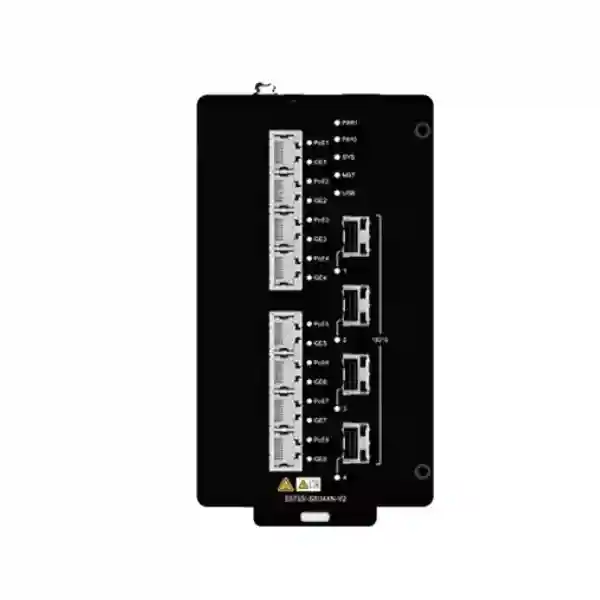
Huawei CloudEngine S5735I-S8U4XN-V2 in UAE
A compact industrial access switch for harsh edge locations where eight powered Gigabit Ethernet endpoints, four 10 Gigabit fiber uplinks, advanced Layer 3 services and environmental resilience must coexist in a DIN-rail footprint. The S5735I-S8U4XN-V2 targets smart transportation, surveillance, utilities, manufacturing, logistics and outdoor cabinet networks across Dubai, Abu Dhabi and the wider UAE.
Uplinks: 4 × 10GE SFP+
Forwarding: 72 Mpps
Switching: 96 Gbps device / 520 Gbps system capability
Cooling: Fanless, natural heat dissipation
Protection: IP40 industrial enclosure
Mounting: DIN rail
Direct answer: what is the S5735I-S8U4XN-V2 designed to do?
The Huawei CloudEngine S5735I-S8U4XN-V2 is an industrial-grade managed Ethernet switch intended for edge locations that need powered copper access and high-bandwidth fiber aggregation without the acoustic and mechanical complexity of internal fans. Its eight 10/100/1000BASE-T ports support PoE++ for high-power powered devices, while four 10GE SFP+ ports provide substantially more uplink headroom than a conventional industrial switch limited to one or two Gigabit fiber interfaces. Huawei specifies 72 Mpps forwarding performance and a 96 Gbps device switching capability, with 520 Gbps listed as the system switching capability. That combination makes the model particularly relevant when a small number of endpoints generate sustained video, telemetry or industrial traffic that must be moved northbound without creating an avoidable Gigabit bottleneck.
The switch is also more than a basic Layer 2 device. The published S5735I-S-V2 feature set includes static routing, RIP, OSPF, OSPFv3, IS-IS, BGP, BGP4+, ECMP, VRRP and VRRP6, plus multicast functions such as PIM and IGMP snooping. This allows the same industrial platform to operate as a robust access switch, a routed industrial edge device, or a compact aggregation point depending on the project topology. The value is especially clear in distributed UAE deployments where a roadside cabinet, factory cell, parking system, gatehouse, utility substation or remote surveillance node may need to keep local traffic segmented and resilient while maintaining redundant fiber paths back to a control room or data center.
For project engineering, the most important point is that environmental and PoE figures must be treated as system parameters, not isolated headline specifications. The series is promoted for operation from −40°C to +75°C, but Huawei’s hardware documentation applies enclosure, airflow, optical-module and power conditions to the upper end of the range. Likewise, the S5735I-S8U4XN-V2 can power IEEE 802.3af, 802.3at and 802.3bt devices, but the number of simultaneously supported high-power endpoints depends on the selected power arrangement. FourTeck therefore recommends sizing the switch together with the enclosure, DC plant or AC adapter, optics, surge protection, UPS strategy and actual endpoint wattage rather than selecting the chassis in isolation.
Verified hardware specification profile
Ports and forwarding
Eight 10/100/1000BASE-T Ethernet access ports with PoE++ support, four 10GE SFP+ uplink ports, one DI/DO interface and one RS-485 interface. Published forwarding performance is 72 Mpps. Published switching capability is 96 Gbps at the device level, while Huawei also lists 520 Gbps as system switching capability. The four 10GE uplinks are especially useful for dual-homing, ring construction, high-bandwidth aggregation or separating operational technology, video and management paths.
Management hardware
The hardware specification lists an RJ45 console port and USB 2.0. The management CPU is specified at 1.1 GHz with two cores, backed by 2 GB RAM and 1 GB total flash storage. These resources are for control-plane, management and software functions; they should not be confused with packet-forwarding throughput, which is handled by the switch forwarding architecture.
Physical and environmental
The S5735I-S8U4XN-V2 is approximately 150 × 86 × 133 mm and Huawei lists a packaged chassis weight of about 2.21 kg. It uses natural heat dissipation with no internal fan modules. IP40 ingress protection, 5% to 95% non-condensing relative humidity, storage temperatures down to −40°C and up to +85°C, and a published operating altitude up to 5000 m make it suitable for industrial enclosures when installation limits are observed.
Power and PoE
The platform supports a 240 W AC PoE power adapter option or external DC. For PoE, the rated DC input is 56 V. Huawei documents 1:1 hot-backup power capability. Typical device power consumption is about 20.45 W excluding powered-device load, while maximum device consumption is listed at 21.7 W without PDs. The potential PD budget is much larger and depends on the selected supply architecture.
Port architecture and uplink design
The physical port mix is one of the strongest reasons to consider this model for industrial edge designs. Eight copper Gigabit ports are enough for a concentrated field node without forcing the installation team to deploy an oversized 24-port chassis, yet four SFP+ uplinks provide forty gigabits per second of aggregate line-rate interface capacity across those uplink ports. That does not mean every deployment requires four live 10GE links; rather, it gives the designer options. Two SFP+ ports can be assigned to redundant aggregation paths, a third can carry a local high-volume connection such as a video recorder or neighboring switch, and the fourth can be reserved for expansion, test access or a second service domain. In ring networks, the four-port uplink arrangement also makes it possible to form resilient east-west paths while retaining additional northbound connectivity.
In surveillance deployments, a common mistake is to size only for average camera bit rate. Eight cameras might appear trivial at 5 to 12 Mbps each, but modern deployments can include higher frame rates, H.265 profile variation, multi-stream output, bursts during motion events, analytics metadata and future resolution upgrades. A Gigabit uplink may still be sufficient numerically, but a 10GE design creates operational margin and prevents the uplink from becoming the point that has to be replaced when new analytics servers, wireless backhaul or additional downstream switches are introduced. The four SFP+ ports also permit physically diverse fiber paths where the civil infrastructure supports route diversity.
For industrial automation, interface count is only part of the story. The series supports forwarding of mainstream industrial protocols including PROFINET RT, EtherNet/IP, Modbus TCP, OPC UA and GOOSE according to Huawei’s published feature matrix. That support should be interpreted correctly: the switch forwards Ethernet and IP traffic used by these industrial applications; application-specific determinism, controller timing and end-to-end industrial certification still depend on the complete automation design. A project engineer should validate VLAN mapping, QoS, multicast behavior, latency objectives and redundancy requirements against the PLC, protection relay, SCADA or automation vendor’s architecture.
The DI/DO and RS-485 interfaces add useful integration paths for industrial environments. Digital input and output can be used in supported designs for local alarm or status interaction, while RS-485 can fit certain equipment-management requirements. These interfaces should not be treated as substitutes for the eight Ethernet ports; they are auxiliary industrial connectivity options. Huawei notes that DI/DO and RS-485 are unavailable when switches operate as members of an iStack, so any design that intends to use those auxiliary interfaces should account for the selected redundancy model before finalizing the topology.
For UAE procurement, optics deserve the same attention as the chassis. Industrial temperature ratings, reach, wavelength, connector type and fiber plant all have to match. A 10GE SFP+ slot does not by itself guarantee that every third-party optic will satisfy Huawei support requirements or the desired environmental rating. FourTeck can align switch selection with compatible optics, patching and structured cabling through the FourTeck UAE project team so the BOM reflects the actual fiber distances and cabinet temperatures rather than a generic transceiver assumption.
PoE++ engineering: budget by endpoint, not by port count
The S5735I-S8U4XN-V2 supports PoE++ and is intended for powered devices that may need more than classic 15.4 W PoE. Huawei’s series documentation describes support for up to 90 W per port under IEEE 802.3bt conditions. This is important for high-power PTZ cameras, outdoor wireless access points, video phones and other devices that exceed the practical limits of 802.3af or 802.3at. However, the maximum wattage of an individual port is not the same as the total available chassis PoE budget. The supply architecture determines how many high-power devices can operate simultaneously.
| Power arrangement | Published available PoE | Illustrative fully loaded port counts |
|---|---|---|
| PAC240S56-CN | 210 W | 8 × 15.4 W, 7 × 30 W, 3 × 60 W, or 2 × 90 W |
| Dual PAC240S56-CN | 210 W in Huawei’s table | Same published fully loaded counts; second supply is primarily a redundancy design point |
| External 56 V DC power | Up to 400 W | 8 × 15.4 W, 8 × 30 W, 6 × 60 W, or 4 × 90 W |
This table reveals a design nuance that is easy to miss. Adding a second PAC240S56-CN does not automatically mean the switch gets twice the usable PoE budget; Huawei’s published configuration table still shows 210 W. The second adapter can therefore be viewed as a resiliency measure rather than a capacity multiplier in that specific arrangement. Projects that genuinely need a higher simultaneous PD load should evaluate the external 56 V DC option and verify the complete DC plant, protection and redundancy plan. The external supply can raise available PoE to as much as 400 W, but the engineer must still consider cable length, thermal loading, endpoint class, startup inrush and the ambient limits of the enclosure.
A practical sizing method starts by listing every powered endpoint with three values: negotiated PoE class, vendor maximum input and realistic design allowance. For example, four fixed cameras at 18 W design allowance consume 72 W. Two PTZ cameras at 60 W each raise the total to 192 W. That already leaves little reserve under a 210 W budget, even though only six of the eight ports are populated. If two additional endpoints are planned, the design either needs a larger external 56 V budget, lower endpoint consumption, local power for selected devices or another PoE switch. Designing from the phrase “eight PoE++ ports” alone would hide this constraint.
Huawei also documents Fast PoE and Perpetual PoE capabilities for the series. Fast PoE can begin supplying power to PDs shortly after switch power-on instead of waiting for the complete software boot process. Perpetual PoE is intended to maintain PD power through certain switch software restart or upgrade conditions. For security and transport deployments, these features can reduce endpoint outage windows. They do not replace a UPS or redundant power architecture: upstream AC or DC failure still needs an energy source if cameras, access points or field devices must remain powered.
Switching performance, latency and forwarding architecture
Huawei publishes 72 Mpps forwarding performance and 96 Gbps device switching capability for the S5735I-S8U4XN-V2. The specification also shows 520 Gbps as system switching capability, and Huawei explicitly distinguishes the number before the slash as the device’s switching capability from the value after the slash as system switching capability. That distinction matters when comparing datasheets: the 96 Gbps value is the more direct figure for the individual product’s switching capability, while the larger system figure should not be misread as an independent 520 Gbps line-rate promise for this twelve-port unit.
The feature table lists forwarding latency below 4 microseconds. In practice, end-to-end latency is affected by frame size, queueing, QoS, congestion, optics, link distance and upstream equipment, so the switch’s published forwarding latency is only one element of an industrial control or video transport budget. Where deterministic behavior matters, the design should include expected packet rates, traffic classes and worst-case congestion rather than assuming a single laboratory latency number represents the complete application path.
Public Huawei documentation for this model does not name a specific merchant-silicon or custom switching ASIC. It is therefore not technically responsible to invent an ASIC model or claim a particular fabrication architecture. What can be evaluated from published information is the externally visible forwarding envelope, control-plane resources and supported service set. The unit has a 1.1 GHz dual-core management CPU, 2 GB RAM and 1 GB flash for control, management and software functions, while the data-plane forwarding path is designed to deliver the stated switch throughput and packet rate independently of ordinary management-plane CPU utilization.
For packet-density calculations, 72 Mpps provides a useful high-level ceiling but should not be converted into a false promise about every combination of ACLs, multicast, routing, telemetry and QoS. Features consume hardware resources such as forwarding entries, ACL rules, queues and counters. Huawei lists up to 32K MAC entries, up to 8192 IPv4 FIB entries and up to 3072 IPv6 FIB entries in the series feature table. Those values are meaningful for edge routing and segmentation, but an engineer should still check the target software version and feature interactions for a complex design.
The device’s 10GE uplinks give the topology room to grow beyond the immediate eight copper endpoints. An engineer can aggregate a local industrial VLAN set over 10GE, maintain a second redundant uplink, reserve one SFP+ for a local compute or NVR connection and use another for ring continuation. Whether that is the best design depends on failure domains. In many industrial networks, a single high-capacity uplink is less desirable than two diverse 10GE paths at lower average utilization because physical resilience matters more than raw throughput. The S5735I-S8U4XN-V2 gives enough uplink interfaces to make that engineering choice instead of forcing a single topology.
Layer 2 segmentation, loop protection and industrial resilience
At Layer 2, the series supports up to 4K VLANs simultaneously and up to 1K VLANIF interfaces according to Huawei’s feature matrix. It also supports conventional VLAN functions alongside Sub-VLAN, Super-VLAN, MUX VLAN, Voice VLAN, QinQ, enhanced selective QinQ, VLAN stacking and VLAN mapping. These options are valuable in multi-service industrial networks where camera traffic, Wi-Fi, access control, building management, SCADA, operations management and contractor access may share the same physical cabinet but must remain logically isolated.
Loop resilience is equally important. Huawei lists STP, RSTP, MSTP, Smart Link, SEP and ERPS based on ITU-T G.8032. ERPS is particularly relevant to ring topologies used along roads, rail corridors, factory perimeters, substations and distributed surveillance zones. A correctly designed ring can provide an alternate path after a link or node failure without requiring every cabinet to have a direct star connection back to the core. Huawei describes fast protection switching for ERPS, but the actual recovery experience depends on the full ring configuration, timer settings, topology and upstream services.
LACP allows multiple physical links to operate as a logical aggregate where the peer device and topology support it. This can increase usable bandwidth and provide member-link resilience. On a compact industrial switch with four 10GE uplinks, that means a designer could allocate two SFP+ ports to a LAG toward one aggregation domain and retain two ports for a secondary path or ring. The correct choice depends on whether the project favors active-active bandwidth, independent failure domains, ring protection or routed links.
Huawei’s iStack technology can virtualize multiple physical switches as one logical device, simplifying management and enabling inter-device aggregation. The series documentation notes support for stacking through electrical ports and also notes a limitation: DI/DO and RS-485 interfaces are unavailable when the switches operate as stack members. That makes stack selection a design trade-off. A deployment that depends heavily on auxiliary industrial I/O may be better served by resilient routed or ringed standalone switches, while a cabinet cluster that values logical-device simplicity may favor stacking if all hardware and software prerequisites are satisfied.
These mechanisms should be chosen deliberately rather than enabled in parallel without a clear control-plane design. STP, ERPS, Smart Link, LACP and routing solve different failure problems. Mixing them without a documented convergence model can create unexpected blocked paths or fault domains. For managed deployment, configuration backup, change control and structured testing are available through FourTeck IT Services UAE, allowing the switch to be integrated into a complete acceptance plan rather than treated as a stand-alone appliance.
Layer 3 routing for distributed industrial edge networks
The S5735I-S-V2 family offers a comparatively rich routing set for an industrial access platform. Huawei lists static routes, RIPv1/v2, RIPng, OSPF, OSPFv3, ECMP, IS-IS, IS-ISv6, BGP, BGP4+, VRRP and VRRP6. This makes it possible to keep traffic routed closer to the edge, reducing the need to stretch every VLAN across a wide physical footprint. In large surveillance, transport, utility or campus environments, routed access can contain broadcast domains and create clearer fault boundaries.
A typical routed-edge design might assign dedicated VLANIF interfaces to cameras, field controllers, maintenance devices and management traffic. The switch can then advertise those subnets upstream using OSPF while applying ACLs and QoS policies at the edge. If two upstream routers or aggregation switches are present, VRRP can provide a resilient default-gateway design where appropriate. ECMP can be used in supported routed topologies to distribute traffic across equal-cost paths. BGP is available for designs that need policy-rich routing or integration with larger enterprise networks, though most small industrial cabinets do not require BGP simply because the protocol is supported.
Huawei lists up to 8192 IPv4 FIB entries and up to 3072 IPv6 FIB entries, as well as up to 3072 IPv6 neighbor-discovery entries. These capacities are ample for many industrial edge roles, but architects should keep the difference between control-plane route learning and hardware forwarding resources in mind. A network can learn more logical information than it can necessarily forward in hardware under every feature combination, so capacity planning should be based on the actual design and the software release selected for deployment.
IPv6 capability is relevant even when the current project remains IPv4-heavy. Huawei lists IPv4/IPv6 dual stack, OSPFv3, BGP4+, RIPng, IPv6 multicast and associated management tools. UAE smart infrastructure projects may have lifecycle expectations of ten years or more. Choosing an industrial switch with mature IPv6 functions can reduce the risk that a future addressing transition requires wholesale replacement of field hardware.
Routing does not remove the need for a security boundary. The S5735I-S8U4XN-V2 is a switch, not a next-generation firewall. ACLs, authentication and control-plane protections can enforce segmentation and limit undesired traffic, but internet-facing threat prevention, application inspection, VPN termination and advanced security policy normally belong on dedicated security infrastructure. FourTeck’s Firewall Dubai team can align industrial switching with upstream firewall policy when the project requires separation between OT, enterprise IT, remote access and external networks.
Security controls for access-layer hardening
Industrial switching security begins with controlling who can connect, what addresses are trusted and which management paths are exposed. Huawei’s feature set includes IEEE 802.1X authentication, MAC address authentication, AAA, RADIUS and HWTACACS. These mechanisms can be used to move an industrial network away from the assumption that any device plugged into a cabinet port is automatically trusted. In environments where many field endpoints cannot run 802.1X supplicants, MAC-based policies or carefully controlled static port profiles can provide a pragmatic alternative, though MAC authentication should not be considered cryptographically equivalent to certificate-based identity.
DHCP snooping helps defend against unauthorized DHCP servers and creates a binding relationship between address assignment and access location. Huawei also supports bindings involving IP address, MAC address, port and VLAN information, along with strict ARP learning and protections against ARP-related attacks. Port isolation, port security, sticky MAC, blackhole MAC entries and limits on the number of learned MAC addresses provide additional tools for reducing lateral movement and accidental bridging between endpoints.
Control-plane defense is also part of the platform. Huawei lists defenses against common denial-of-service and ICMP attacks, CPU defense, blacklists and whitelists, plus attack-source tracing for selected IPv6 behaviors. These features matter because an industrial switch often sits in a location where physical access is less controlled than a data-center rack. A misconfigured camera, compromised maintenance laptop or faulty field device should not be able to overwhelm the switch CPU simply because it shares the same access network.
Secure management should use SSH v2 and HTTPS rather than legacy plaintext methods wherever operational constraints permit. SNMPv3 is preferable to earlier SNMP versions when centralized monitoring is used, because it can provide authenticated and encrypted management. The web interface, console access, remote CLI and any cloud-management connection should be restricted to dedicated management networks or approved sources. Credentials should be unique, role-based and integrated with centralized AAA where possible.
The most important security principle is to treat switch features as one layer in a broader architecture. An access switch can enforce identities, VLANs, ACLs and control-plane policy, but it cannot replace firewall inspection, endpoint hardening, secure remote access or governance. A robust UAE industrial deployment normally separates OT devices, cameras, wireless infrastructure, facilities systems and management traffic; uses upstream firewall zones for higher-level policy; and records administrative access. The S5735I-S8U4XN-V2 gives the network team the Layer 2 and Layer 3 controls needed to participate effectively in that architecture.
QoS, multicast and video traffic behavior
The series supports eight queues per port, port-based traffic policing, two-rate three-color CAR, SP, DRR and combined DRR+SP scheduling, as well as 802.1p and DSCP remarking. These functions matter when the same industrial link carries traffic with different operational priorities. A control or protection flow may have strict latency expectations, voice traffic may need predictable treatment, and bulk video archive traffic may tolerate delay but consume substantial bandwidth. QoS lets the engineer define those relationships instead of allowing bursts from one application to affect all others equally.
ACL matching can operate across Layer 2 to Layer 4 criteria including source and destination MAC, source and destination IP, TCP or UDP port, protocol type and VLAN ID. That enables targeted policy: maintenance access can be limited to management hosts, camera VLANs can be prevented from initiating connections toward sensitive controllers, and specific industrial service ports can be permitted only between expected endpoints. Because ACL resources are finite on every switch platform, complex policy sets should be reviewed and tested rather than generated without regard to hardware scale.
For multicast, Huawei lists PIM-DM, PIM-SM, PIM-SSM, PIMv6, IGMP versions 1 through 3, IGMP snooping and IGMP fast leave, plus multicast VLAN functions. This is useful for industrial applications, IPTV-style distribution, some video systems and control networks that rely on multicast. IGMP snooping can keep multicast traffic from flooding every port, while Layer 3 multicast protocols can route streams between segments when required. Correct querier placement and multicast boundary design remain essential; simply enabling snooping without understanding the Layer 3 multicast topology can still lead to intermittent stream behavior.
Video surveillance is a natural fit for this switch because PoE++ access and 10GE uplinks are available in the same industrial chassis. Yet high camera density introduces more than bandwidth planning. Investigators may request multiple live streams during incidents, analytics platforms may subscribe to many channels, and NVRs may generate large retrieval flows when recorded footage is exported. The uplink and QoS design should anticipate these exceptional states instead of considering only the quiet daytime average.
On industrial control networks, packet prioritization should be validated against the application vendor’s requirements. Some control protocols have their own timing and redundancy mechanisms, while others rely heavily on correct Ethernet behavior. Huawei’s support for industrial protocol forwarding and sub-4-microsecond forwarding latency is useful, but the complete path includes endpoint NICs, media converters if any, optics, upstream switches and controllers. Acceptance testing should therefore measure the network as a system.
Management, telemetry and operations
A field switch is only as useful as the operational visibility around it. Huawei supports CLI, SSH v2, web-based management, SNMP v1/v2c/v3, RMON, system logs, alarms, traffic statistics and virtual cable test functions. In a distributed UAE network with tens or hundreds of cabinets, those functions reduce troubleshooting time because operations teams can distinguish a port-down event, optical issue, cable fault, authentication problem or traffic anomaly before dispatching a field technician.
Telemetry, sFlow, NQA and iPCA are included in the published management feature set. Telemetry can stream operational data at higher cadence than traditional polling and is intended to integrate with Huawei’s campus management and analytics ecosystem. NQA can support active network quality measurement, while sFlow offers sampled traffic visibility. iPCA can assist with performance analysis in supported architectures. The exact management feature set available in production should always be mapped to the selected software release and license package.
Huawei also describes WebMaster as an embedded local management approach for topology visibility, device alarms, guided provisioning, batch upgrade and device onboarding without an external management system in suitable scenarios. For larger estates, iMaster NCE-Campus and related tools can provide centralized automation and assurance. The correct choice depends on estate size, whether the deployment is isolated from the internet, cybersecurity policy and whether the customer standardizes on Huawei campus management.
The series supports Netconf/YANG-based cloud management and an Open Programmability System based on Python. Programmability can help automate repetitive operations such as information collection, policy checks or controlled workflows. In critical infrastructure, however, automation should be subject to version control, peer review, staged testing and rollback planning. A script that can change hundreds of ports quickly can also propagate a mistake quickly, so operational discipline matters as much as programmability.
For replacement and upgrade planning, Huawei’s Easy Operation capabilities include mechanisms for zero-touch deployment, batch configuration, USB-based deployment and replacement of failed devices without fully manual configuration in supported designs. These functions can reduce mean time to restore service at remote sites. To get that value, organizations need a current configuration repository, consistent templates, known software versions and spare hardware strategy. FourTeck can combine supply with staging, configuration and deployment services rather than treating the switch purchase as an isolated hardware transaction.
Licensing and software package planning
Huawei documents two licensing approaches for the S5735I-S-V2 series: traditional feature-based licensing and Huawei IDN One Software, commonly referred to as N1 mode. N1 organizes software capabilities into Basic, Foundation and Advanced packages. The published series matrix shows basic Layer 2, IPv4 and IPv6 networking in all three package levels, while network automation based on iMaster NCE-Campus is associated with Foundation and Advanced, and advanced automation plus intelligent O&M functions such as iPCA and CampusInsight are associated with Advanced.
The practical purchasing lesson is that the switch chassis and software entitlement should be quoted together whenever centralized management or analytics is part of the requirement. A project can fail operationally even when the hardware is correct if the expected management function belongs to a license or service package that was not included. Conversely, customers that only need local Layer 2/Layer 3 switching should not assume that every cloud or analytics subscription is mandatory. The BOM should follow the actual operational model.
Software release also matters. Features evolve across VRP versions, and Huawei documentation occasionally notes version-specific availability. A procurement specification should therefore avoid language such as “supports every listed feature in all releases.” Instead, list the exact functions that matter to the project—such as OSPFv3, ERPS, telemetry, 802.1X, iStack or WebMaster—and verify those against the release and license proposed in the quotation. This is especially important in long projects where engineering, tendering and delivery can span multiple software generations.
Support services should be treated similarly. Hardware replacement objectives, software update rights and vendor support access may be tied to the selected service package. Critical field sites may justify spares or expedited replacement even if the switch itself has strong reliability figures. Remote cabinets can be expensive to access; the operational cost of a site visit can exceed the price difference between support tiers.
For UAE enterprise customers with multi-country operations, procurement can also be coordinated with FourTeck Global when standardizing BOMs across sites. The important point is to keep hardware model, software entitlement, support service, optic type, power module and region-specific installation requirements in one controlled parts list so substitutions do not silently change functionality.
Thermal engineering for Dubai and UAE outdoor cabinets
The S5735I-S8U4XN-V2 is positioned as an industrial switch with a headline extended operating range that can reach −40°C to +75°C under the documented conditions. That makes it far more appropriate for harsh cabinets than a conventional office access switch, but it does not make enclosure engineering optional. Direct solar gain can raise internal cabinet temperature well above measured ambient air temperature, particularly on roadside or rooftop installations. A cabinet mounted in full sun in Dubai can experience thermal conditions that differ sharply from a shaded meteorological reading.
Huawei’s hardware table distinguishes sealed, ventilated and actively ventilated cabinet conditions and ties the upper operating temperature to airflow and installed optical modules. The correct engineering interpretation is that +75°C is conditional, not unconditional. The enclosure designer must account for switch heat, PoE conversion losses, AC/DC power-module heat, endpoint power, nearby equipment, solar loading, dust filtering and cable congestion. A sealed IP-rated box may protect against contaminants but retain more heat, while a ventilated cabinet requires filtration and maintenance suited to the local environment.
The switch itself is fanless, which is beneficial because there is no internal fan bearing or filter to maintain. Fanless does not mean heat-free. Huawei lists typical device consumption around 20.45 W excluding powered devices and much larger total thermal impact when high PoE loads are involved. The power delivered to cameras or access points is ultimately dissipated at those endpoints, but power conversion and the DC plant still contribute heat within or near the cabinet. Thermal analysis therefore needs to cover the complete power chain.
IP40 protects against solid objects above a specified size but does not make the switch enclosure itself weatherproof or waterproof. Outdoor deployment requires a suitable external cabinet with an ingress rating appropriate to the site. Cable glands, grounding, fiber entry, drainage, condensation control and maintenance access should all be planned. Coastal UAE locations may add concerns around salt and corrosion, while industrial sites may add dust, chemicals or vibration. The switch’s industrial design improves resilience, but cabinet selection must still match the actual environment.
Surge protection is another strength. Huawei lists ±7 kV common-mode surge protection on RJ45 service ports and specified surge withstand on DC power input. Even so, outdoor copper should be minimized where long exposed runs create lightning and ground-potential risk. Fiber uplinks are valuable partly because they provide galvanic isolation between locations. Proper earthing, bonding and surge protection at the cabinet level remain essential for field reliability.
UAE deployment scenarios where this model fits well
Smart city and surveillance
Eight PoE++ ports can serve cameras, PTZ units, analytics sensors or wireless bridges, while four 10GE uplinks support resilient fiber rings or direct high-capacity aggregation. Fanless operation and extended-temperature support suit roadside and parking cabinets when enclosure conditions are engineered correctly.
Manufacturing and process sites
The Layer 2/3 feature set, industrial protocol forwarding, VLAN segmentation, ring protection and DIN-rail form factor fit factory-floor aggregation where PLCs, HMIs, cameras, access points and maintenance devices require controlled connectivity.
Transportation
Roadside, rail, station and depot networks benefit from fiber-based rings, rapid protection mechanisms, telemetry and environmental tolerance. The four SFP+ uplinks reduce pressure to choose between ring continuation and aggregation capacity.
Utilities and remote infrastructure
Routed edge capability, GOOSE forwarding support, redundant power options and industrial temperature range can suit utility communications where the network design requires resilient field switching. Protection-system certification and timing requirements should still be validated against the full solution.
The model is also useful in smart buildings and logistics sites where ordinary enterprise access switches may be poorly suited to unconditioned plant rooms, loading yards or gatehouses. A small industrial switch can aggregate badge readers, cameras, intercoms and wireless devices while using 10GE fiber to connect back to the main campus. The four uplinks help avoid a “single fiber plus spare” design and make it possible to reserve dedicated paths for operational and security traffic.
It is not automatically the right choice for every site. A cabinet requiring more than eight copper endpoints may be better served by a larger S5735I variant or a different industrial family. A site that needs only two or three low-power sensors and one Gigabit uplink may not need this level of uplink capacity. Selection should be based on endpoint count, power budget, fiber topology, route scale, environmental constraints and growth plan rather than choosing the most capable switch available.
Sizing methodology for a real project
A reliable sizing process begins with the field-device schedule. Record every endpoint, its copper or fiber interface, expected VLAN, normal bit rate, peak bit rate, PoE class, maximum wattage, environmental rating and criticality. Then add growth. For an eight-port switch, a design that consumes all eight copper ports on day one has no local expansion and may create avoidable site visits. If six ports are populated and two are reserved, the site has meaningful headroom.
Next, model PoE. Do not use nameplate maximum for every device if that produces an unrealistic design, but do not use measured idle draw either. A conservative engineering allowance should reflect the endpoint’s maximum operational state: heater active, IR illuminator on, PTZ motors moving, radio transmitting or USB peripherals attached. Sum those allowances, then add reserve. Compare the result with the selected power arrangement, not simply the maximum theoretical switch capability.
Third, model uplink traffic. For cameras, calculate aggregate video plus management and burst reserve. For wireless, consider client traffic rather than only AP management. For industrial applications, include multicast and redundancy overhead. If the site is part of a ring, remember that a link failure may redirect traffic from neighboring switches through this node. The normal load can therefore be much lower than the post-failure load. Sizing only for steady state defeats the purpose of a resilient topology.
Fourth, define failure behavior. Decide what happens if one fiber is cut, one power supply fails, the upstream aggregation switch goes offline or a cabinet loses utility power. The S5735I-S8U4XN-V2 supports redundant power arrangements and multiple network-resilience mechanisms, but the switch cannot create redundancy where the surrounding design has only one power source or one fiber route. Distinguish equipment redundancy, path redundancy and utility redundancy in the design documents.
Fifth, verify the environmental envelope. Capture expected internal cabinet temperature, direct sun exposure, ventilation strategy, dust, humidity, altitude, salt exposure if coastal, and the operating range of the selected SFP+ modules. The switch may support high temperatures while a commercial-grade optic in one slot becomes the weak link. Every component in the thermal path matters.
Finally, lock the software and support requirements. Identify routing protocols, authentication, management platform, telemetry, logging, stacking, industrial I/O and upgrade workflow. Map those requirements to the proposed software release and licensing package. This process turns a model number into an engineered solution and dramatically reduces late-stage changes during commissioning.
Reference design example: eight-device roadside or perimeter cabinet
Consider a perimeter-security cabinet with four fixed cameras, two PTZ cameras, one outdoor Wi-Fi access point and one access-control controller. All eight copper ports are occupied. The fixed cameras are budgeted at 18 W each, the PTZ units at 55 W each, the outdoor AP at 30 W and the controller at 12 W. The design allowance is therefore 224 W before reserve. A 210 W PoE budget would be undersized even though every endpoint individually fits within a supported PoE class. An external 56 V DC design with a higher available PoE budget would be the logical direction, provided the exact endpoint and Huawei power requirements are verified.
For network connectivity, two 10GE SFP+ ports can form east and west ring links to neighboring cabinets using ERPS. A third 10GE interface can provide a direct uplink to a nearby aggregation node or local NVR if the topology requires it. The fourth remains available for future expansion or diagnostic use. Camera and AP traffic can be placed in separate VLANs, with management on another VLAN. ACLs can prevent cameras from initiating sessions toward the management subnet while permitting NVR and management systems to reach the cameras as required.
QoS can prioritize access-control and management traffic above bulk video when a failure condition causes rerouted traffic to increase utilization. IGMP snooping can be enabled if multicast streams are present. SNMPv3, syslog and telemetry can feed the operations platform. The switch management interface should be reachable only from approved administrative networks. Remote CLI uses SSH, while web management is restricted or disabled according to customer policy.
The cabinet itself needs appropriate outdoor ingress protection, thermal analysis, surge protection, earthing and a UPS or DC battery system if service must continue through local utility outages. Because the switch is fanless, there is no internal fan maintenance, but the external cabinet may still need managed ventilation or cooling to stay inside the required temperature envelope. Industrial-rated SFP+ optics are selected based on fiber distance and cabinet temperature.
This example illustrates why the S5735I-S8U4XN-V2 is best treated as part of a complete edge subsystem. Its interface density, PoE++, routing, resilience and industrial mechanics are strong, but the final reliability outcome is determined by optics, power, enclosure, topology and policy together.
Procurement and BOM considerations in the UAE
When requesting a quotation, specify the exact model suffix: CloudEngine S5735I-S8U4XN-V2. Similar names within the S5735I-S-V2 family differ in PoE capability, number of SFP/SFP+ ports and access-port count. A quotation that lists only “S5735I industrial switch” is not precise enough for engineering approval. The power adapter or DC option also needs to be explicit because PoE budget and redundancy depend on that choice.
The BOM should include SFP+ optics by exact speed, wavelength, reach and temperature grade; patch leads; fiber termination; DIN-rail cabinet hardware; AC/DC power components; surge devices; grounding accessories; and any management or licensing entitlement. If the switch will connect PoE++ devices above 30 W, verify that field cabling and patch components meet the chosen PoE class and length requirements. Cable bundle heating can become significant in high-power PoE installations.
For spare strategy, decide whether the project holds complete spare switches, spare power modules, spare optics or all three. A single spare chassis is not sufficient if the most likely field failure is an optic or external power module and those parts are not locally available. Conversely, buying one complete spare for every small site may be unnecessary. Spares should reflect fleet size, criticality, service-level target and lead time.
Configuration ownership should also be clear before purchase. Identify whether the customer will provide a standard template, whether FourTeck will stage the switch, or whether commissioning will be performed on site. For repeated sites, template-based staging can reduce commissioning time and configuration drift. Serial-number tracking, labeling, software version and configuration checksum can be captured during staging for asset-control purposes.
FourTeck can supply the device as part of a wider UAE network solution, including switching, firewall integration, optics, structured cabling and deployment support. For multi-vendor infrastructure planning and enterprise procurement, the main FourTeck UAE site provides the broader route into project scoping, while product-specific firewall and IT service teams can support adjacent requirements.
Frequently asked technical questions
Does every copper port support PoE++?
Huawei lists the model with eight GE PoE++ access ports. The amount of power available across all ports at the same time depends on the selected power arrangement. One PAC240S56-CN is shown with 210 W available PoE, while an appropriate external 56 V DC arrangement can provide up to 400 W.
Can it power 90 W devices?
The series supports IEEE 802.3bt PoE++ up to 90 W per port, subject to supply and PoE budget. With a 210 W budget, Huawei’s table shows two 90 W ports fully loaded. With the higher external 56 V configuration, it shows four 90 W ports.
Is the switch fanless?
Yes. Huawei specifies natural heat dissipation and zero internal fan modules. The external cabinet may still need ventilation or cooling to remain within the required operating envelope, especially at high UAE ambient temperatures and high PoE load.
Does it support Layer 3 routing?
Yes. Huawei’s series feature set includes static routing, RIP, OSPF, OSPFv3, IS-IS, BGP, BGP4+, ECMP, VRRP and VRRP6, with published IPv4 and IPv6 forwarding-table capacities suitable for many industrial edge roles.
Can the 10GE ports run a resilient ring?
Yes, the series supports ERPS, SEP, STP/RSTP/MSTP, Smart Link and LACP. The exact topology should be designed around failure domains and convergence objectives. Four SFP+ ports provide useful flexibility for ring and aggregation designs.
Is +75°C operation unconditional?
No. The series headline range reaches +75°C, but Huawei’s hardware documentation ties high-temperature operation to cabinet and airflow conditions and to the optical-module environment. Thermal engineering remains mandatory for outdoor UAE cabinets.
Does it replace a firewall?
No. It provides switching, routing, ACLs, authentication and control-plane security features, but a dedicated firewall is normally required for stateful threat inspection, VPN services, internet-edge security and advanced segmentation policy.
What should be confirmed before ordering?
Confirm port count, PoE budget, power architecture, optics, fiber distances, enclosure temperature, required routing protocols, license package, management platform, support service and spare strategy. These items determine the correct production BOM.
Decision recap: where the S5735I-S8U4XN-V2 is strongest
Choose this model when the site needs a compact DIN-rail switch with eight powered Gigabit endpoints and substantially more uplink flexibility than a basic industrial access device. Its combination of PoE++, four 10GE SFP+ ports, Layer 3 routing, industrial protocol forwarding, ring protection, telemetry, fanless cooling and extended-temperature design is well aligned to edge cabinets that must operate as part of a larger managed network rather than as isolated unmanaged switches.
The most useful procurement question is not “is this switch powerful enough?” but “does its exact combination of port count, PoE budget, uplink topology and environmental behavior match the site?” When those four dimensions align, the S5735I-S8U4XN-V2 can be a highly efficient industrial edge platform with little wasted chassis capacity.
Quotation input checklist
For an accurate UAE quotation and engineering review, provide the following project data. Supplying these items at the start reduces revision cycles and helps ensure that the switch, power modules, optics and licensing are sized as one system.
Number of cameras, access points, controllers, phones, sensors and maintenance devices; copper or fiber interface; required VLAN; endpoint location.
Per-device standard, maximum wattage, expected simultaneous load, startup behavior and desired power reserve.
Number of uplinks, single-mode or multimode fiber, distances, connector type, ring or star design, route diversity and redundancy objectives.
AC adapter or 56 V DC, UPS or battery, redundant feeds, available cabinet power and required backup runtime.
Indoor or outdoor cabinet, expected internal temperature, ventilation strategy, dust, humidity, coastal exposure and ingress rating.
Routing protocols, authentication, management platform, telemetry, N1 licensing need, support level, staging and commissioning requirements.
Consult FourTeck for Huawei industrial switching in the UAE
FourTeck can help validate the Huawei CloudEngine S5735I-S8U4XN-V2 against your endpoint count, PoE budget, fiber topology, cabinet thermal conditions and software requirements. The objective is to produce a clean BOM that includes the right switch, power arrangement, optics, licensing and implementation scope without over-sizing or leaving hidden dependencies for the installation stage.

Reviews
There are no reviews yet.