
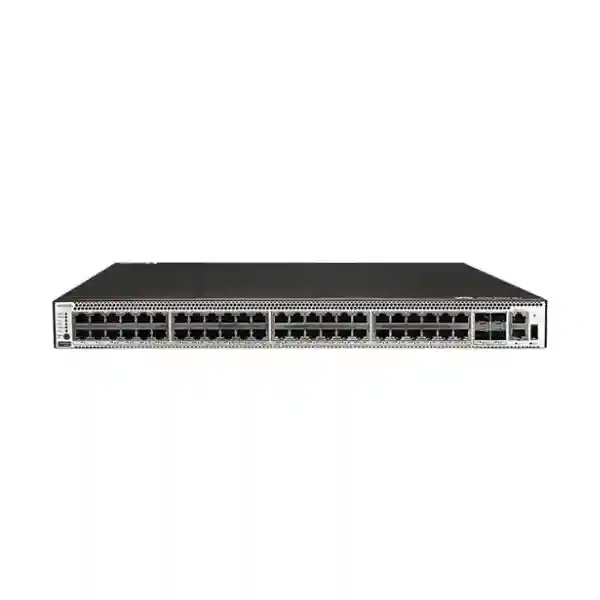
Huawei CloudEngine S5736-S48UM4XC
High-density Multi-Gigabit switching for modern wireless-first campuses, demanding access layers, secure enterprise segmentation, resilient uplinks, and operationally efficient networks.
Huawei CloudEngine S5736-S48UM4XC Overview
The Huawei CloudEngine S5736-S48UM4XC belongs to the CloudEngine S5736-S campus switching family and is aimed at enterprise access designs that require substantially more edge bandwidth than traditional 1GbE switches can deliver. In practical campus engineering terms, the model is relevant when access points, workstations, local servers, collaboration systems, imaging devices, content-creation endpoints, surveillance systems, or specialist appliances can generate sustained traffic above 1 Gbit/s or can benefit from multiple negotiated Ethernet rates without replacing the installed copper plant immediately. The platform fits the architectural gap between conventional fixed-Gigabit access switches and more expensive data-center-class switching by bringing Multi-Gigabit connectivity, enterprise Layer 2 and Layer 3 functions, high-speed uplink options, Huawei VRP software capabilities, and centralized operational visibility into a campus-oriented form factor.
For UAE organizations, the value proposition is not simply the number printed on an Ethernet port. A useful design asks whether the access layer can keep up with current wireless AP radio capacity, whether uplinks can be engineered without chronic oversubscription, whether the switch can participate in a resilient campus topology, whether the operating model supports consistent configuration and telemetry, and whether the selected power system can sustain peak PoE demand. The S5736-S family is built around Huawei’s Versatile Routing Platform and is associated with enhanced Layer 3 services, mature IPv6 capabilities, simplified operations and maintenance, flexible Ethernet functions, intelligent campus integration, and stacking technologies. Those attributes allow network teams to standardize switching behavior from individual access closets through larger aggregation domains.
The exact factory bill of materials, power module combination, license entitlement, port-speed activation, supported interface module, feature availability, and software release should always be confirmed against the current Huawei ordering guide for the specific S5736-S48UM4XC shipment. Huawei public regional pages expose extensive S5736-S family information but do not consistently publish a dedicated S48UM4XC specification page in every region. FourTeck therefore validates the quotation BOM rather than assuming that every capability associated with another S5736-S submodel is automatically present in a given hardware revision.
High-Density Edge
Designed for dense campus access where many endpoints require more than ordinary 1GbE and where wireless APs can drive multi-gigabit aggregate throughput.
Enterprise VRP
Huawei VRP provides a consistent software foundation for switching, routing, IPv6, policy, security, management, stacking, and campus operational workflows.
Resilient Campus Design
Supports architectures that use redundant uplinks, link aggregation, spanning-tree controls, gateway redundancy, and switch virtualization or stacking where licensed and supported.
Operational Visibility
Telemetry, SNMP, logs, diagnostic functions, traffic statistics, and intelligent campus tools can give operations teams a clearer picture of edge health and user experience.
Why Multi-Gigabit Access Matters
The migration from 1GbE to Multi-Gigabit Ethernet at the access layer is driven mainly by a mismatch between modern endpoint capability and legacy wiring economics. Wi-Fi 6 and Wi-Fi 6E access points can offer aggregate wireless capacity that exceeds a single 1GbE wired uplink, particularly in high-density deployments with multiple radios, wide channels, efficient modulation, and many concurrently active clients. Replacing a complete horizontal copper plant only to gain more wired bandwidth can be disruptive and expensive. Multi-GE access is attractive because compatible switching can negotiate rates such as 2.5GbE, 5GbE, and in suitable cabling conditions 10GbE over twisted pair, allowing an organization to extract more value from existing structured cabling while planning longer-term Cat6A or fiber modernization.
The benefit is broader than wireless. A design studio transferring large media assets, an engineering department using network-attached storage, a healthcare site moving imaging data, a hotel deploying dense AP coverage, or a university supporting high-concurrency lecture halls may all find that 1GbE access creates a practical bottleneck. A 48-port Multi-GE switch class lets architects consolidate many high-bandwidth endpoints in one rack unit or one access-layer position instead of mixing multiple switch families. This can simplify spare strategy, configuration templates, monitoring, and rack layout.
However, Multi-GE ports should never be evaluated in isolation. Forty-eight edge interfaces capable of multi-gigabit operation can generate an enormous theoretical load, far beyond what typical campus uplinks are sized to carry simultaneously. Real engineering therefore depends on application profiles, concurrency, upstream capacity, aggregation architecture, traffic locality, PoE requirements, and failure scenarios. FourTeck approaches the S5736-S48UM4XC as part of an end-to-end topology rather than treating port count as the only sizing variable.
Port Architecture and Edge Connectivity Planning
The S5736-S48UM4XC naming is associated in channel catalogs with a high-density 48-port Multi-GE access configuration and four 10GE-class uplink interfaces. Because Huawei ordering data and regional public pages can vary, an implementation should confirm the exact negotiated speed set, PoE class, uplink media type, and any extended-slot or license-dependent function on the quoted part number. This validation matters because two switches with similar product-family names can differ materially in supported line rates, power budget, hot-swappable power options, or expansion capability.
In an access closet, port assignment should be intentional. Wireless AP ports may need Multi-GE negotiation and higher PoE classes, user workstations may only require 1GbE or 2.5GbE, local edge servers may justify 5GbE or 10GbE, and building systems may need conventional low-bandwidth Ethernet with strict VLAN isolation. Reserving port groups by endpoint role can simplify templates, troubleshooting, and power allocation. It also helps operations teams interpret interface counters quickly because ports with similar expected behavior are grouped together.
Uplinks deserve equal attention. Four 10GE-class uplinks can be used as separate routed or switched links, combined through link aggregation, or split across redundant aggregation devices depending on topology. A pair of 10GE links in an LACP bundle provides more aggregate bandwidth and physical resilience than a single uplink, but the failure behavior of the upstream devices, hashing algorithm, Layer 2 domain, gateway placement, and spanning-tree design still determine actual availability. For very high-density wireless or sustained east-west traffic, architects should calculate whether the uplink layer becomes the bottleneck before activating high rates on many access ports.
VRP Software Foundation
Huawei’s Versatile Routing Platform, commonly abbreviated as VRP, is the software foundation used across many CloudEngine enterprise switches. For network engineers, the operational significance is consistency: command-line behavior, routing constructs, interface models, policy mechanisms, logging conventions, management methods, and automation interfaces can follow a common design philosophy across access and aggregation layers. This is important in large UAE estates where a network may span headquarters, branches, warehouses, schools, hotels, retail stores, or government facilities managed by one operations team.
A mature network operating system matters most during change and fault conditions. Day-to-day forwarding can make many products look similar, but software quality becomes visible when engineers need to roll out VLAN changes, diagnose a one-way routing issue, inspect MAC movement, trace an authentication failure, analyze an unexpected spanning-tree event, or stage a software upgrade with minimal user impact. VRP provides familiar enterprise constructs for interfaces, VLANs, link aggregation, routing protocols, access control, quality of service, AAA, IPv6, and monitoring.
The software release should be treated as part of the solution BOM. Feature support is tied not only to hardware but also to the release train and license state. Before implementation, FourTeck can map the required functions to a validated VRP release, check interoperability with existing Huawei or third-party equipment, define an upgrade baseline, and document rollback procedures. This prevents a common procurement error in which hardware is selected correctly but the intended feature is unavailable in the installed software image or entitlement.
Layer 2 Switching, VLAN Segmentation, and Loop Control
A campus access switch must do far more than forward Ethernet frames. It must enforce segmentation boundaries, learn endpoint locations, prevent accidental loops, carry tagged traffic toward distribution devices, and recover predictably when links or switches fail. The S5736-S family supports mature VLAN functionality, including standard 802.1Q segmentation and common enterprise VLAN assignment methods. In a well-designed deployment, separate VLANs can be used for corporate users, voice, wireless management, employee WLANs, guest services, security cameras, building automation, printers, IoT systems, and network-management traffic.
Segmentation should correspond to policy rather than organizational charts alone. For example, putting all devices in the same department into one VLAN may create an unnecessarily large broadcast domain and weaken containment. A better design can separate trusted user endpoints from unmanaged IoT devices, isolate CCTV systems from general-purpose hosts, and keep switch management reachable only from designated administration networks. VLAN design should be coordinated with gateway placement, firewall policy, DHCP scopes, IP address management, wireless SSIDs, and identity services.
Loop prevention is equally important. Redundant Ethernet paths improve availability only if control protocols prevent forwarding loops. Huawei campus switching supports spanning-tree technologies and interoperability mechanisms designed to coexist with established enterprise networks. During migration, the root-bridge strategy, bridge priorities, edge-port configuration, BPDU protection, link aggregation, and failure timers must be reviewed before cables are moved. Incorrect spanning-tree assumptions can convert a resilience upgrade into an outage.
MAC address learning and aging are fundamental to forwarding efficiency, but MAC behavior also provides useful diagnostics. A rapidly moving MAC may indicate a physical loop, misconnected hypervisor, incorrect LAG, wireless bridging issue, or unauthorized device. Operations teams should baseline normal MAC counts and monitor unusual changes, especially when deploying large 48-port access blocks.
Layer 3 Routing and Gateway Design
The CloudEngine S5736-S family provides enterprise Layer 3 capabilities that can support static routes and dynamic routing protocols appropriate to campus designs. Huawei’s published S5736-S family information lists technologies including OSPF, OSPFv3, IS-IS, IS-ISv6, BGP/BGP4+, ECMP, and VRRP/VRRP6 on applicable models and releases. This allows an architect to decide whether the access switch should remain primarily Layer 2, terminate selected user VLAN gateways locally, or participate in a routed-access architecture.
Routed access can reduce Layer 2 fault domains and simplify convergence because each access switch or stack has a routed relationship with the aggregation layer. This approach is especially attractive in large campuses where extending many VLANs across multiple closets creates operational complexity. On the other hand, centralized gateway designs may be preferable when security inspection, policy enforcement, or mobility requirements dictate that user VLANs remain anchored upstream. There is no single correct architecture; the choice depends on scale, operational maturity, security policy, application behavior, and existing network standards.
VRRP can provide first-hop gateway redundancy where two routing nodes share a virtual gateway address. Dynamic routing can then advertise connected networks and maintain reachability during upstream path changes. ECMP can use parallel next hops in suitable designs, increasing path utilization while retaining resilience. When implementing these functions, engineers should define route summarization, metric policy, passive interfaces, authentication where available, convergence objectives, and clear boundaries between access, aggregation, core, firewall, and WAN routing domains.
FourTeck can design the S5736-S48UM4XC as a pure access switch or as part of a Layer 3 campus. The important point is to avoid enabling advanced routing simply because the platform supports it. Every routing adjacency expands the operational and security surface, so Layer 3 functions should be introduced with a documented topology and ownership model.
IPv6 Readiness and Dual-Stack Operations
IPv6 is no longer a theoretical future requirement. Many enterprise operating systems, cloud services, mobile devices, and network platforms use IPv6 natively, and poorly controlled IPv6 can exist inside a network even when the organization believes it is IPv4-only. Huawei’s S5736-S family is designed with mature IPv6 networking functions, including IPv6 routing support and IPv6 variants of major control protocols on supported software releases.
A dual-stack campus needs more than IPv6 addresses. Network teams should define router advertisements, DHCPv6 strategy, DNS behavior, first-hop security, ACL equivalents, monitoring, log interpretation, and route filtering. IPv4 and IPv6 security policies should be symmetrical enough that enabling IPv6 does not create an uninspected path around controls designed only for IPv4. Management services should also be reviewed because SNMP, SSH, NTP, syslog, AAA, and automation endpoints may become reachable over IPv6 if not explicitly restricted.
For organizations that are not ready to deploy IPv6 broadly, an IPv6-capable switch still provides value because it enables deliberate control. Engineers can suppress unwanted behavior, monitor IPv6 activity, and prepare the campus for phased adoption. When the business later needs IPv6 for cloud integration, mobile services, research networks, carrier requirements, or application modernization, the access platform does not have to be replaced merely to support the protocol family.
PoE and Power-Budget Engineering
High-density Multi-GE switching is frequently purchased for wireless APs, and that makes power engineering as important as packet forwarding. Modern Wi-Fi access points, cameras, video endpoints, access-control devices, and IoT gateways may require PoE+, PoE++, or other high-power delivery modes depending on model and feature set. A switch can have many PoE-capable ports while still being unable to deliver the maximum power class on every port simultaneously if the installed power-supply combination does not provide enough total budget.
A professional PoE calculation therefore begins with the endpoint inventory. For each powered device, record the required IEEE class or vendor specification, expected steady-state draw, peak draw, cable length, redundancy requirement, and growth allowance. Sum the realistic peak demand rather than multiplying port count by the highest theoretical per-port wattage. Then add engineering headroom for startup behavior, future AP upgrades, additional cameras, or temporary devices. If dual power supplies are planned for resiliency, verify whether the required PoE budget remains available after one supply fails; some designs retain switching functionality during a power-supply failure but shed PoE load because the remaining unit cannot sustain the original budget.
Power sourcing also affects UPS sizing. A communications room with two high-density PoE switches can draw far more power than an older 1GbE non-PoE stack. UPS runtime, breaker capacity, PDU rating, plug type, rack airflow, and heat load should be checked during design. UAE facilities may also have generator-backed circuits or centralized UPS systems, but the network team should confirm which rack sockets are truly protected rather than assuming every outlet in a telecom room is on conditioned power.
Because public documentation for the exact S5736-S48UM4XC configuration can vary by market, FourTeck confirms the selected power modules and achievable PoE budget in the quotation BOM. This avoids relying on a family-level maximum that may require a different PSU combination or hardware revision.
Wi-Fi 6 and Wi-Fi 6E Campus Integration
One of the strongest use cases for Multi-GE access is the wireless campus. Wi-Fi 6 increased efficiency through OFDMA, improved multi-user operation, and higher-density scheduling, while Wi-Fi 6E extended compatible WLANs into the 6 GHz spectrum. In dense environments, the aggregate wireless capacity of an access point can exceed a single Gigabit Ethernet backhaul, particularly when the AP serves many active clients or uses multiple high-performance radios. A Multi-GE switch lets the wired side scale with the WLAN rather than becoming the bottleneck.
Switch selection should still follow wireless design. An AP’s Ethernet capability, PoE requirement, expected client count, RF channel width, spatial streams, local application mix, and uplink concurrency determine how much wired bandwidth is useful. Connecting every AP at the highest possible Ethernet rate does not automatically improve user experience if the RF plan is poor, the Internet circuit is constrained, DNS latency is high, or the wireless controller path is congested. Conversely, a carefully designed WLAN can be held back by 1GbE edge ports in high-demand areas.
Common UAE deployments include luxury hotels with high device density, universities with lecture theatres, office towers with collaboration-heavy tenants, healthcare facilities with clinical mobility, logistics sites with handheld terminals, and retail spaces with guest Wi-Fi plus operational devices. The S5736-S48UM4XC can act as a high-density wired foundation for these environments when paired with appropriately specified APs and an uplink design that reflects real traffic patterns.
FourTeck can align switch-port templates with SSID and VLAN architecture, define management networks, confirm LLDP behavior, plan PoE budgets, choose fiber uplinks, and validate redundancy between the access layer and wireless controllers or campus gateways.
Uplink Sizing and Oversubscription Methodology
A 48-port Multi-GE switch can present a very large theoretical edge bandwidth. It would be economically inefficient to size most campus uplinks for the sum of every access port’s maximum line rate because users and APs rarely transmit at full capacity simultaneously. The correct approach is to estimate concurrency and traffic concentration, then select an acceptable oversubscription ratio for the business application.
Start by classifying ports. Wireless APs may have bursty traffic and highly variable utilization by time of day. Content-production workstations may generate large sustained transfers. CCTV cameras generate predictable upstream flows. Voice endpoints consume little bandwidth but are sensitive to delay and loss. Local servers can create substantial east-west traffic that may not traverse the uplink if they are attached to the same switch and VLAN, while centralized applications drive traffic toward the data center or firewall. These patterns should be reflected in the model rather than assigning one arbitrary utilization percentage to every port.
Next, define failure behavior. Two 10GE uplinks in an LACP bundle may provide 20 Gbit/s aggregate capacity under normal conditions, but if one link fails the bundle drops to 10 Gbit/s. If two bundles are split across different upstream switches, the logical architecture must support that design and the hashing behavior should be understood. A resilient network should remain usable during a failure, even if it temporarily operates at a higher oversubscription ratio.
Monitoring after deployment is essential. Interface utilization, queue drops, error counters, buffer pressure, and application experience should be reviewed during peak periods. If the uplink is consistently congested, the remedy may involve additional uplink capacity, local routing changes, traffic engineering, or application redesign. Buying a Multi-GE switch is the beginning of capacity planning, not the end.
iStack and Logical Switch Simplification
Huawei campus platforms commonly support iStack capabilities that allow multiple physical switches to operate as a logical system where the exact model, cards, software, and license state support the feature. Stacking can simplify operations because engineers manage one logical device rather than several independent switches. It can also support cross-member link aggregation, which is useful when a server, access point controller, or upstream aggregation switch needs physically diverse links without relying on spanning tree to block one path.
Stacking should be engineered rather than enabled by habit. The stack topology, bandwidth, member roles, master election behavior, split-brain protection, cabling, and software compatibility need to be documented. Large stacks can reduce device-count complexity but increase the failure domain of a software upgrade or control-plane event. Smaller stacks can provide a good balance between manageability and containment. Some organizations prefer independent switches with routed uplinks because that design creates clearer fault boundaries.
For a high-density model such as the S5736-S48UM4XC, stacking can be attractive in telecom rooms that require 96 or more edge ports. A two-member design can present a large access block and distribute uplinks across members. The physical layout should keep stack or interconnect cabling short, labeled, protected from accidental removal, and accessible without obstructing power supplies or fiber management.
FourTeck validates the supported stack method and bandwidth for the exact hardware revision, then builds a configuration plan covering member numbering, priority, software alignment, uplink distribution, management addressing, and rollback procedures. This is particularly important when adding a new switch to an existing stack because incompatible software can prevent a clean join or trigger an unexpected upgrade process.
Security Controls at the Access Layer
The access switch is the first network infrastructure device many endpoints touch, making it a critical enforcement point. Security architecture should prevent unauthorized hosts from casually gaining trusted network access, limit the impact of compromised devices, protect control protocols, and restrict management-plane exposure. Huawei enterprise switching provides mechanisms that can support 802.1X authentication, MAC-based controls, ACLs, DHCP protection, ARP-related protections, port isolation, storm control, and secure management practices depending on software and license.
802.1X can integrate the switch with a RADIUS-based identity system so wired devices or users authenticate before receiving normal network access. Where legacy devices cannot support 802.1X, MAC-based authentication or dedicated restricted VLANs may be used, but these methods should be understood as weaker and should be paired with segmentation. Dynamic authorization can make access policy more granular than static port configuration if the identity platform and switch software are designed together.
DHCP snooping and related first-hop protections help defend against rogue services and address-spoofing attacks. ACLs can restrict management subnets, block unwanted east-west traffic, or enforce basic policy before traffic reaches an upstream firewall. Port security and isolation can reduce lateral movement among devices sharing the same switch. BPDU protection can stop an accidental user-connected switch from influencing spanning-tree topology.
The management plane requires special attention. Disable insecure services that are not needed, prefer SSH and secure management protocols, use AAA with named administrative accounts, restrict source IP ranges, synchronize time using authenticated or trusted NTP sources, send logs to a centralized collector, and maintain configuration backups. SNMPv3 should be preferred when operational platforms support it because it provides stronger authentication and privacy than older SNMP versions.
Security hardening should be tested against operational requirements. An overly aggressive access policy can block phones, printers, cameras, or APs during rollout. A phased deployment using monitor modes, exception inventories, and controlled change windows reduces risk.
Quality of Service for Voice, Video, Wireless, and Business Applications
Bandwidth alone does not guarantee application quality. Voice packets, interactive video, transactional systems, bulk backups, software updates, and guest Internet traffic have different sensitivity to delay, jitter, loss, and throughput. Quality of Service allows the network to classify traffic, mark or trust priority values, queue packets intelligently, and police or shape selected flows so that congestion affects lower-priority traffic before it disrupts latency-sensitive services.
At the access layer, trust boundaries are crucial. A user device should not automatically gain priority simply because it marks its own traffic as high priority. Network policy can trust markings from known IP phones or wireless infrastructure while re-marking untrusted endpoints. Queue scheduling should be configured consistently across access and aggregation devices; otherwise packets may receive priority on one hop and lose it on the next.
Wireless networks add another layer because the WLAN has its own airtime scheduling and QoS mechanisms. Mapping wireless classes to wired DSCP or 802.1p markings should be deliberate. Guest traffic may be rate-limited or assigned lower priority, while voice and collaboration applications can receive preferential handling. CCTV traffic is usually steady and bandwidth-intensive but may not need the same latency treatment as voice.
QoS should be driven by observed congestion and business requirements. Configuring a complex policy on an uncongested network can create troubleshooting complexity without delivering measurable benefit. FourTeck can build a class model, identify trust boundaries, align wired and wireless policy, and validate behavior under controlled load before production rollout.
Telemetry, Monitoring, and Intelligent O&M
Traditional network monitoring relies heavily on periodic SNMP polling and syslog. Those tools remain useful, but modern campus operations increasingly require higher-frequency telemetry, event correlation, user-experience visibility, and automation. Huawei’s CloudEngine campus portfolio supports telemetry-oriented operations and can integrate with Huawei management and analysis platforms on compatible releases. The purpose is to shorten the time between a user-impacting condition and an actionable diagnosis.
For example, a user reporting that Wi-Fi is slow may actually be experiencing packet drops on a wired uplink, a duplex or physical-layer error, a saturated queue, an authentication delay, or a routing problem. If the switch exports detailed counters and events to a monitoring platform, operations staff can correlate interface utilization, errors, MAC movement, route changes, CPU load, PoE state, and device alarms around the time of the complaint. This is more efficient than logging into multiple switches after the event and hoping the condition is still present.
A monitoring design should collect only what the team can operationalize. High-frequency telemetry can generate substantial data. Retention, dashboard design, alert thresholds, ownership, and escalation procedures should be defined. Baselines are valuable because a 60 percent uplink load may be perfectly normal for one site and a serious anomaly for another.
FourTeck can integrate the S5736-S48UM4XC into existing monitoring using SNMP, syslog, NTP, configuration backup, and supported telemetry or automation interfaces. For organizations modernizing campus operations, we can also define KPIs such as uplink utilization, error rate, PoE headroom, authentication success, device availability, route stability, and configuration compliance.
Resiliency: Power, Links, Devices, and Control Plane
Resilience is achieved by removing single points of failure that matter to the business. Installing two uplink cables does not create a resilient network if both terminate on the same upstream line card, follow the same fiber path, or depend on one power circuit. Likewise, a switch with dual power supplies provides limited value if both supplies are connected to one PDU. Availability engineering must consider the whole path from endpoint through access switch, aggregation, core, firewall, WAN, and application service.
For the S5736-S48UM4XC, a resilient design may include redundant PSUs where supported, diverse power feeds, dual uplinks, LACP, stacking or multi-device topology, VRRP for gateways, dynamic routing, and redundant upstream devices. Each mechanism addresses a different fault. LACP helps with link failure; it does not protect against an upstream switch failure unless the architecture supports links across different logical members. VRRP protects a default gateway address but does not automatically repair a broken Layer 2 path. Dynamic routing can reconverge around a failed routed link but cannot overcome a common power failure in the access room.
Maintenance resilience is also important. A network that survives hardware failure but requires a full-site outage for every software upgrade may not meet operational expectations. The upgrade strategy should consider stack behavior, redundancy, ISSU support where applicable, maintenance windows, configuration checkpoints, image storage, and rollback.
FourTeck uses a failure-mode review during solution design: power supply failure, PDU failure, uplink failure, aggregation failure, stack-member failure, software reboot, fiber cut, configuration error, and upstream service loss. The resulting design can then be matched to the organization’s actual availability objective rather than an abstract list of redundancy features.
Campus Topology Option 1: Layer 2 Access with Centralized Routing
In a traditional campus, the S5736-S48UM4XC can operate mainly as a Layer 2 access switch. User and device VLANs are carried upstream to distribution switches, where default gateways and routing policy reside. This model is familiar, easy to understand, and can integrate smoothly with existing campus architectures. It is particularly suitable when firewalls, wireless controllers, or centralized policy systems expect VLANs to terminate upstream.
The key design issue is controlling Layer 2 scope. Extending the same VLAN through many telecom rooms can enlarge broadcast domains and create dependence on spanning tree. A better implementation keeps VLANs local to a building, floor group, or functional area unless mobility or application requirements justify wider extension. Redundant uplinks can use LACP when the aggregation layer presents a single logical endpoint, or spanning-tree mechanisms when the upstream devices are independent and the design requires blocked backup paths.
This topology is often a sensible migration path because existing IP addressing and gateway configuration can remain stable while the access layer is upgraded to Multi-GE. It allows organizations to modernize edge capacity first and later consider routed access if scale or convergence requirements change.
Campus Topology Option 2: Routed Access
Routed access moves the Layer 3 boundary closer to users. The access switch terminates selected VLAN interfaces and forms routed adjacencies toward aggregation. This reduces Layer 2 extension, can speed convergence, and gives each access block a clear routing boundary. The approach works well in larger campuses where network teams want deterministic paths and smaller fault domains.
OSPF or another supported routing protocol can advertise access subnets toward the core. ECMP may use multiple routed uplinks where the architecture allows it. First-hop redundancy can be provided within a logical stack or across a pair of devices depending on design. Policy must then determine where inter-VLAN traffic is filtered. Some organizations route locally for performance but send sensitive traffic through a firewall; others use upstream segmentation gateways.
Routed access requires disciplined IP planning, route summarization, automation, and monitoring. Each closet becomes part of the routing system, so misconfiguration can have broader impact. For teams with mature change control and standardized templates, the operational benefits can be substantial.
Campus Topology Option 3: Wireless-First High-Density Access
A wireless-first deployment treats the switch primarily as the power and transport layer for a dense AP estate. Port planning begins with the AP map rather than desk count. Each AP’s negotiated Ethernet speed, PoE draw, management VLAN, user-tunnel architecture, and controller path are recorded. Uplinks are then sized from aggregate AP demand and failure conditions.
This model is common in hotels, higher education, conference environments, healthcare, and modern offices where user connectivity is predominantly wireless. The access switch may still serve cameras, phones, meeting-room systems, and local wired users, but the WLAN determines the power and bandwidth envelope. Monitoring should correlate wired interface health with wireless performance so operations teams can distinguish RF problems from switch or uplink problems.
A high-density switch can reduce rack count, but power and thermal design become more important. If many APs use high PoE classes, the PSU and UPS must be sized for realistic peak load. Copper certification should confirm that installed links can sustain the desired Multi-GE rates.
Structured Cabling for 2.5G, 5G, and 10G Edge Rates
Multi-Gigabit Ethernet can extend the life of existing twisted-pair cabling, but cabling quality still determines achievable performance. Older Cat5e links may support 2.5GbE or 5GbE in many environments, while 10GBASE-T is most predictable on Cat6A within standards-based channel limits. Cat6 performance at 10GbE depends on length and alien crosstalk conditions. Patch panels, keystone jacks, patch cords, bundling, termination quality, and electromagnetic environment all affect the link.
Before a large Multi-GE rollout, representative cable certification is recommended. Do not assume a cable labeled Cat6 is compliant because field termination may be the weakest point. For APs mounted above ceilings, long horizontal runs plus patching at both ends can approach channel limits. Power delivery can also raise cable-bundle temperature, which should be considered in dense PoE installations.
The switch should be configured to negotiate appropriate rates rather than forcing an unsupported speed. If an AP expected to connect at 5GbE repeatedly negotiates at 1GbE, investigate cabling, patch leads, endpoint NIC capability, and switch configuration before treating the problem as a software fault. Interface counters such as CRC errors can reveal marginal physical links.
FourTeck can coordinate switch deployment with structured-cabling partners and provide a port schedule that maps switch interfaces to patch-panel positions, AP identifiers, endpoint classes, VLANs, and expected negotiated speeds.
Fiber Uplinks and Optics Selection
The uplink optic must match distance, fiber type, connector standard, wavelength, and peer interface. For short in-building links, multimode fiber with suitable 10G SR optics is often economical. Longer campus or building-to-building links typically use single-mode fiber with LR or longer-reach optics. Direct-attach copper can be appropriate for very short rack-to-rack or same-rack connections when both devices support the cable type.
Optics selection should not be based only on reach. Verify optical power budget, patch-panel losses, number of splices, fiber grade, connector cleanliness, and whether existing links are multimode or single-mode. Bidirectional optics and wavelength-division designs can conserve fiber strands in constrained environments, but they introduce pairing requirements and should be documented carefully.
For redundant uplinks, physical route diversity matters. Two fibers in the same cable tray or the same multi-core cable may fail together if the pathway is cut. Critical sites should consider diverse risers, separate building entrances, or physically independent paths where facilities allow it.
FourTeck can supply the switch together with compatible transceivers, DACs, patch cords, fiber accessories, and labeling. The quotation should identify both ends of every optical link so that the optic type, connector, and speed are consistent with the upstream Huawei or third-party device.
Network Automation and Configuration Consistency
A high-density campus can contain thousands of access ports, making manual configuration a major source of risk. The S5736-S family can participate in Huawei campus automation and management workflows depending on software and controller architecture. Even without a full intent-based platform, organizations can improve consistency through standardized CLI templates, configuration version control, centralized backups, naming conventions, and automated compliance checks.
A useful access template defines management services, NTP, AAA, syslog, SNMP or telemetry, spanning-tree defaults, edge-port protections, VLAN naming, uplink configuration, QoS policy, PoE behavior, authentication controls, and interface descriptions. Site-specific variables such as management IP, hostname, uplink address, or VLAN IDs can then be inserted in a controlled manner. This reduces configuration drift across buildings.
Automation should include verification, not just deployment. After a change, the system should confirm that expected VLANs exist, interfaces are up, routing adjacencies are established, no unexpected loop state has appeared, power budget is healthy, and management systems can reach the device. A fast automated rollback is valuable when a change produces abnormal results.
Management Access, AAA, Logging, and Time Synchronization
Operational security begins with knowing who changed what and when. Switch administrators should authenticate through a centralized AAA platform where practical, with individual accounts rather than shared passwords. Local accounts can remain as controlled emergency access, stored securely and tested periodically. Authorization levels should reflect job function so that monitoring staff do not automatically receive full configuration privileges.
SSH should replace Telnet for command-line access. Web management, if used, should be restricted to trusted administration networks and secured with supported HTTPS settings. Management-plane ACLs should permit only approved subnets or jump hosts. Out-of-band management is ideal for critical sites, but where it is unavailable, a dedicated management VLAN with upstream filtering is preferable to exposing device administration interfaces to general user networks.
Accurate time synchronization is indispensable. Syslog messages, authentication records, routing events, and security alerts are difficult to correlate when device clocks differ. Use reliable NTP sources and a consistent timezone policy. Central syslog should retain enough history for troubleshooting and security review. Configuration backups should be taken automatically after approved changes and tested for readability.
These practices are simple compared with advanced network features, yet they often determine how quickly an outage is diagnosed. A switch with excellent forwarding performance can still be operationally fragile if administrators cannot reconstruct a change history or reach the device securely during an incident.
UAE Environmental, Power, and Rack Considerations
Enterprise switches are normally installed in conditioned rooms, but telecom closets across the UAE can vary significantly. Some are purpose-built with redundant cooling; others are converted utility rooms where temperature rises rapidly when a fan coil fails. High-density PoE switching increases heat output because the switch electronics and power conversion for connected devices both draw energy. The room should be designed for the realistic heat load of all switches, UPS systems, patch panels, routers, and adjacent equipment.
Airflow direction must match rack design. Front and rear clearances should allow unobstructed intake and exhaust. Dense copper bundles should not block vents. Patch cords should be managed with horizontal and vertical organizers so that power supplies and fans remain serviceable. If the switch uses hot-swappable components, technicians need enough rear access to replace them without removing neighboring cables.
Power planning should confirm socket type, circuit capacity, UPS feed, generator coverage, and PDU redundancy. Two power supplies connected to one PDU provide PSU redundancy but not feed redundancy. Where dual electrical paths are available, each PSU should connect to a separate protected source. UPS runtime calculations must include PoE load, not only the switch chassis consumption.
Dust is another practical concern, particularly in industrial, warehouse, or construction-adjacent sites. Filters and room pressurization should be managed at the facility level, and routine maintenance should include inspection of vents and environmental alarms. For sites that exceed standard enterprise operating conditions, an industrialized switch family may be more appropriate than a conventional campus model.
Use Case: Corporate Offices and Headquarters
Modern office networks combine high-density Wi-Fi, video conferencing, cloud applications, IP phones, printers, meeting-room systems, smart-building devices, and specialist wired workstations. A high-density Multi-GE access switch can support this mix while allowing the organization to reserve faster ports for APs and bandwidth-intensive users. Segmentation keeps corporate, guest, voice, IoT, and facilities traffic separated even when they share the same physical switch.
For headquarters, resilience is usually more important than raw port count. Access switches can uplink redundantly to a distribution pair, with gateway redundancy and dynamic routing upstream. High-priority collaboration traffic can receive QoS treatment, while guest Internet is isolated and rate controlled. Telemetry helps operations teams diagnose whether a reported collaboration problem originates on the local port, wireless AP, uplink, WAN, or cloud service.
The S5736-S48UM4XC class is especially relevant where one floor has many APs and high-performance endpoints. A 48-port density can reduce the number of chassis required, but designers should avoid concentrating too many critical users on one failure domain without suitable redundancy.
Use Case: Hotels, Hospitality, and Large Venues
Hospitality networks have unusual density and service diversity. Guest-room APs, corridor APs, IPTV, phones, cameras, access control, point-of-sale systems, digital signage, building automation, and staff devices may all converge on the same access infrastructure. A Multi-GE switch can provide headroom for modern APs in conference areas, ballrooms, lobbies, restaurants, and premium spaces where device density is high.
Segmentation is essential because guest devices must not gain access to property systems. VLANs, ACLs, firewalls, WLAN policy, and identity controls should create clear trust zones. PoE planning must account for APs, cameras, phones, and door devices simultaneously. In a hotel with hundreds of powered endpoints, inaccurate power assumptions can cause service disruption during peak demand or after a PSU failure.
Operational simplicity is equally important. Hospitality IT teams need rapid identification of a faulty room port or AP without sending engineers through guest areas unnecessarily. Consistent interface descriptions, centralized monitoring, PoE status visibility, and remote diagnostics can reduce mean time to repair.
Use Case: Education and Campus Environments
Universities, schools, and training centers can generate extreme concurrency. Lecture halls may contain hundreds of wireless devices, laboratories may move large datasets, media departments may use high-bandwidth storage, and dormitory networks may experience heavy evening demand. A 48-port Multi-GE access switch class allows dense AP deployments and fast wired connections while keeping the access architecture standardized.
Education also introduces diverse security profiles: managed staff devices, student BYOD, research equipment, guest access, cameras, printers, and building systems. Identity-aware access and VLAN segmentation help keep these groups separated. IPv6 readiness may be more important in research environments where institutions participate in advanced networks or require native IPv6 services.
Because academic buildings often have legacy cabling, Multi-GE can be a pragmatic modernization path. Cable certification can identify which runs support 2.5GbE, 5GbE, or 10GbE, allowing investment to be prioritized instead of replacing every cable immediately.
Use Case: Healthcare and Clinical Networks
Healthcare access networks carry a mix of clinical workstations, imaging systems, wireless medical devices, staff mobility, voice, cameras, building systems, and patient or guest connectivity. The engineering priority is predictable availability and segmentation rather than maximum benchmark throughput. Multi-GE access can help where imaging, local data transfer, or dense Wi-Fi demands exceed 1GbE, while Layer 3 and policy functions support separation of clinical and non-clinical traffic.
Change control should be conservative because many endpoints are operationally sensitive. Authentication and NAC policies need exception handling for devices that cannot run standard supplicants. Maintenance windows, configuration backups, and tested rollback are important. Redundant power and uplinks can reduce single points of failure, but critical workflows should also consider upstream firewalls, wireless controllers, DNS, DHCP, and application servers.
For healthcare deployments, FourTeck can work from an approved port matrix so each endpoint category receives the correct VLAN, QoS, authentication behavior, and monitoring profile.
Use Case: Retail, Warehousing, and Logistics
Retail and logistics sites often combine wireless handheld terminals, scanners, point-of-sale devices, cameras, access control, label printers, back-office PCs, digital signage, and automation equipment. Reliability and rapid remote support matter because many locations have limited on-site IT staff. A standardized CloudEngine access design can make branch configurations easier to monitor and replicate.
In warehouses, AP density and placement are driven by aisle geometry, racking, mobility, and RF reflection. Multi-GE uplinks to high-performance APs can remove wired bottlenecks in busy zones. PoE simplifies AP and camera installation, but long cable runs and harsh environmental conditions require careful certification and enclosure planning. If a telecom location is exposed to temperature extremes, vibration, or dust outside enterprise specifications, an industrial switch should be considered.
Retail environments also benefit from strict segmentation. Payment systems, guest Wi-Fi, corporate devices, cameras, and IoT should not share an unrestricted broadcast domain. The switch can enforce access policy locally while upstream firewalls provide deeper inspection.
Migration from Legacy 1GbE Access Switching
Replacing an access switch is deceptively simple when viewed as a hardware task and surprisingly complex when viewed as a service migration. A legacy switch may contain years of undocumented interface exceptions, voice VLAN settings, static MAC bindings, security rules, trunk allowances, QoS policies, spanning-tree priorities, and management integrations. Copying configuration line by line to a new platform can preserve obsolete design decisions; rebuilding from scratch can miss hidden dependencies. A controlled migration balances both risks.
The first phase is discovery. Export the current configuration, MAC table, ARP table where relevant, LLDP neighbors, VLAN list, port status, PoE status, error counters, and uplink topology. Compare interface descriptions with physical patching. Identify ports that have been down for months and determine whether they still need to be migrated. Record endpoint speed and duplex negotiation to identify cabling problems before the change.
Next, build a target configuration from standards, not from a blind copy. Preserve required VLANs and policies but apply current security defaults, naming conventions, AAA, logging, NTP, and monitoring. Test the configuration in staging if possible. During the change, migrate uplinks first only when the rollback method is clear, or pre-stage the new switch in parallel and move access ports in controlled batches. Validate DHCP, DNS, gateway reachability, voice, wireless AP adoption, PoE, and critical applications after each batch.
Post-migration, compare interface error rates and negotiated speeds. A new Multi-GE switch can expose marginal copper that an older 1GbE switch tolerated. Keep the old configuration and port map until the new environment has passed an agreed stability period.
Sizing the S5736-S48UM4XC for Your Environment
A correct switch size is determined by more than available ports. Begin with port count and growth. If a closet requires 43 ports today, a 48-port switch leaves little room for new APs, cameras, or temporary devices. A second switch or a larger access block may be more sensible even if the first-day utilization looks inefficient. Conversely, a site with only 18 active endpoints may not need a high-density 48-port Multi-GE platform unless major expansion is planned.
Next, classify speed requirements. Count how many devices genuinely need 2.5GbE, 5GbE, or 10GbE. Many printers, phones, and IoT devices remain well below 1GbE and do not justify premium high-speed ports by themselves. The business case for the S5736-S48UM4XC becomes stronger as the proportion of high-bandwidth APs and workstations increases.
Then calculate PoE. List every powered device and its peak requirement, add growth, and confirm that the chosen PSU combination can deliver the result even under the desired redundancy scenario. Size UPS runtime from the same figure. Finally, model uplink traffic under normal and single-failure states. A switch should not be selected simply because its edge ports are fast if the network cannot carry the resulting traffic upstream.
FourTeck can convert this data into a bill of materials covering switches, power supplies, optics, cables, stack components, licenses, rack accessories, and services. The goal is to quote a deployable system rather than a bare chassis that later requires unplanned accessories.
Licensing and Right-to-Use Planning
Huawei campus platforms may use feature or port-speed licensing depending on model and software generation. The S5736-S family is associated with flexible Ethernet concepts in which some capabilities can be activated through Right-to-Use licensing. The exact entitlement for S5736-S48UM4XC must be checked against the ordering guide and software release because assumptions based on another family member can lead to a mismatch between purchased hardware and expected port behavior.
Licensing should be documented as part of the network design. Record the license identifier, scope, quantity, activation method, account ownership, renewal requirement if any, and the operational effect if a license is absent or expires. Store entitlement records with the asset inventory so future engineers understand why a port or feature is limited.
When requesting a quotation, specify required edge speeds, Layer 3 functions, management platform integration, stacking, and any advanced services rather than asking only for the switch model. FourTeck can then validate whether the base hardware includes the needed capability or requires an additional entitlement.
Interoperability with Existing Networks
The S5736-S48UM4XC may be introduced into a Huawei-only campus or a mixed-vendor network. Standards-based Ethernet, VLANs, LACP, spanning tree, IP routing, VRRP, LLDP, RADIUS, SNMP, and common optical standards make multi-vendor operation possible, but interoperability should still be tested at feature boundaries. Vendor-specific enhancements, proprietary discovery protocols, spanning-tree variants, transceiver validation, and stacking mechanisms may not behave identically.
During a migration from Cisco, Aruba, HPE, Juniper, Extreme, or another platform, map features conceptually rather than translating command syntax directly. A voice VLAN mechanism or spanning-tree optimization may have a different default behavior. Link aggregation requires matching LACP mode, member speed, VLAN tagging, and MTU. Dynamic routing requires aligned timers, authentication, area design, route filtering, and metrics. SNMP object identifiers and telemetry formats may differ, requiring monitoring-system updates.
FourTeck can stage representative interoperability tests before a large rollout. This is particularly valuable for critical uplinks, NAC integration, IP phones, wireless systems, and third-party optics where a small compatibility issue can affect hundreds of endpoints.
Performance Validation After Deployment
A successful installation is not confirmed merely because link LEDs are green. Post-deployment validation should demonstrate forwarding, resilience, power, and management behavior. Start with physical checks: expected ports are up, negotiated speeds match design, no abnormal CRC or symbol errors appear, optics show healthy levels where monitoring is available, and PoE devices receive the expected power class.
Then validate logical services. Check VLAN assignment, DHCP, DNS, default-gateway reachability, Layer 3 routing adjacencies, ACL behavior, authentication, voice registration, AP adoption, and management access. Test redundancy intentionally during an approved window by removing one uplink, failing one power feed, or rebooting a stack member according to the architecture. Measure the resulting user impact rather than assuming the protocol configuration behaves as expected.
Performance tests should reflect real applications. Synthetic throughput tools can confirm basic capacity, but a campus is more sensitive to packet loss, latency, jitter, and microbursts than to a single headline throughput number. Monitor uplink utilization and queue drops while representative user activity occurs. If a 20 Gbit/s aggregate uplink rarely exceeds 3 Gbit/s, the design has comfortable headroom; if it reaches sustained saturation during backups, traffic scheduling or additional capacity may be needed.
Document the baseline once the network is stable. Future troubleshooting becomes easier when engineers can compare a fault condition with known-good CPU utilization, memory, interface traffic, PoE budget, route counts, and error rates.
Software Lifecycle, Patching, and Change Management
Switch software is part of the organization’s security and availability posture. A stable campus should run a vendor-supported release appropriate to the deployed features, not simply the newest image or the version that happened to ship with the hardware. New releases may fix vulnerabilities and defects but can also change behavior. The upgrade process should therefore include release-note review, compatibility checks, configuration backup, image verification, maintenance planning, and a rollback path.
For stacked or redundant environments, determine whether an upgrade requires simultaneous reboot, supports staged behavior, or changes stack compatibility. Confirm boot variables and available flash space before copying images. Preserve console or out-of-band access for critical sites in case management connectivity is lost during restart.
Configuration changes deserve similar discipline. Use tickets or change records, peer review for high-risk modifications, pre-change snapshots, validation commands, and explicit rollback conditions. Automation can help ensure consistency, but automated errors can also propagate rapidly; templates and scripts should be tested on a small scope first.
FourTeck can provide deployment documentation, baseline configuration, upgrade planning, and ongoing managed network support through FourTeck IT Services UAE where project scope requires continued operational assistance.
Procurement and BOM Validation in the UAE
Enterprise network procurement should identify the complete deployable BOM. The switch chassis is only one line item. Depending on the project, the solution may require AC or DC power modules, redundant PSUs, fans, stack components, transceivers, direct-attach cables, fiber patch cords, power cords, rack hardware, licenses, support services, and spare units. Omitting these items can delay installation even when the chassis itself is available.
For the Huawei CloudEngine S5736-S48UM4XC, FourTeck validates the exact regional SKU, hardware revision, power options, supported interface speeds, software baseline, license needs, and accessory compatibility before final quotation. This is especially important because public product-family information can span multiple submodels with different physical interfaces and performance figures. The quotation should therefore be treated as the authoritative project BOM rather than a generic family summary.
UAE deployments may also require coordination across Dubai, Abu Dhabi, Sharjah, Ajman, Ras Al Khaimah, Fujairah, and Umm Al Quwain. Stock availability, lead time, project staging, site access, and installation windows can influence the delivery plan. For multi-country organizations, FourTeck can also coordinate broader sourcing through FourTeck Global, while UAE product and integration requirements can be handled through FourTeck UAE.
Always include the required support term and replacement expectations in the request for quotation. A mission-critical switch may justify on-site spare hardware or accelerated support even if the manufacturer warranty is adequate for ordinary branch use.
Firewall, Segmentation, and Secure Campus Integration
The access switch and firewall serve different security roles. The switch is excellent for local segmentation, authentication, first-hop protections, and routing policy, while a next-generation firewall provides deeper application inspection, threat prevention, Internet security, VPN, and policy enforcement between sensitive zones. A secure campus uses both layers intentionally rather than expecting one device to perform every function.
For example, guest Wi-Fi can enter a dedicated VLAN on the S5736-S48UM4XC, traverse a controlled path to the firewall, and reach only the Internet. Cameras can be isolated from user devices and permitted to communicate only with recording servers. Building-management systems can be restricted to their controllers and administration hosts. Corporate users can access internal applications according to identity and firewall policy. Management traffic from network devices can be placed in a protected infrastructure segment.
This architecture reduces lateral movement and makes troubleshooting easier because each traffic class has a known path. It also supports phased policy improvement: basic VLAN separation can be implemented first, followed by 802.1X, dynamic authorization, micro-segmentation, or more granular firewall rules as operational maturity increases.
For integrated security projects, FourTeck can align switching with firewall architecture through the specialist Firewall Dubai practice, ensuring that VLAN IDs, routed interfaces, DHCP, NAC, wireless networks, and security zones are designed as one system.
Technical Specification Interpretation
When comparing enterprise switches, published specifications should be read carefully. Switching capacity is an internal bandwidth figure and may be presented as one value for current hardware and another system capability figure depending on vendor convention. Forwarding performance is usually expressed in millions of packets per second and reflects packet-processing capability. Neither number alone guarantees application performance because buffers, traffic mix, uplink design, software features, and oversubscription all affect real behavior.
Port count also needs context. A switch advertised as 48-port Multi-GE may support a defined set of negotiated rates, but the exact rates, license requirements, and PoE behavior must be confirmed for the specific SKU. Uplink ports can differ by transceiver form factor and supported speed. Expansion slots may accept different modules, but using one module can impose restrictions on another interface depending on hardware architecture.
MAC table size, VLAN count, ARP or neighbor entries, route scale, ACL resources, multicast scale, and stacking limits become relevant in large networks. Resource limits are not always independent: enabling one feature can consume shared hardware tables used by another. For ordinary access deployments these ceilings may never be approached, but architects designing large routed campuses should validate scale against the intended software release.
FourTeck uses vendor ordering guides, release documentation, and project requirements to validate technical fit. This page describes the role and design considerations of the S5736-S48UM4XC class without substituting for the final BOM validation required before purchase.
What to Provide for an Accurate Quotation
A good quotation is faster when the network requirement is specific. Provide the number of switches, site location, required delivery date, existing network vendor, number of active ports, expected number of Multi-GE devices, AP models, PoE requirements, uplink speed, uplink distance, fiber type, redundancy expectation, routing requirement, stack requirement, management platform, support term, and any mandatory software features. If replacing an existing switch, include its model and a sanitized interface summary if available.
For wireless projects, provide the AP count per closet and each AP’s Ethernet and power specification. For fiber uplinks, state whether the path is multimode or single-mode and the approximate distance. For resilient designs, indicate whether dual aggregation switches and dual power feeds already exist. For routed access, include the preferred routing protocol and IP addressing standard.
This information allows FourTeck to confirm whether the S5736-S48UM4XC is the best fit, identify required optics and power modules, and avoid quoting accessories that are unnecessary or omitting components that would block deployment.
Decision Recap: When the S5736-S48UM4XC Makes Sense
Choose It for Density
A strong fit when one access block must serve many high-bandwidth APs or endpoints and a 48-port Multi-GE format can reduce chassis count.
Choose It for Campus Features
Relevant when Layer 2 segmentation, Layer 3 routing, IPv6, stacking, policy, telemetry, and mature enterprise operations are part of the requirement.
Validate PoE and Uplinks
Do not select on port count alone. Confirm PSU budget, UPS capacity, uplink oversubscription, optics, cabling, and single-failure performance.
Validate Exact BOM
Confirm the precise S5736-S48UM4XC regional SKU, software, licensing, power modules, and supported port behavior before purchase.
Quotation Input Checklist
FourTeck UAE Consultation for Huawei CloudEngine Campus Switching
FourTeck can assist with S5736-S48UM4XC validation, high-density access design, wireless backhaul planning, PoE budgets, fiber optics, VLAN and routing architecture, NAC integration, migration, testing, documentation, and ongoing support. For broader enterprise networking and infrastructure requirements, visit the FourTeck UAE platform and coordinate your campus project from a single technical scope.
Before final ordering, request a validated BOM so the exact hardware revision, power modules, optics, licenses, and software features are matched to your UAE deployment.

Reviews
There are no reviews yet.