
Huawei CloudEngine Remote Unit for UAE Enterprise Networks
Huawei CloudEngine S5751-L8T2HJ-RUA
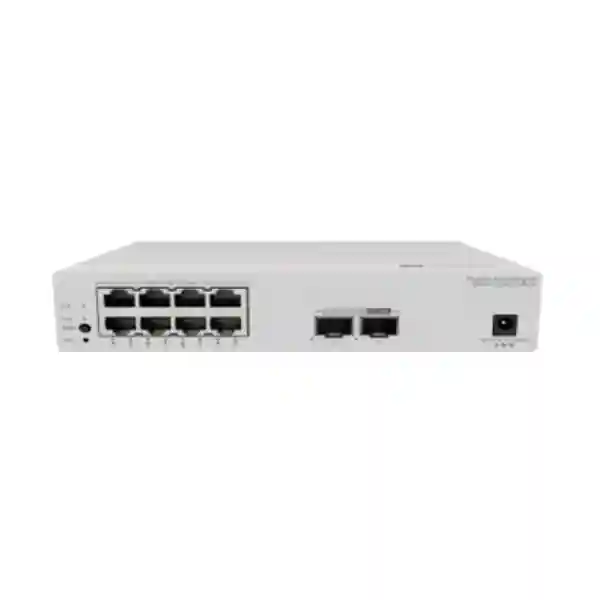
The Huawei CloudEngine S5751-L8T2HJ-RUA is a compact remote unit switch built for simplified campus architectures that extend centrally managed Ethernet access into offices, hospitality floors, classrooms, healthcare spaces, branch locations, commercial buildings, and other distributed edge environments. This exact model combines eight Gigabit Ethernet copper downlink ports with two hybrid optical-electrical SFP uplink ports operating at 100M, 1GE, or 2.5GE rates. Huawei specifies 19.5 Mpps forwarding performance and 98 Gbps switching capacity for the platform.
FourTeck positions this product as part of a complete access solution rather than as an isolated box. Correct deployment requires attention to the upstream Huawei central switch, software release, transceivers or hybrid optical-electrical components, power method, cable distance, physical mounting, port count, endpoint power requirements, redundancy objectives, and the intended operating environment. The sections below explain these decisions in practical engineering terms for UAE buyers and network teams.
Eight 10/100/1000BASE-T ports for wired endpoint connectivity. These access ports are not PoE on the L8T model.
Two hybrid optical-electrical SFP interfaces supporting 100M, 1GE, and 2.5GE uplink rates.
Huawei-rated forwarding performance with a platform switching capacity of 98 Gbps.
Power adapter, compatible hybrid power cable, or Phoenix-terminal power arrangement according to solution design.
Compact metal chassis suited to desk or wall installation in distributed access locations.
Natural heat dissipation supports quiet operation in user-adjacent environments such as offices and hotel spaces.
What the S5751-L8T2HJ-RUA Is Designed to Do
The CloudEngine S5751-L family is part of Huawei’s simplified campus architecture. Instead of treating every access switch as a fully independent device that must be planned, configured, upgraded, monitored, and troubleshot on its own, Huawei’s remote-unit concept shifts control toward a central switch. The remote unit behaves as an access-port expansion element that connects endpoints near users while the central switch provides the management anchor. This approach is intended to reduce the number of independently managed network nodes and to simplify expansion across a building or campus.
For the S5751-L8T2HJ-RUA, the design center is compact Gigabit access with hybrid 2.5GE uplinks. Eight copper ports are available for standard Ethernet endpoints such as PCs, printers, thin clients, building controllers, non-PoE cameras with local power, AV devices, kiosks, security appliances, room systems, or other IP-connected equipment. Two uplink interfaces provide 100M, 1GE, or 2.5GE SFP connectivity and are specifically identified by Huawei as hybrid optical-electrical ports. In compatible designs, that hybrid capability can carry connectivity and remote power toward the remote unit, which can reduce the need for an AC outlet immediately beside the access device.
The most important product-selection point is the letter T in this model. The eight access ports are data-only Gigabit Ethernet ports; they are not PoE access ports. Huawei offers related S5751-L variants with PoE+ access ports, but those are different SKUs. Therefore, a project that expects the remote unit to power IP phones, wireless access points, surveillance cameras, door controllers, or other powered devices directly from the eight RJ45 ports should not assume the S5751-L8T2HJ-RUA will do so. The hybrid uplink power mechanism is about powering the remote unit itself in a compatible architecture, not converting the eight downlink ports into PoE outputs.
For UAE projects, this distinction affects both bill of materials and site readiness. If endpoint PoE is required, FourTeck can help compare the PoE-enabled members of the same family, calculate endpoint power budgets, and align the access layer with the intended central switch. If endpoint devices already have local power, or if the requirement is simply to extend quiet, low-footprint Ethernet access with centralized control, the S5751-L8T2HJ-RUA can be a strong fit.
Verified Hardware and Platform Specifications
| Specification | Huawei CloudEngine S5751-L8T2HJ-RUA | Engineering Meaning |
|---|---|---|
| Downlink ports | 8 × 10/100/1000BASE-T | Eight Gigabit copper access interfaces for locally powered endpoints. |
| Uplink ports | 2 × 100M/1GE/2.5GE SFP, hybrid optical-electrical | Flexible uplink speed with support for Huawei’s compatible optical-electrical hybrid architecture. |
| Forwarding performance | 19.5 Mpps | Packet-forwarding capability appropriate to the eight-port Gigabit edge role and 2.5GE uplink design. |
| Switching capacity | 98 Gbps | Huawei platform switching-capacity specification for the remote unit. |
| PoE on downlinks | No | Endpoints that need electrical power require local power or a different PoE-capable model. |
| Power supply methods | Power adapter, compatible hybrid power cable, or Phoenix terminal arrangement | Supports flexible site placement when engineered with the correct upstream power system. |
| Dimensions | 43.6 × 195 × 160 mm | Small form factor for distributed edge locations. |
| Weight | Approximately 1.2 kg without packaging | Low mechanical load for suitable desk or wall installations. |
| Cooling | Fanless, natural heat dissipation | No fan noise and fewer moving components at user-adjacent access points. |
| Installation | Desk or wall mounting | Useful for compact telecommunications spaces and distributed access zones. |
| Operating temperature | -5°C to +45°C | The actual enclosure temperature and ventilation must stay within the supported range. |
| Relative humidity | 5% to 95%, non-condensing | Avoid condensation and maintain the installation environment within Huawei limits. |
Huawei documentation for this model also lists typical power consumption of approximately 11.14 W when powered by an adapter and approximately 13.14 W when powered through the hybrid cable. Maximum consumption figures depend on the power method. These figures are useful for cabinet thermal estimation and UPS planning, but project design should always be checked against the exact accessory, central-switch, power-source, and software combination being quoted.
Hybrid Optical-Electrical Uplinks: Why They Matter
A conventional remote access switch normally needs at least two separate services at the installation point: a data uplink and a local electrical power source. That creates practical limitations in locations where a network outlet is easy to provide but a protected AC socket is not. Huawei’s hybrid optical-electrical concept is designed to address this by combining optical data transport with electrical power delivery in a compatible hybrid-cable solution. The S5751-L8T2HJ-RUA includes two hybrid 100M/1GE/2.5GE SFP uplink interfaces and can be powered using compatible hybrid infrastructure.
The benefit is architectural flexibility. A remote unit can be positioned nearer to a cluster of users or devices, allowing shorter copper runs while the uplink traverses a longer distance back toward the central switch. Huawei describes the S5751-L remote-unit family as suitable for optical or optical-electrical hybrid connections and positions the design around centralized planning and operation. This can be valuable in hotels where access equipment may be distributed by floor or service area, in education where classroom blocks need compact access nodes, in healthcare where equipment rooms can be constrained, and in enterprise offices where network cabinets are being reduced or consolidated.
Hybrid cabling should not be treated as a generic SFP fiber deployment. The optical-electrical cable, compatible transceiver or hybrid interface, remote power source, conductor sizing, route length, termination method, upstream central-switch capability, and solution software release all need to align. UAE projects also need to consider cable containment, civil-defense requirements where applicable, low-voltage pathway standards, room temperature, fire stopping, labeling, and maintainability. A hybrid solution is most effective when those requirements are designed as a complete system rather than purchased as unrelated components.
When local AC power is already available and preferred, the S5751-L8T2HJ-RUA can also use an appropriate power adapter. Huawei additionally lists Phoenix-terminal power as an option for this model family. The right choice depends on whether the deployment values centralized remote power, local simplicity, power redundancy strategy, UPS-backed operation, cable-route length, or ease of replacement. FourTeck can scope these alternatives as part of the bill of materials.
Centralized Architecture and Operational Model
The S5751-L8T2HJ-RUA should be understood as a remote unit rather than as a traditional standalone access switch selected in isolation. Huawei’s simplified campus architecture separates the access function into central switches and remote units. The remote unit extends physical ports, while the central switch provides the primary control and management relationship. Huawei states that supported central-switch families can work with remote modules when running the required software release, and current product material references CloudEngine S16700, S12700E, S8700, S6700, and S5700 series platforms with R24C00 or later as an architecture baseline. Exact model and release compatibility should still be validated at quotation time because platform matrices and recommended software can evolve.
This operating model can simplify lifecycle management. In a conventional building with dozens of standalone access switches, each switch may require its own configuration baseline, software tracking, credentials, monitoring status, backup, and replacement procedure. With remote units, Huawei’s objective is to reduce that distributed management burden. The central switch manages connected remote units in a unified manner, and Huawei’s cloud management platform can use the central switch as the path for visualized monitoring, configuration, and inspection of attached remote units.
For operations teams, the value is not merely fewer configuration files. A central policy model can also reduce drift. Port behavior, VLAN assignment, isolation, security features, uplink aggregation, and other supported functions can be governed from the central architecture. Remote-unit replacement can become more standardized because the access node is less dependent on locally maintained standalone configuration. That is useful in multi-floor sites, branch rollouts, repeated hotel-room or office-zone designs, education campuses, and managed-service environments where the same access pattern may be reproduced across many locations.
Centralization also makes design discipline more important. If the central switch fails, loses compatible software, runs out of supported remote-unit scale, or is incorrectly sized for aggregate bandwidth, downstream remote-unit services can be affected. A professional design therefore evaluates central-switch performance, software, uplink density, remote-unit count, failure domains, redundant topology options, maintenance windows, and growth headroom. FourTeck’s UAE IT services team can align the remote-unit layer with the wider campus design rather than treating it as a port-count exercise.
Port Design and Bandwidth Sizing
Eight Gigabit Access Ports
Each copper downlink supports 10, 100, and 1000 Mbps Ethernet. In most modern enterprise designs, the expected operating rate is 1 Gbps for PCs, printers, room systems, building devices, or other compatible endpoints. Auto-negotiation allows the port to support older lower-speed equipment when required.
Because the unit has eight downlinks, it is well suited to small endpoint clusters rather than high-density wiring closets. That can help distribute access closer to users, but the designer must account for spare ports. A unit filled to eight of eight ports on day one has no growth capacity, so practical designs commonly reserve at least one or two ports where future endpoint additions are likely.
Two 2.5GE-Capable Uplinks
The two SFP uplinks support 100M, 1GE, and 2.5GE rates. This gives more aggregate headroom than a single 1GE uplink and provides options for link design, including supported uplink aggregation. Actual topology should be selected according to central-switch port capabilities and resiliency requirements.
A 2.5GE uplink does not mean every one of eight Gigabit endpoints can simultaneously transmit at full line rate toward a single uplink without oversubscription. That is normal in access networking. The engineering task is to estimate real application demand, east-west traffic behavior, peak concurrency, backup windows, video usage, and whether both uplinks are used.
19.5 Mpps Forwarding
Packet-forwarding performance matters when traffic consists of large numbers of small packets. Huawei specifies 19.5 million packets per second for this model, which aligns with its role as an eight-port Gigabit remote access device with 2.5GE-class uplinks.
For ordinary office traffic, capacity decisions are usually driven more by uplink utilization, application peaks, service mix, and central-switch architecture than by the forwarding figure in isolation. Environments with specialized high-packet-rate applications should still be profiled before deployment.
98 Gbps Switching Capacity
The 98 Gbps switching-capacity figure is a platform specification and should not be confused with usable uplink bandwidth. Traffic leaving the remote unit still traverses the configured physical uplinks and their negotiated rates.
Procurement teams should avoid comparing switches solely on the largest marketing number. The more relevant questions are how many active endpoints exist, what uplink topology is planned, whether traffic is bursty, whether local services remain within the access segment, and how much spare capacity is needed over the project lifecycle.
Security Capabilities in the Remote-Unit Architecture
Huawei documentation for the S5751-L remote-unit family lists MACsec encryption, port isolation, port-based VLAN assignment, automatic MAC address learning, automatic MAC aging, and other access controls as supported features. MACsec is particularly relevant for protecting Ethernet frames on supported links because it provides link-layer confidentiality, integrity protection, and replay protection when deployed with compatible peers and policy. This can strengthen security on campus links where sensitive traffic crosses shared pathways or extended building infrastructure.
Port isolation is useful when endpoints connected to the same remote unit should not communicate directly at Layer 2. In guest, hospitality, training, lab, retail, or security-device networks, this can reduce unintended lateral communication. VLAN assignment can segment users or devices by role and service. The architecture then relies on the central network to apply routing, firewall, access-control, and policy decisions according to the organization’s design.
The remote unit is not a substitute for a firewall. A campus edge design still needs appropriate security controls between trust zones, Internet services, data-center resources, OT networks, guest access, and sensitive applications. FourTeck’s Firewall Dubai practice can integrate the access layer with firewall segmentation, secure Internet edge design, VPN services, and policy enforcement where the project includes broader security requirements.
Security design also includes software lifecycle. A remote-unit deployment should be installed with a central-switch release that Huawei supports for the intended remote-unit functions. Change management should define how central-switch upgrades are tested, how remote-unit software matching is handled, how rollback is managed, and how configuration backups are protected. Centralization reduces the number of access nodes that administrators manage individually, but it increases the importance of protecting the central control plane and maintaining disciplined software governance.
Fanless Design, Thermal Planning, and UAE Installation Conditions
The S5751-L8T2HJ-RUA uses natural heat dissipation rather than a fan. Huawei lists the device as noise-free in normal operating conditions, with acoustic values below typical office background levels. This makes the unit appropriate for locations where a traditional fan-cooled access switch would be intrusive, such as meeting areas, hotel service zones, reception spaces, classrooms, small offices, treatment support spaces, and distributed wall-mounted access points.
Fanless does not mean ventilation-free. Natural convection needs clear airflow around the chassis. The device should not be enclosed in a small unventilated metal box exposed to direct sunlight or installed beside heat-producing equipment without thermal assessment. Huawei lists an operating temperature range of -5°C to +45°C and relative humidity of 5% to 95% non-condensing for the model. In the UAE, indoor air-conditioned spaces are normally easier to control, while ceiling voids, risers, plant areas, outdoor cabinets, guardhouses, warehouses, and partially conditioned spaces may experience substantially higher ambient temperatures.
Site design should therefore evaluate the worst-case local temperature at the actual mounting point, not only the room thermostat reading. A ceiling space can be considerably hotter than the occupied zone below. A cabinet may retain heat from power supplies, ONTs, media converters, controllers, and UPS systems. A west-facing enclosure can gain solar heat. Dust can obstruct ventilation surfaces. Condensation can occur when equipment moves between hot humid outdoor air and a cold indoor environment. These are installation considerations rather than product defects, and they should be addressed during survey and commissioning.
The compact 43.6 × 195 × 160 mm chassis supports desk or wall mounting. Its approximately 1.2 kg unboxed weight makes it mechanically easy to place, but the mounting surface still needs suitable fasteners, cable strain relief, bend-radius control, service access, and physical protection. For wall installations, ports should remain accessible without forcing excessive bends in copper patch cords or hybrid uplink assemblies. Labels should identify the remote-unit ID, central-switch association, uplink path, power source, and endpoint port mapping.
Power Architecture: Adapter, Hybrid Cable, or Phoenix Terminal
Huawei lists three power approaches for the S5751-L8T2HJ-RUA: a local power adapter, hybrid-cable power, or a Phoenix-terminal arrangement. Choosing among them should be an engineering decision based on site constraints, availability requirements, upstream equipment, cable pathways, and maintenance practices.
Local adapter power is straightforward when a stable AC socket exists near the remote unit. It can simplify troubleshooting because the local technician can identify the power source immediately. The tradeoff is that the site needs an appropriate socket, ideally on a protected and UPS-backed circuit if service continuity matters. In distributed deployments, dozens of local adapters can also complicate asset management and socket planning.
Hybrid-cable power can reduce dependence on local electrical outlets by delivering power along with the optical-electrical link from a compatible upstream architecture. This can be attractive in building retrofits or distributed access designs where power is difficult to add. It also allows the network team to centralize power protection if the upstream power source is connected to a UPS. The hybrid-cable route, length, compatible components, power budget, and central-switch configuration must be validated as one system.
Phoenix-terminal power may suit engineered low-voltage installations where a dedicated DC-style power distribution arrangement is part of the design. This should be implemented only with the correct electrical specification, polarity, protective devices, conductor sizing, and installation practice defined for the product and local project standards.
For capacity planning, Huawei’s published technical material indicates typical consumption around 11.14 W through an adapter and around 13.14 W through a hybrid cable for this model. These low figures make the device attractive for distributed edge use, but the complete power system still needs headroom, conversion-loss allowance, UPS runtime calculations, and consideration of upstream hybrid-power limits. FourTeck can include power accessories and compatibility checks in the quotation rather than leaving those items to post-purchase discovery.
Where the S5751-L8T2HJ-RUA Fits Best
Enterprise Offices
Useful for small user clusters, meeting areas, executive suites, distributed work zones, printer groups, and edge devices where centralized access management is preferred over multiple standalone switches.
Hotels and Hospitality
Suitable for quiet distributed service areas, room-floor access nodes, back-office endpoints, IPTV-related infrastructure, building systems, and locally powered devices where a compact fanless unit is desirable.
Education
Can extend centrally managed Ethernet to classrooms, labs, administration spaces, libraries, and teaching blocks without placing a large traditional access switch in every local zone.
Healthcare
Useful for locally powered clinical support devices, office endpoints, room systems, and distributed non-PoE equipment when quiet operation and centralized management are priorities.
Retail and Branch Sites
Provides compact access for POS-adjacent devices, back-office systems, printers, signage controllers, local appliances, and branch endpoints where the wider Huawei architecture is centrally operated.
Smart Buildings
Can connect building-management controllers, gateways, room systems, sensors with local power, AV devices, and other Ethernet equipment distributed through commercial properties.
When This Exact Model Is Not the Right Choice
The S5751-L8T2HJ-RUA is not a universal access switch, and identifying mismatches early prevents expensive redesign. The first mismatch is endpoint PoE. If the eight connected devices include phones, cameras, access points, biometric terminals, or controllers that expect IEEE PoE from the Ethernet switch, use a PoE-capable S5751-L variant or another suitable access platform. The fact that the remote unit itself can receive power over a hybrid infrastructure does not provide PoE output on its L8T downlink ports.
The second mismatch is high uplink demand. This model’s hybrid uplinks top out at 2.5GE. If the endpoint cluster is expected to generate sustained multi-gigabit aggregate traffic, or if there is a requirement for 10GE remote-unit uplinks, Huawei offers HX variants with hybrid 10GE-capable SFP+ uplinks and other X-series models. Application traffic should drive the choice, not the assumption that every access edge needs 10GE.
The third mismatch is standalone deployment. The main value of this product is its role inside Huawei’s central-switch plus remote-unit architecture. If a site needs an independently managed switch with a standalone feature set and no compatible central switch, another CloudEngine access switch family may be more appropriate. Procurement should verify the intended management architecture before ordering large quantities.
The fourth mismatch is port density. Eight access ports can be ideal for distributed clusters but inefficient in a conventional wiring closet with dozens of endpoints. A higher-density access switch or larger S5751-L model may reduce hardware count, cabling complexity, and wall space. Conversely, placing a 24- or 48-port switch near a group of only four to six endpoints may waste capacity and require a larger enclosure.
The fifth mismatch is environmental. The published operating range reaches +45°C, so unconditioned UAE outdoor or semi-outdoor spaces can exceed the supported limit. A different industrial or hardened platform may be required. FourTeck can help select the model from the actual application rather than forcing a preferred SKU into an unsuitable environment.
UAE Deployment Design: From Core to Remote Unit
A successful UAE deployment begins at the central layer. The design team identifies the Huawei central-switch family, current software release, available uplink interface types, expected remote-unit count, redundancy model, and spare capacity. Huawei’s current remote-unit documentation indicates compatibility with several CloudEngine central-switch families when they are on the appropriate software level. That compatibility should be checked against the exact central-switch SKU, line cards where applicable, intended optics, and feature requirements.
The next step is physical topology. Each S5751-L8T2HJ-RUA needs one or two uplink paths according to the chosen architecture. For hybrid optical-electrical deployment, pathway length, cable routing, bend radius, pulling tension, termination, power delivery, and the location of the central power source must be planned. For local-adapter deployment, AC outlets and UPS strategy become part of the network design. Copper downlinks then connect the eight endpoint positions using structured cabling that meets the required Ethernet category and installation standards.
A site survey should document mounting locations, available wall space, local temperature, ventilation, cable entry direction, grounding arrangements where required, service access, ceiling or riser restrictions, and endpoint distances. In office or hotel retrofits, the survey should also check whether existing copper runs can be reused and whether fiber or hybrid cable can be pulled through current containment. The remote-unit concept can reduce the length and concentration of horizontal copper runs, but only when the physical layout supports distributed nodes.
Logical design follows the physical plan. VLANs are mapped to endpoint roles, port-isolation requirements are defined, uplink aggregation is considered, security controls are integrated, monitoring is configured, and central-switch policies are standardized. Where the project includes Internet edge or inter-zone security, the access design should align with firewall and routing policy. FourTeck’s UAE enterprise technology team can coordinate switching, security, structured connectivity, servers, voice, and managed services as one deployment scope.
Finally, commissioning should test every port, negotiated speed, uplink path, power source, management visibility, software version, VLAN assignment, security function, failover condition if applicable, and endpoint service. Labels and as-built records should be delivered with the final handover so that future support staff can identify which central switch and uplink serve each remote unit.
Sizing Methodology for Remote-Unit Projects
Buying the correct number of S5751-L8T2HJ-RUA units starts with endpoint mapping. List every endpoint by physical zone, required network speed, PoE requirement, VLAN, expected traffic profile, criticality, and future-growth status. Any endpoint requiring switch-supplied PoE should be flagged immediately because it may drive a different model. Group the remaining locally powered endpoints into geographic clusters that can be served by eight-port remote units without exceeding structured-cabling distance limits.
Next, decide the reserve-port policy. A common mistake is dividing the endpoint count by eight and rounding up. That produces maximum utilization at deployment and no expansion room. For example, a floor with 24 endpoints could mathematically use three eight-port units, but the design would have zero spare ports. Four units would provide eight spare ports distributed among zones, although the final answer depends on physical location and cost objectives. In facilities where user density changes frequently, more spare capacity may be justified.
Uplink sizing then considers aggregate demand. Office users are typically bursty, while video production, imaging, surveillance recording, backup, or engineering workloads may have heavier sustained traffic. If one remote unit serves eight ordinary office devices, 2.5GE uplink capability can provide practical aggregation headroom. If the connected endpoints frequently transfer large datasets simultaneously, the project may benefit from two uplinks, a different topology, or a higher-speed hybrid model.
Power sizing depends on the selected power method. Local adapters require enough protected sockets and UPS capacity. Hybrid powering requires compatible upstream power sources, supported cable distance, power budget, and any project-specific redundancy requirements. The remote unit’s own low consumption is helpful, but centralized deployments with dozens of units can still represent a meaningful aggregate load. UPS calculations should include central switches, remote-unit power, optics, management appliances, firewalls, routers, and any other equipment that must remain online during utility interruption.
Central-switch scale is the final major element. A design with 50 remote units is not only a 400-port access project; it also consumes central-switch uplink ports, remote-unit scale, power resources where hybrid powering is used, control-plane capacity, and monitoring objects. Growth should be modeled over the expected network lifecycle. It is often cheaper to reserve central capacity during the initial design than to replace a central switch early because the remote-unit footprint expanded faster than expected.
FourTeck can turn the endpoint schedule into a validated bill of materials covering remote units, central switches, optics, hybrid components, power supplies, mounting hardware, patching, firewalls, and supporting services. This reduces the risk of receiving a switch that is technically correct but incomplete as a deployable solution.
Operational Advantages for Multi-Site and Repeated Deployments
Organizations with repeated site patterns can gain more from the remote-unit model than a single small office might. A hotel chain, school group, healthcare operator, retail network, property manager, or multi-branch enterprise can standardize remote-unit placement, uplink design, VLAN templates, labeling, and commissioning procedures across many locations. The central management concept then reduces the number of individually administered access devices.
Standardization improves procurement and support. Instead of carrying many unrelated eight-port switches with different management interfaces and software, the operations team can build a reference architecture. Spare hardware can be held against a known configuration pattern. Remote-unit replacement can be documented with consistent steps. Monitoring teams know where to look for status. Field technicians can work from predictable labels and cabling schemes. Training becomes easier because the same concepts repeat across sites.
Centralization can also improve change governance. When access policy is driven from central infrastructure, a change to VLAN handling, port isolation, or related controls can be implemented using standardized procedures rather than logging into a large collection of small standalone switches. This does not eliminate the need for testing and approvals, but it can reduce configuration inconsistency.
For managed services, the architecture offers a cleaner operational boundary. The provider can monitor the central switch and its attached remote units as a coordinated access system. Site personnel only need to identify the remote-unit location and endpoint port when reporting a fault. This can reduce troubleshooting time because the network team sees the relationship between central switch, uplink, remote unit, and client.
FourTeck’s broader enterprise technology portfolio can support organizations that need to extend the same architecture beyond the UAE or integrate switching with security, compute, communications, and managed infrastructure services.
Procurement Considerations for UAE Buyers
Exact SKU Control
Specify S5751-L8T2HJ-RUA exactly. Nearby model names can differ by PoE support, uplink speed, port count, and power behavior. Purchase orders should not abbreviate the model in ways that create ambiguity.
Central-Switch Compatibility
Confirm the exact central-switch model and software release before ordering. Remote-unit architecture depends on supported upstream control, not merely physical SFP connectivity.
Optics and Hybrid Components
Define whether the uplink is standard optical or optical-electrical hybrid. Include compatible modules, cable assemblies, connectors, power components, and spares in the same BOM.
Power Method
Decide whether each remote unit uses local adapter power, hybrid remote power, or a Phoenix-terminal design. Mixed methods can be supported operationally, but they should be documented clearly.
Spares Strategy
Large deployments should consider spare remote units, uplink modules, power components, and patching accessories. The spare ratio depends on site criticality, replacement lead time, and service-level targets.
Documentation and Handover
Request port maps, device labels, central-switch associations, IP and VLAN records, software versions, test results, warranty information, and as-built drawings as part of the implementation package.
Frequently Asked Technical Questions
Does the S5751-L8T2HJ-RUA provide PoE on its eight RJ45 ports?
No. This L8T model has eight standard 10/100/1000BASE-T data ports. If connected phones, access points, cameras, or other endpoints need PoE from the switch, select a PoE-capable S5751-L model after checking the required endpoint power budget.
What does hybrid optical-electrical mean?
It refers to an uplink architecture that combines optical data transmission with electrical power delivery using compatible Huawei components. In the correct solution, the central side can provide connectivity and remote power to the remote unit over a hybrid cable.
Can the remote unit use a normal local power adapter instead?
Yes. Huawei lists power-adapter supply as an option for this model. This is often appropriate where a protected AC socket already exists near the mounting position.
What is the maximum uplink speed?
Each hybrid SFP uplink supports up to 2.5GE on the S5751-L8T2HJ-RUA. Projects that specifically need hybrid 10GE uplinks should evaluate the HX variants instead.
Is it fanless?
Yes. Huawei identifies the S5751-L8T2HJ-RUA as fanless with natural heat dissipation. This supports quiet operation but still requires adequate airflow and an installation environment within the published temperature range.
Can it be wall mounted?
Huawei lists desk and wall mounting for this chassis. Final mounting should provide secure fastening, cable strain relief, bend-radius compliance, clear ventilation, and enough access for maintenance.
Which Huawei switches can act as the central switch?
Huawei’s current remote-unit brochure references CloudEngine S16700, S12700E, S8700, S6700, and S5700 series platforms with R24C00 or later as capable of working with remote modules. Exact hardware and software compatibility should be validated against the current support matrix before procurement.
Is it suitable for outdoor UAE installation?
The model is not an outdoor hardened switch merely because it is fanless. Huawei publishes an operating range up to +45°C. Many UAE outdoor and semi-outdoor locations can exceed that, especially inside enclosures exposed to sun, so the real site environment must be assessed.
Can the two uplinks be aggregated?
Huawei documentation lists uplink port link aggregation among the remote-unit features. The central-switch configuration, software release, and target resiliency design should be confirmed before deployment.
What should be included in a quotation besides the remote unit?
Depending on the topology, the quote may need a compatible central switch, optics or hybrid modules, hybrid or fiber cables, power adapter or remote-power components, mounting accessories, copper patching, UPS capacity, spares, installation, configuration, testing, and documentation.
Comparison Logic Within the S5751-L Family
Huawei uses closely related names across the S5751-L remote-unit family, so the suffixes matter. The S5751-L8T2HJ-RUA has eight non-PoE Gigabit copper ports and two hybrid 2.5GE SFP uplinks. The S5751-L8P2HJ-RUA is the related PoE+ access-port variant. The S5751-L8T2HX-RUA keeps non-PoE copper access but uses hybrid uplinks capable of 10GE. The S5751-L8P2HX-RUA combines PoE+ access with hybrid 10GE-capable uplinks.
This creates a simple decision matrix. First ask whether the endpoints need PoE. If no, the T variants are relevant; if yes, evaluate the P variants and calculate the required PoE budget. Second ask whether 2.5GE uplinks are sufficient. If yes, HJ models can be considered; if the traffic profile or design standard requires 10GE uplinks, HX variants are more suitable. Third confirm whether eight access ports match the local endpoint density. Larger models in the family may be more efficient for dense zones.
The S5751-L8T2HJ-RUA is therefore particularly attractive when a project wants eight quiet Gigabit data ports, does not need PoE output on those access ports, values remote-unit centralization, and wants the flexibility of hybrid 2.5GE uplinks. Buying a more capable model is not automatically better. A 10GE or high-PoE model may cost more, consume more power, and introduce unnecessary components if the site does not use those capabilities.
Conversely, under-specifying is expensive. Adding external PoE injectors after deployment or replacing 2.5GE units because the application needs sustained higher uplink bandwidth can eliminate the savings from an initially cheaper SKU. FourTeck’s quoting process can compare adjacent variants against the endpoint and uplink requirements before finalizing the part number.
Implementation and Commissioning Workflow
A disciplined commissioning workflow reduces the risk of remote units appearing online but not meeting the intended service design. The first stage is inventory verification. Each device SKU, serial number, accessory, optic, hybrid component, and power item is checked against the approved bill of materials. Central-switch software is reviewed before field installation so that the project does not discover a release mismatch during the maintenance window.
The second stage is physical installation. The mounting surface is prepared, the remote unit is fixed in the approved orientation, uplink cables are routed with appropriate bend radius and strain relief, and copper endpoint cables are labeled. The power method is then connected and verified. For local adapter deployments, the power source should be identified and, where required, tested for UPS backup. For hybrid-power deployments, the upstream power path should be tested before the unit is put into production.
The third stage is central discovery and software alignment. The remote unit should appear correctly under the intended central switch, with the expected model and uplink relationship. Huawei’s architecture supports centralized software handling for remote units, so the operations team should confirm that the unit is on the expected compatible version and that upgrade behavior matches the deployment plan.
The fourth stage is service validation. Each RJ45 port is tested for link, speed, VLAN, reachability, security policy, and application connectivity. Where port isolation or MACsec is used, those functions should be validated rather than assumed. Uplink utilization and errors are checked under traffic. Redundant or aggregated uplinks, if configured, are tested with controlled failure scenarios so that the real behavior is documented.
The fifth stage is monitoring and handover. Device status, alarms, interface utilization, and remote-unit identity should be visible to the monitoring platform. The final documentation should map each remote unit to its central switch, physical location, uplink port, power method, endpoint ports, VLANs, and support contacts. Photographs of wall-mounted nodes can also help future technicians.
For projects that need deployment services, FourTeck can combine supply with design validation, installation coordination, configuration, testing, and support. That is especially useful when the project spans switching and security, because the access-port policy can be tested end to end through the firewall, routing, DHCP, DNS, authentication, and application layers.
Lifecycle, Maintenance, and Support Planning
Network lifecycle planning begins before the equipment is installed. Record the exact S5751-L8T2HJ-RUA quantities, central-switch relationships, purchase dates, warranty or support entitlements, software baseline, and installed location. A remote-unit architecture simplifies some operations, but only if the inventory is accurate. Unlabeled edge devices become difficult to support when dozens of identical units are spread across a property.
Software management should follow the central platform’s maintenance policy. Because remote units depend on the central switch for the simplified management relationship, software upgrades should be tested on representative remote units before broad rollout. The change plan should include compatibility validation, backup, maintenance-window timing, monitoring after the upgrade, and rollback criteria. Critical sites may benefit from a staged upgrade by building, floor, or group.
Hardware spares should match the actual failure-impact model. A large campus with 80 remote units may justify several on-site spares so that a failed unit can be replaced immediately. A small office with two units may rely on rapid supplier replacement instead. Hybrid cables and compatible uplink modules should also be considered because a remote-unit spare is not enough if the failed component is the power-delivery or optical interface.
Preventive maintenance is simple but important. Check that wall mounts remain secure, ventilation openings are unobstructed, cables are not sharply bent, labels remain readable, uplink error counters are normal, and no unsupported devices have been added to the endpoint ports. In dusty spaces, the installation environment should be inspected regularly. Fanless design removes one common mechanical wear item, but thermal and connector conditions still matter.
Support contracts should align with business impact. A hotel guest-services area, healthcare facility, payment environment, or critical branch may need faster replacement targets than a low-impact training room. FourTeck can scope spare holding, onsite support, remote monitoring, and broader managed services according to service-level requirements rather than applying the same response model to every deployment.
Decision Recap: Is the Huawei S5751-L8T2HJ-RUA the Right Fit?
This model is a strong candidate when the project needs a small, quiet, centrally managed remote unit with eight Gigabit Ethernet data ports and hybrid uplinks up to 2.5GE. It is particularly relevant where distributed access reduces copper concentration, where local AC power is inconvenient, or where the organization is adopting Huawei’s simplified campus architecture.
Good Fit When
- You need eight or fewer locally powered Gigabit Ethernet endpoints per zone.
- A 2.5GE-capable uplink architecture is sufficient for the traffic profile.
- The site benefits from fanless, compact, wall- or desk-mounted access.
- You have or plan a compatible Huawei central-switch architecture.
- Hybrid optical-electrical power can simplify remote placement.
- Centralized configuration and lifecycle management are operational priorities.
Reconsider the SKU When
- The connected endpoints require PoE from the access switch.
- The design standard calls for 10GE remote-unit uplinks.
- More than eight local access ports are needed in the same zone.
- The site requires a standalone switch with no compatible central Huawei platform.
- The mounting environment can exceed the supported +45°C operating range.
- Industrial hardening, outdoor ingress protection, or specialized environmental ratings are required.
Quotation Input Checklist for FourTeck UAE
A precise quotation is faster when the engineering team receives the project context together with the requested switch model. The following information allows FourTeck to confirm whether the S5751-L8T2HJ-RUA is the correct variant and to identify all required accessories.
1. Endpoint Count
Number of endpoints per room, floor, branch, or local zone, including expected growth during the next three to five years.
2. PoE Requirements
Identify phones, APs, cameras, controllers, or other devices that need power from the switch. This may require a different S5751-L variant.
3. Central Switch
Provide the exact Huawei central-switch model, line cards where relevant, current software version, and available uplink interfaces.
4. Uplink Distance
State estimated cable distance from the central switch or distribution point to each remote-unit location and any existing fiber infrastructure.
5. Power Method
Choose local adapter, hybrid remote power, or engineered Phoenix-terminal power, or ask FourTeck to recommend the approach from site conditions.
6. Resiliency Target
Define whether dual uplinks, aggregation, central-switch redundancy, UPS backup, onsite spares, or specific recovery objectives are required.
7. Installation Environment
Describe indoor or semi-outdoor location, air conditioning, cabinet or wall mounting, expected temperature, dust exposure, and available service access.
8. Logical Services
List VLANs, security zones, port isolation, MACsec requirements, authentication, monitoring, voice, video, guest, and application traffic needs.
9. Services Scope
Indicate whether the request is supply-only or includes survey, design, installation, configuration, testing, documentation, training, and support.
Consultation Panel: Build the Complete Remote-Access Solution
FourTeck can supply the Huawei CloudEngine S5751-L8T2HJ-RUA as part of a validated UAE campus or branch access design. A complete proposal can include the compatible Huawei central switch, optical or hybrid uplink components, power accessories, copper patching, wall-mount planning, firewall integration, UPS considerations, configuration, commissioning, and support.
For projects starting from a greenfield architecture, the design process can compare centralized remote-unit switching with conventional standalone access switching. The comparison should consider not only equipment price but also switch count, rack and cabinet needs, copper-cable concentration, power outlets, UPS capacity, management effort, software lifecycle, replacement process, fault domains, and future expansion. In the right building layout, remote units can simplify physical and operational design. In other layouts, traditional access switches may remain more efficient. The objective is to select the architecture that best matches the property, not to force a particular technology model.
For existing Huawei environments, provide the current central-switch model and software release so compatibility can be checked before the quote is finalized. For new projects, provide the endpoint schedule and floor plan if available. FourTeck can use that information to estimate remote-unit quantity, uplink count, central-switch port requirements, hybrid-power strategy, spares, and commissioning scope.
The wider FourTeck team can also coordinate related security, compute, voice, and infrastructure requirements so that the access layer fits the complete network. This is especially valuable for hotels, schools, hospitals, commercial properties, and multi-branch organizations where the switching project intersects with firewall segmentation, IP telephony, Wi-Fi, servers, surveillance, and building systems.

Reviews
There are no reviews yet.