
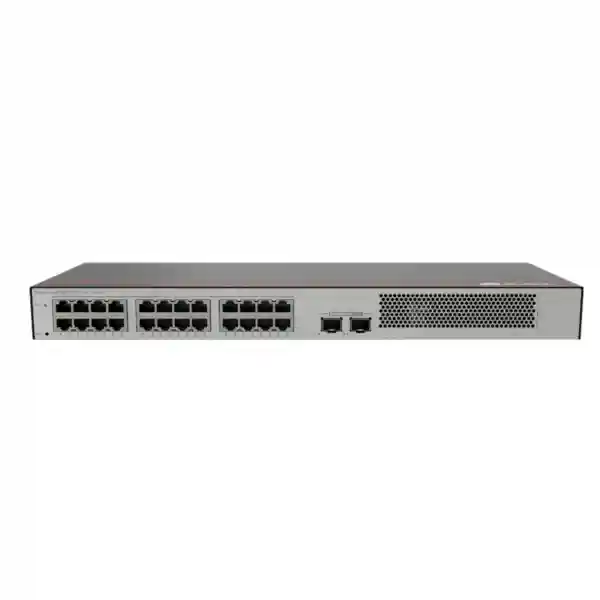
Huawei CloudEngine S5751-L24T2J-RUA
The Huawei CloudEngine S5751-L24T2J-RUA is a 24-port fanless remote-unit switch for streamlined campus access. It provides twenty-four Gigabit copper downlink ports and two optical uplink ports that support 100M, 1GE and 2.5GE. Huawei specifies 43.5 Mpps forwarding performance, 98 Gbps switching capacity and built-in AC power. The most important buying point is architectural: this is designed to operate as a remote unit under a compatible Huawei central switch rather than being selected only as a generic 24-port access switch.
2 × 100M/1/2.5GE SFP
Fanless
Built-in AC
Non-PoE model
Manufacturer-published forwarding performance for this exact model.
Published switching capacity for the S5751-L family variant listed here.
Fanless natural heat dissipation; about 1.98 kg without packaging.
Direct answer: what should a buyer know first?
S5751-L24T2J-RUA is the non-PoE, 2.5GE-uplink 24-port member of Huawei’s S5751-L remote-unit family. Do not confuse it with S5751-L24P2J-RUA, which adds PoE+, or S5751-L24T2X-RUA, which changes the optical uplinks to 10GE SFP+. If your endpoint plan requires switch-delivered power for phones, cameras or wireless access points, this exact T2J model is not the PoE choice. If your uplink design requires 10GE, the T2J’s 2.5GE SFP uplinks must also be reviewed carefully. The correct procurement sequence is therefore to confirm endpoint count, endpoint power, central-switch compatibility, central-switch software release, optical module type, fiber path, VLAN requirement, uplink bandwidth and cabinet environment before requesting a commercial quotation.
Verified Huawei CloudEngine S5751-L24T2J-RUA specifications
| Item | Manufacturer information | Buying implication |
|---|---|---|
| Downlink ports | 24 × 10/100/1000BASE-T | Suitable for up to twenty-four wired access links at Gigabit Ethernet rates, subject to network design. |
| Uplink ports | 2 × 100M/1/2.5GE SFP | Confirm transceiver type, fiber distance and whether 2.5GE is sufficient for the intended aggregation path. |
| Forwarding performance | 43.5 Mpps | Use the published figure as one design input rather than the only sizing criterion. |
| Switching capacity | 98 Gbps | Provides the platform switching-capacity figure published by Huawei for this model. |
| Power | Built-in AC, 100–240 V AC, 50/60 Hz | Verify local power protection, earthing, outlet availability and UPS strategy at the installation site. |
| Maximum / typical / static power | 18.90 W / 18.30 W / 8.14 W | Helpful for rack power and UPS planning; actual operating draw depends on use. |
| Cooling | Fanless, natural heat dissipation | Reduces fan noise and moving parts, but still requires suitable ventilation and ambient conditions. |
| Dimensions / weight | 43.6 × 442 × 220 mm; about 1.98 kg | Check shelf, cabinet, wall or desktop placement and cable bend space before installation. |
| Operating environment | -5°C to +45°C; 5%–95% RH non-condensing | Plan protected indoor deployment with temperature and humidity inside the published limits. |
| PoE | Not provided on this exact model | Endpoints needing power require another power method or a different PoE-capable switch model. |
How the remote-unit architecture changes the buying decision
Huawei positions the S5751-L family as remote units within a simplified campus design. In this approach, the access layer is divided between central switches and remote units, and the remote unit acts as a distributed port-expansion device managed through the central switching layer. This can reduce the amount of device-by-device planning and administration compared with treating every edge switch as an independent management point. Huawei’s current brochure states that compatible CloudEngine S16700, S12700E, S8700, S6700 and S5700 series central switches can work with remote modules when running R24C00 or a later compatible release. That statement should still be checked against the exact central-switch model and current Huawei documentation before procurement because feature support can depend on software release and platform combination.
For a procurement team, this means the first question is not merely “Do I need twenty-four ports?” The stronger question is “Is the planned campus already using, or being designed around, a compatible Huawei central switch and simplified architecture?” If the answer is yes, S5751-L24T2J-RUA can provide a clean way to distribute Gigabit access ports closer to users while retaining centralized control. If the site uses an unrelated switching architecture, treat interoperability and management expectations as a design review rather than assuming the remote-unit functions will map directly to another vendor’s network.
Huawei also documents VLAN functions, uplink link aggregation, automatic MAC learning and aging, port isolation, MACsec security across the S5751-L remote-unit family, factory reset and centralized upgrade/management workflows. Buyers should distinguish between series-level capabilities and the exact topology they plan to deploy. A feature can be supported by the family yet still depend on the central switch, software combination, license context or configuration. A pre-sales compatibility matrix is therefore more valuable than a long feature checklist copied from a brochure.
Who should evaluate this model?
Campus and multi-room access
Organizations standardizing on Huawei campus switching can use a remote unit to place wired access ports near groups of users while maintaining a simplified central management model. Confirm the fiber path and expected uplink load before deciding whether dual 2.5GE optical uplinks are adequate.
Quiet work areas
The fanless design can be attractive for offices, classrooms, clinics, hospitality areas and other locations where equipment noise matters. The enclosure still needs proper airflow and environmental control because fanless does not mean ventilation-free.
Non-PoE wired endpoints
This variant suits wired endpoints that do not depend on switch-provided PoE. If the access layer includes many IP phones, cameras or access points powered from Ethernet, compare the PoE-capable S5751-L variants before finalizing the bill of materials.
Deployment and compatibility checklist
- Central switch: record the exact Huawei central-switch model, installed software release and target software release.
- Optics: confirm supported SFP modules, fiber type, wavelength, connector, distance and availability for 1GE or 2.5GE operation.
- Endpoint power: identify any phones, cameras or APs that require PoE, because S5751-L24T2J-RUA itself does not provide PoE on the copper access ports.
- Uplink design: estimate aggregate traffic and redundancy expectations rather than assuming the presence of two SFP sockets automatically meets every bandwidth requirement.
- Physical installation: allow room for the 442 mm-wide chassis, power cable, optical bend radius and patching, with environmental conditions kept inside Huawei’s published limits.
- Security and segmentation: document required VLANs, port isolation, management access and central policy behavior before deployment.
- Commercial scope: request the exact model, quantity, optics, mounting accessories if needed, warranty terms, support scope and installation requirements in writing.
Related FourTeck network planning resources
For UAE network design context, review FourTeck’s network switch solutions in the UAE. Regional customers can also use FourTeck’s Uganda IT solutions, Kenya enterprise networking resources, Africa IT infrastructure portal, and Kuwait IT solutions portal when discussing local procurement and related infrastructure requirements.
Huawei CloudEngine S5751-L24T2J-RUA Dubai
Businesses evaluating Huawei CloudEngine S5751-L24T2J-RUA Dubai deployments should begin with the architecture rather than the product label. The model is designed as a Huawei campus remote unit with twenty-four Gigabit copper access ports and two 100M/1/2.5GE SFP uplinks. For a Dubai office, education site, clinic, hotel back-office area, retail environment or multi-floor commercial premises already using compatible Huawei campus switching, that design can be useful when access ports need to be distributed while management remains centered on a compatible Huawei central switch. The first technical check should be the exact central-switch model and software release. Huawei’s current S5751-L documentation describes remote-unit interoperability with specified CloudEngine central-switch families on suitable software, but a project team should still confirm the exact combination before an order is released.
Dubai buyers also need to separate this T2J variant from nearby model names. S5751-L24T2J-RUA is non-PoE and uses 2.5GE-capable SFP uplinks; it should not be ordered when the bill of materials assumes the switch will directly power IP phones, Wi-Fi access points or cameras. Where those devices are part of the same access layer, decide whether they have local power, whether a separate PoE switch is planned, or whether a PoE-capable S5751-L variant is more suitable. Likewise, if the upstream design expects 10GE optics, this model’s 2.5GE optical uplink ceiling must be recognized at design stage. These two details prevent common model-selection mistakes and are more important than simply seeing “24 ports” in a product title.
For procurement in Dubai, prepare the switch quantity, planned endpoint count, central switch, software version, fiber type, uplink distance, required SFP modules, rack or wall location, power source and required support scope. The built-in 100–240 V AC supply fits common commercial power environments, while the fanless chassis can help in noise-sensitive locations. Even so, cabinet ventilation and ambient temperature must remain within the published operating range. A useful quotation should therefore cover the complete deployment requirement rather than only the chassis: optics, patching, mounting needs, configuration responsibility, warranty channel, lead-time confirmation and post-deployment support should be documented before purchase.
Huawei CloudEngine S5751-L24T2J-RUA UAE
For Huawei CloudEngine S5751-L24T2J-RUA UAE projects, the model can be considered where an organization wants a centralized Huawei campus design with distributed wired access. Across offices, campuses, hospitality properties, education facilities and business branches, the practical value of this remote unit comes from combining twenty-four Gigabit copper ports with centralized operation through a compatible Huawei central switch. The S5751-L family is designed around simplified campus architecture, so selection should be based on the complete campus topology rather than on port count alone. A UAE project team should document whether the central switch is from a supported family, whether its software is at the required release, and whether the selected optical modules and fiber paths are supported for the planned uplink speed.
The model’s physical and power characteristics are also relevant to UAE installations. Huawei publishes a 43.6 × 442 × 220 mm chassis, approximately 1.98 kg weight, fanless natural heat dissipation and built-in AC input. Fanless operation can be advantageous in quiet working areas, but equipment cabinets can still become warm, especially in communications rooms with multiple active devices. Installers should maintain airflow around the unit and keep the site within the published -5°C to +45°C operating range. Power protection, grounding and UPS requirements should be reviewed as part of the network cabinet design rather than after delivery. The published maximum power consumption is modest, but resilience depends on the wider power plan.
Commercially, UAE buyers frequently need a quote that can be approved by IT and procurement together. The request should identify the exact model code S5751-L24T2J-RUA, quantity, end-user locations, central switch, software version, optics, fiber distance, expected VLANs, installation method and whether configuration assistance is required. Because this is a non-PoE model, list every access device that needs power and show how that power will be supplied. If the requirement later expands to PoE or 10GE uplinks, it is better to compare another S5751-L variant before purchase than to discover the limitation during installation.
Huawei CloudEngine S5751-L24T2J-RUA Uganda
Organizations researching Huawei CloudEngine S5751-L24T2J-RUA Uganda typically need more than a reseller part number. The key question is whether the planned network uses a Huawei simplified campus design where remote units operate under a compatible central switch. In a corporate building, school, healthcare site, hospitality property or distributed office environment, the model can provide twenty-four Gigabit copper access ports at the edge while two optical uplinks connect toward the central switching layer. Before selection, document the central-switch family and software, because remote-unit operation is tied to Huawei’s supported architecture. An independent 24-port switch and a Huawei remote unit may look similar physically, but the management and deployment model is different.
Uganda projects should also plan the optical and electrical details carefully. S5751-L24T2J-RUA provides two SFP uplinks supporting 100M, 1GE and 2.5GE. Procurement teams should specify the required fiber type and link distance rather than simply requesting “SFP modules,” since module choice affects reach, connector type and compatibility. The switch is fanless and uses built-in AC power, which can simplify local device power compared with models that need an external adapter. However, stable power, surge protection and UPS planning remain important for access infrastructure. The model’s published AC input range is 100–240 V, 50/60 Hz, and the unit should be installed in an indoor environment that remains within Huawei’s temperature and humidity limits.
A further Uganda buying consideration is endpoint power. The T2J model does not provide PoE on its twenty-four copper ports. If a deployment includes IP cameras, wireless APs or phones that normally draw power from Ethernet, confirm whether those devices use local adapters, separate injectors or another PoE switch. That decision should be made before the chassis is ordered. For a cleaner quotation, provide the required quantity, site city, fiber route, central switch, optics, endpoint list, power design, rack or wall location, configuration expectations and warranty requirement. This gives the supplier enough information to check the whole deployment instead of quoting a switch that may not match the site.
Huawei CloudEngine S5751-L24T2J-RUA Kampala
For Huawei CloudEngine S5751-L24T2J-RUA Kampala requirements, a useful design conversation starts with where the remote unit will sit in the building and what it will connect. A Kampala office or institutional site may need a block of wired ports near a department, floor, classroom cluster, reception area or equipment zone while the principal switching intelligence remains at a Huawei central switch. The S5751-L24T2J-RUA supplies twenty-four Gigabit RJ45 access ports and dual SFP uplinks with speeds up to 2.5GE. That combination can reduce long copper runs when fiber is already available toward a local access position, but only when the upstream design and central switch are compatible with the remote-unit architecture.
At site-planning stage, measure the fiber path and decide whether one or both uplinks will be used, what redundancy is expected and which optical modules are required. A short indoor multimode link and a longer single-mode link may require different transceivers, so the purchasing request should not leave the optics unspecified. The fanless chassis is useful where acoustic noise should be minimized, yet natural heat dissipation still needs clear airflow around the switch. Cabinet depth, patch-cord bend radius and access to the built-in AC inlet should be checked against the 43.6 × 442 × 220 mm chassis before installation. A UPS strategy is also worth documenting for network areas where continuity matters.
Kampala buyers should pay particular attention to the T in the model name: this S5751-L24T2J-RUA is not the PoE variant. If the access ports will serve computers, printers and other self-powered Ethernet devices, that may be entirely appropriate. If the same switch is expected to energize phones, access points or cameras, the bill of materials needs another power plan or another switch variant. Share the endpoint schedule, expected uplink traffic, central-switch details and software release with the supplier so compatibility can be reviewed before quotation. This approach reduces the risk of receiving correct hardware that is nevertheless wrong for the intended topology.
Huawei CloudEngine S5751-L24T2J-RUA Arua
Huawei CloudEngine S5751-L24T2J-RUA Arua projects should be scoped as infrastructure projects rather than single-box purchases. When a remote office, education site, clinic, hotel or administrative facility needs multiple wired connections, this model offers twenty-four Gigabit copper ports in a fanless chassis and two optical SFP uplinks supporting up to 2.5GE. Its main architectural value appears when the site forms part of a compatible Huawei simplified campus network and the remote unit is controlled through a supported central switch. Before a buyer requests shipment to Arua, the network designer should verify the exact central-switch model, current software, target topology and optical-module support.
Logistics planning is especially important when replacement parts or alternative optics may not be immediately available at a remote installation. The quotation should therefore identify the necessary SFP modules, fiber patch leads, mounting arrangement and any spares required by the project’s own service policy. The built-in AC power design avoids a separate external power brick, and the fanless hardware removes fan maintenance from the unit itself. Even so, power continuity and environmental protection remain site responsibilities. Place the switch in a protected indoor location, maintain airflow and keep the ambient environment inside Huawei’s specified temperature and non-condensing humidity ranges. Where utility power quality is a concern, include appropriate UPS and surge-protection planning at the cabinet level.
The non-PoE design should also be treated as a deliberate choice. Self-powered PCs, printers, controllers and similar devices can connect directly for data, but a PoE camera or wireless access point will still need an independent power method. If the site is being built from scratch, compare the power plan and cabling plan together so devices are not installed without a practical source of power. For a procurement request, specify quantity, delivery destination, central switch, fiber path, optics, endpoint list, power expectations, configuration scope, required documentation and support arrangement. That level of detail is more useful than asking only for “Huawei S5751 price in Arua.”
Huawei CloudEngine S5751-L24T2J-RUA Mbarara
A Huawei CloudEngine S5751-L24T2J-RUA Mbarara deployment can suit an organization that wants to extend managed campus access into a local network zone without building a separate independently managed switching island. The product’s twenty-four 10/100/1000BASE-T ports provide a practical density for wired users, printers, controllers and other self-powered devices, while dual SFP uplinks can operate at 100M, 1GE or 2.5GE. The correct use case, however, depends on the Huawei central-switch architecture. Project teams should confirm supported central-switch families and software releases, then map the remote unit to the intended central switch before purchase.
For Mbarara sites with mixed IT and facility systems, segment planning matters as much as physical connectivity. Determine which endpoints belong to staff, administration, building systems, guest services or other network groups, and document VLAN and port-isolation requirements. Huawei’s S5751-L family supports centralized functions that can simplify remote-unit operations, but the desired policy still needs to be designed at the central layer. Uplink capacity should also be estimated from actual traffic. Twenty-four Gigabit access ports do not imply that every endpoint will transmit at line rate simultaneously; nevertheless, an application-heavy site should verify whether a maximum 2.5GE uplink per SFP port aligns with expected aggregate traffic and resiliency.
Procurement should include a physical installation review. The chassis is approximately 442 mm wide and 220 mm deep, uses built-in AC and relies on natural heat dissipation rather than fans. Ensure the chosen cabinet, shelf or mounting location supports the equipment dimensions, cable management and airflow. This exact T2J model does not provide PoE, so any camera, access point or IP phone requiring Ethernet power needs another solution. A well-prepared Mbarara quote request should therefore include the endpoint list, optical distance, module requirement, central switch and firmware, power-protection plan, required quantity, installation scope and desired support terms.
Huawei CloudEngine S5751-L24T2J-RUA Gulu
For Huawei CloudEngine S5751-L24T2J-RUA Gulu enquiries, the strongest buying case is a planned Huawei campus architecture that benefits from centralized remote-unit management. The switch offers twenty-four Gigabit copper access ports and two optical uplinks up to 2.5GE, giving a site a compact way to place wired connectivity near users or devices. Before specifying it for a Gulu office, school, healthcare facility, service center or other business environment, confirm that the central switch and its software can manage the remote unit as intended. This avoids treating the product as a generic unmanaged or independently managed edge switch when its real value is tied to Huawei’s simplified campus design.
Where the local network supports critical applications, plan the uplink and recovery approach in advance. Decide whether one SFP is primary and the second is reserved, whether both participate in the intended topology, and how fiber faults will be diagnosed. Specify supported optics explicitly. Huawei lists uplink link aggregation among S5751-L family functions, but the final configuration should be checked against the exact central-switch and release combination. For maintenance, the fanless design is attractive because there are no fans in this model, and the built-in AC supply simplifies the power connection. Natural cooling still requires a clean and ventilated equipment location.
Gulu procurement teams should also review the endpoint-power requirement before comparing prices. S5751-L24T2J-RUA does not deliver PoE on its access ports. If a new wireless deployment, surveillance project or IP telephony rollout is expected on the same switch, count how many devices need PoE and decide whether separate PoE infrastructure or a different S5751-L variant is more sensible. Include any optics and accessories in the same quotation so total project cost is visible. Share the central switch, network diagram if available, site location, quantity, delivery requirement, installation expectations and warranty preference to support a more accurate procurement discussion.
Huawei CloudEngine S5751-L24T2J-RUA Kenya
Huawei CloudEngine S5751-L24T2J-RUA Kenya buyers may be planning corporate campuses, branch environments, learning facilities, hospitality networks or other multi-user sites where a distributed access layer is useful. This model is a remote unit with twenty-four Gigabit Ethernet copper ports and two SFP uplinks supporting speeds through 2.5GE. Its design should be evaluated together with the Huawei central switch that will control it. Confirm the exact central-switch platform, software release and remote-unit support before placing an order. This is especially important when procurement is separate from network engineering, because a model can meet a port-count requirement yet still be unsuitable for the intended management architecture.
Kenya deployments often need a clear fiber bill of materials. Determine whether the remote unit will connect across a building, between communications rooms or along a longer campus path, then match the fiber and supported optics to that distance. The two SFP ports are not 10GE ports on this T2J model; they operate up to 2.5GE. If 10GE uplinks are a project requirement, review another S5751-L model before purchasing. The unit is fanless, approximately 43.6 mm high and 442 mm wide, and uses built-in AC power. These characteristics can help in quiet indoor spaces, but cabinet cooling, dust control, UPS design and access for service should still be planned.
A second critical Kenya procurement question is PoE. The exact S5751-L24T2J-RUA has no PoE on its 24 copper ports. A network serving desktop computers and self-powered equipment may be well matched, but a floor dominated by wireless access points, phones and cameras may need a PoE variant or a separate PoE layer. Ask for a quotation that lists the chassis, optics, quantity, warranty basis, installation or remote-configuration scope and delivery terms. For wider infrastructure planning, FourTeck’s Kenya platform can be used to discuss enterprise networking needs alongside the switch requirement.
Huawei CloudEngine S5751-L24T2J-RUA Kuwait
For Huawei CloudEngine S5751-L24T2J-RUA Kuwait procurement, the model should be assessed as part of a Huawei simplified campus architecture. The switch provides 24 Gigabit copper access ports and dual 100M/1/2.5GE SFP uplinks, with Huawei-published forwarding performance of 43.5 Mpps and switching capacity of 98 Gbps. A business, education site, clinic, hospitality property or multi-room commercial environment can consider it when a compatible central Huawei switch will manage the remote unit. The central-switch model and firmware must be verified before purchase; that compatibility check is a core requirement, not an optional technical detail.
Kuwait installations should give particular attention to the equipment-room environment. Huawei specifies an operating range up to +45°C and a non-condensing humidity range, so the switch should be installed in a protected, conditioned indoor location rather than treated as an outdoor or uncontrolled-temperature device. The fanless design supports quiet operation and removes fan servicing, while the built-in AC supply accepts 100–240 V AC at 50/60 Hz. The unit’s low power consumption does not eliminate the need for UPS and surge-protection planning where network continuity is important. Cabinet ventilation and spacing around the chassis remain necessary for natural heat dissipation.
Before requesting Kuwait pricing, identify whether the 2.5GE uplink ceiling and non-PoE access ports are aligned with the site. If the network requires 10GE uplinks, select a model designed for that requirement. If phones, APs or cameras expect PoE, include their power plan or choose a PoE-capable variant. Specify SFP module type and fiber distance, because optics should not be assumed. A complete quotation request should include exact model, quantity, central switch, firmware release, optics, endpoint list, power resilience, mounting location, installation scope and support expectations. This gives procurement a clearer total cost and gives engineering a better chance to catch incompatibilities before delivery.
Huawei CloudEngine S5751-L24T2J-RUA Ghana
Huawei CloudEngine S5751-L24T2J-RUA Ghana customers evaluating a campus or branch-network refresh should consider how the switch will be managed and connected before focusing on commercial price. Huawei designed the S5751-L family as remote units working with compatible central campus switches. The L24T2J variant provides twenty-four 10/100/1000BASE-T access interfaces plus two 100M/1/2.5GE SFP uplinks. This architecture can be attractive for organizations that want to distribute wired ports while keeping the switching environment centrally operated. It is less useful to select the unit in isolation without first confirming the central-switch platform and software support.
For Ghana deployments, the project bill of materials should identify every optical component and power dependency. Determine fiber type, link distance and supported SFP modules for each uplink. Because the unit is non-PoE, list access points, IP phones, cameras or other devices that require power from the network and decide how they will be powered. Where a large share of the endpoint estate is PoE-dependent, compare the cost and operational simplicity of a PoE-capable S5751-L model rather than adding many external injectors. The switch’s fanless design and built-in AC supply can simplify placement in indoor network areas, but proper ventilation, power protection and temperature control are still required.
A Ghana procurement request should also clarify whether installation, configuration, documentation or remote support is part of the scope. A chassis-only price can look attractive but may omit optics, transport, accessories or engineering work needed for deployment. Provide the exact model code, quantity, delivery destination, central switch and version, topology, fiber distance, uplink-speed expectation and warranty requirement. If the organization is building a wider network refresh, include the expected number of future endpoints and any plan for higher-speed uplinks so the selected remote unit remains aligned with the design rather than becoming a short-term constraint.
Huawei CloudEngine S5751-L24T2J-RUA Nigeria
For Huawei CloudEngine S5751-L24T2J-RUA Nigeria opportunities, large sites and multi-location organizations should treat the model as one component of a broader Huawei campus design. Its twenty-four Gigabit copper ports can serve a dense group of wired endpoints while two SFP interfaces provide optical uplinks at up to 2.5GE. The remote-unit concept is intended to simplify the access architecture through a compatible Huawei central switch, so technical approval should confirm the central-switch family, software release and supported remote-unit topology. That compatibility record is particularly useful when purchasing decisions pass through multiple teams, because it prevents a generic 24-port specification from obscuring the architectural requirement.
Nigeria deployments should also review power continuity and optical spares as part of network resilience. The switch itself uses a built-in AC supply and Huawei publishes a modest maximum power figure, but a remote unit still becomes a local connectivity dependency for every attached endpoint. If the site requires high availability, document how power is protected, how uplink failures are handled and which replacement optics are kept available under the organization’s support plan. The model is fanless, which helps reduce acoustic noise and fan failure points, but it must be installed where dust, heat and humidity remain within appropriate indoor conditions. Natural heat dissipation needs clear airflow around the chassis.
From a commercial perspective, the exact variant matters. S5751-L24T2J-RUA has 2.5GE optical uplinks and no PoE. If an office expects to power many phones, cameras or APs directly from the switch, another model may reduce design complexity. If aggregation requires 10GE, compare an X-uplink variant rather than assuming all S5751-L products have the same optical ports. A Nigeria quotation request should therefore name the exact model, specify quantity, central switch, software, optics, fiber distance, endpoint power needs, delivery city, installation scope and warranty/support expectation. That information supports a more complete and defensible purchase decision.
Huawei CloudEngine S5751-L24T2J-RUA Seychelles
Huawei CloudEngine S5751-L24T2J-RUA Seychelles projects may involve offices, hospitality environments, education facilities, service organizations or other sites where a compact remote access layer is required. The device offers twenty-four Gigabit RJ45 access ports and two SFP uplinks that support 100M, 1GE and 2.5GE. The central design question remains the same: this is a Huawei remote-unit model intended to operate within a compatible simplified campus architecture. Buyers should identify the central-switch model and current software before ordering and ask the supplier to verify the intended combination. A remote unit should not be selected only because the port count looks right.
For island logistics, it is prudent to include optics, accessories and any organization-required spares in the same procurement plan rather than discovering missing components after the chassis arrives. Confirm the fiber run and transceiver type for each uplink. The switch is fanless and uses built-in AC power, with a published chassis width of 442 mm and depth of 220 mm. Install it in a protected, ventilated indoor space with suitable power conditioning and UPS support where required. Environmental planning is important for any network device: the manufacturer specifies non-condensing humidity and an operating temperature range that should be respected, and coastal or humid conditions make appropriate indoor equipment protection especially relevant.
The T2J model is also non-PoE, so a Seychelles site should list every endpoint that needs switch-supplied power before finalizing the bill of materials. Computers and other self-powered devices may fit the design directly; Wi-Fi APs, cameras and many IP phones may require a different power approach. Where bandwidth growth is expected, consider whether 2.5GE optical uplinks provide sufficient headroom for the anticipated traffic profile. A useful quote request includes the exact model, quantity, site, central switch, firmware, fiber route, optics, endpoint list, expected deployment date, warranty preference and configuration scope. This helps avoid costly changes once equipment is already in transit or on site.
Frequently asked questions
Is Huawei CloudEngine S5751-L24T2J-RUA a PoE switch?
No. Huawei lists twenty-four 10/100/1000BASE-T downlink ports for this exact model without PoE. If powered Ethernet endpoints are required, compare a PoE-capable S5751-L variant or plan a separate power method.
Does S5751-L24T2J-RUA have 10GE uplinks?
No. Its two SFP uplinks support 100M, 1GE and 2.5GE. The similarly named S5751-L24T2X-RUA is the model Huawei lists with 10GE-capable SFP+ uplinks.
Can it work as part of a Huawei simplified campus network?
Yes, that is the intended product family role. Huawei documents S5751-L devices as remote units used with compatible central campus switches. The exact central-switch model and software release should be verified for each project.
Is the switch fanless?
Yes. Huawei’s ordering information and hardware table identify S5751-L24T2J-RUA as fanless with natural heat dissipation. Suitable ventilation is still required.
What information should I send for a quotation?
Send the exact model and quantity, delivery location, compatible central switch, software release, fiber distance, optics requirement, endpoint list, PoE needs, expected uplink traffic, mounting location, warranty expectation and any installation or configuration requirement.
Decision recap
Strong fit when
You need 24 Gigabit non-PoE access ports, up-to-2.5GE SFP uplinks, fanless operation and centralized remote-unit use under a compatible Huawei campus switch.
Reconsider when
Your endpoint plan requires PoE, your uplink plan requires 10GE, or your network does not use a compatible Huawei central-switch architecture for remote units.
Confirm before PO
Central-switch model and software, optics, fiber distance, power protection, mounting, support scope, warranty terms and current commercial availability.
Quotation checklist
For a cleaner sales response, include all of the following in your enquiry:
- Exact model: S5751-L24T2J-RUA
- Required quantity
- Country and delivery city
- Central switch model
- Current / target software version
- Fiber type and distance
- Required SFP modules
- Endpoint list and PoE requirement
- Mounting / cabinet details
- Configuration or installation scope
- Warranty / support expectation
- Required deployment date
Plan the complete Huawei access requirement
A successful S5751-L24T2J-RUA purchase is not simply a chassis order. It is a compatibility decision covering the central Huawei switch, software release, optics, fiber, endpoint power, uplink capacity and operational support. Share those details with FourTeck so the commercial quotation can be aligned with the intended network design and any model mismatch can be identified before deployment.

Reviews
There are no reviews yet.