
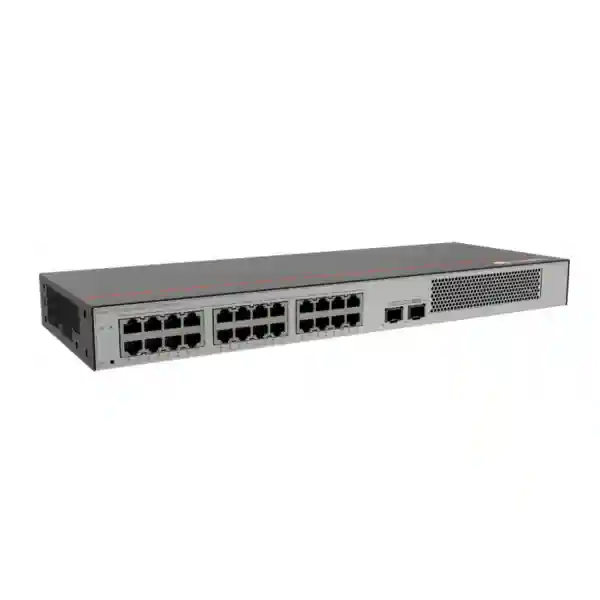
Huawei CloudEngine S5751-L24T2X-RUA
The Huawei CloudEngine S5751-L24T2X-RUA is a 24-port Gigabit Ethernet remote unit designed for simplified Huawei campus networks that need dense wired access with fast optical uplinks. Huawei’s current outside-mainland product information lists 24 x 10/100/1000Base-T downlink ports, two 100M/1GE/2.5GE/10GE SFP+ uplink ports, built-in AC power, 66 Mpps forwarding performance, and 98 Gbps switching capacity. It is the non-PoE variant in the 24-port S5751-L family, making it appropriate where connected endpoints have independent power or where PoE is provided elsewhere in the design.
FourTeck can help business buyers turn the exact model requirement into a complete bill of materials by confirming central-switch compatibility, software release expectations, uplink optics, fiber type, copper patching, rack and power requirements, quantity, regional logistics, installation scope, and support expectations before quotation.
Direct answer: what is the Huawei CloudEngine S5751-L24T2X-RUA?
It is a Huawei CloudEngine remote unit switch for streamlined campus access architecture. Instead of treating every access switch as an independently planned and managed device, Huawei positions S5751-L remote units as port-expansion elements associated with a compatible central campus switch. This architecture can reduce the amount of device-by-device planning and operational work in environments where a Huawei centralized campus design is already being deployed or is under consideration. The S5751-L24T2X-RUA provides twenty-four standard Gigabit Ethernet copper access ports for endpoints and two multi-rate SFP+ uplinks that support 100M, 1GE, 2.5GE, and 10GE optical connectivity according to Huawei’s current outside-mainland specification.
The most important buying point is that this model should not be selected only because it has 24 ports and 10GE uplinks. A procurement team should confirm how the remote unit will connect to the intended Huawei central switch, which software release is required, which optical modules and fiber type match the distance, whether endpoint power is needed, and whether the network design expects local standalone behavior or centralized remote-unit operation. Huawei documentation describes the broader S5751-L family as part of a simplified access-and-core architecture and identifies compatible central-switch families subject to supported software releases. FourTeck can help translate those architecture details into a practical quotation checklist without assuming compatibility from the model name alone.
Campus access
Use the 24 GE copper interfaces for office PCs, printers, building systems, access-layer devices, non-PoE phones, or other Ethernet endpoints that fit the approved network design.
Fast uplinks
Two multi-rate SFP+ uplinks allow the access layer to connect over optical links at rates up to 10GE when the chosen optics, fiber plant, and central-switch ports support the required design.
Non-PoE model
The T2X model is not the PoE variant. Choose it when endpoints have separate power, or compare it with an appropriate PoE-capable S5751-L model when phones, cameras, or access points must receive power from the switch.
Built-in AC
Huawei lists built-in AC power for this model. Buyers should still confirm site voltage, socket and PDU arrangements, rack location, surge protection strategy, and resilience requirements for the final installation.
Where this model fits in a network design
The S5751-L24T2X-RUA is most relevant where a project is intentionally using Huawei’s remote-unit campus architecture rather than buying an isolated 24-port access switch with no central-switch relationship. In a conventional three-layer campus, access switches, aggregation switches, and core switches may each require their own planning and management. Huawei’s S5751-L concept is aimed at a simplified architecture in which remote units extend ports from a compatible central switch. This can be attractive for office floors, classrooms, hotel areas, healthcare zones, branch spaces, and distributed building sections where many copper endpoints need local access but the operations team wants a centralized design.
The two SFP+ uplinks are an important part of that design because the remote unit can be placed near endpoint clusters while fiber returns toward the central switching layer. A buyer should confirm required link distance, single-mode or multimode fiber, connector type, optic speed, optic compatibility, redundancy expectations, and whether both uplinks are needed for the planned topology. A 10GE-capable uplink does not automatically mean every optical module or fiber run will operate at 10GE; the complete link must be designed as a system.
The non-PoE nature of this exact T2X model is equally important. If the connected endpoints include wireless access points, IP cameras, IP phones, or access-control devices that require switch-delivered power, procurement should not assume the S5751-L24T2X-RUA will power them. Instead, confirm whether endpoint power is external, supplied through another device, or whether a PoE-capable S5751-L model is more appropriate. This one distinction prevents a common purchasing error: choosing the correct port count and uplink speed but the wrong power-delivery variant.
Buying checklist before requesting a quotation
1. Central switch
Share the exact Huawei central-switch model and software release, or ask for architecture review if the central switch has not yet been selected.
2. Endpoint count
List active copper devices, spare-port allowance, expected growth, and whether any endpoints require PoE.
3. Uplink design
Provide fiber type, route distance, required speed, connector format, redundancy needs, and existing optic standards.
4. Site readiness
Confirm rack or cabinet location, AC power, ventilation, patching, labeling, UPS strategy, and physical access constraints.
5. Commercial scope
State quantity, destination, required date, preferred warranty/support terms, and whether supply-only or implementation assistance is required.
6. Migration plan
If replacing existing access switches, identify VLANs, uplinks, port mappings, special devices, cutover windows, and rollback requirements.
Huawei CloudEngine S5751-L24T2X-RUA Dubai
Customers searching for Huawei CloudEngine S5751-L24T2X-RUA Dubai are usually not looking for a generic 24-port switch description; they want to know whether the exact remote-unit model fits a new office, commercial building, hospitality property, education site, clinic, warehouse, or multi-floor network in Dubai and what should be included in the quotation. For a Dubai deployment, the starting point should be the campus topology. Confirm whether a compatible Huawei central switch is already present, whether the project is moving toward a simplified Huawei campus architecture, and how many remote access locations need 24 copper ports. The S5751-L24T2X-RUA is particularly relevant where endpoint clusters can be connected locally while optical uplinks return to the central switching layer.
Dubai projects often combine structured copper cabling, fiber risers, wireless networks, CCTV, voice, access control, and internet security within the same building. That makes power planning important. This exact T2X model is the non-PoE version, so a buyer should identify which connected devices need switch-delivered power before approving the bill of materials. Desktop computers, printers, controllers with their own power supplies, and many fixed Ethernet appliances can use standard copper access. Wireless access points, IP cameras, and many IP phones often require PoE, so they may need separate power or a different switch variant. The distinction should be settled during design rather than after installation.
For the two SFP+ uplinks, specify whether the building fiber is multimode or single-mode, the approximate route length, the connector type, and the intended link speed. Optics should be quoted against the actual fiber plant and compatible central-switch interface, not added as an unspecified accessory. For commercial planning, provide the number of switches, delivery destination in Dubai, project schedule, and whether configuration, rack installation, labeling, testing, or migration support is required. Current price and availability should be requested against the exact model and quantity because supply conditions can change.
FourTeck’s UAE technology portal provides broader networking context, while the Firewall Dubai contact page can be used to submit the exact switch model, quantity, destination, uplink requirements, and implementation scope. Buyers integrating the switching layer with secure internet access can also review perimeter firewall planning so LAN segmentation and gateway security are designed together rather than as unrelated purchases.
Huawei CloudEngine S5751-L24T2X-RUA UAE
For organizations searching Huawei CloudEngine S5751-L24T2X-RUA UAE, procurement commonly spans more than one site or emirate. A head office may be in Dubai while branch offices, warehouses, schools, clinics, workshops, or operational locations are in Abu Dhabi, Sharjah, Ajman, Ras Al Khaimah, Fujairah, or Umm Al Quwain. In that situation, standardization becomes as important as the individual switch specification. The S5751-L24T2X-RUA can be considered where the organization wants a repeatable 24-port Gigabit access building block linked to a compatible Huawei centralized campus design. A consistent architecture can simplify documentation, spares planning, fiber standards, and support procedures across sites, provided the central-switch and software requirements are validated.
The bill of materials for a UAE project should distinguish the switch itself from items that are often forgotten: SFP or SFP+ optics, fiber patch leads, copper patch cords, rack accessories, labeling, UPS or PDU capacity, and any central-switch changes needed to adopt the remote units. If the project includes multiple buildings, document uplink distances and fiber type per building rather than assuming one optic choice fits every location. A 10GE uplink may be desirable for traffic concentration, but some locations may use a lower supported rate depending on the central design and available fiber. The model’s multi-rate SFP+ interfaces give design flexibility, but the final speed must be deliberate.
UAE buyers should also check the endpoint-power profile. The S5751-L24T2X-RUA is not the PoE model, so an estate with many powered cameras, access points, and IP phones may need a mixed switch strategy. A non-PoE unit can still be useful for user PCs, printers, server-room management ports, building controllers, and other independently powered endpoints. Separating PoE and non-PoE needs by floor or cabinet can reduce unnecessary power budgets while keeping the architecture consistent.
For purchasing, request a quotation that lists the exact model, quantity, optics, support terms, warranty guidance, delivery destination, and services as separate line items where practical. FourTeck’s technology product catalogue and deployment and support services can help frame the wider network requirement. If a secure-gateway refresh is happening at the same time, use the switching change as an opportunity to confirm VLAN boundaries, guest access, server segments, voice networks, CCTV separation, and firewall policy design before cutover.
Huawei CloudEngine S5751-L24T2X-RUA Uganda
A buyer searching for Huawei CloudEngine S5751-L24T2X-RUA Uganda may be planning an office network, education environment, healthcare site, hospitality property, financial-services branch, NGO facility, distribution operation, or multi-building campus. The first design question is not simply whether 24 Gigabit ports are enough. Because the S5751-L24T2X-RUA is a Huawei remote unit, the project should be evaluated as part of a compatible centralized campus architecture. If the organization already has Huawei campus switching, share the exact central-switch model and software version so compatibility can be checked. If the network is new, define whether the simplified remote-unit architecture is part of the desired design before purchasing access hardware.
Uganda projects often benefit from careful planning around fiber between buildings, floors, or equipment rooms. The two SFP+ uplinks support multiple rates up to 10GE, which can be useful when an access cabinet must aggregate many wired users back to a central location. However, optic selection should reflect the real cable plant. Record whether the path is single-mode or multimode, approximate length, patch-panel arrangement, available cores, and whether redundant links are required. Where long runs or outdoor pathways are involved, include fiber protection, termination quality, grounding practices for associated equipment, and physical-security considerations in the site survey.
Power reliability and endpoint power should also be separated. The switch has built-in AC, so the cabinet needs suitable AC supply and a resilience plan appropriate to the site. The switch does not provide PoE on its 24 copper ports, so cameras, access points, and IP phones that need PoE require an alternative arrangement. This is especially relevant for schools, hotels, clinics, and offices that combine user data and powered edge devices in one cabinet. A mixed design may use this model for non-PoE endpoints and PoE-capable switching where device power is required.
FourTeck’s Uganda technology portal provides a regional inquiry route for networking projects. For quotation preparation, send the exact model, quantity, city, central-switch details, uplink distance, fiber type, endpoint count, PoE requirements, and whether installation or remote configuration assistance is expected. This creates a more useful proposal than asking only for a unit price, because optics, cabling, power, and architecture can materially change what is actually needed.
Huawei CloudEngine S5751-L24T2X-RUA Kampala
Huawei CloudEngine S5751-L24T2X-RUA Kampala searches commonly indicate a city-level deployment where procurement, installation access, and building conditions matter as much as the model specification. Kampala organizations may be upgrading a headquarters floor, business center, hotel, school, clinic, bank branch, professional-services office, or technology room with a larger wired-device count. The 24 copper ports give a predictable access density, while the two SFP+ uplinks allow fiber connectivity back to the central network. For a multi-floor building, this can support a design in which each floor or zone has local copper termination and optical connectivity to a central switching location, subject to Huawei remote-unit compatibility.
A Kampala site survey should record cabinet space, AC power condition, UPS availability, patch-panel capacity, copper cable categories, fiber risers, and any existing switching that will remain in service. If the project is a migration, map current VLANs and critical ports before replacing equipment. User computers, printers, building-management interfaces, and other independently powered devices can fit a non-PoE access switch. Devices such as access points, cameras, and phones should be identified separately because the S5751-L24T2X-RUA does not provide PoE. This avoids a cutover where data connectivity is present but powered endpoints cannot start.
The uplink design deserves its own line items. Do not quote two unspecified SFP+ modules simply because the switch has two cages. Confirm the central-switch interface type, target speed, fiber mode, connector, path length, and whether a second uplink is for redundancy, aggregation, or future expansion. Where the campus includes several buildings, each link may need a different optic reach. The same discipline should apply to spare optics and patch leads so troubleshooting is not delayed by mismatched components later.
For Kampala procurement, provide exact quantities and identify whether the requirement is supply-only, staged configuration, rack installation, migration, testing, or documentation. If internet-edge security is also being refreshed, the FourTeck firewall deployment guidance offers a useful checklist for VLANs, routing, gateway dependencies, testing, and handover. Although the service page is Dubai-focused, the planning principles help procurement teams define the boundary between access switching and firewall work before a multi-vendor cutover.
Huawei CloudEngine S5751-L24T2X-RUA Arua
For Huawei CloudEngine S5751-L24T2X-RUA Arua requirements, the project may involve a branch office, education site, healthcare facility, NGO operation, hospitality property, public-facing service location, or regional commercial site where a stable wired access layer is required without unnecessary complexity. The model’s 24 Gigabit copper ports are suitable for independently powered Ethernet endpoints, while the two multi-rate SFP+ uplinks create options for fiber connection toward a central switching location. Because this device is part of Huawei’s remote-unit family, the architecture should be checked before ordering: identify the central Huawei campus switch, required software level, and intended remote-unit topology.
Arua deployments may require more attention to logistics and spares planning than a city-center installation where replacement parts are easier to source quickly. Procurement can reduce operational risk by defining a practical spare strategy for the switch, supported optics, fiber patch cords, and power components that are appropriate to the design. This does not mean ordering arbitrary duplicates; it means identifying which single component failure would interrupt the most users and ensuring support and replacement expectations are clear in the commercial proposal. Warranty terms and the process for handling a failed unit should be written into the purchasing discussion rather than assumed.
Power and cabling readiness should be confirmed before dispatch. The switch uses built-in AC power, so the cabinet needs stable supply, suitable protection, and a UPS strategy aligned with the site’s uptime needs. The copper ports are non-PoE, so powered edge devices should be documented separately. If an Arua site depends heavily on IP cameras or wireless access points, compare the total cost and maintainability of separate injectors versus using an appropriate PoE switch model. A design that looks cheaper at the switch line item can become harder to support if it creates many individual power supplies.
When requesting a quote, include Arua as the destination, the required quantity, endpoint types, central-switch information, optic reach, fiber mode, preferred support arrangement, and target deployment window. For organizations standardizing across Uganda, use the same template for Kampala, Arua, Mbarara, and Gulu but allow each city’s fiber distances, cabinet conditions, power resilience, and endpoint mix to differ. That produces genuinely comparable site designs instead of copying one bill of materials into every location.
Huawei CloudEngine S5751-L24T2X-RUA Mbarara
A Huawei CloudEngine S5751-L24T2X-RUA Mbarara deployment can be a good fit for organizations that need a structured access layer in offices, education facilities, healthcare environments, hospitality sites, retail administration, distribution facilities, or branch campuses. The model offers a straightforward port profile: 24 Gigabit copper downlinks and two SFP+ uplinks supporting rates up to 10GE. The design value comes from how those ports are integrated into Huawei’s simplified remote-unit architecture. Buyers should therefore confirm the intended central-switch platform and supported software rather than treating the unit as an interchangeable unmanaged edge switch.
Mbarara projects with several buildings or extended compounds should document fiber pathways early. The dual uplink interfaces can support fast backbone connectivity, but a reliable implementation depends on matching optics to the installed fiber. Record the distance between equipment rooms, whether the fiber is single-mode or multimode, the connector and patch-panel standard, and whether one or two uplinks will be activated. If the design requires resilience, clarify how link redundancy will be implemented at the central-switch layer and what testing will confirm failover behavior. If the second port is only reserved for future growth, label and document that choice to avoid confusion during support.
Endpoint classification is another useful procurement step. Build a list of user PCs, printers, time-attendance terminals, building systems, servers or appliances, access points, phones, and cameras. Mark which devices need PoE. Since the S5751-L24T2X-RUA does not supply PoE, it is best suited to the independently powered portion of that list. For mixed environments, this can still be cost-effective because not every cabinet needs a high PoE budget. The final decision should compare port density, power requirement, and operational simplicity rather than using one switch type everywhere by default.
For a Mbarara quotation, provide the exact model name to avoid substitution with the similarly named PoE variants. Ask the supplier to show optics, accessories, warranty guidance, and services separately. Include installation location, rack condition, power source, target cutover date, and any migration requirements. If the site connects to a central internet firewall, plan switch VLANs and gateway policies together so user, guest, voice, camera, and management traffic have clear boundaries from the first day of operation.
Huawei CloudEngine S5751-L24T2X-RUA Gulu
Huawei CloudEngine S5751-L24T2X-RUA Gulu inquiries often come from buyers who already know the model number but still need to validate deployment details. For a regional branch, institutional site, campus building, hotel, healthcare location, NGO office, or enterprise facility, the switch can provide 24 standard Gigabit access ports close to users and two optical uplinks toward the central network. That physical layout can reduce long copper runs and make fiber the backbone between equipment areas. The architecture remains the key qualifier: the S5751-L family is designed as Huawei remote units working with compatible central switches, so central-switch model and software validation should be part of the purchase process.
For Gulu sites where technical visits may need advance coordination, good documentation has practical value. Label each copper port by room or endpoint, record VLAN intent, identify the active uplink and spare path, and keep optic types and serial details in the handover record. If the deployment replaces an existing switch, export or document the old port map before disconnecting cables. A simple migration worksheet can reduce downtime because the installer knows which ports carry staff data, printers, management systems, cameras, voice, or special devices.
Power planning should address both the switch and the endpoints. The S5751-L24T2X-RUA uses built-in AC power and is not the PoE model. If continuity is important, the cabinet’s UPS autonomy should be sized for the network equipment that must remain available, not just the switch. At the endpoint layer, avoid assuming cameras, wireless access points, or IP phones will be powered through these ports. Where powered devices are numerous, compare an appropriate PoE-capable model or a separate PoE access layer. Where most devices already have local power, the non-PoE T2X can keep the access design focused on data connectivity.
A complete Gulu quote request should include the destination, quantity, central-switch model, desired uplink speeds, fiber characteristics, endpoint and PoE mix, support expectations, and whether local installation, remote configuration, or supply-only is needed. If the project spans several Ugandan cities, FourTeck can use one technical standard while preserving site-specific differences, reducing the risk of buying incompatible optics or unnecessary power features simply because a bill of materials was copied from another location.
Huawei CloudEngine S5751-L24T2X-RUA Kenya
Customers looking for Huawei CloudEngine S5751-L24T2X-RUA Kenya may be designing wired access for corporate offices, education campuses, hotels, healthcare organizations, financial branches, logistics operations, industrial administration, retail back offices, or distributed business locations. The model can be useful when the project calls for 24 non-PoE Gigabit access ports and optical uplinks to a Huawei central switching layer. Kenya deployments should begin by clarifying whether the remote-unit architecture is already standardized. If the central switching platform is not yet selected, the access-switch purchase should be held within the broader architecture decision so software and compatibility are not discovered after hardware arrival.
In Nairobi and other dense commercial environments, fiber uplinks may connect floors or buildings within a structured campus. In regional sites, the same uplinks may connect a local communications room to a central equipment area over longer fiber paths. The S5751-L24T2X-RUA supports uplink rates up to 10GE, but the correct optic depends on distance, fiber type, connector, and central-switch capability. A good bill of materials identifies each link rather than listing generic SFP+ modules. It should also state whether the second uplink is active, redundant, aggregated where supported, or reserved for expansion.
For enterprise standardization, compare the endpoint mix across sites. Branches dominated by PCs and printers may fit the non-PoE model well. Locations with high densities of cameras, phones, and Wi-Fi access points may need PoE-capable switching. Using the T2X where PoE is not required can avoid paying for unused power capacity, while forcing it into a PoE-heavy cabinet can create a patchwork of injectors that complicates support. Procurement should therefore collect device-power requirements as part of port-count planning.
FourTeck’s Kenya technology portal provides a regional channel for network inquiries. For the most accurate Huawei S5751-L24T2X-RUA Kenya quotation, share exact quantity, deployment city, central-switch details, expected uplink rate and distance, required optics, endpoint-power profile, target schedule, and service scope. Where the network also includes internet-edge protection, review FourTeck’s firewall solution portal to align VLAN segmentation, security boundaries, and access-switch changes during the same planning cycle.
Huawei CloudEngine S5751-L24T2X-RUA Kuwait
For Huawei CloudEngine S5751-L24T2X-RUA Kuwait requirements, buyers are often balancing high-density office connectivity, fast backbone links, cabinet space, equipment standardization, and long-term support. The switch provides 24 Gigabit copper access ports and two multi-rate SFP+ uplinks up to 10GE, with built-in AC power. In a Huawei simplified campus design, the remote unit can extend access ports from a compatible central switching platform. That makes it relevant for office floors, commercial properties, education environments, healthcare sites, hospitality networks, and distributed facilities where endpoints are concentrated away from the core equipment room.
Kuwait deployments should account for the physical environment around the communications cabinet. Indoor temperature control, rack ventilation, dust management, stable AC power, UPS coverage, and organized patching all contribute to reliability. Even when network equipment is installed in an air-conditioned building, small closets can become warmer than expected when several switches, firewalls, UPS systems, and patch panels share limited space. The procurement checklist should therefore include cabinet dimensions, power outlets, PDU capacity, equipment spacing, and maintenance access instead of focusing only on data-sheet performance.
The non-PoE specification must also be matched to the endpoint plan. If a floor contains mostly workstations, printers, local controllers, and other devices with their own power, this model may be an efficient choice. If the same floor has many IP cameras, wireless access points, or phones requiring PoE, select the power architecture intentionally. That may mean pairing non-PoE and PoE switching by device zone, or choosing a different Huawei model. Avoid adding many individual injectors without considering support complexity, spare requirements, and cabinet power load.
For Kuwait quotations, specify quantity, exact model, delivery destination, central-switch model and software, fiber distances, optic requirements, and whether installation or configuration support is required. Where the campus network connects through enterprise security appliances, review FourTeck’s enterprise firewall planning example to see the level of bill-of-material and deployment detail that is useful: interfaces, routing, segmentation, migration, testing, and operational handover should all be defined before a production cutover.
Huawei CloudEngine S5751-L24T2X-RUA Ghana
Huawei CloudEngine S5751-L24T2X-RUA Ghana buyers may be sourcing for corporate offices, financial services, education, hospitality, healthcare, energy-related administration, logistics, retail operations, or multi-site organizations that need a consistent wired-access standard. The model’s 24 copper Gigabit ports support common business endpoints, while the two SFP+ uplinks can provide fiber connectivity toward a central network at rates up to 10GE. Because the device belongs to Huawei’s remote-unit family, a successful purchase depends on confirming the central Huawei campus switch and supported software environment rather than viewing the switch as a generic standalone substitute.
In Accra and larger business locations, a project may involve several communications rooms linked by fiber. In branch or regional locations, the priority may be predictable support and a smaller number of standardized components. In both cases, document the fiber plant. Multi-rate uplinks provide flexibility, but choosing optics without knowing the distance and fiber type creates avoidable risk. The quotation should identify the optic on each side of the link, required patch cords, and whether spare optics are needed for critical sites. Where the switch is part of a new structured-cabling project, copper certification and fiber test results should be part of handover if installation services are included.
The model does not provide PoE, so Ghana projects should categorize endpoints before selecting quantities. A bank office or professional-services floor may have many PCs and printers with separate power and only a small number of powered access points or phones. A hotel, school, or surveillance-heavy site can have the opposite profile. The best bill of materials may therefore use different switch variants by cabinet. This is more maintainable than buying the same non-PoE model everywhere and later adding dozens of individual injectors.
FourTeck’s Ghana technology portal provides a country-focused route for IT product inquiries. For the S5751-L24T2X-RUA, provide exact quantity, destination, central-switch details, desired uplink speed, fiber type and distance, endpoint mix, project date, and required services. Ask for current sourcing, warranty guidance, and logistics to be confirmed in writing because these commercial details can vary by order and should not be inferred from a general product page.
Huawei CloudEngine S5751-L24T2X-RUA Nigeria
For Huawei CloudEngine S5751-L24T2X-RUA Nigeria projects, the exact model may be part of a larger campus refresh, branch standardization, office expansion, education network, hotel deployment, healthcare system, logistics operation, industrial administration network, or financial-services rollout. The switch supplies 24 non-PoE Gigabit copper interfaces and two multi-rate SFP+ uplinks up to 10GE. That combination can suit access cabinets where many independently powered endpoints need connectivity and fiber is used for the backbone. Before procurement, confirm that the wider Huawei network is intended to use the S5751-L remote-unit architecture and that the central-switch and software combination supports the proposed deployment.
Nigeria deployments can vary greatly by city, site type, available fiber, power resilience, and support model. A Lagos office tower may have structured riser fiber and redundant power, while another branch may rely on a smaller cabinet and a different backup-power arrangement. The switch’s built-in AC supply means the site needs an appropriate AC source and UPS strategy if continuity is required. Procurement should calculate runtime for the whole communications stack—switches, firewall, router, wireless controller if present, and other essential devices—rather than sizing backup only for one switch.
Optics are another place where precise documentation saves cost. Define whether each link uses single-mode or multimode fiber, the distance, required speed, and compatible optic at both ends. Do not assume that 10GE is necessary on every branch or that an available SFP+ module will match every fiber path. The multi-rate uplinks allow architecture choices, but the final configuration should be based on traffic, future growth, and the central platform. If two uplinks are used for resilience, document the failover design and test procedure.
FourTeck’s Nigeria technology portal can be used for regional sourcing discussions. A useful quote request includes the exact S5751-L24T2X-RUA model, quantity, destination city, central-switch model, software version if known, optic requirements, endpoint count, PoE needs, installation scope, and target schedule. Buyers who are also replacing the security gateway can review a FourTeck firewall product page as an example of how hardware, interfaces, licensing, deployment, and availability should be separated in a commercial discussion rather than collapsed into one vague price.
Huawei CloudEngine S5751-L24T2X-RUA Seychelles
Huawei CloudEngine S5751-L24T2X-RUA Seychelles requirements may arise in hospitality, professional services, government-related facilities, education, healthcare, island offices, utility administration, or multi-building properties where a reliable wired access layer is needed. The device provides 24 Gigabit copper downlinks and two SFP+ uplinks supporting multiple rates up to 10GE. For hotels and resorts in particular, a distributed access design can place switches nearer endpoint groups and use fiber toward a central communications room. However, this exact model is a Huawei remote unit, so the intended central-switch architecture and supported software should be checked before it is specified across a property.
Island logistics make bill-of-material completeness especially important. A missing optic, incorrect fiber patch lead, unsuitable rack accessory, or overlooked power component can cause a disproportionate delay when the deployment location is separated from the supplier. The purchase request should therefore include the switch, required optics, patch cords, spare strategy, rack position, power arrangement, labeling plan, and any configuration or testing services. For critical properties, consider which spares should remain on site based on business impact and support lead times rather than relying on an assumption of immediate replacement availability.
Seychelles environments can also place network equipment close to coastal conditions, so cabinet selection and environmental protection deserve attention. The switch should be installed in a suitable indoor equipment space with controlled temperature, clean power, and protection from moisture, salt-laden air, dust, and accidental access. Fiber can be useful for building-to-building links because it avoids the distance limitations of copper and provides electrical isolation between separate structures, but route design, termination, and physical protection should be handled carefully.
The non-PoE port set must be reconciled with the device mix. Hospitality and campus sites often have many access points, phones, cameras, and access-control devices that may require PoE. The S5751-L24T2X-RUA can still serve independently powered endpoints, but the complete property may need PoE-capable switches in other cabinets. Request a Seychelles quotation with quantities by cabinet, fiber distances, endpoint-power requirements, central-switch details, target installation date, and support expectations. This enables a project-specific proposal instead of an incomplete unit-price response.
Compatibility and deployment guidance
Huawei’s S5751-L series is intended to work within a simplified campus architecture where remote units connect to supported central switches. Huawei’s current brochure states that CloudEngine S16700, S12700E, S8700, S6700, and S5700 series central switches can work with remote modules when upgraded to a supported software release identified by Huawei. Because product software and compatibility matrices evolve, the safest procurement approach is to provide the exact central-switch model and current software version for validation at quotation time. Do not assume that every switch in those broad families supports every remote-unit design without the required release and configuration.
Uplink optics require the same discipline. The S5751-L24T2X-RUA has two multi-rate SFP+ interfaces, but the correct transceiver depends on supported optics, speed, fiber type, wavelength, distance, and the interface at the other end. For a new build, ask the cabling contractor for fiber test results and route lengths. For an existing site, inspect installed fiber and patch-panel labels before ordering optics. When the project includes security or routing changes, the access switch migration should be coordinated with the gateway and VLAN plan. FourTeck’s firewall deployment planning page provides a useful framework for documenting interfaces, VLANs, routing, testing, and rollback during wider network changes.
Search-intent questions buyers ask before ordering
Is S5751-L24T2X-RUA a PoE switch?
No PoE capability is listed for this exact T2X model in Huawei’s outside-mainland specification. If endpoints need power from Ethernet, compare an appropriate PoE-capable S5751-L variant.
How many ports does it have?
Huawei lists 24 x 10/100/1000Base-T downlink ports plus two 100M/1GE/2.5GE/10GE SFP+ uplink ports.
Can it use 10GE fiber uplinks?
Yes, the two SFP+ uplinks support rates up to 10GE. The optic, fiber, distance, and central-switch interface must be compatible with the selected speed.
Can I use it as an ordinary standalone switch?
Huawei positions the S5751-L series as remote units within a simplified campus architecture. Confirm the intended operating mode and compatible central-switch design before treating it as a general standalone replacement.
What is the current price?
Price depends on region, quantity, sourcing, optics, accessories, services, currency, and support terms. Request a current written quotation for the exact model and bill of materials.
What should I send for compatibility checking?
Send the central-switch model and software version, fiber type and distance, desired uplink rate, endpoint list, PoE requirements, quantity, site location, and target deployment date.
Related FourTeck resources for a complete network project
A remote access switch is only one layer of the network. The pages below are useful when the Huawei switch is being introduced as part of a broader infrastructure or security project. They are not substitutes for the Huawei compatibility check; they help buyers define adjacent requirements so the final scope is complete.
FourTeck product catalogue
Review complementary network-security products when a campus switch refresh is being coordinated with a gateway or branch-security purchase.
Network security services
Use service planning to define installation, migration, testing, documentation, and operational-support responsibilities around a wider network change.
Firewall deployment planning
Helpful when VLANs, routing, NAT, VPN, or gateway policies will change during the same maintenance window as the access-switch migration.
Perimeter firewall architecture
Connect access-layer VLAN decisions with the security boundary so staff, servers, guest users, cameras, and management networks have intentional policy separation.
Enterprise firewall planning example
See a structured approach to interfaces, resilience, subscriptions, migration, testing, and lifecycle considerations for enterprise security projects.
Branch firewall product example
Useful for buyers separating hardware, interfaces, subscriptions, availability, and implementation scope in a branch-network bill of materials.
About FourTeck Firewall Dubai
Review the site’s service focus and approach to requirement assessment, deployment planning, documentation, and support.
Request a technical quotation
Send the exact Huawei model, quantity, destination, central-switch details, uplink requirements, endpoint mix, and requested service scope.
Why contact FourTeck for this model?
The main value of a technical quotation is not simply receiving a number beside the switch model. A complete proposal should make it clear whether the requested Huawei CloudEngine S5751-L24T2X-RUA is architecturally appropriate, which central-switch relationship is expected, which optics and fiber interfaces are required, whether the endpoint mix needs PoE elsewhere, and what installation or migration work is included. FourTeck can help organize these questions into a bill of materials and deployment scope that procurement and technical teams can review together.
Regional requirements can be routed through FourTeck’s approved network, including FourTeck UAE, FourTeck Uganda, FourTeck Kenya, FourTeck Ghana, and FourTeck Nigeria. Availability, lead time, warranty handling, logistics, and service scope should be confirmed for the destination and order rather than assumed from another country.
Decision recap
Choose this model when
- You need 24 standard Gigabit copper access ports.
- Your Huawei campus design uses compatible remote units.
- You need one or two optical uplinks with speeds up to 10GE.
- Connected endpoints do not require switch-delivered PoE from this unit.
Recheck the design when
- Most endpoints are PoE phones, cameras, or access points.
- The central-switch model or software release is unknown.
- Fiber type, distance, or optics have not been identified.
- The requirement assumes generic standalone-switch behavior without validating Huawei’s remote-unit architecture.
Send with the quote request
- Exact model and quantity.
- Destination country and city.
- Central-switch model and software version.
- Fiber type, distance, and desired uplink rate.
- Installation, migration, testing, and support scope.
Quotation checklist and consultation
For the fastest technical review, prepare one short requirement sheet containing: Huawei CloudEngine S5751-L24T2X-RUA; required quantity; deployment country and city; central Huawei switch model; current software version if known; number and type of endpoints; PoE requirement; fiber mode and approximate length; desired uplink speed; rack and power status; target installation date; and whether the request covers supply only, configuration, installation, migration, testing, documentation, or ongoing support.
FourTeck can then confirm what can be quoted, what needs technical validation, and which accessories or services should be listed separately. Current price, availability, warranty, delivery timing, and regional support terms should be confirmed in the formal quotation. This approach gives procurement a defensible bill of materials and gives the technical team a clearer path to deployment.

Reviews
There are no reviews yet.