
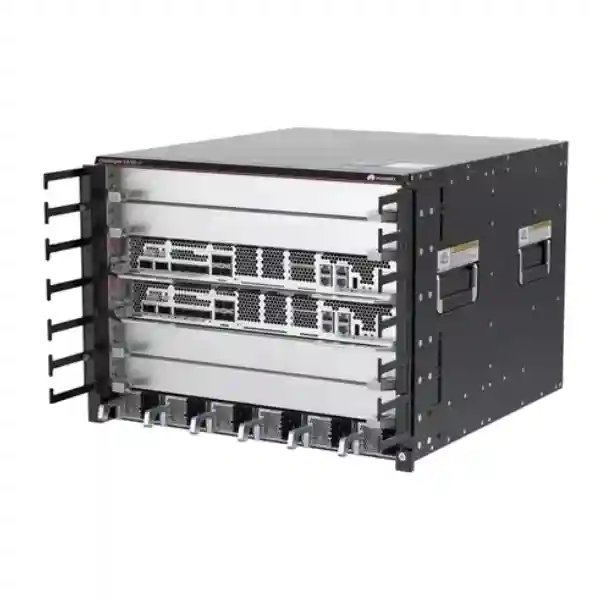
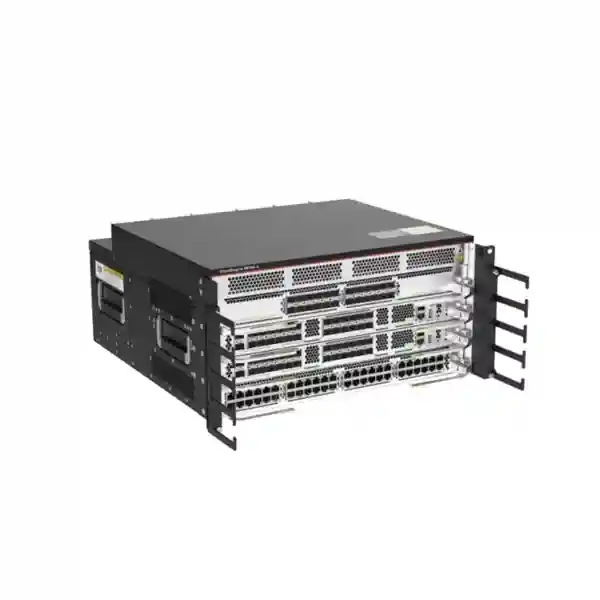
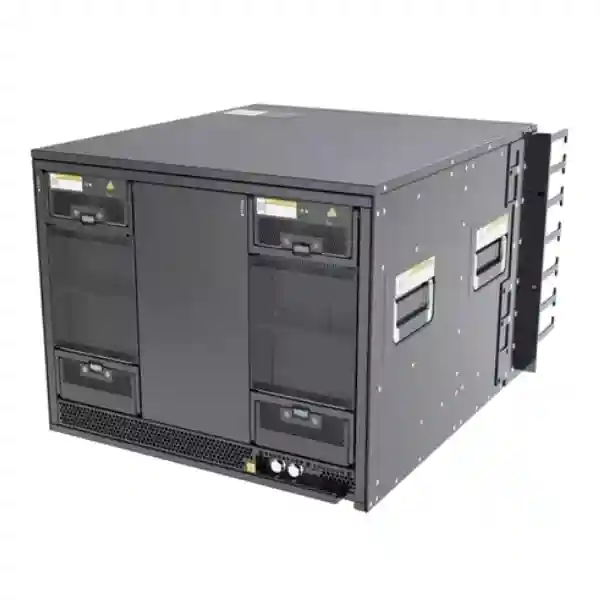
Huawei CloudEngine S8700-4
Huawei CloudEngine S8700-4 is the four-slot member of Huawei’s CloudEngine S8700 modular campus switch family, positioned for premium campus aggregation and access designs. Huawei documents the family with support for high-density GE, 10GE, 25GE, 40GE and 100GE connectivity options, redundancy across key components, and enterprise features including VXLAN, MACsec, IPv4/IPv6, network access control and granular quality-of-service functions. The exact bill of materials matters: chassis, control boards, service boards, transceivers, power modules, software release and feature requirements should be matched to the intended architecture before purchase.
This FourTeck buyer guide is written for organizations comparing the Huawei CloudEngine S8700-4 in Dubai, the wider UAE, Uganda, Kampala, Arua, Mbarara, Gulu, Kenya, Kuwait, Ghana, Nigeria and Seychelles. It focuses on practical procurement questions rather than assumed stock or unverified commercial promises.
Direct Answer: What Is the Huawei CloudEngine S8700-4?
The Huawei CloudEngine S8700-4 is a modular enterprise campus switch intended for aggregation and access roles where a fixed-port switch may not provide the desired expansion model, interface mix or component resilience. Huawei describes the S8700 family as next-generation modular aggregation/access switching for cloud campus networks. Rather than treating the chassis as a finished one-line product, buyers should specify it as a system: the selected main control boards, service cards, optical or copper media, power arrangement, software capabilities, rack environment and uplink/downlink requirements determine the finished deployment.
For a procurement team, the practical question is therefore not simply “What is the S8700-4 price?” but “Which S8700-4 configuration meets our port density, uplink speed, resiliency, security, management, PoE or optical requirements, and what exactly is included in the quotation?” FourTeck can structure that discussion so technical and commercial stakeholders review the same bill of materials before approval.
Platform role
Modular campus aggregation/access switching for enterprise and institutional networks.
Interface strategy
Huawei documents GE through 100GE options across the S8700 family, subject to the selected boards and configuration.
Resiliency
Key components are designed with redundancy options, including main control, power and fan elements within the family architecture.
Network services
VXLAN, MACsec, IPv4/IPv6, NAC and QoS capabilities support modern campus segmentation and controlled access designs.
Verified Capabilities That Matter to Buyers
Huawei’s current product materials position the S8700 family around high-density campus connectivity and resilient modular design. The S8700-4 is identified as the four-slot model. Huawei also lists two main control board slots for the S8700-4 on current product pages and describes redundant key components across the family. These characteristics are relevant when the switching layer must remain serviceable and expandable without relying on a single fixed interface layout.
VXLAN and EVPN-oriented campus design
Huawei lists VXLAN Layer 2 and Layer 3 gateway functions, centralized and distributed gateway approaches, BGP-EVPN and NETCONF-based configuration support. Organizations planning virtualized campus fabrics should confirm the exact feature set, software version and controller design intended for the project.
Access security and segmentation
MACsec is listed for secure hop-by-hop data transmission on supported ports, while NAC capabilities include MAC-address authentication and 802.1X. These can be relevant in office, education, healthcare, finance and government environments where identity-aware access and segmented traffic paths are required.
IPv4/IPv6 routing transition
Huawei documents IPv4/IPv6 dual-stack and multiple IPv6 routing options across the family. A migration plan should verify the selected software feature set, route scale and interoperability requirements rather than assuming identical behavior to an existing switch platform.
Traffic engineering and QoS
The platform includes traffic classification, queue scheduling and congestion-control capabilities. Buyers supporting voice, video, wireless, business applications and large east-west campus flows should define classes, trust boundaries and latency requirements before configuration.
Configuration Comes Before Quotation
A modular chassis quote can be incomplete even when the model name is correct. Before requesting commercial pricing, document the number and speed of access ports, uplink requirements, copper versus optical media, redundancy target, required routing and segmentation features, authentication method, management platform, transceiver distances, available rack space, power source and any planned growth. If existing switches are being replaced, include current VLANs, trunks, routing neighbors, spanning-tree design, link aggregation, access policies and maintenance-window constraints.
FourTeck’s UAE technology portfolio covers enterprise networking alongside security and IT infrastructure. Buyers who are planning a combined switching, server, wireless or security project can review broader FourTeck UAE IT and networking solutions while keeping the S8700-4 bill of materials specific to the campus design.
Huawei CloudEngine S8700-4 Dubai
Organizations searching for Huawei CloudEngine S8700-4 Dubai are commonly evaluating a core or aggregation refresh, a new office or campus build, a higher-density wireless rollout, a network segmentation project, or an enterprise standardization exercise. Dubai environments can vary from single-building corporate headquarters to multi-floor towers, education campuses, healthcare facilities, hospitality properties, logistics operations and mixed-use developments. The useful starting point is not a generic chassis price; it is a documented traffic and connectivity model. Record existing access-switch uplinks, expected 10GE or higher-speed aggregation links, fiber type, optical distance, routing boundaries, required redundancy, wireless controller or campus-management approach and the number of services that depend on the switching layer.
For a Dubai deployment, facilities planning deserves equal attention. Confirm rack depth and free rack units, front-to-rear airflow requirements, available power feeds, grounding, cable-management space, fiber termination method and maintenance access. A modular platform may be selected precisely because the organization wants expansion and serviceability, but those benefits are reduced if the physical installation leaves no room for additional boards, optics or cable management. Where the switch will aggregate Wi-Fi, IP telephony, cameras, servers or branch links, define those dependencies in the network diagram before finalizing the bill of materials.
Security teams should also identify where MACsec, NAC, 802.1X, segmentation, QoS and IPv6 are expected to operate. If VXLAN or BGP-EVPN is part of the intended architecture, clarify whether the S8700-4 will operate as an overlay gateway, an underlay node, an aggregation point or a conventional Layer 2/Layer 3 switch. The design should state which existing routers, firewalls, wireless systems and management tools must interoperate with the switch. This avoids purchasing optics, cards or licenses that do not match the final topology.
FourTeck can help Dubai buyers turn those details into a quotation checklist and deployment scope. For projects where the campus core also connects to perimeter security, review the same site’s perimeter firewall planning guidance so VLAN boundaries, north-south traffic paths and routing handoffs are considered together rather than as separate purchases. Availability, final pricing, optics and installation scope should be confirmed for the exact project before order approval.
Huawei CloudEngine S8700-4 UAE
A Huawei CloudEngine S8700-4 UAE requirement often reaches procurement as a short model reference, while the engineering requirement is much broader. The organization may be standardizing campus networks across Dubai, Abu Dhabi, Sharjah, Ajman or other emirates, consolidating older aggregation switches, increasing fiber capacity, supporting new Wi-Fi infrastructure, or preparing for more segmented access. A UAE quotation should therefore state the intended role of each chassis, the number of sites, expected port population at installation, expansion headroom and whether the same hardware standard will be repeated across multiple facilities.
Multi-site buyers should normalize design inputs before asking suppliers to quote. For every location, list access-switch counts, uplink speeds, fiber distances, redundant paths, IP addressing, routing protocols, management requirements and security controls. If one location needs only aggregation while another will use the chassis as a small campus core, the board mix and implementation effort may differ. Treat optics and cabling as first-class design items. Single-mode versus multimode fiber, connector type, link distance and desired speed all influence the correct transceiver choice; those parts should not be guessed from the chassis name.
Operational planning is also important across UAE sites. Decide how configurations will be backed up, how software versions will be standardized, who will approve changes, which logs and telemetry are required, and how maintenance windows will be coordinated. If NAC or 802.1X will be introduced at the same time, account for identity services, endpoint readiness and exception handling. If IPv6 is planned, define whether the immediate goal is dual-stack access, routing readiness or a broader address-transition program. These decisions affect the configuration and testing plan more than a simple hardware comparison.
FourTeck can assist with requirement clarification, bill-of-material review and implementation scoping for UAE buyers without assuming that a particular configuration is suitable for every site. The broader FourTeck UAE technology site provides context for enterprise networking and related infrastructure. For security-edge integration on the target website, firewall deployment planning can help teams coordinate switch uplinks, VLANs, routing and migration sequencing with perimeter changes.
Huawei CloudEngine S8700-4 Uganda
Customers searching for Huawei CloudEngine S8700-4 Uganda are typically looking beyond a small access-switch purchase. A modular S8700-4 can be considered where a business, institution, campus, service provider, university, hospital, government environment or multi-building organization needs a more structured aggregation layer with room for interface choice and resilient system design. Before requesting a quote, identify whether the chassis will aggregate existing access switches, connect wireless infrastructure, provide a routed campus core function or create a migration path from an older network. The answer determines which boards, optics and logical features need to be validated.
Uganda projects often benefit from careful attention to physical links between buildings. Document every fiber run, approximate distance, fiber type, patch-panel arrangement and required link speed. Where different generations of access switches are already in service, record which ports are copper, GE optical, 10GE or higher speed and whether link aggregation is currently used. This produces a clean migration map and prevents an order that omits the correct transceivers or interface density. It also helps determine whether legacy equipment will be retained temporarily during a phased cutover.
Power resilience and operational support should be planned at the same level. Confirm available rack power, UPS design, generator or alternate supply arrangements where applicable, grounding, environmental conditions, spare optics strategy and the process for configuration backup. A modular switch can provide architectural resilience only when the rest of the deployment—including upstream routes, downstream links and power—is designed to remove avoidable single points of failure. Network teams should also define whether 802.1X, MAC authentication, QoS, IPv6, MACsec or VXLAN functions are part of the day-one scope or a later phase.
FourTeck’s Uganda IT solutions site covers networking and broader business infrastructure, which can help organizations frame the switch as part of a complete site requirement rather than as an isolated chassis. Buyers should request an itemized quotation that clearly distinguishes chassis, control components, service boards, optics, power modules, software or support items and professional services. Final availability, commercial terms and service coverage should be confirmed for the specific destination and project scope.
Huawei CloudEngine S8700-4 Kampala
A Huawei CloudEngine S8700-4 Kampala search often comes from IT teams planning a headquarters, university, hospital, hotel, financial-services environment, public-sector network or growing commercial campus where multiple access layers converge on a central communications room. Kampala projects should start with a site diagram showing buildings, floors, wiring closets, server rooms and internet/security edges. Mark each uplink with current speed and media type, then note the target speed after the upgrade. This turns the S8700-4 selection into an engineering decision rather than a model-name purchase.
Where existing network equipment has been accumulated over several years, migration sequencing is especially important. Create an inventory of access switches, VLANs, trunks, routing interfaces, DHCP relay points, voice networks, CCTV networks, guest Wi-Fi, server segments and management subnets. The new aggregation platform should be introduced with a test and rollback plan, not by moving all links simultaneously. If the organization wants to adopt 802.1X or stronger segmentation during the refresh, stage identity and policy changes separately from basic physical migration so troubleshooting remains manageable.
Kampala buyers should also define the operational ownership model. Who will administer the switch after handover? How will configurations be backed up? Which alarms are monitored? What software release is approved? Are remote changes permitted, and who authorizes them? These questions matter because a modular campus switch is usually a long-lived network dependency. A clear runbook for normal operation, failover testing, change control and recovery can be as valuable as the hardware specification itself. If MACsec or VXLAN is required, the design should identify the peer devices and verify end-to-end compatibility before procurement.
FourTeck can help Kampala organizations prepare the bill of materials and scope around these questions through its regional networking channel at FourTeck Uganda. The quotation request should state the chassis quantity, expected interface population, optical distances, redundancy expectation, rack and power conditions, software features, installation needs and any migration support. This level of detail makes commercial comparisons clearer and reduces the risk of discovering missing components after the purchase process has already started.
Huawei CloudEngine S8700-4 Arua
For buyers searching Huawei CloudEngine S8700-4 Arua, the central procurement question is usually how to build a dependable aggregation point that can support local users while remaining manageable from a wider organizational network. The site may be a regional office, education institution, healthcare facility, logistics operation, public-sector location or branch campus with several network closets. Begin by identifying which services are critical during a switch outage: business applications, voice, wireless access, CCTV, remote administration, internet connectivity or inter-site links. This priority list helps define which links and components require redundancy and which can tolerate planned maintenance.
Fiber and transport planning should be documented before hardware selection. If the S8700-4 will aggregate links from separate buildings or distant closets, record the fiber type and measured or estimated path length rather than ordering optics based only on a rough assumption. Where an upstream WAN or internet service enters the site through another router or firewall, document the handoff speed, routing protocol, VLAN tagging and failover behavior. The new switch should fit that topology without creating an undocumented dependency between campus switching and wide-area connectivity.
Arua deployments can also benefit from a practical spare-parts and support discussion. Identify which optics, cables or field-replaceable components would be difficult to obtain quickly if a failure occurs, then decide what should be kept as a local spare according to the organization’s risk tolerance. This is not the same as assuming stock or guaranteed response times; it is a procurement-planning exercise. Configuration backups, software images, access credentials, diagrams and change records should be stored in a controlled location so support does not depend on one individual administrator.
FourTeck can use the same structured requirement to prepare a regional quotation through FourTeck Uganda networking support. Include intended switch role, port-speed mix, optics, number of connected closets or buildings, required routing and security features, power conditions and implementation scope. If the project also includes network-edge security, the FourTeck firewall platform provides related planning context for segmentation and secure upstream connectivity, while final product compatibility must be validated against the exact design.
Huawei CloudEngine S8700-4 Mbarara
A Huawei CloudEngine S8700-4 Mbarara requirement may arise when an organization is consolidating several access layers, expanding a campus, opening new buildings or replacing an aging core. Mbarara buyers should first classify the workload carried by the network. A university environment may prioritize high client density, lab connectivity and Wi-Fi aggregation; a healthcare environment may separate clinical, administrative, guest and device networks; a hospitality or commercial site may combine voice, wireless, surveillance and business systems. Those use cases create different requirements even when the same chassis is considered.
Capacity planning should focus on real interface counts and traffic paths. Count current switch uplinks, spare links required for growth, server or storage connections, firewall handoffs, WAN connections and management interfaces. Then document speed targets and whether links will be bundled for resiliency. If 10GE, 25GE, 40GE or 100GE options are being considered, confirm which boards and optics support the intended combinations. Huawei’s S8700 family provides a broad interface strategy, but the exact configuration must be checked rather than inferred from the series name.
Deployment planning should also address what happens during change windows. Define a migration sequence by closet or service, prepare old and new configuration maps, test routing adjacency before moving production users, and agree on rollback thresholds. For NAC projects, avoid enabling authentication policy across every port at once unless endpoint readiness has been validated. For QoS, identify trusted markings from phones, access points and applications and decide where traffic should be remarked or queued. For IPv6, establish whether dual-stack services are required immediately or only future readiness is needed.
FourTeck can help buyers in Mbarara structure these inputs through the Uganda FourTeck IT channel. A useful quotation request includes the network diagram, chassis quantity, preferred redundancy model, board and port needs, fiber distances, environmental and power information, software requirements and service expectations. This reduces ambiguity for both procurement and engineering and supports a cleaner handover after installation.
Huawei CloudEngine S8700-4 Gulu
Organizations searching Huawei CloudEngine S8700-4 Gulu may be planning a regional campus, institutional network, enterprise branch, education environment, healthcare site or a central aggregation layer for several wiring closets. The first design decision is the switch’s role. If the S8700-4 is an aggregation node, identify every downstream access switch and the uplink capacity it requires. If it is also acting as a routed core for a smaller campus, document Layer 3 interfaces, dynamic-routing neighbors, default-route behavior, firewall connections and any server or shared-service networks. Clear role definition prevents unnecessary complexity.
Gulu projects should place special emphasis on maintainability. A resilient chassis is useful only when administrators have accurate diagrams, configuration backups and an understood process for replacing components or moving links. Label fiber pairs, patch panels, switch ports and upstream/downstream devices consistently. Record optical module types and distances. Keep a version-controlled configuration baseline and define who has administrative access. If remote support is part of the operating model, ensure out-of-band or alternate access has been considered so a routing or VLAN mistake does not remove every path to the device.
Security and performance features should be mapped to business requirements rather than enabled because they appear on a datasheet. Use NAC or 802.1X where identity-based access is operationally supportable. Use MACsec where supported links require hop-by-hop protection and both ends are compatible. Use QoS where real-time voice, video or critical applications need differentiated treatment. Use VXLAN and BGP-EVPN when there is a clear fabric architecture and the operations team is prepared to manage it. The S8700 platform can support sophisticated designs, but the best configuration is the one aligned with the site’s actual operational maturity.
FourTeck can support the requirement-definition and quotation process via FourTeck Uganda. For the quote, state expected connected users only as supporting context; interface counts, topology, optical distances, redundancy, routing, management and security requirements are more important for a modular switch. Final availability, lead time, commercial terms and service scope should be confirmed against the exact bill of materials before procurement.
Huawei CloudEngine S8700-4 Kenya
Huawei CloudEngine S8700-4 Kenya searches usually indicate a requirement for enterprise aggregation, campus modernization, multi-building connectivity or a modular core for a medium-scale network. Kenya buyers may be comparing chassis-based switching against fixed high-density alternatives, and the comparison should account for more than purchase price. Evaluate expansion requirements, serviceability, interface flexibility, power design, operational skills, software features, optics and the expected service life of the architecture. A modular system can be attractive when the organization expects the network to evolve, but only if the initial configuration leaves a sensible growth path.
Create a capacity worksheet that lists every planned connection by speed and media. Separate downstream access-switch uplinks, server links, wireless infrastructure, firewall handoffs, WAN routers and inter-building fibers. Note whether each connection is single or redundant and whether link aggregation is required. This makes it easier to determine the correct board mix and transceiver list. It also exposes hidden dependencies such as an older access switch limited to a specific optical standard or a new Wi-Fi design requiring more uplink bandwidth than the current core can provide.
For organizations with multiple Kenyan sites, standardization can reduce operational complexity. Define a reference configuration for naming, management addressing, VLAN conventions, routing, NTP, AAA, logging, monitoring and configuration backup, then document site-specific exceptions. If the design uses IPv6, NAC, QoS, MACsec or VXLAN, make sure those features are represented in acceptance testing. Procurement should request a bill of materials that clearly separates the chassis, control components, service boards, optical modules, cables, power components and any support or implementation services.
The FourTeck Kenya technology site includes enterprise networking as part of its business IT portfolio. FourTeck can use your topology and capacity worksheet to review a proposed S8700-4 configuration and prepare a quotation discussion without assuming a universal board population. If the campus architecture also includes dedicated edge security, reference the target site’s enterprise firewall platform guidance as an example of how routing handoffs and security policy boundaries should be documented alongside switching.
Huawei CloudEngine S8700-4 Kuwait
Buyers searching Huawei CloudEngine S8700-4 Kuwait are often planning enterprise campuses, government facilities, education networks, commercial properties, hospitality environments or multi-floor office infrastructure where the aggregation layer must carry several service types. The design process should begin with port and traffic requirements, but Kuwait projects should also give careful attention to equipment-room conditions. Confirm rack placement, airflow, cooling, dust management, power feeds, UPS capacity and access for maintenance. Manufacturer environmental limits must be respected even when the wider outdoor climate is more severe; the relevant condition is the controlled environment in which the switch operates.
For a modular chassis, power planning is not just a facilities task. The final board population and attached services influence the complete power design, so the quotation and rack plan should be reviewed together. Identify whether redundant power paths are required and whether the rack has independent feeds. Confirm grounding and cable organization. If optical uplinks leave the equipment room for other buildings, verify fiber type, distance, patch-panel design and surge or pathway considerations according to the site’s cabling standard. Avoid selecting transceivers by brand familiarity alone; use the exact supported interface and optical specification.
Network architects should define how the S8700-4 fits between the access and security layers. If VLANs terminate on the switch, document inter-VLAN routing, default gateways, ACLs and firewall routes. If gateways remain elsewhere, document trunking and failure behavior. For VXLAN or BGP-EVPN projects, include controller and underlay requirements. For NAC and 802.1X, include authentication services and fallback behavior. For voice and video, establish a QoS policy that is consistent from access switches through the aggregation layer and toward the WAN or internet edge.
FourTeck can help Kuwait buyers review the requested configuration, identify missing bill-of-material items and define the implementation boundary. Where a campus switch will connect to a next-generation firewall, comparing the security edge at the same time can avoid routing and interface mismatches. The PA-410 planning page is one example of the site’s structured approach to ports, segmentation and deployment questions; it is not presented as a direct capacity match for the S8700-4. Final Kuwait availability and support terms should be confirmed at quotation time.
Huawei CloudEngine S8700-4 Ghana
A Huawei CloudEngine S8700-4 Ghana requirement is typically associated with a campus, business headquarters, education network, healthcare environment, public-sector site, hotel, industrial facility or larger office where multiple access networks need a stable aggregation point. Ghana buyers should prepare a network inventory before requesting a quote: list each connected switch, link speed, fiber type, VLANs, routed interfaces, server connections, firewall handoffs, wireless dependencies and critical services. This inventory allows the modular chassis to be configured around actual needs instead of a generic package.
Growth planning is important because a chassis platform is often selected for a multi-year network lifecycle. Estimate how many additional closets, access switches, wireless access points, cameras, voice endpoints or server connections may be added, but avoid turning those estimates into unsupported traffic claims. Translate growth into concrete port and uplink requirements. If the organization expects a transition from 1GE aggregation toward 10GE or higher-speed links, determine which parts of the fiber plant can support the target speeds and which may need replacement. A switch upgrade cannot compensate for unsuitable cabling or optics.
Operational design should cover backup power, monitoring, configuration management and administrative control. Decide how faults will be detected, where logs are sent, how configuration changes are approved and how quickly a failed uplink can be isolated. If redundant links are required, test the behavior rather than assuming it. If MACsec is part of the design, confirm peer support. If NAC is planned, verify identity infrastructure and endpoint onboarding. If IPv6 is required, document addressing and routing rather than enabling dual stack without governance.
FourTeck’s Ghana IT solutions platform explicitly includes network switches and broader infrastructure, giving procurement teams a regional route for discussing the S8700-4 alongside the rest of the project. For a complete quote, provide the site count, chassis quantity, board and port needs, optics, distances, rack and power details, software functions and requested services. If the project includes a security gateway, the PA-415 deployment guide illustrates the separate questions that should be addressed at the perimeter; suitability must be evaluated independently.
Huawei CloudEngine S8700-4 Nigeria
Huawei CloudEngine S8700-4 Nigeria searches can come from enterprises, universities, financial institutions, healthcare providers, hospitality groups, public-sector organizations, industrial sites and multi-branch businesses that need a more structured campus aggregation layer. The S8700-4 should be evaluated as part of a complete topology. Identify which access switches feed the chassis, which links go to servers or data-center resources, how internet and WAN traffic reaches the firewall or router, and where Layer 3 gateways are located. A simple diagram with link speeds and redundancy is often the most useful input for quotation accuracy.
Nigeria deployments may span sites with very different requirements, so avoid assuming one standard configuration will fit every branch or campus. A headquarters may need more high-speed optical aggregation, while a regional facility may prioritize resilience and manageable growth. Use a common design framework but allow the board population, optics and service scope to reflect each location. Where power continuity is a business concern, coordinate the switch design with UPS and generator strategy and verify that redundant power paths are actually independent. Environmental control, rack access and cable organization should also be included in readiness checks.
For security, document where user and device authentication occurs and which traffic needs separation. Huawei lists 802.1X and MAC authentication under the S8700 family, and MACsec can support protected hop-by-hop links on compatible ports. These features should be deployed according to a tested policy model. QoS should be based on real application classes such as voice, conferencing and business-critical services. VXLAN and BGP-EVPN should be adopted only where the organization has an intentional fabric design and the operational tools to support it.
The FourTeck Nigeria IT platform provides a regional channel for broader technology requirements. FourTeck can help review the S8700-4 bill of materials, separate required from optional components and define installation or migration activities. If a branch architecture also requires a compact firewall, the target site’s Sophos XGS 88 planning page demonstrates how edge-device sizing differs from chassis-switch sizing; the two should not be treated as equivalent products. Request current commercial information for the exact Nigerian destination and configuration.
Huawei CloudEngine S8700-4 Seychelles
A Huawei CloudEngine S8700-4 Seychelles inquiry may relate to hospitality, government, education, healthcare, financial services, utilities or a larger commercial campus where reliable aggregation is needed across buildings or network zones. Because island deployments can place extra importance on procurement planning and replacement logistics, the bill of materials should be complete before shipment is arranged. List the chassis components, required service boards, control elements, optical modules, cables, power items and any recommended project spares separately. Do not rely on the chassis model name as proof that every necessary interface or accessory is included.
Site readiness should include environmental and physical details. Confirm that the communications room provides controlled temperature, appropriate airflow, rack space, grounding and stable power. For links between buildings, document fiber type and distance and ensure that the selected optical modules match the physical plant. In hospitality or campus environments, the switch may aggregate large numbers of access switches that in turn connect Wi-Fi, voice, CCTV, guest networks and operational systems. Those services should be mapped to VLANs, routing, redundancy and QoS policies before cutover.
Remote manageability is another practical consideration. Decide how administrators will reach the S8700-4 if the primary network path is disrupted, how configuration backups are stored, and how logs or alerts are transmitted. If changes will be supported remotely, clear diagrams and port labels are essential. Where 802.1X, MAC authentication, MACsec, IPv6 or VXLAN are part of the design, validate dependencies on identity servers, peer devices, routing infrastructure and software versions in advance. Complex features should be included in the acceptance test so the handover verifies more than simple link connectivity.
FourTeck can help Seychelles buyers prepare a structured quotation request and review the proposed topology against the intended S8700-4 configuration. For projects where the switch connects to a dedicated security gateway, use the target site’s FourTeck firewall solution overview to frame the security-edge discussion separately from switching. Confirm shipping, commercial terms, support boundaries, installation responsibility and current availability for the exact destination before approval; this page does not assume local stock, office presence or fixed delivery timing in Seychelles.
How to Size the S8700-4 Configuration
Sizing a modular campus switch is a topology exercise. Start by drawing the network, then convert every link into an interface requirement. For each downstream access switch, record primary and redundant uplink speed. For each server, firewall, router, wireless controller or other infrastructure device, record media and speed. Add expected growth, but keep current and future requirements clearly separated. This allows the quotation to show what is needed on day one and what expansion remains possible later.
1. Port matrix
Count GE, 10GE, 25GE, 40GE and 100GE requirements by media type. Separate required ports from spare growth capacity.
2. Resilience target
Define redundant supervisors, power paths, uplinks and upstream routes according to the business impact of an outage.
3. Optical design
Verify fiber type, connector, distance and supported transceivers for every optical link before ordering.
4. Feature scope
List VLAN, routing, IPv6, NAC, QoS, MACsec, VXLAN, EVPN and management requirements, including software dependencies.
5. Operations
Plan monitoring, logging, backups, AAA, change control, spare parts, software maintenance and escalation ownership.
6. Migration
Document current dependencies, maintenance windows, test cases and rollback steps before moving production links.
Compatibility and Integration Checklist
Compatibility should be verified at the exact hardware and software level. A series-level feature statement does not prove that every line card, optic or software release supports the same function. Before purchase, confirm the proposed component list against the intended Huawei software release and the peer devices already installed.
- Confirm supported service boards and the port combinations required for the design.
- Confirm optical-module compatibility, wavelength, reach, connector and fiber type.
- Confirm routing interoperability with existing OSPF, BGP, static routing or other protocols in use.
- Confirm NAC and 802.1X integration with the organization’s identity and authentication services.
- Confirm MACsec support on both ends of any link where encrypted Ethernet is required.
- Confirm management integration, telemetry, SNMP or controller requirements and approved software version.
- Confirm rack, power, airflow and grounding before installation day.
Related FourTeck Resources on This Site
A campus switch normally sits beside other infrastructure rather than operating alone. The following verified pages are useful when the S8700-4 project also touches security, routing, migration or operational planning.
Firewall Dubai platform
Use this overview when the campus switch uplinks to a new or redesigned security edge and routing boundaries must be coordinated.
About FourTeck firewall solutions
Review the site’s solution approach before combining switching, VLAN segmentation and perimeter-security work in one project scope.
Firewall deployment planning
Useful for coordinating VLANs, routing, cutover sequence, network diagrams and rollback planning with the S8700-4 migration.
Perimeter firewall design
Helps teams document where campus VLANs, trusted routes and internet-facing policy boundaries meet at the security gateway.
Enterprise firewall family guidance
Relevant when the S8700-4 is part of a larger enterprise architecture and firewall capacity, optics and segmentation are being reviewed in parallel.
Palo Alto Networks PA-410
A compact firewall example for small-edge scenarios; useful only when a branch or management segment needs a separate gateway, not as a substitute for the S8700-4.
Palo Alto Networks PA-415
Another edge-security reference for interface and PoE planning where a compact security appliance must connect to the campus switching environment.
Sophos XGS 88
A small-site firewall reference for projects where branch security is being standardized separately from the central S8700-4 aggregation platform.
Questions to Ask Before Approving a Quote
- Does the quotation identify every chassis component, board, power module, optic and cable separately?
- Which software release and feature set are planned, and are they compatible with the current network?
- Are the uplink speeds and optical reaches based on measured site requirements?
- What redundancy is included for supervisors, power, links and routing, and how will failover be tested?
- Which configuration, installation, migration, documentation and training tasks are included or excluded?
- Who supplies rack power, patching, fiber preparation, IP addressing, identity services and maintenance-window approval?
- What commercial terms, support entitlements and current availability apply to the exact destination and bill of materials?
Huawei CloudEngine S8700-4 FAQ
Is the S8700-4 a fixed-port switch?
No. Huawei positions the S8700-4 as a modular member of the CloudEngine S8700 campus switching family. The final port mix depends on the selected hardware configuration rather than a single fixed front-panel layout.
What network role is it designed for?
Huawei describes the S8700 family for campus aggregation and access. Depending on topology and scale, organizations may use an S8700-4 as an aggregation node or as a core/aggregation platform in a smaller campus design, subject to validated capacity and feature requirements.
Does the S8700 family support high-speed interfaces?
Huawei documents GE, 10GE, 25GE, 40GE and 100GE access options across the S8700 family. The exact interface availability must be matched to supported boards and the proposed software/hardware combination.
Does it support VXLAN?
Huawei lists VXLAN Layer 2 and Layer 3 gateway functions, centralized and distributed gateway approaches, BGP-EVPN and NETCONF configuration capabilities for the platform family. Confirm exact release and design dependencies before deployment.
Can it be used in IPv6 networks?
Huawei lists IPv4/IPv6 dual-stack and IPv6 routing capabilities. Buyers should still validate route scale, protocol support and software release against the intended network design.
Does it support 802.1X and access control?
Huawei lists MAC-address authentication and 802.1X under NAC capabilities. A complete deployment also requires compatible identity services, endpoint readiness and a tested policy design.
Can FourTeck quote only the chassis?
A chassis-only request can be discussed, but most production projects need a complete bill of materials. Share the required boards, optics, power design, software features and service scope so the quotation reflects a usable configuration.
What information should I send for a quote?
Send the destination, quantity, intended network role, required port counts and speeds, fiber distances, redundancy target, routing and security features, rack and power details, existing switch models, required migration work and any support expectations.
Decision Recap
The Huawei CloudEngine S8700-4 is most relevant when the project calls for modular campus aggregation or access, flexible high-speed interface choices and a resilient platform architecture. Its value depends on the configuration being engineered around the real network rather than selected from a generic bundle. Define the topology, port matrix, optics, redundancy, security features, software requirements and operating model before comparing quotations.
If you already have a network diagram or an existing switch list, FourTeck can use it to structure the commercial discussion. If you do not, start with a simple inventory of connected switches, link speeds, fiber distances, VLANs, routing, firewall interfaces and future growth. That information is enough to identify the next technical questions without inventing assumptions.
Quotation Checklist
- Destination and required quantity
- Current topology and target switch role
- Port speeds, media and optical distances
- Redundancy and power requirements
- Routing, VXLAN, NAC, MACsec, QoS and IPv6 scope
- Installation, migration and documentation needs
- Support and commercial requirements
Related Product Area
The S8700-4 is commonly part of a larger architecture involving access switches, wireless, routing, security gateways, optics and structured cabling. FourTeck can review the switching requirement together with the upstream security handoff so the port speeds, VLAN design and routing responsibilities line up.
For small branch-security examples on the same site, compare the documented interface planning on the PA-410, PA-415 and Sophos XGS 88 pages; they illustrate why every adjacent device should be sized independently.
Plan the S8700-4 Around Your Actual Campus
Send FourTeck the existing network diagram or a simple list of access switches, uplink speeds, fiber distances, required redundancy and security features. The response can then focus on the specific chassis configuration and project scope instead of a generic switch description.
For regional infrastructure discussions, FourTeck maintains dedicated technology channels for Kenya, Ghana and Nigeria, alongside the Uganda and UAE resources referenced above. Commercial availability and delivery arrangements remain subject to confirmation for the selected configuration and destination.

Reviews
There are no reviews yet.