
Modular enterprise campus switching • high-density access • resilient architecture
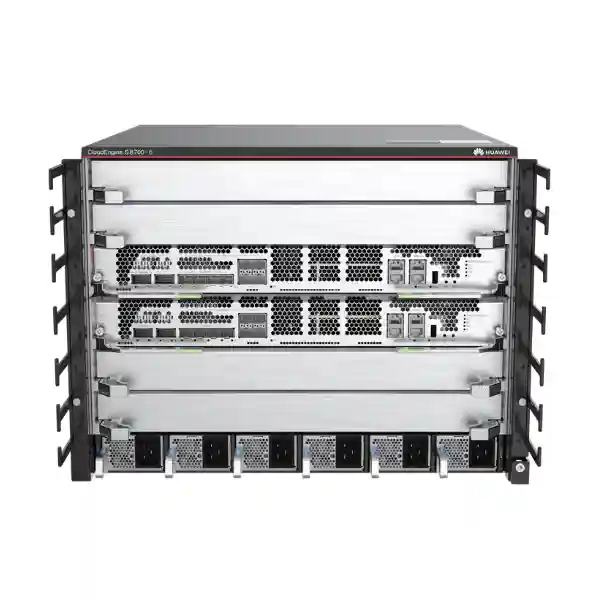
Huawei CloudEngine S8700-6
The Huawei CloudEngine S8700-6 is a next-generation modular aggregation and access switch designed for premium campus networks where high port density, resilient control, scalable uplinks, advanced segmentation and wired-wireless convergence must be planned as one architecture. For buyers searching for Huawei CloudEngine S8700-6 Dubai pricing, UAE supply guidance, enterprise switch sizing or regional procurement support, the important task is not simply choosing the chassis. A complete solution must match the correct SRUs, service cards, power modules, optics, PoE demand, software release, licensing, rack environment and migration plan to the real network.
Published switching capacity: 7.2 Tbit/s
Chassis layout: 2 SRU slots + 4 LPU/service-card slots
Chassis height: 8U
System power slots: 6
Primary role: enterprise campus access, aggregation and core use depending on design
High-density modular design
Huawei publishes chassis density of up to 312 GE, 312 10GE, 208 25GE, 134 40GE or 70 100GE ports for the S8700-6, depending on the selected cards and configuration.
Resilient control and power
Two SRUs can operate in 1:1 hot standby, while the chassis supports redundant power arrangements and two fan slots for a design that can be planned around business continuity requirements.
Campus services
The platform supports functions including VXLAN, BGP EVPN, IPv4/IPv6, MACsec, NAC, QoS, multicast, programmable operations and wired-wireless convergence, subject to the exact software and hardware configuration.
PoE and hybrid access options
Supported line-card options can provide PoE++ and hybrid optical-electrical access for selected campus designs. The bill of materials must account for cards, power budget, powered-device demand and cabling method.
Direct answer: what is the Huawei CloudEngine S8700-6?
The Huawei CloudEngine S8700-6 is an 8U modular enterprise switch in Huawei’s CloudEngine S8700 family. Huawei positions the series as next-generation modular aggregation and access switching for premium campus networks. The S8700-6 chassis provides two Switch Routing Unit slots and four Line Processing Unit slots, six system power-supply positions and two fan slots. Huawei publishes 7.2 Tbit/s switching capacity for this model. The architecture is intended to let organizations build dense multi-gigabit and high-speed optical campus connectivity while retaining a modular path for service cards and uplink expansion.
The key buying point is configurability. The chassis alone does not define the final port mix or project capability. A deployable system can require the appropriate SRU pair, line cards, power modules, fan modules, optics or direct-attach cabling, software release, licenses, grounding, rack capacity and implementation services. Different SRU options also have different supported functions and access-point management specifications, so a quotation should identify the exact part numbers rather than use only the family name. For PoE-heavy campus designs, the electrical load and selected power modules require particular attention because the switch can support high PoE output configurations that are materially different from a non-PoE build.
FourTeck’s role is to help turn a model request into a clear bill of materials. Buyers can share the existing topology, number of floors or buildings, current edge switches, fibre paths, required 10GE/25GE/40GE/100GE uplinks, Wi-Fi access-point count, PoE classes, expected growth, routing design and maintenance expectations. This enables a discussion about whether the S8700-6 is appropriate, what must be included in the quotation and which design assumptions should be verified before purchase.
Verified Huawei CloudEngine S8700-6 specifications
| Specification | Published value / capability | Buyer interpretation |
|---|---|---|
| Switching capacity | 7.2 Tbit/s | Use as a platform value; final design still depends on populated cards, traffic patterns and software features. |
| SRU / control slots | 2 | Two compatible SRUs can be designed for 1:1 hot standby. |
| Service-card slots | 4 | Port density and media type depend on which LPUs are installed. |
| Maximum published chassis port densities | 288 FE; 312 GE; 312 10GE; 208 25GE; 134 40GE; 70 100GE | These are model-level maximum densities and should not be treated as one simultaneous mixed-port configuration. |
| Chassis dimensions | 352.8 × 442.0 × 482.8 mm (H × W × D) | Check rack depth, cable-management clearance and front-to-rear airflow before ordering. |
| Chassis height | 8U | Reserve adequate rack space plus practical service clearance for installation and maintenance. |
| Base / full configuration weight | 52.7 kg base; 85.5 kg full configuration | Confirm rack loading, safe handling and installation procedure. |
| System power-supply positions | 6 | Power-module selection and redundancy mode should be sized from the actual card and PoE load. |
| Maximum power consumption | 1560 W in full configuration without PoE | This is a planning figure for the chassis without PoE load; actual electrical design must use the proposed BOM. |
| Long-term operating temperature | -5°C to 45°C at the stated Huawei altitude range | Equipment-room cooling and environmental conditions must remain within the vendor limits for the exact deployment. |
| Airflow | Front air intake, rear exhaust | Align the rack row and hot/cold aisle design with the chassis airflow direction. |
Published specifications can change with hardware revisions and software releases. The commercial bill of materials should be checked against current Huawei documentation before order placement.
Key capabilities that matter in an enterprise campus
Wired and wireless convergence
CloudEngine S8700 can integrate WLAN access-controller capabilities. Huawei documentation notes 16 APs managed by default for the series, while higher AP-management scale requires suitable SRU options and licenses. For S8700-6, documented SRU combinations include management specifications from 500 to 5,000 APs. Buyers planning campus Wi-Fi should therefore specify the exact controller role and access-point count before choosing SRUs and licenses.
VXLAN and BGP EVPN
The platform supports VXLAN Layer 2 and Layer 3 gateway functions, centralized and distributed gateway designs and BGP EVPN. These capabilities are useful where a campus needs scalable virtual networks, policy separation and modern fabric architectures. They should be designed with the wider controller, routing, addressing and operations model rather than enabled as isolated features.
Network admission control and MACsec
Huawei lists MAC address authentication, 802.1X authentication, policy association and free mobility among the platform’s NAC functions. MACsec is supported on ports for hop-by-hop secured data transmission. Actual deployment depends on endpoint capability, identity architecture, policy design and the line-card/software combination.
IPv6, QoS and multicast
The S8700 family supports IPv4/IPv6 dual stack, IPv6 routing functions, detailed QoS controls and Layer 2/Layer 3 multicast technologies. This is relevant for campus designs carrying business applications, voice, video, wireless services, surveillance and segmented operational traffic on shared infrastructure.
PoE++ and hybrid optical-electrical access
Supported line cards can provide up to 90 W PoE++ on a port for devices such as Wi-Fi access points, cameras and conferencing endpoints. Huawei also documents hybrid optical-electrical access capable of carrying optical data and remote power over supported hybrid cabling. Confirm card type, power budget, cable design, endpoint requirements and distances before treating this as part of the project scope.
Operations and programmability
Huawei documents IFIT-based performance measurement, NETCONF/YANG configuration for relevant fabric functions, Open Programmability System support and configuration rollback. These tools can help mature network teams automate tasks and improve fault isolation, but operational value depends on monitoring architecture, software version, staff process and integration with management platforms.
How to size a Huawei CloudEngine S8700-6 configuration
Sizing starts with the service role, not with a single throughput number. An access-heavy campus may prioritize hundreds of downlink ports, PoE and wireless convergence. An aggregation deployment may emphasize resilient 10GE/25GE uplinks, 40GE/100GE core connectivity, route scale and failure domains. A core-oriented use may depend more heavily on high-speed optical interfaces, routing policy, redundancy and fabric design. In each case, the S8700-6 chassis can be the same while the bill of materials differs substantially.
- Define the role. Specify whether the chassis will operate at campus access, aggregation or core, whether it will host WLAN controller functions, and whether it participates in VXLAN/BGP EVPN or conventional Layer 2/Layer 3 architecture.
- Build the port matrix. List current and future copper, GE optical, 10GE, 25GE, 40GE and 100GE links. Add media type, fibre distance, connector, redundancy and breakout requirements.
- Choose the SRU strategy. Select the SRU model against software support, service-port needs, AP-management scale and required feature set. For resilient environments, identify whether a matched dual-SRU design is required.
- Choose service cards. Map each LPU to real downlinks and uplinks rather than buying maximum theoretical density. Allow practical spare ports and future growth without wasting slots.
- Calculate the power plan. Include chassis consumption, installed cards, redundancy mode, PoE demand and power-source arrangement. Verify PDU, UPS and facility load.
- Check optics and cabling. Confirm SFP/SFP+/SFP28/QSFP+/QSFP28 requirements, approved transmission distances and fibre plant quality. Do not assume existing optics are compatible.
- Plan operations. Define software baseline, licenses, network management, AAA, logging, monitoring, backup, rollback, upgrade procedure and vendor-support entitlement.
- Plan migration and acceptance. Document current VLANs, routing, spanning tree or fabric design, QoS, multicast, DHCP relay, NAC, wireless integration and test criteria before cutover.
Buyer warning: the chassis name is not the bill of materials
A quotation that lists only “Huawei CloudEngine S8700-6” is not enough for a production deployment. Ask for the exact chassis, SRU quantity and part number, LPU types, power modules and redundancy mode, fan modules, optics, cables, licenses, software/support entitlement and any installation services. Also ask the supplier to state what is excluded. This avoids a common procurement problem in modular switching: a chassis may appear competitively priced while essential cards, optics, licenses or redundant power components are missing from the comparison.
Huawei CloudEngine S8700-6 Dubai
Organizations searching for Huawei CloudEngine S8700-6 Dubai typically need more than a switch price. Dubai campus and enterprise projects frequently combine multi-floor offices, hospitality environments, education campuses, healthcare facilities, logistics operations, data-heavy professional services and mixed wired/wireless networks. The practical question is whether the chassis can be configured for the required downlink density, fibre topology, wireless growth, surveillance traffic and high-speed uplinks without creating unnecessary complexity. The S8700-6 is especially relevant when a fixed-port switch no longer provides enough scale or when the network team wants modular service-card expansion and resilient control in an 8U platform.
For a Dubai deployment, rack and equipment-room planning deserve early attention. Huawei publishes front-to-rear airflow, an 8U chassis height, a base weight of 52.7 kg and a full-configuration weight of 85.5 kg. A project team should therefore confirm cabinet depth, mounting method, safe installation handling, hot/cold aisle direction, cooling capacity, PDU arrangement and UPS design before the equipment arrives. The published full-configuration consumption of 1560 W excludes PoE, so a campus using high-power APs or cameras requires a separate PoE budget based on the selected cards and endpoints. Optical design should also be documented floor by floor, with fibre type, connector, distance and transceiver specifications included in the BOM.
Buyers comparing Huawei S8700-6 price in Dubai should request like-for-like quotations. One proposal may include dual SRUs and redundant power modules while another may not. One may include 100GE uplink optics, another may list only empty ports. Licenses for wireless management or other software functions can also change the commercial scope. FourTeck can help structure the requirement, identify the information needed for sizing and prepare the commercial discussion around a complete system rather than an ambiguous chassis-only request. The broader FourTeck UAE technology portfolio is also relevant where the switch must be coordinated with enterprise networking, security, wireless or server infrastructure.
Before requesting a Dubai quotation, prepare the desired deployment role, port count by speed, current switching topology, uplink bandwidth, number of access points, PoE classes, fibre distances, routing requirements, preferred redundancy level, rack details and target project schedule. If the S8700-6 will connect directly to a security edge, coordinate VLAN handoffs, routing adjacency, link aggregation and failover with the firewall design. FourTeck’s Dubai firewall and network-security overview can help frame that edge-side planning without assuming that the switch itself provides firewall functions.
Huawei CloudEngine S8700-6 UAE
For UAE organizations evaluating the Huawei CloudEngine S8700-6, procurement often spans more than one site or emirate. A head office may need aggregation switching, a warehouse may require long fibre links and surveillance connectivity, and a branch campus may require resilient Wi-Fi and voice. The useful way to evaluate the platform is to build a standardized architecture with a repeatable port, optic, software and management policy while allowing each site to use the line-card mix it actually needs. The S8700-6’s four service-card slots can support this approach, but the system should be specified from a network design rather than from a generic model name.
UAE buyers should pay particular attention to facility conditions and change management. The published long-term operating range reaches 45°C under Huawei’s stated altitude conditions, yet enterprise switching should still be installed in a controlled environment where intake temperature, dust, airflow and power quality are managed. The full-configuration chassis can be heavy, so rack suitability and installation access are practical issues. For business-critical networks, dual SRUs, redundant power architecture, diverse upstream links and documented recovery procedures should be discussed together. A hardware redundancy feature is not a substitute for a complete high-availability design that considers routing protocols, link paths, upstream devices, power feeds and operational procedures.
Compatibility planning is another common UAE search concern. If the switch is being added to an existing mixed-vendor environment, document VLAN tagging, LACP, spanning-tree mode, routing protocol, multicast, DHCP relay, authentication, logging, NTP, SNMP or telemetry requirements and optic standards. If the organization wants VXLAN and BGP EVPN, include the fabric design and management model in the project scope. If it wants MACsec, confirm endpoint and intermediate-device support. If it wants integrated WLAN control, confirm the chosen SRU, access-point scale and required licensing. This prevents feature names on a datasheet from being mistaken for a ready-to-run architecture.
For a commercial request, specify whether the quotation should include supply only, staging, configuration, migration, rack installation, fibre patching, acceptance testing, documentation, training or ongoing support. Request written confirmation of the exact BOM, warranty/support entitlement, lead-time basis and any region-specific ordering constraints. This gives procurement teams a transparent comparison and reduces the risk of discovering missing optics, power modules or licenses after the purchase order has been issued.
Huawei CloudEngine S8700-6 Uganda
Uganda buyers looking for Huawei CloudEngine S8700-6 supply or enterprise campus switch guidance often need to balance expansion, central management and infrastructure resilience. The platform can suit large offices, universities, government environments, hospitality groups, healthcare networks and multi-building business sites where aggregation needs exceed the limits of fixed switches. The first step should be to map each building or network zone: how many access switches feed the chassis, which links are copper or fibre, where 10GE or 25GE is required, which services need 40GE or 100GE uplinks, and how much spare capacity is needed over the planned service life.
Power and environmental planning should be explicit in the Uganda BOM. The S8700-6 supports several power-module and redundancy arrangements, but the correct selection depends on the cards and PoE demand. Where the campus has access points, cameras or conferencing endpoints drawing switch power, calculate the maximum expected powered-device load rather than using a rough average. Where site power continuity is important, the UPS, generator and PDU design must be sized for the proposed configuration. Rack depth, 8U space, equipment-room cooling, dust control and front-to-rear airflow should also be included in site readiness checks.
Regional procurement can also make spares strategy important. A modular chassis is easier to sustain when the project documents the exact installed SRUs, line cards, power modules, optics and software baseline. Buyers can consider which components are business-critical enough to keep as local spares and which can rely on supplier replacement processes. The answer depends on the site’s tolerance for downtime, support entitlement and logistics. The FourTeck Uganda technology site provides a regional path for networking and infrastructure enquiries, while final product availability and commercial terms should be confirmed for the specific order.
For compatibility, provide the current switch models, routing design, wireless platform, authentication method, management tools and fibre standards. If migrating from an older core or aggregation stack, include the existing VLAN list, gateway addresses, routing adjacencies, link aggregation, spanning-tree settings, QoS, multicast and security controls. A staged configuration and acceptance checklist can reduce cutover risk. The quotation should clearly separate hardware, optics, licenses, vendor support, implementation, travel or site work and any training requirement so procurement teams can compare complete project costs rather than only the chassis line item.
Huawei CloudEngine S8700-6 Kampala
In Kampala, a Huawei CloudEngine S8700-6 project may be driven by high user density, multi-floor office connectivity, education networks, hospitality properties, financial-service environments, healthcare campuses or organizations consolidating multiple legacy switches into a structured aggregation layer. City deployments can place many services on the same campus backbone: staff data, guest Wi-Fi, IP telephony, CCTV, building systems, server connectivity and internet-edge traffic. The switch can carry these services, but the design should separate them logically with appropriate VLANs, routing, access policies, QoS and, where required, VXLAN-based virtual networks.
A Kampala buyer should begin with a floor-by-floor and building-by-building link inventory. Record which access switches use 1GE, 10GE or faster uplinks, the number of fibre pairs available, existing transceiver types and actual path distances. Where new Wi-Fi 6 or Wi-Fi 7 access points are planned, confirm whether PoE will come from the S8700-6 directly through supported cards or from downstream access switches. If the chassis is intended to perform WLAN controller functions, specify the access-point quantity and growth target because supported management scale depends on SRU type and licenses. These details determine whether the S8700-6 is being used efficiently or simply purchased because it appears powerful.
Business continuity should be designed around likely failure points. Dual SRUs can provide 1:1 hot standby, but upstream links, power feeds and routing also need redundancy if the chassis is a central dependency. A campus that has two internet circuits but only one physical fibre route to the core still has a common point of failure. Similarly, two power modules on one PDU may not provide the expected resilience. Kampala organizations can improve procurement quality by asking for a topology diagram alongside the BOM and by requiring the proposal to explain failure behavior during an SRU, power, uplink or upstream-device outage.
When requesting a Huawei S8700-6 Kampala quotation, include the required installation location, cabinet size, current topology, optical distances, port matrix, expected PoE load, desired software features and support scope. Ask whether the quote includes configuration templates, migration assistance, documentation and post-cutover support. Avoid assuming stock or delivery dates until the supplier confirms them in writing. A technically complete request gives the supplier enough information to quote the right line cards and optics and gives the buyer a clearer basis for commercial comparison.
Huawei CloudEngine S8700-6 Arua
Arua network projects that consider the Huawei CloudEngine S8700-6 may have a different priority from dense capital-city campuses: sustaining a central switching platform across a regional facility where replacement logistics, fibre quality and power continuity need careful planning. The chassis can provide substantial scale, but that scale only creates value when the surrounding infrastructure is prepared. Before selecting it, determine whether the site truly needs modular aggregation, how many access switches or buildings will connect, which uplink speeds are justified by traffic, and how much future growth should be reserved.
For an Arua installation, resilience planning should include power-source diversity and practical recovery procedures. The S8700-6 supports redundant control and power designs, yet the site should also evaluate UPS runtime, generator transition, PDU capacity, grounding and cooling. If the network will power wireless access points or cameras directly from supported PoE cards, the UPS must cover both the chassis and the PoE load. If remote support is expected, ensure that out-of-band access, configuration backups, logging and documented console procedures are part of the deployment. These operational details can matter more to recovery time than a headline switching-capacity figure.
Optical planning deserves special attention where buildings or facilities are separated by longer distances. Record fibre type, number of cores, connector quality, splice history and measured loss if available. Specify each link distance so the quotation can include appropriate transceivers. Do not assume that an existing SFP or QSFP will work simply because its speed matches the desired port. Hardware compatibility, wavelength, fibre type and supported transmission distance must align. For critical links, consider route diversity and redundant optics rather than using two logical links over the same physical cable path.
When asking for Huawei CloudEngine S8700-6 Arua pricing, request a detailed BOM and a support plan. The BOM should identify the SRUs, line cards, power modules, fans, optics, cables and licenses. The support plan should state entitlement, escalation path, remote assistance scope and what happens if a hardware component fails. Where local spare holdings are justified, include them in the procurement decision rather than adding them after a failure. This approach makes the project easier to operate and reduces the chance that an unavailable small component creates extended downtime for an otherwise resilient modular chassis.
Huawei CloudEngine S8700-6 Mbarara
For Mbarara organizations evaluating the Huawei CloudEngine S8700-6, the buying case may involve consolidating enterprise connectivity across offices, education facilities, healthcare environments, hospitality sites, distribution operations or multi-building campuses. A modular chassis is most useful where network growth is predictable enough to justify spare service-card capacity and where central aggregation simplifies operations. Buyers should quantify current port usage and expected three-to-five-year growth, but they should also distinguish between edge ports and aggregation ports. Hundreds of desktop endpoints do not automatically mean they must all connect directly to the S8700-6; a hierarchical access design may be more practical.
A useful Mbarara sizing exercise separates traffic classes. Business applications, cloud access, IP voice, CCTV, wireless clients, guest traffic, backup flows and server traffic can place very different demands on uplinks. Measure or estimate peak traffic where possible, then decide which access switches need 10GE uplinks and which aggregation or server links may justify 25GE, 40GE or 100GE. If multicast video or conferencing is important, include the relevant multicast and QoS requirements. If the campus has multiple tenants or departments that need separation, evaluate whether traditional VLAN/routing architecture or VXLAN-based segmentation is the better operational fit.
Facilities readiness should be verified before the purchase order. The chassis occupies 8U, uses front-to-rear airflow and can weigh 85.5 kg in a full configuration. Confirm rack load rating, depth, access, cable managers and safe lifting method. Confirm cooling in the actual equipment room rather than assuming general room air conditioning is sufficient. Review the electrical design using the proposed cards and PoE demand, not only the published non-PoE chassis maximum. If redundant power is required, clarify whether the feeds originate from independent PDUs or sources and how the UPS and generator architecture behaves during faults.
A Huawei S8700-6 Mbarara quotation should state what is included in staging and configuration. If the switch replaces an existing core, ask for migration sequencing, rollback, test criteria and responsibility boundaries. If the buyer’s internal team will configure it, ask for current documentation, software entitlement and a clear hardware compatibility matrix. A well-defined scope lets the buyer choose between supply-only procurement and a service-led deployment without assuming that configuration, onsite work or training is automatically bundled with the hardware.
Huawei CloudEngine S8700-6 Gulu
Gulu buyers searching for a Huawei CloudEngine S8700-6 should evaluate the platform against the operational importance of the site. A central campus switch may aggregate administration, wireless, CCTV, voice, building systems and server traffic, so its availability can affect most users at once. The S8700-6 provides a modular architecture with dual-SRU capability and redundant power options, which can support a resilient design, but the network around it must be engineered to the same standard. Redundant control without redundant uplinks, upstream paths or power sources can leave major single points of failure.
The physical infrastructure is part of the buying decision. Confirm that the Gulu site has a suitable enclosed rack, reliable grounding, adequate front-to-rear airflow and enough conditioned cooling for the proposed configuration. Verify that the UPS and generator system can sustain the chassis, line cards and any PoE endpoints through the required outage window. If the installation will use high-power wireless access points or cameras, calculate peak PoE demand and expected simultaneous load. If powered endpoints are instead connected to access switches, the S8700-6 power budget may be lower but uplink resilience becomes more important.
Operations planning is especially valuable for sites where experienced support staff are not always physically present. Define secure management access, AAA, configuration backups, log collection, NTP, firmware policy and remote troubleshooting procedures during implementation. Maintain a record of the exact installed part numbers and optic types. Consider whether a spare power module or critical optic should be held for rapid replacement. These are procurement choices, not afterthoughts, because the cost of an appropriate spare can be small compared with the business impact of waiting for a replacement component.
For Huawei S8700-6 Gulu procurement, ask the supplier to distinguish confirmed product availability from estimated lead time and to document warranty/support entitlement. Share the intended topology, number of buildings, current switch models, fibre distances, required uplink speeds and software functions. If the switch will support wireless convergence, include AP count and controller expectations. If it will connect to a firewall or WAN router, include routing and link-aggregation requirements. This level of detail produces a more accurate quotation and helps prevent expensive mismatches between the chassis, service cards, optics and actual site needs.
Huawei CloudEngine S8700-6 Kenya
Kenyan enterprises evaluating the Huawei CloudEngine S8700-6 may be planning large corporate campuses, universities, hospitals, hospitality groups, manufacturing sites, data-heavy headquarters or aggregation points serving multiple access layers. The platform’s modular design is attractive when organizations want a single chassis that can grow through different service cards and higher-speed uplinks. However, a buyer should first define whether the chassis is serving access, aggregation or core. That role affects every other decision: port density, optics, routing, PoE, wireless integration, redundancy and support model.
For multi-building Kenyan campuses, fibre topology often determines the practical design. Document each link’s distance, fibre type and existing termination, then map required speeds to SFP+, SFP28, QSFP+ or QSFP28 interfaces as appropriate. A 100GE-capable chassis does not remove the need for correct optical engineering. Where the same ducts or pathways carry all fibre, logical redundancy may still share a physical risk. Projects that require genuine continuity should consider route diversity, separate upstream devices and distinct power paths as well as dual SRUs inside the chassis.
Kenya buyers also commonly need a clear commercial breakdown. Ask for chassis, SRUs, LPUs, power modules, fans, optics, licenses and support entitlement as separate identifiable items. If professional services are required, specify whether the scope covers staging, rack installation, software upgrade, configuration, migration, testing, documentation and handover. The FourTeck Kenya technology site provides a regional route for networking enquiries, while actual S8700-6 supply, lead time and project scope should be confirmed against the requested configuration and order date.
When comparing Huawei S8700-6 price in Kenya, beware of incomplete quotations. A lower chassis figure may omit redundant SRUs, required service cards, optical modules or software licenses. A technically stronger comparison uses one agreed BOM and asks each proposal to identify deviations. For existing networks, share the current VLAN and routing design, uplink utilization, wireless controller model, authentication architecture, multicast requirements and monitoring tools. That information helps determine whether the S8700-6 should be introduced as a straightforward replacement or as part of a larger campus redesign with segmentation, higher-speed uplinks and improved operational visibility.
Huawei CloudEngine S8700-6 Kuwait
Kuwait organizations considering the Huawei CloudEngine S8700-6 often need a high-capacity campus switching platform for headquarters, ministries, universities, healthcare networks, hospitality sites, large commercial facilities or enterprise compounds. The S8700-6 can support dense GE and 10GE access plus 25GE, 40GE and 100GE connectivity through compatible service cards, making it relevant where a network must aggregate many high-speed access switches. The design should still be justified by measured or forecast traffic, because modular capacity is valuable only when it matches the organization’s growth and operational model.
Environmental planning is important in Kuwait because the equipment room must protect enterprise electronics from external heat and dust. Huawei publishes a long-term operating range up to 45°C under its stated conditions, but the target should remain a controlled data-room environment with stable intake temperature, filtration and front-to-rear airflow. Review cabinet depth, rack load, cable routing, cooling redundancy and PDU placement. If the switch powers connected devices through PoE-capable cards, include that load in the UPS and generator calculations rather than relying on the 1560 W non-PoE chassis figure.
Kuwait buyers should also define the security and segmentation architecture before choosing line cards. MACsec may be relevant for selected high-security links, while NAC can support endpoint authentication and policy. VXLAN and BGP EVPN can be useful for virtualized campus fabrics, but they require deliberate control-plane and operational design. Traditional VLAN and routed-campus designs may remain appropriate for many environments. The procurement request should state the intended architecture so software feature compatibility and management requirements can be reviewed with the hardware BOM.
For a Huawei CloudEngine S8700-6 Kuwait quotation, include the exact port matrix, expected optics, preferred power redundancy, software baseline, support term and installation scope. Ask for delivery assumptions and entitlement in writing rather than assuming immediate availability. If the project includes a migration, request a method of procedure covering backups, preconfiguration, cutover, validation and rollback. If the network connects to next-generation firewalls, WAN routers or SD-WAN appliances, document interface speeds, routing protocols, MTU, VLAN handoffs and failover behavior so the switch and edge designs operate consistently.
Huawei CloudEngine S8700-6 Ghana
Ghanaian enterprises evaluating the Huawei CloudEngine S8700-6 may need to modernize a campus backbone, consolidate several distribution switches, support new Wi-Fi capacity or create higher-speed links between access layers and servers. The switch is a modular platform rather than a fixed configuration, so buyers should translate business needs into a physical port and service matrix. Start with the number of connected buildings, access switches, server or storage links, internet-edge devices and wireless access points. Then identify the bandwidth and resilience required for each connection.
A Ghana deployment should have a clear power and operations plan. Determine whether the chassis will use one or two SRUs, how many power modules are required for the proposed load and redundancy mode, and how the equipment will be protected by UPS and generator systems. If the campus needs PoE from S8700 line cards, calculate endpoint demand with realistic headroom. If all PoE is delivered by downstream access switches, focus on resilient optical uplinks and aggregation capacity. In both cases, ensure that the equipment room provides suitable rack space, airflow and cooling for an 8U modular chassis.
The FourTeck Ghana technology site offers a regional enquiry path for IT infrastructure projects. For S8700-6 procurement, request confirmation of the exact parts being supplied and do not rely on a broad model description. SRU choice can affect software feature support and AP-management scale, while line cards determine actual port density and media. Optical modules should be matched to fibre type and distance. Vendor support entitlement and software access should also be identified, especially where the network is expected to remain in service for several years.
For a migration from an existing campus core, inventory current VLANs, subnet gateways, routing protocols, access-control policies, QoS classes, multicast settings, spanning-tree behavior, link aggregation and management interfaces. Decide whether the project will preserve the existing architecture or introduce VXLAN, BGP EVPN, NAC or broader automation. A phased migration can be easier to test than a wholesale redesign during one cutover. Ask for acceptance criteria that cover connectivity, failover, routing convergence, management access, logging and key business applications. This turns the hardware purchase into a controlled infrastructure project rather than a simple box replacement.
Huawei CloudEngine S8700-6 Nigeria
Nigeria enterprise networks can vary from dense headquarters and university campuses to distributed branches, industrial facilities and large hospitality or healthcare environments. For organizations searching Huawei CloudEngine S8700-6 Nigeria supplier or price information, the right first question is what role the chassis will perform. The S8700-6 can be used in access, aggregation or core scenarios depending on the design, but each role produces a different bill of materials. High-density access may prioritize 10GE-capable service cards and PoE options; aggregation may prioritize resilient uplinks and routing; a core role may place more emphasis on high-speed optical ports, route scale and redundancy.
Power resilience deserves detailed attention. A modular switch may remain a central dependency even when several downstream systems have their own UPS. Build a site power diagram showing utility, generator, UPS, PDU and switch feeds. Verify how many power modules are required for the configured chassis and any PoE output, then decide what redundancy mode is needed. Where power events are frequent or maintenance windows are difficult, the operational plan should include configuration backups, remote management and controlled restart procedures. Environmental monitoring for temperature and equipment-room conditions can also help identify risks before they cause an outage.
Nigeria buyers can use the FourTeck Nigeria technology site as a regional point for infrastructure enquiries. For the S8700-6, ask for a detailed configuration rather than a generic availability statement. Product lead time can depend on the exact chassis, SRU, line-card and optic combination, so availability should be confirmed at quotation stage. If a project has a strict deployment deadline, identify acceptable alternatives in the design rather than assuming every card and optic will have the same supply timeline.
Compatibility is especially important in mixed-vendor Nigerian environments. Provide the current access-switch brands, firewall interfaces, WAN routers, wireless system and management tools. Standard protocols can ease integration, but details such as LACP mode, spanning-tree configuration, MTU, VLAN tagging, routing timers, authentication and optic support still matter. For organizations introducing VXLAN or NAC, include the wider controller and identity infrastructure in the design review. A complete quotation should separate hardware, support, licensing, professional services and spare components so procurement can evaluate total project scope and reduce the risk of unplanned additions during deployment.
Huawei CloudEngine S8700-6 Seychelles
Seychelles organizations considering the Huawei CloudEngine S8700-6 may operate hospitality properties, government facilities, education networks, financial services or multi-building enterprise sites where reliable campus connectivity is business-critical. Island logistics can make design completeness particularly important: a missing transceiver, power module or cable can delay commissioning even when the main chassis has arrived. The procurement process should therefore start with a full BOM and compatibility review, not a chassis-only price request. Every optic, cable and module should have a defined role in the network diagram.
A Seychelles site should review environmental and facilities readiness before deployment. The chassis requires 8U and front-to-rear airflow, and a full configuration can be heavy. Ensure the rack is correctly rated and installed in a controlled equipment room with reliable cooling. Where coastal environmental conditions are relevant to the facility, keep networking hardware in an appropriate indoor environment protected from moisture, salt-laden air and uncontrolled dust. Electrical design should include UPS and generator behavior, power-module redundancy and the real PoE budget if high-power endpoints will be fed from supported S8700 cards.
Spares and support planning can materially reduce recovery time. Identify components whose failure would stop the site from operating as designed, then decide whether an onsite spare is commercially justified. Common candidates may include critical optics or a power module, but the right list depends on the final configuration and vendor support process. Maintain an accurate inventory of serial numbers, part numbers, software versions and configuration backups. Define who can perform a remote or onsite replacement and what support entitlement is available. These steps make the modular architecture easier to sustain over its service life.
For a Huawei CloudEngine S8700-6 Seychelles quotation, share the current topology, number of sites or buildings, fibre distances, port-speed matrix, wireless plans, redundancy requirements and target deployment date. If equipment must be shipped with other project components, ask for packaging and delivery assumptions to be stated clearly. If the switch will connect to firewalls, internet circuits or WAN services, document the interface and routing handoffs in advance. Acceptance testing should include both normal traffic and selected failure scenarios so the team verifies that redundant SRUs, links and power arrangements behave as the design intended.
Compatibility, integration and migration guidance
The S8700-6 can participate in standards-based enterprise networks, but “compatible” is too broad a word for procurement. Compatibility should be checked at several layers. At the physical layer, verify connector type, speed, wavelength, fibre type, link distance, transceiver support and breakout requirements. At Layer 2, verify VLAN tagging, link aggregation, spanning-tree behavior, LLDP and MTU. At Layer 3, document static and dynamic routing, route policies, equal-cost multipath, IPv6 requirements and gateway placement. At the services layer, include multicast, DHCP relay, QoS, authentication, NAC, telemetry, time synchronization and logging.
Migration planning should preserve business intent rather than blindly reproduce every legacy configuration line. Old networks often contain unused VLANs, stale ACLs, inconsistent descriptions and obsolete uplinks. Use the migration as an opportunity to document what each network segment is for, who owns it and which traffic it should carry. Build the new configuration from verified requirements, then retain a rollback plan for the cutover. If the new design uses VXLAN/BGP EVPN, introduce it as a structured fabric project with clear control-plane and management design rather than as a last-minute feature during a hardware refresh.
Where the switch connects to a firewall, the two devices should have a clear division of responsibility. The campus switch may provide internal routing and segmentation while the firewall enforces internet-edge or inter-zone security policy, or the firewall may route selected sensitive segments. Either model can work, but the handoff must define VLANs, routed links, MTU, dynamic routing, link aggregation, high availability and failure behavior. FourTeck’s Palo Alto Networks PA-410 product page and Sophos XGS 88 product page illustrate smaller security-edge options for environments where firewall capacity is separate from the campus switching layer.
Related security and network-edge planning on this site
A high-capacity campus switch should be planned with the devices that protect and route traffic beyond the campus. The right security appliance depends on inspected throughput, interfaces, sessions, VPN, subscriptions and segmentation design rather than on the switch model. These verified pages on the same FourTeck site can help teams compare adjacent infrastructure roles while keeping the S8700-6 discussion focused on switching:
Palo Alto Networks PA-415
A compact branch firewall page useful when a campus has smaller satellite locations that need security separate from the central S8700-6 switching design.
Palo Alto Networks PA-Series overview
A portfolio view for teams that need to size the security boundary around the WAN, internet edge or segmented campus zones connected to the switch.
Palo Alto Networks PA-5450 platform
A modular security-platform reference for large environments where the firewall side of the design also requires chassis-level capacity planning and lifecycle review.
Palo Alto Networks PA-400R rugged firewalls
Relevant where a central campus connects remote or industrial sites whose security appliances face different environmental requirements from the S8700-6 data-room chassis.
About FourTeck Firewall Dubai
Review the site’s broader approach to firewall and network-security projects when the S8700-6 must be coordinated with security, VPN or edge migration work.
Frequently asked questions about Huawei CloudEngine S8700-6
Is the Huawei CloudEngine S8700-6 a core switch or an access switch?
Huawei positions the S8700 series as modular aggregation/access switches for premium campus networks, and its multi-service routing and switching capabilities can support access, aggregation and core roles depending on architecture. The correct role should be determined from port density, routing, uplink bandwidth, resiliency, software features and the wider campus design.
What is the switching capacity of the S8700-6?
Huawei publishes 7.2 Tbit/s switching capacity for the CloudEngine S8700-6. This is a platform specification. Real project performance and usable port combinations depend on the selected SRUs, line cards, software and traffic profile, so the BOM should be validated against the intended deployment.
How many service-card slots does the S8700-6 have?
The S8700-6 has four LPU/service-card slots and two SRU slots. The four service-card slots are where compatible line cards can be selected to build the required port mix. The SRUs provide control and switching functions and can also provide service ports depending on the specific SRU model.
Does the S8700-6 support redundant control boards?
Yes. Huawei documents 1:1 hot standby for two installed SRUs. For a complete high-availability design, also evaluate power modules, uplinks, upstream devices, fibre paths, routing convergence and facility power. Internal redundancy alone does not eliminate external single points of failure.
Can the S8700-6 power Wi-Fi access points?
Supported PoE-capable line cards can provide PoE++, including up to 90 W on a supported port. The project must confirm the exact line card, endpoint power class, aggregate PoE budget, power-module configuration and cabling. Do not assume every S8700-6 configuration includes PoE.
Does the S8700-6 support Wi-Fi controller functions?
The S8700 series can integrate WLAN AC capabilities. Huawei documents different AP-management limits for different SRU options, including S8700-6 combinations ranging from 500 to 5,000 AP management specifications, while licenses are required to extend beyond default management capacity. Confirm the exact SRU and license requirement for the planned wireless environment.
Does the switch support VXLAN and BGP EVPN?
Yes. Huawei lists VXLAN Layer 2 and Layer 3 gateway functions, centralized and distributed gateway deployment and BGP EVPN. A production fabric should still be designed around controller/management architecture, underlay routing, addressing, redundancy, monitoring and operations.
What should I ask for when requesting S8700-6 price?
Request a detailed BOM showing chassis, SRU quantity and exact model, line cards, power modules, fans, optics, cables, licenses, software/support entitlement and professional services. Ask the supplier to state exclusions and lead-time assumptions. This makes quotations comparable and reduces the risk of missing components.
Can I reuse existing optical modules?
Possibly, but it should not be assumed. Verify the exact optic model against the chosen card, software version, speed, wavelength, fibre type and distance. Also check whether the existing fibre plant supports the target speed and whether link loss remains within specification.
What information should I send FourTeck for sizing?
Send the current topology, intended switch role, port count by speed and media, fibre distances, wireless AP count, PoE devices, uplink requirements, routing protocols, VLAN/segmentation design, rack and power details, desired redundancy, software functions, support term and target deployment timing. A network diagram and existing BOM are especially useful.
Why contact FourTeck for an S8700-6 requirement?
A modular enterprise switch purchase becomes easier when the technical and commercial scope are built together. FourTeck can help buyers organize the requirement into an exact configuration for quotation, identify questions that need manufacturer confirmation and coordinate adjacent network-security or infrastructure planning. The focus is on reducing ambiguity: what hardware is included, what features require licenses, which optics are needed, what power arrangement is proposed and what implementation work is expected.
For projects in Uganda, Kenya, Ghana and Nigeria, the regional FourTeck network includes dedicated enquiry sites, while commercial availability for the S8700-6 must still be confirmed against the exact configuration and current sourcing. Buyers can review FourTeck Uganda, FourTeck Kenya, FourTeck Ghana and FourTeck Nigeria for broader regional infrastructure context. Those links are provided for regional enquiry context and do not imply stock status, delivery time or onsite resources for this exact model.
A strong enquiry contains enough information to prevent repeated clarification. Include the business purpose, site location, required date, existing network, desired capacity, redundancy level, service expectations and whether the buyer needs supply only or a complete deployment scope. The more precise the requirement, the easier it is to identify gaps before the purchase order rather than during installation.
Decision recap
Consider the S8700-6 when
You need a modular campus platform, high-density multi-speed connectivity, resilient control architecture, advanced Layer 2/3 services and room to select service cards around a planned access or aggregation design.
Validate before ordering
SRU model, LPU mix, optics, PoE budget, power modules, rack conditions, software baseline, licenses, AP-management scale, feature compatibility, support entitlement and project delivery assumptions.
Compare quotations fairly
Use one agreed BOM and require suppliers to identify deviations. A chassis-only price cannot be compared fairly with a complete system that includes redundant control, line cards, optics, licenses and support.
Quotation checklist for Huawei CloudEngine S8700-6
- Deployment country, city and site type
- Access, aggregation or core role
- Required port counts by 1GE/10GE/25GE/40GE/100GE
- Copper, fibre and hybrid access requirements
- Fibre distances and existing optic details
- Current and future wireless AP count
- PoE device count and power classes
- SRU redundancy requirement
- Power-feed and UPS architecture
- Rack size, depth and available U space
- VLAN, routing, VXLAN and BGP EVPN requirements
- NAC, MACsec, QoS and multicast requirements
- Software release and management platform
- License and support term
- Migration, configuration and testing scope
- Documentation, training and handover requirements
- Desired project date and acceptance criteria
- Preferred spare modules or optics
Prepare a complete Huawei CloudEngine S8700-6 request
Send your topology, port matrix, fibre distances, PoE needs, redundancy target, preferred support term and deployment location. FourTeck can use those details to clarify the chassis configuration, identify BOM questions and prepare a commercial discussion around the actual project. For related implementation planning, review the FourTeck deployment-planning guidance and then share the network design for review.

Reviews
There are no reviews yet.