
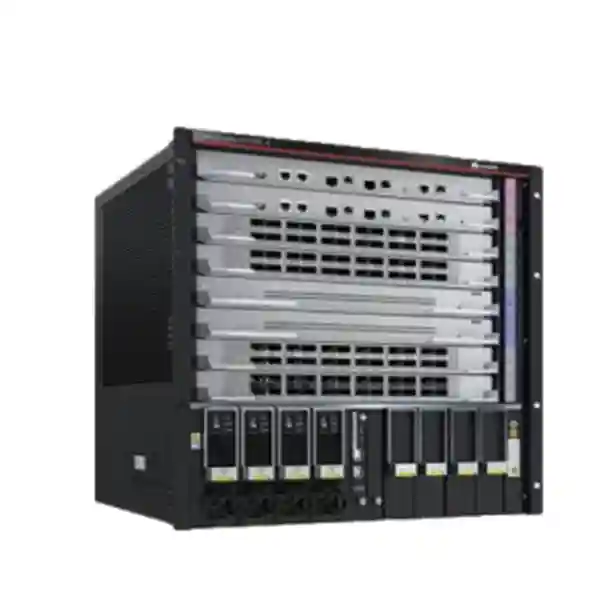
Huawei CloudEngine S12700E-4
Huawei CloudEngine S12700E-4 is a four-service-slot modular core switch in the CloudEngine S12700E family. It is built for demanding campus and multi-service environments where buyers need high forwarding capacity, a resilient chassis design, flexible line-card choices, wired and wireless policy convergence, network virtualization and an upgrade path that can be planned around real growth rather than an oversized fixed configuration.
Choose the S12700E-4 when a four-slot modular core fits the required port mix and growth plan. Final suitability depends on the exact service cards, software release, licenses, optics, uplink speeds, redundancy design, rack capacity, power feed and integration requirements. Confirm the bill of materials before ordering; the chassis model alone does not define the finished system.
Huawei-listed forwarding performance for the CloudEngine S12700E-4 platform.
Current switching capability / hardware-ready switching capability, according to Huawei.
A modular footprint suited to campus cores that need selectable interface and service-card combinations.
Chassis architecture supports control and switching-fabric redundancy planning.
What is the Huawei CloudEngine S12700E-4?
The Huawei CloudEngine S12700E-4 is the four-service-slot member of Huawei’s S12700E modular campus core family. Huawei positions the family for high-end campus networks and converged wired and wireless environments. The platform uses a modular chassis so the final system can be assembled around the required service cards instead of being limited to a fixed port layout. For procurement teams, that means the buying process should start with the traffic model and interface plan, then work backward to the chassis, control units, fabric units, service cards, optical modules, power modules, licenses and support scope.
Huawei publishes 14,400 Mpps forwarding performance for the S12700E-4 and lists 19.2 Tbit/s current switching capability with hardware readiness for 28.8 Tbit/s. The model provides two MPU slots, two SFU slots, four service-card slots and two fan slots. Huawei’s series brochure also identifies a 10U chassis for the S12700E-4, four power positions, CSS service-port clustering, redundant MPU, SFU, power and fan design options, and support across line-card families that include GE, 10GE, 25GE, 40GE and 100GE choices. The exact card and software combination must still be verified for the intended release and topology.
The S12700E family also supports capabilities that matter in modern campus cores: VXLAN Layer 2 and Layer 3 gateway functions, BGP-EVPN, NETCONF-based configuration, telemetry, iPCA service-quality monitoring, Super Virtual Fabric, unified wired and wireless user management and integrated WLAN AC functions. These are not reasons to buy the product in isolation; they are design tools. A buyer should confirm which features are required, which are included in the selected software package and which depend on licensing, controller integration or specific hardware.
Verified S12700E-4 hardware snapshot
| Specification | Huawei CloudEngine S12700E-4 |
|---|---|
| Forwarding performance | 14,400 Mpps |
| Switching capability | 19.2 Tbit/s current / 28.8 Tbit/s hardware-ready |
| MPU slots | 2 |
| SFU slots | 2 |
| Service-card slots | 4 |
| Fan slots | 2 |
| Power positions | 4 listed in Huawei series brochure |
| Chassis height | 10U listed in Huawei series brochure |
| Virtualization | CSS service-port clustering; VXLAN and BGP-EVPN functions supported by the family |
| Wireless integration | Integrated WLAN AC functions; Huawei states the series can scale to 10,240 APs with appropriate licensing and design |
Specification note: platform figures are manufacturer-published family/model values. Actual forwarding, port density, feature availability and scale depend on the installed service cards, software release, licenses and configuration. Confirm the proposed bill of materials against current Huawei documentation before purchase.
Where the S12700E-4 fits
Campus core and aggregation
The four-slot chassis can suit headquarters, education campuses, healthcare environments, hospitality estates and large commercial sites where access and aggregation layers converge into a resilient core. Interface planning should include present uplinks, east-west traffic, internet edge connectivity, server paths and realistic growth.
Wired and wireless convergence
The S12700E family supports integrated WLAN AC capabilities and unified policy concepts for wired and wireless users. Buyers should verify AP model compatibility, software versions, controller architecture, license quantities and whether an existing wireless design should be retained or consolidated.
Virtualized campus fabrics
VXLAN, BGP-EVPN and Huawei campus-management tooling can support segmented multi-service networks. The value comes from a clear underlay, address plan, redundancy model, virtual-network policy and operations process, not from enabling overlay features without a design.
High-availability core refresh
Dual MPU and SFU positions, redundant power and fan options and CSS clustering can be considered where the campus core needs fault tolerance. The final resilience level depends on duplicate components, physical path diversity, upstream and downstream topology, software design and tested failover procedures.
Configuration and quotation checklist
A request for “S12700E-4 price” is incomplete because the finished platform is modular. A useful quotation should identify the chassis and every component required to make the target design operational. Prepare the information below before asking for a commercial offer.
- Required copper and optical port counts by speed: GE, 10GE, 25GE, 40GE and 100GE.
- Number and type of service cards, plus spare-slot strategy for future growth.
- MPU, SFU, fan and power redundancy requirements.
- AC or DC power design, available rack units, cabinet depth, airflow and site cooling.
- Optical transceiver types, fibre standard, distances and patching requirements.
- Existing switch models, software versions, routing protocols, VLANs, STP design, multicast and QoS requirements.
- VXLAN, BGP-EVPN, iMaster NCE-Campus, telemetry, SVF, WLAN AC or automation requirements.
- Required software and license package, including AP scale where integrated wireless control is planned.
- Migration window, staging, configuration, onsite work, testing, documentation, training and support expectations.
Huawei CloudEngine S12700E-4 Dubai
Searches for Huawei CloudEngine S12700E-4 Dubai usually come from IT teams that are not simply looking for a chassis; they are planning a core-network decision for an office tower, enterprise campus, hospitality property, education environment, healthcare facility, logistics operation, data-rich commercial site or regional headquarters. In Dubai, the practical questions are often about exact configuration, port density, optics, rack and power planning, software entitlement, integration with existing switching and wireless infrastructure, migration risk and the commercial difference between a bare chassis and a complete bill of materials. FourTeck can help organize those requirements before a quote is requested so the proposed configuration reflects the actual network rather than a generic model description.
For a Dubai campus, start by mapping every uplink and downstream domain. Identify how many access or aggregation switches connect to the core, their present and expected link speeds, the number of server or data-centre interconnects, internet-edge paths, wireless controller requirements and any east-west traffic that could create burst conditions. The S12700E-4 has four service-card slots, so card selection has a direct impact on interface density and future expansion. A design that consumes all slots on day one may still be technically valid, but it leaves a different growth path than a design that reserves a slot for later capacity. That trade-off should be visible in the quotation and network diagram.
Dubai buyers should also treat facilities planning as part of network design. Huawei’s series brochure lists the S12700E-4 as a 10U chassis with left-to-rear airflow for the referenced platform generation, and the modular system can require meaningful power and cooling depending on the installed cards and redundancy level. Check cabinet depth, PDU capacity, power-feed redundancy, room temperature, airflow clearance and cable management before delivery. If the core is moving from another vendor or an older Huawei platform, document VLANs, routed interfaces, spanning-tree behavior, dynamic routing, multicast, QoS, DHCP relay, access-control policies, link aggregation and monitoring before the cutover.
For related UAE infrastructure planning, review FourTeck’s integrated IT and network solutions. On the target site, the network security product area and deployment and support services are useful when the switching refresh also changes segmentation, routing toward the firewall or secure branch connectivity. A Dubai quotation request should include the intended topology, required line cards, optics, software and licenses, rack and power constraints, installation location and desired support scope so commercial and technical review can happen together.
Huawei CloudEngine S12700E-4 UAE
For UAE customers, a Huawei CloudEngine S12700E-4 requirement is often part of a multi-site network rather than a single standalone purchase. A head office in Dubai or Abu Dhabi may aggregate branches in Sharjah, Ajman, Ras Al Khaimah, Fujairah or Umm Al Quwain, while core services may be split between on-premises server rooms, hosted facilities and cloud platforms. In that environment, switch selection should begin with topology and service dependency. Identify which sites terminate at the campus core, which applications are sensitive to delay or packet loss, how internet and WAN circuits are presented, and whether the core must carry multiple security or tenant zones. The four-service-slot S12700E-4 can be designed around those requirements, but the exact value comes from selecting the right cards and software rather than assuming every S12700E-4 is configured the same way.
Procurement teams comparing Huawei CloudEngine S12700E-4 UAE offers should ask every supplier to state the complete BOM. The quote should separate chassis, MPUs, SFUs, service cards, fans, power modules, software and licenses, optical transceivers, patching accessories, support entitlement and professional services. If the design needs redundant supervisors, switching fabric or power, those components should be explicit. If integrated WLAN AC is part of the objective, confirm the AP scale, AP models, controller architecture and licensing. Huawei states that the S12700E family can scale to large wireless deployments, but usable scale depends on the purchased licenses and supported software combination; it should never be inferred from the chassis name alone.
UAE deployments also benefit from a clear change plan. Before replacing an existing core, export or document routing tables, VLAN databases, trunk definitions, STP root roles, LAGs, ACLs, DHCP relay, multicast settings, QoS classes, management networks, SNMP or telemetry targets and any firewall-facing transit networks. Build a rollback method, define acceptance tests and agree which business services must be validated after migration. If the campus uses a mix of vendors, check interoperability for spanning tree, link aggregation and routing behavior rather than assuming defaults will align.
A strong UAE purchase decision therefore combines hardware, operations and lifecycle planning. Ask how the platform will be monitored, how configuration backups will be handled, who owns software updates, what spare strategy is required and how the design can grow without a disruptive re-architecture. FourTeck can use this information to prepare a more useful S12700E-4 quotation and to coordinate the adjacent security design through its verified firewall deployment planning resource where the core refresh changes perimeter or segmentation interfaces.
Huawei CloudEngine S12700E-4 Uganda
Organizations researching Huawei CloudEngine S12700E-4 Uganda are typically considering a significant campus-core or institutional network investment, so the most important step is to translate business growth into a realistic port and resilience plan. The platform may be relevant to large corporate compounds, universities, healthcare networks, hospitality groups, public-sector environments, financial institutions, telecom-adjacent facilities and enterprises with many access switches or dense wireless coverage. In Uganda, site conditions can vary widely between purpose-built data rooms and locations where power, cooling, rack space and fibre infrastructure need additional planning. A quotation should therefore be based on a site-specific bill of materials rather than a chassis-only price.
Begin with connectivity. Count the access and aggregation switches that will attach to the core, classify uplinks by speed and fibre type, and document the distances between buildings or communications rooms. Where a campus spans several buildings, optics and fibre design can be as important as the switch itself. Confirm whether existing links are single-mode or multimode, what connector and patching standards are in use, and whether any paths require upgrading to 10GE, 25GE, 40GE or 100GE. Because the S12700E-4 provides four service-card slots, a balanced line-card plan can reserve capacity for expansion while still meeting present port needs.
Power reliability and operational support also deserve early attention. Review UPS runtime, generator transition, redundant feeds, cabinet PDUs, grounding, ambient temperature and airflow. Huawei lists redundant MPU, SFU, power and fan design options for the series, but redundancy only delivers value when the surrounding electrical and physical paths are also designed to avoid common points of failure. For a network that supports critical services, define how configuration backups, spare optics, replacement components and escalation will be handled after installation. If integrated wireless control is planned, verify the exact AP models and license requirements before assuming that existing wireless devices can be adopted unchanged.
FourTeck’s Uganda IT solutions site can provide regional context for network, security and infrastructure discussions. When requesting S12700E-4 pricing for Uganda, include the city, number of buildings, uplink speeds, required service cards, optics, redundancy level, software and licensing needs, installation scope and expected project timeline. That gives the supplier enough information to distinguish a technically complete system from an incomplete chassis offer.
Huawei CloudEngine S12700E-4 Kampala
A Huawei CloudEngine S12700E-4 Kampala project often has a different profile from a nationwide Uganda procurement. Kampala concentrates large offices, universities, hospitals, hotels, financial organizations, development agencies, data-intensive professional firms and multi-branch headquarters, so the core network may need to handle dense wired access, large Wi-Fi estates, server traffic, internet edge links and branch connectivity simultaneously. The S12700E-4 can be considered for that type of campus when four service-card slots provide the right balance of current interface density and room for planned growth.
For a Kampala headquarters or campus, map physical and logical traffic separately. Physically, identify fibre routes between buildings, uplink redundancy, rack locations and power sources. Logically, document user VLANs, voice, CCTV, access control, guest Wi-Fi, servers, management networks, internet transit, WAN links and any isolated zones. This inventory helps determine whether the core should be a simple Layer 3 aggregation point or part of a more advanced virtualized campus. If VXLAN and BGP-EVPN are being considered, define the operational objective first—such as segmentation, mobility or simplified service deployment—then check controller, underlay and team-readiness requirements. Enabling an overlay without a support model can make troubleshooting harder rather than easier.
Kampala projects should also consider migration sequencing. If the existing core is in production around the clock, stage the new chassis before the change window, load the approved software, install licenses, configure management, validate line cards and optics, and test representative links. Prepare a port-by-port cutover sheet and a rollback plan. Business owners may only notice the core switch when something fails, so acceptance testing should include DNS, DHCP, internet access, critical business applications, voice, wireless authentication, inter-VLAN routing, CCTV viewing and branch connectivity where applicable.
When requesting a Kampala quotation, ask for the complete BOM and implementation assumptions in writing. State whether professional services should include staging, configuration, onsite cutover, post-change validation, documentation and administrator handover. This avoids comparing a low chassis-only figure with a complete deployment package. Buyers can use the regional FourTeck Uganda resource to frame wider networking and IT support requirements around the switch purchase.
Huawei CloudEngine S12700E-4 Arua
Huawei CloudEngine S12700E-4 Arua searches are more likely to involve a specific institutional or regional-site requirement than a generic enterprise refresh. In Arua, a modular core may be relevant where a large campus, healthcare organization, education site, government-related facility, hospitality environment, logistics operation or regional business hub has outgrown fixed switching and needs a more structured core. The key question is not whether the S12700E-4 is powerful; it is whether the site can use its modular capacity effectively and support the platform operationally over its intended lifecycle.
Start with the physical network. Document every communications room, fibre path and access-switch uplink. Note link speed, fibre type, distance and whether redundant routes exist. If the network currently relies heavily on 1GE uplinks, moving to a modular core can be an opportunity to prioritize the busiest paths for 10GE or higher rather than upgrading everything at once. That phased approach can reduce unnecessary optics and line-card cost while preserving expansion space. The S12700E-4’s four service slots make slot utilization a useful planning metric: buyers should know what each slot does today and what future growth is expected to consume.
Arua deployments should also evaluate infrastructure resilience carefully. Check UPS sizing and battery condition, generator support, surge protection, grounding, rack security, room cooling and dust management. Redundant switch components do not compensate for a single unstable power path or an overheated room. Where remote technical support may be needed, configure secure out-of-band or management access, reliable monitoring and automated configuration backups. Keep spare transceivers and patch cords appropriate to the fibre plant, because small passive components can become the fastest point of recovery after a link issue.
For procurement, ask suppliers to state what is included and excluded: chassis, MPUs, SFUs, line cards, fans, power modules, licenses, optics, cables, support, installation, travel and commissioning. If local onsite work is required, define access conditions and change windows before the order. The broader FourTeck Uganda networking portfolio can support discussion of surrounding access switching, wireless, security and implementation needs so the core is not specified in isolation.
Huawei CloudEngine S12700E-4 Mbarara
For Huawei CloudEngine S12700E-4 Mbarara projects, the buying requirement often sits between a growing regional campus and an enterprise-grade network standard. Universities, hospitals, hospitality sites, commercial groups, regional offices and organizations with multiple buildings may need a core that can aggregate many access switches while maintaining clear routing, segmentation and operational visibility. A modular chassis can provide a longer growth path than a fixed switch, but only when the initial card layout, power design and software plan are prepared with future expansion in mind.
A useful design exercise is to build a three-year port map. Record current uplinks and add expected access-switch, server, Wi-Fi, CCTV, voice and building-expansion requirements. Then classify which connections truly need high-speed optical interfaces and which can remain at lower speed. This prevents overbuying expensive ports that will not be used while avoiding a design that fills all four S12700E-4 service slots immediately. Include spare capacity for maintenance and future projects, and verify line-card support against the intended software release before the BOM is approved.
Network services should be reviewed at the same time. If the existing environment uses static routing today but may adopt OSPF, BGP or a campus fabric later, document that roadmap. If wireless coverage is expanding, decide whether integrated WLAN AC capabilities are part of the target design or whether a separate controller architecture remains preferable. If network virtualization is being considered, identify which departments, tenants or service groups need isolation and how the security policy will be enforced across the core and firewall. The S12700E family offers technologies such as VXLAN, BGP-EVPN, NETCONF, telemetry and iPCA, but each should map to an operational requirement.
In Mbarara, implementation planning should also account for power continuity, rack conditions and access to support. Before installation, validate UPS headroom, generator behavior, cooling, airflow and cable organization. After installation, keep current configuration backups, diagrams and a list of installed modules and serial references. A quotation should clearly separate hardware, licenses, optics, installation and ongoing support so procurement can compare equivalent scopes rather than headline prices.
Huawei CloudEngine S12700E-4 Gulu
A Huawei CloudEngine S12700E-4 Gulu requirement should be approached as a network architecture project, especially for organizations building or consolidating a large institutional campus. Education, healthcare, administration, hospitality, logistics and expanding commercial facilities can all generate a mix of user, server, voice, video-surveillance and wireless traffic that eventually strains a simple fixed-switch core. The S12700E-4 offers a modular four-service-slot design, but the business case should be based on measurable port and service requirements rather than on chassis scale alone.
The first planning task is to identify failure impact. Which services stop if the core is unavailable? Does the site require continuous access to clinical systems, learning platforms, internet, IP telephony, CCTV, access control, cloud services or branch connectivity? Critical services may justify dual control components, switching-fabric redundancy, redundant power feeds and diverse uplinks, while less critical environments may choose a simpler configuration. Huawei provides the architectural options, but the buyer decides the level of resilience by choosing duplicate components and building surrounding network paths that avoid common points of failure.
The second task is to evaluate the fibre plant. Record every building link, fibre-core availability, optical standard, connector type and current transceiver. Campus expansions often reveal inconsistencies accumulated over time: mixed multimode generations, undocumented patching, spare strands that are not actually usable or links running at lower speeds than expected. Resolve those issues before migration. The right core switch cannot compensate for poor fibre documentation. If higher-speed links are planned, confirm distance and optical budget so the required transceivers are included in the quote.
Finally, plan the operating model. Decide who will manage the S12700E-4, how remote support will be secured, which monitoring platform will receive telemetry or SNMP data, how backups are stored and how changes are approved. For Gulu procurement, request a complete parts list, software and license details, optics, rack and power requirements, deployment tasks and post-installation documentation. This produces a purchase package that can be evaluated on technical completeness and supportability rather than only initial equipment cost.
Huawei CloudEngine S12700E-4 Kenya
Huawei CloudEngine S12700E-4 Kenya buyers commonly include large enterprises, universities, hospitals, hospitality groups, financial organizations, technology companies and multi-site institutions that need a scalable campus core. In Nairobi and other major business centres, network design may involve high-density Wi-Fi, data-centre or server connectivity, dual internet links, SD-WAN or private WAN services, security segmentation and many access switches. Outside major centres, facility and support conditions can vary, making power, spares and remote-management planning equally important. The S12700E-4 can fit both scenarios when its four service-card slots and redundancy options are matched to a clear deployment model.
Kenya procurement teams should compare proposals using normalized BOMs. Ask suppliers to identify chassis, control and fabric units, each line card, fan modules, power modules, software, feature licenses, optical transceivers, support entitlement and implementation services. A quote that simply says “S12700E-4” can hide major differences in functionality and cost. If the design requires 100GE uplinks, confirm the exact number of ports and optics. If most access-layer connections are 10GE or 25GE, verify that the proposed card mix leaves a sensible upgrade path. If CSS clustering is expected, include the necessary hardware and cabling assumptions.
Operational integration matters too. Map the existing routing protocols, VLANs, ACLs, QoS, multicast, authentication and monitoring. If the network already uses iMaster NCE-Campus or plans to adopt it, verify the supported software and licensing scope. If third-party access switches remain in place, test interoperability for LACP, spanning tree and routing behavior. If the S12700E-4 will face a next-generation firewall, agree transit VLANs, routing responsibility, high-availability behavior and failure detection so the security edge and campus core fail over predictably.
FourTeck’s Kenya IT and network solutions site can provide regional procurement and project context. A useful request should include destination city, site type, required interfaces, fibre distances, resilience target, software and licensing requirements, installation scope and target timeline. That enables a technically comparable S12700E-4 quote instead of a generic hardware response.
Huawei CloudEngine S12700E-4 Kuwait
Huawei CloudEngine S12700E-4 Kuwait requirements are often driven by enterprise campuses, government-related environments, education, healthcare, hospitality, finance, oil-and-gas support businesses and large commercial sites that need a resilient switching core. In Kuwait, the network equipment room is normally a controlled environment, but the broader project can still be affected by high external temperatures, building infrastructure, power design and the need to coordinate changes across multiple contractors. The S12700E-4’s 10U modular chassis should therefore be evaluated as part of the complete rack, power, cooling and cabling plan.
For sizing, separate raw interface count from traffic behavior. A campus may have dozens of access-switch uplinks but only a smaller number of links carrying very high utilization. Conversely, a site with fewer physical uplinks may move large data sets, video, backups or storage traffic that creates bursts. Huawei lists 14,400 Mpps forwarding performance for the S12700E-4 and a 19.2 Tbit/s current switching capability, but the practical capacity of the installed chassis depends on the service boards selected. Review expected traffic and card forwarding characteristics, not just system-level figures.
Kuwait buyers should also confirm whether the new core will preserve the current network architecture or introduce a fabric approach. VXLAN and BGP-EVPN can support segmentation and service mobility, while NETCONF and telemetry can support automation and visibility. These functions can be valuable in a large environment, but they also change operational procedures. Define who will manage the solution, which controller or monitoring tools are involved, how configuration changes are approved and what skills are available to troubleshoot the design. For a straightforward Layer 3 campus, unnecessary architectural complexity should be avoided.
FourTeck’s Kuwait IT solutions resource can support regional project discussions. For an accurate S12700E-4 Kuwait quotation, provide required line cards and optics if already known, or provide port counts, uplink speeds, fibre distances, redundancy level, routing and wireless requirements, cabinet and power constraints, software and licensing needs, and whether staging, installation, migration or support should be included.
Huawei CloudEngine S12700E-4 Ghana
For Ghana, the Huawei CloudEngine S12700E-4 can be evaluated by organizations that are consolidating a large campus core, expanding wireless and access-switch density, or replacing a fixed platform that no longer offers the required port mix and resilience. Potential environments include corporate headquarters, universities, healthcare groups, hospitality properties, financial institutions, public-sector facilities, mining and industrial support operations and multi-building commercial campuses. A successful purchase should begin with the network diagram and facilities conditions, because the difference between a good modular design and an expensive one is usually in component selection rather than the chassis label.
Ghana buyers should document the fibre and power environment before choosing line cards. Identify building-to-building distances, fibre type, available strands and existing transceivers. Where the campus includes older fibre, verify whether planned 25GE, 40GE or 100GE links are practical or whether some routes need remediation. On the electrical side, assess UPS capacity, generator support, redundant feeds, grounding, PDUs and cooling. Huawei’s redundancy architecture can protect against internal component failure, but external power and environmental weaknesses remain common failure domains and should be treated separately.
The S12700E-4 also raises software and operations questions. Will it operate as a conventional routed core, join a CSS cluster, support a VXLAN fabric, integrate with iMaster NCE-Campus, control wireless APs or provide telemetry to a monitoring system? Each requirement may affect software, licensing and the final BOM. For wireless convergence, confirm AP compatibility and licenses. For fabric designs, confirm underlay routing, addressing and controller architecture. For traditional networks, document STP, LACP, VLANs, routing, ACLs, multicast and QoS so migration preserves required behavior.
For Ghana procurement, request that proposals identify the exact component part numbers where possible and separate hardware, licenses, optics, professional services and support. Ask how availability and lead time will be confirmed at order stage rather than relying on a static website statement. FourTeck can coordinate broader West Africa requirements through its Africa IT solutions network, while the target page’s security resources can help when the switch refresh also changes segmentation and firewall connectivity.
Huawei CloudEngine S12700E-4 Nigeria
Huawei CloudEngine S12700E-4 Nigeria projects can range from a large Lagos headquarters or commercial campus to education, healthcare, hospitality, financial, industrial and multi-site enterprise networks in other cities. The common requirement is usually not just faster switching; it is a more scalable and manageable core that can aggregate many access-layer domains, maintain segmentation, support high-speed uplinks and provide a cleaner expansion path. Because the S12700E-4 is modular, the procurement team should insist on a detailed configuration rather than treating every quote for the model as equivalent.
A strong Nigerian design starts with traffic and resilience. Count uplinks, but also identify which applications create sustained or burst-heavy traffic: backups, video, collaboration, ERP, imaging, cloud synchronization, CCTV, wireless user traffic or large file transfers. Define the failure tolerance for each service. If downtime at the core has major operational impact, build the design around redundant control and fabric components, power feeds and uplinks. If the business can tolerate a simpler design, avoid buying redundancy that is not connected to an operational need. The same principle applies to high-speed ports: purchase the density and optics required for the lifecycle, not simply the maximum available.
Power quality, cooling and remote support planning can materially affect reliability. Review UPS and generator transitions, PDU loading, grounding, rack depth, airflow and environmental monitoring. Define secure management access and configuration backup before commissioning. Where network teams are distributed across multiple sites, standardized naming, documentation and monitoring are especially important. If VXLAN, BGP-EVPN or automation is in scope, document the intended operational benefit and training requirements so advanced features reduce manual work rather than adding hidden complexity.
A Nigerian S12700E-4 quotation request should state destination city, quantity, port-speed requirements, expected line-card layout, redundancy level, optics and fibre distances, software and license needs, rack and power conditions, integration requirements and professional-services scope. For adjoining firewall policy or perimeter design, buyers can review the verified perimeter firewall planning page. For wider regional coordination, FourTeck’s Africa solutions site provides a broader point of reference.
Huawei CloudEngine S12700E-4 Seychelles
Huawei CloudEngine S12700E-4 Seychelles requirements are likely to be project-specific because the market is smaller and many enterprise networks are concentrated in hospitality, government, finance, education, utilities and larger corporate environments. For an island deployment, procurement should place extra emphasis on configuration completeness, logistics, spares and remote support. A modular core switch can provide strong expansion options, but a missing optical module, power component or license can delay commissioning when replacement logistics are not immediate. The goal is therefore to arrive with a verified bill of materials, tested configuration and realistic spare strategy.
Hospitality and multi-building environments are a useful example. A resort or large property may aggregate guest Wi-Fi, back-office systems, voice, CCTV, IPTV, access control, point-of-sale, staff devices and internet links over shared fibre infrastructure. The core must keep these services segmented while providing predictable uplink capacity. The S12700E family supports high-capacity forwarding, VXLAN, BGP-EVPN and integrated wireless functions, but the design should select only the features that operations staff can support. In many cases, a clean Layer 3 core with disciplined VLANs, routing and redundant uplinks may be preferable to a more complex fabric unless there is a clear business need.
Seychelles projects should validate environmental and physical details before shipment. Check rack dimensions and free rack units, power availability, UPS and generator coverage, grounding, room cooling, salt-air exposure risk where relevant to the facility, fibre routes and spare patching materials. Confirm transceiver distances and keep an appropriate set of spare optics. If specialist onsite support is limited, enable secure management, reliable monitoring and automated backup so experienced engineers can assist remotely without relying on emergency travel for routine changes.
For commercial comparison, ask for a componentized quote including chassis, MPUs, SFUs, line cards, fans, power modules, software, licenses, optics, support and professional services. State the destination, delivery constraints, required commissioning approach and acceptance tests. FourTeck can coordinate wider regional networking discussions through the Africa IT solutions resource while keeping the S12700E-4 BOM tied to the exact Seychelles site requirement.
Licensing, wireless and software considerations
Huawei’s S12700E series brochure describes both traditional feature-based licensing and Huawei IDN One Software licensing modes for relevant releases. Buyers should confirm the exact software train, required feature package and support entitlement at quotation time. Do not assume that every capability shown in a family datasheet is available without additional licenses or controller components. This is especially important for large wireless deployments, advanced campus automation and some network-management functions.
For wireless convergence, Huawei states that an S12700E can manage up to 10,240 APs, while the brochure also notes a default AP-management allowance and that additional AP management requires licenses. The practical design must therefore specify AP quantity, AP models, software compatibility, redundancy expectations, forwarding architecture and license count. If an existing standalone WLAN controller already meets requirements, migration should be justified by management or policy benefits rather than performed only because integrated control is available.
For automation, the family supports NETCONF/YANG and programmable operational functions. These interfaces are useful when the organization has a management platform or automation workflow capable of using them. Include API, credential, change-control and rollback procedures in the operational design. Automation without governance can propagate mistakes faster; automation with tested templates can reduce repetitive configuration and improve consistency.
Security and firewall integration
A campus core and a firewall solve different problems but must be designed together. The S12700E-4 can provide segmentation, routing, access control and policy-aware campus functions, while a firewall can enforce deeper security policy between trust zones, the internet, branches or data-centre services. Define where Layer 3 gateways live, which routes are exchanged, how default routes and return paths behave, and what happens during failover. Avoid an architecture where both core and firewall make independent routing decisions without a clear ownership model.
FourTeck’s Sophos XGS 88 product guide shows how smaller branch firewalls are specified around throughput, interfaces and licenses, while the Palo Alto PA-410 guide covers a different edge platform. These are not direct substitutes for the S12700E-4; they illustrate why firewall sizing should be treated separately from campus-core switching. Larger security requirements can be explored through the PA-Series firewall portfolio page.
If the project includes both switching and firewall changes, create one end-to-end cutover plan. Validate trunks, VLAN tags, routing adjacencies, MTU, link aggregation, first-hop gateway behavior, firewall zones, NAT, VPN dependencies, monitoring and logging. Test business services from representative user networks rather than declaring success only because interfaces are up.
Frequently asked questions
Is the Huawei CloudEngine S12700E-4 a fixed-port switch?
No. It is a modular chassis with four service-card slots. The final port mix depends on the selected line cards, so quotations should state the complete configuration.
What is the forwarding performance of the S12700E-4?
Huawei lists 14,400 Mpps forwarding performance for the S12700E-4. Actual usable system behavior depends on installed boards, traffic patterns, software and configuration.
What switching capacity does Huawei publish?
Huawei publishes 19.2 Tbit/s current switching capability and 28.8 Tbit/s hardware-ready capability for the S12700E-4. The manufacturer notes that the post-slash value represents hardware readiness rather than current capability.
Does the S12700E-4 support redundancy?
The chassis provides dual MPU and SFU slots, and Huawei describes redundancy options for MPU, SFU, power and fan modules. A resilient deployment still requires duplicate components and properly designed upstream, downstream and power paths.
Can it manage wireless access points?
The S12700E family includes integrated WLAN AC capabilities. Huawei states scaling up to 10,240 APs for the series, subject to licensing, compatible APs, software and design. Confirm exact requirements before purchase.
Does it support VXLAN and BGP-EVPN?
Yes, Huawei lists VXLAN Layer 2 and Layer 3 gateway functions and BGP-EVPN support for the S12700E series. The final deployment should confirm release-specific support and controller or management requirements.
Can I ask for only a chassis price?
You can, but it is rarely enough for project budgeting. A production system may require MPUs, SFUs, line cards, fans, power modules, software, licenses, optics, cables, support and deployment services. Ask for an itemized BOM.
How do I request current availability?
Send the required quantity, destination, line-card and optical requirements, software and license needs, support term and target timeline. Availability should be confirmed during quotation rather than assumed from static website content.
Why contact FourTeck for the S12700E-4?
The useful role of a supplier in a modular-core project is to reduce ambiguity before purchase. FourTeck can help turn a general model request into a structured BOM by asking about interface speeds, card density, fibre distances, redundancy, software, licenses, power, rack space and deployment scope. This is particularly important when procurement is comparing offers from different sources, because a low-priced chassis without required modules is not comparable to a complete configured system.
FourTeck can also help connect the core switch decision to the rest of the network. The target site’s company and service background explains the wider infrastructure focus, while the sales contact page provides the route for a project brief. Share the existing topology or even a simple port-count worksheet; it is more useful than sending only the product name.
No stock status, delivery time, warranty term or final price is assumed on this page. Those commercial details can change by destination, quantity, component selection and vendor channel. Request written confirmation with the final quotation.
Decision recap
The Huawei CloudEngine S12700E-4 is a four-service-slot modular campus core platform with manufacturer-published 14,400 Mpps forwarding performance and 19.2 Tbit/s current switching capability. It is worth evaluating when a network needs a resilient, expandable core rather than a fixed port layout.
The decision should be based on the exact service-card mix, software and licenses, optical interfaces, redundancy, rack and power capacity, integration design and support model. A complete BOM is the basis for comparing quotations.
What to send for a quote
- Destination country and city
- Required quantity
- Port counts and speeds
- Fibre distances and optic types
- Redundancy target
- Software, licenses and wireless scope
- Installation and migration requirements
Related infrastructure planning
A core-switch refresh can affect routing, segmentation, firewall capacity and operational support. Review adjacent components before locking the switch BOM so the project does not create an unexpected bottleneck at the security edge or access layer.
Ready to validate the S12700E-4 configuration?
Send FourTeck your network diagram, port-count requirements, destination, redundancy target and deployment scope. The sales and technical team can use those inputs to review the required chassis components, line cards, optics, licenses and services before preparing a quotation.

Reviews
There are no reviews yet.