
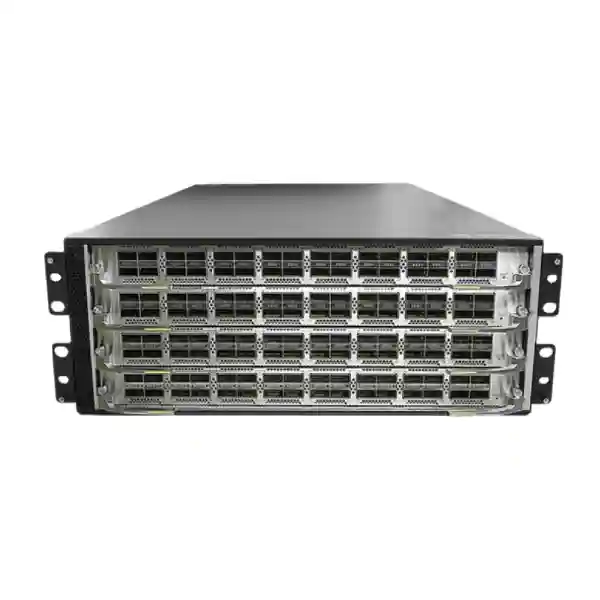
Huawei CloudEngine CE9860-4C-EI
A high-density four-slot data center switching platform for organizations planning 100GE and 400GE aggregation, scalable fabric interconnection and resilient core or aggregation designs. FourTeck supports specification review, bill-of-material planning, optics and cabling alignment, migration scope and quotation coordination for enterprise and service-provider projects.
Up to 32 x 400GE QSFP-DD or 128 x 100GE QSFP28 ports through flexible interface cards.
25.6 Tbps switching capacity and 65 MB system buffer listed by Huawei.
M-LAG, PFC, ECN, telemetry, NetStream, sFlow and enhanced ERSPAN are among Huawei’s listed capabilities.
Huawei-published switching capacity for the CE9860-4C-EI.
Four card slots allow a project-specific combination of supported line cards.
Or up to 128 x 100GE, depending on the installed flexible cards.
Published system buffer figure for this model.
What the Huawei CloudEngine CE9860-4C-EI is designed to solve
The Huawei CloudEngine CE9860-4C-EI is intended for network designs that have moved beyond ordinary access-switch requirements and need dense, high-speed aggregation in a data center or large campus core. Instead of purchasing a fixed-port switch and then redesigning around its limitations, buyers can use the CE9860-4C-EI’s four flexible card slots to align port density with the actual architecture. Huawei documents CE98-D32CQ cards with 32 x 100GE QSFP28 interfaces and CE98-D8DQ cards with 8 x 400GE QSFP-DD interfaces. A fully populated chassis can therefore provide up to 128 x 100GE or 32 x 400GE, subject to the selected bill of materials and supported software release.
This matters in modern data centers because the aggregation layer often has to connect large numbers of leaf switches, server fabrics, storage environments, border devices or inter-building links without creating an early bandwidth bottleneck. The right design is not simply the highest port count. The project must consider oversubscription, expected east-west traffic, uplink speeds, failure domains, rack and power constraints, optical reach, transceiver types, cable plant, redundancy strategy and the operational model used by the network team.
FourTeck approaches the CE9860-4C-EI as a solution component rather than an isolated box. Before quotation, buyers should identify the number and speed of required links, existing switch models, optical distances, connector types, routing design, redundancy objectives, management requirements and any planned growth. This reduces the risk of receiving a chassis without the correct cards, optics, fan direction, power design or software entitlement. For broader enterprise technology requirements, customers can also review FourTeck UAE solutions as a starting point for coordinated infrastructure discussions.
Verified technical profile
Specifications can vary by software version, line card, power module, deployment conditions and regional ordering options. The final quotation should identify the exact chassis, cards, power supplies, fan assemblies, optics, cables and software or support entitlement required for the project.
Architecture and buying guidance
Choose the port mix before the chassis
Start by mapping every required 100GE and 400GE connection, including future growth. The four-slot format is useful only when the card plan matches real uplinks and aggregation requirements. Reserve capacity for redundancy and expansion rather than filling every port on day one.
Validate optics and reach
QSFP28 and QSFP-DD describe form factors, not a single optical distance. Confirm wavelength, reach, fiber type, connector, breakout requirements and the exact supported transceiver or cable choice for each link. This is especially important for inter-rack, inter-room and campus connections.
Design power and airflow deliberately
High-density switching places real demands on rack power, cooling and airflow planning. Confirm available rack units, power feeds, power-module redundancy, PDU capacity, room cooling and airflow direction before approving the bill of materials.
Plan for migration, not just installation
A core or aggregation change can affect routing adjacencies, MLAG peers, spanning-tree boundaries, VLANs, VRFs, monitoring, firewall paths and upstream services. A controlled cutover plan should define configuration translation, test points, rollback criteria and maintenance-window dependencies.
Quotation checklist for the CE9860-4C-EI
To obtain a meaningful commercial proposal, prepare the information that determines the actual configuration rather than requesting only a bare chassis price.
- Required number of 100GE and 400GE interfaces now and over the expected growth period.
- Preferred line cards, or enough topology information for the card mix to be proposed.
- Optical reach, fiber type, connector and any breakout-cable requirements.
- Rack location, airflow direction, available rack units, PDU type and redundant power-feed requirements.
- Existing Huawei or third-party switches, routing protocols, VLAN/VRF design, M-LAG requirements and monitoring platform.
- Required software release, feature dependencies, support entitlement and lifecycle expectations.
- Whether configuration, migration planning, on-site implementation, testing, documentation or administrator handover is needed.
Huawei CloudEngine CE9860-4C-EI Dubai
Customers searching for Huawei CloudEngine CE9860-4C-EI Dubai are typically planning more than a routine switch replacement. Dubai data-center and enterprise projects often combine high-speed switching with carrier handoffs, colocated infrastructure, virtualization platforms, storage traffic, security appliances and cloud connectivity. In this environment, the main procurement question is not simply whether the CE9860-4C-EI has enough ports. Buyers need to determine how the four flexible slots should be populated, which 100GE or 400GE optics are required, whether links will remain inside one room or cross between racks and facilities, and how redundancy should be engineered around the platform.
Huawei’s published specifications make the model relevant to dense aggregation: up to 32 x 400GE or 128 x 100GE, 25.6 Tbps switching capacity and a 65 MB system buffer. For a Dubai project, these figures should be translated into a real topology. A customer may need a pair of switches for resilient aggregation, multiple leaf uplinks, redundant firewall or router connections and separate management paths. That design affects the number of interfaces consumed, the optics list, cable lengths, rack placement and power allocation. FourTeck can review these inputs and help structure a request for quotation that identifies the complete bill of materials instead of leaving critical accessories until after purchase.
Dubai buyers should also include deployment planning in the commercial scope when the switch will replace an existing core or aggregation layer. The migration may require changes to routing, VLAN trunks, VRFs, M-LAG relationships, monitoring and upstream security policies. Documenting the existing environment before cutover helps reduce avoidable surprises. If the switch is going into a new facility, the same disciplined process should verify rack depth, power feeds, cooling, airflow direction and cross-connect arrangements. No assumption should be made that a quoted chassis includes every required card, fan, power module, optic or service.
For organizations comparing enterprise infrastructure options across the UAE, FourTeck can coordinate the CE9860-4C-EI discussion with wider network, security and data-center requirements. Share the intended topology, interface count, optical distances, target deployment date and required implementation scope. The resulting conversation can then focus on configuration suitability, project dependencies and current commercial availability rather than a generic price request.
Huawei CloudEngine CE9860-4C-EI UAE
For customers searching for Huawei CloudEngine CE9860-4C-EI UAE, the most useful starting point is a country-wide infrastructure view. UAE organizations may operate a primary data center in one emirate, offices in several cities, disaster-recovery infrastructure in another facility and cloud connections delivered through multiple carriers. A high-density data-center switch can form part of that architecture, but the design should be based on traffic flow and resiliency rather than on headline port density alone. Huawei lists the CE9860-4C-EI with four flexible slots and up to 128 x 100GE or 32 x 400GE, giving network teams several ways to build an aggregation layer around current and future bandwidth requirements.
UAE procurement teams should request an itemized bill of materials. The chassis choice must be matched with the line cards, power modules, fan assemblies, optics or direct-attach cables, software entitlement and support plan needed for the chosen design. If the organization already runs Huawei CloudEngine switches, the project should record software versions, supported feature sets and operational standards before finalizing the new device. If the environment is multi-vendor, document interoperability requirements for routing, LACP, VLANs, monitoring and any technologies used at the aggregation boundary. Huawei’s published feature set for the CE9860-4C-EI includes LACP, BFD, M-LAG, PFC, ECN and several telemetry and traffic-visibility mechanisms, but feature behavior should always be validated against the exact software release and architecture.
UAE buyers frequently need a quotation that separates hardware supply from professional services. That separation is useful because installation scope can vary greatly. A greenfield rack installation with prepared configurations is very different from replacing a live core during a controlled maintenance window. When implementation is required, define who provides rack-and-stack work, fiber patching, base configuration, migration, testing, documentation and post-cutover support. Also identify whether on-site access procedures, change-control approvals or coordination with a data-center operator are part of the project.
FourTeck can use these inputs to help create a technically clearer procurement request. Customers can review FourTeck’s UAE technology portfolio for adjacent infrastructure needs and then submit the CE9860-4C-EI requirement with the topology, port mix and deployment scope. Current availability, lead time and commercial terms should be confirmed in the formal quotation rather than assumed from online listings.
Huawei CloudEngine CE9860-4C-EI Uganda
A search for Huawei CloudEngine CE9860-4C-EI Uganda often comes from enterprises, service providers, financial institutions, universities or large organizations planning a data-center refresh or network consolidation. In Uganda, the business case for a high-density 100GE/400GE platform should be tied to the actual aggregation requirement: the number of server or leaf-switch blocks, inter-building or inter-site links, upstream routers, security systems and expected expansion. The CE9860-4C-EI offers four flexible card slots, so a project can be specified around a particular interface mix rather than purchasing a fixed configuration that may not suit the topology.
Procurement teams should pay particular attention to optics and infrastructure dependencies. A 100GE or 400GE interface still requires the correct transceiver, fiber type and reach. Long campus links, metro connections or data-center cross-connects may require different optical choices from short rack-to-rack links. These components can materially affect project cost and lead time, so the quotation should not treat optics as an afterthought. The same principle applies to rack depth, power feeds and cooling. Huawei publishes the chassis dimensions and power architecture, but the selected line cards and site conditions determine the practical installation plan.
Ugandan customers replacing an existing core should also document routing and resilience before procurement. If the old environment uses static routing, OSPF, BGP, LACP, multi-chassis redundancy or segmented VRFs, the target design should make those relationships explicit. Huawei lists support for LACP, BFD for several routing protocols, M-LAG, PFC and ECN on the CE9860-4C-EI. The exact intended features should be checked against the software version and migration plan. This is especially important where the network supports business-critical applications and the change window is limited.
FourTeck can help structure the requirement for buyers in Uganda without making assumptions about local stock or delivery. The FourTeck Uganda website provides a regional path for technology enquiries. When requesting the CE9860-4C-EI, include the desired quantity, line-card mix, optical distances, current network diagram, power requirements and whether installation or migration assistance is expected. That information allows the commercial process to focus on a complete, supportable solution.
Huawei CloudEngine CE9860-4C-EI Kampala
Kampala organizations considering the Huawei CloudEngine CE9860-4C-EI are often dealing with concentrated data-center, headquarters or campus infrastructure where many high-speed links converge in one location. A city-level requirement may involve connecting server rooms across buildings, consolidating several aggregation switches, preparing a private-cloud platform, or introducing faster links between network, security and compute layers. The CE9860-4C-EI can support this type of role when its card configuration, software features and physical installation are properly matched to the design.
For Kampala projects, begin with a port map. List every existing uplink, its speed, fiber type, destination, redundancy relationship and current utilization. Then add planned growth. This exercise reveals whether the required configuration is primarily 100GE, primarily 400GE or a staged mix. Huawei lists CE98-D32CQ and CE98-D8DQ cards for the platform, providing 100GE QSFP28 and 400GE QSFP-DD interfaces respectively. The number of cards directly affects power, heat and the bill of materials, so the quotation should specify the intended slot population rather than naming only the chassis model.
A Kampala deployment should also account for operational access. Out-of-band management is valuable when the production network is being changed or recovered, and Huawei lists a GE management interface, RJ45 console and USB port on the model. Network teams should decide how management traffic is separated, where logs and telemetry will be collected, how configuration backups are handled and who is authorized to administer the switch. Huawei’s O&M features include telemetry, NetStream, sFlow and enhanced ERSPAN, which can be useful for visibility when integrated into the organization’s monitoring stack.
Commercially, buyers should request current availability only after the configuration is clear. A quote for the wrong line card or optic can appear attractive but fail the deployment need. FourTeck can help convert the port map and migration scope into a more precise request covering chassis, cards, power, fan assemblies, optics, cabling, software/support and professional services where required. Kampala customers can use the Uganda regional channel for enquiry while ensuring the final project documentation records the exact deployment site and installation dependencies.
Huawei CloudEngine CE9860-4C-EI Arua
For Huawei CloudEngine CE9860-4C-EI Arua enquiries, the decision should start with whether a high-density 100GE/400GE aggregation platform is justified by the local network architecture. Organizations may be expanding a regional data room, supporting a large institutional campus, connecting a high-capacity WAN edge or standardizing infrastructure with a central enterprise design. The CE9860-4C-EI is a substantial data-center switch, and its value comes from placing it where many high-bandwidth links need to converge with resilience and room for expansion.
Arua buyers should avoid specifying the switch in isolation. If the device will connect to a national or regional backbone, record the handoff speed and media type from the carrier or upstream router. If it will aggregate campus switches, record the number of uplinks, whether they are single or redundant, and the distances between buildings. If it will serve a data-center role, document the leaf or server-facing architecture and expected east-west traffic. These details determine whether the available 100GE and 400GE card options align with the real requirement and which optics or breakouts are needed.
Physical readiness is equally important in a regional site. Confirm rack depth, available rack units, dual power feeds, PDU capacity, cooling and controlled airflow before ordering. Huawei’s published data identifies 1200 W AC modules with 2+2 backup for the CE9860-4C-EI, but actual power planning must reflect the installed card configuration and site design. A resilient switch does not create a resilient service if both power feeds terminate on the same failure point or if the upstream links lack diverse paths.
For procurement, provide FourTeck with a simple network diagram and a list of required interfaces rather than asking for a generic switch price. Include the expected deployment role, quantity, target software features, optic distances, power arrangement and whether migration support is needed. FourTeck can then help clarify the bill of materials and quotation assumptions. Availability, shipping arrangements, taxes, site access and implementation timing should be confirmed as part of the formal commercial process and should not be inferred from a web page.
Huawei CloudEngine CE9860-4C-EI Mbarara
Customers searching for Huawei CloudEngine CE9860-4C-EI Mbarara may be planning a major institutional network, a resilient enterprise hub, a data-center modernization or a backbone aggregation point. The product’s four flexible slots and high-density 100GE/400GE options can be valuable when traffic from several parts of the organization converges in one core. Before selecting it, however, the network team should quantify current uplink demand and expected growth so the platform is right-sized for the environment rather than chosen only because of its headline capacity.
A good Mbarara design exercise separates access, aggregation, data-center and WAN traffic. Identify which connections will terminate on the CE9860-4C-EI, their speeds, whether they are Layer 2 or Layer 3, and how failure should be handled. If two switches will form a redundant pair, reserve interfaces for peer connectivity and consider how downstream devices will dual-home. Huawei lists M-LAG as a data-center capability for the model and LACP as part of its reliability feature set, but the exact redundancy design must be validated against the chosen software release, peer topology and neighboring devices.
Operational visibility is another useful selection criterion. A faster core can make troubleshooting more difficult if monitoring is not upgraded at the same time. Huawei lists telemetry, NetStream, sFlow and enhanced ERSPAN for the CE9860-4C-EI. Network teams can plan how those mechanisms fit existing monitoring, traffic-analysis and incident-response tools. The project should also document out-of-band management, administrator access, configuration backups and change-control procedures so the new platform remains maintainable after commissioning.
For a commercial request, include the interface schedule, preferred card mix if known, optics and fiber details, rack and power information, existing switch models, planned redundancy and whether configuration or migration is in scope. FourTeck can use this to help prepare a clearer procurement path for Mbarara requirements through the Uganda regional channel. Current product availability and delivery arrangements must be confirmed at quotation stage, especially when a project requires multiple chassis, specific optics or a time-sensitive implementation window.
Huawei CloudEngine CE9860-4C-EI Gulu
A Huawei CloudEngine CE9860-4C-EI Gulu project is likely to be infrastructure-led rather than a simple branch-switch purchase. The platform is designed for high-density data-center or large aggregation roles, so buyers should first define the workload that needs 100GE or 400GE connectivity. Suitable planning scenarios can include a regional enterprise hub, university or institutional data center, service-provider aggregation, or an organization building a backbone that must accommodate substantial future growth.
The four-slot design gives flexibility, but it also makes bill-of-material accuracy essential. Huawei lists a 32-port 100GE QSFP28 card and an 8-port 400GE QSFP-DD card for the CE9860-4C-EI. A Gulu buyer therefore needs to know how many interfaces are required at each speed and whether any links will use breakouts. Each connection should also have an optical specification: single-mode or multimode fiber, approximate distance, connector type and any intermediate patching. These details determine the appropriate optics and help avoid mismatches at installation.
Because regional infrastructure can involve longer service paths and coordinated logistics, the project plan should distinguish what must be delivered with the switch from what already exists on site. Check rack capacity, power distribution, cooling, fiber readiness, console access and management connectivity. If a new core is replacing older hardware, record the existing routing protocols, VLANs, link aggregation, IP addressing and critical services. This information supports a structured migration plan and makes rollback preparation possible if an unexpected issue appears during cutover.
FourTeck can help Gulu customers convert these technical requirements into a complete quotation request without claiming unverified local inventory. The objective is to identify the right chassis configuration, cards, power components, optics, support entitlement and services for the project. Include the deployment location, target timeline and any site-access constraints when requesting a quote, because logistics and implementation scope may affect the commercial proposal. Final availability and delivery commitments should be confirmed in writing at order stage.
Huawei CloudEngine CE9860-4C-EI Kenya
Huawei CloudEngine CE9860-4C-EI Kenya searches are typically associated with enterprise data centers, service-provider environments, cloud platforms, large campuses or organizations consolidating several high-speed network layers. The CE9860-4C-EI offers the density needed for demanding aggregation designs, but a technically sound purchase begins with the topology. Buyers should map leaf switches, server fabrics, storage platforms, routers, firewalls, data-center interconnects and any carrier handoffs that will terminate on the new core or aggregation layer.
Huawei publishes up to 128 x 100GE or 32 x 400GE on this model through flexible cards. For a Kenya project, that flexibility can support a phased architecture in which current 100GE requirements coexist with selected 400GE links for backbone growth. The design should reserve capacity for maintenance and failure scenarios, not just normal operation. If one link, card or peer switch fails, remaining paths must have enough capacity to carry critical traffic. This is why port-count planning, oversubscription and redundancy calculations should be completed before asking for the final bill of materials.
Procurement should also address optics, software and support. A switch price without optics may omit a significant part of a 100GE/400GE project. Likewise, software feature requirements should be documented so that routing, M-LAG, telemetry and lossless-networking needs are evaluated against the intended release. Huawei lists M-LAG, PFC, ECN, telemetry, NetStream, sFlow and enhanced ERSPAN for the platform, while detailed behavior can depend on software and topology. Support entitlement and firmware-access expectations should be agreed before deployment.
Kenyan customers can use the FourTeck Kenya website for regional enquiries. To obtain a useful CE9860-4C-EI quote, submit the required quantity, port-speed mix, optical reach, existing network diagram, target deployment date and service scope. FourTeck can help align hardware procurement with configuration, migration and documentation needs where required. Product availability, logistics and lead time should be verified in the formal quotation because they can change by configuration and project timing.
Huawei CloudEngine CE9860-4C-EI Kuwait
For organizations looking for Huawei CloudEngine CE9860-4C-EI Kuwait, the switch can be considered for high-capacity enterprise, government, telecom, hospitality or data-center environments where dense 100GE and 400GE aggregation is required. Kuwait projects often place significant emphasis on controlled infrastructure environments, resilient power and cooling, and clearly documented implementation responsibilities. Those considerations fit naturally with the CE9860-4C-EI procurement process because the chassis, cards, optics and supporting services should be treated as one engineered solution.
Start by defining the switch role. If the CE9860-4C-EI will function as a data-center aggregation or core switch, record every connected leaf block, edge router, firewall pair, interconnect and management dependency. If it will serve a large campus core, include building distribution links, routing boundaries and failover requirements. Huawei lists 25.6 Tbps switching capacity and up to 32 x 400GE or 128 x 100GE through flexible interface cards. These capabilities are substantial, but the useful capacity depends on the topology, line-card mix and redundancy model selected for the site.
Kuwait buyers should verify environmental and power requirements early. The equipment room must accommodate the chassis dimensions, rack depth and airflow direction, while power design should account for the actual card population and redundant feeds. A formal installation checklist should identify rack position, PDU ports, grounding, fiber trays, patch-panel references, console access and management IP information. Completing this work before arrival can shorten the commissioning process and reduce last-minute infrastructure changes.
FourTeck can assist with the procurement conversation through the FourTeck Kuwait website. Share your intended 100GE/400GE port count, optical distances, current network topology, expected software features, quantity and whether migration or implementation services are required. Current stock, delivery timing, project access, local commercial terms and any service scheduling should be confirmed in the quotation. This approach keeps the buying decision grounded in a complete technical scope rather than an isolated chassis price.
Huawei CloudEngine CE9860-4C-EI Ghana
A Huawei CloudEngine CE9860-4C-EI Ghana requirement is most relevant where an organization needs a high-capacity aggregation or core layer rather than ordinary access switching. Potential projects include enterprise data centers, financial platforms, education and research environments, carrier or ISP networks, and large multi-site organizations consolidating infrastructure. The switch’s four flexible slots allow project teams to align interface density with the design, but that flexibility makes advance planning essential.
Ghanaian buyers should create a connection schedule before procurement. List each intended 100GE or 400GE port, its destination, optical distance, redundancy relationship and expected traffic. Then identify which links can be consolidated or upgraded over the next few years. Huawei lists CE98-D32CQ cards with 32 x 100GE QSFP28 ports and CE98-D8DQ cards with 8 x 400GE QSFP-DD ports. The connection schedule helps determine how many cards are required and whether capacity should be reserved for growth instead of fully populating the chassis immediately.
The commercial request should also cover the physical layer and operational lifecycle. Specify transceiver or cable requirements, fiber type, rack space, power redundancy, cooling, management access, software feature expectations and support entitlement. If the switch is replacing an existing core, capture the configuration dependencies that must move during the cutover: VLANs, routing protocols, link aggregation, access policies at connected firewalls, monitoring targets and management systems. A migration plan should define test criteria and rollback steps rather than relying on an undocumented change.
FourTeck can coordinate Ghana enquiries through its wider FourTeck Africa technology channel. Provide the required model quantity, preferred card mix if known, optics, destination city, network diagram and implementation scope. This makes it easier to distinguish essential items from optional services and to confirm current commercial availability. Buyers should request written confirmation of lead time, delivery terms, support coverage and any project services before order placement because these factors can vary with configuration and timing.
Huawei CloudEngine CE9860-4C-EI Nigeria
Huawei CloudEngine CE9860-4C-EI Nigeria enquiries can arise from large enterprises, financial institutions, cloud and hosting providers, telecom environments, universities and organizations building resilient data-center infrastructure. In these deployments, 100GE and 400GE links are usually part of a wider architecture involving routers, security platforms, server fabrics and multiple redundancy layers. The CE9860-4C-EI should therefore be selected against a documented network design rather than as a standalone high-capacity switch.
The model provides four flexible line-card slots, and Huawei lists a maximum of 128 x 100GE or 32 x 400GE depending on the card population. Nigerian buyers should determine how many ports are needed for production, peer links, spare capacity and growth. If a pair of CE9860-4C-EI switches will be used for resilience, the design must account for dual-homed downstream devices, peer connectivity, routing convergence and the capacity required during a failure. Huawei lists LACP, BFD and M-LAG among the platform’s reliability and data-center capabilities, but implementation details must be validated against the software release and adjacent network equipment.
Power and cooling planning also deserve early attention. The quoted solution should identify the power modules and fan assemblies included, the expected installed cards and the site’s redundant feed arrangement. For 100GE and 400GE links, optics should be specified line by line because reach and fiber type can vary across a campus or data-center environment. This reduces the risk of receiving hardware that cannot connect to the existing cable plant or upstream devices without additional purchases.
From a procurement perspective, request a complete bill of materials plus separate pricing for optional professional services. The service scope may include design validation, base configuration, migration planning, cutover assistance, testing, documentation and administrator handover. FourTeck can coordinate the requirement through its regional network and help clarify configuration assumptions. Buyers should provide destination, quantity, target dates and any compliance or site-access requirements, while current availability, freight, taxes, support terms and service scheduling are confirmed in the formal quotation rather than assumed from online information.
Huawei CloudEngine CE9860-4C-EI Seychelles
For Huawei CloudEngine CE9860-4C-EI Seychelles requirements, careful pre-deployment planning is especially valuable because data-center hardware, optics and replacement components may require coordinated logistics. The CE9860-4C-EI is suited to high-capacity aggregation or core roles where organizations need dense 100GE or 400GE connectivity, but the right configuration depends on the actual topology. Buyers should document the number of links, optical distances, redundancy model and growth plan before requesting the final commercial proposal.
A Seychelles project may involve a hotel or hospitality group, financial organization, government or public-sector environment, telecom operator, enterprise data center or other institution with mission-critical connectivity. In any of these cases, resilience should extend beyond the switch itself. Consider dual power feeds, redundant upstream paths, spare optics, configuration backups, management access and a documented restoration procedure. Huawei lists the CE9860-4C-EI with four flexible slots, 25.6 Tbps switching capacity and up to 32 x 400GE or 128 x 100GE. These specifications support substantial aggregation, but the design must still identify how traffic behaves when a component or link fails.
Logistics planning should include the complete bill of materials. Chassis, line cards, power modules, fan assemblies, transceivers, cables, support entitlement and any required spare components should be reviewed together. Optical compatibility deserves particular attention because an incorrect wavelength, connector or reach can delay commissioning even when the switch itself is present. Where the deployment replaces an existing core, the project should also capture all critical configuration dependencies and schedule a change window with clear test and rollback procedures.
FourTeck can help Seychelles buyers prepare a structured request through the FourTeck Africa regional channel. Share the destination island or site, required quantity, port-speed mix, optical distances, existing network overview and whether professional services are required. Current availability, freight method, customs-related commercial terms, lead time and implementation scheduling should be confirmed before order placement. The goal is a complete project scope that reduces avoidable follow-up purchases and deployment delays.
Deployment, integration and lifecycle considerations
A CE9860-4C-EI deployment should begin with architecture validation. Confirm which devices will connect to the platform, which links require Layer 2 versus Layer 3 operation, whether M-LAG is part of the design, how routing convergence will be handled and how management traffic is separated. If PFC or ECN is required for a specific lossless-networking use case, document the end-to-end design rather than enabling features only on the core. Data-center traffic behavior depends on the complete path, including neighboring switches, servers, adapters and application requirements.
For operations, decide how telemetry, NetStream, sFlow or ERSPAN will be used. High-speed networks can generate substantial monitoring data, so collection, retention and analysis systems must be sized appropriately. The configuration should also include secure administration, AAA integration where required, time synchronization, configuration backup and a documented software-upgrade process. Huawei’s current support tools list the CE9860-4C-EI under the CE9800 family, but software compatibility and feature support must be confirmed for the exact target release before a production change.
Lifecycle planning should start at purchase. Record serials, support entitlements, software versions, card models and optics in an asset register. Keep a copy of the approved configuration and the topology that was used for commissioning. When the environment grows, those records make it easier to add line cards or optics without rediscovering the original design. For regional enterprise projects, this documentation also helps central IT teams support remote sites consistently.
Frequently asked questions
How many ports does the CE9860-4C-EI support?
Huawei lists four flexible card slots and up to 32 x 400GE QSFP-DD or 128 x 100GE QSFP28 ports, depending on the installed cards.
What is the switching capacity?
Huawei publishes 25.6 Tbps switching capacity for the CE9860-4C-EI.
Which line cards are listed for the platform?
Huawei documentation lists the CE98-D32CQ with 32 x 100GE QSFP28 interfaces and the CE98-D8DQ with 8 x 400GE QSFP-DD interfaces for this model.
Does a quote automatically include optics?
Do not assume so. Optics, cables, cards, power modules, fans, software and support should be itemized in the formal bill of materials.
Can it be used in a redundant pair?
Huawei lists M-LAG and LACP capabilities, which can support resilient designs. The exact architecture, peer links and downstream behavior should be validated for the intended software release and topology.
What information should I send for a quote?
Send quantity, required 100GE/400GE port count, optical distances, existing topology, rack and power information, software feature needs, destination and whether installation or migration services are required.
Why contact FourTeck for this project
The CE9860-4C-EI is best purchased as a defined configuration rather than a model number alone. FourTeck can help organize the technical inputs needed for a quotation, including line-card mix, optics, power, support entitlement and implementation scope. For multi-country requirements, the regional FourTeck network can be used to coordinate enquiries while final availability, delivery and services are confirmed for each destination.
A useful first message is simple: provide the current network diagram, required interface speeds, quantity, destination, target date and whether the requirement is new installation or migration. That gives the sales and technical teams enough context to ask the right follow-up questions and avoid quoting a configuration that is incomplete for the intended design.
Decision recap
Choose this platform when
Your design genuinely needs high-density 100GE/400GE aggregation, flexible slot-based growth and a data-center switching platform with advanced resilience and visibility features.
Validate before purchase
Line cards, optics, cable reach, rack depth, airflow, power feeds, software features, support entitlement and interoperability with the existing environment.
Include in the quote
All hardware components plus any required configuration, migration, testing, documentation, training and post-deployment support.
Request a Huawei CloudEngine CE9860-4C-EI quotation
Send FourTeck the required quantity, destination, 100GE/400GE port mix, optical distances, current topology, power and rack details, target date and implementation scope. The team can then help align the hardware bill of materials with the network design and confirm current commercial availability.
For regional infrastructure planning beyond this single model, the FourTeck Africa portal, FourTeck Kenya, FourTeck Uganda and FourTeck Kuwait provide country and regional paths for related technology enquiries.

Reviews
There are no reviews yet.