
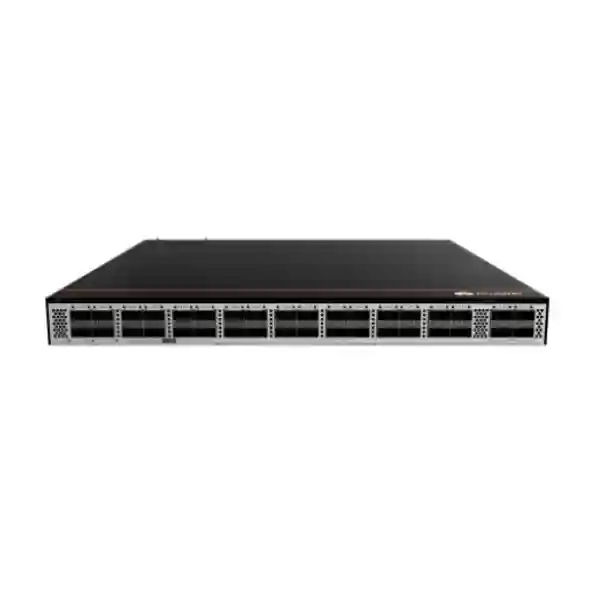
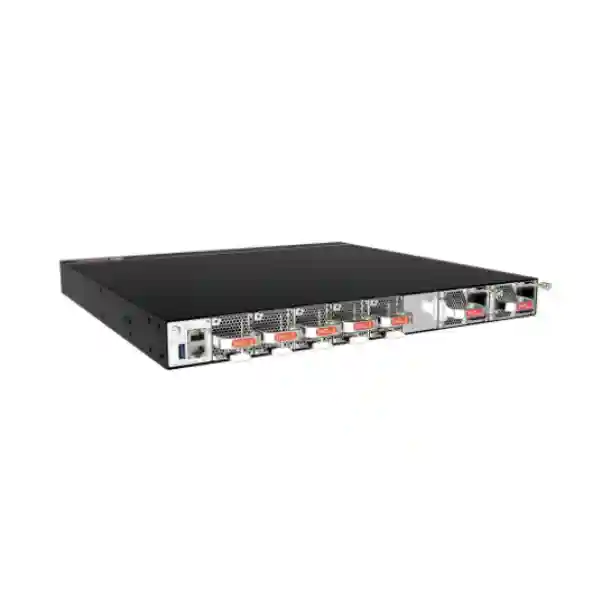
Huawei CloudEngine CE8855-32CQ4BQ
The Huawei CloudEngine CE8855-32CQ4BQ is a high-density 1U data center switch aimed at environments that need substantial 40GE/100GE server-facing capacity and 200GE uplink options without moving immediately to a larger chassis platform. Huawei publishes 32 x 40/100GE QSFP28 interfaces, four 200GE QSFP56 interfaces, 8 Tbps switching capacity and 1200 Mpps packet forwarding performance for this model. The platform also supports data-center functions such as VXLAN routing and bridging, BGP-EVPN, M-LAG, telemetry, IFIT, Packet Event, PFC and AI ECN. FourTeck can help procurement and network teams translate those capabilities into a complete project bill of materials covering transceivers, breakout requirements, airflow, power, licensing, rack readiness and deployment planning.
Direct answer for buyers
Choose this model when the design calls for dense 40/100GE connectivity, high-speed 200GE uplinks, modern EVPN-VXLAN data-center functions and a compact fixed-form-factor switch. Do not finalize the order from the chassis name alone. Confirm optical module types, cable reach, breakout use, airflow direction, AC/DC power requirements, software package, controller integration, redundancy topology and the exact hardware bundle quoted.
QSFP28 access interfaces for dense high-speed server, storage or fabric connectivity.
QSFP56 uplinks; Huawei states each 200GE port can also operate at 100 or 40 Gbit/s.
Published switching capacity with 1200 Mpps packet forwarding performance.
Compact 43.6 mm × 442 mm × 420 mm chassis for rack-based data-center deployment.
What the Huawei CloudEngine CE8855-32CQ4BQ is designed to do
Huawei positions the CloudEngine 8855 family as high-performance, high-density 40GE/100GE access switching for data centers with 200GE uplink capability. In practical procurement terms, the CE8855-32CQ4BQ is relevant when an organization is building or refreshing a leaf layer for high-bandwidth servers, converged infrastructure, storage-heavy applications, virtualized workloads, cloud platforms or high-performance computing environments. It can also be considered for selected aggregation or campus core roles where its interface mix and software capabilities match the topology. The important design question is not simply whether the switch has enough ports. The buyer should map every intended link speed, transceiver form factor, cable reach, oversubscription target, redundant path and upstream interface before a purchase order is released.
The model supports VXLAN routing and bridging with BGP-EVPN, allowing it to participate in modern leaf-spine fabrics where network virtualization and scalable Layer 2/Layer 3 services are required. M-LAG provides an option for active-active multichassis link aggregation, while hardware-based BFD can contribute to faster detection of path failures. Huawei also lists telemetry, enhanced ERSPAN, IFIT and Packet Event capabilities for operational visibility. For congestion-sensitive traffic, the platform supports PFC, AI ECN and RoCE functions. These capabilities are especially relevant when the network carries storage, clustered compute or latency-sensitive east-west traffic, but they still require correct end-to-end configuration. A feature on a datasheet should not be treated as a guarantee that a workload will be lossless or low latency without compatible hosts, adapters, QoS settings and fabric design.
Power and cooling are equally important. Huawei publishes typical power consumption of 378 W and maximum power consumption of 541 W for the CE8855-32CQ4BQ, with supported AC, DC and high-voltage DC arrangements depending on the selected power modules. The platform supports front-to-back or back-to-front airflow based on the fan and power module selection. That means the bill of materials must match the hot-aisle/cold-aisle design of the rack. Mixing an airflow direction that does not match the data-center standard can create avoidable thermal and maintenance problems even when the switch itself is technically compatible.
Verified CE8855-32CQ4BQ specification snapshot
| Service interfaces | 32 × 40/100GE QSFP28 |
| High-speed uplinks | 4 × 200GE QSFP56; each 200GE port can operate at 100 or 40 Gbit/s |
| Switching capacity | 8 Tbps |
| Packet forwarding rate | 1200 Mpps |
| Packet buffer | 36 MB published on Huawei CloudEngine 8800 series specifications |
| Virtualization and fabric | VXLAN routing/bridging, BGP-EVPN, M-LAG |
| Lossless / RDMA functions | PFC, AI ECN, RDMA, RoCE v1 and RoCE v2 |
| O&M | Telemetry, NetStream, enhanced ERSPAN, IFIT, Packet Event |
| Dimensions | 43.6 mm × 442 mm × 420 mm |
| Full configuration weight | 8.31 kg |
| Published operating temperature | 0°C to 40°C at 0 m to 1800 m altitude |
| Power consumption | 378 W typical; 541 W maximum |
Specification note: figures above are based on Huawei Enterprise information for the CE8855-32CQ4BQ. Exact fan modules, power modules, optics, software entitlements and part-number bundles can vary by ordered configuration. Confirm the complete manufacturer and supplier bill of materials before purchase.
Configuration and procurement checklist
1. Interface map
List every 10/25/40/100/200GE connection, the remote device, port type and required distance. If QSFP28 breakout will be used for 10GE or 25GE links, confirm breakout support, cable type and the software design before ordering.
2. Optics and fibre
Specify multimode or single-mode fibre, connector type, wavelength and link reach. The switch chassis alone does not define whether the physical link will work; optics at both ends and the installed fibre plant must form one compatible path.
3. Airflow and power
Confirm rack airflow direction, electrical feed, connector/PDU arrangement and desired power redundancy. Ask the quotation to state exactly which power modules and fan trays are included rather than assuming they are bundled with every chassis code.
4. Software and management
Document the required features, Huawei software package, iMaster NCE-Fabric integration, monitoring stack and operational model. Licensing should be reviewed at quote stage so advanced functions are not assumed to be included by default.
Huawei CloudEngine CE8855-32CQ4BQ Dubai
Customers searching for the Huawei CloudEngine CE8855-32CQ4BQ Dubai usually need more than a price for a bare switch. Dubai data-center, cloud, systems-integration, financial-services, hospitality, logistics and enterprise IT projects often involve strict rack standards, planned maintenance windows and a mixture of server generations. The first useful question is therefore how the CE8855-32CQ4BQ will sit in the topology. For a leaf-spine design, buyers should identify the number of 40GE or 100GE downlinks needed today, the expected growth in high-speed server ports, and whether the four 200GE QSFP56 interfaces will be used toward a spine, aggregation layer or another fabric block. If the design includes breakout, the port map should be prepared before the quote so the correct optics and cables can be reviewed together.
Dubai buyers should also check power and airflow early. The CE8855-32CQ4BQ supports selectable front-to-back or back-to-front airflow through the installed fan and power module combination. In a controlled server room or colocation rack, the direction should match the facility’s hot-aisle/cold-aisle standard. The published operating envelope also needs to be considered as part of the rack and room design rather than treated as a substitute for appropriate cooling. For projects using redundant feeds, ask the quotation to identify the power module configuration and the intended PDU connection. This avoids a common procurement problem in which the chassis, power modules, fans and optics are discussed separately and important items are discovered after the order is placed.
For data-center fabrics, the buyer may be evaluating VXLAN, BGP-EVPN, M-LAG, telemetry, IFIT and lossless Ethernet capabilities. These functions should be mapped to the operational plan. A network team that intends to use EVPN-VXLAN should document the routing design, VTEP role, underlay addressing and controller approach. A storage or AI environment considering RoCE should validate host NICs, PFC/ECN behavior and end-to-end QoS. FourTeck can help collect these requirements and prepare a commercial request around the actual deployment. Related UAE infrastructure support can also be reviewed through FourTeck UAE and the Firewall Dubai services team when the switching project must integrate with routing, perimeter security, segmentation or migration work.
When requesting a Huawei CloudEngine CE8855-32CQ4BQ Dubai quotation, provide quantity, preferred power type, airflow direction, optics list, cable lengths, software requirements, installation location and whether configuration assistance is required. FourTeck does not need to assume stock, delivery timing or warranty terms in advance; those details can be confirmed for the specific quotation and supply route. This gives procurement a clearer basis for comparing offers and gives the engineering team confidence that the quoted hardware is aligned with the intended network rather than simply matching a model number.
Huawei CloudEngine CE8855-32CQ4BQ UAE
A Huawei CloudEngine CE8855-32CQ4BQ UAE requirement can come from a centralized data center, a disaster-recovery site, a campus core refresh, a managed-service platform or a private cloud deployment. Across the UAE, network teams often need a consistent design that can be documented for multiple facilities rather than a one-off switch purchase. The CE8855-32CQ4BQ provides 32 high-density 40/100GE QSFP28 interfaces and four 200GE QSFP56 interfaces in a compact 1U form factor, making it relevant for high-bandwidth interconnection where a fixed switch is preferred. The procurement discussion should begin with link roles: server-facing access, east-west fabric traffic, storage connectivity, aggregation, or uplinks to a larger CloudEngine core. Each role influences optics, oversubscription, redundancy and software requirements.
For organizations operating across Abu Dhabi, Dubai, Sharjah and other emirates, standardization can reduce support complexity. If several sites will use the same model, define a repeatable bill of materials that includes the same airflow direction, power modules, compatible optical families, labels and baseline configuration where appropriate. Standardization is particularly helpful when spare optics or replacement parts must be managed centrally. At the same time, local rack layouts and fibre distances can differ, so a single standard should not erase site-specific requirements. The quotation can separate common components from location-dependent optics and cabling.
The CE8855-32CQ4BQ also deserves attention from teams modernizing network operations. Huawei lists telemetry, NetStream, enhanced ERSPAN, IFIT and Packet Event functionality, along with standard management protocols and iMaster NCE-Fabric integration. Before purchasing, decide how these functions will feed the organization’s monitoring, automation and incident-response processes. An advanced switch that is deployed only with basic polling may not deliver the visibility expected from the platform. Conversely, enabling telemetry without a collection and retention plan can create unnecessary operational noise. FourTeck can help buyers separate the required day-one functions from optional future capabilities so licensing and management choices are clearer.
A UAE quotation should therefore include a technical scope alongside the commercial request. State the required port speeds, expected uplink utilization, redundancy design, IPv4/IPv6 routing needs, EVPN-VXLAN intentions, management platform, maintenance window expectations and any requirement for staging or configuration assistance. For perimeter and segmentation dependencies, buyers can review the FourTeck firewall product portfolio and firewall deployment guidance. The objective is not to add unrelated equipment, but to make sure the data-center switching layer and security architecture are planned as parts of one network.
Huawei CloudEngine CE8855-32CQ4BQ Uganda
Organizations evaluating the Huawei CloudEngine CE8855-32CQ4BQ Uganda may include service providers, universities, financial institutions, government-linked projects, large enterprises, cloud or hosting environments and systems integrators delivering regional infrastructure. For these buyers, the key task is to separate the switch model from the complete deployment requirement. A CE8855-32CQ4BQ can provide the density needed for 40GE/100GE server or aggregation links, but the project still depends on the correct optics, fibre plant, rack power, cooling, software package and upstream architecture. Buyers should send the actual topology and interface schedule with the request for quotation rather than asking only for “one CE8855 switch.”
Power and environmental planning can be particularly important for regional data-center and enterprise facilities. The switch’s published consumption figures help estimate rack load, but the site team should also account for redundant power feeds, UPS capacity, generator design and the thermal load of adjacent equipment. Airflow direction must match the rack standard because the model can be configured for front-to-back or back-to-front cooling depending on the installed modules. If equipment is being deployed into an existing cabinet, record the available rack units, PDU type, cable-management space and fibre entry direction before approving the bill of materials. These practical details often determine whether installation is smooth.
From a network-design perspective, Uganda buyers may be using the platform to support virtualized services, private cloud, storage clusters or high-capacity campus aggregation. Huawei’s VXLAN and BGP-EVPN functions can be useful for scalable segmentation and fabric designs, while M-LAG provides an active-active approach to dual-homed connectivity. For organizations planning RoCE or other congestion-sensitive traffic, PFC and AI ECN should be evaluated as part of an end-to-end design that includes server NICs and QoS policy. FourTeck can help turn these requirements into a structured technical request. Customers can also use FourTeck Uganda for country-focused procurement discussions and regional coordination.
Before placing an order, Uganda procurement teams should ask for the exact chassis part number, included fan trays and power modules, optics list, software and support items, commercial validity and delivery basis. If several sites are involved, provide a site-by-site quantity and port plan so common parts can be standardized while fibre reach and power details remain location specific. The result is a clearer quotation and a more supportable deployment. FourTeck should be asked to confirm current availability and commercial terms for the requested configuration rather than relying on generic online stock statements that may refer to a different bundle or region.
Huawei CloudEngine CE8855-32CQ4BQ Kampala
A Huawei CloudEngine CE8855-32CQ4BQ Kampala enquiry is often tied to a specific data-center room, headquarters environment, university, financial platform, ISP facility, integration project or enterprise consolidation effort. Kampala buyers can make the procurement process faster by providing the intended network role first. If the switch is a leaf device, list the number and speed of server links plus the required uplinks. If it is being used for aggregation or a compact core role, show the downstream switch count, routing requirements, expected traffic pattern and redundancy design. This prevents a quotation from focusing on the headline port count while missing the transceivers, breakouts or software features needed for the real topology.
The CE8855-32CQ4BQ’s 32 QSFP28 interfaces can operate at 40GE or 100GE, and Huawei documents breakout options on the 100GE ports for lower-speed links in supported scenarios. Breakout can be useful during a migration in which older 10GE or 25GE servers remain in service while newer equipment moves to 100GE. However, a mixed-speed design should be documented carefully because cable type, optics and port grouping affect the bill of materials. A practical Kampala deployment plan should show which links are permanent, which are transitional and which ports are reserved for growth.
Operational visibility should also be designed from the beginning. Telemetry, NetStream, ERSPAN+, IFIT and Packet Event features can help network teams investigate congestion, drops and path behavior, but they need collectors, management access and procedures. If the switch will integrate with iMaster NCE-Fabric, note whether the organization already operates the platform or whether the project includes new controller deployment and licensing. If not, define the SNMP, CLI, automation or monitoring method that the support team will use. The aim is to avoid installing a sophisticated data-center switch without a clear operational model for backup, monitoring, change control and troubleshooting.
For Kampala procurement, include delivery destination, rack and power details, preferred airflow, optics and cable list, requested quantity and whether installation or remote configuration assistance is part of the project. FourTeck can coordinate the commercial request without claiming that every configuration is locally stocked. If the switch will sit behind a firewall or serve segmented server networks, the perimeter firewall planning resource can help teams identify routing, VLAN and security dependencies that should be discussed before cutover.
Huawei CloudEngine CE8855-32CQ4BQ Arua
For a Huawei CloudEngine CE8855-32CQ4BQ Arua project, logistics and site readiness can be as important as the switch specifications. A high-density 100GE data-center switch is normally part of a larger infrastructure stack, so procurement should identify whether the equipment is going into an established server room, a new regional site, a telecom facility or a centralized institutional network. Before the hardware moves to site, confirm rack depth and free rack units, PDU compatibility, earthing, UPS/generator strategy, cooling, fibre patching and the availability of the correct transceivers. A missing optical module or unsuitable power lead can delay a deployment even when the main chassis has already arrived.
The technical design should also consider how much of the CE8855-32CQ4BQ’s capacity will be used at day one. If only a portion of the 32 high-speed ports are needed initially, identify which ports will be populated and reserve a clear growth plan. If uplinks will operate at 200GE, verify that the remote switch supports the required interface and optical standard. If the upstream network is still 100GE, Huawei states that the QSFP56 ports can run at 100 or 40 Gbit/s, which can support staged migration. That flexibility is valuable only when it is translated into an exact port and optics schedule.
Arua buyers should also define who will operate the switch after commissioning. Will configuration be managed locally, from Kampala, from a regional NOC or by an external integrator? That decision affects management addressing, secure remote access, configuration backups, monitoring, escalation and documentation. For networks with constrained support windows, a standardized baseline and labelled fibre plan can reduce recovery time after a fault. Features such as M-LAG and hardware BFD can improve resiliency when the topology is designed for them, but the complete redundant path—including upstream devices, servers and power—must be considered rather than assuming the switch alone creates high availability.
When asking FourTeck for an Arua quotation, include the delivery point, site access constraints, project timeline, exact quantity, port speeds, optics reaches, power type and desired airflow. Ask for the bill of materials to identify separately the switch, fans, power modules, optics, software and support elements. This is especially useful for remote-site procurement because it creates a checklist before shipment and reduces the risk of discovering an omitted component during installation. Current availability and delivery arrangements should be confirmed for the specific request rather than inferred from another market.
Huawei CloudEngine CE8855-32CQ4BQ Mbarara
A Huawei CloudEngine CE8855-32CQ4BQ Mbarara requirement may be driven by a growing institutional network, education environment, regional enterprise, service-provider point, private cloud project or a data-center consolidation that needs more bandwidth between servers and the core. The model’s dense 40/100GE interface set makes it a significant step beyond ordinary campus access switching. Buyers should therefore confirm that the connected infrastructure is ready for that speed: server network adapters, fibre transceivers, patch panels, upstream switches and monitoring tools all need to be compatible. A switch upgrade that leaves the rest of the path unchanged may not produce the expected application improvement.
For Mbarara sites that are migrating gradually, the project can be planned in phases. Phase one might connect existing 40GE equipment and selected 100GE servers while reserving 200GE uplinks for a later core refresh. Another approach may use supported breakout connectivity for a transition period. Whichever method is chosen, the network diagram should show the intended end state as well as the temporary links. This helps procurement avoid buying optics that will be discarded quickly and helps engineers understand which configuration is transitional. It also makes maintenance documentation more useful because the team can see why certain ports operate at different speeds.
Resiliency is another design area that deserves explicit discussion. The CE8855 family supports M-LAG and BFD-related functions, but a reliable service needs redundant links, diverse upstream devices where required, power protection and tested failover behavior. If the site carries business-critical services, define what should happen when an uplink, switch or power source fails. A documented failover test should form part of commissioning when the project scope allows. Telemetry and Packet Event functions can then support ongoing visibility by helping identify abnormal forwarding or latency conditions, provided the monitoring platform is prepared to receive and interpret the data.
For a useful Mbarara quote, send FourTeck the application context, current and target link speeds, quantity, airflow preference, power details, rack standard, optics list and required support scope. If the project is part of a wider Uganda rollout, use consistent naming and common spare components wherever practical while keeping site-specific fibre lengths and power requirements separate. This creates a more maintainable regional network and gives procurement a stronger basis for comparing complete solutions instead of comparing only the headline chassis price.
Huawei CloudEngine CE8855-32CQ4BQ Gulu
For buyers researching the Huawei CloudEngine CE8855-32CQ4BQ Gulu, the most important starting point is to confirm whether the site genuinely needs a high-density 100GE data-center platform. The switch is a strong fit when the network has servers, storage, virtualization hosts, high-speed aggregation or fabric links that can use its interface capacity. It may be excessive for an ordinary office access layer where user devices connect at 1GE or 2.5GE. A clear requirement protects the budget and makes the quotation easier to validate. FourTeck can review the port map and intended role before procurement so the model is evaluated against the actual workload.
If the CE8855-32CQ4BQ is selected, the Gulu site-preparation checklist should cover power quality, redundant supply planning, room cooling, rack space and fibre management. The switch is 1U, but high-speed fibre cabling can still create substantial patching density. Plan horizontal or vertical cable management so QSFP connections can be serviced without stressing adjacent ports. Record each fibre route and label both ends. If the design uses single-mode links to another room or building, provide the measured or planned distance when requesting optics so the correct reach can be quoted. If multimode fibre is already installed, confirm its type and supported distance for the selected optical standard.
The model’s EVPN-VXLAN and M-LAG capabilities can help create resilient, scalable architectures, but organizations should adopt only the complexity they can operate. A smaller technical team may prefer a simpler routed design unless virtualization requirements justify a fabric. If EVPN is required, define the routing protocols, address plan, VLAN/VNI mapping and change-control process. If iMaster NCE-Fabric will be used, include controller integration and licensing in the design. If the switch will be managed through standard tools, document the secure management path, administrator roles, configuration backup and monitoring method. Operational simplicity is part of good architecture.
For Gulu procurement, share the exact destination, project stage, required date, network diagram, quantity and complete accessory list. Ask the supplier to state what is included in each quoted part number, particularly fan modules, power modules and software items. This is more reliable than assuming one online listing represents every bundle. FourTeck can prepare the request around the Gulu project and coordinate with broader Uganda requirements when several locations need the same switching platform.
Huawei CloudEngine CE8855-32CQ4BQ Kenya
The Huawei CloudEngine CE8855-32CQ4BQ Kenya is relevant to data-center operators, financial and technology companies, carriers, universities, large enterprises and integrators that need dense 40/100GE switching with 200GE uplink capability. Kenya buyers commonly need a complete project quotation rather than a chassis-only price. That means the request should describe the topology, link speeds, fibre distances, quantity, software requirements, power and airflow direction, and whether the switch will form part of an EVPN-VXLAN fabric, M-LAG pair or conventional routed architecture. The more complete the brief, the less chance of receiving an offer that omits essential optics or software components.
For Nairobi data-center deployments and other Kenyan facilities, the CE8855-32CQ4BQ can be considered as a high-density leaf or aggregation platform. The four 200GE ports can support higher-speed uplinks, while the 32 QSFP28 ports support 40GE/100GE access and documented breakout flexibility in supported designs. When planning oversubscription, calculate expected traffic rather than dividing port counts mechanically. Workloads with substantial east-west traffic, backup windows or distributed storage can behave very differently from ordinary north-south business applications. Engineering should confirm whether the uplink capacity and redundancy model match peak traffic expectations.
Operational tooling matters as much as raw capacity. Huawei lists telemetry, IFIT, Packet Event and NetStream, providing several options for observing traffic and service behavior. Kenyan organizations with a centralized NOC can decide which data will be collected, where it will be stored and how alerts will be handled. For high-performance computing or storage environments using RoCE, PFC and AI ECN should be tested with the server stack and traffic profile rather than enabled as isolated switch features. A pilot or staged deployment can be useful when the fabric is introducing new operational concepts.
FourTeck can support country-focused enquiries through FourTeck Kenya. Send the required destination, quantity, optics and cable schedule, power arrangement, airflow direction, licensing needs and target installation date. If the project will integrate with perimeter firewalls or segmented data-center security, review the FourTeck network-security capability overview so responsibilities between switching and security teams can be planned before cutover. Stock status and delivery terms should be confirmed against the specific configuration and quotation.
Huawei CloudEngine CE8855-32CQ4BQ Kuwait
A Huawei CloudEngine CE8855-32CQ4BQ Kuwait project may support enterprise data centers, service providers, financial platforms, government infrastructure, cloud environments or large campus aggregation where high interface density and modern data-center functions are required. The switch’s 32 x 40/100GE QSFP28 ports and four 200GE QSFP56 ports make it suitable for compact high-bandwidth fabrics, but the final design should consider the full path from server NIC to upstream core. Procurement should request a bill of materials that states transceivers, cables, fan modules, power modules, software and support separately so technical teams can validate each element.
Kuwait buyers should give particular attention to facility and cooling integration. Huawei supports front-to-back or back-to-front airflow based on the chosen modules, so the ordered direction must match the rack’s aisle design. The published device operating range does not remove the need for a properly controlled data-center environment. When the installation is in a live rack, record available electrical circuits, PDU connectors and redundant-feed requirements. The switch’s typical and maximum power figures can be incorporated into the rack load calculation together with optics and adjacent equipment. These details should be checked during design, not after delivery.
For virtualized data centers, VXLAN routing and bridging with BGP-EVPN can support scalable overlay networking, while M-LAG can provide active-active attachment options. Huawei also documents telemetry and IFIT functions that can contribute to detailed operational visibility. Before using those capabilities, define the monitoring architecture and ownership. If a central team operates multiple sites, a consistent configuration template and change process can reduce mistakes. If local staff will support hardware but a remote NOC controls configuration, document the console, management and escalation procedures so physical and logical responsibilities are clear.
Customers can use FourTeck Kuwait for Kuwait-focused commercial coordination. Include project location, quantity, topology, link speeds, optics distances, software package, airflow, power feed and any installation or staging requirement. If the CE8855-32CQ4BQ is replacing an older data-center switch, provide the existing port map and maintenance window so migration risks can be identified. A structured request makes it easier to compare suppliers on a complete and technically equivalent configuration rather than on a headline chassis figure alone.
Huawei CloudEngine CE8855-32CQ4BQ Ghana
The Huawei CloudEngine CE8855-32CQ4BQ Ghana can be evaluated for financial institutions, universities, telecom and service-provider environments, large enterprises, hosting platforms and data-center projects that require dense high-speed switching. Ghana buyers should begin with an interface schedule showing every expected server, storage, firewall, router and upstream switch connection. The CE8855-32CQ4BQ provides substantial capacity, but the project succeeds only when those links are matched to the right optics, fibre and software configuration. A complete schedule also helps determine whether breakout is needed during migration from lower-speed interfaces.
For sites in Accra and other Ghanaian locations, power resilience and service continuity are important design inputs. Redundant power modules should be planned together with UPS and generator arrangements, and the rack should be checked for correct airflow. Where the switch is part of a critical service, the network architecture should include redundant upstream paths and a tested failover plan rather than depending on a single device. M-LAG and BFD capabilities can support resilient designs, but they must be combined with appropriate peer devices, server teaming and routing behavior. Documenting the expected failure scenarios makes the commissioning test more meaningful.
The CE8855-32CQ4BQ can also support organizations moving toward EVPN-VXLAN fabrics and automated data-center operations. If those capabilities are planned, the design should define the underlay, overlay, route-reflector strategy where applicable, VNI mapping and management integration. Telemetry and IFIT can support troubleshooting, but the organization should decide which collector or analysis platform will consume the information. For RoCE or storage traffic, the network and server teams need a shared QoS plan because PFC and AI ECN depend on coordinated configuration across the path.
FourTeck can help prepare a Ghana quotation based on actual project requirements. Send quantity, installation city, port speeds, optics reach, power and airflow preferences, software/licensing needs and target deployment date. For broader regional product and switching discussions, FourTeck Africa provides an additional procurement route. Current stock and lead time should be confirmed specifically for the CE8855-32CQ4BQ configuration requested. Avoid relying on third-party listings that may describe different bundles, used equipment or unsupported combinations.
Huawei CloudEngine CE8855-32CQ4BQ Nigeria
For the Huawei CloudEngine CE8855-32CQ4BQ Nigeria, common buyer concerns include whether the platform fits a modern leaf-spine architecture, how to select compatible 100GE/200GE optics, what power and fan modules are required, which software package supports the planned features and how the equipment will be supported after deployment. These are more important than a simple web price because data-center switching is purchased as a system. Banks, carriers, fintech platforms, universities, cloud providers, large enterprises and integrators can use the model’s dense interfaces for high-bandwidth server and aggregation roles when the architecture is designed accordingly.
Nigeria deployments should include a detailed power and environmental review. The switch’s published 378 W typical and 541 W maximum consumption figures help with rack calculations, but the facility design must also include redundant feeds where required, UPS/generator capacity and cooling. Front-to-back or back-to-front airflow should be selected to match the cabinet. For larger projects in Lagos, Abuja or other cities, standardizing on one airflow direction and common optical types across racks can simplify spares and operations, provided the physical plant supports that standard.
A network architecture using EVPN-VXLAN can benefit from the CE8855-32CQ4BQ’s BGP-EVPN and VXLAN functions, while M-LAG can provide active-active connectivity in appropriate designs. When planning high-performance storage or AI traffic, PFC and AI ECN should be assessed with the full traffic model. If the network team is moving from a traditional VLAN/STP environment, a staged migration and lab validation may be more prudent than introducing every advanced feature at once. Operational maturity—monitoring, configuration management, rollback, change approval and trained staff—should grow with the fabric’s complexity.
For a Nigeria quotation, provide the exact project destination, quantity, topology, software requirements, optics and cable schedule, airflow, power type and deployment timeline. Ask that commercial terms distinguish hardware, software, support and services. FourTeck can coordinate regional requirements and help review whether the quoted bundle matches the intended use. If the switch sits in a protected data-center segment, security teams can also review the example enterprise firewall product guidance to understand how switching, routing and security specifications should be separated and validated rather than bundled under a vague “network upgrade” description.
Huawei CloudEngine CE8855-32CQ4BQ Seychelles
A Huawei CloudEngine CE8855-32CQ4BQ Seychelles deployment can be relevant for telecom, hospitality, government, financial, cloud, data-center or enterprise environments that need high-speed switching in a compact footprint. For island procurement, a complete bill of materials is particularly valuable because an omitted optic, cable or power component can create disproportionate delays. Buyers should therefore prepare a pre-shipment checklist covering the exact switch variant, fan trays, power modules, mounting hardware, optics, patch leads, spare transceivers where required, software and support documentation. The request should also state whether staging and baseline configuration are expected before shipment.
Network teams should map fibre distances accurately. If the CE8855-32CQ4BQ connects to servers within the same rack, short-reach optics or direct-attach options may be appropriate depending on interface support and design. Links between rooms or buildings may require different optical reach. For 200GE uplinks, verify the remote platform and transceiver standard at both ends. The switch’s ability to run the 200GE ports at lower speeds can assist phased upgrades, but compatibility still needs to be confirmed for the specific optics and peer device. A written interface schedule is the best way to reduce ambiguity.
Operational resilience should include more than redundant switch features. Seychelles organizations may want to keep critical spares on island for components that would otherwise require international shipment. The appropriate spare strategy depends on the importance of the service, available redundancy and commercial support arrangement. Configuration backups, remote management and monitoring should also be prepared so a local technician can perform physical checks while a specialist team assists remotely if required. Features such as telemetry, Packet Event and IFIT can provide useful visibility when a compatible monitoring process is in place.
When contacting FourTeck, include island/site location, quantities, fibre plan, target speeds, rack details, power feeds, airflow direction, software needs and desired deployment date. Ask for confirmation of current availability and shipping basis for the exact configuration. If the project is part of a wider regional architecture, common templates for VLANs, routing, management and logging can simplify support across locations. The goal is to arrive with a deployable, documented system rather than a collection of parts that still needs major specification work after delivery.
Frequently asked questions about the CE8855-32CQ4BQ
How many high-speed ports does the Huawei CloudEngine CE8855-32CQ4BQ provide?
Huawei publishes 32 x 40/100GE QSFP28 ports and four 200GE QSFP56 ports for the CE8855-32CQ4BQ. The 200GE ports can operate at 100 or 40 Gbit/s, and the 100GE interface design supports lower-speed breakout options in supported scenarios. Always validate the required optics and peer-device compatibility before ordering.
Is the CE8855-32CQ4BQ suitable for EVPN-VXLAN?
Yes. Huawei lists VXLAN routing and bridging together with BGP-EVPN for the model. Whether it is the right fabric platform for a particular project depends on scale, routing design, software package, management architecture and the operational skills of the team.
Does it support M-LAG?
Huawei lists M-LAG support. M-LAG can be used to create active-active multichassis link aggregation in suitable architectures. The full resilience design should still account for peer links, upstream paths, server bonding, routing behavior and redundant power.
What should be included in a quotation request?
Provide quantity, deployment location, interface map, optics and cable distances, airflow direction, power type, required software features, management platform, redundancy design and target installation date. If installation or configuration support is needed, state the desired scope so services can be separated from hardware and licensing.
Can FourTeck confirm price and availability?
FourTeck can prepare a current quotation after the requested configuration and destination are known. Pricing, availability, support terms and delivery arrangements can change by quantity, bundle, supplier route and location, so they should be confirmed in the formal quote rather than assumed from a generic online listing.
Related FourTeck resources for a complete network project
Switching and security integration
Use the Firewall Dubai services page when the new data-center switch must coordinate with firewall VLANs, routing, segmentation, VPN or migration work.
Security product planning
The FourTeck security products area helps buyers review firewall options that may sit northbound of the data-center switching layer.
Deployment process
Review firewall deployment planning when a switch cutover depends on coordinated security policies, NAT, VPN or perimeter routing changes.
Perimeter architecture
The perimeter firewall resource is useful when architects need to define where data-center VLANs, routed links and security zones meet.
Complementary product example
See the PA-415 firewall product page as an example of documenting security interfaces and licensing separately from switch requirements.
Compact firewall example
For smaller branch or management-plane contexts, the Sophos XGS 88 page illustrates how edge security scope differs from high-speed data-center switching.
Company and support context
Learn about FourTeck’s approach through the about page and use the verified contact route for quotation or project scoping.
Decision recap
The CE8855-32CQ4BQ is most relevant when a project genuinely needs dense 40/100GE connectivity, 200GE uplinks and data-center features such as EVPN-VXLAN, M-LAG and advanced telemetry in a compact 1U platform. The purchase decision should be based on the entire network design rather than the switch alone. Confirm interface speeds, optical reaches, breakout, airflow, power, software, management, failover and support responsibilities before the quotation is approved.
High-density data-center leaf, aggregation and selected campus core use cases with high-speed fibre requirements.
Optics, software entitlements, fan and power module bundle, airflow direction and peer-device compatibility.
Topology, port map, fibre distances, quantity, destination, power, airflow, licensing and service scope.
Quotation checklist for FourTeck
To obtain a useful commercial response, send the exact model name Huawei CloudEngine CE8855-32CQ4BQ together with quantity, destination, required arrival window, expected port speeds, server and upstream device models, fibre type and distance, optical transceiver requirements, desired airflow, power feed, redundancy design, software features, management platform and whether staging, configuration or installation support is required. If the project spans several countries or cities, provide a separate site quantity and accessory list. This lets the commercial team request current availability and terms for the right configuration while helping the engineering team detect missing dependencies before purchase.
FourTeck’s regional network can support procurement discussions through the UAE, Uganda, Kenya, Kuwait and wider Africa resources linked above. The purpose of those links is to route country-specific enquiries to relevant FourTeck channels, not to imply a warehouse, office, stock commitment or guaranteed delivery time in every location. Those commercial details must be confirmed in the quotation.

Reviews
There are no reviews yet.