
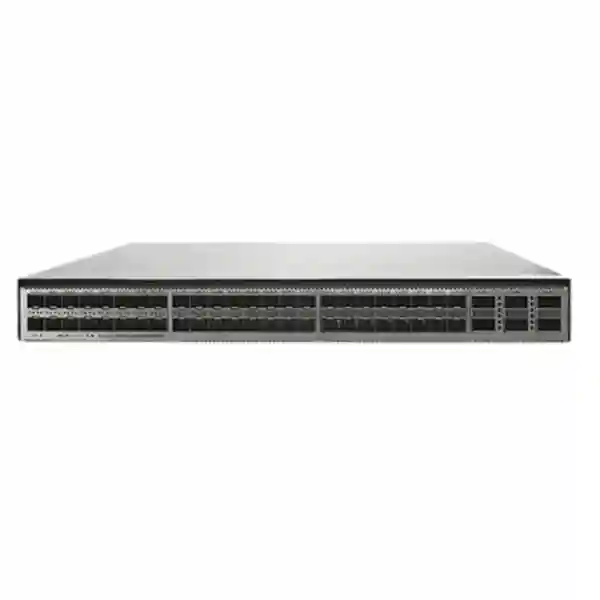
Huawei data-center switching for Dubai and UAE infrastructure
Huawei CloudEngine CE6881E-48S6CQ Dubai
The Huawei CloudEngine CE6881E-48S6CQ is designed for high-density data-center access where a project needs a practical mix of 10GE, 25GE and 100GE connectivity in a compact switching layer. Huawei specifies the model with twenty-four 10GE SFP+ interfaces, twenty-four 25GE SFP28 interfaces and six 100GE QSFP28 interfaces. For Dubai buyers, the important purchasing question is not simply whether the switch has enough ports. It is whether the chosen chassis configuration, fan direction, power modules, optics, cabling, uplink design and software expectations match the rack, servers and network architecture in which the switch will operate.
Direct answer
Choose the CE6881E-48S6CQ when your design specifically benefits from mixed 10GE and 25GE downlink density with 100GE uplinks. Before approving a quote, confirm power-module type, fan airflow, optical transceivers, cable media, software requirements and whether the exact ordered bundle includes the components your rack needs.
What the Huawei CloudEngine CE6881E-48S6CQ is
Huawei positions the CloudEngine CE6800 family for data-center switching, and the CE6881E-48S6CQ sits in that family as a fixed-form-factor platform for high-speed Ethernet access and aggregation. The port mix is especially relevant to organizations modernizing from a predominantly 10GE server environment toward 25GE while retaining substantial 10GE connectivity. Instead of forcing every attached system to move to one speed at the same time, the switch provides separate groups of 10GE SFP+ and 25GE SFP28 ports plus a set of 100GE QSFP28 interfaces for uplinks, peer links or other high-capacity connections supported by the design.
That mixed-port arrangement can make the model useful in phased data-center refreshes, virtualization clusters, private-cloud environments, storage and application networks, enterprise server rooms and campus core or aggregation designs that require optical connectivity and high uplink capacity. The value is not simply port count. The value is having a platform that can connect legacy or existing 10GE equipment alongside newer 25GE hosts while giving the switching layer enough high-speed interfaces to build resilient uplinks.
For buyers searching for a Huawei CloudEngine CE6881E-48S6CQ supplier in Dubai, the most useful procurement conversation starts with the exact topology. Share which ports will connect to servers, storage, firewalls, routers, existing switches, virtualization hosts or data-center fabric nodes. Also identify the required transceiver types and fiber distances. This reduces the risk of receiving the correct switch model but the wrong optics, wrong airflow direction or incomplete power and fan combination.
Verified interface layout and ordering context
Useful for established 10-gigabit server, appliance and inter-switch connections where compatible SFP+ optics or direct-attach media are selected.
Designed for higher-bandwidth server and fabric access where 25GE is required and the attached host adapters, optics and cabling support the intended design.
Provide high-speed uplink capacity for leaf-spine, aggregation, peer-link or core connectivity depending on the approved network architecture.
Huawei’s ordering information identifies the base CE6881E-48S6CQ chassis separately from populated variants. The base description is the switch without fan and power modules, while populated versions are available with AC power supplies and defined airflow direction. This distinction matters during procurement. A bill of materials that lists only the base model can be incomplete for deployment if it does not separately include the required fan trays and power modules. FourTeck therefore recommends checking the complete line-item configuration rather than approving by model name alone.
Why Dubai data-center buyers look at this model
Dubai organizations increasingly run mixed generations of compute and network equipment. A rack may contain 10GE appliances that are still commercially useful, newer virtualization servers with 25GE network adapters, security devices that need dedicated high-speed links and upstream infrastructure operating at 100GE. A mixed-speed switch can reduce the need to replace every connected device at once. The CE6881E-48S6CQ therefore tends to be evaluated in projects where migration flexibility is as important as headline bandwidth.
The model is also relevant when a project is moving toward a leaf-spine architecture. In such environments, the switch can be considered as a leaf or top-of-rack platform with server-facing connectivity on 10GE and 25GE ports and high-capacity links toward the spine. The final suitability depends on the exact routing, VXLAN, EVPN, redundancy, latency, monitoring, software and scale requirements of the project, so architecture review should happen before purchase rather than after installation.
For a more general view of business switching options in the UAE, buyers can review FourTeck’s network switch solutions for UAE businesses. That broader resource helps teams compare the role of access, aggregation and data-center switching before narrowing the bill of materials to a specific Huawei model.
10GE and 25GE migration without replacing everything at once
One of the strongest practical reasons to consider the CE6881E-48S6CQ is the way its port layout supports a staged transition. Many established data centers still contain 10GE interfaces on application servers, backup systems, network appliances and older virtualization hosts. At the same time, new server platforms increasingly use 25GE to provide more bandwidth per host without immediately jumping to 40GE or 100GE at every endpoint. A mixed 10GE and 25GE switch lets procurement teams plan a controlled refresh rather than forcing an all-at-once change.
A practical migration might begin by connecting existing 10GE systems to the SFP+ group while new hypervisors and storage-facing hosts use the SFP28 group. The six 100GE interfaces can then be allocated to redundant uplinks or fabric connections according to the architecture. Over time, workloads can move to newer hosts without disturbing every legacy connection. This approach can be operationally useful because server refresh cycles, software licensing, storage upgrades and network modernization rarely happen on exactly the same date.
The important caveat is that speed labels alone do not guarantee compatibility. The transceiver, cable, fiber type, connector, wavelength, distance and interface capability on both ends must match. For direct-attach copper or active optical cables, supported lengths and use cases should be confirmed against Huawei documentation and the device at the far end. For optical links, verify whether the application needs multimode or single-mode fiber and whether the patching system uses the correct connector type.
Server-access planning
Count the actual server interfaces that require 10GE and 25GE, then include growth. A design with twenty-two current 25GE hosts leaves very little room for expansion if each host consumes one switch port. If hosts are dual-attached to two switches for resilience, the port calculation must be performed per switch rather than as one combined total.
Also identify whether each server uses one data interface, multiple bonded interfaces, dedicated storage links or separate management connectivity. The physical port count can rise quickly when redundancy and traffic separation are designed correctly.
Uplink planning
The six QSFP28 interfaces should be mapped before purchase. Decide whether they will be used for spine uplinks, core connections, M-LAG peer connectivity, stack-related functions or another approved design. A switch can appear to have abundant uplink capacity until redundancy and peer links consume several ports.
Document each intended link, its speed, remote device, optic type and expected traffic role. This makes quotation and commissioning significantly easier.
Airflow is a buying decision, not an afterthought
Data-center switches use forced-air cooling, and airflow direction should match the rack’s hot-aisle and cold-aisle strategy. Huawei lists populated variants of the CE6881E-48S6CQ with different airflow directions. This means buyers should not treat every suffix or fan module as interchangeable. The required fan trays and power supplies need to work together with the intended airflow direction so that the unit pulls cool air from the correct side and exhausts hot air toward the correct aisle.
In a Dubai data-center environment, where cooling efficiency is a significant operational consideration, a wrong airflow choice can create avoidable thermal stress. Even if the switch powers on, incorrect airflow relative to the cabinet layout can recirculate hot exhaust air. Before ordering, record whether the rack requires port-side intake or port-side exhaust, check the direction used by neighboring equipment and confirm the exact fan and power-module combination in the quote.
This check is especially important when replacing an existing switch. The old platform may have used a different airflow convention, and copying only the physical rack position is not enough. The replacement design should confirm front and rear rack orientation, cable-management space, blanking panels, power-feed position and access for replacing hot-swappable components.
Power-module selection and redundancy
The base Huawei CloudEngine CE6881E-48S6CQ ordering description does not include fan or power modules. Huawei documentation for the platform lists supported AC, DC and high-voltage DC power-module options. In a normal procurement process, the power design should therefore be treated as a separate engineering decision rather than assumed from the chassis model. Confirm which electrical feed is available in the rack, which module type is approved for the environment and whether dual power modules are required for redundancy.
Redundant power works best when each power module is connected to an independent upstream source where the facility provides that option. Connecting two power supplies to the same single point of failure gives component redundancy but not full path redundancy. In a mission-critical rack, power planning may include separate PDUs, separate UPS paths or separate distribution circuits. The network team should coordinate with facilities or the data-center operator before finalizing the order.
Power planning also affects cable type, plug format, rack PDU availability and maintenance procedure. If the organization uses DC or HVDC infrastructure, the correct modules and installation practices must be selected by qualified personnel. For a Dubai enterprise server room using standard AC rack power, the quote should clearly show the exact AC modules, fan trays and any required power cords instead of using a vague statement such as “switch complete.”
FourTeck can discuss broader infrastructure dependencies through its business IT infrastructure and network services, which covers switching, server rooms, connectivity and related technical support considerations for UAE organizations.
Optics, DACs and fiber: where many switch orders go wrong
Buying the switch chassis is only one part of a working data-center link. Every SFP+, SFP28 and QSFP28 connection needs a supported physical medium. Depending on the distance and the devices being connected, that medium may be a direct-attach copper cable, an active optical cable or an optical transceiver with a separate fiber patch lead. A quote that includes the right switch but omits the link media can delay deployment just as effectively as ordering the wrong switch.
For short in-rack links, direct-attach cables can be attractive because they are simple and avoid separate transceivers. For longer rack-to-rack connections, optical modules and structured fiber are more common. The design team should confirm distance, fiber type, patch-panel path, connector type and remote interface. It is also important to confirm whether an existing third-party optic will be accepted operationally and commercially. Even where a transceiver is technically recognized, support policy and firmware behavior may vary.
The safest procurement method is to build a port map. For each switch port that will be used, document the far-end device, requested speed, medium, estimated distance and optic or cable part number. This can be done in a spreadsheet before requesting a quotation. The result prevents common mistakes such as ordering multimode optics for a single-mode run, selecting the wrong wavelength, overlooking a connector mismatch or assuming a 100GE cable will automatically break out into multiple lower-speed links.
Because Huawei’s high-speed interfaces have specific operating rules, do not rely on generic assumptions about breakout behavior. Confirm the intended QSFP28 use against the current Huawei documentation and the software release that will run on the switch. This is particularly important when a topology depends on unusual breakout, stacking or peer-link combinations.
Where CE6881E-48S6CQ can fit in a leaf-spine design
A leaf-spine network uses leaf switches to connect servers and other endpoints, with each leaf normally connecting upward to multiple spine switches. This architecture creates predictable east-west paths and can scale more cleanly than a traditional multi-tier design for many data-center workloads. The CE6881E-48S6CQ’s mix of 10GE and 25GE access interfaces with 100GE uplinks makes it a model that organizations may evaluate for the leaf role.
However, the number of leaf ports alone does not determine whether the switch is the right fit. The design must calculate the oversubscription ratio, expected server traffic, uplink count, redundancy model and growth. For example, using multiple 100GE uplinks can provide strong northbound bandwidth, but those ports may also be required for inter-switch peer relationships. A design review should reserve ports for resilience and operations before assigning every high-speed interface to application traffic.
If the environment uses VXLAN and BGP EVPN, confirm the exact feature set, scale limits, licensing and software release required by the architecture. Huawei documents data-center functions across the CloudEngine family, but configuration details and scale limits are version-specific. The implementation team should work from the current product documentation rather than from a generic feature list copied from another CE6800 model.
M-LAG, resilient uplinks and dual-homed systems
Many enterprise data-center designs use two top-of-rack or leaf switches so that critical servers can connect to both. The objective is to avoid a single access-switch failure interrupting every connected workload. Huawei CloudEngine data-center platforms support technologies used for multi-device resiliency, including M-LAG in supported designs. When the CE6881E-48S6CQ is being considered for this role, the quote and architecture should be built as a pair rather than as isolated single switches.
A dual-switch design affects port allocation, optics, cabling, server NIC configuration and uplink count. Each server may need one physical interface to each switch. The two switches may also require a peer link using high-speed interfaces. Each leaf then needs independent links to the upstream network. As a result, the number of available server-facing and uplink ports can be lower than a simple front-panel count suggests.
The implementation plan should define how failover is expected to work, how link aggregation is configured, which routing protocol or EVPN design is used upstream and how maintenance will be performed without interrupting workloads. It is also wise to test firmware upgrades and switch reload behavior in a maintenance window before relying on redundancy assumptions in production.
Virtualization clusters
Hosts with 25GE adapters can use the SFP28 ports while older 10GE nodes remain on SFP+. This can support phased hypervisor refreshes where compute hardware is upgraded over several budget cycles.
Storage and backup traffic
High-throughput backup, replication and storage workloads can consume significant bandwidth. The network design should separate or prioritize traffic where required and confirm latency, buffering and loss-control needs for the storage protocol in use.
Security appliances
Firewalls, load balancers and security gateways can connect at 10GE, 25GE or higher depending on model. Confirm interface speed, optic compatibility and the actual inspected throughput of the appliance rather than designing only around its physical port rate.
Campus core and aggregation considerations
Although the CE6881E-48S6CQ is strongly associated with data-center switching, organizations may also evaluate high-density CloudEngine switches for campus core or aggregation roles where optical ports, high-speed uplinks and Layer 3 capabilities are needed. The decision should be based on the actual campus architecture. A data-center-oriented switch can be technically powerful, but the management model, feature set, port media and operational practices should still match the campus team’s needs.
For a campus aggregation project, collect the number and speed of downstream fiber links, the type of access switches, required routing protocols, multicast requirements, redundancy method, uplink bandwidth, optics and distance. If access switches are spread across buildings, the fiber plant may be the dominant design constraint. Long-distance single-mode links require different optics from short multimode data-center connections.
A campus core also tends to interact with firewalls, WAN routers, wireless controllers, server networks and internet edge equipment. Map those dependencies before deciding whether the CE6881E-48S6CQ should sit in the core, aggregation layer or only in a data-center segment. FourTeck can help frame this discussion through its broader UAE IT solutions portfolio when the switching requirement is part of a larger infrastructure upgrade.
Operational visibility and troubleshooting
A high-speed switch should be selected not only for forwarding traffic but also for how effectively the operations team can observe and troubleshoot the network. Huawei documents telemetry and traffic-analysis capabilities across CloudEngine data-center platforms. In a production design, determine which monitoring system will consume those signals and what operational questions the team needs to answer. Useful monitoring includes interface utilization, errors, discards, optical power, queue behavior, CPU and memory state, routing-neighbor health and environmental alarms.
Before deployment, define a naming standard for interfaces and connected devices. Port descriptions should identify the far-end server, rack, device and purpose. Store the switch management address, software version, configuration backup location and administrator access process in the network documentation. These small operational details become critical during an outage when engineers need to understand the topology quickly.
Also decide how logs and alerts will be collected. A switch can support sophisticated monitoring, but the capability has little value if no system receives the data or no one reviews the alarms. Integrate the switch into the organization’s network-management, syslog, authentication and backup processes as part of the commissioning checklist.
Security and segmentation planning
Data-center security is not achieved by a single switch feature. The CE6881E-48S6CQ can participate in a segmented architecture, but the project must define trust boundaries, VLANs, routing, access control, management access and firewall placement. Start by documenting which applications and systems are allowed to communicate. Then decide whether enforcement happens at the switch, firewall, hypervisor, overlay network or a combination of layers.
Management access deserves special attention. Keep switch administration on a controlled management network, use strong authentication, restrict administrative protocols and record changes. If centralized AAA is used, design a safe fallback method so administrators are not locked out if the authentication service becomes unavailable. Configuration backups should be protected because they can reveal IP addressing, interface assignments and security policy details.
Segmentation also has operational consequences. The more VLANs, VRFs, overlays and policy layers the environment uses, the more important accurate documentation becomes. Before moving production workloads, test routing, failover, MTU, name resolution, backup traffic and application dependencies. Network changes that look correct from the switch perspective can still expose application problems when an overlooked dependency crosses a newly enforced boundary.
Dubai procurement checklist before requesting price
Price requests are faster and more accurate when the technical scope is clear. Instead of asking only for “Huawei CE6881E-48S6CQ best price Dubai,” send a concise bill-of-materials requirement. State the switch quantity, whether the base chassis or a populated airflow variant is required, the preferred power-feed type, the airflow direction, the number and type of 10GE, 25GE and 100GE links, the optical distances, the required transceivers or DACs, and whether installation or configuration assistance is part of the project.
- Exact switch model and quantity.
- Required airflow direction for the rack.
- AC, DC or other approved power-module requirement.
- Need for dual power modules and redundant feeds.
- 10GE SFP+ link count and media type.
- 25GE SFP28 link count and media type.
- 100GE QSFP28 uplink count, distance and far-end device.
- Existing Huawei software release or target software requirement if relevant.
- Rack location, patch-panel path and available RU space.
- Whether installation, configuration, migration, testing or documentation is required.
How to compare a quotation properly
Two quotations that both say “Huawei CE6881E-48S6CQ” may not contain the same usable system. One may quote the bare chassis, while another includes power supplies and fan modules. One may include optics, while another expects the customer to supply them. One may include installation, configuration and testing, while another is hardware-only. The correct comparison is therefore based on complete scope and line items, not just the total price.
Check the exact part numbers, included modules, condition, commercial warranty terms, support entitlement if any, software expectations, delivery terms, taxes, freight and implementation services. If a populated airflow variant is quoted, confirm whether it matches the rack’s cooling direction. If third-party optics are included, confirm whether your organization accepts them and how support will be handled. If the quote includes professional services, define what “configuration” means—basic management setup, VLAN creation, routing, EVPN, M-LAG, migration and documentation are very different scopes.
For formal UAE procurement, FourTeck can prepare a quotation discussion through the FourTeck UAE contact team. Share the model number and project context so the response can address the correct hardware and deployment scope rather than a generic switch request.
Replacement and migration projects
Replacing an existing switch is more involved than matching port count. A migration plan should capture the current interface configuration, VLANs, trunks, routing, link aggregation, MTU, access policies, spanning-tree behavior, monitoring, management addressing, time synchronization and authentication. If the old switch is part of a pair, understand the existing failover process before changing either side.
Build a port-by-port migration sheet. Record old switch port, old optic, far-end device, VLAN or routed interface, new switch port, new optic and validation test. During the maintenance window, move links in a controlled sequence and verify each service before proceeding. For critical systems, define rollback steps before work begins. A clear rollback plan is more useful than assuming every change will succeed on the first attempt.
If the migration changes speed from 10GE to 25GE at the same time, confirm the server NIC, driver, firmware, optic and operating-system configuration. Changing several variables at once can make troubleshooting difficult. Where possible, separate the physical switch replacement from application or host changes so faults can be isolated more easily.
New data-center build: a practical design sequence
For a new data-center or server-room build, start with workloads rather than hardware. List the servers, appliances and storage systems that will be installed over the first phase and the expected expansion period. Record each device’s network interfaces and redundancy requirements. Then group the endpoints by rack and calculate the required 10GE and 25GE ports. This reveals whether one switch pair is enough or whether multiple leaf switches are needed.
Next, calculate uplinks. Decide how many 100GE connections each leaf will use and to which spine or core devices. Reserve interfaces for peer links if the design requires them. Verify that the upstream switches have matching port types and available capacity. Confirm the oversubscription ratio against expected east-west and north-south traffic instead of assuming that every server will use peak bandwidth simultaneously or, at the other extreme, assuming traffic will always remain light.
Then select optics and cabling. Short same-rack links may use DACs where supported, while longer connections may require optical modules and fiber. Coordinate with structured-cabling teams so patch panels and fiber trunks are installed with the correct type and connector. Finally, confirm airflow, rack depth, PDU feeds, power redundancy, management network and console access before equipment arrives.
This sequence helps prevent a common project problem: choosing a technically capable switch before understanding the physical and operational environment around it.
For enterprise IT teams
Provide your existing topology, switch configurations, server NIC speeds, uplink requirements and rack details. The more precise the technical input, the easier it is to validate whether the CE6881E-48S6CQ matches the design and to build a complete bill of materials.
If the organization already uses Huawei VRP and CloudEngine switching, also share the current software release and operational standards so the new device can be aligned with existing configuration, monitoring and change-control practices.
For procurement teams
Ask the technical team to approve the exact BOM before price comparison. A low-cost line item can become expensive if it excludes fans, power modules, optics or services that must be added later. Compare warranty and commercial terms on the same basis.
Request clear part numbers, quantities and descriptions in the quotation. Avoid approving a generic description such as “Huawei 48-port switch” when the project depends on a specific CE6881E variant and defined airflow.
Dubai industries and project types that may evaluate the CE6881E-48S6CQ
The model is not limited to one industry. Its suitability depends on network design, but the mixed-speed optical layout can be relevant to organizations with dense server infrastructure. Financial services, technology companies, managed service providers, logistics operators, hospitality groups, universities, healthcare environments, media companies and large corporate offices may all operate virtualization clusters or private application platforms that need faster east-west connectivity.
A logistics company may use the switch in a central data room that supports warehouse management systems, databases, CCTV storage and integration services. A hotel group may use it in a central server environment supporting property systems, applications and backup platforms. A university may need high-speed connectivity between compute servers and research storage. A software company may run private-cloud workloads with high east-west traffic between application tiers.
The common requirement is not the industry label; it is the combination of port speed, density, redundancy and architecture. For small offices with standard 1GE access devices, the CE6881E-48S6CQ is generally far beyond the access-layer requirement. Those environments should evaluate business access switches instead. Matching the device to the actual workload prevents overbuying and keeps operations simpler.
Organizations with projects extending beyond the UAE can also review FourTeck’s Africa regional IT solutions site for broader project coordination context. Regional availability, shipping, support and installation scope should always be confirmed per project rather than assumed from a Dubai requirement.
Compatibility questions to answer before purchase
Will the switch work with my servers? The server NIC must support the intended Ethernet speed and physical interface. A 25GE SFP28 switch port still requires a compatible 25GE NIC, supported transceiver or cable and matching configuration at both ends.
Can I reuse existing SFP+ optics? Possibly for the 10GE interfaces, but reuse should be validated by part number, wavelength, fiber type, distance, vendor support and the device at the far end. Do not assume that any SFP+ optic is automatically appropriate.
Can the 100GE ports connect to 40GE? Huawei documentation for the platform describes QSFP28 interfaces with 40GE/100GE operating use in supported scenarios. The specific optic, cable and software configuration should be verified for the intended connection.
Can I connect the switch to another vendor’s spine or core? Ethernet interoperability is possible when both ends use matching standards and protocols, but the exact design must verify optics, speed, FEC, routing, link aggregation and any vendor-specific behavior.
Do I need Huawei optics? The technical and support decision should be made according to the organization’s policy, Huawei support requirements and the specific transceiver. Third-party optics may introduce support or compatibility considerations that should be understood before deployment.
Software version and feature verification
Huawei’s current support center lists the CE6881E-48S6CQ in the CloudEngine CE6800 family and provides software-version mapping for the model. This matters because network features, commands, limits and bug fixes can vary by release. A project should never assume that a feature mentioned in a general CloudEngine brochure behaves identically on every hardware model and every software version.
Before deployment, identify the approved target version and read the corresponding release notes and configuration documentation. Check feature support for routing protocols, EVPN, VXLAN, M-LAG, telemetry, authentication and any feature that is essential to the design. If the switch is joining an existing Huawei environment, consider version compatibility and the organization’s upgrade policy.
Software planning should also include configuration backup, rollback, console access and maintenance windows. A data-center switch upgrade can affect many workloads at once, so the operational procedure should be documented before the first production change.
Installation scope: hardware-only or engineered deployment?
Some customers need only hardware because their internal network team will install and configure the switch. Others need an engineered deployment that includes rack mounting, power connection, optics installation, base configuration, VLANs, routing, redundancy, management integration, migration and testing. The quotation should distinguish these scopes clearly.
A professional installation plan can include pre-staging the switch, checking software, loading an approved configuration, labeling cables, validating optical levels, documenting interfaces and performing failover tests. If the work involves a live migration, define the maintenance window and rollback steps. If the switch is part of a new leaf-spine fabric, implementation may also involve multiple devices and routing or EVPN configuration.
For procurement-only projects, FourTeck can still help the buyer identify the technical details that should appear in the bill of materials so the customer’s implementation team receives the correct components.
Frequently asked questions about Huawei CloudEngine CE6881E-48S6CQ Dubai
How many 25GE ports does it have?
The CE6881E-48S6CQ is specified with twenty-four 25GE SFP28 interfaces. It also has twenty-four 10GE SFP+ interfaces and six 100GE QSFP28 interfaces.
Does the base model include fans and power supplies?
Huawei’s base CE6881E-48S6CQ ordering description is without fan and power modules. Populated variants are listed separately, so the quotation should show the full module set.
Is it suitable for leaf-spine networks?
It can be evaluated for high-density leaf or top-of-rack roles because of its mixed 10/25GE access and 100GE uplinks, subject to architecture, scale, software and redundancy requirements.
Can it be used for a campus network?
Organizations may evaluate it for high-speed aggregation or core roles, but the decision should consider optics, routing, management, feature requirements and the rest of the campus design.
What should I send for a fast Dubai quote?
Send quantity, airflow direction, power type, required optics or DACs, 10GE/25GE/100GE link counts, delivery location and whether configuration or installation is needed.
Can FourTeck confirm availability?
Availability can change, so request a current quotation for the exact model and required modules rather than relying on a static stock statement.
Should I order one switch or two?
Mission-critical designs commonly evaluate switch pairs for resilience, but the correct quantity depends on topology, server redundancy and acceptable failure impact.
Does the switch automatically solve network congestion?
No. Port speed helps, but congestion depends on traffic patterns, uplink design, oversubscription, routing, queues, application behavior and the capacity of connected systems.
Why contact FourTeck for this Huawei switch requirement
A useful supplier conversation should reduce technical ambiguity. FourTeck can work from the exact Huawei model and your project details to clarify whether the quotation needs a bare chassis or populated configuration, what airflow direction is required, which power modules fit the rack and what optics or cables should be included. This is especially valuable for CE6881E projects because the base chassis description does not itself represent a complete powered and cooled installation.
FourTeck can also discuss the switch in the context of server connectivity, uplinks, firewalls, structured cabling and migration. The objective is to help the customer request a usable bill of materials, not simply a model number. Where installation is included, the scope can be defined around the real topology and change window.
For security-focused environments, the Firewall Dubai specialist site provides additional context around network-security solutions that often connect to data-center switching. Firewall selection and switch design should be coordinated when high-speed east-west or north-south traffic will traverse security appliances.
Detailed quotation checklist
Copy the following information into your request. Even partial answers help FourTeck understand the project and identify the missing decisions before the quotation is finalized.
CE6881E-48S6CQ quantity, required populated or bare chassis, fan direction, power type, redundancy requirement and rack location.
Number of 10GE, 25GE and 100GE connections, far-end devices, link distances and whether DAC, AOC or optical transceivers are preferred.
Single switch, dual-switch pair, leaf-spine, core/aggregation, server access, peer links and upstream redundancy.
Hardware supply only, rack mounting, base configuration, migration, routing, M-LAG, EVPN/VXLAN, testing, documentation or handover requirements.
Delivery location, target project date, requested warranty/support terms and any required quotation validity or procurement documentation.
Current switches, software versions, server NICs, firewalls, fiber plant, management tools and any known compatibility constraints.
Decision recap
The Huawei CloudEngine CE6881E-48S6CQ is most compelling when the network genuinely needs its mixed-speed data-center port layout: twenty-four 10GE SFP+ interfaces, twenty-four 25GE SFP28 interfaces and six 100GE QSFP28 interfaces. It can support a gradual transition from 10GE to 25GE server connectivity and provide high-speed uplinks for a leaf-spine or aggregation design.
The critical buying detail is that the base chassis is specified without fan and power modules. A complete deployment therefore requires careful selection of airflow and power components, plus the optics or cables for every intended link. Buyers should compare quotations by complete BOM, not headline switch price.
Before approving the purchase, validate the topology, uplink allocation, redundancy, software feature requirements, transceiver compatibility, airflow, power feeds and migration plan. If those decisions are documented, the CE6881E-48S6CQ can be evaluated on its real fit for the project rather than on generic product claims.
Request a Huawei CloudEngine CE6881E-48S6CQ Dubai quotation
Send FourTeck the exact model, quantity, airflow requirement, power preference, optical-module list and project topology. If you do not yet have a complete BOM, share the server and uplink requirements and the team can discuss what needs to be confirmed before pricing. This approach is especially useful for data-center switches, where chassis, fans, power supplies and optics must be treated as one deployable system.

Reviews
There are no reviews yet.