
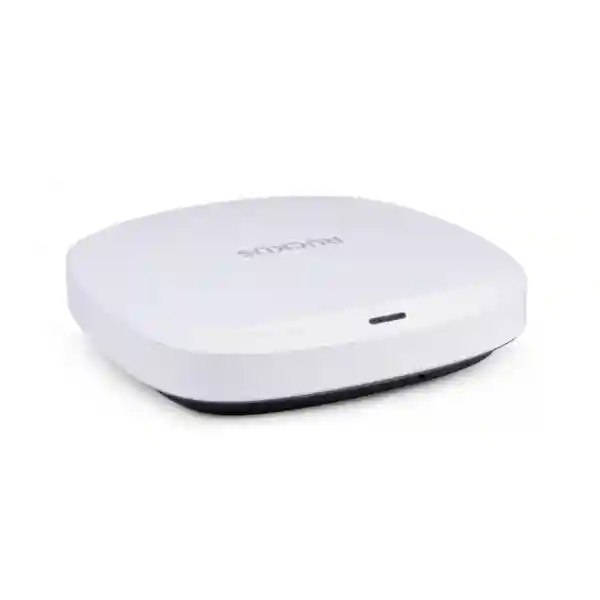
RUCKUS R670 Indoor Access Point
The RUCKUS R670 is a mid-range indoor Wi-Fi 7 access point for organizations that want higher wireless capacity, low-latency connectivity and a practical path to 6 GHz without moving immediately to the largest enterprise AP class. RUCKUS specifies six spatial streams in tri-band mode, a combined maximum PHY rate of 9.34 Gbps, a 1/2.5/5GbE PoE interface, an additional 1GbE port, BeamFlex adaptive antennas, SmartMesh, integrated BLE or Zigbee and multiple controller choices. FourTeck helps procurement and IT teams turn those capabilities into a complete deployment plan covering switching, PoE, cabling, radio design, management, security, regional ordering and implementation scope.
Direct answer: what is the RUCKUS R670?
The RUCKUS R670 is an indoor enterprise wireless access point built around Wi-Fi 7 technology. In its tri-band operating mode it provides 2×2:2 radio operation on 2.4 GHz, 5 GHz and 6 GHz for six spatial streams in total. RUCKUS also documents a software-configurable dual-band mode using 2×2 on 2.4 GHz and 4×4 on 5 GHz. Features associated with the platform include Multi-Link Operation, preamble puncturing, 4K QAM and channel widths up to 320 MHz, subject to client capability, software support and the radio rules of the country where the AP is deployed. The published combined maximum PHY rate is 9.34 Gbps; that is a radio-link specification rather than a promise of real application throughput to one client.
The R670 is intended for professional indoor deployments such as offices, meeting rooms, classrooms, guest rooms, hotel public areas, retail spaces and other locations where many connected devices compete for airtime. Its 5GbE-capable primary Ethernet interface helps prevent a basic 1GbE uplink from becoming the obvious wired bottleneck when multiple radios are active. Buyers should still confirm the complete path: cable category, switch port speed, PoE capability, VLAN design, controller platform, firewall policy, internet capacity and the client mix. A wireless upgrade performs best when the rest of the LAN is planned around it.
Verified RUCKUS R670 specification highlights
| Product type | Indoor enterprise access point |
| Wireless generation | Wi-Fi 7 / IEEE 802.11be, with legacy Wi-Fi standards supported as documented by RUCKUS |
| Bands | 2.4 GHz, 5 GHz and 6 GHz; actual 6 GHz operation depends on local authorization and the configured regulatory domain |
| Spatial streams | Six streams in tri-band mode: 2×2:2 on each of 2.4, 5 and 6 GHz; software-configurable 2.4 GHz 2×2 plus 5 GHz 4×4 dual-band mode |
| Combined maximum PHY rate | 9.34 Gbps vendor-listed combined figure |
| Ethernet | One 100M/1/2.5/5GbE PoE port plus one 10M/100M/1GbE port |
| Power options | PoE support documented across 802.3af/at/bt, plus 48 V DC input; full-feature power planning should be checked against the intended PoE source and configuration |
| Management | RUCKUS One, RUCKUS SmartZone and RUCKUS Unleashed |
| Wireless optimization | BeamFlex+, ChannelFly, SmartMesh, adaptive client and airtime management features |
| Security features | WPA3, WPA3-SAE, OWE, PMF, Dynamic PSK/DPSK3, WIPS/WIDS, TPM 2.0 and Secure Boot among documented capabilities |
| IoT | Integrated selectable BLE or Zigbee radio, with USB 2.0 expansion |
| Client and SSID capacity | Up to 768 clients per AP and up to 36 SSIDs in vendor documentation; practical design should be based on traffic, airtime and user experience, not the maximum association count alone |
| Dimensions and weight | Approximately 22 × 22 × 4.9 cm and 1.02 kg |
| Operating environment | 0°C to 50°C operating temperature and up to 95% non-condensing humidity |
Specification note: radio behavior, supported channels, power profile, software features and 6 GHz availability depend on regulatory domain, firmware, controller platform and local rules. Confirm the destination-country part number and current RUCKUS documentation before ordering.
Multi-gig switching matters
A 5GbE-capable AP should be paired with a switch port and cabling path that can support the desired wired rate. A Gigabit-only switch can still provide connectivity but may constrain aggregate traffic before the radio becomes the limit.
PoE should be engineered
Check the switch PoE standard, available per-port power and total chassis budget. RUCKUS documents different consumption and feature behavior depending on the power source, so do not treat every PoE port as equivalent.
6 GHz is country dependent
The presence of a 6 GHz radio does not mean every channel is usable everywhere. The AP must operate under the correct country regulatory domain, and 6 GHz can remain disabled where local authorization is unavailable.
Who should consider the RUCKUS R670?
The R670 is relevant to organizations refreshing from older Wi-Fi generations, adding higher-capacity meeting or learning spaces, increasing support for modern laptops and mobile devices, or standardizing business WLAN operations across several indoor areas. It is particularly useful when the project needs enterprise policy, secure guest access, roaming, VLAN integration and managed firmware rather than a collection of standalone consumer routers. Hospitality properties can use it for guest rooms, lounges and common areas; education sites can use it for classrooms and learning spaces; offices can place it across open-plan floors and collaboration rooms; and retail or public-facing sites can use it where staff devices and visitor traffic need predictable separation.
The AP is not a substitute for a full wireless design. An accurate bill of materials begins with floor plans, wall materials, ceiling height, expected client count, application mix, internet bandwidth, existing switching, cable category, PoE budget and management preference. For busy or high-value sites, a predictive survey followed by onsite validation is preferable to choosing AP quantity from square-meter estimates alone. Dense environments often need more cells at lower power rather than one AP pushed to maximum coverage.
Wireless, firewall and LAN planning around the R670
The R670 belongs inside a wider network architecture. SSIDs should map to deliberate VLAN and security policies, not simply share one flat LAN. Staff, guests, voice, IoT, payment, building systems and management devices can have different trust levels, authentication requirements and internet permissions. The firewall, switching and WLAN configuration therefore need to agree on VLAN tagging, DHCP, DNS, routing, authentication, captive-portal behavior and access control. FourTeck’s perimeter firewall planning guidance explains why Wi-Fi segmentation should be treated as part of the security design rather than an isolated wireless setting.
For buyers planning a faster wired edge, the Sophos XGS 88 product page is useful context because it discusses 2.5 GE branch interfaces and the need to size the security gateway alongside faster switches and access points. Where a branch firewall must directly power selected edge devices, the Palo Alto Networks PA-415 page covers integrated PoE planning; however, the R670’s multi-gigabit and power requirements still need to be matched to the exact switch or injector rather than assumed from a firewall PoE port.
Sites using separate access switching can review the FourTeck firewall product catalogue, the network security services overview, and the firewall deployment planning page to coordinate guest isolation, VLANs, VPN, internet access and policy changes around the WLAN. The PA-410 deployment notes also illustrate an important procurement point: a security appliance without integrated Wi-Fi or PoE normally requires separate wireless and switching infrastructure, which keeps WLAN capacity and power design independent. Larger estates can also review the PA-Series portfolio guidance for segmentation and multi-site security design.
RUCKUS R670 Indoor Access Point Dubai
Customers searching for a RUCKUS R670 Indoor Access Point Dubai solution are usually not looking for a consumer Wi-Fi upgrade. The common requirement is a managed business WLAN for offices, hotel floors, classrooms, showrooms, meeting areas, clinics, co-working environments or other indoor sites where multiple users depend on cloud applications, video calls, voice, SaaS and mobile devices throughout the working day. The R670 fits that discussion because it combines Wi-Fi 7 radios with a 5GbE-capable wired interface, BeamFlex adaptive antenna technology and enterprise management choices. For a Dubai project, the first design question should be the physical site: floor layout, wall and glass construction, ceiling type, user density, neighboring networks and the location of cable routes and telecom rooms.
A buyer asking for RUCKUS R670 price in Dubai should request a complete bill of materials rather than a bare AP price. The quotation may need the correct regional AP part, appropriate PoE source, mounting accessories, controller or cloud subscription where applicable, support entitlement, structured cabling work, switch ports and implementation. RUCKUS documents the AP with an adjustable acoustic-drop-ceiling bracket and states that the external power adapter is not included with the standard access-point ordering description, so power method should be settled before purchase. If the site is upgrading from Gigabit switching, confirm whether existing ports can negotiate at 2.5 or 5 GbE and whether the installed copper cabling is suitable for the required distance and rate.
Dubai deployments also need careful RF planning in modern glass-and-concrete interiors. A powerful AP does not remove the effects of walls, metal, lift cores, partitions, neighboring tenants or dense clusters of users. Meeting rooms may require different cell planning from corridors or reception spaces. Hotels need predictable roaming and guest isolation. Retail environments may combine staff handhelds, POS, guest traffic and operational devices. FourTeck’s UAE technology site at FourTeck UAE can be used alongside the Firewall Dubai network planning resources when the requirement spans wireless, switching and security.
For procurement, share the Dubai site address, number of floors, approximate floor area, expected user and device count, switch model, available PoE budget, current WLAN platform, internet bandwidth and management preference. Also identify whether the project requires 6 GHz operation, because local regulatory authorization and the correct country domain determine whether that radio can be enabled. This information lets the quotation focus on deployment fit instead of only the access-point model name.
RUCKUS R670 Indoor Access Point UAE
A RUCKUS R670 Indoor Access Point UAE project can range from one office floor to a multi-site wireless refresh across branches, schools, hospitality properties, clinics, warehouses and customer-facing environments. The R670 is best assessed as part of the wired and wireless architecture, not as a standalone ceiling device. Its 9.34 Gbps combined maximum PHY rate and 5GbE-capable Ethernet port create an opportunity to use newer multi-gigabit switching, but those figures do not guarantee end-user throughput. Real performance depends on client radio capability, channel width, interference, airtime contention, RF power, switching, firewall processing and the upstream internet or application path.
UAE buyers should pay particular attention to regulatory-domain selection. The R670 hardware supports 2.4, 5 and 6 GHz operation, but RUCKUS states that 6 GHz is enabled only where authorized under local rules and the configured country domain. Procurement should therefore avoid importing an arbitrary regional code based only on online price. Confirm the destination-country ordering information, software support and allowed radio operation before the equipment is dispatched. The same discipline applies to power accessories: region-specific power supplies and PoE injectors can have different order suffixes, and the chosen switch should provide the required PoE mode with enough total budget for all APs.
For multi-emirate deployments, standardization can reduce support effort. Agree SSID names, authentication, VLAN IDs, guest policies, firmware process, controller hierarchy, monitoring, admin roles and naming conventions before the first site is installed. RUCKUS One can provide a cloud-oriented management path, while SmartZone and Unleashed cover other deployment models. The right choice depends on scale, operational preference, existing RUCKUS estate and licensing. Sites with a mature network team may favor centralized templates and role-based administration; smaller environments may prioritize simplicity and fast local deployment.
A useful UAE quotation request should include quantity by location, floor plans where available, planned switch and cable types, power constraints, expected client density, critical applications, guest-access requirements and the desired management platform. FourTeck can then coordinate the AP requirement with firewall segmentation, multi-gig access switching and regional supply planning. Avoid basing the project solely on a maximum client figure: an AP may technically allow many associations while user experience becomes constrained much earlier by traffic demand and airtime.
RUCKUS R670 Indoor Access Point Uganda
Organizations searching for a RUCKUS R670 Indoor Access Point Uganda solution may be planning business Wi-Fi for corporate offices, education, hospitality, healthcare, development organizations, professional services or multi-site operations. In these environments, reliable WLAN design depends on more than the headline Wi-Fi generation. The R670 supports modern 2.4, 5 and 6 GHz radio operation, but the deployment should begin with the client mix and the physical environment. Older devices may continue to rely on 2.4 or 5 GHz, while newer laptops and phones can benefit from Wi-Fi 6/7 capabilities. The WLAN should therefore balance compatibility, capacity and coverage instead of moving every service to the newest band by default.
Uganda procurement teams should confirm the destination regulatory code and whether 6 GHz operation is permitted for the intended use. RUCKUS explicitly ties 6 GHz enablement to country authorization, so the AP should be ordered and configured for the correct market. Power and switching are equally important. Where a site uses standard Gigabit access switches, the AP can connect, but the network may not exploit the full multi-gigabit uplink capability. A refresh project should review 2.5/5GbE switching, uplink capacity, cable quality and PoE budget together. For locations with power variability, UPS design for the switching stack can be more important to wireless availability than the AP specification itself.
FourTeck Uganda resources at FourTeck Uganda can support regional procurement discussions. A useful request should identify the city, floor area, number of rooms or buildings, expected clients, existing switches, internet links, required guest access, authentication method and whether the WLAN will be centrally managed. Education sites may need separate staff, student and guest networks. Hotels may need room-by-room coverage and roaming. Offices may prioritize voice and video quality, while clinics may need stricter segmentation between staff, visitors and connected equipment.
The R670’s BeamFlex adaptive antennas and channel-management features are designed to help in changing RF conditions, but they do not replace a survey. Thick walls, reinforced construction, long corridors and equipment rooms can affect coverage significantly. For a new building, plan AP locations before ceilings close so data cabling and mounting positions are available where RF design requires them. For an existing site, capture current complaints and dead zones, then validate placement after installation. That approach produces a more supportable Uganda deployment than estimating one AP per arbitrary floor area.
RUCKUS R670 Indoor Access Point Kampala
A RUCKUS R670 Indoor Access Point Kampala deployment is often driven by concentrated indoor demand: business offices, hotels, training centers, universities, conference spaces, clinics, retail premises and shared work areas where many users connect in a relatively small footprint. In that setting, density and interference deserve as much attention as raw coverage. A single high-capability access point placed centrally may produce a strong signal while still creating an airtime bottleneck in busy rooms. Good design divides the space into sensible RF cells, uses appropriate channel widths and transmit power, and places APs close to the areas where users actually spend time.
The R670 is attractive for Kampala sites that want to prepare for newer Wi-Fi 7 clients while continuing to support established devices. Its tri-band design can use 2.4, 5 and 6 GHz where allowed. The 6 GHz band is especially relevant for compatible clients in environments where additional spectrum can help reduce contention, but procurement must first confirm local regulatory support and the correct RUCKUS regional code. Do not treat 6 GHz as guaranteed merely because the AP contains the radio. The controller and firmware must also be kept aligned with the intended configuration.
For Kampala offices using cloud applications, Teams or Zoom meetings, VoIP, CRM and ERP systems, the wired path should be sized along with the WLAN. The primary R670 Ethernet port can negotiate up to 5GbE, so check whether the access switch provides suitable multi-gigabit copper and enough PoE. If the switch is only 1GbE, the AP can still serve clients but the uplink may limit aggregate traffic. Structured cabling condition should be tested rather than assumed, particularly when reusing older copper runs. UPS-backed switching also helps maintain wireless service through brief power disturbances.
When requesting a Kampala quotation, list the building type, floor count, ceiling construction, number of staff and guests, busy-room locations, switch model, available PoE ports and the current wireless pain points. If the site is already using RUCKUS management, state whether it is RUCKUS One, SmartZone or Unleashed and provide the software version. If it is a new estate, define who will administer the WLAN and how many sites may be added later. That operational information can be more important to long-term success than choosing the AP in isolation.
RUCKUS R670 Indoor Access Point Arua
A RUCKUS R670 Indoor Access Point Arua requirement may involve a branch office, hotel, education facility, healthcare environment, NGO office or professional workspace that needs stable indoor wireless connectivity with room for growth. For these sites, the buying decision should begin with resilience and supportability. The R670 offers modern radio capacity, but the surrounding infrastructure must be able to keep it online: PoE switching, UPS protection, suitable cabling, a clear internet design and remote management where local IT resources are limited. A well-planned smaller deployment can be more valuable than installing an advanced AP onto an unmanaged or unstable LAN.
Because the R670 supports a 5GbE primary interface, Arua buyers should decide whether multi-gigabit access switching is necessary for the applications at the site. A branch with light web and email traffic may not need every AP uplink running at the maximum rate, while a training facility or hotel handling many simultaneous streams may benefit from more headroom. The switch selection should therefore consider actual traffic, number of APs, PoE budget, uplink capacity and future expansion. If an injector is used instead of a PoE switch, confirm the correct regional accessory and ensure the data path still meets the required Ethernet speed.
Wireless coverage in a low-rise compound, multi-room office or hotel wing can be affected by masonry walls, roof structures and long distances between usable cable points. BeamFlex adaptive antennas can improve link selection, but placement remains critical. Avoid installing the AP inside metal cabinets, above dense mechanical plant or at one end of a long building simply because a cable already exists there. Where the project budget allows, use a predictive plan and verify with onsite measurements after deployment. Roaming-sensitive applications should be tested while walking the actual user paths.
For procurement, Arua customers should provide destination details, exact quantity, floor plan or building sketch, switch and firewall models, expected staff and guest devices, power constraints, required SSIDs and support expectations. If centralized administration from Kampala or another city is planned, define remote-access and monitoring requirements at the same time. The correct RUCKUS regional code and local 6 GHz authorization also need confirmation before shipment, ensuring the installed radios operate under the proper country domain rather than relying on a generic imported part.
RUCKUS R670 Indoor Access Point Mbarara
Businesses evaluating a RUCKUS R670 Indoor Access Point Mbarara solution may be upgrading wireless coverage for hotels, education sites, healthcare facilities, offices, retail operations or growing branch networks. In these environments, the practical value of Wi-Fi 7 is not just a higher headline rate. It is the ability to serve a changing client population while improving spectrum use, latency behavior and capacity when the network, software and endpoint devices support the relevant features. The R670 also retains support for earlier Wi-Fi generations, making it suitable for phased upgrades where older laptops, handhelds or IoT devices will remain in service.
Mbarara projects should review how the WLAN connects to business applications. If an office depends on cloud accounting, online collaboration, VoIP and remote systems, the AP needs a stable upstream path. If a hotel serves guest streaming and staff operations, guest traffic should be separated from internal management systems. If a campus supports students and administrators, authentication and bandwidth policies may need to differ by role. RUCKUS supports VLANs, guest access and policy tools, but the network team must map them to the firewall and switching design. A flat wireless network can negate much of the control expected from enterprise equipment.
Power is another procurement detail. RUCKUS documents higher feature availability when the AP receives an appropriate higher-power source, while lower PoE modes can operate with different power limits. Before ordering, confirm the switch standard, per-port budget and total chassis budget for all APs. For sites using UPS systems, calculate the wireless load as part of the switching runtime. A multi-gigabit switch with insufficient PoE reserve can create deployment problems even when its Ethernet specification looks suitable on paper.
A useful Mbarara quote request should include the planned AP count, floor layout, wall construction, busy-room locations, internet speed, existing cable category, switch make and model, firewall/VLAN design and management preference. Buyers should also state whether they need supply only or support with configuration, installation, testing and documentation. Confirm the Uganda regulatory domain for the exact R670 part and verify whether 6 GHz operation is supported for the intended deployment at the time of installation. This avoids designing capacity around channels that may not be available locally.
RUCKUS R670 Indoor Access Point Gulu
A RUCKUS R670 Indoor Access Point Gulu deployment can suit offices, hospitality properties, learning facilities, clinics, NGO environments and other indoor sites where users need consistent wireless access across rooms and common areas. Buyers should look beyond the access-point count and define the service experience they want: reliable video calls in meeting rooms, controlled guest access, smooth roaming between work areas, stable connectivity for cloud software and enough capacity at the busiest times of day. Those goals determine placement, channel planning and uplink requirements more accurately than a simple coverage-radius estimate.
The R670’s BeamFlex adaptive antenna system is intended to optimize the RF path for connected devices, while ChannelFly and client-management functions can help the WLAN respond to congestion. These tools are valuable in environments where neighboring networks and changing device populations affect airtime. They still work best when the initial design is sound. In a Gulu hotel or office with thick internal walls, several carefully placed APs at moderate transmit power can produce better roaming and capacity than a small number of APs transmitting at high power from corridors or equipment rooms.
The wired side requires the same discipline. The R670 has one multi-gigabit PoE interface up to 5GbE and a secondary 1GbE port. Confirm whether the access switch provides the intended Ethernet rate, whether cabling is tested, and whether PoE power is sufficient. Where remote support is important, use manageable switches and a controller design that allows administrators to review AP health, firmware and client experience without traveling to the site for routine changes. RUCKUS One, SmartZone and Unleashed provide different operational models, so select the platform that matches the number of sites and the skills of the support team.
Before ordering for Gulu, provide the exact delivery destination, AP quantity, floor plan, switch model, firewall model, available PoE standard, user estimate and current Wi-Fi problems. Also confirm the required security method, guest network design, controller preference and whether installation services are needed. Regional radio compliance should be part of the purchase decision: the 6 GHz band is subject to country authorization, so the design must use the correct Uganda regulatory domain and not assume every Wi-Fi 7 channel will be available.
RUCKUS R670 Indoor Access Point Kenya
A RUCKUS R670 Indoor Access Point Kenya project is relevant to enterprises, hospitality groups, schools, universities, healthcare facilities, retailers and service organizations that want a managed Wi-Fi 7 platform for indoor use. Kenya deployments can range from dense Nairobi offices to branch sites in other cities, so the same AP model may need very different RF and switching designs. The R670 should be selected after understanding client density, room layout, building materials and application demand. A video-heavy office with many modern laptops has a different airtime profile from a warehouse with handheld scanners or a hotel where many guest devices connect intermittently.
The AP’s multi-gigabit Ethernet interface can negotiate up to 5GbE, making access-switch choice an important part of the project. If the estate is being refreshed, consider switches with sufficient 2.5/5GbE port density, PoE budget and uplink capacity rather than connecting high-capability APs to oversubscribed Gigabit access layers. Cabling should be tested, especially when reusing older copper runs. For larger buildings, also check aggregation and firewall throughput so the wireless upgrade does not simply move congestion upstream.
Kenya buyers can use FourTeck Kenya for regional technology inquiries and procurement coordination. When asking for a RUCKUS R670 price or supplier quotation, include the site city, quantity, management platform, expected PoE method, switch model, current WLAN and whether licenses or support are required. If the project spans multiple branches, provide an approximate rollout schedule and identify which configuration elements should be standardized across all sites.
The regulatory domain deserves explicit confirmation. RUCKUS states that 6 GHz is enabled according to local authorization, and the hardware operates under the configured country rules. A Kenya wireless design should therefore confirm current 6 GHz availability before relying on it for capacity. Even when 6 GHz is available, 2.4 and 5 GHz remain important for compatibility and coverage. A balanced design can steer capable clients to cleaner spectrum while maintaining service for established devices. The quotation should distinguish hardware supply from survey, installation, configuration, testing, controller onboarding and ongoing support so the buyer understands the complete project scope.
RUCKUS R670 Indoor Access Point Kuwait
Customers searching for a RUCKUS R670 Indoor Access Point Kuwait solution often need dependable Wi-Fi for offices, clinics, retail outlets, hospitality, education or professional spaces where indoor wireless carries most day-to-day applications. The R670 offers a modern Wi-Fi 7 platform with tri-band operation, multi-gigabit wired backhaul and enterprise management choices. The design process should still start with the site rather than the specification sheet. Dense meeting areas, partitioned office floors, reception spaces and mixed staff/guest environments all require different AP placement and capacity assumptions.
For Kuwait procurement, confirm the correct regional part and power accessories. The RUCKUS ordering information uses country or regional suffixes, while optional PoE injectors and DC power supplies also have regional variants. A reseller quotation should therefore identify the exact part numbers being offered, the power method and any controller or support entitlement. If a 5GbE uplink is expected, verify the switch port speed and PoE class together. A switch may provide multi-gigabit Ethernet but insufficient power, or enough PoE but only Gigabit data, so both capabilities should be reviewed.
FourTeck’s regional route at FourTeck Kuwait includes business wireless content that can help buyers compare access-point and deployment approaches. For the R670, provide the building type, floor size, current switch, firewall, user count, client types and management preference. Retail sites may need isolated payment and guest networks. Clinics may separate administrative, patient-facing and connected-device traffic. Offices may prioritize voice, roaming and collaboration applications. Hotels may require separate guest, staff and operational SSIDs with consistent policy across floors.
Kuwait buyers should also confirm the current regulatory position for 6 GHz before finalizing a design that depends on that band. RUCKUS documents 6 GHz as country-regulated, so channel availability may differ from another market even with the same base AP model. The safest procurement approach is to confirm regulatory code, firmware/controller compatibility, required quantity, mounting, PoE and support in one bill of materials. This reduces the risk of receiving hardware that powers on but cannot operate exactly as the network design assumed.
RUCKUS R670 Indoor Access Point Ghana
A RUCKUS R670 Indoor Access Point Ghana deployment can support offices, hospitality, schools, healthcare, retail and enterprise sites that need a managed indoor wireless platform with a path to Wi-Fi 7. Procurement teams should distinguish between the AP’s maximum technical capabilities and the performance expected in a real building. The vendor-listed 9.34 Gbps figure combines radio PHY rates; it is not the throughput one laptop will receive. Client capability, channel width, signal quality, interference, airtime load, Ethernet backhaul and internet/application capacity all influence real results. This distinction is important when comparing quotations or explaining project expectations to stakeholders.
For Ghana sites, the network should be designed around business use. A hotel may need coverage in rooms, corridors, lobbies and meeting areas with guest isolation and roaming. A school may need different policies for administration, teaching staff, students and visitors. A clinic may require separation of staff, guest and connected-device networks. An office may prioritize video meetings, cloud applications and voice. The R670 can support multiple SSIDs, VLAN integration and enterprise security functions, but the design should avoid creating unnecessary SSIDs because each WLAN also consumes management airtime.
Switching and power are key purchasing items. The primary Ethernet port supports 1/2.5/5GbE and PoE, while the AP can operate under different PoE profiles. Check the actual access-switch model, PoE standard, per-port power and overall power budget for the planned number of APs. Where sites depend on stable connectivity during short power interruptions, include the PoE switching load in UPS sizing. For large deployments, calculate upstream switching and firewall capacity so many fast APs do not converge on a constrained aggregation link.
Regional inquiries can also use FourTeck Africa for wireless and network infrastructure context. When requesting a Ghana quotation, provide city, site count, AP quantity, floor plans, existing cable and switch details, desired controller, internet links and support scope. Confirm the Ghana regulatory domain and current 6 GHz authorization before relying on that band. This ensures the final configuration is based on channels that the destination country allows rather than specifications from a different market.
RUCKUS R670 Indoor Access Point Nigeria
A RUCKUS R670 Indoor Access Point Nigeria project can be appropriate for corporate offices, hotels, education, healthcare, financial services, professional firms, retail chains and multi-branch organizations that need centrally managed indoor Wi-Fi. The R670 provides a strong feature set for modern client devices, but network planners should first define the required service level. A headquarters with dense collaboration areas and many video sessions needs a different AP density from a branch with mostly web and email traffic. A hotel needs roaming and guest controls. A training center may need short periods of very high concurrency. Designing around use cases produces better results than applying one AP-per-area rule to every site.
Nigeria buyers should treat switching and power as part of the access-point purchase. The 5GbE-capable primary port can exploit multi-gigabit access switching, while the AP’s PoE behavior depends on the available power mode. Confirm whether the proposed switch provides 802.3bt or the intended alternative, and calculate total PoE budget for all connected APs, phones, cameras and other devices. If the deployment uses injectors, specify their Ethernet capability and power rating. A lower-cost injector that only supports Gigabit data can silently constrain a 5GbE access point.
Operational management also matters for geographically distributed organizations. RUCKUS One can support cloud-oriented administration, while SmartZone and Unleashed suit other operating models. The correct choice depends on site count, existing controller investment, administrator roles, reporting expectations and licensing. Multi-branch customers should standardize SSIDs, VLANs, authentication, guest policy, firmware cadence and naming conventions so troubleshooting is consistent. Remote visibility reduces the need for site visits when a problem is caused by client behavior, switch connectivity or configuration rather than failed AP hardware.
For a Nigeria quotation, send the exact destination, quantity by site, current WLAN and switching details, floor plans, required user groups, controller preference and whether the project includes installation or only supply. If the site depends on 6 GHz for future capacity, confirm the current Nigerian regulatory position and the correct RUCKUS country code before ordering. RUCKUS states that 6 GHz operation is controlled by local regulations; planning against an overseas channel set can produce an unrealistic design. For broader regional coordination, FourTeck Africa resources can support network and wireless project discussions without assuming local stock or delivery until formally quoted.
RUCKUS R670 Indoor Access Point Seychelles
A RUCKUS R670 Indoor Access Point Seychelles deployment can be especially relevant to hotels, resorts, offices, education facilities and service organizations that depend heavily on guest and staff wireless connectivity. Hospitality requirements often extend beyond basic coverage: roaming should be smooth between common areas, staff systems should remain separated from guest access, and busy periods should not cause avoidable congestion in lobbies, restaurants or conference areas. The R670’s Wi-Fi 7 radios, BeamFlex adaptive antennas and multi-gigabit uplink make it a candidate for these indoor environments, but the final AP count and placement must follow the property layout rather than a generic range figure.
For resort or multi-building projects, consider how the indoor WLAN connects back to switching rooms and the internet edge. The R670 can use up to 5GbE on its primary Ethernet interface, but long copper runs, limited riser capacity or older access switches may constrain the design. Where APs are spread across floors or buildings, plan distribution switches, fibre uplinks where appropriate, PoE budgets, UPS protection and monitoring. In guest environments, an internet circuit can also become the true bottleneck long before the radio reaches its technical capacity, so WAN bandwidth and fair-use policies should be sized alongside wireless density.
Seychelles procurement should confirm the correct RUCKUS regional code, supported software and local 6 GHz rules before purchase. The manufacturer states that 6 GHz operation depends on country authorization and the configured regulatory domain. This is particularly important when equipment may be sourced through international distribution, because an inexpensive part intended for another region can create compliance or functionality problems. The same care applies to power accessories: confirm the PoE switch standard or the correct power supply/injector variant for the destination.
When requesting a quotation, provide property type, island/location, room or floor count, approximate user density, existing AP and switch brands, internet links, guest portal requirements, staff VLANs, controller preference and any implementation schedule constraints. For hospitality, identify peak guest areas separately from bedrooms because they often need different capacity planning. For offices, specify video, voice and cloud workloads. A complete design should include post-installation validation so channel use, roaming and coverage can be adjusted after the real environment is measured.
RUCKUS R670 Indoor Access Point — deployment and configuration checklist
Before ordering
Confirm destination country, exact part number, AP quantity, management platform, required subscriptions or support, mounting method, PoE source, switch port speed, cabling, expected client count, critical applications, guest-network requirement and local 6 GHz authorization.
Before installation
Prepare floor plans, AP locations, cable test results, VLANs, DHCP scopes, DNS, authentication, firewall rules, controller onboarding, firmware plan, switch port configuration, PoE budget and rollback steps. Confirm ceiling or wall mounting and access requirements.
After installation
Validate coverage, roaming, channel use, client steering, authentication, guest isolation, application performance, switch negotiation rate, PoE status and controller health. Record AP names, locations, serials, cable ports, switch ports and final configuration for support.
Frequently asked questions about the RUCKUS R670
Regional FourTeck resources for wireless and network projects
FourTeck operates several regional and specialist websites that can help buyers research complementary networking, wireless and security requirements. For UAE wireless alternatives and local project context, review FourTeck UAE. East African requirements can use FourTeck Uganda and FourTeck Kenya. Gulf buyers can review FourTeck Kuwait, while multi-country African projects can use FourTeck Africa. These links are intended as supporting resources; exact R670 availability, lead time, regulatory part number, support entitlement and service coverage should be confirmed in the formal quotation for the requested destination.
Decision recap: is the RUCKUS R670 the right AP for your project?
Good reasons to shortlist it
You want a business-grade indoor Wi-Fi 7 platform, require 2.4/5/6 GHz capability where permitted, need a multi-gigabit wired path, value RUCKUS BeamFlex and SmartMesh, plan enterprise guest and VLAN policies, or already use RUCKUS management and want to expand the estate.
Items to verify before buying
Confirm the exact regional part number, 6 GHz authorization, controller compatibility, PoE standard, switch port speed, cable readiness, AP quantity, mounting, support entitlement, accessory needs and whether the network’s firewall and uplinks can support the intended traffic.
Quotation checklist
For the most useful RUCKUS R670 quotation, prepare the details below. This reduces follow-up and helps avoid missing infrastructure items after the APs arrive.
Plan the RUCKUS R670 as a complete wireless solution
The strongest R670 deployment is not simply the one with the most APs. It is the one that matches RF design, client demand, multi-gig switching, PoE, cabling, controller operations and firewall segmentation to the business requirement. Share your destination, floor plan, user count, existing network and management preference with FourTeck so the commercial quote can identify the correct regional hardware, power method, accessories and implementation scope. Availability, pricing, delivery and service coverage should be confirmed for the exact project rather than assumed from general product information.

Reviews
There are no reviews yet.