
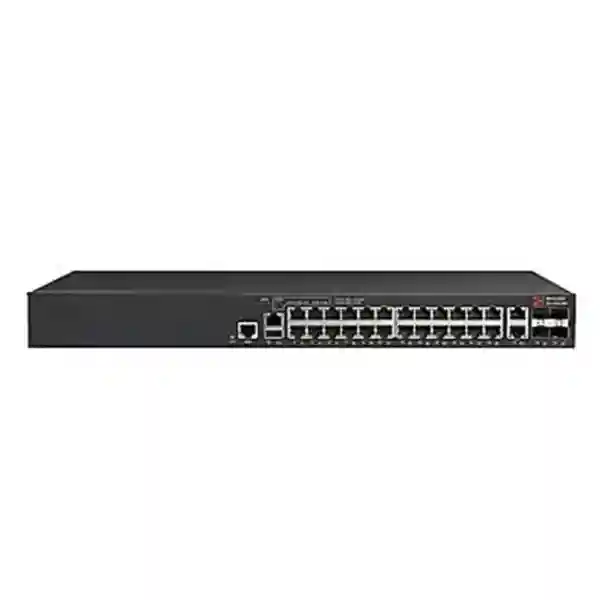
RUCKUS ICX 7150-24P PoE Switch
The RUCKUS ICX 7150-24P is a 24-port Gigabit Ethernet PoE+ access switch created for enterprise edge networks that need powered endpoints, managed switching and flexible uplinks. Its verified hardware profile includes 24 10/100/1000 Mbps PoE+ access ports, two additional Gigabit RJ45 uplink ports, four 1/10 GbE-capable SFP/SFP+ uplink or stacking ports, a maximum 370 W PoE budget, up to 132 Gb/s switching capacity, and support for stacking up to 12 switches. RUCKUS now identifies the model as discontinued, which changes the buying conversation: organizations should verify condition, entitlement, support expectations and available alternatives before approving a purchase.
Designed to connect and power compatible phones, access points, cameras and other edge devices over Ethernet.
The project should total endpoint power demand with headroom rather than assuming every powered port can draw its maximum simultaneously.
The family supports 1 GbE and licensed 10 GbE uplink or stacking operation, subject to exact part number and entitlement.
RUCKUS lists the model as discontinued and identifies the ICX 8200 family as the current replacement path for buyers evaluating new deployments.
Important lifecycle note before you request a quote
RUCKUS announced end-of-sale for the ICX 7150-24P platform before later marking the product discontinued. That means a buyer searching for “RUCKUS ICX 7150-24P price”, “ICX7150-24P supplier”, “ICX 7150 24 port PoE switch” or a replacement unit should not assume that ordinary new-channel stock, licensing or long-term support are still available. FourTeck can use the exact requirement to frame a sourcing discussion, but the quotation should state the offered condition, hardware part number, software or license position, included accessories, warranty terms and support scope. For a new rollout, ask whether the RUCKUS ICX 8200 family or another current switch is the more sustainable choice.
What the RUCKUS ICX 7150-24P was designed to do
The ICX 7150-24P sits at the access layer of a wired network. In practical terms, it is the switch that can connect desktop computers, IP phones, Wi-Fi access points, network cameras, printers, access-control equipment and other Ethernet devices back to a distribution or core network. The 24 PoE+ ports are especially useful where power and data should travel through one structured-cabling run, reducing the need for individual power adapters at each endpoint. The 370 W maximum PoE budget is substantial for a 24-port access design, but the correct project calculation depends on the real wattage profile of every connected device.
The uplink architecture is another reason this model remains visible in upgrade and replacement searches. RUCKUS specifies two Gigabit RJ45 uplink ports plus four SFP/SFP+ ports that can be used for uplink or stacking. The family supports software licensing that can move qualifying uplink ports from 1 GbE to 10 GbE, so procurement teams should identify the exact license entitlement rather than treating all used, legacy or secondary-market units as equivalent. A device advertised under the same model family may arrive with a different uplink license, software version or accessory bundle.
RUCKUS also published enterprise features for the platform, including stacking, sFlow, Layer 3 functions such as static routing, RIP and OSPF, OpenFlow hybrid-port mode, Campus Fabric technology and Energy Efficient Ethernet. Maximum published switching capacity for the ICX 7150-24P is 132 Gb/s, while the platform can form a stack of up to 12 switches with aggregate stack bandwidth listed at up to 480 Gb/s. These capabilities make the model relevant to installed-base environments, but lifecycle status is now as important as raw specification. A technically suitable legacy switch can still be a poor procurement choice if future support, licenses or spares do not match the organization’s operating plan.
Verified specification snapshot
| Product type | Managed Ethernet access switch |
|---|---|
| Access ports | 24 × 10/100/1000 Mbps RJ45 PoE+ ports |
| Copper uplinks | 2 × 10/100/1000 Mbps RJ45 uplink ports |
| Fiber / stacking ports | 4 × 1/10 GbE SFP/SFP+ uplink or stacking ports, subject to license entitlement |
| Maximum PoE budget | 370 W |
| Maximum switching capacity | 132 Gb/s |
| Maximum stack size | 12 switches |
| Aggregate stack bandwidth | Up to 480 Gb/s |
| Selected network capabilities | PoE/PoE+, stacking, sFlow, static routing, RIP, OSPF, OpenFlow hybrid mode, Campus Fabric technology and Energy Efficient Ethernet |
| Power redundancy | No redundant internal power option and no hot-swappable internal power supplies or fans are listed for this model |
A sensible fit when
- You are replacing a failed unit in an existing ICX 7150 environment and operational consistency matters.
- Your configuration, cabling and endpoint design are already built around 1 GbE access with PoE+.
- You can confirm the exact hardware condition, software version, license entitlement and support plan before purchase.
- You have evaluated the lifecycle risk and intentionally prefer continuity over migrating to a current-generation platform.
Reconsider the model when
- You are building a new network with a long planned service life and want an actively current platform.
- You need stronger redundancy, newer uplink options or a support lifecycle that extends further into the future.
- You cannot verify license entitlement for 10 GbE uplinks or the software state of the offered hardware.
- You would prefer a current RUCKUS replacement path such as the ICX 8200 family rather than a discontinued access switch.
Planning PoE, uplinks and stack design
A 370 W PoE budget should be treated as a shared power pool. Start with the endpoint schedule: count access points, phones, cameras, door controllers, paging devices and any other powered equipment, then record the expected draw of each model. Add realistic growth margin and consider what happens during endpoint boot-up or feature changes. A project with twenty-four low-power phones has a very different power profile from one with high-performance wireless access points and pan-tilt-zoom cameras. Port count alone is therefore not enough to size the switch.
For uplinks, identify the traffic concentration behind the switch. A small voice-and-data branch may be comfortable with Gigabit uplink capacity, while a floor carrying many wireless users, CCTV streams, local storage traffic or application servers may need 10 GbE. Because the ICX 7150 family used software licensing for higher-speed uplink capability, the quotation should specify whether the offered unit and license actually support the intended speed. The same discipline applies to optics: confirm fiber type, link distance, connector type, optic compatibility and the equipment at the far end before ordering transceivers.
Stacking can simplify management where several access switches serve the same site, but it should not be adopted merely because the feature exists. Document stack topology, stack cabling, uplink redundancy, software compatibility and the failure domain. If an organization is expanding a live stack, confirm that the incoming legacy unit can run the required code and participate in the existing configuration. For new sites, compare the operational value of extending an ICX 7150 design against moving to the current replacement platform.
RUCKUS ICX 7150-24P PoE Switch Dubai
Dubai buyers searching for the RUCKUS ICX 7150-24P PoE switch are often dealing with one of two very different projects: replacing equipment in an established network or comparing an older specification against a current switch for a new office, hotel, school, clinic, retail site or technology room. Those projects should not be quoted the same way. For an installed-base replacement, the key questions are configuration continuity, software compatibility, uplink license entitlement, PoE load, optics and the condition of the proposed unit. For a new network, lifecycle support and upgrade flexibility deserve equal weight with port count and price because RUCKUS now lists the ICX 7150-24P as discontinued.
The model can still match many practical Dubai edge-network designs on paper. Its 24 Gigabit PoE+ access ports can support compatible IP phones, access points, cameras and other powered endpoints, while the 370 W shared PoE budget gives planners useful capacity for mixed device groups. The two Gigabit copper uplinks and four SFP/SFP+ ports provide options for connecting the access layer toward a distribution switch or for stacking compatible ICX 7150 units. However, a buyer should confirm whether the specific unit is licensed for the required 1 GbE or 10 GbE SFP+ operation. In a busy office or hospitality deployment, an uplink bottleneck can matter more to user experience than the nominal speed of the access ports.
Dubai projects also benefit from documenting the non-switch items before purchase: rack depth and ventilation, UPS runtime, structured-cabling readiness, fiber path, SFP/SFP+ type, VLAN plan, voice requirements, wireless design and any CCTV traffic. The ICX 7150-24P does not provide an internal redundant power-supply option, so resilience has to be considered at the network and power-design level rather than assumed from the chassis. If the switch is being added to a live stack, software and stacking compatibility should be verified before installation day.
For procurement, request a quote that explicitly states hardware condition, included accessories, software or license entitlement, warranty terms, support scope and delivery assumptions. Avoid approving a generic “ICX7150-24P” line item without those details. Organizations that are not tied to the legacy model should ask FourTeck to compare the requirement with a current replacement platform. UAE customers can also review FourTeck UAE infrastructure and networking solutions when the switching requirement is part of a wider firewall, Wi-Fi, IP telephony, cabling or surveillance project.
RUCKUS ICX 7150-24P PoE Switch UAE
Across the UAE, the RUCKUS ICX 7150-24P is most relevant to organizations that already operate ICX 7150 access switching and need a consistent spare, replacement or controlled expansion. A multi-site business with branches in different emirates may value common configuration, familiar management and a standardized set of optics and cabling. At the same time, standardization should not hide lifecycle risk. RUCKUS has moved the ICX 7150-24P into discontinued status, so an organization setting a three-, five- or longer-year network plan should compare the cost of preserving the old platform with the operational benefits of a supported current-generation replacement.
A UAE procurement team should create a technical bill of requirements before seeking “best price”. State whether the need is 24 powered Gigabit endpoints, whether all endpoints require PoE+, the calculated wattage, expected growth, uplink speed, fiber media, routing features, stacking, management method, software version and support expectations. The ICX 7150-24P has a maximum 370 W PoE budget, but that number is not a promise that every connected endpoint can simultaneously draw its maximum PoE+ allowance. For sites combining Wi-Fi, voice and surveillance, calculate the aggregate device power and leave sensible headroom. If cameras record across a WAN or access points serve dense user groups, also model the uplink traffic rather than sizing only by port count.
Compatibility can become the decisive factor in an existing UAE network. If the new unit must join a stack, confirm software alignment and stack configuration. If it connects to an upstream switch over fiber, confirm both ends of the optical link. If RUCKUS SmartZone or another management workflow is involved, validate current software support for the exact installed environment rather than relying on historical feature lists. Legacy hardware can remain technically functional while management or support policies have moved on.
For organizations opening new branches, upgrading Wi-Fi or refreshing an entire access layer, request an options-based quotation: one path for an ICX 7150-24P replacement where continuity is essential, and another path for a current RUCKUS platform where lifecycle and future expansion matter more. That approach helps finance and IT compare like-for-like scope instead of comparing a legacy switch price against a new-platform price without considering licenses, migration work, support and expected service life.
RUCKUS ICX 7150-24P PoE Switch Uganda
Organizations in Uganda searching for the RUCKUS ICX 7150-24P PoE switch may be supporting offices, education facilities, hospitality properties, health facilities, security systems or distributed branch networks that need a managed 24-port PoE access layer. The model’s 24 Gigabit PoE+ ports and 370 W maximum shared PoE budget can align with mixed endpoint environments where phones, wireless access points and cameras use the same structured cabling. The important procurement step is to convert that broad use case into an endpoint and power schedule so the switch is evaluated against real site demand, not only against the number of ports printed on the front panel.
Power planning deserves particular attention in any network closet where service continuity matters. The ICX 7150-24P does not list an internal redundant power-supply option, so the deployment should consider a suitable UPS, stable power distribution, grounding and the desired runtime for both the switch and upstream equipment. If the switch powers access points or phones, a switch power interruption also removes power from those endpoints. A procurement specification should therefore state the operational priority of each connected device and whether backup power is required for the complete communications chain, including routers, firewalls, controllers and any upstream fiber equipment.
For fiber-connected Ugandan sites, specify optic type, distance and the equipment on the far end of each link. The ICX 7150-24P provides four SFP/SFP+ uplink or stacking ports, with the family supporting software-licensed 10 GbE capability, so a seller should confirm the exact entitlement of the offered unit. If the requirement is only to replace a failed switch in an existing stack, software version and stack compatibility may be more important than a feature comparison. If the project is new, however, the discontinued status should trigger a comparison with the current ICX 8200 family or another supported platform.
FourTeck’s regional site for Uganda IT and networking solutions can be used as a broader project path when the switch sits inside a larger requirement for VoIP, Wi-Fi, network security, CCTV or infrastructure planning. When requesting pricing, include location, quantity, whether the unit must be new or another condition is acceptable, required uplink speed, PoE endpoint list, support expectation and target implementation date. Those details make it easier to distinguish a simple hardware replacement from a lifecycle-sensitive network refresh.
RUCKUS ICX 7150-24P PoE Switch Kampala
Kampala deployments often concentrate many connected services into a relatively small network room: user data, wireless access, IP telephony, CCTV, access control, printers and business applications may all share the same access-switching layer. In that setting, a RUCKUS ICX 7150-24P can provide 24 powered Gigabit access ports, but the design should be based on traffic and power profiles rather than a simple count of wall outlets. A 24-port switch can be fully occupied yet still have spare PoE wattage, or it can have free ports while running close to its 370 W power budget. Planning both dimensions prevents unexpected constraints during expansion.
Wireless projects are a good example. An office can start with several access points and later add higher-performance radios, meeting-room devices or additional coverage zones. Before assigning PoE ports, record the power requirement of the exact access-point models and confirm that the switch’s PoE+ capabilities match them. For voice, document VLAN and quality-of-service requirements and check whether the phone model passes data to a connected PC. For surveillance, estimate the aggregate video traffic and the route toward the recorder or storage system. These details influence uplink capacity and may justify 10 GbE rather than 1 GbE, subject to the ICX 7150-24P unit’s license entitlement.
Kampala buyers replacing a device in an existing ICX 7150 stack should supply the current software version, stack topology and configuration context with the request for quotation. That can reduce the risk of receiving hardware that is physically similar but operationally awkward to integrate. It is also sensible to identify which optics, stack cables and rack accessories are already available on site. When equipment is discontinued, small differences in bundled accessories or licensing can create more project delay than the chassis itself.
For a completely new Kampala installation, compare the legacy model against a current-generation switch before commitment. A lower purchase price does not automatically produce the lower lifecycle cost if the new project later needs a platform migration, hard-to-source spares or support that is no longer aligned with the hardware. Ask for a quotation that separates hardware, optics, licenses, configuration assistance, installation scope and warranty so the decision is based on the complete deployment rather than a single line-item price.
RUCKUS ICX 7150-24P PoE Switch Arua
For an Arua organization evaluating the RUCKUS ICX 7150-24P, the most useful question is not simply “does it have 24 PoE ports?” but “does this exact legacy platform fit the site’s operational support model?” Branch facilities, training centres, offices, hospitality sites, healthcare environments and public-facing service locations can all need powered Ethernet for phones, Wi-Fi and surveillance. The switch’s published 370 W PoE budget can support a varied endpoint mix, but a remote or distributed site benefits from more conservative planning because correcting an undersized power or uplink design after deployment may require additional coordination.
Start with resilience. List every device that depends on the switch and determine which services must remain available during a local power interruption. A UPS sized only for the switch may not keep the network useful if the router, firewall, wireless controller, storage or upstream radio loses power at the same time. Because the ICX 7150-24P does not provide redundant internal power, site-level backup power and spare strategy matter. For a critical location, the procurement plan may include a spare switch, pre-recorded configuration backup, compatible optics and clear replacement procedures rather than relying on urgent sourcing after a failure.
Connectivity also needs deliberate sizing. If the Arua site connects to another building or upstream cabinet over fiber, confirm fiber type, distance and transceiver compatibility. If the uplink carries internet access, cloud applications, CCTV streams and inter-site traffic, measure expected load and decide whether 1 GbE is enough. The ICX 7150 family supports 10 GbE on qualifying SFP+ uplinks through software licensing, so the offered hardware should be checked for the actual entitlement rather than assumed to have 10 GbE enabled.
The model’s discontinued lifecycle status makes documentation especially important. An Arua buyer replacing an existing unit should provide the current model, software level and network role, while a buyer building a new network should ask for a current alternative in the same quotation. The comparison should cover port count, PoE wattage, uplinks, management, stacking, support lifecycle, warranty and migration work. This gives the project team a clear basis for choosing continuity where continuity is valuable and moving to a newer platform where the long-term operating case is stronger.
RUCKUS ICX 7150-24P PoE Switch Mbarara
Mbarara organizations considering the RUCKUS ICX 7150-24P may be supporting an office floor, educational facility, clinic, hotel, retail environment or a branch that combines business data with IP phones, Wi-Fi and cameras. These mixed-use networks are exactly where PoE budget planning becomes more important than headline port count. The switch has 24 Gigabit PoE+ access ports with a 370 W maximum shared PoE budget. A practical design therefore assigns every endpoint a port, a power requirement and a business priority, then checks both present demand and expected expansion before hardware is approved.
For sites with several access switches, stacking can simplify administration and provide a cleaner access-layer design, but legacy stack expansion should be approached carefully. The ICX 7150 platform supports up to 12 switches per stack and up to 480 Gb/s aggregate stack bandwidth, yet the incoming unit still needs appropriate software and configuration compatibility. If the requirement is to add capacity to an operational stack, provide the stack member models, software release and uplink topology when requesting a quote. That information helps distinguish a straightforward hardware addition from a project that may require software alignment or planned maintenance.
Mbarara sites using fiber between buildings or floors should also verify optics before purchase. The four SFP/SFP+ ports can support uplink or stacking roles, and the family offered licensed 10 GbE capability, but transceiver compatibility, fiber type and license entitlement remain separate decisions. Do not assume that a switch sold without optics or with a basic uplink license will meet a 10 GbE fiber requirement out of the box. Define the complete path from the access switch to the far-end device and include the required transceivers in the bill of materials.
Because RUCKUS now lists this model as discontinued, a new Mbarara project should have a documented reason for choosing it. Existing-platform consistency can be a valid reason; a low headline price alone is not. Ask for the current replacement option alongside the legacy unit and compare support horizon, hardware condition, licenses, warranty, power resilience and expected future growth. For organizations with limited on-site IT coverage, a simpler current platform with easier support may deliver more operational value even if the acquisition cost differs.
RUCKUS ICX 7150-24P PoE Switch Gulu
A Gulu deployment may involve a single business site or several buildings that need consistent connectivity for staff, guests, phones, wireless devices and surveillance. The RUCKUS ICX 7150-24P offers the access-layer building blocks for that type of design: 24 Gigabit PoE+ ports, a 370 W maximum PoE budget, copper uplink ports and SFP/SFP+ uplink or stacking interfaces. The architecture should still begin with a site map. Identify which endpoints are in each room or building, where network cabinets will sit, which links are copper or fiber and which services have uptime requirements. This prevents the switch selection from being isolated from cabling and power reality.
For a multi-building Gulu campus, the distance between cabinets will usually determine whether fiber is required for backbone links. When fiber is used, specify the optic type and far-end switch interface before ordering. The ICX 7150-24P family’s SFP/SFP+ architecture gives flexibility, but legacy units may differ in enabled uplink speed according to license entitlement. If the site expects substantial wireless, server or surveillance traffic, model the combined throughput across the uplink and avoid assuming that a 1 GbE connection is adequate simply because each endpoint port is Gigabit Ethernet.
Operational recovery is another useful planning topic. Keep a current configuration backup, document VLANs and uplinks, label cables, record optic models and decide how a failed switch would be replaced. Those practices are valuable on any network, but they become more important for a discontinued model because replacement sourcing can be less predictable than it was during the active sales lifecycle. If an ICX 7150-24P is purchased specifically as a spare, confirm that its software and licensing align with the environment it is intended to protect.
For a new Gulu network, request a side-by-side bill of requirements for the ICX 7150-24P and a current replacement rather than making the decision from model familiarity alone. Compare PoE capacity, uplink speed, stacking, management, support lifecycle, warranty and the effort required to migrate configurations. That process helps preserve existing investments where sensible while avoiding a situation in which a newly installed network begins its service life on a platform that the manufacturer already treats as discontinued.
RUCKUS ICX 7150-24P PoE Switch Kenya
Kenyan customers searching for the RUCKUS ICX 7150-24P may find both legacy stock references and historical product listings, so procurement teams should separate specification research from actual sourcing status. The technical profile remains clear: 24 Gigabit PoE+ access ports, a maximum 370 W PoE budget, two Gigabit RJ45 uplinks, four SFP/SFP+ uplink or stacking ports and enterprise switching features. The commercial status is different because RUCKUS now lists the model as discontinued. Any Kenya quotation should therefore identify the exact offered hardware condition, license position, warranty, accessories and support rather than relying on a generic model description.
For a Nairobi office, branch network, school, hospitality property, healthcare site or distributed business, the most common design question is how the switch fits with powered endpoints. List IP phones, access points, cameras, intercoms and other PoE devices, then calculate the total expected draw. Reserve ports and power for growth where possible. A site with many wireless access points may consume PoE and uplink bandwidth differently from a voice-heavy office, while a surveillance site may place sustained traffic on the uplink toward a recorder. These patterns affect whether 1 GbE uplinks are sufficient or whether 10 GbE capability is desirable.
Kenya projects that already standardize on ICX 7150 can have a strong continuity case for replacement hardware, especially where configuration templates, staff knowledge and optics are already established. Even then, confirm software and stack compatibility before installing another unit. New projects should compare the ICX 7150-24P with the manufacturer’s current replacement family. The comparison should include lifecycle, management, uplink options, resilience and future expansion rather than only purchase price.
FourTeck’s Kenya IT and enterprise networking site provides a regional route for projects that combine switching with VoIP, security, wireless connectivity or wider infrastructure needs. For a useful quote, send the destination city, required quantity, endpoint list, PoE calculation, fiber or copper uplink requirement, desired support level and whether the request is for a legacy replacement or a complete network refresh. That context helps keep the sourcing decision technically grounded.
RUCKUS ICX 7150-24P PoE Switch Kuwait
Kuwait businesses evaluating the RUCKUS ICX 7150-24P should first decide whether the objective is compatibility with an installed ICX 7150 network or procurement for a new site. That distinction matters because the model remains technically capable as a 24-port PoE+ access switch, but RUCKUS now classifies it as discontinued. An existing environment may prioritize configuration consistency and quick replacement, while a new office, retail operation, hospitality property or enterprise branch should consider the support lifecycle and upgrade path of a current switch before committing to legacy hardware.
The physical network room also needs to be part of the specification. Place the switch in a suitably ventilated rack or cabinet, coordinate power through an appropriate UPS where continuity is required and keep cable management clear enough for service work. The ICX 7150-24P does not list an internal redundant power supply, so availability depends on the overall design rather than chassis-level PSU redundancy. Where the switch powers phones or access points, remember that power loss at the switch also takes those endpoints offline, making UPS sizing a service-level decision rather than only an equipment-protection decision.
A Kuwait site with high-density Wi-Fi, IP telephony or camera traffic should validate uplink requirements. Four SFP/SFP+ interfaces can serve uplink or stacking roles, and the platform offered licensed 10 GbE operation, but the exact unit and entitlement must be confirmed. Specify whether the project uses multimode or single-mode fiber, required distance, connector type and far-end equipment. If the switch is intended to join a stack, supply the running software version and stack details so compatibility can be checked before installation.
For procurement, request an itemized offer that states model, part number, condition, power accessories, rack accessories if applicable, software or license entitlement, optics, warranty and support. Do not accept a vague “RUCKUS 24-port PoE switch” substitution unless the technical differences are clearly documented. If the organization is not locked into ICX 7150, ask for a current-generation alternative in the same proposal. This gives stakeholders a transparent basis for comparing immediate acquisition cost with expected support life and expansion needs.
RUCKUS ICX 7150-24P PoE Switch Ghana
Ghanaian organizations looking for the RUCKUS ICX 7150-24P often need a switch that can consolidate data and powered endpoints in the same access layer. The model provides 24 Gigabit PoE+ ports and a maximum 370 W PoE budget, which can be useful for offices, schools, hotels, clinics, retail environments and surveillance networks where access points, phones and cameras share structured cabling. The correct design still depends on the endpoint schedule. Count each powered device, document its expected draw and ensure enough power and ports remain for planned additions.
For Accra or other Ghana deployments with multiple floors or buildings, uplink design can be as important as access-port density. The ICX 7150-24P includes two Gigabit copper uplinks and four SFP/SFP+ interfaces for fiber uplink or stacking. If traffic from several access points, cameras and user devices converges on one link, estimate peak demand before choosing uplink speed. The ICX 7150 family supported licensed 10 GbE operation on qualifying interfaces, so the procurement team should ask for the exact entitlement of the offered switch and specify the required optics separately.
Lifecycle must be part of the Ghana buying decision because RUCKUS has discontinued the model. For a branch replacing a failed ICX 7150-24P, continuity may justify another unit if condition, software and licenses can be verified. For a greenfield installation, however, a current replacement platform may offer a better support horizon. Ask the supplier to identify both options and include any migration work, optics, licenses and configuration services so the total project scope is visible.
FourTeck’s Ghana technology and IT solutions site provides a regional path for broader projects involving networking, communication and security infrastructure. A strong request for quotation should include destination, quantity, expected installation date, existing switch model, software version if relevant, number of PoE endpoints, required uplink speed, fiber details and support expectation. That information makes it possible to discuss the ICX 7150-24P as part of a complete network rather than as an isolated box.
RUCKUS ICX 7150-24P PoE Switch Nigeria
Nigeria buyers may encounter the RUCKUS ICX 7150-24P while maintaining established enterprise networks in Lagos, Abuja, Port Harcourt and other business locations, or while searching broadly for a managed 24-port PoE switch. The model’s verified specification includes 24 Gigabit PoE+ ports, a 370 W maximum PoE budget, two copper Gigabit uplinks and four SFP/SFP+ uplink or stacking ports. Those specifications can still meet many access-layer requirements, but the model’s discontinued status means the commercial decision must include lifecycle, support and condition rather than treating it as a normal current-production switch.
Power architecture is particularly important when the switch supplies critical phones, wireless access points or surveillance devices. The ICX 7150-24P does not offer redundant internal power, so site resilience should be designed through a suitable UPS, power distribution and wider network redundancy where required. If the switch powers multiple services, calculate the runtime needed for the complete communications path. Keeping the access switch alive does not preserve connectivity if upstream routing, firewall or WAN equipment loses power at the same time. A clear backup-power design helps the project team understand what level of continuity is actually being purchased.
For larger offices and multi-floor sites, traffic engineering should accompany PoE sizing. CCTV can generate sustained upstream traffic, modern Wi-Fi access points can aggregate many user sessions, and server access or backups can create bursts. Decide whether Gigabit uplinks are adequate or whether 10 GbE is required, then verify license entitlement on the offered ICX 7150-24P. For fiber links, specify optic type and distance. For stacking, confirm software compatibility and the intended topology before deployment.
FourTeck’s Nigeria IT services and infrastructure site can support a broader requirement conversation when switching is connected to Wi-Fi, security, VoIP, servers or network upgrades. For a legacy replacement, share the existing configuration context; for a new project, ask for a current-generation alternative in the same quotation. An options-based offer lets procurement compare hardware price, warranty, licenses, support horizon, migration effort and expected growth rather than selecting purely on the familiarity of the model number.
RUCKUS ICX 7150-24P PoE Switch Seychelles
For Seychelles organizations, switching projects often benefit from especially clear procurement and spare planning because the network may support guest services, office operations, Wi-Fi, IP telephony, cameras and property systems from a compact IT environment. The RUCKUS ICX 7150-24P can provide 24 Gigabit PoE+ ports with a maximum 370 W shared PoE budget, but its discontinued lifecycle status means buyers should consider replacement logistics and long-term support at the same time as technical fit. A switch that is easy to integrate today may be harder to source again later, so the project should decide whether it is extending an installed platform or starting a new lifecycle.
For hospitality and multi-building environments, map all powered endpoints before selecting quantity. Access points may be distributed across guest areas, offices and service zones; cameras may cover entrances and shared spaces; phones may serve reception, administration and operations. Each device uses a port and contributes to the PoE budget. Reserving capacity for expansion can reduce the need to add an unplanned switch later. If several access switches feed one distribution point, document the uplink design and decide whether the four SFP/SFP+ interfaces should serve fiber links, stacking or both.
Remote support readiness is also valuable. Keep configuration backups, label ports, record optic part numbers, document VLANs and maintain a simple network diagram. If a replacement unit is kept as a spare, confirm that its software and license entitlement match the intended environment. The ICX 7150 family’s 10 GbE uplink capability depended on software licensing, so an apparently identical spare should not be assumed to have the same enabled features without verification.
For a new Seychelles project, request a lifecycle comparison with the current RUCKUS replacement family. The goal is not merely to find a newer model; it is to match port count, PoE budget, uplink speed, stacking, management, warranty and support to the site’s operating needs. Include destination, quantity, endpoint list, required optics, rack environment, backup-power plan and installation timeline in the request for quotation. A detailed scope makes it easier to evaluate sourcing options and reduces the risk of missing accessories or licenses after the hardware arrives.
Compatibility questions to answer before ordering
Is this joining an existing stack?
Provide the current ICX model mix, software release, stack topology and active uplink design. Physical model compatibility alone does not guarantee a trouble-free stack addition.
Do you need 10 GbE?
Confirm that the offered unit has the required uplink license entitlement and that suitable SFP+ optics and the far-end interface are included in the design.
What is the real PoE load?
List every powered device and its expected draw. Use the 370 W budget as a total shared limit and preserve headroom for endpoint changes and future additions.
What support is expected?
Because the model is discontinued, state whether the requirement is simple hardware replacement, configuration assistance, migration planning, warranty cover or longer-term vendor support.
Frequently asked questions
Regional procurement paths with FourTeck
A switch enquiry is more useful when it includes the network context around the hardware. FourTeck can discuss the requirement as part of a broader infrastructure project rather than treating it as an isolated model search. Regional customers can use the relevant FourTeck sites to frame associated requirements for communication, networking, security and IT infrastructure.
For East African requirements, review FourTeck Kenya or FourTeck Uganda. For West African requirements, use FourTeck Ghana or FourTeck Nigeria. UAE projects can begin with FourTeck UAE. Availability, delivery, warranty and service scope should always be confirmed in the actual quotation for the destination and project.
Decision recap: legacy replacement or current-generation refresh?
Keep the ICX 7150-24P
Choose this path when the priority is continuity with an installed environment and you can verify condition, software, license entitlement, optics, support and spare strategy. It is most defensible as a controlled replacement or expansion decision, not as an automatic default for a new network.
Move to a current platform
Choose this path when you are building a new site, planning a long service life or want a platform with a current manufacturer roadmap. Compare the RUCKUS ICX 8200 family or another suitable current switch against the same port, PoE, uplink, management and resilience requirements.
Quotation checklist
Send the following information so the sales and technical team can separate a straightforward hardware request from a lifecycle-sensitive migration project:
- Destination country and city
- Required quantity
- Legacy replacement or new deployment
- Existing model and software version
- Number and type of PoE endpoints
- Estimated total PoE wattage
- 1 GbE or 10 GbE uplink requirement
- Copper or fiber uplinks and distance
- Stacking requirement
- Required optics and accessories
- Warranty and support expectation
- Configuration or installation scope
RUCKUS ICX 8200 family
RUCKUS identifies the ICX 8200 family as the replacement path for the discontinued ICX 7150-24P. For a new project, compare the exact current model against your required port count, PoE power, uplink speed, stacking, management and support objectives rather than assuming a one-to-one replacement.
Bring the existing network details
If you are replacing an ICX 7150-24P, send a photo or export showing the exact model, software version, port use, uplinks and stack role when available. If the project is new, send the endpoint and uplink requirements. FourTeck can then frame the discussion around a technically comparable option rather than a model name alone.

Reviews
There are no reviews yet.