
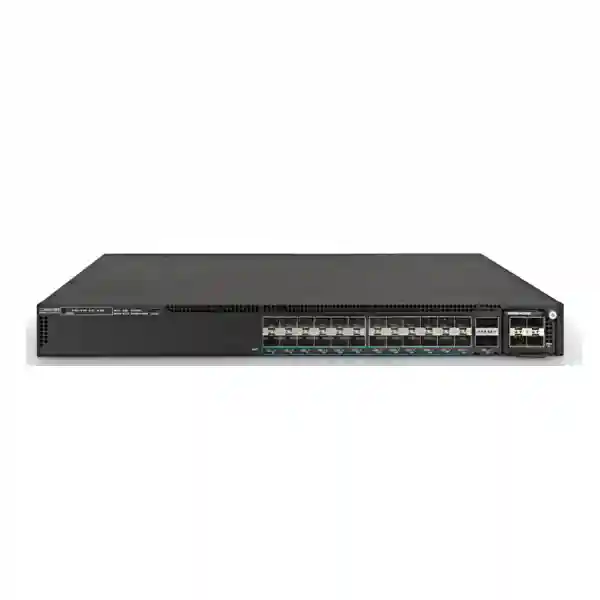
RUCKUS ICX 7550-24F Fiber Switch
The RUCKUS ICX 7550-24F Fiber Switch is designed for organizations that need dense fiber aggregation, high-speed uplinks, stackable growth and advanced routing features in a managed enterprise switching platform. RUCKUS currently classifies the ICX 7550-24F as an entry-level aggregation model with up to twenty-four 1GbE SFP and twenty-four 10GbE SFP+ interfaces, high-speed QSFP-family connectivity, stacking for up to twelve switches, MACsec, VxLAN, sFlow and Layer 3 capabilities. It is a non-PoE switch, so it is best evaluated for fiber aggregation, distribution, server connectivity and high-capacity inter-switch links rather than direct power delivery to phones, cameras or wireless access points.
- 24 x 1/10GbE SFP/SFP+ fiber-facing capacity.
- High-speed QSFP uplink and stacking capability.
- Up to 12 switches per stack and up to 2.4 Tb/s aggregate stack bandwidth published by RUCKUS.
- Layer 3, BGP, VRF, MACsec, VxLAN, sFlow and OpenFlow support listed by RUCKUS.
- No PoE/PoE+; confirm optics, fans, power supplies and licensing in the final bill of materials.
Direct answer: what is the RUCKUS ICX 7550-24F?
The RUCKUS ICX 7550-24F is a managed fiber aggregation switch in the ICX 7550 family. It is intended for networks that need a concentrated set of 1GbE and 10GbE optical connections with faster uplink or stacking options. In practical designs, that can mean aggregating access switches from several floors, connecting server or storage resources over 10GbE, building a distribution layer between access and core switching, or standardizing a fiber-heavy campus topology. Its role is different from a copper PoE access switch: the ICX 7550-24F does not provide PoE, and buyers should plan the access layer separately when endpoints need power.
The published RUCKUS product page lists a maximum switching capacity of 880 Gb/s, up to 24 1GbE SFP ports, up to 24 10GbE SFP+ ports, up to four 40GbE QSFP ports or up to two 100GbE QSFP28 ports, stacking for as many as 12 switches and aggregate stack bandwidth up to 2400 Gb/s. RUCKUS also lists static routing, RIP and OSPF support, along with BGP, VRF, MACsec, VxLAN, sFlow, OpenFlow with Hybrid Port Mode, redundant power options, hot-swappable internal power supplies and fans, and reversible airflow options. Because manufacturer publications can evolve, the quotation should always confirm the exact hardware bundle, software entitlement, airflow direction, power units and supported optics for the part number being ordered.
Dense fiber access to aggregation, servers or upstream switching, depending on the design.
Plan higher-speed uplinks or stacking where the selected configuration and optics support them.
Useful where operational simplicity and scalable port density are priorities.
Use separate PoE access switching for powered endpoints and aggregate those switches over fiber.
Verified capabilities and what they mean for a buyer
| Area | Published ICX 7550-24F information | Buying implication |
|---|---|---|
| Fiber interfaces | Up to 24 x 1GbE SFP and 24 x 10GbE SFP+ | Confirm optic type, fiber type, distance and connector format for every link. |
| High-speed links | Up to 4 x 40GbE QSFP or 2 x 100GbE QSFP28 | Use for core uplinks, stacking or high-capacity interconnects where supported by the chosen module and software. |
| Stacking | Up to 12 switches; up to 2400 Gb/s aggregate stack bandwidth | Map stack topology, cable types, failure behavior and growth plan before purchase. |
| Routing | Static, RIP, OSPF; BGP and VRF listed | Confirm required license and software release for advanced routing features in the final design. |
| Security and overlays | MACsec and VxLAN listed | Validate topology, key management, interoperability and software requirements rather than assuming feature presence equals deployment readiness. |
| Power and cooling | Redundant power option, hot-swap internal power supplies and fans, reversible airflow option | Specify actual PSU/fan bundle and airflow direction; base hardware part numbers can differ from bundled variants. |
Where the ICX 7550-24F fits
This model makes the most sense when fiber density and aggregation matter more than endpoint PoE. A campus can use it to aggregate access switches over 1GbE or 10GbE fiber. A server room can use 10GbE SFP+ links for selected servers, appliances or storage paths while using faster QSFP-family links toward the network core. A multi-building site can use optical links to bridge distance between distribution points, subject to the selected transceivers and fiber plant. A branch or headquarters refresh can place the ICX 7550-24F behind a firewall and ahead of access-layer switching to provide a controlled distribution point for VLANs, routing and redundant uplinks.
For network-security context, buyers can review perimeter firewall planning and firewall deployment guidance. A switch and firewall solve different problems: the switch moves and segments traffic inside the network, while the firewall applies security policy between trust zones and external or sensitive networks. Planning both together helps prevent accidental bottlenecks at uplinks, trunk ports, VLAN gateways or inspection points.
Optics, power, airflow and licensing: do not quote only the chassis
The most common procurement mistake with a fiber switch is to treat the switch part number as the entire solution. Optical networking depends on matched transceivers, the installed fiber type, connector format, supported wavelength, distance, link speed and the capabilities at both ends. A 10GbE SFP+ link can require very different optics for short multimode runs and long single-mode routes. A 100GbE QSFP28 uplink adds its own decisions around optics, breakout requirements, patching and destination hardware. Buyers should list every planned link and identify its speed, distance, fiber medium and remote interface before finalizing a bill of materials.
Power and cooling also require explicit confirmation. RUCKUS publishes the ICX7550-24F base part in material that can be supplied without fans or power supplies, while bundled variants may include power and fan assemblies. That means a quotation should specify whether the required power supplies and fans are included, the airflow direction, input power expectations, redundancy objective and any support bundle. Do not assume that a picture or shortened reseller description represents the final hardware configuration.
Advanced routing and software capabilities should be checked against the intended release and entitlement. If the network needs BGP, advanced OSPF behavior, VRF segmentation, VxLAN, MACsec or controller integration, share those requirements before ordering. FourTeck can use that information to structure a bill of materials and clarify what must be validated with current RUCKUS documentation. For broader UAE switching guidance, see FourTeck UAE networking solutions.
RUCKUS ICX 7550-24F Fiber Switch Dubai
Buyers searching for a RUCKUS ICX 7550-24F Fiber Switch Dubai supplier are usually trying to solve one of four problems: aggregate a growing access layer, introduce more 10GbE fiber links, create faster uplinks toward a core or firewall zone, or replace a distribution switch that no longer has enough capacity or resilience. In Dubai, those requirements can arise in corporate offices, hotels, schools, logistics facilities, warehouses, healthcare environments, multi-tenant buildings and regional headquarters. The useful question is therefore not simply whether the model is available, but whether the ICX 7550-24F has the right port profile and architecture for the proposed network.
For a Dubai project, start with the fiber map. Count every access-switch uplink, server link, firewall handoff and inter-building connection that may terminate on the aggregation layer. Record which links are currently 1GbE, which need 10GbE and which should move to 40GbE or 100GbE. Identify whether the installed cabling is single-mode or multimode and note actual route lengths rather than building-to-building straight-line estimates. This makes the optic selection more defensible and prevents a high-performance switch from being delayed by missing or incompatible transceivers.
Power, rack and airflow deserve equal attention. Dubai equipment rooms vary from well-controlled data spaces to compact communications cupboards shared with UPS, patching and ISP equipment. Confirm rack depth, available power feeds, airflow direction and the exact fan and power-supply bundle. Where business continuity matters, ask how redundant power and redundant uplinks will be implemented, not merely whether the switch supports them in principle. If the design places the switch behind a security gateway, coordinate the VLAN trunks, routing boundaries and link speeds with the firewall. FourTeck’s network security and firewall services can be reviewed alongside the switching requirement when the aggregation layer and security edge are part of the same refresh.
For quotation purposes, Dubai buyers should provide the exact switch quantity, required optics, desired high-speed uplinks, preferred power redundancy, current switch model, VLAN count, routing protocols and target deployment date. Ask for written confirmation of the hardware bundle and commercial terms rather than relying on generic online stock claims. This produces a more accurate RUCKUS ICX 7550-24F Dubai quote and gives technical teams a clearer basis for acceptance testing after installation.
RUCKUS ICX 7550-24F Fiber Switch UAE
A RUCKUS ICX 7550-24F Fiber Switch UAE deployment may serve a single head office, a campus, a multi-emirate business or a standardized regional network. UAE procurement teams often need more than a switch model: they need a repeatable bill of materials that clearly separates the chassis, power supplies, fans, transceivers, fiber patch cords, support entitlement and professional services. The ICX 7550-24F can be attractive where a design needs many 1/10GbE fiber connections and faster aggregation uplinks, but the value comes from fitting it into a complete topology rather than buying it as an isolated component.
For UAE-wide standardization, document one reference architecture. Define whether the ICX 7550-24F will act as aggregation, collapsed core for a smaller site, server-room distribution or a fiber concentration point. Set common VLAN naming, uplink speeds, spanning-tree or routed-access strategy, logging, monitoring and management standards. If stacking is planned, define how many switches are expected initially and over the next refresh cycle, which ports are reserved for stacking, and how the stack will behave during maintenance or a member failure. RUCKUS lists stacking up to twelve units and up to 2.4 Tb/s aggregate stack bandwidth, but the project should still confirm the exact physical stack design.
The UAE fiber environment can range from short data-room patching to building risers and longer campus runs. Buyers should avoid ordering optics by speed alone. Confirm fiber mode, connector type, wavelength, distance, remote transceiver compatibility and any patch-panel transitions. If existing access switches use 1GbE today but will migrate to 10GbE, plan whether the same fiber plant supports the proposed optics. This is especially important when the switch is intended to extend the useful life of an existing cabling investment.
FourTeck can help structure a requirement around switch role, interface count, routing, optics and deployment dependencies. The FourTeck Firewall Dubai platform is relevant when the wider project also includes edge security, while related security products can be reviewed for networks that require new firewall hardware alongside switching. When requesting a RUCKUS ICX 7550-24F UAE quote, include the final destination, quantities, expected support term and any configuration or installation scope so commercial and technical assumptions are visible before approval.
RUCKUS ICX 7550-24F Fiber Switch Uganda
Organizations searching for the RUCKUS ICX 7550-24F Fiber Switch Uganda are commonly evaluating enterprise switching for a headquarters, education campus, hospitality property, healthcare site, multi-building compound, ISP-facing business network or a structured branch environment. The model is most relevant where the design needs optical aggregation and high-capacity uplinks rather than PoE access ports. It can sit above PoE access switches and below a core or firewall, collecting fiber uplinks while providing Layer 3 routing and segmentation features where the final software and license design supports them.
For Uganda projects, the bill of materials should reflect practical infrastructure conditions. Confirm whether the deployment site has stable rack power, UPS protection and environmental control. If the base switch is being quoted, verify whether power supplies and fans are included; do not assume they are built into every part-number bundle. Specify airflow direction to suit the rack. For sites outside a main data room, consider dust control, temperature management and secure rack access as part of installation readiness. These are not switch features, but they directly affect reliability and maintainability.
Fiber planning should be done link by link. A campus might have single-mode links between buildings and multimode inside a server room. A branch interconnect may need 10GbE today with an upgrade path later. Long routes require careful optical-budget and patching review. Share the existing fiber type, termination format, route distance and the switch or appliance at the far end. This enables the quote to include suitable optics rather than a generic set of transceivers that may not fit the installed plant.
FourTeck’s Uganda technology portal can be used for regional enquiries, while the wider Africa network can support cross-border project discussions. For a useful RUCKUS ICX 7550-24F Uganda quotation, provide the number of sites, switch quantity, intended role, fiber links, uplink speeds, routing requirements and any staging or configuration needs. Ask the final quote to distinguish hardware, optics, power/fan components, support and services so procurement can compare proposals on the same basis rather than comparing only a chassis price.
RUCKUS ICX 7550-24F Fiber Switch Kampala
A Kampala buyer looking for the RUCKUS ICX 7550-24F Fiber Switch may be dealing with a more concentrated enterprise environment than a country-wide deployment: a headquarters, university building, hotel, hospital, financial office, shared campus, large retail operation or a server room serving several floors. In these designs, the switch can provide a central aggregation point for fiber-connected access switches and high-speed appliances. Its twenty-four 1/10GbE SFP/SFP+ interface profile allows a network team to concentrate a substantial number of optical links without moving immediately to a large chassis platform.
The first Kampala design decision should be whether the switch is serving Layer 2 aggregation or taking on Layer 3 gateway and routing functions. If VLAN gateways remain on a firewall or another core switch, the ICX 7550-24F may primarily carry trunks and aggregated links. If routing is moved to the distribution layer, confirm static routes, OSPF, BGP or VRF requirements and the associated software entitlement. This boundary matters because it affects failure domains, troubleshooting responsibility and the bandwidth required between the switch and the security edge.
The second decision is uplink resilience. A single high-speed uplink may be simple, but a business-critical site should consider how traffic behaves when a cable, optic, upstream device or power feed fails. Define whether links will be aggregated, routed independently or connected to separate upstream devices. If stacking is used, decide which members carry uplinks and how access switches are dual-homed. These choices should be documented before configuration rather than improvised during installation.
Kampala procurement teams should also specify exact optics and support expectations. A quote that lists only “24-port fiber switch” is incomplete. Include the switch variant, power supplies, fans, airflow, SFP/SFP+ optics, any QSFP-family components, stacking accessories, rack requirements and desired support term. FourTeck can use this information to prepare a more coherent proposal through its Uganda regional channel, while businesses coordinating a firewall refresh can review the compact branch firewall example to understand how switch and security interface planning should be documented together.
RUCKUS ICX 7550-24F Fiber Switch Arua
For an Arua deployment, the RUCKUS ICX 7550-24F Fiber Switch is best considered when the network has a genuine aggregation requirement rather than simply a need for more endpoint ports. A site with several buildings, multiple communications rooms, a local server environment or long fiber runs can benefit from a switch that concentrates 1GbE and 10GbE optical links and offers faster uplink options. That may apply to education, healthcare, hospitality, logistics, public-service projects, enterprise compounds or regional offices where the network must remain manageable as additional buildings or services are connected.
In Arua, planning should pay close attention to the physical fiber path. Long outdoor runs, patch-panel transitions and mixed generations of installed fiber can create uncertainty that is not visible from a switch datasheet. Before selecting optics, identify whether each run is single-mode or multimode, the approximate end-to-end distance, the connector type, the number of patch points and the device at the far end. If an existing link is being upgraded from 1GbE to 10GbE, verify that the fiber and optics support the new target speed over the actual route.
Power continuity should also be treated as part of the switching design. The ICX 7550-24F supports redundant power options, but a redundant switch power configuration only helps if the upstream electrical design, UPS arrangement and distribution are also considered. Ask whether the selected bundle includes one or two power supplies and the required fans. Define airflow direction to match the rack, and ensure the communications room can keep the equipment within vendor environmental requirements. Where remote technical access is limited, clear configuration backups, labeling and monitoring become especially useful.
A practical Arua quotation request should include a simple topology drawing, even if it is only one page. Mark the firewall, core or upstream router, the ICX 7550-24F, each access switch, server connection and fiber route. Add intended speeds and distances. This allows the supplier to review the full path instead of quoting the chassis in isolation. FourTeck can coordinate the enquiry through its Uganda-facing channel and help identify the questions that should be resolved before purchase, staging and deployment.
RUCKUS ICX 7550-24F Fiber Switch Mbarara
The RUCKUS ICX 7550-24F Fiber Switch Mbarara requirement is most credible when a business or institution is consolidating multiple fiber uplinks into a structured aggregation layer. Mbarara sites such as campuses, hotels, medical facilities, offices, distribution operations and multi-building organizations can have several access switches that need reliable uplinks back to a central network room. A 24-port 1/10GbE SFP/SFP+ aggregation switch can give that design room to move from 1GbE toward 10GbE without replacing the entire distribution platform immediately.
Before selecting the ICX 7550-24F, calculate port use realistically. Reserve capacity for current access-switch uplinks, redundant links, servers, security appliances and future additions. Do not count all twenty-four ports as immediately available if several will be used in pairs for resiliency or link aggregation. If the network expects rapid growth, model the port requirement over the next few years and decide whether one switch, a stack or a higher-density alternative is more appropriate. RUCKUS supports stacking on this model family, but physical stack architecture and software requirements must still be validated.
Mbarara buyers should also decide where inter-VLAN routing occurs. Keeping routing on the aggregation switch can reduce unnecessary traffic toward a firewall, while keeping sensitive inter-zone traffic on the firewall can provide deeper security control. Many networks use a hybrid approach: routine internal routing on the switch and policy-sensitive boundaries on the firewall. The correct choice depends on the security model, logging needs, network size and administrator skills. If BGP, OSPF, VRF or VxLAN is required, include that explicitly in the request so feature and license validation happens before ordering.
A complete quote should list the switch variant, power supplies, fans, airflow, optics, stacking components, support and any configuration service. If a new firewall is part of the same project, review the firewall appliance planning example as a reminder to document interface media, uplink speed and segmentation boundaries on both sides of the connection. FourTeck can then align the switching bill of materials with the intended Mbarara network design instead of treating the switch as a standalone box.
RUCKUS ICX 7550-24F Fiber Switch Gulu
A RUCKUS ICX 7550-24F Fiber Switch Gulu project should begin with the network role, not the brand name. If the site needs a central fiber switch to collect uplinks from several buildings, floors or access switches, the ICX 7550-24F offers a port profile that can support a structured aggregation design. It may also suit organizations that are increasing server bandwidth, consolidating communications rooms or preparing for faster 40GbE or 100GbE links toward another core device. If the requirement is simply to connect desktop users, cameras or access points directly, a PoE copper access switch may be a better first layer because this model does not provide PoE.
Gulu projects that cover several buildings should document the outside-plant and inside-plant fiber separately. The fiber between buildings may use different media, pathways and protection than short indoor links. Identify where patch panels, splices and converters exist. If the network has grown in stages, verify whether older links use optics that can be reused or whether new matched transceivers are required. It is often cheaper to discover an optical mismatch during planning than during an outage window.
Operations planning matters too. Decide how the switch will be monitored, where configuration backups will be stored, who has administrative access and what information should be logged centrally. RUCKUS lists sFlow support, which can contribute to traffic visibility when integrated with suitable monitoring. The switch also lists MACsec and VxLAN capabilities, but those features should be deployed only when the broader architecture and software support have been validated. Avoid enabling complex features simply because they appear on a specification sheet.
For a Gulu quotation, send the current topology, number of fiber links, link speeds, distances, routing needs, redundancy goal and rack-power information. State whether you need only supply, staged configuration, remote assistance or a wider project scope. FourTeck can route Uganda enquiries through its regional platform and can coordinate wider infrastructure questions where the switch connects to firewalls, servers or wireless networks. The result should be a documented bill of materials that a technical team can review before purchase and test systematically during commissioning.
RUCKUS ICX 7550-24F Fiber Switch Kenya
The RUCKUS ICX 7550-24F Fiber Switch Kenya page addresses buyers who need an enterprise fiber aggregation switch for offices, campuses, hospitality, healthcare, education, data rooms, logistics operations or distributed business infrastructure. In a Kenya design, the switch can aggregate access layers over fiber, connect selected 10GbE servers or appliances and provide high-speed uplinks toward a larger core. Its non-PoE design makes it particularly relevant in distribution and aggregation roles rather than as the final access switch for powered endpoints.
For projects in Nairobi, Mombasa or other locations, begin with a standardized interface schedule. List each link, its source and destination, required speed, medium, distance and redundancy requirement. This is especially useful for multi-site organizations that want the same network design repeated across branches. Standardizing optics, port naming, VLANs, monitoring and configuration templates can simplify support, but the physical fiber environment at each site still needs individual verification. A 10GbE optical design that works over short multimode links at headquarters may need a different optic at another site with longer single-mode runs.
If the ICX 7550-24F will also perform Layer 3 routing, define the protocols and route scale expected. RUCKUS lists static routing, RIP, OSPF, BGP and VRF support, but advanced features may have license or release dependencies. Include any VxLAN or MACsec requirement in the technical brief so it can be validated. Where traffic crosses a security boundary, decide whether the firewall or switch owns the gateway for each VLAN. This prevents avoidable hairpin traffic and clarifies where security policy and logging are applied.
Kenya buyers can use the FourTeck Kenya portal for regional enquiries. When asking for a RUCKUS ICX 7550-24F Kenya price or availability, request a complete bill of materials: chassis variant, power supplies, fans, airflow, required optics, stacking components, support and professional services. This lets procurement compare equivalent proposals and prevents lower headline pricing from hiding missing components. If the project includes a new edge firewall, the switch uplinks, VLAN trunks and routed handoff should be reviewed together so neither platform becomes an unexpected throughput constraint.
RUCKUS ICX 7550-24F Fiber Switch Kuwait
Businesses searching for the RUCKUS ICX 7550-24F Fiber Switch Kuwait may be planning a network refresh for an office tower, hospitality environment, education facility, retail operation, industrial site or regional branch. The model’s strength is its dense 1/10GbE fiber interface profile combined with higher-speed QSFP-family links. That makes it useful where access switches, servers or distribution points are already connected optically and where the network needs a cleaner path to 10GbE aggregation or faster uplinks.
Kuwait projects should specify environmental and rack details early. Confirm whether the switch will be installed in a conditioned data room, a floor-distribution rack or a remote equipment space. Verify airflow orientation, fan and power-supply inclusion, UPS capacity and rack power distribution. RUCKUS lists reversible airflow and redundant power options, but the quote must identify the actual assemblies supplied. For business-critical networks, redundant power should be combined with redundant uplinks and a tested failure design rather than treated as an isolated checkbox.
Optical compatibility is equally important. If the network uses an existing fiber backbone, document fiber type and distance before ordering transceivers. When the ICX 7550-24F connects to third-party firewalls, servers or switches, confirm that both ends support the selected optic and speed. For 100GbE links, review QSFP28 compatibility, patching and any breakout requirements. If multiple switches are stacked, identify the stack cabling and physical layout so the rack design remains serviceable.
FourTeck’s Kuwait technology portal can be used for regional procurement enquiries. A useful request should include the current switch or core model, required quantity, interface schedule, optics, routing protocols, power redundancy, target support term and delivery destination. Ask for confirmation of the exact RUCKUS part number and included components. This is particularly important with the ICX 7550 family because base and bundled variants can differ in included power, cooling and support. A clear bill of materials turns a simple “fiber switch Kuwait price” enquiry into a procurement document that technical and finance teams can evaluate together.
RUCKUS ICX 7550-24F Fiber Switch Ghana
The RUCKUS ICX 7550-24F Fiber Switch Ghana requirement is suited to organizations that need an aggregation or distribution platform rather than a simple access switch. A business campus, hotel, education site, healthcare organization, financial office, data room or multi-building enterprise can use a fiber aggregation layer to concentrate access-switch uplinks and create predictable high-speed paths toward servers, firewalls or a core. The ICX 7550-24F offers up to twenty-four 1/10GbE SFP/SFP+ interfaces and high-speed QSFP-family connectivity, making it a candidate when the fiber count is growing or when existing 1GbE uplinks are being upgraded.
For Ghana projects, the optical bill of materials should be based on the installed fiber plant, not a generic accessory bundle. Identify whether each route is multimode or single-mode, its approximate length and the device at the far end. If a site in Accra or another city has multiple buildings, include patch-panel and splice information where available. This helps avoid the common situation where the switch arrives but the optical components do not match the cable plant or the remote interfaces.
Routing architecture should also be decided before ordering. If the aggregation layer must run OSPF, BGP or VRF-based segmentation, state those requirements explicitly so license and software support can be checked. If routing remains on a firewall or separate core, define trunking, link aggregation and failover behavior instead. The switch’s MACsec and VxLAN capabilities can be valuable in certain enterprise architectures, but their practical use depends on the rest of the network and should not be assumed from a feature list alone.
Ghana buyers can coordinate through the broader FourTeck Africa network when preparing a requirement. Include switch quantity, optics, power supplies, fans, airflow, stack design, management expectations, support term and any staging service. If a firewall replacement is happening at the same time, review the interface boundary carefully: the security appliance, aggregation switch and WAN design should have aligned speeds and redundant paths where required. A detailed request gives suppliers enough information to quote the complete solution instead of offering a chassis-only price that creates extra purchasing rounds later.
RUCKUS ICX 7550-24F Fiber Switch Nigeria
A RUCKUS ICX 7550-24F Fiber Switch Nigeria deployment can support enterprise networks that need to aggregate many optical links without moving directly to a large chassis core. In Lagos, Abuja or other business locations, that can include multi-floor offices, campuses, hotels, financial organizations, media environments, healthcare, education, logistics or regional data rooms. The model’s twenty-four 1/10GbE SFP/SFP+ interface capability can give network teams a practical migration path from 1GbE fiber uplinks to 10GbE while retaining the option for faster high-capacity links toward upstream infrastructure.
Nigeria buyers should separate technical sizing from commercial availability. First determine the required switch role, link count, routing function, resilience level and optics. Then ask suppliers to confirm current sourcing, lead time, warranty/support arrangement and exact part-number bundle. This sequence avoids designing around a vague stock claim and makes it easier to compare alternatives if a particular bundle is not immediately available. Because some ICX 7550-24F variants are sold with different combinations of power supplies, fans and support, every quotation should state what is included.
For larger Nigerian environments, consider whether stacking simplifies operations. A stack can increase port density and provide a more unified management experience, but it also requires careful cable planning, software consistency, maintenance procedures and failure testing. RUCKUS lists up to twelve switches per stack and high aggregate stack bandwidth. The design team should decide whether to stack all distribution switches, keep failure domains smaller, or use routed links between separate blocks. There is no single correct answer for every site.
When requesting a Nigeria quote, provide a topology diagram and port schedule, including fiber type, speeds, distances, existing upstream devices and any firewall handoff. If the network also needs a new edge security platform, FourTeck’s branch firewall product example illustrates the importance of documenting interfaces, power, licenses and deployment scope in one bill of materials. The same discipline should be applied to the ICX 7550-24F so procurement receives a complete, supportable switching proposal rather than only a hardware line item.
RUCKUS ICX 7550-24F Fiber Switch Seychelles
The RUCKUS ICX 7550-24F Fiber Switch Seychelles is relevant where a hotel, resort, business campus, public institution, healthcare site, education facility or enterprise network needs a central fiber aggregation layer. In a property with multiple buildings or communications rooms, optical links can provide distance and electrical-isolation advantages over copper. The ICX 7550-24F can concentrate 1GbE and 10GbE SFP/SFP+ connections while providing higher-speed QSFP-family uplink options, making it suitable for designs that need to connect several access switches back to a main server or network room.
For Seychelles deployments, environmental and logistics planning deserves special attention. A complete bill of materials should be checked before shipment because missing optics, fan assemblies, power supplies or stack components can create avoidable project delays. Confirm the exact chassis variant and included hardware, and consider holding suitable spare optics for critical links where operational policy supports it. Equipment rooms should have controlled temperature, clean airflow, appropriate rack protection and UPS-backed power according to vendor requirements; coastal conditions make good equipment-room discipline especially important.
The fiber design should be documented from the outset. Resort or campus layouts may include routes between separate buildings, and each run should be checked for distance, fiber type, connector format and patching. Do not assume that all optical links should use the same transceiver simply because they operate at the same speed. Longer single-mode routes and short multimode data-room links can require different optics. If the design uses 40GbE or 100GbE uplinks, confirm compatibility with the upstream switch or appliance and include any breakout or patching accessories in the review.
A Seychelles quotation request should therefore include the network diagram, destination, switch quantity, required optics, redundancy plan, power and fan configuration, routing requirements, support expectations and implementation scope. For organizations with other sites in Africa, the FourTeck Africa platform can support broader standardization discussions. The objective is to make the switch one part of a fully documented architecture, with clear links to access switching, wireless, servers and security rather than treating the ICX 7550-24F as a generic 24-port product.
How to size the ICX 7550-24F for your network
1. Count fiber links
List every current and planned 1GbE or 10GbE optical connection. Include redundant links separately. Reserve ports for growth, monitoring and temporary migration work.
2. Define uplinks
Decide whether upstream capacity should use 10GbE, 40GbE or 100GbE and whether links require aggregation, physically diverse paths or separate upstream devices.
3. Decide routing boundaries
Clarify which VLAN gateways remain on a firewall, which move to the switch and whether OSPF, BGP, VRF or VxLAN is actually required.
4. Verify optics
For each link, confirm speed, fiber mode, connector, wavelength, distance and compatible transceiver at both ends. Treat optics as part of the solution, not an afterthought.
5. Complete power and cooling
Specify the actual power supplies, fan assemblies, airflow direction, UPS integration and redundancy target for the selected bundle.
6. Define operations
Set monitoring, backups, administrator access, software policy, logging, support term, documentation and acceptance tests before the switch goes into production.
Compatibility and integration checklist
Compatibility is not limited to whether an optic physically fits a port. The proposed switch must fit the logical architecture, management tools, routing policy, server interfaces, firewall design, monitoring platform and support model. If the organization already uses RUCKUS wireless and management technologies, confirm the intended wired-management approach and software version. If the network uses mixed vendors, test link negotiation, LACP behavior, spanning-tree settings, routing adjacencies and optics compatibility against the actual devices in the topology.
- Optics: SFP/SFP+, QSFP/QSFP28 type, fiber mode, wavelength, connector and distance.
- Switching: VLAN trunks, LACP, spanning tree, MTU requirements and link redundancy.
- Routing: static routes, RIP, OSPF, BGP, VRF requirements and license/software dependencies.
- Security: MACsec, access control, management-plane restrictions and any firewall segmentation boundary.
- Virtualization: VxLAN or overlay requirements only where the wider architecture calls for them.
- Operations: sFlow, SNMP/management tooling, backups, logging, authentication and change control.
- Physical: rack fit, power feeds, fan direction, UPS, patch panels, cable management and labeling.
Related FourTeck resources for a complete network design
The ICX 7550-24F normally sits inside a wider architecture. Use the following verified FourTeck pages when the switching project also requires firewall selection, security deployment or regional procurement support.
Firewall products
Review FourTeck firewall product categories when the aggregation switch will connect to a new security gateway.
PA-410 branch firewall
Use the Palo Alto Networks PA-410 page as an example of branch-security interface and deployment planning.
PA-415 with PoE
Review the Palo Alto Networks PA-415 page when a branch needs security interfaces and limited PoE at the edge.
Sophos branch security
The Sophos XGS 88 page highlights the questions that matter when sizing a smaller firewall connected to switching.
Implementation services
See FourTeck firewall services for migration, configuration, VPN and network-security project context.
About FourTeck
Review FourTeck’s infrastructure and security approach before defining project scope and handover expectations.
Sales and scoping
Send the final port schedule, optics list and project details through the FourTeck contact page.
Frequently asked questions
Is the RUCKUS ICX 7550-24F a PoE switch?
No. RUCKUS lists PoE/PoE+ as not supported on the ICX 7550-24F. It is a fiber-focused aggregation model. If access points, cameras, IP phones or other powered endpoints need PoE, use suitable PoE access switches and uplink them to the ICX 7550-24F over fiber where appropriate.
How many 10GbE ports does the ICX 7550-24F support?
RUCKUS lists up to 24 10GbE SFP+ ports on the model-specific product page. The final interface use still depends on installed optics, software and the actual topology.
Can it connect at 100GbE?
RUCKUS lists up to two 100GbE QSFP28 ports for the ICX 7550-24F. Confirm the exact module, port mode, supported transceiver and upstream compatibility before designing a 100GbE link.
Can the ICX 7550-24F be stacked?
Yes. RUCKUS lists stacking support, up to twelve switches per stack and up to 2400 Gb/s aggregate stack bandwidth. The physical stack topology and stack-port use should be validated for the intended software release and hardware configuration.
Does it support Layer 3 routing?
RUCKUS lists Layer 3 support including static routing, RIP and OSPF, and also lists BGP and VRF. Advanced routing requirements should be checked against the current software and license entitlement before purchase.
Are SFP and QSFP optics included?
Do not assume so. RUCKUS ordering materials describe transceivers as sold separately for common ICX 7550-24F configurations. Request a quote that separately identifies every required optic and patching component.
Are power supplies and fans included?
It depends on the exact part-number bundle. RUCKUS ordering descriptions show a base ICX7550-24F configuration without fans or power supplies and bundled variants with power and cooling components. The quotation must state exactly what is included.
What information is needed for a RUCKUS ICX 7550-24F price?
Provide the destination, quantity, exact switch variant if known, required power and fan arrangement, optics, 40/100GbE requirements, support term, routing or license requirements and any staging or installation scope. A complete requirement produces a more accurate commercial comparison than a chassis-only price request.
Quotation checklist
Send these details with your enquiry so FourTeck can review the design and reduce missing-component risk.
Aggregation, distribution, collapsed core, server-room fiber or other defined use.
Number of 1G, 10G, 40G and 100G links, including redundant connections.
Fiber mode, distance, connector, wavelength and device at each remote end.
PSU count, fan assemblies, airflow direction, rack power and UPS requirement.
Static, OSPF, BGP, VRF, MACsec, VxLAN, stacking and monitoring expectations.
Quantity, destination, support term, configuration, staging, installation and target project timing.
Decision recap
Choose the RUCKUS ICX 7550-24F when the network genuinely needs dense fiber aggregation, many 1/10GbE optical interfaces, high-speed uplink or stacking options and enterprise routing features. Do not choose it simply because it is a 24-port switch. Its value is strongest in the aggregation layer, where access switches, servers and security infrastructure need a structured high-capacity meeting point.
Before ordering, validate the exact part-number bundle, power supplies, fans, airflow, optics, high-speed modules, software requirements and support term. Confirm the fiber plant and remote interfaces. Decide where routing and security boundaries sit. Document failure behavior and acceptance tests. These steps turn a product purchase into a supportable network design.
FourTeck can review the technical requirement and prepare a quotation based on the chosen region, quantity and bill of materials. The goal is a configuration that matches the real fiber links, rack environment, network role and growth plan without inventing stock, delivery or compatibility promises that have not been verified.
Consult FourTeck before finalizing the bill of materials
Send the network topology, fiber schedule, current switch models, desired link speeds and target destination. FourTeck can help organize the request around switch hardware, optics, power and fan assemblies, stack components, software requirements and service scope. For organizations standardizing infrastructure across several countries, the same technical template can be used for each site while preserving local fiber, power and procurement differences.
If the project also includes edge security, migration or segmentation changes, include those details in the same discussion. A well-sized switch connected to an undersized firewall, or a high-performance firewall connected through an unsuitable aggregation path, can still create bottlenecks. Reviewing switching and security boundaries together supports a cleaner final architecture.

Reviews
There are no reviews yet.