
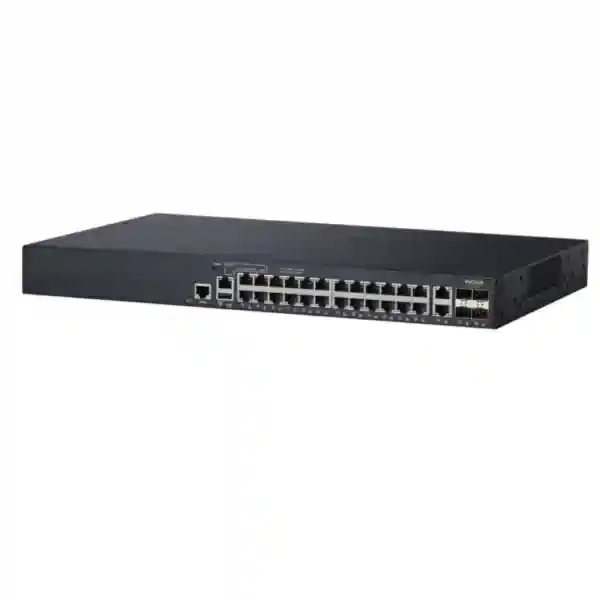
RUCKUS ICX 7150-24 Network Switch
The RUCKUS ICX 7150-24 is an enterprise access switch designed around 24 Gigabit Ethernet user-facing ports, two additional Gigabit RJ45 uplink ports and four SFP/SFP+ interfaces that can serve uplink or stacking roles depending on the licensed configuration. It is relevant to organizations maintaining established RUCKUS switching estates, standardizing branch access, replacing a failed member in an existing stack or planning a controlled move from a legacy campus design to a current platform.
Lifecycle note: RUCKUS marks the ICX 7150-24 as discontinued from January 15, 2026 and points customers to the ICX 8200 family as a replacement. A current buying decision should therefore verify unit condition, exact uplink license, firmware path, support entitlement, optics and long-term replacement strategy instead of assuming ordinary new-product availability.
Quick buyer answers
Access ports: 24 × 10/100/1000 Mbps RJ45.
Extra copper uplinks: 2 × 1 GbE RJ45.
Fiber/uplink interfaces: 4 × SFP/SFP+ capable interfaces, with supported speed depending on license and configuration.
Switching capacity: up to 132 Gb/s for the ICX 7150-24 model.
Stacking: supported, with up to 12 switches per stack published for the model family.
Best-fit request
Existing ICX 7150 estates that need a compatible access switch, stack member, spare, lab unit or migration reference.
Important distinction
The ICX 7150-24 is the non-PoE model. Buyers needing powered endpoints should not assume PoE simply because other ICX 7150 variants support it.
Procurement priority
Confirm exact part variant, 1G/10G uplink entitlement, included accessories, optics requirements, firmware compatibility and support status before purchase.
What the RUCKUS ICX 7150-24 does
The RUCKUS ICX 7150-24 is a managed access-layer switch built for networks that need reliable Gigabit connectivity at the edge and higher-speed uplink or stacking paths toward distribution infrastructure. Its 24 copper access ports suit desktop computers, printers, servers with Gigabit copper interfaces, IP appliances that have independent power, wireless infrastructure that uses separate power injection, building systems and general LAN devices. The model also provides two additional Gigabit RJ45 uplink ports plus four optical uplink/stacking interfaces. Those SFP/SFP+ interfaces are particularly useful where the access cabinet connects over fiber, where multiple access switches are stacked, or where the design calls for higher-speed uplinks enabled by the appropriate software entitlement.
From an operations perspective, the platform supports capabilities associated with managed enterprise access switching, including VLAN segmentation, Layer 3 routing features, sFlow monitoring, stacking and integration into broader RUCKUS wired and wireless designs. That makes it more than a simple unmanaged 24-port switch. It can participate in structured campus, hospitality, education, office and branch networks where traffic separation, predictable uplinks, monitoring and centralized operational practices matter.
The present-day buying context is different from when the ICX 7150 was an active catalog platform. Because the model is now discontinued, a sound procurement process should begin by asking why this exact model is required. If the answer is compatibility with an installed stack, a like-for-like maintenance replacement may be reasonable subject to condition and software checks. If the requirement is for a new site or a long lifecycle project, the current RUCKUS ICX 8200 family deserves comparison. FourTeck can assist with broader network and security product planning so the switch choice fits the firewall, uplink, VLAN and branch design rather than being treated as an isolated purchase.
Verified model specifications that matter to buyers
24 Gigabit access ports
Twenty-four 10/100/1000 Mbps RJ45 interfaces form the primary access layer. This model does not provide PoE/PoE+ on those access ports.
Copper plus fiber uplink choices
Two 1 GbE RJ45 uplink ports complement four SFP/SFP+ interfaces. Exact 10 GbE use depends on the ordered or licensed uplink configuration.
132 Gb/s switching capacity
RUCKUS publishes a maximum switching capacity of 132 Gb/s for the ICX 7150-24, providing useful headroom for a 24-port Gigabit access design.
Stacking up to 12 switches
The model supports stacking, with RUCKUS publishing up to 12 switches per stack and up to 480 Gb/s aggregate stack bandwidth for the platform.
Layer 3 and visibility features
Published features include static routing, RIP, OSPF capability, sFlow, OpenFlow hybrid-port support and Campus Fabric technology, subject to software and licensing conditions.
Energy-efficient Ethernet
Energy Efficient Ethernet is listed for the model, which can matter in access-layer designs where large numbers of connected ports remain active over long operating periods.
Buying and migration checklist for a discontinued ICX 7150-24
A discontinued enterprise switch can still have practical value, but the buying checklist must be stricter than for a current model. Start with the exact reason the ICX 7150-24 is needed. A maintenance spare for an existing stack has different risk, compatibility and budget priorities from a new greenfield deployment. Ask for the precise commercial part variant because ICX 7150-24 configurations were sold with different uplink capabilities and Layer 3 feature entitlements. A listing that simply says “ICX 7150-24” may not tell you whether the four uplink ports are operating as 1 GbE, partly activated for 10 GbE, or fully enabled for the intended design.
Condition is another major factor. Confirm whether the unit is new old stock, manufacturer-refurbished, seller-refurbished or previously deployed. Request a clear inventory description and verify the included power cord, rack hardware and any optics. Transceivers are not interchangeable assumptions: fiber type, connector, distance, wavelength and peer-side optics must match. If the switch will join an existing stack, confirm software release alignment and the operational procedure for adding the member. For standalone use, verify the management and routing features you actually require rather than assuming every historical license is included.
For organizations planning a refresh, compare the cost of acquiring and supporting a legacy ICX 7150-24 against migrating to a current platform. The hardware price is only one part of lifecycle cost. Support availability, software maintenance, spares strategy, engineer familiarity, replacement timing and the risk of extending an aging estate all matter. FourTeck’s infrastructure and network services can be considered alongside the hardware requirement when VLANs, uplinks, firewall policies or branch connectivity need coordinated planning.
RUCKUS ICX 7150-24 Dubai
Customers searching for a RUCKUS ICX 7150-24 Dubai supplier are often trying to solve one of three practical problems: replace a failed access switch without redesigning the network, source a compatible spare for an installed RUCKUS estate, or determine whether an older ICX 7150 specification can still be fulfilled for a project. The model is a 24-port non-PoE Gigabit access switch, so the first question for a Dubai office, warehouse, school, hotel or branch project is whether powered endpoints are part of the requirement. Wireless access points, IP phones and cameras frequently depend on PoE, and the base ICX 7150-24 does not provide it. If those endpoints use separate injectors or local power, the non-PoE model may still fit; otherwise the specification should be reviewed rather than forcing the wrong hardware into the design.
Dubai business networks also commonly combine access switching with firewall segmentation, guest Wi-Fi, CCTV, voice, cloud applications and multiple ISP links. That makes uplink design important. The ICX 7150-24 provides two Gigabit copper uplinks plus four SFP/SFP+ interfaces used for fiber uplinks or stacking, but the actual 10 GbE capability depends on the licensed configuration. Before requesting a Dubai quotation, identify the core switch model, required fiber distance, optic type, number of VLANs, whether the unit must join an existing stack and the software release used by neighboring switches. This information helps prevent a purchase that is physically compatible but operationally awkward.
Because RUCKUS discontinued the ICX 7150-24 on January 15, 2026, buyers should also decide whether they want a legacy replacement or a current-platform migration. For an existing site, a verified legacy unit can minimize change when continuity is the main objective. For a new Dubai deployment, it is usually more useful to compare the requested specification with the current RUCKUS ICX 8200 family and other supported options. The comparison should cover port count, PoE requirement, uplink speed, stacking, management, software entitlement and future support—not just the purchase price.
FourTeck can coordinate switch requirements with broader UAE infrastructure planning through FourTeck UAE IT and networking solutions. When the switch sits behind an edge firewall, customers can also review firewall deployment planning in Dubai so VLANs, routing and security zones are designed together. For a useful quotation, send the exact requested model, quantity, existing switch details, uplink optics, rack preference and whether migration support is required.
RUCKUS ICX 7150-24 UAE
A search for RUCKUS ICX 7150-24 UAE usually reflects a wider procurement requirement than a single office purchase. Multi-site organizations may have branches in different emirates, standardized RUCKUS switching already in service, or a bill of materials created when the ICX 7150 was still an active product. The first task is to establish whether the request is for compatibility or for a new network standard. Compatibility-driven requests should document the installed model variants, firmware level, stack configuration, uplink licenses and optical modules. New-standard requests should compare the legacy specification with current RUCKUS platforms before committing to an end-of-life architecture.
The ICX 7150-24 itself delivers 24 Gigabit RJ45 access ports and is not a PoE switch. It also includes two Gigabit RJ45 uplink interfaces and four SFP/SFP+ uplink or stacking interfaces. This port mix can suit UAE offices that separate user access from high-speed fiber paths to the distribution layer. However, many modern branches now expect PoE for Wi-Fi access points, IP telephony, CCTV, access control and IoT devices. A buyer should therefore list the number of powered and non-powered endpoints before deciding that the ICX 7150-24 is functionally equivalent to the intended design.
For organizations with distributed UAE sites, stack design can reduce operational complexity by allowing multiple compatible switches to be managed as a logical unit. RUCKUS published support for up to 12 switches per stack in this family. That capability is useful only when the software, cabling and member compatibility are properly planned. Replacing one stack member is different from commissioning a fresh stack, and a maintenance purchase should preserve the operational state of the installed environment. If high availability, spare strategy or support continuity is a major concern, a planned transition to a current model can reduce long-term dependence on discontinued hardware.
UAE procurement teams should ask suppliers for written confirmation of condition, exact part variant, included rack accessories, uplink entitlement and support status. Avoid treating marketplace descriptions as authoritative when they combine specifications from PoE and non-PoE versions. The ICX 7150-24 and ICX 7150-24P are distinct products. FourTeck can help structure the request around user port count, fiber uplink design, routing features, management requirements and migration priorities so the resulting quotation is useful to both procurement and the network team.
RUCKUS ICX 7150-24 Uganda
Organizations searching for a RUCKUS ICX 7150-24 Uganda supplier may be maintaining a campus, hospitality property, financial branch, NGO office, school, healthcare site, warehouse or multi-branch business that already uses managed switching. In these environments, the right procurement question is not simply whether a 24-port switch can be sourced. It is whether the exact unit will work with the existing VLAN design, uplink media, routing requirements, management practices and power strategy. The ICX 7150-24 is a non-PoE model, so any deployment that powers IP phones, wireless access points or cameras from the switch should be reassessed before purchase.
For a Ugandan site with fiber between buildings or floors, the four SFP/SFP+ interfaces can be valuable for uplinks or stacking. Buyers should identify whether the installed optics are single-mode or multimode, the required fiber reach, connector type and the speed expected on the peer switch. The ICX 7150-24 family was sold with uplink capabilities that varied by license, so a used or legacy unit should be checked for the actual entitlement rather than selected from a generic product photograph. Two additional Gigabit RJ45 uplink ports provide copper connectivity where fiber is not required.
The model’s lifecycle status matters particularly for organizations that need dependable support over several years. RUCKUS lists the ICX 7150-24 as discontinued from January 15, 2026 and identifies the ICX 8200 family as the replacement. A legacy ICX 7150-24 can still be relevant as a like-for-like spare where minimizing operational change is the priority. For a new branch, expansion or modernization project, buyers should compare supported current products so they do not create a new dependency on a discontinued platform.
FourTeck’s Uganda IT and networking information can help organizations frame broader connectivity requirements around structured cabling, switching, voice and wireless needs. For a switch quotation, provide the city, quantity, exact current RUCKUS model if replacing an existing unit, expected number of endpoints, PoE requirement, uplink medium and whether configuration assistance is needed. Clear technical information is more valuable than asking only for “best price,” because it reduces the risk of receiving a visually similar but functionally unsuitable model.
RUCKUS ICX 7150-24 Kampala
For Kampala businesses, schools, hotels, development organizations, professional offices and distributed operations, a RUCKUS ICX 7150-24 request often starts with an installed network that already has defined VLANs, fiber uplinks and RUCKUS operating procedures. In that context, a replacement switch must be assessed as part of the existing topology. Document the failed or existing unit’s exact label, uplink configuration, software version, stack position and transceivers. If the current switch is part of a stack, replacing it without checking software and licensing can introduce avoidable maintenance complexity even when the chassis model looks correct.
The ICX 7150-24 provides 24 Gigabit copper access ports for endpoint connectivity and does not provide PoE. That distinction is important in Kampala offices where the access layer may also serve IP phones, surveillance cameras or wireless access points. If the existing site uses separate injectors or locally powered equipment, the non-PoE model may match the design. If the old switch was actually an ICX 7150-24P, substituting the non-PoE ICX 7150-24 would remove power delivery and could disrupt several systems at once. Always verify the suffix and not only the front-panel appearance.
Kampala network upgrades also need practical attention to uplink capacity. Where multiple user VLANs, Wi-Fi, CCTV feeds and cloud applications share the same uplink, a 1 GbE path can become a bottleneck even if individual access ports are Gigabit. The ICX 7150-24’s SFP/SFP+ uplink interfaces can support higher-speed designs when appropriately licensed and configured. Buyers should therefore identify actual uplink utilization, core-switch capabilities and fiber type before ordering optics or deciding whether the legacy model remains appropriate.
Because the ICX 7150 platform is discontinued, a Kampala quotation should include a lifecycle decision. A maintenance spare may justify staying with the exact model for operational continuity, while a site expansion may be better served by a current platform with longer support prospects. The commercial request should specify whether refurbished equipment is acceptable, whether a supported replacement is preferred, how many ports are needed now, expected growth and any configuration or migration scope. This gives the supplier enough context to respond with alternatives instead of treating a legacy part number as the only possible answer.
RUCKUS ICX 7150-24 Arua
Arua buyers looking for the RUCKUS ICX 7150-24 may have different priorities from a large-city data center. Branch offices, education facilities, healthcare organizations, NGOs, logistics operations and regional institutions often value straightforward maintenance, predictable spares and the ability to keep an existing network stable without redesigning every connected service. The ICX 7150-24 can fit that maintenance scenario when it matches the installed platform, but buyers should be clear that it is now a discontinued model and not assume an ordinary current-production supply chain.
The base hardware offers 24 Gigabit RJ45 access interfaces, two Gigabit copper uplinks and four SFP/SFP+ uplink or stacking ports. It is a non-PoE switch. Before sourcing one for Arua, identify the devices connected to the existing access layer. Desktop computers, printers and locally powered appliances can connect without issue, while IP cameras, Wi-Fi access points and IP phones may need separate power unless another powered switching arrangement is used. A purchase specification should explicitly state whether PoE is required, because product listings for the ICX 7150 family can easily mix the 24 and 24P variants.
Regional sites can also benefit from a stronger spare strategy. If the switch is mission-critical and replacement logistics may take time, procurement teams can consider whether maintaining one tested spare is operationally justified, or whether replacing several aging switches with a supported current family provides a better long-term outcome. The decision should consider firmware, support, optics, stacking compatibility and the expertise available to recover the site after a failure. The cheapest legacy unit is not necessarily the least expensive option if its software state or uplink licensing does not match the live environment.
For an Arua quotation, send a photograph or exact text from the existing chassis label, current uplink speeds, the number of active ports, the stack configuration if any and the fiber transceiver details. If the requirement is not tied to an existing ICX 7150 estate, ask for a comparison with the current RUCKUS replacement family. This approach preserves compatibility when compatibility matters, while still giving the organization a path toward a supportable future network.
RUCKUS ICX 7150-24 Mbarara
In Mbarara, a RUCKUS ICX 7150-24 requirement may arise from a university building, health facility, hotel, retail operation, office, warehouse or distributed business that needs reliable wired access. The model’s 24 Gigabit access ports make it suitable for a conventional access layer where endpoints already have their own power. The key limitation is the absence of PoE on the ICX 7150-24. If the planned switch must directly power phones, wireless access points, cameras or access-control devices, procurement should review a PoE-capable alternative rather than treating all ICX 7150 24-port models as equivalent.
For buildings that rely on fiber to connect communications rooms, the four SFP/SFP+ interfaces are a significant design point. They can support uplink and stacking roles, but the usable speed depends on the specific licensed configuration. When requesting a Mbarara replacement, note whether the current system uses 1 GbE or 10 GbE uplinks, how many links are bonded, and what optics are installed. A switch that has the correct number of physical ports may still fail to meet expectations if its software entitlement or optic type differs from the current deployment.
The ICX 7150-24 also supports enterprise management features such as VLANs, monitoring through sFlow, stacking and Layer 3 capabilities. That makes configuration preservation important. Organizations replacing a failed switch should maintain a recent configuration backup, document VLAN assignments and understand any routing role the access switch performs. If the device participates in OSPF or other Layer 3 functions, confirm that the replacement has the necessary software capability and that the network team has a tested restoration plan.
Since RUCKUS has discontinued the model, a Mbarara buyer should separate emergency maintenance from strategic expansion. Emergency maintenance may favor a compatible legacy unit to restore service quickly. Strategic expansion should evaluate the current ICX 8200 family or another supported design with appropriate port count, PoE budget, uplink speeds and management features. A well-prepared RFQ should therefore ask for both the exact legacy requirement and a supported migration option where practical, giving procurement a comparison between short-term continuity and long-term lifecycle value.
RUCKUS ICX 7150-24 Gulu
Gulu organizations considering the RUCKUS ICX 7150-24 may be maintaining branch networks that prioritize simplicity, stable wired access and compatibility with existing RUCKUS infrastructure. The switch provides 24 Gigabit Ethernet access ports for computers, printers, locally powered appliances and other wired devices, with separate uplink interfaces for connection to the rest of the network. Its managed feature set supports structured VLANs, monitoring and routing functions, which is useful where a branch needs more control than an unmanaged desktop switch can offer.
One of the most important checks is endpoint power. The ICX 7150-24 is not the same as the ICX 7150-24P. The non-PoE model does not supply power over Ethernet. In a Gulu deployment that includes wireless access points, IP surveillance or voice handsets, confirm whether those devices receive power from injectors, separate PoE switches or local adapters. If not, selecting this model can create an immediate installation problem. A supplier should be given an endpoint schedule rather than only a desired port count.
Uplink resilience is another useful planning topic. The model has two Gigabit copper uplinks and four SFP/SFP+ interfaces. Depending on configuration and license, those fiber-facing ports can help build higher-bandwidth uplinks or stacks. A Gulu site that sends backups, video traffic, cloud application data or inter-VLAN traffic through a single narrow uplink should have its utilization reviewed before hardware is ordered. Increasing access port count without checking the uplink can move the bottleneck rather than solve it.
Lifecycle should be addressed openly. The ICX 7150-24 is discontinued, so buyers need a plan for software support, spares and eventual migration. If an installed network depends on this platform, keep configuration backups and record the exact hardware and license variants in use. If the requirement is a new build, ask for a current-model comparison. This is especially valuable for organizations that expect site growth, more Wi-Fi, additional cameras or higher-speed internet, because the future switch may need PoE, larger uplink capacity and a longer support horizon than the original ICX 7150 design provides.
RUCKUS ICX 7150-24 Kenya
Kenyan enterprises searching for a RUCKUS ICX 7150-24 network switch may be supporting offices, schools, hospitality properties, financial branches, logistics sites, campuses or distributed retail networks that already use RUCKUS wired and wireless infrastructure. The ICX 7150-24 offers a familiar 24-port Gigabit access footprint with two additional copper uplinks and four SFP/SFP+ uplink or stacking interfaces. For organizations standardizing around managed access switching, this combination supports VLAN-based segmentation, monitored access and scalable uplink design, but the product’s discontinued status changes how it should be procured in 2026.
The first Kenya buying decision is whether the requirement is legacy compatibility or new deployment. Existing stacks and established configurations can justify a like-for-like replacement, especially when a failed member needs to be replaced with minimal design change. In that case, verify the exact software version, stack cabling, uplink entitlement, optics and configuration backup. A new site should compare the ICX 7150-24 specification with current platforms, particularly if the project expects longer support, higher uplink speeds or PoE for wireless and security devices.
Kenya’s diverse deployment environments also make physical network planning important. A headquarters may have fiber between floors, while a branch may rely on copper uplinks over shorter distances. Warehouses and campuses may require longer fiber links and separate communications rooms. The SFP/SFP+ interfaces can support those topologies, but the transceiver must be selected for the actual fiber type and distance. Procurement should therefore state whether the site uses single-mode or multimode fiber, the connector standard, link length and required speed rather than ordering generic “SFP modules.”
FourTeck’s Kenya networking and IT solutions information can help buyers place the switch within a broader design that includes enterprise networking, firewalls and business connectivity. For a useful quote, provide quantity, intended use, whether PoE is required, existing RUCKUS models, expected uplink speed and whether configuration or migration assistance is part of the scope. This allows a supplier to respond with a technically comparable option instead of simply matching a model name that may no longer be the best long-term choice.
RUCKUS ICX 7150-24 Kuwait
A RUCKUS ICX 7150-24 Kuwait search commonly comes from procurement teams trying to source a known enterprise switch model for an existing network, spare pool or project specification. The most useful starting point is to confirm whether the buyer truly needs this exact discontinued model or needs a 24-port managed access switch with equivalent capabilities. The ICX 7150-24 delivers 24 non-PoE Gigabit Ethernet access ports, two Gigabit copper uplinks and four SFP/SFP+ uplink or stacking interfaces. That makes it suitable for conventional wired access where endpoint power is provided separately.
Kuwait offices, hospitality sites, retail branches and enterprise facilities frequently combine switching with Wi-Fi, telephony, surveillance and firewall segmentation. If those edge devices depend on PoE, the ICX 7150-24 will not supply the required power. Buyers should therefore produce a port schedule showing data-only devices and powered devices. This avoids the common mistake of specifying a 24-port model by number while overlooking the functional difference between ICX 7150-24 and ICX 7150-24P.
Where fiber connects floors, buildings or equipment rooms, the SFP/SFP+ uplinks are central to the design. Verify optic type, distance, link speed and the actual software entitlement on any legacy unit. Some commercial variants enabled different combinations of 1 GbE and 10 GbE uplinks, so a generic listing may not reflect the capability required by the live network. If the switch will participate in a stack, confirm the intended member count, cable arrangement and software compatibility before installation.
RUCKUS discontinued the ICX 7150-24 from January 15, 2026 and identifies the ICX 8200 family as the replacement, so Kuwait procurement should include a current-model comparison where long-term service matters. Organizations with an installed ICX 7150 estate can request a legacy-compatible option and a supported replacement path in the same RFQ. This creates a clearer commercial decision around immediate continuity versus lifecycle value. Include quantity, rack requirements, uplink optics, support expectations and any need for configuration or migration services to receive an accurate, comparable quotation.
RUCKUS ICX 7150-24 Ghana
Ghanaian organizations searching for the RUCKUS ICX 7150-24 may be operating corporate offices, hotels, educational campuses, financial branches, healthcare facilities, retail sites or industrial locations with established managed networks. A 24-port access switch can seem simple, but the technical details determine whether it will fit. The ICX 7150-24 provides 24 Gigabit RJ45 access ports and does not provide PoE. It also supplies two additional Gigabit copper uplinks and four SFP/SFP+ interfaces that can be used for uplink or stacking functions according to the installed license and configuration.
For a Ghana deployment, begin with the endpoint list. If the switch connects ordinary workstations, printers, locally powered servers or other data-only equipment, the non-PoE design may be suitable. If it serves IP phones, wireless access points, CCTV or access-control devices, confirm how those endpoints receive power. The difference matters both technically and commercially because a network that relies on PoE requires a different switch specification or separate injectors and power equipment.
Fiber uplinks are another area where clear information improves the quote. A site with multiple floors, separate buildings or a distant server room should specify the fiber type and link distance. The switch’s SFP/SFP+ interfaces can support different uplink speeds, but a legacy unit’s actual entitlement should be verified. Procurement teams should avoid assuming that every ICX 7150-24 can deliver the same 10 GbE arrangement without checking its commercial variant and software licensing.
Lifecycle planning is now essential because the ICX 7150 family is discontinued. A Ghana business maintaining an existing estate may sensibly source a compatible unit as a spare or replacement while planning a future migration. A greenfield project should compare a current RUCKUS platform and other supported managed-switch options. Ask for a quotation that separates hardware, optics, any required licenses and implementation services. Include the existing switch model, quantity, VLAN count, uplink topology and whether the unit must join a stack. That level of detail gives the supplier a much better basis for recommending a workable solution and helps avoid a purchase driven by an outdated bill of materials alone.
RUCKUS ICX 7150-24 Nigeria
Nigeria-based businesses looking for the RUCKUS ICX 7150-24 network switch often need an access-layer product for offices, campuses, hospitality, financial services, healthcare, retail, logistics or branch networks. The switch’s 24 Gigabit Ethernet access ports can support a conventional wired LAN, while two extra Gigabit RJ45 uplinks and four SFP/SFP+ uplink or stacking interfaces provide connectivity toward distribution or core switches. The model is managed and supports enterprise features including VLANs, Layer 3 routing capabilities, sFlow monitoring and stacking, making it more suitable for structured business networks than an unmanaged switch.
The non-PoE design must be understood before purchase. Nigerian offices frequently deploy IP phones, wireless access points and surveillance cameras on the same access layer. Those devices may need PoE, but the ICX 7150-24 does not provide it. A project that requires powered access ports should review a PoE-capable model or a current replacement platform. Buying on port count alone can create hidden costs if separate power injectors, adapters or additional PoE switches then have to be added.
For larger Nigerian sites and multi-floor buildings, uplink capacity and fiber compatibility can be more important than the number of access ports. Specify whether the connection to the core is 1 GbE or 10 GbE, whether links are aggregated, which fiber medium is installed and which optics are used at the peer switch. Because historical ICX 7150-24 variants had different uplink entitlements, a replacement unit should be checked against the live design. If stacking is required, document current stack membership, software version and the operational procedure for adding the unit.
The model’s discontinuation means Nigeria procurement teams should treat every request as a lifecycle decision. If maintaining a known environment is the immediate priority, source a verified compatible legacy unit and confirm condition, entitlement and support. If the network is expanding, compare the current RUCKUS ICX 8200 family and other supported access-switch options. The RFQ should state whether the buyer wants a strict like-for-like replacement, a supported equivalent, or both. This gives decision-makers a clearer view of short-term cost, migration effort and long-term support rather than limiting the conversation to a legacy part number.
RUCKUS ICX 7150-24 Seychelles
A RUCKUS ICX 7150-24 requirement in Seychelles may come from hospitality, government, education, professional services, retail or multi-site organizations that need dependable access switching and straightforward maintenance. Island deployments can place extra emphasis on accurate pre-order planning because an unsuitable switch, optic or accessory is more disruptive when replacement logistics are not immediate. For that reason, buyers should send a complete technical requirement rather than ordering from a model name alone.
The ICX 7150-24 has 24 10/100/1000 Mbps RJ45 access ports and no PoE capability. Two additional Gigabit copper uplink ports and four SFP/SFP+ interfaces support uplink and stacking roles. In a hotel or resort environment, the lack of PoE is particularly important because access points, IP phones, surveillance cameras and door systems may all depend on powered Ethernet. If the existing design uses separate powered switches or injectors, the ICX 7150-24 may still have a role. If the new switch is expected to power those endpoints directly, choose a different model.
Fiber planning should include link distance, fiber type, connector and peer equipment. This is important for properties with separate buildings or communications rooms. The SFP/SFP+ ports can provide flexible uplink options, but the exact 10 GbE availability must be confirmed on a legacy unit because licensing and part variants differ. Stacking can also simplify management across multiple access switches, with RUCKUS publishing support for up to 12 switches in the family, but software alignment and stack compatibility should be verified before deployment.
Because the ICX 7150-24 is discontinued, Seychelles buyers should request both a legacy compatibility path and a current replacement option when the application is not tied to an installed stack. For a maintenance spare, ask for condition, test status, included rack hardware and the precise uplink license. For a new project, compare support lifecycle, PoE needs, uplink bandwidth, management and future growth. A detailed RFQ should include site type, expected number of endpoints, current core switch, fiber topology, VLAN requirements and whether remote or onsite configuration coordination is needed. This reduces the chance of shipping the wrong combination of switch and optics and makes the commercial response easier to evaluate.
Compatibility, optics and configuration guidance
Compatibility for an enterprise switch involves more than Ethernet speed. Verify the management software version, VLAN configuration, spanning-tree behavior, link aggregation, routing features, authentication requirements and any stack role. If the switch is replacing an existing member, record the current configuration before removing hardware. Configuration backups should be stored outside the failed device and kept with network documentation. For networks using dynamic routing or specialized features, confirm the required license and software support before purchase.
Optics should be specified by function. A short multimode fiber run within a building may need a different transceiver from a single-mode link between buildings. The peer device must support the same Ethernet speed and compatible optical standard. Do not assume that an SFP+ cage automatically means every 10 GbE optic is supported in every configuration. Validate RUCKUS compatibility guidance and the exact transceiver code used in the existing site. If third-party optics are considered, support implications should be understood before standardization.
When the switch uplinks to a security gateway, routing and VLAN boundaries should also be coordinated. FourTeck can help customers review the relationship between managed switching and secure edge design so that access networks, guest traffic, voice, CCTV and server segments reach the correct firewall policies without unnecessary bridging or duplicated routing. This integrated approach is especially useful when replacing legacy infrastructure because a hardware refresh is an opportunity to remove abandoned VLANs, document uplinks and simplify the network.
Frequently asked questions
Is the RUCKUS ICX 7150-24 still a current product?
No. RUCKUS states that the ICX 7150-24 was discontinued on January 15, 2026 and identifies the ICX 8200 family as the replacement. Availability of legacy units must therefore be confirmed case by case.
Does the ICX 7150-24 provide PoE?
No. The ICX 7150-24 is the non-PoE model. The ICX 7150-24P is a different variant with PoE+ capability. Confirm endpoint power needs before ordering.
How many Gigabit access ports does it have?
It has 24 primary 10/100/1000 Mbps RJ45 access ports. RUCKUS also lists two additional 1 GbE RJ45 uplink ports.
Can the SFP ports run at 10 GbE?
The model uses SFP/SFP+ uplink and stacking interfaces, but 10 GbE operation depends on the specific licensed configuration. Confirm the exact part variant and entitlement of any legacy unit.
Can it be stacked?
Yes. RUCKUS publishes stacking support for the ICX 7150 platform, with up to 12 switches per stack. Software compatibility and cabling should be checked before adding a replacement member.
Should I buy ICX 7150-24 for a new project?
For a new project, compare the requested legacy specification with a current supported switch family. The ICX 7150-24 can still make sense for compatibility-driven maintenance, but lifecycle, support, PoE and uplink requirements should guide the decision.
Decision recap
Choose the RUCKUS ICX 7150-24 primarily when compatibility with an existing non-PoE ICX 7150 environment is important and the exact uplink, firmware and feature requirements can be verified. Do not select it simply because a project needs “24 ports.” If powered endpoints are required, if a new long-life network is being built, or if current manufacturer support is a priority, compare a current managed access switch before purchasing.
Good reason to request this exact model
Like-for-like maintenance, tested spare strategy, existing stack compatibility or a controlled migration where changing the platform immediately would add unnecessary risk.
Good reason to compare alternatives
Greenfield deployment, PoE requirement, long support horizon, higher-density future needs, new wireless rollout or a broader campus refresh.
Quotation checklist
To receive a useful commercial and technical response, include the following information with your enquiry. A complete request helps distinguish a strict legacy replacement from a modern equivalent and reduces delays caused by missing compatibility details.
- Required quantity and destination country/city.
- Exact existing switch model and part variant, if replacing hardware.
- Whether PoE is required for phones, access points, cameras or other endpoints.
- Required uplink speed, fiber type, link distance and optic model if already standardized.
- Whether the unit must join an existing stack and the current software release.
- Required Layer 3 features, monitoring or management integration.
- Preferred hardware condition: current supported replacement, new old stock, refurbished or other accepted option.
- Need for configuration, migration, VLAN cleanup, optics or firewall integration.
Plan the switch as part of the complete network
Access switching affects Wi-Fi, voice, CCTV, servers, user devices, branch routing and security policy. A replacement should therefore preserve more than port count. It should preserve the intended VLAN map, uplink bandwidth, management access and operational documentation. Where the current design has grown organically, a refresh can also be used to remove unused VLANs, rationalize trunk links, standardize optics and document the relationship between the switch and the firewall.
FourTeck can help buyers turn an ICX 7150-24 enquiry into a clearer bill of materials by comparing the requested model with current alternatives, identifying whether PoE or 10 GbE uplinks are actually required, and coordinating switching with secure network design. The goal is not to force a replacement where a legacy unit is justified, but to make the lifecycle tradeoff visible before procurement.

Reviews
There are no reviews yet.