
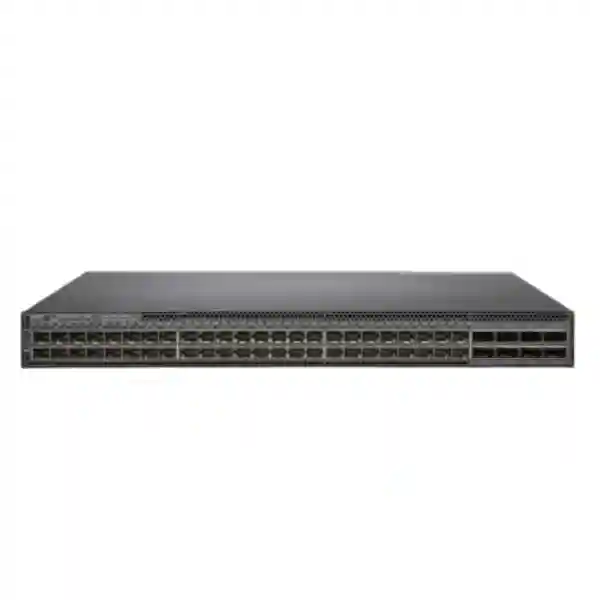
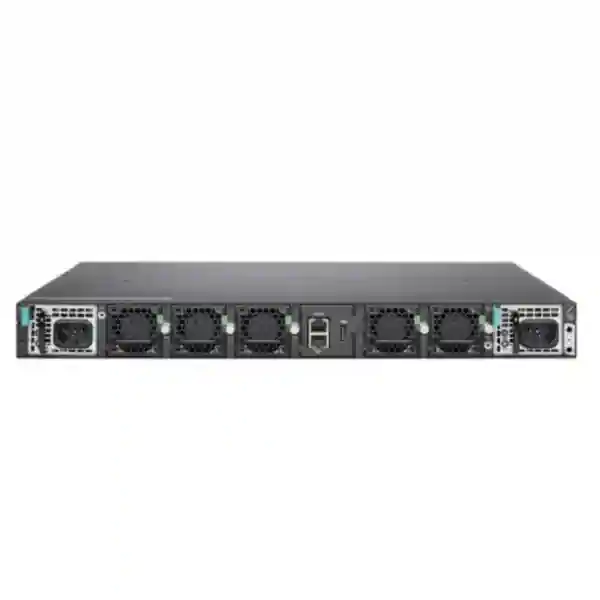
RUCKUS ICX 7850-48F Aggregation and Core Switch
The RUCKUS ICX 7850-48F is designed for organizations that need high-density fiber aggregation, 25GbE server or distribution connectivity, 40/100GbE uplinks, resilient stacking and advanced Layer 3 services in a compact fixed-form-factor platform. It is suited to campus cores, aggregation layers, data-center access or leaf-style roles, large wireless backbones and environments where growth from 10GbE toward 25GbE and 100GbE must be planned without moving immediately to a modular chassis.
48 × 1/10/25GbE SFP28 ports
8 × 40/100GbE QSFP28 ports
Maximum switching capacity: 4000 Gb/s
Up to 12 switches per stack
BGP, OSPF, VRF, VXLAN, MCT, sFlow and Campus Fabric support
Direct answer: who should consider the ICX 7850-48F?
Organizations should consider the RUCKUS ICX 7850-48F when the aggregation or core layer needs many fiber interfaces at 10GbE or 25GbE and also needs 40GbE or 100GbE links for upstream connectivity, inter-switch transport or stacking. The model is particularly relevant when a network team wants high port density in 1U, wants to scale by adding fixed switches instead of buying a large chassis at the outset, or must aggregate access switches, Wi-Fi infrastructure, servers, storage or branch/data-center links into a resilient high-speed backbone.
The ICX 7850-48F is not a Power over Ethernet access switch; RUCKUS lists PoE/PoE+ as not supported on this model. That makes it a better fit for fiber aggregation and core duties than for directly powering phones, cameras or access points. Buyers should therefore review the surrounding access-layer design, optics, fiber type, transceiver reach, routing architecture, redundancy model, rack airflow, power feeds and management platform before purchasing. FourTeck can help convert those design requirements into a quotation request rather than treating the switch as a standalone line item.
Verified RUCKUS ICX 7850-48F specifications
Up to 48 SFP28 ports supporting 1GbE, 10GbE and 25GbE operation, allowing mixed migration plans where supported optics and endpoint speeds differ.
Eight QSFP28 ports supporting 40GbE and 100GbE, suitable for uplinks, backbone links or stacking subject to the intended topology and supported configuration.
RUCKUS publishes a maximum switching capacity of 4000 Gb/s for the ICX 7850-48F, with stacks of up to 12 switches and aggregate stack bandwidth up to 9600 Gb/s.
Published capabilities include static routing, RIP, OSPF, BGP, VRF, VXLAN, Multi-Chassis Trunking, sFlow, OpenFlow with hybrid port mode and Campus Fabric technology.
The model also supports redundant power options, hot-swappable internal power supplies and fans, and reversible airflow. These functions are valuable for core and aggregation deployments where maintenance windows are limited, but the bill of materials must still match the desired airflow direction, power input arrangement and redundancy policy. Confirm final software support, transceiver compatibility and ordered accessories for the proposed deployment before purchase.
Design and procurement questions to answer before requesting a quote
A useful ICX 7850-48F quotation starts with architecture rather than quantity. Define how many 1GbE, 10GbE and 25GbE fiber ports are required now, which ports must grow to higher speeds, and how many 40GbE or 100GbE links will be consumed by uplinks, inter-core connections, stacking or high-capacity downstream systems. Then document the fiber plant: multimode or single-mode, connector type, distances, patching method and any existing optics that must be reused. Transceiver selection is part of the design because a switch port speed alone does not guarantee compatibility with the cable plant or the far-end device.
Next, define the resilience model. A single switch may be adequate for a non-critical lab, but production campus cores generally require consideration of redundant devices, power feeds, uplinks and routing. Where stacking is planned, determine whether it is being used for operational simplicity, bandwidth, distributed placement or failure-domain design. Where MCT, BGP, OSPF, VRF or VXLAN is required, document the intended topology and software baseline so configuration assumptions can be reviewed before procurement.
Finally, include rack location, available rack units, airflow direction, power source, cooling, management access, monitoring requirements, support expectations and migration scope. The surrounding firewall and security architecture also matters. Buyers can review FourTeck’s firewall product catalogue and perimeter firewall planning guidance when the new core switch will connect directly to an internet edge or security cluster.
Compatibility, optics and migration guidance
The ICX 7850-48F gives network teams flexibility because the SFP28 interfaces support multiple Ethernet rates and the QSFP28 interfaces support 40GbE and 100GbE. That flexibility does not remove the need for a port-by-port compatibility plan. Confirm the required optic type, wavelength, reach and connector for every link. Where breakout is considered on QSFP28 connectivity, verify the exact supported mode and whether the same ports are reserved for stacking, because stacking and breakout choices can affect one another.
Migration projects should identify every existing upstream and downstream device, including access switches, wireless controllers or management systems, servers, storage, firewalls, routers and WAN handoffs. Record their interface speeds, LAG/LACP design, VLAN requirements, spanning-tree behavior, routing adjacencies, MTU settings and management dependencies. This avoids buying the correct switch but the wrong optics or discovering during cutover that an older endpoint cannot negotiate the planned speed.
For security-adjacent projects, FourTeck’s firewall deployment planning page explains why routing, VLANs, addressing and policy dependencies should be mapped before changes. Organizations evaluating edge firewalls alongside the core can also review the Palo Alto PA-410, Palo Alto PA-415, Sophos XGS 88 and Palo Alto PA-5450 platform as examples of security platforms that may sit northbound of a switching core, depending on scale and design. These are not direct substitutes for the ICX 7850-48F; they perform a different network-security role.
RUCKUS ICX 7850-48F Aggregation and Core Switch Dubai
Customers searching for the RUCKUS ICX 7850-48F Dubai typically need more than a model number: they need to know whether a 25GbE aggregation switch fits an existing campus or data-center design, which optics should be quoted, how 100GbE uplinks will connect to the rest of the network, and whether the switch should operate independently or as part of a resilient stack. In Dubai enterprise environments, the practical design question is often how to consolidate many high-speed fiber links from access, server, storage or wireless infrastructure while keeping enough uplink capacity for future expansion. The ICX 7850-48F addresses that requirement with 48 multi-rate SFP28 interfaces and eight 40/100GbE QSFP28 interfaces, but the final design should be based on actual traffic paths rather than only port counts.
For a Dubai deployment, buyers should document rack location, available power feeds, preferred airflow direction, cooling, fiber distances and whether the switch sits in a main data room, campus distribution room or data-center rack. If two core switches are planned, determine how gateway redundancy, routing, link aggregation and failure handling will work. If the ICX platform will connect to internet-edge or data-center firewalls, define the handoff speed and whether the security platform can process the expected traffic at that rate. This prevents an expensive core upgrade from simply moving the bottleneck to another device.
Procurement teams can use the FourTeck UAE technology site for broader infrastructure enquiries. When requesting a RUCKUS ICX 7850-48F Dubai quotation, include switch quantity, required port speeds, optic counts and distances, power preference, airflow preference, stacking or routing requirements, destination, target deployment window and any installation or migration assistance needed. FourTeck can then review the requirement as a complete network bill of materials rather than treating the base switch as the only component. Availability, lead time, software entitlement and support terms should be confirmed in the formal quotation.
RUCKUS ICX 7850-48F Aggregation and Core Switch UAE
A UAE buyer evaluating the RUCKUS ICX 7850-48F is often planning a network refresh across more than one building or emirate. That changes the purchasing conversation because standardization becomes as important as the switch specification. A multi-site enterprise may want the same aggregation platform, optic types, management approach and spare strategy across headquarters, branch campuses, warehouses, hospitality sites, education facilities or other operations. The ICX 7850-48F can support a common high-speed fiber design, but each site should still be validated for actual port count, link speed, distance and redundancy requirements.
For UAE procurement, create a site-by-site schedule showing the number of 1/10/25GbE links, the number of 40/100GbE uplinks, fiber media, rack and power conditions, existing switch models and the systems that connect through the core. If some sites only need 10GbE while the main site needs 25GbE, the multi-rate SFP28 interfaces provide useful flexibility. However, do not assume existing optics can always move into the new switch; confirm supported transceivers and reach for every connection. Where stacks are planned, identify the stack topology and ports required so they are not accidentally double-allocated to other uplinks.
The UAE design should also consider operational support. Decide who will manage routing, VLANs, monitoring, backups and software updates, and whether configuration templates need to be consistent between sites. If the project includes a firewall refresh, keep the core and security designs aligned so routed interfaces, VLAN trunks and high-availability links are documented together. A complete request for quote should therefore include the switch, optics, patching assumptions, power supplies, stacking or uplink requirements and any professional-services scope. FourTeck can review this information and help structure a quotation while keeping stock, delivery and warranty statements subject to current supplier confirmation rather than website assumptions.
RUCKUS ICX 7850-48F Aggregation and Core Switch Uganda
Organizations searching for the RUCKUS ICX 7850-48F Uganda may be planning a central campus backbone, a data-center aggregation layer, a service-provider-style enterprise network or a multi-building fiber core. In Uganda, the most important buying exercise is to translate the site topology into a practical bill of materials. A high-capacity switch is valuable only when the fiber routes, transceivers, patch panels, power protection, racks and upstream systems are ready to operate at the planned speeds. The ICX 7850-48F offers 1/10/25GbE SFP28 density and 40/100GbE QSFP28 connectivity, which can support both current 10GbE links and an upgrade path toward 25GbE aggregation where compatible endpoints are available.
Uganda projects frequently benefit from a stronger spares and resilience discussion before purchase. If the switch will sit at a critical core, document whether there will be one unit or a redundant pair/stack, whether dual power feeds are available, and which optics or cables are essential spares. For sites outside the main data room, power quality, cooling, dust control and physical security should be evaluated as part of the deployment environment. Long fiber runs between buildings also require correct wavelength and reach choices; the transceiver selection should be based on measured distance and fiber type rather than assumptions.
The FourTeck Uganda platform provides a regional route for business IT and networking enquiries. For a RUCKUS ICX 7850-48F Uganda quotation, provide the destination, switch quantity, expected 10/25GbE port use, 40/100GbE uplink plan, optic distances, desired redundancy, routing requirements and whether deployment support is part of the scope. This information allows procurement and technical teams to discuss the same architecture and reduces the risk of missing optics, power components or migration tasks in the commercial request.
RUCKUS ICX 7850-48F Aggregation and Core Switch Kampala
For Kampala enterprises, the RUCKUS ICX 7850-48F can be considered where a headquarters, campus, hotel, university, healthcare environment, financial-services network, technology facility or large office estate needs a higher-capacity fiber core. The city-level requirement is usually less about simply finding a switch and more about replacing a bottleneck without disrupting applications. Before moving from a 10GbE aggregation layer to 25GbE or 100GbE uplinks, map the present network: which access switches feed the core, where servers and storage connect, which firewall or router is northbound, which VLANs and routing protocols are active, and what maintenance window is available.
A Kampala deployment should also plan the physical cutover. Confirm rack space, patching, labeling, optic compatibility and management access before installation day. If a new core is introduced in parallel with an old switch, decide how VLANs and routes will be migrated and how rollback will work. If the network uses OSPF or BGP, prepare adjacency and route-validation checks. If Layer 2 trunks are being moved, document spanning-tree roots and LACP groups. These steps are important because the ICX 7850-48F supports advanced routing and fabric functions, but successful deployment still depends on matching the configuration to the existing environment.
When requesting a RUCKUS ICX 7850-48F Kampala quote, include the number of sites or buildings involved, fiber distances, existing switch models, target speeds, uplink count, planned stack size, power and airflow requirements, and whether configuration migration or testing assistance is required. A well-scoped request helps distinguish the base hardware purchase from optics, cables, installation and support. It also allows the technical team to identify whether all 48 SFP28 interfaces are needed immediately or whether the primary value is the 100GbE uplink capability and future expansion path.
RUCKUS ICX 7850-48F Aggregation and Core Switch Arua
A RUCKUS ICX 7850-48F Arua requirement is likely to come from an organization building a regional hub, expanding a campus, consolidating multiple fiber-connected buildings or creating a stronger backbone for business systems. The first question should be whether the site truly needs a 25GbE/100GbE core now, or whether the value is in establishing a platform that can support growth. The ICX 7850-48F can operate its SFP28 interfaces at 1GbE, 10GbE or 25GbE, which gives designers a migration path, but optics and endpoint capabilities must be matched carefully for each link.
For Arua, logistics and support planning deserve the same attention as port speeds. A critical network core should have a documented spare strategy for optics, patch leads and other replaceable items, plus clear records of configuration backups and management credentials. If the site has limited maintenance windows or depends heavily on WAN connectivity to other locations, define a rollback plan before replacing the existing core. Redundant power options and hot-swappable components can improve serviceability, but they do not replace good power design, environmental control or operational procedures.
A useful RUCKUS ICX 7850-48F Arua procurement request should specify whether the switch connects local servers, access switches, wireless aggregation, surveillance networks, voice systems, WAN routers or firewalls. State the required VLAN count, routing protocols, uplink speed and number of physical links. If long-distance single-mode fiber is involved, provide approximate route lengths and connector information so suitable transceivers can be reviewed. FourTeck can use these details to prepare a more complete discussion around hardware, optics and deployment support, while final availability, lead time and warranty handling remain subject to confirmation at quotation stage.
RUCKUS ICX 7850-48F Aggregation and Core Switch Mbarara
Businesses and institutions evaluating the RUCKUS ICX 7850-48F Mbarara may be looking to improve fiber aggregation between departments, buildings, data rooms or high-bandwidth systems. The model is relevant where 10GbE is becoming restrictive and the network roadmap includes 25GbE downlinks or 40/100GbE uplinks. Because the switch provides 48 multi-rate SFP28 interfaces, a migration does not have to move every connection to 25GbE at once. Network teams can plan phases, provided the selected optics, far-end interfaces and software configuration support the chosen speeds.
For a Mbarara core upgrade, begin with traffic and dependency mapping. Identify which links carry business-critical applications, backups, video, voice, Wi-Fi, server traffic or inter-site services. Check whether uplinks are oversubscribed today and whether server or storage systems will actually benefit from higher-speed connectivity. If the switch will become the routing core, document current default gateways, static routes, OSPF/BGP relationships, VRFs and access-control dependencies. If it remains primarily Layer 2, document VLAN trunks, LACP bundles and spanning-tree roles. This makes migration testing measurable rather than subjective.
The physical environment also matters. Confirm rack depth and clearance, airflow direction, power sources, earthing, cooling and fiber management. A high-density fiber switch can create a substantial patching requirement, so labeling and cable routing should be designed before the equipment arrives. For a RUCKUS ICX 7850-48F Mbarara quotation, include current topology, desired port speeds, optic distances, redundancy needs and installation scope. Procurement teams should also request written confirmation of included components and separately quoted accessories so that power supplies, transceivers, cables and support entitlements are not assumed.
RUCKUS ICX 7850-48F Aggregation and Core Switch Gulu
A RUCKUS ICX 7850-48F Gulu deployment can make sense for organizations creating a regional aggregation point, modernizing a large campus network or connecting high-speed fiber between operational buildings. The switch’s 1/10/25GbE SFP28 ports provide flexibility for mixed-speed migration, while the 40/100GbE QSFP28 interfaces can support higher-capacity backbone connections. The design benefit is strongest when the network has a clear growth plan and enough high-bandwidth traffic to justify a modern aggregation or core platform.
For Gulu projects, resilience should be documented in practical terms. Decide which failures the network must tolerate: loss of one uplink, one power feed, one switch, one fiber path or an entire equipment room. Then design the switch topology around those requirements. A stack may simplify management and expand capacity, but the cabling and physical placement still need careful planning. Independent routed cores may be preferred in other architectures. The ICX 7850-48F supports multiple routing and fabric features, including OSPF, BGP, VRF, VXLAN and MCT, but choosing among them depends on the network design rather than a generic product template.
When requesting RUCKUS ICX 7850-48F Gulu pricing or availability information, provide the number of switches, required uplink speeds, fiber media, link distances, expected stack size if any, routing requirements and target site conditions. Mention whether the project includes migration from an existing core, because professional-service effort may depend on how many VLANs, routes and connected systems must be moved. Buyers should also ask for a bill of materials that separates the switch from optics and other accessories. That clarity is particularly useful for projects where procurement, installation and configuration may occur at different times.
RUCKUS ICX 7850-48F Aggregation and Core Switch Kenya
The RUCKUS ICX 7850-48F Kenya is relevant to enterprises, campuses, data centers and service-intensive organizations that need a dense fiber aggregation layer with 25GbE and 100GbE capability. Kenya buyers may be upgrading from 1GbE or 10GbE distribution networks as server virtualization, Wi-Fi, video, cloud access and east-west application traffic increase. The ICX 7850-48F provides a useful bridge because its 48 SFP28 ports can operate at 1/10/25GbE while eight QSFP28 ports support 40/100GbE. This allows a phased migration where not every connected device has to move to the same speed on day one.
A Kenya deployment should begin with a capacity plan. Measure or estimate traffic on current uplinks, identify peak periods and determine whether the next bottleneck will be the core, firewall, WAN edge, server interface or storage network. If two or more switches are used for resilience, decide whether stacking, MCT or a routed topology best fits operational requirements. Also confirm whether the network needs BGP for upstream or data-center routing, OSPF for internal route exchange, VRFs for segmentation or VXLAN for overlay use cases. The presence of these features in the platform does not mean every deployment should enable them.
The FourTeck Kenya site provides a regional channel for networking and IT infrastructure enquiries. For RUCKUS ICX 7850-48F Kenya procurement, share quantity, delivery destination, current topology, required optics, link distances, preferred support scope and target implementation plan. Ask that the quotation identify hardware, power components, transceivers, cables and services separately. This reduces ambiguity and helps the technical team verify that high-speed ports have the correct physical media and far-end compatibility before the order is finalized.
RUCKUS ICX 7850-48F Aggregation and Core Switch Kuwait
For customers searching for the RUCKUS ICX 7850-48F Kuwait, the usual requirement is a dependable high-speed aggregation or core layer for enterprise, campus or data-center networks. The model’s 48 multi-rate SFP28 interfaces and eight 40/100GbE QSFP28 interfaces can support dense fiber environments where multiple access or server links converge on a small number of high-capacity uplinks. The 1U fixed-form-factor approach may appeal to teams that want to scale in increments rather than commit immediately to a large modular chassis.
Kuwait deployments should give particular attention to data-room conditions and airflow design. The platform supports reversible airflow options, so the ordered fan and power configuration should align with the hot-aisle/cold-aisle or rack airflow plan. Confirm available power feeds and whether redundancy is required. The same principle applies to optics: specify fiber type, reach and connectorization for every 10/25/40/100GbE link. A 100GbE port does not determine the correct transceiver by itself; the cable plant and far-end equipment must be part of the selection.
The FourTeck Kuwait platform can be used for regional IT enquiries. A strong RUCKUS ICX 7850-48F Kuwait quotation request should state how the switch will be used, the number of active fiber links, planned uplink capacity, routing protocols, stack design, power requirements and whether installation, migration or configuration is needed. If the switch will connect directly to a firewall pair or WAN routers, include those interface speeds and redundancy requirements as well. This ensures the switching and security layers are sized as one end-to-end path rather than as isolated purchases.
RUCKUS ICX 7850-48F Aggregation and Core Switch Ghana
The RUCKUS ICX 7850-48F Ghana can serve as a high-capacity aggregation or core option for organizations modernizing campus backbones, data-center connectivity or fiber-connected business locations. A typical Ghana project may start with 10GbE links today but need room for 25GbE server or distribution connectivity and 100GbE backbone uplinks as demand grows. Because the ICX 7850-48F supports 1/10/25GbE on its 48 SFP28 interfaces, it can support staged transitions, provided the chosen transceivers and connected equipment are compatible with each operating speed.
The design should consider both bandwidth and operations. If the core must remain available during component maintenance, plan power feeds and device redundancy accordingly. If the switch will aggregate multiple buildings, verify fiber-path diversity rather than assuming two fibers automatically provide resilience. If the network requires segmentation for departments, tenants or services, review whether VLANs alone are sufficient or whether VRF-based routing is appropriate. If data-center workloads require overlays, VXLAN support may be relevant, but the complete architecture and software interoperability should be validated before selecting a feature simply because it exists on the datasheet.
Organizations can use the FourTeck Africa technology platform for broader regional infrastructure enquiries. A RUCKUS ICX 7850-48F Ghana request should include the destination, quantity, target topology, optic distances, link speeds, redundancy policy, management requirements and expected implementation services. Procurement teams should ask for written confirmation of current availability, lead time, support terms and exact bill of materials. Avoid assuming that a web product listing confirms local stock or that transceivers and redundant power components are automatically included with the base switch.
RUCKUS ICX 7850-48F Aggregation and Core Switch Nigeria
The RUCKUS ICX 7850-48F Nigeria is a strong technical candidate for large organizations that need high-density fiber aggregation, 25GbE connectivity and 100GbE uplinks in a compact core platform. Nigeria deployments may span headquarters, campuses, financial-services networks, data centers, large commercial facilities, education, healthcare or distributed enterprise environments. The first sizing question is how many high-speed fiber links must terminate in the core and what traffic is expected across northbound uplinks. The ICX 7850-48F provides substantial interface flexibility, but the architecture should still be validated against measured or forecast traffic.
For a critical Nigeria core, power and fault-domain planning are essential. Define whether the installation needs redundant power feeds, two switches, diverse fiber paths and independent upstream devices. Hot-swappable internal power supplies and fans improve serviceability, yet the system design should not depend on a single upstream circuit or single physical path if business continuity requires more. Where BGP or OSPF is used, document route policy and failover testing. Where the switch aggregates Layer 2 networks, document STP, LACP and VLAN behavior. This information also helps estimate the migration effort from an existing core.
A complete RUCKUS ICX 7850-48F Nigeria quotation request should list switch quantity, rack location, airflow requirement, optic types or link distances, port-speed plan, 40/100GbE uplinks, stacking requirement, routing features and expected support scope. If the installation connects to internet-edge firewalls, include the firewall interface and throughput design so the overall path remains balanced. FourTeck can use the submitted details to coordinate a more precise bill of materials and implementation discussion. Current stock status, delivery schedule, support entitlement and warranty handling should be confirmed for the exact order rather than inferred from general product information.
RUCKUS ICX 7850-48F Aggregation and Core Switch Seychelles
A RUCKUS ICX 7850-48F Seychelles project may support a hospitality group, enterprise campus, government or institutional network, data facility, multi-building resort environment or other organization that depends on stable fiber aggregation. In island deployments, careful bill-of-material planning is particularly important because missing optics, patch leads or power components can delay a project even when the main switch has arrived. The ICX 7850-48F supports 48 multi-rate 1/10/25GbE SFP28 interfaces and eight 40/100GbE QSFP28 interfaces, so the procurement list should identify the exact media and reach for each link rather than buying transceivers generically.
Environmental and operational planning also deserves attention. Equipment should be installed in an appropriate controlled data-room environment with suitable cooling, clean power, rack protection and cable management. Where links cross a campus or connect separate buildings, confirm fiber route, distance and protection. If the switch is business-critical, consider how faults will be handled and which spares should be kept locally. Redundant power options and hot-swappable components can reduce maintenance impact, but a full resilience plan may also require multiple switches, diverse uplinks and tested configuration backups.
For a RUCKUS ICX 7850-48F Seychelles quotation, provide the delivery destination, required quantity, port-speed schedule, fiber distances, optic type if known, power and airflow preference, intended routing or stacking model and any on-site or remote deployment assistance required. If the switch forms part of a larger infrastructure refresh, include the firewall, WAN, Wi-Fi and server/storage dependencies so that interface compatibility can be checked as a system. FourTeck can then structure the commercial discussion around the complete requirement and confirm current sourcing, shipping, support and warranty details for the selected bill of materials.
Why the ICX 7850-48F is different from an access switch
The ICX 7850-48F is built for aggregation and core work, not for directly powering edge devices. RUCKUS lists PoE/PoE+ as unavailable on this model, while the port mix is oriented toward high-speed fiber and 100GbE. That distinction matters during solution design. Wireless access points, IP phones, cameras and other powered devices normally connect to PoE-capable access switches. Those access switches then uplink through 10GbE or 25GbE fiber toward an aggregation or core platform such as the ICX 7850-48F.
This layered design allows the core to focus on high-speed transport, routing and resiliency. When a buyer asks whether the ICX 7850-48F can replace an access switch, the answer depends on the endpoints: it can aggregate fiber-connected systems, but it will not supply PoE to edge devices. When a buyer asks whether it can replace a modular chassis, the better question is whether the required port density, redundancy, routing and growth model fit the fixed-form-factor distributed architecture. That evaluation should be done against the full network design rather than a single headline specification.
RUCKUS ICX 7850-48F FAQ
How many 25GbE ports does the ICX 7850-48F support?
RUCKUS lists a maximum of 48 25GbE SFP28 ports on the ICX 7850-48F. The same SFP28 interfaces can support 1GbE and 10GbE operation, subject to compatible optics and configuration.
Does it have 100GbE uplinks?
Yes. RUCKUS lists up to eight 100GbE QSFP28 ports on this model, with 40GbE also supported. Port use for uplinks, stacking or breakout should be planned as part of the topology.
Can the ICX 7850-48F provide PoE?
No. The manufacturer lists PoE/PoE+ as not supported for the ICX 7850-48F. Use PoE-capable access switches for powered edge devices and aggregate them into the ICX platform where appropriate.
How many ICX 7850 switches can be stacked?
RUCKUS lists a maximum of 12 switches per stack and aggregate stack bandwidth up to 9600 Gb/s for the platform. The exact stack design should account for port allocation, physical topology and software requirements.
Which Layer 3 features are available?
Published support includes static routing, RIP, OSPF and BGP, along with VRF. VXLAN and Multi-Chassis Trunking are also listed. Final feature use should be checked against the intended software release and architecture.
What should be included in a quote request?
Provide quantity, destination, planned port speeds, optics and fiber distances, 40/100GbE uplink count, redundancy model, power and airflow preference, routing or stacking requirements, support term and any installation or migration services needed.
Related infrastructure and security planning
A core-switch purchase should be coordinated with the systems around it. If the ICX 7850-48F connects to a security edge, review firewall interface speeds, LACP or routed handoffs, VLAN segmentation and high-availability cabling. FourTeck’s company and solution overview provides context for broader project discussions. The objective is to avoid a design in which the core is capable of 100GbE but the adjacent security or routing layer is undersized for the traffic path.
Similarly, coordinate the switch with server and storage teams. A 25GbE port may be technically available, but actual performance depends on NICs, host configuration, storage architecture, virtualization, MTU and application behavior. For large migrations, agree on a test plan that verifies physical links, LACP, VLANs, routes, reachability, monitoring and application performance before the old core is removed.
Quotation checklist for the RUCKUS ICX 7850-48F
Switch quantity; required 1/10/25GbE ports; required 40/100GbE ports; optic types and distances; patching and breakout needs; power-supply configuration; airflow direction; rack requirements.
Stacking or independent cores; OSPF/BGP/static routing; VRFs; VLANs; MCT or VXLAN requirements; LACP; firewall and router handoffs; management network; monitoring and sFlow requirements.
Destination; target deployment window; requested support term; warranty expectations; configuration or migration assistance; testing; documentation; spare optics; implementation responsibilities and acceptance criteria.
Decision recap
Choose the RUCKUS ICX 7850-48F for evaluation when the requirement centers on dense 1/10/25GbE fiber aggregation, 40/100GbE uplinks, advanced Layer 3 functions and a scale-out fixed-switch architecture. Do not select it only because the headline speeds are high. Confirm that the surrounding access switches, servers, firewalls, routers, fiber plant and operational team can use those capabilities effectively.
A well-prepared quote should make every assumption visible: switch count, optics, distances, stack or routing design, redundancy, power, airflow, software/support requirements and implementation scope. That approach improves technical accuracy and makes commercial comparisons easier because competing quotations can be checked against the same bill of materials.
For multi-region projects, use the same engineering template at every site but validate local conditions individually. Standardization is valuable, yet a campus in Dubai, a regional site in Uganda, a Kenya data center, a Kuwait enterprise rack or a Seychelles island deployment may have different fiber distances, power arrangements, spares needs and logistical constraints. FourTeck can help structure those requirements and prepare a quotation discussion around the exact project rather than an assumed one-size-fits-all bundle.

Reviews
There are no reviews yet.