
WatchGuard Firebox M495
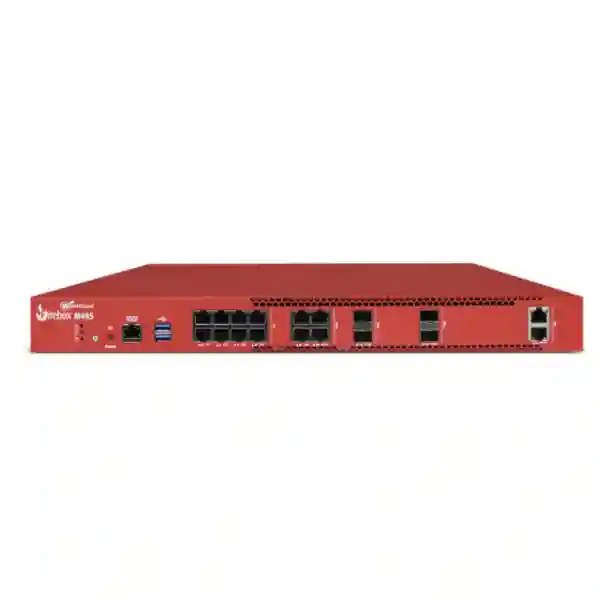
The WatchGuard Firebox M495 is built for organizations that need more security inspection capacity than a small branch appliance while still wanting a manageable 1U platform for a larger office, regional branch or midsize headquarters. WatchGuard positions the M495 for up to 500 users and publishes 6.3 Gbps UTM throughput, 3.5 Gbps HTTPS inspection with IPS enabled, 7.4 Gbps IPS throughput and 37 Gbps raw firewall throughput under its specified test conditions. The platform combines twelve 2.5G copper interfaces with two 10G copper interfaces, two 1G SFP interfaces and two 10G SFP+ interfaces, giving network teams useful options for ISP handoffs, server or core-switch uplinks, segmented LANs and branch aggregation. FourTeck helps buyers evaluate the appliance, confirm the right security subscription, review migration requirements and prepare a deployment plan before purchase.
WatchGuard published full-scan UTM performance; actual results depend on configuration and traffic.
Published HTTPS throughput with IPS enabled under vendor test methodology.
Vendor positioning for larger branches and midsize headquarters; sizing should still be workload based.
12 × 2.5G RJ45, 2 × 10G RJ45, 2 × 1G SFP and 2 × 10G SFP+.
What the WatchGuard Firebox M495 is designed to do
A firewall purchase should begin with the traffic and security workload rather than with a model number. The M495 is relevant when a site has moved beyond basic internet gateway requirements and now needs higher inspected throughput, several network segments, multiple WAN or upstream paths, more VPN capacity, faster copper or fibre uplinks, and centralized policy administration. It can sit between internet circuits and the internal core, protect server and user VLANs, provide controlled connectivity to branches, apply security services to outbound and inbound traffic, and support remote users through WatchGuard VPN capabilities. Its port mix is particularly useful for environments where 1G connectivity is no longer sufficient everywhere: 2.5G copper can connect modern switches without immediately requiring fibre, while 10G copper and SFP+ allow faster uplinks to a core switch, aggregation layer or compatible ISP handoff.
WatchGuard lets the Firebox be managed locally through Fireware Web UI or WatchGuard System Manager, or centrally through WatchGuard Cloud. That gives organizations flexibility when deciding whether each appliance should be locally administered, cloud managed, or integrated into a broader multi-site operational model. The correct choice depends on the IT team, reporting requirements, change-control process and subscription. FourTeck can help translate these options into a practical bill of materials and deployment scope rather than treating the firewall as a hardware-only purchase.
Choose the M495 only after checking real internet bandwidth, HTTPS inspection demand, concurrent users, VPN users, branch tunnels, required security services, logging load, port types and expected growth. Published maximum throughput figures are laboratory measurements and should not be treated as guaranteed application performance in every deployment.
Verified WatchGuard Firebox M495 specifications
| Specification | Published / verified detail | Buyer relevance |
|---|---|---|
| UTM throughput | 6.30 Gbps full scan | Useful reference when multiple security services inspect traffic. |
| HTTPS inspection | 3.50 Gbps with IPS enabled | Important where encrypted web and cloud traffic dominates. |
| IPS throughput | 7.40 Gbps full scan | Helps assess intrusion-prevention inspection capacity. |
| Firewall throughput | 37.00 Gbps UDP 1518 | Raw forwarding benchmark; not equal to fully inspected application traffic. |
| VPN | 3.0 Gbps IMIX; up to 800 Branch Office VPN and 800 Mobile VPN tunnels | Relevant for distributed sites and remote-user planning. |
| Network interfaces | 12 × 2.5G RJ45; 2 × 10G RJ45; 2 × 1G SFP; 2 × 10G SFP+ | Supports mixed copper/fibre designs and faster upstream or core links. |
| Processor / memory | Intel Core i3-14100; 8 GB DDR4 | Verified hardware platform information from WatchGuard documentation. |
| Storage | 128 GB M.2 PCIe SSD | Supports the appliance platform and local operating requirements. |
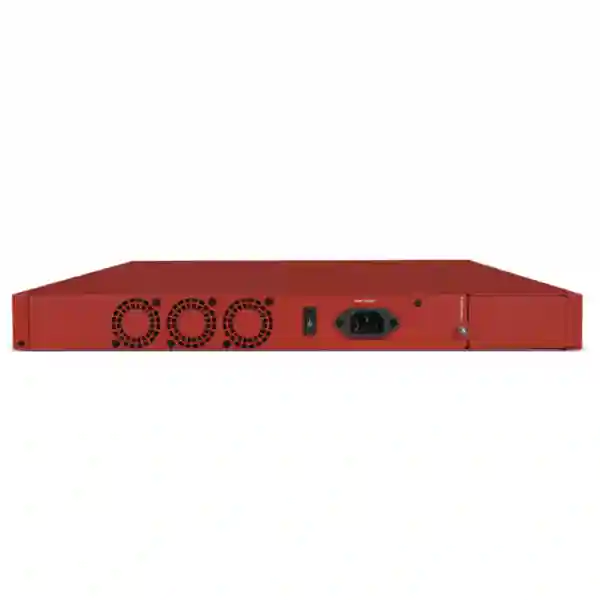
| Form factor | 1U-class rackmount, 440 × 310 × 44 mm; 4.9 kg | Check rack depth, airflow and conditioned power before deployment. |
| Operating environment | 0°C to 40°C; 0–95% non-condensing humidity | Important for comms rooms and sites with high ambient temperatures. |
Performance figures are WatchGuard-published test results and can vary with firmware, traffic mix, packet size, enabled inspection, TLS decryption, security policy complexity, logging and network design. Confirm sizing against your production workload before ordering.
Licensing: Standard Support, Basic Security Suite or Total Security Suite
Standard Support
Includes the stateful firewall foundation, VPN capability, built-in SD-WAN, centralized management options and support entitlement. It can be appropriate when the organization has another layered security design or needs a specific routing/VPN role, but it does not provide the same security-service set as the paid suites.
Basic Security Suite
Adds key network security services such as Intrusion Prevention Service, Gateway AntiVirus, WebBlocker, Application Control, spamBlocker, Reputation Enabled Defense and Tor exit-node blocking. This bundle is relevant when the Firebox must act as the active security inspection gateway for users and internet traffic.
Total Security Suite
Includes the Basic Security services and adds advanced protections such as IntelligentAV, APT Blocker, DNSWatch and EDR Core according to WatchGuard’s current service documentation. Buyers should compare security objectives, retention/reporting needs and subscription duration before selecting a bundle.
Licensing is a major part of M495 procurement because the appliance, term length and security suite determine the usable security capability and commercial cost. A quote request should therefore state whether the requirement is hardware only, a one-year or multi-year subscription, a renewal or migration, high availability, and whether advanced security services are expected. FourTeck can help prepare the correct requirement before pricing is requested.
Planning a Firebox M495 deployment
The strongest M495 deployment begins before the device is racked. Document the internet circuits, current firewall model, WAN addressing, VLANs, IP subnets, published services, DHCP/DNS dependencies, site-to-site VPN tunnels, remote-user VPN groups, routing protocols or static routes, switch uplinks, authentication sources and any applications that depend on fixed source addresses or port forwarding. This information lets the implementation team decide which interfaces should be WAN, LAN, DMZ or transit links and whether 2.5G or 10G connectivity is required on the inside as well as the outside.
For replacement projects, avoid a blind one-to-one copy of every existing rule. Older firewalls often contain temporary allows, obsolete NAT entries, expired vendor access, unused VPNs and naming conventions that no longer match the network. Migration is an opportunity to identify required traffic, remove unnecessary exposure and create a cleaner policy structure. Use a rollback plan, configuration backup and defined change window for production cutovers. If high availability is part of the requirement, the design should also include matching hardware, switch connections, failure domains, synchronization, upstream/downstream behavior and testing of actual failover rather than assuming redundancy works because two appliances are installed.
WatchGuard Firebox M495 Dubai
Businesses searching for a WatchGuard Firebox M495 in Dubai are often trying to solve one of three problems: replacing a firewall that no longer keeps up with inspected internet traffic, standardizing security for a regional office, or building a new headquarters network with faster internal links and better policy control. The M495 is worth evaluating for these projects because it is not limited to 1G interfaces. Twelve 2.5G copper ports can fit modern access or distribution switching, while the two 10G copper and two 10G SFP+ interfaces create options for higher-speed links to a core switch, server zone or compatible internet handoff. For a Dubai office using cloud ERP, Microsoft 365, video collaboration, hosted applications, remote-user VPN and branch connectivity at the same time, that interface flexibility can be as important as the headline firewall throughput.
Dubai buyers should size the M495 against the traffic that will actually be inspected. If the organization has a 1, 2, 5 or multi-gigabit internet service, compare expected encrypted traffic with WatchGuard’s 3.5 Gbps published HTTPS inspection figure rather than using the 37 Gbps raw firewall benchmark as the only sizing number. Include peak user traffic, backup windows, cloud synchronization, remote VPN, guest Wi-Fi, public services and branch tunnels in the discussion. If TLS decryption will be enabled broadly, test business applications and certificate deployment because some applications require exceptions or additional trust configuration. The objective is to select a model that protects the business without creating an avoidable bottleneck.
Procurement in Dubai should also separate hardware, security subscription and implementation services. Ask whether the quotation includes Standard Support, Basic Security Suite or Total Security Suite, the subscription term, any required SFP/SFP+ transceivers, power requirements, rack installation, migration, VPN configuration, high-availability design and post-cutover support. Do not assume every security feature is included with a hardware-only price. For organizations migrating from an older WatchGuard, review the old configuration before transfer and clean up inactive policies rather than carrying historical exposure into the new platform.
FourTeck’s Firewall Dubai resource explains broader firewall selection and deployment considerations, while the Dubai firewall quotation channel can be used to share user count, internet speed, existing firewall, security bundle preference, interface requirements and deployment scope. A complete requirement produces a more useful quote than simply asking for “M495 price,” because licensing and implementation choices can materially change the final solution.
WatchGuard Firebox M495 UAE
For UAE organizations, the WatchGuard Firebox M495 can be evaluated as a security gateway for a head office, regional operations center or larger branch where internet use, site connectivity and internal segmentation have grown beyond a small-appliance design. A UAE deployment may need to connect Dubai, Abu Dhabi, Sharjah, Ajman or other emirate locations through site-to-site VPN while also supporting remote staff, cloud applications, guest networks and locally hosted business services. WatchGuard lists capacity for up to 800 Branch Office VPN tunnels and 800 Mobile VPN connections, which gives the platform substantial logical VPN headroom, but the practical design should still be based on encrypted throughput, real concurrency, authentication, routing and application behavior.
The M495’s multi-gigabit interface layout matters when the firewall sits between modern switching and high-speed WAN connections. Twelve 2.5G RJ45 ports can serve segmented trusted, guest, server or transit networks without forcing every zone onto a single trunk. Two 10G RJ45 and two 10G SFP+ ports can be allocated to a core, data-center edge or upstream provider depending on the topology. Before ordering, confirm the physical media, switch port type and optics. An SFP port does not automatically include a transceiver, and the exact compatible optics should be checked against WatchGuard’s support documentation. Planning this during procurement avoids a common problem where the appliance arrives but the network cannot be connected at the intended speed.
UAE buyers should also decide how the Firebox will be administered. WatchGuard supports local management with Fireware Web UI or WatchGuard System Manager, and cloud management through WatchGuard Cloud. A company with several branches may prefer centralized templates and unified visibility; another may require local control for a specific operational process. Licensing affects logging and reporting capability, so the management model, security bundle and reporting expectations should be discussed together. For businesses with formal change management, document policy owners, VPN approvers, backup procedures, firmware windows and admin access before the firewall goes live.
FourTeck’s UAE technology platform at FourTeck UAE covers broader network security and IT infrastructure, while the Firewall Dubai site provides focused firewall planning. When requesting an M495 quotation, include current and target internet bandwidth, inspected traffic expectations, number of users and sites, VPN type, required 2.5G/10G interfaces, security suite, subscription term and whether migration or high availability is part of the project. This information helps procurement compare like-for-like proposals rather than mixing appliance-only and fully configured solution prices.
WatchGuard Firebox M495 Uganda
Organizations evaluating the WatchGuard Firebox M495 in Uganda may be planning security for a central office that supports branch sites, remote workers and cloud-based services across different connectivity conditions. The M495 is most relevant when the site needs a rackmount appliance with higher inspection capacity, large VPN scale and flexible copper/fibre connectivity rather than a simple small-office gateway. For a headquarters environment with business applications, VoIP, CCTV networks, guest Wi-Fi, finance systems and remote access, the firewall can create policy boundaries between traffic types and provide a controlled point for internet access, VPN and security inspection. The platform’s twelve 2.5G RJ45 interfaces and 10G options also allow the internal network to grow without being restricted to a 1G-only firewall design.
Uganda projects should pay particular attention to WAN architecture and resilience. A site may have primary fibre plus a secondary provider or cellular backup, and the firewall design should define how failover is detected, which traffic moves to the backup path, and whether branch VPNs recover automatically. WatchGuard’s SD-WAN and multi-WAN capabilities can be part of that design, but the business needs clear priorities: ERP and voice may need a different failover policy than guest browsing or large backups. If remote sites use varying bandwidth, tune branch expectations around the slowest link rather than the head-office capacity alone. The M495’s VPN scale is valuable, but tunnel count does not guarantee application performance over a weak or unstable last-mile circuit.
Licensing should be included in the purchase plan from the beginning. Basic Security Suite adds services such as IPS, Gateway AntiVirus, WebBlocker and Application Control, while Total Security Suite extends the security layer with additional advanced services. If the firewall will be the principal internet-security control for hundreds of users, evaluate the security suite based on the protections the organization intends to operate, not only on acquisition price. Also document renewal ownership so subscriptions do not lapse without a plan.
Uganda buyers can use FourTeck Uganda for regional IT and networking context and the Firewall Dubai technical pages for detailed firewall planning. A useful quote request should include location count, ISP bandwidth, whether links use static or dynamic addressing, user and VPN estimates, switch uplink speeds, required security services, existing firewall model and expected support scope. That allows the M495 to be assessed as part of the real network rather than as an isolated appliance.
WatchGuard Firebox M495 Kampala
Kampala organizations looking for a WatchGuard Firebox M495 are often larger offices, institutions, hospitality groups, service companies or multi-site operations that need a central security gateway with capacity for many users and branch connections. The buying question is not simply whether the M495 is “powerful.” The more useful question is whether its inspected throughput and interface mix align with the Kampala site’s WAN links, internal switching and application load. A headquarters with hundreds of users may have substantial HTTPS traffic from Microsoft 365, Google Workspace, cloud ERP, CRM, software updates, video meetings and hosted services. For that environment, compare the expected encrypted traffic with the M495’s published 3.5 Gbps HTTPS inspection performance and build margin for growth.
Network segmentation is another reason to consider this class of appliance. A Kampala office may need separate VLANs for employees, servers, guest Wi-Fi, CCTV, IP phones, management devices and visiting contractors. The Firebox can apply policy between those zones so a guest network cannot directly reach finance systems or internal servers. Use the M495’s multiple 2.5G interfaces where physical separation is useful, or connect a tagged trunk to managed switching where the design is easier to maintain that way. The correct topology depends on the switch architecture and failure requirements; more ports do not mean every network must be physically separated.
For branch-heavy Kampala deployments, define VPN naming, addressing and access policy before configuration. Branch Office VPN can connect district offices or regional sites, but each tunnel should have a documented purpose and limited routes rather than unrestricted network access by default. Remote-user VPN should also be mapped to roles. Finance, administrators, engineers and external vendors rarely need identical access. Strong authentication, user offboarding and log review should be part of operations, not an afterthought introduced after the firewall is installed.
When requesting a Kampala quote, include whether the project needs appliance supply only, security subscriptions, migration from an existing firewall, site-to-site VPN, remote VPN, web filtering, application control, high availability, installation or ongoing policy support. If the current network uses fibre uplinks, confirm whether compatible SFP or SFP+ transceivers are required. The broader FourTeck Uganda platform can support regional technology inquiries, while FourTeck’s firewall specialists can use the same requirement set to assess whether the M495 is appropriately sized.
WatchGuard Firebox M495 Arua
Arua buyers considering the WatchGuard Firebox M495 may have a different requirement from a capital-city headquarters. The appliance can still make sense for a substantial regional operation, institution, distribution hub or branch aggregation site, but connectivity quality and supportability should be evaluated carefully. If the local internet connection is far below multi-gigabit speeds, the reason to choose an M495 may be user density, VPN aggregation, internal segmentation, future bandwidth growth or standardization with other corporate locations rather than raw WAN throughput alone. Sizing should therefore separate immediate internet speed from the broader lifecycle requirement.
Arua deployments can benefit from deliberate resilience planning. If the business depends on centralized applications in Kampala, another country or the cloud, the firewall may need to maintain site-to-site VPN across more than one WAN path. Document how a secondary connection will be used, which routes or SD-WAN policies should fail over, and which applications must remain available during degraded connectivity. Backup links may have lower bandwidth or higher latency, so the failover policy should prioritize business-critical traffic rather than trying to reproduce normal performance for every user. Voice, transactional applications and remote management may need priority while software updates and large synchronization jobs can wait for the primary circuit.
Physical deployment also matters. WatchGuard specifies an operating range up to 40°C and recommends a secure indoor location with conditioned power. In a regional site, verify rack space, ventilation, UPS capacity and electrical quality before installation. The M495 is a rackmount appliance, so it should be placed in a suitable communications area rather than on an exposed desk or shelf. If local switching uses copper only, the 2.5G and 10G RJ45 ports may simplify installation; if fibre is required between rooms or buildings, verify supported SFP/SFP+ optics and cable type.
Procurement teams in Arua should request a complete bill of materials that identifies the firewall, subscription term, optics if needed, support level and any implementation service. The FourTeck Uganda site provides a regional contact point, while the M495 requirement can be reviewed against user count, traffic, VPN, WAN resilience and operational support. That avoids buying a device that is technically capable but poorly matched to the site’s connectivity or maintenance model.
WatchGuard Firebox M495 Mbarara
In Mbarara, the WatchGuard Firebox M495 can be evaluated for larger commercial offices, education environments, healthcare networks, hospitality operations and regional businesses that need to protect several types of users and devices behind one security gateway. The platform’s value is not limited to blocking internet threats. It can enforce separation between staff systems, guest Wi-Fi, servers, CCTV, voice networks and management interfaces, while supporting secure VPN links to headquarters or other branches. For an organization whose local network has grown organically, moving to a structured firewall design can improve both security and troubleshooting because traffic paths become explicit and logged.
A practical Mbarara sizing exercise should start with the busiest hour. Count simultaneous users, cloud application sessions, video meetings, file transfers, backups, software updates, IP phones and remote-access connections. Then identify which traffic will be inspected by IPS, antivirus, web filtering or HTTPS decryption. The M495’s 6.3 Gbps UTM figure is more relevant to security-heavy deployments than the 37 Gbps raw firewall figure, and the 3.5 Gbps HTTPS inspection result is especially important if most user traffic is encrypted. Real-world performance varies, so allow operating headroom instead of planning to run at a published maximum continuously.
The M495 also offers room for network modernization. Twelve 2.5G copper ports can connect higher-speed switches without immediately moving all uplinks to fibre. The two 10G RJ45 and two 10G SFP+ ports can support a faster core or server path where needed. Before purchase, review the current switch model and available interfaces so the firewall’s faster ports are actually usable. If the LAN remains 1G everywhere, the M495 will still negotiate lower speeds on its multi-gig copper ports, but the design should understand where future upgrades are expected.
For commercial procurement in Mbarara, include security subscriptions and renewal planning in the business case. A firewall with expired security services may continue basic routing and policy functions but will not deliver the intended full security posture. Use FourTeck Uganda to discuss regional requirements and provide a network summary with WAN speeds, user count, VLANs, VPN sites and desired security features. That information helps determine whether M495 is justified or whether another Firebox size would be more proportionate.
WatchGuard Firebox M495 Gulu
For Gulu organizations, a WatchGuard Firebox M495 purchase should be tied to a clear operational role. It may act as the primary internet security gateway for a major branch, aggregate VPN connections from smaller sites, protect a campus-style network, or standardize firewall hardware across an organization with several Ugandan locations. Because the M495 supports a large number of VPN tunnels, it can accommodate complex site connectivity, but the best design still uses deliberate address planning, route control and limited access between locations. A tunnel should carry only the networks and services that the business needs rather than creating a flat trust relationship across every branch.
Gulu deployments can also benefit from strong change and backup procedures. Regional sites sometimes rely on a small local IT team or remote support from another city. In that situation, the firewall configuration should be understandable to people who were not present during installation. Use clear interface names, policy names, network objects, VPN descriptions and backup routines. WatchGuard supports cloud and local management models, so choose the model that gives the organization an appropriate balance of central visibility and local control. Confirm that the chosen subscription supports the reporting and log-retention expectations of the IT team.
Environmental and power conditions should be reviewed before delivery. The M495 is a rackmount appliance with an internal power supply and WatchGuard recommends conditioned power. In a Gulu server or communications room, verify a stable UPS, adequate ventilation, secure rack access and cable management. If a secondary internet path uses a different medium or provider, plan the cabling and WAN failover before cutover. Test both normal traffic and the failure scenario, because a backup circuit that has never been tested may not preserve VPN or DNS behavior as expected.
When discussing the M495 with FourTeck Uganda, provide the current firewall model, WAN details, internal network diagram, number of branch tunnels, remote users, required filtering services and preferred subscription term. Also state whether configuration, migration and post-installation support are required. That creates a procurement record that can be checked later during renewal or expansion instead of leaving the organization dependent on undocumented assumptions.
WatchGuard Firebox M495 Kenya
Kenyan businesses searching for the WatchGuard Firebox M495 are commonly comparing enterprise-class branch security with the need to manage growing internet bandwidth, cloud applications and multiple locations. The M495 is aimed at the segment between smaller branch firewalls and much larger data-center platforms. WatchGuard positions it for larger branches or midsize headquarters and publishes up to 500 users, 6.3 Gbps UTM throughput and 3.5 Gbps HTTPS inspection. For Nairobi headquarters, regional offices or multi-site organizations, those figures should be mapped to the actual workload rather than treated as a generic promise. A 500-user office with heavy encrypted cloud traffic can stress a firewall differently from a 500-user organization where many users are intermittent.
The interface layout is useful for Kenya deployments that are moving to faster access and core switching. Twelve 2.5G copper interfaces can support multiple LAN segments or multi-gig uplinks; two 10G copper and two 10G SFP+ interfaces can serve core, data-center or provider connections; and two 1G SFP ports provide additional fibre flexibility. Before buying optics, confirm supported transceiver models and fibre type. For organizations in multi-tenant buildings or data centers, also confirm how the service provider presents the circuit—copper, single-mode fibre, multimode fibre or another handoff—so the correct cabling and transceivers are ordered with the firewall.
Kenya procurement should consider branch VPN and SD-WAN needs together. If sites connect back to Nairobi or another central location, document the preferred and backup paths, application priorities, route ownership and IP ranges. WatchGuard supports built-in SD-WAN with Standard Support and more extensive security services in the Basic and Total Security suites. The security bundle should align with the organization’s threat-prevention expectations, while the WAN design should align with business continuity. These are related decisions but not the same thing.
The FourTeck Kenya platform provides regional IT and firewall context. For an M495 quote, provide internet bandwidth, number of locations, user count, expected encrypted inspection, VPN usage, switching speeds, licence duration and whether the appliance is replacing another WatchGuard or a different vendor. If migration is required, export and review the old policy set early so NAT, VPN and business application dependencies are understood before the cutover date.
WatchGuard Firebox M495 Kuwait
In Kuwait, the WatchGuard Firebox M495 can suit organizations that need a high-capacity rackmount security gateway for a central office, major branch, hospitality operation, professional services environment or distributed enterprise. The appliance is especially relevant where internet circuits and internal switching are moving beyond 1G. The availability of 2.5G and 10G copper plus SFP/SFP+ fibre connections allows a network architect to avoid placing a slower firewall interface between a faster ISP connection and a modern core. The topology should still be planned carefully: the fastest available port is not automatically the correct WAN or LAN assignment, and high availability may require duplicated switch paths and ports.
Kuwait buyers should also account for encrypted traffic and cloud use. Modern offices depend on web-based ERP, collaboration tools, cloud storage, hosted email, video meetings and SaaS applications, so HTTPS traffic may represent most of the internet workload. The M495’s vendor-published 3.5 Gbps HTTPS inspection figure is therefore a key sizing reference. If the organization has a multi-gigabit internet line and intends to decrypt a large proportion of outbound web traffic, validate the expected load with a sizing exercise and maintain headroom for peak periods. Some traffic may need decryption exceptions for compatibility or policy reasons, which should be documented.
Environmental planning is also important in the Gulf. WatchGuard specifies a maximum operating temperature of 40°C for this hardware, so the appliance should be installed in a controlled indoor communications room with adequate cooling, a rack and conditioned power. Do not treat room air conditioning as an optional comfort feature for network equipment. A UPS should be sized for the firewall and the surrounding network devices so short power events do not drop the gateway while switches and servers remain active.
Use FourTeck Kuwait to discuss regional procurement and include the security suite, subscription term, interface media, rack and power requirements, migration scope and support expectation in the request. If the M495 is part of a high-availability design, state that explicitly so the quote and implementation plan account for the second appliance, matching subscriptions where applicable, cabling and failover testing rather than pricing only one standalone device.
WatchGuard Firebox M495 Ghana
Ghanaian organizations evaluating the WatchGuard Firebox M495 may need to secure a headquarters, financial or professional-services office, educational environment, hospitality property, logistics operation or other multi-department network with significant cloud and branch connectivity. The model’s strength is the combination of inspected throughput, large VPN capacity and flexible multi-gig interfaces. Rather than choosing it solely because it is newer or faster, buyers should map each capability to a requirement. For example, the 10G interfaces are valuable when the core or WAN can use them; the 800-tunnel VPN scale matters when many sites or remote connections are expected; and the 6.3 Gbps UTM figure matters when multiple security services inspect substantial traffic.
A Ghana deployment should define network zones before firewall rules are written. Staff devices, guest Wi-Fi, payment or finance systems, servers, CCTV, voice systems, infrastructure management and vendor access have different trust levels. Segmenting these networks limits unnecessary east-west communication and creates more useful logs. The M495 has enough physical interfaces for several direct networks, but large environments may still use VLAN trunks to managed switches. The design should favor clarity and resilience rather than using every port merely because it exists.
If Accra or another central site connects branches through VPN, standardize addressing and tunnel naming early. Duplicate IP subnets across branches create routing problems that become expensive to fix during migration. Document local LAN ranges, server networks, tunnel routes, DNS behavior and failover requirements before the new firewall is introduced. For remote users, decide which groups need VPN, whether full or split tunneling is appropriate, how authentication will be enforced and how inactive accounts are removed.
Procurement can be coordinated through FourTeck Ghana. A complete M495 enquiry should include current internet circuits, user count, branch count, existing firewall, security services required, subscription duration, VPN needs, switch uplinks and expected configuration support. Ask for the quote to identify appliance, license bundle, term and any optics or services separately. This makes renewals and future capacity reviews easier because the organization can see exactly which elements of the solution were purchased.
WatchGuard Firebox M495 Nigeria
Nigeria is a diverse market for enterprise connectivity, so the WatchGuard Firebox M495 should be assessed against the specific site rather than against country-level assumptions. A Lagos headquarters with redundant fibre, hundreds of users and multiple branches has different firewall demands from a regional office using a smaller WAN. The M495 is positioned for larger branches and midsize headquarters, making it relevant where high user concurrency, substantial encrypted cloud traffic, branch VPN and faster core links come together. Its twelve 2.5G RJ45 ports, 10G copper, 1G SFP and 10G SFP+ options provide enough connectivity flexibility for many corporate edge designs.
WAN resilience deserves explicit attention. Many businesses use more than one provider or combine fibre with another backup service. The firewall design should define health checks, failover rules, preferred application paths and what happens to VPN when the active WAN changes. SD-WAN can help steer traffic across available links, but it should be configured around business priorities. Critical SaaS, voice, payment or ERP traffic may receive different treatment from large downloads, guest browsing or software updates. Test the failover process during implementation rather than discovering its limitations during an outage.
Nigeria buyers should also plan for operational ownership after deployment. Decide who can create firewall policies, who approves internet or VPN access, how configuration backups are stored, how firmware upgrades are scheduled, and who monitors subscription expiry. The M495 can be cloud managed or locally managed, and the preferred operating model should reflect the organization’s skills and governance. For companies with multiple sites and a lean security team, centralized templates can reduce inconsistency, but local exceptions still need documentation so they do not become permanent hidden rules.
Use FourTeck Nigeria to start the regional procurement discussion. Provide internet bandwidth, number of sites, user estimate, existing firewall configuration, desired Basic or Total Security services, WAN failover design and interface requirements. If the organization is replacing a legacy firewall, include a policy-review stage in the implementation request. A migration is the right time to remove unused NAT, obsolete remote-access users and old vendor rules instead of replicating them on a more capable appliance.
WatchGuard Firebox M495 Seychelles
Seychelles organizations considering the WatchGuard Firebox M495 may include hospitality groups, financial or professional offices, government-linked operations, service providers or multi-site businesses that depend heavily on reliable internet and secure remote connectivity. Because island connectivity can make business continuity especially visible to users, firewall selection should balance security inspection with WAN resilience. The M495 can support multiple WAN links, SD-WAN policies, site-to-site VPN and remote-user access, but the quality of the overall solution also depends on the upstream circuits, DNS, routing and application architecture. The firewall cannot compensate for every limitation of the internet path, so sizing and failover planning should be done together.
Hospitality environments provide a useful example. A property may have corporate users, guest Wi-Fi, point-of-sale systems, cameras, building systems, IP phones and management platforms sharing the same physical infrastructure. These networks should not automatically trust one another. The Firebox can enforce policy between segments and control what each zone can reach. Where several properties or offices connect to a central system, BOVPN can provide encrypted links, but tunnel routes and permitted services should be restricted to the required applications. A compromised guest or IoT device should not have a simple route to finance systems because both happen to be behind the same gateway.
Procurement for Seychelles should include logistics and lifecycle considerations without assuming immediate local stock or delivery. Confirm current product availability, subscription activation, warranty handling, shipping arrangements and whether implementation will be on-site, remote or coordinated with a local IT team. If fibre optics are required for SFP or SFP+ connections, verify exact transceiver compatibility before the equipment is shipped. Missing optics can delay an otherwise complete installation.
For sizing, share the peak internet bandwidth, user count, guest traffic, number of sites, VPN needs, current switching and security services to be enabled. The Firebox M495 may offer more raw capacity than some Seychelles sites need today, but it can still be appropriate when the organization values standardization, higher inspected throughput, multi-gig interfaces and future growth. The final decision should come from a documented workload and commercial comparison rather than from model name alone.
Compatibility, migration and network design checklist
Before ordering
- Confirm ISP handoff speed and media.
- Confirm switch uplink type: 1G, 2.5G, 10G copper or fibre.
- Identify required SFP/SFP+ transceivers.
- Choose Standard, Basic or Total Security licensing.
- Confirm subscription term and renewal ownership.
- Decide whether high availability is required.
Before migration
- Export or document current firewall rules.
- Inventory NAT, published services and public IPs.
- List branch and remote-user VPN requirements.
- Review VLANs, DHCP, DNS and routing.
- Remove obsolete temporary or vendor access.
- Prepare rollback and test plans.
Before go-live
- Test business applications and web access.
- Test VPN from internal and external users.
- Validate WAN failover where configured.
- Verify logging, alerts and backups.
- Confirm admin access and recovery credentials.
- Document final interfaces, policies and owners.
Related firewall pages and product options on Firewall Dubai
The M495 should be compared with alternatives only when the comparison answers a real requirement such as user scale, inspected throughput, interface type, security ecosystem, budget or management preference. The links below provide verified same-site resources for broader research and procurement.
Sophos XGS 88A compact branch-class option for much smaller edge requirements.
Palo Alto Networks PA-410A compact application-aware NGFW option for smaller sites.
Palo Alto Networks PA-415A branch firewall with PoE-capable ports where integrated edge connectivity matters.
About FourTeck Firewall DubaiUnderstand the site’s firewall planning and support approach.
Frequently asked questions about WatchGuard Firebox M495
How many users can the WatchGuard Firebox M495 support?
WatchGuard positions the M495 for up to 500 users. User count is only a planning guide. Real sizing should include internet bandwidth, encrypted traffic, security services, VPN, concurrent sessions, application mix and growth.
What is the M495 UTM throughput?
WatchGuard publishes 6.3 Gbps full-scan UTM throughput for the M495. This is a vendor test result rather than a guaranteed production speed. Performance varies with configuration, traffic and inspection.
Does the M495 have 10G ports?
Yes. The verified hardware layout includes two 10G RJ45 copper ports and two 10G SFP+ ports, in addition to twelve 2.5G RJ45 and two 1G SFP interfaces.
Can the M495 be managed from WatchGuard Cloud?
Yes. WatchGuard documentation supports cloud-managed and locally managed deployment models. The chosen license affects security services, logging and reporting capability, so management and subscription planning should be done together.
Which license should I choose?
Standard Support includes firewall, VPN, SD-WAN and management fundamentals. Basic Security adds services including IPS, Gateway AntiVirus, WebBlocker and Application Control. Total Security includes Basic and adds advanced services such as IntelligentAV, APT Blocker, DNSWatch and EDR Core. Choose according to the protections you intend to operate.
Is the M495 suitable for high availability?
WatchGuard supports high-availability deployments for the platform. A complete HA design should account for a second matching appliance, licensing, switch paths, synchronization, WAN/LAN failure behavior and actual failover testing.
Can FourTeck migrate an existing firewall configuration?
FourTeck can discuss migration planning, but the correct scope depends on the source firewall, rulebase, NAT, VPN, authentication, routing and application dependencies. A policy review is recommended before recreating rules on the M495.
What information is needed for an accurate quote?
Share the country and site, user count, internet bandwidth, number of WAN links, number of branches, remote VPN users, security suite preference, license term, existing firewall, interface/optic requirements, high-availability need and whether deployment or migration services are required.
Decision recap: when the M495 deserves a place on your shortlist
The WatchGuard Firebox M495 is a strong candidate when a larger branch or midsize headquarters needs multi-gigabit interfaces, substantial security inspection, high VPN scale and centralized WatchGuard management in a 1U rackmount platform. It is less useful to judge it by raw firewall throughput alone. The key buying figures are the performance numbers for the services you will actually enable, especially HTTPS inspection and UTM, combined with the quality of the WAN and internal switching.
A successful purchase also includes the correct subscription, optics, power/rack plan, migration scope, VPN design and support model. If those items are unspecified, two M495 quotes can look very different while describing different solutions. FourTeck can help convert the network requirement into a comparable commercial request.
Quotation checklist
- WatchGuard Firebox M495 appliance requirement
- Standard, Basic Security or Total Security Suite
- One-year or multi-year subscription term
- Expected users and peak internet bandwidth
- HTTPS inspection and UTM requirement
- WAN, 2.5G, 10G copper and fibre connections
- SFP/SFP+ optics and cable requirements
- Branch VPN and remote-user VPN counts
- High availability, migration and configuration scope
- Country, delivery destination and support expectations
Talk to FourTeck about the M495
Send the checklist with your existing firewall and network details. FourTeck can review whether the M495 is appropriately sized, what subscription should be quoted, which interfaces or optics are required and whether migration, VPN or high-availability services should be included.

Reviews
There are no reviews yet.