

10G single-mode fibre connectivity
MikroTik S+31DLC10D in Dubai, UAE
A compact 10G SFP+ optical module for point-to-point single-mode fibre links up to 10 kilometres, with dual-LC connectivity and digital diagnostic monitoring for practical network visibility.
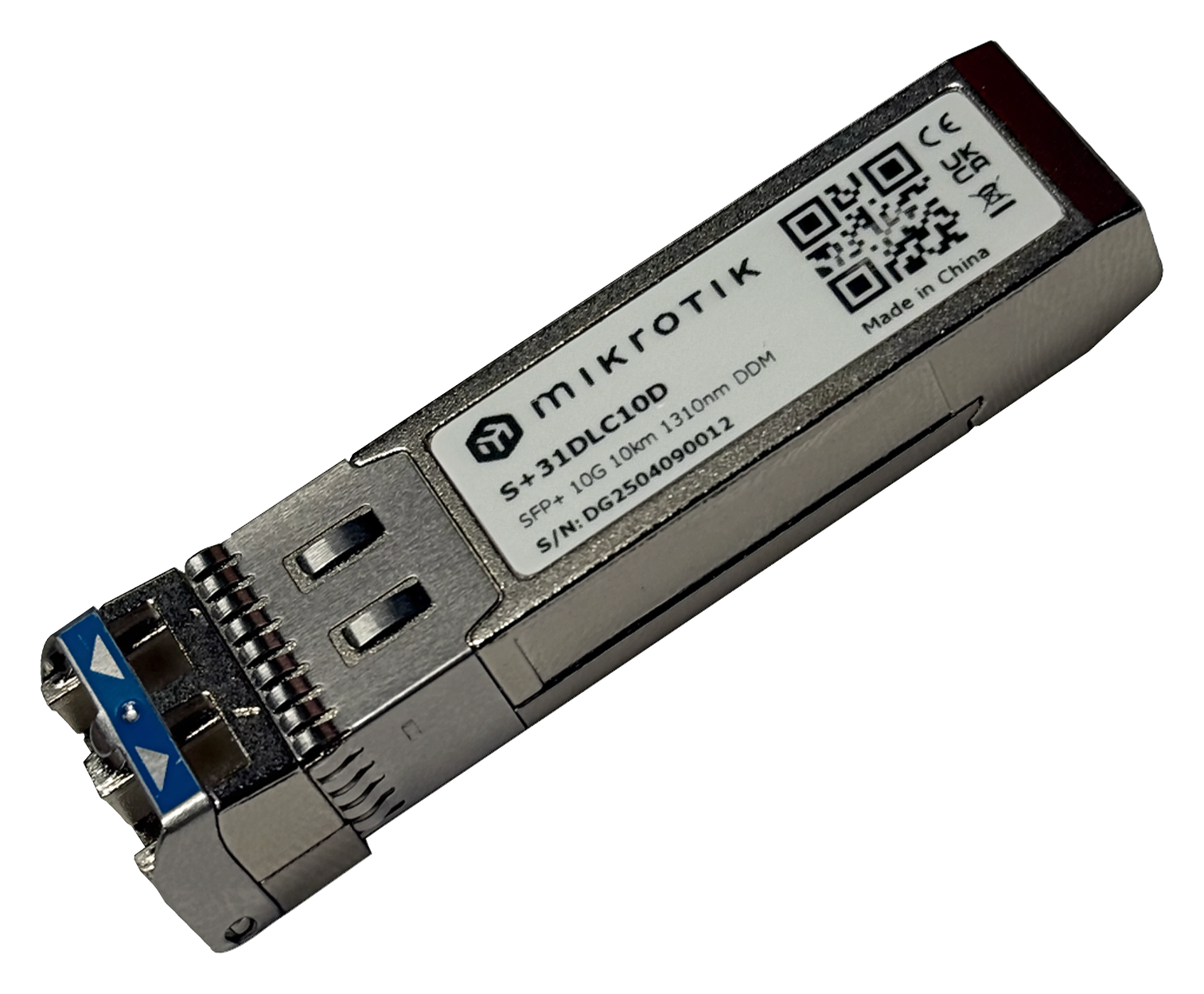
Exact model: S+31DLC10D
Direct answer for buyers
The MikroTik S+31DLC10D is a 10 Gigabit SFP+ transceiver for duplex single-mode fibre connections reaching up to 10 kilometres. It is mainly used to connect compatible routers, switches, aggregation devices and other 10G optical interfaces across buildings, campuses, industrial sites or service-provider infrastructure. It should be considered by buyers who already have, or are planning, a point-to-point single-mode fibre path. Before proceeding, confirm the exact SFP+ compatibility at both ends, the fibre type, LC connector format, wavelength, link distance, optical loss budget and environmental conditions. It is an Ethernet optic, not a GPON ONT, and therefore is not suitable for directly replacing a passive optical broadband terminal.
What it does
This module converts the electrical 10G signal inside a compatible SFP+ cage into an optical signal carried over single-mode fibre. It uses one fibre for transmit and one for receive through a dual-LC interface, enabling full-duplex communication between two network endpoints.
Its 1310 nm wavelength and stated reach of up to 10 kilometres make it suitable for connections that extend well beyond normal copper cabling limits. The practical reach still depends on the complete optical path, including fibre quality, splices, connectors, patch panels and any accumulated signal loss.
Who it suits
The S+31DLC10D may suit enterprises linking buildings, schools connecting campus blocks, hospitality groups joining communications rooms, warehouses extending uplinks, internet service providers building aggregation paths, and integrators deploying MikroTik-based 10G infrastructure.
It is most appropriate when both ends support 10G SFP+, a duplex single-mode fibre route is available, and the planned link falls within the module’s optical design. Buyers needing 25G operation, multimode fibre, copper RJ45, bidirectional single-fibre transmission or passive optical network service should select a different module type.
Business connectivity challenges this module can address
Distance beyond copper
Standard copper Ethernet is unsuitable for many inter-building distances. A correctly designed single-mode optical link can carry 10G traffic across much longer routes while avoiding the distance restrictions of twisted-pair cabling.
Backbone capacity
Organisations moving large files, backups, virtual workloads, surveillance streams or aggregated user traffic may need more uplink capacity than a 1G connection provides. The module supports a 10G optical connection when used with suitable equipment.
Electrical isolation
Fibre does not conduct electrical current, which can be valuable between buildings or facilities where ground-potential differences and electromagnetic interference make copper links undesirable.
Operational visibility
Digital diagnostics can expose optical power, module temperature, supply voltage and laser bias information through compatible host equipment, helping technicians investigate degradation before a link fails completely.
Core capabilities in practical terms
10G optical transport
Designed for 10 Gigabit Ethernet operation in a compatible SFP+ port. The end-to-end throughput achieved depends on the routers, switches, configuration and network workload.
Long-reach single mode
Supports single-mode fibre links up to 10 km under suitable optical conditions. Every connector, splice and patch panel contributes loss and must be included in design calculations.
Dual-LC full duplex
Uses separate transmit and receive fibres. The patch lead and structured cabling must maintain the correct polarity between endpoints.
Diagnostic monitoring
Built-in DDM provides operational measurements where the host device exposes them. Monitoring capability and displayed values depend on the platform and software.
Product-fit matrix
| Requirement | Suitable when | Confirm before ordering |
|---|---|---|
| 10G inter-building link | Both endpoints have supported 10G SFP+ cages and a duplex single-mode path. | Route length, optical loss, lightning protection strategy for associated equipment and fibre ownership. |
| Campus or data-centre backbone | A fixed 10G connection is sufficient and 25G is not required. | Port speed settings, redundancy design and switch compatibility. |
| ISP aggregation | The service is standard Ethernet over point-to-point fibre. | This is not GPON, XGS-PON or an ONT; confirm the provider handoff type. |
| Industrial deployment | The host equipment, enclosure and environmental design are appropriate. | Temperature range, dust protection, vibration and power conditions. |
| Mixed-vendor link | Both devices accept standards-based 10G LR-type optics and do not enforce unsupported coding restrictions. | Vendor support policy, firmware, FEC requirements and link testing. |
Verified product information
| Brand | MikroTik |
|---|---|
| Product code | S+31DLC10D |
| Product type | 10G SFP+ optical transceiver |
| Data rate | 10 Gigabit Ethernet |
| Fibre mode | Single mode |
| Maximum stated distance | Up to 10 km, subject to optical budget and fibre-path conditions |
| Wavelength | 1310 nm |
| Connector | Dual LC |
| Duplex operation | Full duplex over separate transmit and receive fibres |
| Diagnostics | Built-in digital diagnostic monitoring for supported host platforms |
| Typical monitored values | Optical power, voltage, temperature and laser bias current, subject to host support |
| MTBF guidance | Approximately 100,000 hours at 25°C, as stated by the manufacturer |
| Suggested manufacturer price | USD 69; FourTeck selling price, tax and delivery must be confirmed |
| Availability | Contact FourTeck for current UAE options and lead time |
Compatibility and dependency notice
An SFP+ module cannot be selected by speed and distance alone. The host device must support 10G SFP+ operation, and the remote endpoint must use a compatible 1310 nm single-mode 10G optical interface. Some platforms accept standards-based modules freely, while others use vendor coding or impose support restrictions. Firmware and port configuration can also affect link establishment.
This product is intended for point-to-point Ethernet. It is not designed to act as a GPON, EPON or XGS-PON subscriber terminal. A passive optical service may require an approved ONT, serial registration, authentication and provider-specific provisioning. Confirm the service handoff with the internet provider before assuming that a standard SFP+ optic can be connected directly.
A sensible purchase and deployment journey
Define the link
Record both endpoints, route length, required capacity, redundancy needs and whether the fibre is existing or new.
Verify the fibre path
Confirm single-mode fibre, duplex LC termination, polarity, connector cleanliness and expected optical loss.
Check host support
Review the exact router or switch model, SFP+ port speed, software release and manufacturer support policy.
Build the bill of materials
Include two optics for a link, correct patch leads, fibre panels, cleaning tools, labels and any spare units required.
Install and test
Inspect and clean connectors, insert modules correctly, confirm link status, review DDM values and test traffic performance.
10G reach without unnecessary platform complexity
The principal value of the S+31DLC10D is straightforward: it enables a 10G optical link over single-mode fibre at distances suited to campus, metropolitan-building and provider aggregation scenarios. For a buyer who only needs 10G, it avoids paying for a 25G-capable optic that the current infrastructure cannot use. This can simplify procurement when the switching and routing platform is firmly based on 10G SFP+ ports.
Distance should not be treated as a guaranteed outcome merely because the module is rated for up to 10 km. Optical links are governed by transmit power, receiver sensitivity and the losses introduced across the route. Poor splices, dirty connectors, excessive patching, sharp bends or damaged fibre can consume the available margin. A short route can therefore fail if workmanship is poor, while a well-built route can operate reliably within the stated design envelope.
For critical links, the purchase decision should be paired with proper fibre testing. An optical loss test can confirm whether the path is within budget, and an OTDR assessment may help locate faults or unexpected reflection points. FourTeck can help buyers identify the information needed for an accurate quotation and coordinate the required product, patching and implementation scope.
Digital diagnostics for faster fault isolation
The module’s built-in digital diagnostic monitoring is useful because optical problems are not always visible from a simple link-up or link-down indicator. A link may remain operational while received power gradually falls because of contamination, bending, ageing infrastructure or changes in the route. Where the host platform exposes diagnostic values, administrators can review transmit power, receive power, temperature, voltage and laser bias current.
These readings support troubleshooting but do not replace physical inspection and calibrated testing. A low receive reading may indicate excessive attenuation, but it does not by itself identify whether the cause is a dirty patch cord, a poor splice, incorrect fibre routing or a remote transmitter issue. Similarly, values shown by different devices may have varying resolution and alarm thresholds.
The best operational approach is to record healthy baseline readings when the link is commissioned. Future readings can then be compared with the baseline rather than interpreted without context. For organisations managing many optical links, this creates a more disciplined maintenance process and helps technicians decide when a site visit or fibre test is justified.
Full-duplex dual-fibre design and cabling discipline
The S+31DLC10D uses a dual-LC interface. One strand transmits and the other receives, so the link requires a duplex single-mode path between the two endpoints. Polarity matters: the transmit side of one module must reach the receive side of the other. Duplex patch cords normally maintain this crossover, but errors can occur when fibres pass through multiple panels or are re-terminated.
Connector quality is equally important. LC connectors are compact and widely used, but microscopic contamination can cause significant optical loss or reflection. Protective caps should remain in place until installation, and connectors should be inspected and cleaned using suitable fibre tools. Household cloths, compressed air of unknown quality or repeated blind re-plugging can make matters worse.
Buyers should specify whether the existing infrastructure presents LC, SC or another connector at each panel. The optic itself uses dual LC, but an LC-to-SC duplex patch lead may be appropriate where the patch panel uses SC adapters. The fibre grade, connector polish and patch-cord length should all be confirmed rather than assumed.
Ideal business environments and use cases
Campus building links
Connect a core switch to distribution switches in separate buildings using installed single-mode fibre. Confirm route ownership, redundancy and the required number of optical pairs.
Data-centre interconnects
Create 10G links between racks, rooms or nearby facilities where single-mode fibre is the chosen cabling standard. Latency and overall performance depend on the full network architecture.
ISP aggregation
Use the optic in supported Ethernet aggregation devices for point-to-point transport. Provider networks must distinguish this application from PON subscriber access.
Industrial facilities
Extend network connections across electrically noisy areas while keeping active equipment in protected enclosures. Environmental suitability must include the host device and installation conditions.
Video and storage traffic
Aggregate high-volume surveillance, backup or storage traffic where a 10G uplink is appropriate. Capacity planning should consider peak traffic and future growth.
Managed service infrastructure
Standardise compatible 10G single-mode links across customer sites while using DDM readings and documented baselines to support remote troubleshooting.
Integration and operational considerations
The optic is one component in a complete Ethernet service. A successful design must account for switching capacity, routing performance, VLAN architecture, spanning-tree or link-aggregation settings, monitoring, redundancy and change control. Installing a 10G module does not automatically make every path in the network operate at 10G. The host device, remote device and upstream systems must all sustain the required traffic.
Where two links are deployed for resilience, the network design should define whether they operate as active-active, active-standby or as part of a routed redundancy scheme. Two optical links connected without the correct protocol can create loops. Conversely, a single link may become an avoidable point of failure for critical operations.
Port configuration also deserves attention. Some platforms require a fixed speed, auto-negotiation setting or specific FEC behaviour. Although 10G LR-type links are commonly interoperable, support policies differ. A mixed-vendor deployment should be tested using the exact hardware and software versions planned for production.
Operational documentation should record module serial numbers, endpoints, fibre identifiers, patch-panel ports, transmit and receive levels, installation date and any approved spares. This basic discipline reduces troubleshooting time when a link must be restored under pressure.
Buyer questions to resolve before ordering
A 1G SFP cage is not automatically capable of 10G operation. Check the exact hardware specification.
Do not assume installed fibre type from connector appearance. Review records or test the path.
Distance alone does not reveal optical margin. Include panels, splices and patch leads.
Confirm connector type at the equipment and patch panels, plus the correct polarity.
Projects expecting near-term 25G growth may need a different transceiver and host platform.
Check whether the host vendor supports third-party or MikroTik-coded optics in that device.
Procurement checklist
☐ Exact module code S+31DLC10D
☐ Number of links and required module quantity
☐ Spare transceiver requirement
☐ Exact router or switch model at each end
☐ Confirmed 10G SFP+ port support
☐ Single-mode duplex fibre path
☐ Route distance and measured insertion loss
☐ LC patch-cord type and length
☐ Connector polarity and patch-panel mapping
☐ Firmware and mixed-vendor compatibility
☐ Installation, testing and documentation scope
☐ UAE delivery location and requested timeline
☐ Commercial warranty confirmation
How FourTeck can support the decision
FourTeck can help turn a model request into a complete, checkable bill of materials. The review can cover the exact network devices at both endpoints, required link count, fibre type, patch-cord connectors, expected reach, spare policy and installation scope. This reduces the risk of ordering only the optics while overlooking cabling or compatibility dependencies.
For new deployments, buyers can request assistance with switch or router selection, 10G uplink planning, rack and patch-panel coordination, configuration scope and post-installation testing. For existing networks, FourTeck can help identify whether the S+31DLC10D matches the current ports and whether an alternative optic is more appropriate.
Use the FourTeck contact page to share the endpoint models, distance, fibre details, quantity and location. Buyers comparing wider infrastructure can also review the business technology product range and available installation and configuration services.
UAE availability and support guidance
Contact FourTeck to confirm current UAE availability for the MikroTik S+31DLC10D. Availability may depend on requested quantity, vendor lead time and the timing of the project. A quotation should identify the exact model, quantity, tax treatment, delivery location and any installation or configuration work required.
For projects across Dubai, Abu Dhabi, Sharjah and Ajman, FourTeck can coordinate requirement review, quotation preparation and delivery planning after the technical scope is confirmed. Where installation is required, provide the site address, access conditions, rack location, fibre termination details and preferred work window. Delivery dates and service schedules should be agreed in the final quotation rather than assumed from a general product enquiry.
GCC availability
Businesses planning MikroTik optical links in GCC markets can ask FourTeck for requirement review, model confirmation, quotation coordination and deployment planning. The S+31DLC10D may be considered for suitable 10G point-to-point single-mode fibre projects in the United Arab Emirates, Saudi Arabia, Kuwait, Qatar, Bahrain and Oman, but the correct module still depends on the host equipment, fibre route and operational objective. Product availability, vendor lead time, import arrangements, taxes, service scope and project scheduling can vary by destination and quantity.
For an accurate response, share the destination country, endpoint device models, number of links, module quantity, fibre type, approximate distance and desired timeline. State whether patch cords, switches, routers, installation, configuration or testing are also required. FourTeck can then help define a practical bill of materials and coordinate the commercial next step. For Kuwait-focused enquiries, the FourTeck Kuwait technology resource may also be useful.
Africa availability
FourTeck can assist organisations evaluating the MikroTik S+31DLC10D for network projects in Africa, including selected East African and broader regional requirements. Support can begin with confirmation of the exact optic, host-device compatibility, fibre type, required quantity, patching and deployment scope. Availability and fulfilment can depend on the destination, quantity, vendor lead time, shipping route, local taxes, power and environmental conditions, and whether onsite work is required.
Buyers should provide the destination country, endpoint equipment, number of links, fibre distance, connector type, desired deployment schedule and any need for configuration or testing. This information helps avoid selecting an optic that does not match the existing access technology or fibre plant. Regional resources include FourTeck Kenya, FourTeck Uganda and the FourTeck Africa technology site. Shipping, support coverage and installation arrangements must be confirmed for each project.
Related products and services to consider
XS+31LC10D
Consider this MikroTik alternative where 1G, 10G and 25G operation in a suitable SFP/SFP+/SFP28 environment is required. Confirm exact host support.
S+85DLC03D
A different 10G optic for short-reach multimode fibre. It is not a direct substitute unless the fibre type and distance match its design.
MikroTik SFP+ switches
Select the switch according to port count, switching capacity, management requirements, redundancy and rack environment.
Single-mode patch leads
Specify duplex LC connectors, fibre grade, polish type, length and panel-side connector before ordering.
Installation and testing
Include connector inspection, cleaning, optical measurement, link validation, documentation and handover where the project requires it.
Why businesses contact FourTeck
A transceiver request often appears simple, yet a wrong assumption about port type, fibre mode or service handoff can stop the project. Businesses contact FourTeck for practical clarification: identifying the correct model, reviewing endpoint compatibility, confirming the patching requirement, preparing a complete bill of materials and coordinating a quotation.
FourTeck can also help define the boundary between supply and implementation. Some customers need only sealed modules delivered to an IT team. Others require switch configuration, rack work, fibre testing, labelling and commissioning. Stating these expectations early makes the quotation clearer and reduces changes during deployment.
For information about the company and broader capabilities, visit About FourTeck. No stock, delivery or installation commitment should be inferred until the exact requirement has been reviewed and accepted in writing.
Frequently asked questions
What is the MikroTik S+31DLC10D used for?
It is used to create a 10G point-to-point Ethernet link over duplex single-mode fibre, with a stated maximum reach of up to 10 kilometres under suitable optical conditions.
Does it work in a standard 1G SFP port?
It is designed as a 10G SFP+ module. A standard 1G-only SFP port should not be assumed to support it. Check the exact device specification and supported port speeds.
Can it connect directly to a GPON internet line?
No. This is a point-to-point Ethernet optic, not a GPON ONT. Passive optical broadband services normally require provider-approved subscriber equipment and provisioning.
What fibre and connector does it require?
It requires single-mode fibre and uses a dual-LC connector. The complete path must provide separate transmit and receive strands with correct polarity.
Is the 10 km distance guaranteed?
No. Ten kilometres is the stated maximum design reach. Actual operation depends on the optical budget, fibre quality, splices, connectors, cleanliness and host compatibility.
Does the module support digital diagnostics?
Yes, the current manufacturer description states built-in DDM. The values visible to administrators depend on the host platform and software support.
Will it work with non-MikroTik equipment?
Interoperability may be possible with compatible standards-based 10G SFP+ equipment, but vendor coding, firmware and support policies vary. Verify the exact device before purchase.
How many modules are needed for one link?
A normal point-to-point link requires one compatible optic at each endpoint, so two modules are typically needed unless one endpoint already has a matching optical interface.
What information is needed for a quotation?
Share quantity, endpoint device models, fibre type, distance, connector arrangement, delivery location, requested timeline and whether patch cords, installation or testing are required.
How can I confirm UAE availability and warranty?
Request a current FourTeck quotation. Availability, commercial warranty terms, tax, delivery and any service scope should be confirmed in that quotation.
Confirm the optic before you place the order
Send FourTeck the two endpoint models, fibre type, distance, quantity and delivery location. The team can help confirm product fit, patching requirements and current quotation options.
