
Multimode fibre connectivity for business networks
MikroTik HS-85DLC05D in Dubai, UAE
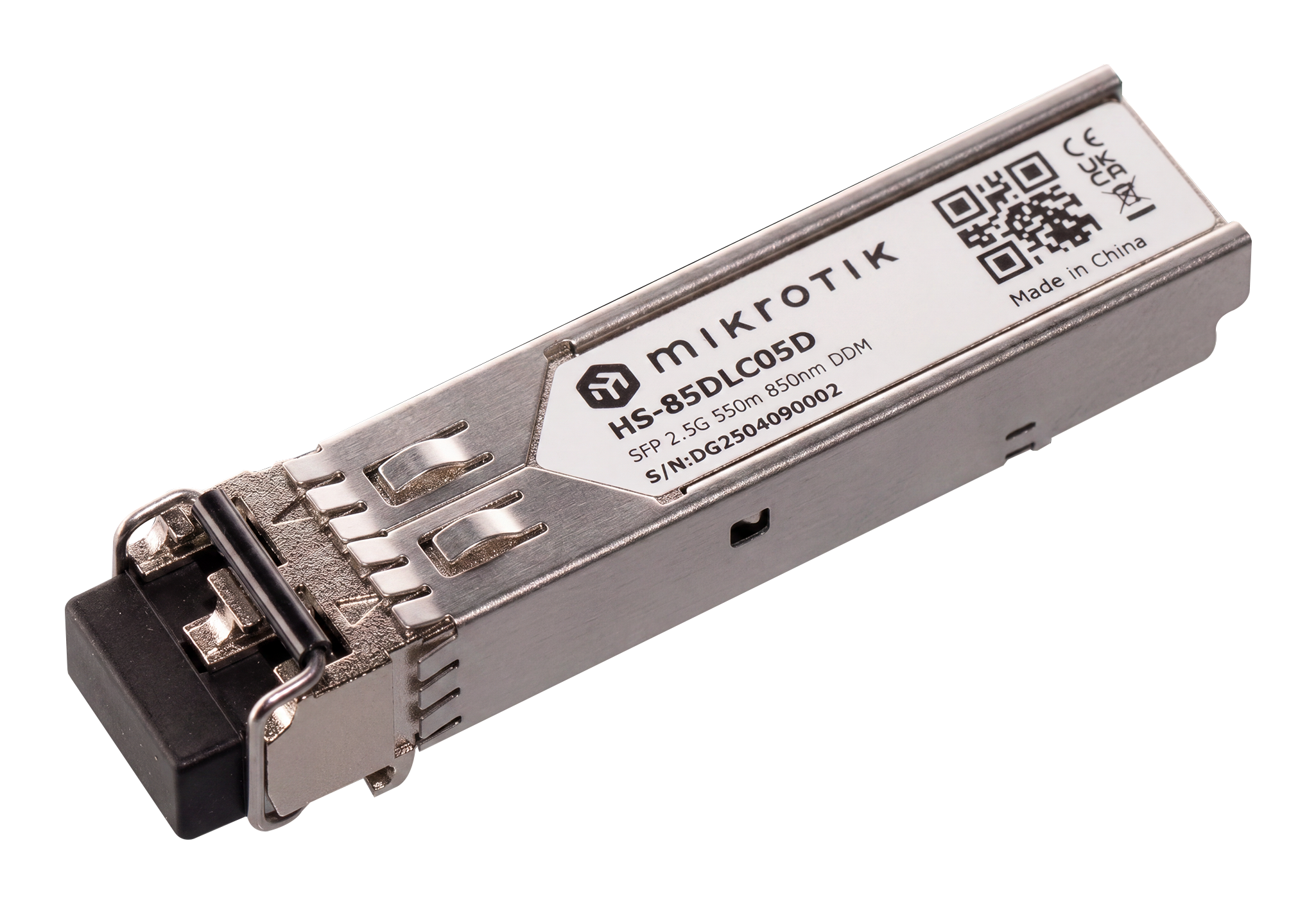
A compact 1G/2.5G SFP optical module for short-to-medium multimode fibre links, designed to help organisations increase link capacity while retaining suitable 850 nm fibre infrastructure and LC connectivity.
Primary buying check
Confirm endpoint port support, required link speed, multimode fibre type, LC patching and the actual optical distance before ordering.
1G and 2.5G
Multimode fibre
850 nm
Up to 550 metres
Built-in DDM
Direct answer for network buyers
The MikroTik HS-85DLC05D is a dual-rate SFP optical transceiver for 1G or 2.5G Ethernet over multimode fibre, using an 850 nm optical interface and a dual LC connector. It is mainly used to connect compatible routers, switches, fibre converters or access devices across buildings, floors, equipment rooms and industrial areas where copper distance or electrical isolation makes fibre preferable. It should be considered by IT teams, system integrators and service providers upgrading an existing multimode fibre route. Before proceeding, confirm that both endpoint cages support the selected rate, the fibre path is suitable for the planned distance, the LC polarity is correct and the network operating system supports the required speed configuration.
What the module does
The HS-85DLC05D converts electrical Ethernet signals from a compatible SFP-family interface into optical signals that travel over multimode fibre. At the far end, a matching and compatible optical interface converts those signals back into Ethernet. This allows a network to bridge distances beyond normal copper cabling limits, cross electrically noisy areas, connect separate communications rooms or create fibre uplinks between access and distribution equipment.
Its dual-rate capability is particularly relevant where a business has an existing 1G network but wants a measured route toward 2.5G. The module itself does not make every SFP port operate at 2.5G. The host platform and software must support that rate, and both ends need compatible optical and interface settings.
Who should consider it
This transceiver is a practical option for enterprises, schools, hotels, warehouses, healthcare sites, managed service providers, industrial operators and ISPs that use multimode fibre inside buildings or campuses. It can suit network teams replacing an older 1G 850 nm module, adding a new fibre uplink or planning a 2.5G upgrade where supported switching or routing equipment is already available.
It is not the right choice for long-distance single-mode links, 10G requirements, single-fibre BiDi designs or installations using incompatible connector types. Buyers should treat the optical module, host interface, fibre grade, patch leads and remote endpoint as one complete link rather than selecting the transceiver in isolation.
Business challenges this optical module can address
Copper distance limits
Fibre can connect equipment rooms, floors or buildings where conventional Ethernet cabling would exceed practical distance limits or require intermediate active equipment.
Gradual bandwidth growth
Dual 1G and 2.5G operation can support a phased upgrade strategy, provided the host ports and software at both ends support the chosen rate.
Operational visibility
Digital diagnostics can expose optical and environmental readings that help administrators investigate link margins and abnormal operating conditions.
Electrical separation
An optical path avoids conductive copper between endpoints, which may be useful across electrically noisy areas or between separate building zones.
Product-fit decision matrix
| Requirement | Suitable when | Confirm before ordering |
|---|---|---|
| 1G fibre uplink | The host device supports 1G optical operation and the remote end uses compatible 850 nm multimode optics. | Port type, duplex LC connection, fibre grade, distance and interface configuration. |
| 2.5G bandwidth upgrade | Both endpoints explicitly support 2.5G-baseX operation through their SFP, SFP+ or SFP28 interfaces. | RouterOS or platform version, manual speed settings and remote-end compatibility. |
| Building or campus fibre | The multimode path is within the supported optical budget and maximum distance. | Actual route length, splice losses, patch panels, connector cleanliness and fibre condition. |
| Industrial installation | An industrial-grade module is required and the host enclosure is suitable for the site environment. | Host temperature rating, cabinet ventilation, dust control, power quality and maintenance access. |
| Non-MikroTik endpoint | The third-party platform accepts standards-aligned SFP modules and supports the intended optical mode. | Vendor coding restrictions, supported rates, alarms and DDM reporting behaviour. |
Verified technical information
Compatibility and configuration dependencies
The physical ability to insert an SFP module does not automatically confirm that every supported data rate will work. For 1G service, the host port must support a 1G optical interface and the remote transceiver must use a compatible 850 nm multimode specification. For 2.5G service, MikroTik documents that the host device must support 2.5G operation on the relevant SFP-family interface. RouterOS support for 2.5G link rate is available from RouterOS v7.3, while current configuration guidance may require auto-negotiation to be disabled and the interface speed set explicitly to 2.5G-baseX on both ends.
The final result also depends on the fibre plant. Route length, fibre grade, connector loss, patch-panel condition, splice quality, bend radius and contamination can all affect optical margin. When one endpoint is not MikroTik, confirm whether that manufacturer accepts third-party modules, whether vendor coding is enforced and whether DDM readings are exposed correctly. FourTeck can review the host models and planned topology before quotation, but final interoperability should be validated against the current platform documentation and, where practical, tested in the intended environment.
A practical purchase and deployment journey
Identify both endpoints
Record the exact router, switch, converter or access-device model at each end, including interface labels and current software versions.
Audit the fibre path
Confirm multimode fibre type, total route length, patch panels, LC polarity, connector condition and any existing optical modules.
Select the link rate
Decide whether the immediate requirement is 1G or 2.5G and verify explicit support at both ends before the bill of materials is finalised.
Prepare and test
Clean connectors, insert the modules carefully, apply the required interface configuration and review link state plus DDM readings.
Document the result
Record module placement, fibre route, port settings, optical readings and rollback steps for future maintenance and troubleshooting.
Dual-rate connectivity without treating every port as identical
The most important characteristic of the HS-85DLC05D is its ability to operate at either 1G or 2.5G on a suitable host. This creates a useful procurement option for organisations that want to preserve an existing multimode fibre run while increasing bandwidth between compatible network devices. A 2.5G link can provide more capacity for aggregated access traffic, Wi-Fi uplinks, surveillance streams, server access or inter-switch communication without moving immediately to a 10G design.
That benefit should be planned carefully. Some devices have an SFP cage that supports only 1G. Others have an SFP+ cage but do not necessarily support every intermediate speed. Even when the hardware supports 2.5G, the operating system version and interface configuration may determine whether the link establishes correctly. A successful purchasing decision therefore begins with the host model and port capability, not only the module specification.
For a mixed environment, buyers should also check the remote endpoint. If one side can operate at 2.5G and the other side supports only 1G, the intended service must be designed around a common rate. The module should not be purchased as a guarantee that a third-party switch will accept it or expose all diagnostic information. A compatibility review, current firmware check and controlled link test provide a more dependable path than assumption-based deployment.
Digital diagnostics for link visibility and maintenance planning
Digital diagnostics monitoring, commonly shortened to DDM, gives a supported host access to operating measurements from the optical module. The manufacturer identifies optical power, voltage, temperature and laser bias current among the available parameters. These readings can help a network administrator see whether a link is operating with a reasonable margin or showing a condition that deserves investigation.
DDM is not a replacement for fibre certification or complete optical testing. A link may still require inspection, cleaning, power-meter checks or an optical time-domain reflectometer when faults are intermittent or the cable route is complex. DDM is most useful as one part of an operational workflow: record normal readings after installation, compare them during maintenance and investigate meaningful changes alongside error counters, interface events and physical inspection.
The visibility available to an administrator depends on the host equipment and software. Some platforms display more values than others, and thresholds or alarm reporting may be handled differently. Before relying on DDM for a monitoring plan, confirm that the intended router or switch exposes the required measurements and that the operations team knows how to interpret them. FourTeck can help include monitoring expectations in the deployment discussion so that the hardware choice aligns with support procedures.
Preserving suitable multimode fibre while improving capacity
Many commercial buildings already have multimode fibre between equipment rooms, floors or nearby facilities. Replacing that cabling can be disruptive, especially where routes pass through ceilings, risers, production areas or leased spaces. The HS-85DLC05D is designed for 850 nm multimode operation up to the manufacturer-stated maximum of 550 metres, giving buyers a way to evaluate whether an existing route can continue serving the network.
The stated maximum should not be treated as a promise for every cable plant. The practical result depends on fibre grade, total insertion loss, connector count, splice quality, cleanliness and the capabilities of both endpoint optics. Older fibre, poorly documented routes or paths with many interconnections may need testing before an upgrade. A route that worked at 1G should still be verified for the intended 2.5G service rather than assumed to be suitable.
A well-planned upgrade may involve more than two transceivers. Correct LC-LC patch leads, polarity verification, labelled patch-panel ports, spare modules, cleaning tools and documentation can all be part of the bill of materials. Where the route connects critical systems, buyers may also want a maintenance window, rollback plan and baseline optical readings. FourTeck can coordinate these practical items in the quotation so that the transceiver is purchased as part of a complete link requirement.
Ideal business environments and use cases
Office and campus uplinks
Connect access switches to a distribution layer across floors or nearby buildings where multimode fibre and LC termination already exist.
Warehouse and industrial zones
Use fibre between communications cabinets where cable distance, machinery, electrical noise or site layout makes copper less suitable.
ISP and managed networks
Deploy short-range optical links inside points of presence, cabinets or customer environments when supported host equipment is selected.
Wi-Fi aggregation
Evaluate 2.5G fibre uplinks for higher-capacity wireless access layers where both the switch and upstream platform support the rate.
Surveillance infrastructure
Carry aggregated camera traffic between access and core switching areas, with capacity planning based on actual stream and retention requirements.
Server and storage access
Support moderate-speed optical connectivity where 1G or 2.5G is sufficient and compatible multimode interfaces are available at both ends.
Integration and operational considerations
Start with port-level documentation. Record whether each endpoint has an SFP, SFP+ or SFP28 cage, which speeds that specific interface supports and whether there are restrictions based on neighbouring ports, breakout modes or device configuration. A label such as “SFP+” indicates a physical family and upper capability, but it does not by itself guarantee every lower intermediate rate. Current vendor compatibility guidance should be checked for the exact host model.
The fibre route must be treated as infrastructure. Confirm whether the path is OM1, OM2, OM3, OM4 or another multimode grade, and identify all patch panels and cross-connects. Clean every connector before insertion using suitable fibre-cleaning tools. Avoid touching ferrules, bending patch leads tightly or leaving open connectors unprotected. A small amount of contamination can increase loss and lead to an unstable link.
For RouterOS environments, administrators should plan the interface configuration before the maintenance window. MikroTik’s current guidance for supported 2.5G transceivers includes disabling auto-negotiation and setting the speed to 2.5G-baseX on both linked interfaces. The correct command syntax depends on RouterOS generation and version. Configuration should be reviewed against current documentation, backed up and tested with a rollback path.
Operations teams should establish acceptance criteria. These may include link stability, expected interface rate, zero unexpected errors, acceptable DDM values, traffic tests and monitoring visibility. For critical uplinks, consider whether a redundant path is required; the transceiver itself does not provide high availability. Redundancy is created through network design, additional interfaces, switching or routing protocols and appropriately separated fibre paths.
Buyer questions to resolve before ordering
Provide model numbers, port labels and software versions so that 1G and 2.5G support can be reviewed accurately.
A 1G replacement and a 2.5G upgrade have different compatibility and configuration checks even when they use the same module.
Share the multimode grade, route length, connector count and any test records rather than relying only on a building drawing.
The quotation should include correct duplex LC patching, lengths and any site-specific accessories needed for a clean installation.
Check vendor coding policies, supported optical modules, accepted link rates and DDM presentation before purchase.
Clarify whether the requirement includes supply only, remote guidance, onsite coordination, testing or documentation.
Procurement checklist
✓ Exact product code: HS-85DLC05D
✓ Required module quantity and spare quantity
✓ Endpoint device models at both ends
✓ Port type and supported link rates
✓ RouterOS or host software version
✓ Required operating rate: 1G or 2.5G
✓ Multimode fibre grade and route length
✓ Duplex LC polarity and patch-lead lengths
✓ Patch-panel and splice information
✓ Third-party coding or compatibility restrictions
✓ Installation and testing responsibility
✓ Delivery destination and target project window
✓ Warranty guidance and return process confirmation
✓ Documentation and support expectations
How FourTeck can support the requirement
FourTeck can help a buyer convert a model request into a complete optical-link bill of materials. This begins with requirement clarification: the host devices, intended link rate, fibre path, quantity, deployment location and operational importance of the connection. From that information, the team can coordinate a quotation for the HS-85DLC05D and identify related items that may need to be included, such as duplex LC patch leads, compatible endpoint equipment or installation support.
Compatibility review is especially useful for 2.5G projects. FourTeck can help check whether the stated MikroTik host model appears in current compatibility guidance, whether the required RouterOS generation is appropriate and what configuration considerations should be discussed before installation. When a non-MikroTik endpoint is involved, the buyer should also provide that manufacturer and model so vendor-specific restrictions can be considered.
For projects requiring more than product supply, the scope can discuss installation planning, interface configuration, link testing, documentation and support coordination. These activities are variable and should be included explicitly in the quotation rather than assumed. Visit the FourTeck technology services page for broader assistance or use the Dubai contact page to share the endpoint and fibre details.
Buyers comparing wider networking options can also review the FourTeck product portfolio or learn more about the organisation through the FourTeck company overview.
UAE availability and support guidance
Contact FourTeck to confirm current UAE availability for the MikroTik HS-85DLC05D. Availability may depend on quantity, vendor lead time and the timing of the project. A request should include the required number of modules, destination, endpoint models, preferred link speed and expected deployment window. This information helps distinguish a simple replacement order from a compatibility-sensitive 2.5G upgrade.
Delivery and project coordination can be discussed after the exact requirement is confirmed. Installation, configuration and testing are not automatically included with a product quotation and should be requested when needed. FourTeck can help organisations in Dubai, Abu Dhabi, Sharjah and Ajman coordinate product selection, quotation review and deployment planning through one combined UAE engagement. No stock position, fixed delivery date or installation schedule should be assumed until confirmed in the quotation.
GCC availability
FourTeck can assist organisations planning MikroTik optical connectivity projects across GCC markets, including the United Arab Emirates, Saudi Arabia, Kuwait, Qatar, Bahrain and Oman. Support can begin with a review of the exact HS-85DLC05D requirement, the network devices at both ends, the intended 1G or 2.5G rate, required quantity and the fibre environment. This helps procurement teams request a quotation that accounts for compatible modules, patch leads, installation scope and project timing rather than purchasing an isolated component.
Product availability, delivery schedules, service visits, configuration scope and vendor lead times can vary by country, quantity and deployment requirement. Buyers should confirm the destination country, site location, host model, software version, licence or support dependencies for the wider platform, required accessories and target implementation window. For Kuwait-related coordination, the FourTeck Kuwait resource may provide an additional regional contact path. No local inventory, customs result, fixed delivery commitment or country-specific certification is implied until the requirement has been reviewed.
Africa availability
Businesses and service providers planning fibre deployments in Africa can contact FourTeck for product evaluation, quantity planning and regional procurement guidance. The HS-85DLC05D may be relevant to campus, enterprise, industrial and ISP links where compatible 1G or 2.5G host ports and suitable multimode fibre are available. A useful enquiry should identify the destination country, endpoint models, route length, fibre grade, required module quantity, preferred deployment schedule and any installation or remote configuration expectations.
Availability and fulfilment may depend on the destination, product quantity, shipping arrangements, vendor lead time, power and environmental conditions of the host equipment, and local project requirements. FourTeck can help review related accessories, support needs and documentation expectations before a quotation is finalised. Organisations in East Africa may use the FourTeck Kenya resource or FourTeck Uganda resource, while broader enquiries can be directed through the FourTeck Africa portal. Local inventory, immediate shipment, customs outcomes and country-wide onsite coverage are not assumed and require case-by-case confirmation.
Related products and services to evaluate
Compatible MikroTik routers or switches
Select a host platform whose specific SFP-family interface supports the intended 1G or 2.5G rate and current RouterOS requirements.
Duplex LC multimode patch leads
Specify fibre grade, connector polish, polarity and length to match the installed cable plant and patch-panel arrangement.
Longer-distance single-mode optics
Where the route exceeds multimode design limits, evaluate an appropriate single-mode transceiver and fibre path instead of treating it as equivalent.
10G SFP+ alternatives
For higher throughput, consider a 10G design only after verifying host interfaces, optical reach, fibre grade and total network capacity.
Installation and configuration
Include fibre inspection, connector cleaning, interface setup, testing and documentation when the project needs more than supply.
Network capacity review
Assess whether 2.5G solves the actual bottleneck or whether switching, routing, wireless or server infrastructure also needs attention.
Why businesses contact FourTeck
A small optical transceiver can still carry significant compatibility risk when the host port, software, fibre plant and remote endpoint are not checked together. Businesses contact FourTeck to clarify those dependencies before purchase. The discussion can cover exact model selection, quantity, replacement versus upgrade goals, bill-of-material guidance and the practical accessories needed to complete the link.
FourTeck can also help coordinate quotation details across procurement and technical teams. A buyer may need commercial availability, while an engineer needs confirmation of link rates, interface commands, DDM visibility and fibre conditions. Bringing those requirements together reduces the chance of receiving hardware that does not match the deployment plan.
Where services are required, the quotation can define whether the engagement includes remote consultation, onsite coordination, configuration, testing, handover documentation or post-installation support. Scope, timing and responsibility should be stated clearly. FourTeck does not treat compatibility, delivery timing or project outcomes as guaranteed until the exact environment and requirement have been reviewed.
Frequently asked questions
What is the MikroTik HS-85DLC05D used for?
It is used to create 1G or 2.5G Ethernet links over multimode fibre between compatible network devices. Typical applications include switch uplinks, inter-room connections, campus links, industrial cabinets and ISP infrastructure within the supported optical distance.
Does it support both 1G and 2.5G?
Yes, the module is designed for both rates. Actual operation depends on the host interface and software at both ends. The presence of an SFP or SFP+ cage alone does not confirm that 2.5G is supported.
What fibre and connector does it require?
It is intended for multimode fibre at 850 nm and uses a dual LC optical connector. The installed fibre grade, patch leads, polarity and route condition should be confirmed before ordering.
Can it reach 550 metres in every installation?
The manufacturer states support for links up to 550 metres, but actual reach depends on the multimode fibre type, connector and splice losses, cleanliness, optical budget and endpoint compatibility. Existing routes should be assessed rather than assumed.
What does DDM provide?
Digital diagnostics monitoring can expose information such as optical power, voltage, module temperature and laser bias current through a supported host. It helps with monitoring and fault investigation but does not replace proper fibre testing.
Will it work in a non-MikroTik switch?
It may work in standards-aligned third-party equipment, but compatibility is not guaranteed for every platform. Confirm whether the device accepts third-party modules, supports the required rate and presents DDM data correctly.
Is a separate licence required?
The transceiver itself does not require a separate licence. The host network device must still have the correct software, supported feature set and interface capability for the intended configuration.
How is 2.5G configured on supported MikroTik devices?
Current MikroTik guidance indicates that supported interfaces may need auto-negotiation disabled and speed set to 2.5G-baseX on both ends. The exact command and support should be verified against the host model and RouterOS version.
What information is needed for a Dubai quotation?
Share the required quantity, both endpoint models, software versions, required rate, fibre type, route distance, patch-lead needs, delivery location and whether installation or configuration support is required.
Is current UAE stock or delivery time guaranteed?
No. Contact FourTeck to confirm current UAE availability, vendor lead time and delivery coordination for the requested quantity. Installation timing should also be confirmed separately when services are required.
Confirm the complete fibre-link requirement
Send FourTeck the endpoint models, required link speed, multimode fibre details, quantity and project location. The team can coordinate compatibility review, accessory selection, UAE availability guidance and a requirement-based quotation.