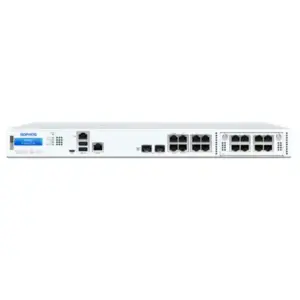
Long-distance Gigabit fibre connectivity
MikroTik S-31DLC20D in Dubai, UAE
A compact 1.25G SFP transceiver for single-mode optical links up to 20 km, using a 1310 nm wavelength, dual LC UPC connectivity, and digital diagnostic monitoring.
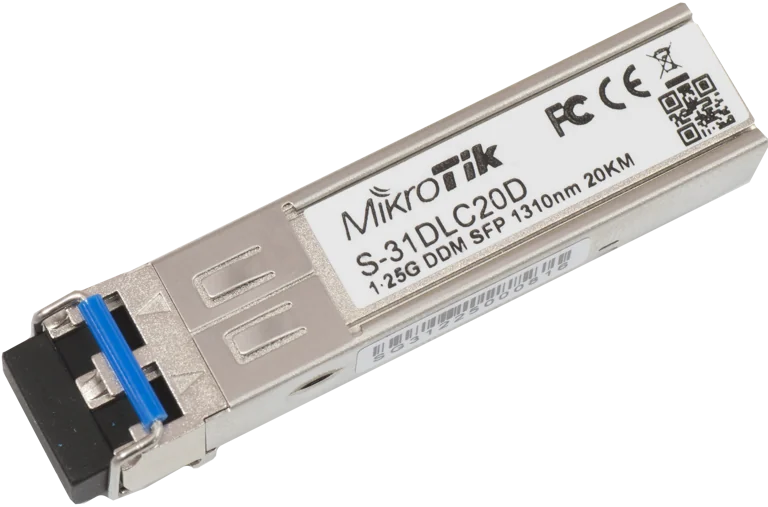
Exact model image shown. Confirm the required quantity, link design, and endpoint compatibility before ordering.
1.25G SFP
Up to 20 km
Single-mode
Dual LC UPC
DDM supported
Direct answer for buyers
The MikroTik S-31DLC20D is a 1.25G small-form-factor pluggable optical module intended for full-duplex Gigabit links over single-mode fibre. It uses a 1310 nm optical wavelength and a dual LC UPC interface, with a stated maximum link distance of 20 km under an appropriate optical budget and fibre design. It is mainly considered for connecting network switches, routers, fibre media converters, cabinets, campus buildings, remote facilities, or service-provider access points. Before proceeding, confirm that both endpoints use compatible 1G SFP interfaces, the fibre is single-mode, the patch leads are duplex LC, the end-to-end loss is within budget, and the host equipment accepts the module.
What the module does
The S-31DLC20D converts electrical data from a compatible SFP host port into optical signals for transmission across single-mode fibre, and it converts received optical signals back into electrical data for the host device. This makes it possible to extend a Gigabit Ethernet connection well beyond the practical distance of copper cabling while also gaining the electrical isolation and low electromagnetic susceptibility associated with fibre.
The module is not a switch, router, media converter, or complete link on its own. A working connection normally requires a compatible SFP-capable device at each end, suitable optical modules, correctly terminated duplex single-mode fibre, clean LC connectors, and correct interface configuration. The far-end transceiver should be matched for speed, wavelength, fibre type, and optical characteristics.
Who should consider it
This model can suit organisations that require a conventional 1G optical uplink over a moderate or long distance. Typical buyers include IT departments linking office buildings, warehouses extending network access to distant cabinets, hotels connecting operational areas, schools and campuses joining separate blocks, system integrators building structured fibre backbones, and service providers delivering Gigabit connections to distributed sites.
It is less appropriate when the required link is 10G or faster, when the installed cable is multimode, when a single-fibre BiDi design is required, or when the endpoint only supports 100 Mbps optical interfaces. Buyers with very short links should still verify the optical design and host compatibility rather than choosing solely by maximum distance.
Business challenges this module can help address
Distance beyond copper
Standard Ethernet copper links are limited in practical reach. A properly designed single-mode fibre link allows network connectivity between locations separated by far greater distances.
Electrical isolation
Fibre does not carry electrical current between buildings, which can be useful where grounding differences, lightning exposure, or electrical noise need to be considered in the network design.
Backbone consolidation
A Gigabit optical uplink can connect access switches or routers into a structured backbone without using multiple copper extenders or intermediate active devices.
Operational visibility
Digital diagnostic monitoring can help administrators review supported optical operating values through compatible host equipment, improving fault isolation and link-health checks.
Product-fit decision matrix
| Requirement | Suitable when | Confirm before ordering |
|---|---|---|
| Link speed | The design requires a 1G-class SFP optical connection. | Both host ports support 1G SFP operation and are configured consistently. |
| Fibre medium | The installed path uses single-mode fibre. | Fibre type, strand count, connector polish, patch leads, and splice plan. |
| Distance | The end-to-end path is within the supported optical budget and up to 20 km. | Measured loss, connector losses, splices, patch panels, and design margin. |
| Connector layout | A duplex LC connection is available at each end. | Transmit and receive polarity, UPC interface, and fibre-pair continuity. |
| Host compatibility | The MikroTik or third-party device accepts the module and exposes the required SFP controls. | Vendor coding restrictions, software version, port mode, and support policy. |
Verified technical information
The values below reflect the manufacturer’s published information for the exact S-31DLC20D model. Real link performance depends on the full optical path, the host device, installation quality, and operating conditions.
| Brand | MikroTik |
|---|---|
| Product code | S-31DLC20D |
| Product type | Optical SFP transceiver |
| Format | SFP |
| Data rate | 1.25G |
| Fibre mode | Single-mode |
| Maximum stated distance | 20 km, subject to optical budget and link conditions |
| Wavelength | 1310 nm |
| Connector | Dual LC UPC |
| Diagnostic monitoring | DDM supported |
| Tested ambient temperature | -40°C to +70°C |
| MTBF guidance | Approximately 100,000 hours at 25°C, as published by the manufacturer |
| License requirement | No separate software license is identified for the module itself; host-device software and policy remain relevant |
| Availability | Contact FourTeck for current UAE quantity and lead-time guidance |
Compatibility and optical-design notice
A matching physical connector does not by itself guarantee a successful link. The host port must support the module’s SFP format and operating speed, and the far-end optic must be compatible in wavelength, fibre mode, duplex arrangement, and Ethernet interface type. Some third-party switches enforce transceiver coding or vendor policies. MikroTik states that the module can be compatible with non-MikroTik SFP devices, but the specific device vendor’s documentation and support position should still be checked.
The 20 km figure is a maximum application distance rather than a guarantee for every cable path. Fibre attenuation, splices, patch panels, connector cleanliness, bend radius, repair points, transmitter power, receiver sensitivity, and engineering margin all affect the result. A site with existing fibre should be assessed using an optical loss budget and, where appropriate, tested with suitable fibre instruments before commissioning.
A practical purchase and deployment journey
Define the link
Record both endpoint devices, SFP port types, required speed, physical route, approximate distance, and whether the link is new or replacing an existing optic.
Inspect the fibre path
Confirm single-mode fibre, duplex strand availability, LC termination, patch-panel positions, splice count, and the expected end-to-end optical loss.
Validate compatibility
Check host-device documentation, software level, SFP coding policy, supported speed, and the optical module proposed for the far end.
Build the quotation
Include module quantity, spare requirements, patch leads, fibre cleaning materials, installation, configuration, testing, and documentation as needed.
Install and test
Clean connectors, observe polarity, insert modules correctly, configure ports, review diagnostics, and verify traffic stability before handover.
1.25G optical connectivity for structured networks
The primary value of the S-31DLC20D is its ability to support a conventional Gigabit optical link across a single-mode fibre route. In many business networks, 1G remains a practical capacity for management networks, building links, CCTV aggregation points, access-switch uplinks, branch connectivity, and low-to-moderate traffic backbones. The module allows an SFP-equipped router or switch to use optical cabling without a separate external media converter, reducing the number of powered devices in the path.
A direct SFP-to-SFP design can simplify rack layouts and fault isolation, but it should be planned carefully. The achievable application is determined by the host device as well as the optic. A switch with an SFP+ cage may accept a 1G SFP module when the port supports that mode, but this is device dependent. A 100 Mbps fibre interface is not the same as a 1G SFP interface, even if the fibre connector and wavelength appear similar. For that reason, the port specification and operating mode should be verified at both ends.
Capacity planning also matters. A 1G link may be suitable today but could become a constraint if the site is expected to aggregate many Wi-Fi access points, high-resolution cameras, virtualisation traffic, backups, or large file transfers. FourTeck can help buyers compare the S-31DLC20D with higher-speed SFP+ options when future growth, switch replacement, or backbone modernisation is part of the project.
Single-mode reach and optical-budget planning
Single-mode fibre is commonly selected for longer building-to-building and site-to-site routes because it supports low attenuation over distance and can provide a useful foundation for future bandwidth upgrades. The S-31DLC20D is specified for operation at 1310 nm with a maximum distance of 20 km. This makes it relevant to metropolitan links, larger industrial sites, distributed campuses, remote compounds, and service-provider access designs where a short-reach multimode optic would not be appropriate.
The maximum distance should never be treated as the only design value. A fibre path contains losses from the cable itself, connectors, adapters, split points, splices, patch cords, and any repair sections. Dust or damage on an LC end face can introduce enough loss or reflection to cause errors or prevent the link from establishing. Engineers normally calculate an optical budget and preserve design margin for ageing, environmental variation, and future maintenance. Existing fibre may also need inspection or testing because route drawings do not always reflect the current condition of the installed plant.
For a new link, the bill of materials should identify the required duplex LC patch cords, fibre type, connector polish, patch-panel adapters, protective management, labelling, and testing scope. For an existing link, buyers should provide any OTDR or power-meter results available. FourTeck can use this information to help coordinate the correct module and accessories rather than relying on distance alone.
Digital diagnostic monitoring and operational checks
The module supports digital diagnostic monitoring, often referred to as DDM or DOM. Through a compatible host device, this can provide visibility into operating information such as optical transmit power, received optical power, module temperature, and supply conditions. The exact values displayed and the way they are presented depend on the router, switch, operating system, and interface tools.
DDM is useful during commissioning because it can help identify whether the received signal is absent, unexpectedly weak, or outside the expected range. It can also assist with maintenance by giving the support team a point of comparison when a stable link begins to experience errors or intermittent behaviour. However, diagnostics do not replace fibre inspection, cleaning, or calibrated testing. A module may report a low receive level without revealing whether the root cause is a dirty connector, damaged patch lead, excessive splice loss, incorrect polarity, incompatible far-end optic, or a host configuration issue.
A sensible handover record can include the device names, port numbers, module models, serial references where available, fibre route, patch-panel positions, transmit and receive readings, software version, and a basic traffic test. This information helps future support teams distinguish gradual degradation from a sudden physical fault. FourTeck can include configuration review and commissioning documentation in the project scope when requested.
Suitable business environments
Campus and education networks
Connect administration buildings, classrooms, laboratories, libraries, or remote network cabinets where the route is already served by duplex single-mode fibre.
Warehouses and industrial sites
Extend network access between operational areas while avoiding long copper runs and reducing exposure to electrical noise along the data path.
Hospitality and property operations
Link separate buildings, security rooms, management offices, or service blocks when a 1G optical uplink meets the expected traffic profile.
Service-provider access
Use within suitable 1G fibre access designs, subject to the operator’s optical budget, equipment policy, monitoring requirements, and network standardisation.
Branch and remote facilities
Connect a remote router or switch to a central site when the fibre path, interface type, and distance align with the module’s published characteristics.
CCTV and building systems
Aggregate cameras or building services across fibre where the total traffic remains within the practical capacity of the Gigabit link.
Integration and installation considerations
Begin by confirming whether the host uses an SFP, SFP+, combination, or proprietary uplink port. Physical fit does not prove electrical or software compatibility. Review the device manual for supported speeds and module policies, update software where appropriate, and note whether the port must be manually set to 1G. When using a third-party switch, check whether unsupported-transceiver warnings affect operation or vendor support.
The optical path should be treated as a managed asset. Duplex polarity must be correct so that the transmitter at one end reaches the receiver at the other. LC UPC connectors should be inspected and cleaned before insertion; protective caps should remain in place until the component is used. Patch leads should be routed without sharp bends or crushing, and fibre trays should provide adequate strain relief. Labels should identify both ends, strand numbers, and patch-panel locations.
During installation, avoid looking into an optical connector. Follow safe fibre handling practices and dispose of fibre shards correctly if field termination or splicing is involved. After the link comes up, verify interface speed, error counters, link stability, diagnostic readings, and application traffic. A simple ping is not enough for every project; throughput or soak testing may be appropriate where the link is operationally important.
Redundancy is a separate design decision. The S-31DLC20D provides one optical interface, not an automatic backup path. Businesses requiring resilient connectivity should consider diverse fibre routes, spare switch ports, redundant switches, link aggregation, routing failover, or a secondary carrier. The appropriate design depends on the acceptable outage window and the systems carried across the link.
Questions buyers should resolve before ordering
Provide the exact router, switch, or media-converter model at both ends, including software versions when known.
Confirm single-mode fibre, duplex strand availability, LC UPC termination, and whether patch panels or adapters are in the path.
Use the actual cable route rather than straight-line distance, and include known splice and connector losses.
Estimate peak and future demand to decide whether 1G is sufficient or a higher-speed design is more appropriate.
Clarify whether the request covers supply only, patching, configuration, fibre testing, commissioning, or documentation.
Operationally important sites may benefit from keeping tested spare modules and patch leads under controlled storage.
Procurement checklist
☐ Exact model: S-31DLC20D
☐ Required module quantity
☐ Endpoint device models
☐ SFP port speed and mode
☐ Single-mode fibre confirmation
☐ Duplex LC UPC patch leads
☐ End-to-end route distance
☐ Optical loss or test results
☐ Far-end transceiver details
☐ Required spare modules
☐ Installation and patching scope
☐ Port configuration requirement
☐ Testing and handover documentation
☐ Delivery destination and target schedule
Submitting these details with the enquiry helps reduce the risk of quoting a module without the patch leads, compatibility checks, or installation services needed to complete the link.
How FourTeck can assist
FourTeck can review the intended application before quotation, helping the buyer distinguish between a straightforward replacement and a link that requires wider design work. The review can cover endpoint models, port capability, fibre type, distance, connector arrangement, expected capacity, and whether a matched pair of modules or additional accessories is required. Where a third-party device is involved, compatibility may need confirmation from the equipment documentation or a controlled test.
For a complete deployment, the quotation can be structured to include optical modules, LC patch cords, compatible switches or routers, rack accessories, fibre management, configuration assistance, and testing. Installation scope varies by site. Existing structured cabling, access permissions, patch-panel documentation, fibre condition, and maintenance windows can affect the work required. FourTeck can help define these items so that supply, implementation, and support responsibilities are clear.
Buyers planning broader network improvements can also review relevant business networking products, discuss installation and configuration services, or contact the team through the FourTeck Dubai enquiry page. For wider infrastructure requirements, the FourTeck UAE technology portfolio provides additional context.
UAE availability and support guidance
Contact FourTeck to confirm current UAE availability for the MikroTik S-31DLC20D. Availability may vary with quantity, procurement channel, vendor lead time, and the complete bill of materials. A module-only request can be quoted separately, while projects that require matched optics, patch cords, switches, configuration, testing, or fibre work should state those requirements at the beginning.
Delivery and project coordination can be discussed after the exact model, quantity, destination, and required timeline are confirmed. Warranty guidance should be checked against the supplied item and quotation terms rather than assumed from a generic product listing. For installations in Dubai, Abu Dhabi, Sharjah, and Ajman, FourTeck can review the requirement and coordinate suitable supply or project support according to scope, access, scheduling, and technical dependencies.
GCC Availability
FourTeck can assist organisations planning MikroTik fibre links across GCC markets by reviewing the exact endpoint devices, module quantity, fibre route, accessory needs, and implementation scope before quotation. Requirements may involve the United Arab Emirates, Saudi Arabia, Kuwait, Qatar, Bahrain, or Oman, but product availability and project conditions can differ by destination. Buyers should share the delivery country, S-31DLC20D quantity, far-end optic, expected link distance, required patch leads, and target deployment schedule. Licensing is not normally the central issue for this optical module, although host-device software, vendor policies, and support conditions still need attention. Delivery timing, service visits, installation planning, and vendor lead times remain dependent on country, quantity, access conditions, and the wider bill of materials. Confirm these points with FourTeck before committing to a project date.
Africa Availability
For projects in Africa, FourTeck can help businesses evaluate the S-31DLC20D alongside compatible SFP hosts, fibre patching, spare requirements, configuration, and support expectations. Planning may cover East Africa, West Africa, Southern Africa, Central Africa, or selected markets such as Kenya and Uganda. Fulfilment depends on the destination, quantity, shipping arrangement, vendor lead time, local power and regulatory considerations, installation scope, and the condition of the fibre infrastructure. Buyers should provide the destination country, endpoint models, required quantity, link distance, preferred deployment schedule, and whether local installation or remote configuration guidance is expected. FourTeck will then be better placed to coordinate an appropriate quotation and identify any dependencies. No assumption should be made about local inventory, customs outcomes, or country-wide onsite coverage until the requirement is reviewed.
View FourTeck Africa support options or review Kenya technology assistance.
Related products and service options
MikroTik SFP-capable switches
Consider a suitable MikroTik switch when the project needs new access ports, uplink capacity, or a managed fibre endpoint. Exact port mode and module support should be verified.
MikroTik routers with SFP
A router with a compatible 1G SFP interface can terminate the optical link while providing routing, firewall, or branch connectivity functions.
Higher-speed SFP+ optics
For growing backbones, compare 10G SFP+ modules and switches. A higher-speed design requires compatible ports and suitable optics at both ends.
Single-fibre BiDi options
Where only one fibre strand is available, a matched BiDi pair may be considered. Do not substitute a BiDi module without redesigning both ends.
Fibre testing and commissioning
Include inspection, cleaning, loss testing, link verification, and documentation when the fibre condition or operational importance warrants it.
Network installation support
FourTeck can discuss rack work, patching, configuration, migration windows, and handover requirements as a separately defined project scope.
Why businesses contact FourTeck
The main reason to involve FourTeck is to turn a model request into a complete and correctly scoped purchasing decision. A fibre module can appear simple, yet many failed deployments result from mismatched port speeds, incorrect fibre type, wrong connector format, unsupported transceiver coding, poor connector cleanliness, missing patch cords, or an optical path that was never tested. FourTeck can help identify these issues before the order is finalised.
Assistance may include requirement clarification, model confirmation, host-device review, bill-of-material guidance, quotation coordination, installation planning, configuration scope, testing requirements, and spare strategy. The precise activities included should be stated in the quotation. Businesses can also learn more about FourTeck’s technology focus or use the general UAE contact channel for multi-site and cross-technology requirements.
Frequently asked questions
What is the MikroTik S-31DLC20D used for?
It is used to create a 1.25G optical connection over duplex single-mode fibre, with a published maximum reach of 20 km under suitable link conditions.
Does the module work with multimode fibre?
The model is specified for single-mode fibre. Buyers with multimode cabling should select an optic designed for that medium and required distance.
Is one module enough for a complete link?
A complete link generally needs a compatible optical module and host port at each end, plus duplex single-mode fibre and the correct LC patching.
Can it be used in a non-MikroTik switch?
MikroTik states that the module can be compatible with non-MikroTik SFP devices. The specific switch vendor’s coding policy, supported speed, software, and support terms should still be confirmed.
Does it support 10G?
No. This is a 1.25G SFP module. A 10G link requires compatible SFP+ ports and 10G optical modules.
What does DDM provide?
Through compatible equipment, digital diagnostic monitoring can expose optical and operating information that assists with commissioning and troubleshooting.
Is the 20 km distance guaranteed?
No. It is the manufacturer’s stated maximum reach. Actual operation depends on fibre attenuation, connectors, splices, cleanliness, optical budget, equipment, and design margin.
What information is needed for a quotation?
Provide quantity, endpoint models, fibre type, approximate route length, connector arrangement, far-end optic, delivery location, and any installation or testing requirement.
Can FourTeck help with installation and configuration?
Installation, patching, port configuration, fibre testing, and handover support can be discussed and included when the site and project scope are known.
How can I confirm current Dubai availability?
Send the required quantity and project details to FourTeck. Availability and lead time will be confirmed for the specific request.
Confirm the module, fibre path, and project scope
Share your endpoint devices, single-mode fibre distance, required quantity, and installation needs. FourTeck can coordinate a suitable MikroTik S-31DLC20D quotation and current UAE availability guidance.