

Compact managed switching with 10G uplinks
MikroTik CRS326-24G-2S+IN in Dubai, UAE
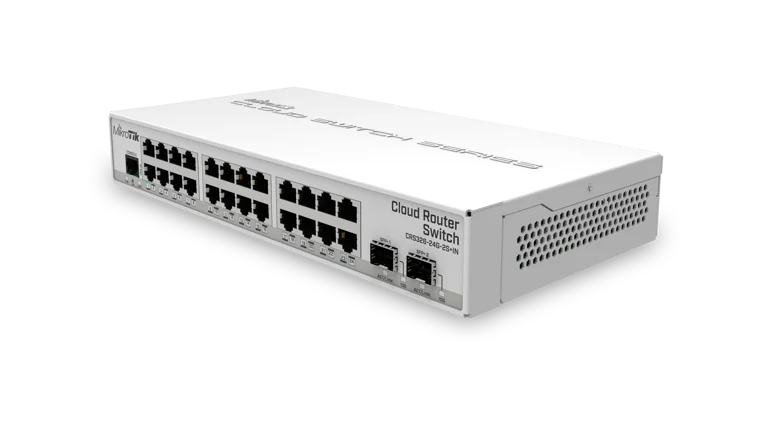
A quiet desktop switch for networks that need twenty-four Gigabit access ports, two high-speed SFP+ uplinks and a choice between RouterOS and SwOS management. FourTeck helps buyers confirm the correct model, transceivers, cabling, configuration scope and delivery requirements before purchase.
A practical fit when
You need many copper access ports, a pair of 10G uplinks, silent operation and flexible management in a compact indoor installation.
Direct answer for buyers
The MikroTik CRS326-24G-2S+IN is a compact managed Ethernet switch with twenty-four 10/100/1000 Mbps copper ports and two SFP+ cages that support 10G SFP+ and compatible 1.25G SFP modules. It is mainly used to aggregate office devices, servers, wireless access points with separate power, surveillance recorders and other network equipment while providing VLAN, forwarding, monitoring and traffic-control functions. It is worth considering for small and medium networks that value silent operation, flexible management and 10G uplink capacity. Before proceeding, confirm whether the desktop form factor is suitable, whether PoE output is needed, which optical or copper modules match the link design, and whether RouterOS or SwOS is the preferred operating approach.
What the switch does
The CRS326-24G-2S+IN concentrates wired network connections into one manageable platform. Its twenty-four Gigabit ports can connect workstations, printers, IP phones that have separate power, network storage, servers, wireless controllers, access points with injectors, building systems and other Ethernet devices. The two SFP+ cages provide higher-speed uplink or aggregation options, subject to module and cable compatibility.
It supports the functions expected from a managed switch, including VLAN configuration, port-to-port forwarding controls, MAC filtering, traffic mirroring and bandwidth controls. RouterOS opens access to broader routing and management capabilities, while SwOS gives administrators a lighter interface focused on switching. The right operating system depends on the network design and the administrator’s skill set.
Who should consider it
This model may suit branch offices, clinics, retail locations, professional practices, training centres, engineering workspaces, small hospitality sites, home labs and compact server areas where a standard desktop enclosure is preferable to a full-width rack switch. It is especially relevant when the buyer wants twenty-four copper ports and dual 10G uplinks but does not need PoE output from the switch.
It may be less suitable for environments requiring built-in 802.3af/at PoE delivery, redundant hot-swappable power supplies, a full enterprise support contract, large Layer 3 routing workloads or a chassis designed specifically for a standard data-centre rack. In those situations, FourTeck can help compare a PoE-capable or rackmount alternative.
Business challenges this model can address
Limited access-port capacity
A growing office may outgrow an eight-port or sixteen-port switch. Twenty-four copper ports provide room for more local devices while keeping administration centralised. Buyers should still reserve capacity for future additions and avoid designing a switch at permanent full utilisation.
Slow switch uplinks
A Gigabit-only uplink can become a bottleneck when many connected endpoints communicate with servers, storage or an upstream core. Two SFP+ cages allow a 10G design where compatible modules, fibre, direct-attach cables and upstream equipment are selected correctly.
Noise-sensitive installation
Passive cooling makes the unit suitable for quiet indoor areas that have appropriate ventilation. Fanless does not mean the device can be enclosed without airflow; placement, ambient temperature and cable management still require attention.
Management preference
Some administrators prefer a focused switching interface, while others want RouterOS tools and a familiar MikroTik workflow. Dual boot helps match the operating environment, but the configuration should be planned and documented before production use.
Core capabilities at a glance
Product-fit decision matrix
| Requirement | Suitable when | Confirm before ordering |
|---|---|---|
| Access ports | Up to twenty-four Gigabit copper connections are required. | Current endpoint count, growth allowance and whether any ports must supply power. |
| High-speed uplinks | One or two 10G links are needed for aggregation, servers or upstream switching. | SFP/SFP+ module, fibre type, connector, distance and peer-device compatibility. |
| Installation style | A compact desktop or shelf installation is acceptable. | Ventilation, physical security, cable access and whether a rackmount chassis is preferred. |
| Administration | The team can manage MikroTik RouterOS or SwOS. | Preferred interface, backup process, change control and administrator experience. |
| Power design | DC input or passive PoE input is suitable. | Voltage, adapter requirements, UPS design and the fact that the unit has no PoE output. |
Verified technical information
The following information is based on the exact MikroTik CRS326-24G-2S+IN model. Performance and behaviour can vary with operating system version, configuration, packet size, traffic pattern and enabled services. The switch should be assessed primarily as a managed switching platform; CPU-based routing, firewall and VPN workloads should be sized carefully rather than assumed from Layer 2 switching capacity.
| Brand | MikroTik |
|---|---|
| Model / product code | CRS326-24G-2S+IN |
| Product type | Compact managed Ethernet switch |
| Architecture | ARM 32-bit |
| CPU | 98DX3236, dual core, 800 MHz nominal frequency |
| Switch chip | 98DX3236 |
| Memory | 512 MB RAM |
| Storage | 16 MB Flash |
| Copper Ethernet | 24 × 10/100/1000 Mbps RJ45 ports |
| Fibre / uplink interfaces | 2 × SFP+ cages; compatible with supported 10G SFP+ and 1.25G SFP modules |
| Console | 1 × RJ45 serial console |
| Operating system | RouterOS with license level 5 or SwOS, dual boot |
| PoE | Passive PoE input supported; no PoE output |
| Power input | 10–30 V DC through DC jack or passive PoE input |
| Maximum power | Manufacturer product page states 21 W; current manual material should be checked for hardware-revision guidance |
| Cooling | Passive, fanless |
| Dimensions | 285 × 144 × 44 mm |
| Tested ambient temperature | −40 °C to +60 °C, subject to proper indoor installation and manufacturer guidance |
| Protection rating | IP20 |
| Included power accessory | 24 V 1.2 A power adapter listed by the manufacturer; confirm regional plug and supplied contents when ordering |
| Availability | Contact FourTeck for current UAE availability, hardware revision, quantity and vendor lead time |
Compatibility and dependency notice
SFP and SFP+ modules are not interchangeable in every design merely because they fit the cage. The transceiver, data rate, optical wavelength, fibre type, connector, distance, digital diagnostic support and peer device must be checked as one link. Copper SFP+ modules and direct-attach cables can also have power, heat and compatibility considerations. Confirm the exact module part number and the upstream device before finalising the bill of materials.
RouterOS functions depend on software version and configuration. Hardware-offloaded switching can deliver very different results from CPU-processed routing, firewalling, queues or VPN functions. For a design that requires substantial internet routing, encrypted traffic or complex security policy, consider a dedicated router or firewall and use the CRS326 primarily for switching.
The unit accepts passive PoE input but does not power downstream devices. Access points, cameras and IP phones that require power must receive it from compatible injectors, local adapters or a separate PoE switch. FourTeck can help separate the switching requirement from the endpoint-power requirement before quotation.
A sensible purchase and deployment journey
Map every connection
List all computers, printers, servers, storage systems, wireless devices, cameras, phones, controllers and uplinks. Mark which endpoints need PoE, which need link aggregation and which belong to separate VLANs. Include spare capacity rather than counting only today’s active connections.
Define the uplink media
Confirm whether each SFP+ port will use multimode fibre, single-mode fibre, a direct-attach cable or a compatible copper module. Record distance, connector type, fibre availability, peer-device model and desired speed. This prevents costly transceiver mismatches.
Choose the operating approach
Decide whether SwOS is sufficient for a switch-focused role or RouterOS is required for the intended administration and feature set. The team should agree on firmware policy, management access, authentication, backups, monitoring and change approval.
Confirm physical and power requirements
Check shelf space, ventilation, cable bend radius, access control, UPS availability and input voltage. Confirm whether the supplied adapter and plug are appropriate for the destination. A fanless chassis still needs a dry, ventilated indoor location.
Request the complete quotation
Share the exact model, quantity, destination, required modules, cables, installation work and configuration tasks. FourTeck can then coordinate a quotation that distinguishes hardware, accessories and services rather than leaving critical items implicit.
Capability focus: twenty-four Gigabit access ports
The twenty-four RJ45 interfaces make the CRS326-24G-2S+IN useful as an access or aggregation switch for a compact network. The immediate value is not simply the port count; it is the ability to organise those connections through a managed platform. Administrators can separate departments, guest services, voice devices, surveillance systems and management traffic with VLANs when the surrounding routers, firewalls, wireless infrastructure and endpoint settings are designed consistently.
A port plan should identify the purpose of every interface, expected speed, VLAN membership, tagging behaviour, security requirement and monitoring need. Unused ports should be documented and handled according to the organisation’s security policy. Where a link connects to another switch, server hypervisor or wireless access point, trunk configuration and allowed VLANs must match both ends. Misaligned tagging is one of the most common causes of deployment delays.
The Gigabit ports do not provide PoE output. That distinction matters in offices where phones, cameras or wireless access points are part of the project. A twenty-four-port count can look sufficient on paper while the power design remains incomplete. FourTeck can review whether separate injectors are reasonable or whether a PoE-capable switch would produce a cleaner installation and easier support model.
Capability focus: dual 10G SFP+ uplinks
Two SFP+ cages allow the switch to connect at up to 10 Gigabit per second per supported interface, which can be valuable when many Gigabit endpoints share access to a core switch, storage system or server platform. The second cage can support another uplink, a server connection, a separate network segment or a redundancy design, depending on the overall architecture and supported configuration.
A 10G port does not guarantee that every application will achieve 10G throughput. End-to-end speed depends on the peer device, module, cable, fibre plant, server interfaces, storage performance, protocol overhead, traffic pattern and configuration. Link aggregation also requires support and matching settings at both ends, and it does not make a single traffic flow automatically use the combined capacity of multiple links.
For buyers in Dubai and the UAE, the most important procurement step is to identify the actual media requirement. Multimode optics may suit shorter links within a building, while single-mode optics may be needed for longer distances. Direct-attach copper cables can suit short equipment-to-equipment links. Every choice should be confirmed against the peer equipment and installed cabling. FourTeck can assist with a compatible bill of materials rather than quoting the switch alone.
Capability focus: RouterOS and SwOS flexibility
Dual boot gives the buyer a choice between two operating environments. SwOS is designed around switching tasks and can be easier for teams that want a focused web-based interface. RouterOS exposes a broader set of network features and management methods, including WinBox and WebFig, which may be preferred by organisations already operating MikroTik routers or switches.
The choice should not be made only on the number of available features. Operational simplicity, team knowledge, configuration standards, monitoring tools, security hardening and support responsibilities are equally important. A smaller feature surface can be easier to maintain, while RouterOS can provide more flexibility where the team understands the platform. The production configuration should be backed up, documented and tested before the switch becomes a dependency for business services.
Software should be maintained in line with MikroTik guidance and organisational change policy. Updates can address stability and security, but they should be assessed, scheduled and verified rather than applied without planning to a critical switch. FourTeck can include baseline configuration, VLAN implementation, management access controls, firmware review and handover documentation as separately defined services when requested.
Ideal environments and practical use cases
Branch-office access switching
Connect employee workstations, printers, local servers and other wired devices, then uplink to a router, firewall or core switch through SFP+. Confirm whether phones and wireless access points require PoE from a different source.
Small server or lab network
Use Gigabit ports for servers and lab systems, with one or two 10G connections to storage or an upstream switch. The design should account for workload patterns rather than assuming every server needs the same connectivity.
Retail and service locations
Segment point-of-sale, administration, guest connectivity and building systems. Security policy should be enforced by the wider architecture, including the firewall, endpoint controls and access management.
Training and technical classrooms
Provide managed connectivity for student stations, instructor systems and lab equipment. Configuration reset, access control and documentation are important where many users interact with the environment.
Surveillance aggregation without PoE
Aggregate cameras or recorders only where endpoint power is supplied separately. Confirm bandwidth, multicast behaviour, recorder connectivity and whether a dedicated PoE switch would be operationally simpler.
Advanced home office
Support a larger wired environment with VLANs, servers and high-speed uplinks. The technical owner should be comfortable maintaining managed switching and securing administrative access.
Integration and operational considerations
The switch does not operate in isolation. VLANs must align with the router or firewall that provides inter-VLAN routing, internet access and security policy. DHCP, DNS, authentication, network monitoring and logging should be considered as part of the design. When the switch is connected to a wireless platform, access-point uplinks may need tagged VLANs for corporate, guest and management networks.
Management access should be restricted to trusted networks and administrators. Change default credentials immediately, apply strong authentication practices, limit exposed services and maintain configuration backups. A management VLAN, out-of-band plan or controlled jump-host process can reduce operational risk. The serial console can assist with recovery, but physical access should also be controlled.
Monitoring requirements should be defined before deployment. Decide which events, port states, bandwidth measurements and device-health indicators must be collected, where logs will be retained and who will respond to alerts. A managed switch becomes much more useful when its operational data supports troubleshooting rather than being reviewed only after an outage.
For environments with critical availability requirements, assess whether a single compact switch and single external power adapter are acceptable. Redundant uplinks can reduce some link risks, but they do not create redundant chassis or power. A higher-resilience design may require multiple switches, redundant power infrastructure and tested failover procedures.
Questions to resolve before ordering
The CRS326-24G-2S+IN does not supply PoE output. Identify every access point, camera and phone that needs power and decide whether injectors or a PoE switch are more suitable.
Specify link speed, distance, fibre type, connector, peer model and redundancy requirement. This determines the modules and cables that belong in the quotation.
Heavy routing, firewalling or VPN workloads may require a dedicated router or firewall. State the expected traffic and feature set so the architecture can be assessed correctly.
Confirm shelf space, ventilation, dust exposure, humidity, physical security, cable routing and UPS availability. The unit is intended for a dry indoor environment.
Identify the administrator, operating-system preference, backup process, monitoring method and support expectation. Configuration ownership should be clear before handover.
State whether you need supply only, configuration, installation, VLAN migration, testing, documentation, remote support or on-site coordination.
Procurement checklist
✓ Exact model: CRS326-24G-2S+IN
✓ Required quantity and spare-unit policy
✓ Current port count and growth allowance
✓ PoE-powered endpoint count
✓ SFP or SFP+ module part numbers
✓ Fibre type, connector and link distance
✓ Peer switch, router or server compatibility
✓ RouterOS or SwOS operating preference
✓ VLAN, trunk and link-aggregation requirements
✓ Desktop placement and ventilation
✓ Power adapter, plug and UPS requirements
✓ Installation and configuration scope
✓ Documentation and administrator handover
✓ UAE delivery destination and requested timeline
How FourTeck can assist
FourTeck can help translate a simple switch request into a complete procurement requirement. This can include checking whether the desktop CRS326 model is appropriate, reviewing endpoint count, identifying the need for PoE, confirming the uplink type, selecting compatible modules and determining whether a dedicated router or firewall should handle Layer 3 and security functions.
For projects that need more than hardware supply, the quotation can define configuration and deployment tasks separately. Typical activities may include firmware review, basic hardening, management-IP setup, VLAN configuration, trunk ports, access ports, link aggregation, monitoring settings, configuration backup, installation coordination, testing and handover notes. The exact scope depends on the existing network and information supplied by the customer.
Buyers can explore broader network and security products, review available technology services, learn more about FourTeck or send the exact requirement through the FourTeck contact page.
UAE availability and support guidance
Contact FourTeck to confirm current UAE availability for the MikroTik CRS326-24G-2S+IN. Availability may depend on the exact hardware revision, requested quantity, vendor lead time, regional supply and whether compatible SFP/SFP+ modules or cables are needed with the switch. A product-page price or international suggested price should not be treated as a confirmed UAE selling price because freight, regional supply, accessories, taxes and project services can affect the quotation.
FourTeck can coordinate requirements for Dubai, Abu Dhabi, Sharjah and Ajman through one combined review. Share the delivery location, quantity, uplink media, configuration scope and required timeline. Installation and configuration should be listed in the quotation when required rather than assumed to be included with hardware. Warranty handling and supplied accessories should also be confirmed against the final commercial offer.
GCC availability
Businesses planning MikroTik deployments across the Gulf can ask FourTeck to review the technical requirement before a regional quotation is prepared. The discussion can cover the exact CRS326-24G-2S+IN quantity, uplink modules, fibre or direct-attach cables, operating-system preference, VLAN design, configuration work and delivery destination. Requirements in the United Arab Emirates, Saudi Arabia, Kuwait, Qatar, Bahrain and Oman may differ because of local procurement processes, regional supply, plug requirements, service access and vendor lead times.
Product availability, delivery schedules, configuration scope, installation visits and warranty handling can vary by country, model, quantity and project conditions. Buyers should provide the destination country, delivery site, expected timeline, contact person, exact hardware list and any onsite or remote-support expectations. FourTeck can then coordinate the commercial and technical discussion without making assumptions about local stock or fixed delivery dates. For Kuwait-related technology enquiries, the FourTeck Kuwait resource may also be useful.
Africa availability
FourTeck can assist organisations evaluating the CRS326-24G-2S+IN for projects in selected African markets by reviewing the switch requirement, compatible uplink optics, power arrangements, deployment environment and support expectations. This is particularly important when equipment will be installed across multiple branches, because fibre standards, available cabling, local power conditions, spares policies and administrator skills may differ between sites.
Availability and fulfilment depend on the destination, quantity, regional supply, shipping arrangements, vendor lead time, installation scope and local project conditions. Buyers should share the destination country, exact model, required modules, preferred schedule and whether configuration or support is needed. FourTeck can then provide appropriate procurement guidance without promising local inventory, customs outcomes or universal onsite coverage. Regional resources include FourTeck Africa, FourTeck Kenya and FourTeck Uganda.
Related products and services to evaluate
CRS326-24G-2S+RM
Consider the rackmount counterpart where a standard 1U installation is more appropriate. Confirm dimensions, power specification and current revision rather than assuming the enclosure is the only difference.
PoE-capable managed switch
A different model may be better when the project must power many access points, phones or cameras directly. PoE standard, power budget, port count and uplink capacity all need sizing.
SFP and SFP+ modules
Select optics or copper modules according to speed, medium, wavelength, distance and peer compatibility. Do not add a generic transceiver without checking the complete link.
Dedicated router or firewall
Use a separately sized gateway when internet routing, VPN, threat protection or complex policy is a major requirement. The switch can then focus on efficient local connectivity.
Configuration service
Define VLANs, trunks, management access, monitoring, port roles and backups as a documented service scope. Testing and handover criteria should be agreed before implementation.
Network assessment
For replacement or expansion projects, a short assessment can identify port demand, PoE requirements, uplink bottlenecks, cabling constraints and resilience gaps before hardware is selected.
Why businesses contact FourTeck
Technology buyers often need help turning a model number into a complete and supportable requirement. FourTeck can assist with model confirmation, port planning, PoE assessment, transceiver selection, compatibility review and bill-of-material guidance. This reduces the chance of receiving a switch without the modules, cables or services needed to deploy it.
The team can also help define the commercial scope. Hardware supply, delivery coordination, installation, configuration, migration, testing and support are separate considerations. Clarifying them before quotation makes it easier for procurement teams to compare offers on a like-for-like basis and avoids uncertainty during implementation.
For broader technology planning, visit the FourTeck UAE website or use the business technology contact channel to describe the project.
Frequently asked questions
Is the MikroTik CRS326-24G-2S+IN a router or a switch?
It is primarily a managed switch with a hardware switch chip and twenty-four Gigabit ports. RouterOS provides routing and other functions, but CPU-processed workloads must be sized carefully. For substantial routing, firewall or VPN demand, a dedicated router or firewall may be more appropriate.
Does it provide PoE output for access points or cameras?
No. The switch supports passive PoE input as one powering method, but it does not deliver PoE to connected endpoints. Devices needing power require injectors, local adapters or a separate PoE-capable switch.
Can both SFP+ ports operate at 10G?
The model has two 10G SFP+ cages. Actual operation depends on supported modules, cabling, peer equipment and configuration. Confirm the complete end-to-end link before purchasing optics or direct-attach cables.
Can I use standard 1G SFP modules?
MikroTik states that the cages support compatible 1.25G SFP as well as 10G SFP+ modules. Compatibility still depends on the exact module, media and peer device, so the part number should be verified before ordering.
What is the difference between RouterOS and SwOS?
SwOS is focused on switch management through a lighter interface. RouterOS provides a broader networking platform and management options. The preferred choice depends on required functions, administrator experience and operational standards.
Is the CRS326-24G-2S+IN suitable for a server room?
It can suit a small indoor server or communications area where the compact desktop form factor, single external power arrangement and fanless design are acceptable. Larger or more resilient environments may prefer rackmount hardware, redundant power and higher-capacity switching.
Does the switch include a RouterOS license?
The manufacturer lists RouterOS license level 5 as part of the device and states that the operating system is preinstalled and licensed. Confirm the supplied hardware revision and current vendor terms in the final quotation.
What information is needed for a UAE quote?
Provide the exact model, quantity, delivery location, required SFP/SFP+ modules, cable type, installation needs, configuration scope and target schedule. Mention any PoE endpoints so the switch choice can be checked.
Can FourTeck configure VLANs and uplinks?
Configuration assistance can be discussed as a defined service. The scope may include management access, VLANs, trunk and access ports, link aggregation, monitoring, backups, testing and documentation, depending on the information supplied.
Is current Dubai availability guaranteed?
No availability claim should be assumed from this page. Contact FourTeck to confirm current UAE supply, quantity, vendor lead time, accessories and the commercial terms applicable to the request.
Confirm the complete switching requirement
Share the port count, uplink design, PoE needs, quantity, location and configuration scope. FourTeck can help prepare a quotation that includes the correct switch, compatible connectivity components and clearly defined services.
