

Direct answer for buyers
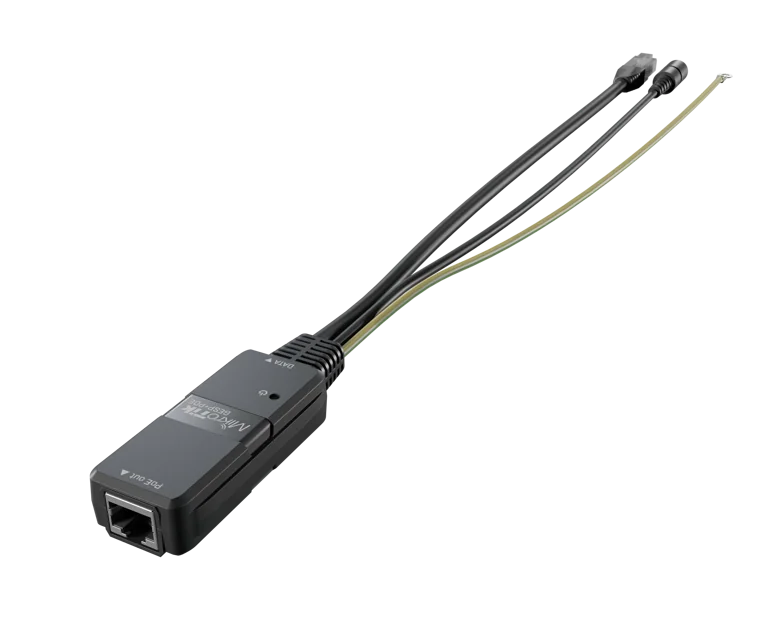
The MikroTik GESP+POE-IN is an indoor passive PoE injector that also protects an RJ45 Gigabit Ethernet path against specified transient electrical events. It is mainly used near the host-side switch or router to inject passive PoE toward a remote device while adding a grounded surge-protection point. It is relevant to organisations operating wireless antennas, access points, cameras, or other compatible passive-PoE equipment on long or exposed copper links. Before proceeding, confirm the remote device’s voltage and polarity, the power adapter, the grounding conductor and earth point, the Ethernet cable and connectors, link distance, mounting position, and whether an outdoor GESP should be installed at the remote end.
What the GESP+POE-IN does
The unit performs two related functions within one compact accessory. First, it introduces passive DC power onto an Ethernet cable so that a compatible remote device can receive both data and power through the same copper run. Second, it provides surge-protection components for the Ethernet data path and a dedicated grounding conductor that must be connected to a dependable grounded structure or earth system.
This combination is particularly useful at the lower end of a mast or at the equipment-room side of a cable leading to an exposed location. The host-side switch, router, or recorder may otherwise be vulnerable when electrical energy is coupled onto the cable through lightning activity, static build-up, or nearby industrial interference. The GESP+POE-IN is not a substitute for a complete lightning-protection design, but it can be one purposeful layer within that design.
Who should consider it
The product may suit wireless internet providers, system integrators, security-camera installers, hospitality groups, schools, warehouses, industrial sites, villas, commercial buildings, and branch networks that use passive-PoE equipment over copper Ethernet. It is especially relevant where a remote radio, antenna, access point, bridge, or camera is installed above roof level, on a pole, on a mast, or at another location exposed to static and electrical transients.
It should be selected by someone who can verify the passive-PoE electrical requirements and implement correct grounding. Buyers using standards-based active PoE switching should not assume that every 802.3af, 802.3at, or 802.3bt design can be replaced by this passive injector. The complete power path must be reviewed device by device.
Business challenges this accessory helps address
Exposed copper cabling
Long Ethernet runs to rooftops and masts can act as paths for transient energy. A grounded protector can help divert specified events away from connected electronics.
Separate power at the remote point
Passive PoE can reduce the need for an AC outlet beside a compatible outdoor or elevated device, provided voltage drop and device requirements are checked.
Protection at both cable ends
A coordinated design can place the GESP+POE-IN on the host side and a suitable GESP near the remote device, with both grounded as required.
Procurement clarity
The buyer can consolidate injector, mounting, protection, cable, power-supply, and grounding requirements into a clearer bill of materials.
Core capabilities in practical terms
Product-fit decision matrix
| Requirement | Suitable when | Confirm before ordering |
|---|---|---|
| Powering a remote Ethernet device | The device accepts compatible passive PoE and the cable run is within acceptable voltage-drop limits. | Input-voltage range, polarity, current demand, cable length, conductor quality, and adapter output. |
| Protecting a host-side network port | The protector can be installed close to the host equipment with a short path to a reliable ground. | Grounding point, bonding conductor route, local electrical requirements, and enclosure environment. |
| Maintaining Gigabit Ethernet | All four pairs, connectors, shield continuity, and installation workmanship support Gigabit operation. | Cable category, connector quality, pinout, shielded termination, and link test results. |
| Outdoor device deployment | The GESP+POE-IN itself remains in a suitable indoor or protected location, with a separate outdoor protector where required. | Weather exposure, enclosure rating, cable entry, drip loops, mast bonding, and remote-end protection. |
| Standards-based active PoE system | Only after the complete design is reviewed and passive injection is confirmed as appropriate. | Do not assume active-PoE negotiation, classification, or universal compatibility. |
Verified technical information
The following values reflect manufacturer-published information for the exact GESP+POE-IN model. They should be interpreted as component specifications, not as a guarantee that a wider installation will withstand every electrical event. Effective protection depends on grounding, bonding, cable routing, installation workmanship, the severity and path of the transient, and the condition of all components.
| Brand | MikroTik |
|---|---|
| Product name | GESP+POE-IN |
| Product type | Passive PoE injector with surge protection |
| Interface connections | RJ45 male/female connector arrangement |
| Data-line protection | RJ45 10/100/1000 Ethernet |
| PoE support | Passive PoE |
| ESD/EMP protection | Transient-current absorption with manufacturer-stated response characteristics and references to IEC 61000-4-2, IEC 61000-4-3, IEC 61000-4-4, and IEC 61643-21; stated levels include ±8 kV contact and ±15 kV air. |
| DC spark-over voltage | 75 V at 100 V/s |
| Maximum impulse spark-over voltage | 700 V at 1 kV/μs |
| Discharge current | 3 kA, 8/20 μs waveform |
| Minimum insulation resistance | 1 GΩ at 50 V |
| Maximum capacitance | 4 pF at 1 MHz |
| Operating temperature | -40°C to 70°C |
| Weather protection | No IP rating is stated for the GESP+POE-IN in the manufacturer comparison table; plan an indoor or otherwise protected installation. The separate GESP model is the weatherproof outdoor unit. |
| Included mounting accessory | Fastening set; current package details should be confirmed at quotation stage. |
| Power adapter | Compatibility and inclusion depend on the selected supply arrangement; confirm the required voltage and connector before ordering. |
| Warranty guidance | Confirm the applicable supplier and manufacturer terms for the destination and purchase channel. |
| UAE availability | Contact FourTeck for current availability, lead time, quantity, and delivery coordination. |
Compatibility and installation dependencies
Passive PoE is fundamentally different from automatically negotiated active PoE. The injector applies power according to the connected power source and wiring arrangement; it does not independently determine whether the remote device can safely accept that power. A mismatch in voltage, polarity, cable pairs, connector wiring, or current capability can prevent operation or damage equipment. The powered device’s official input specification must therefore be checked first.
Grounding is equally important. The protective function relies on the grounding conductor being attached to a suitable grounded rack, mast, or other approved earth point. A loose wire, painted surface, unbonded structure, long indirect conductor, or uncertain building earth may undermine the intended protection. Grounding and bonding should follow local electrical practice and the project’s lightning-protection design.
For long exterior runs, MikroTik recommends protection at both ends. In a typical arrangement, the weatherproof GESP sits near the antenna or remote unit while the GESP+POE-IN is installed near the indoor switch or router. This is a design pattern rather than a universal instruction. Cable route, building entry, mast bonding, equipment enclosure, local standards, and the risk environment should be reviewed by the installer.
Purchase and deployment journey
Identify the remote device
Record the exact model, its passive-PoE input range, polarity, maximum consumption, and connector requirements.
Map the cable path
Confirm cable length, category, shielding, building entry, mast route, patching points, and environmental exposure.
Design grounding
Select a reliable earth or bonded structure and determine the shortest practical protective-conductor route.
Build the materials list
Include the injector, suitable power adapter, remote GESP if required, cables, connectors, mounting items, and test equipment.
Install and validate
Verify grounding, polarity, delivered voltage, Ethernet negotiation, packet stability, cable certification, and mechanical strain relief.
Capability focus: combining power delivery with host-side protection
In many small outdoor-network deployments, the same Ethernet cable carries traffic and electrical power from an indoor communications area to a remote device. This arrangement is convenient, but it also creates a direct conductive path between sensitive electronics and an elevated or exposed location. The GESP+POE-IN addresses both sides of that operational requirement: it injects passive PoE and provides a grounded protection point near the host equipment.
The practical value is not simply a reduced accessory count. Using a purpose-built combined device can make the cable path easier to document and maintain. An installer can identify the data input, the powered output, the power source, and the grounding lead in one location. That clarity matters during troubleshooting, maintenance, and future equipment replacement.
The limitation is that combined functionality does not remove design responsibility. The power source still needs the correct output. The remote device still needs to support the intended passive-PoE arrangement. The ground still needs to be effective. The installer should label the injector voltage and protected cable destination so that future technicians do not connect an incompatible device.
Capability focus: preserving Gigabit connectivity
The manufacturer specifies RJ45 10/100/1000 Ethernet data-line protection. For buyers, this means the accessory is intended for links that may negotiate at Gigabit speed, rather than being limited by design to two-pair Fast Ethernet. Actual link performance, however, depends on the entire channel. All four twisted pairs must be correctly terminated, cable impedance must remain within acceptable limits, connectors must be sound, and shielded components should be bonded consistently where the design calls for shielding.
When an installed link falls back to 100 Mbps, the injector should not be assumed to be the only cause. A technician should test cable continuity, pair mapping, connector crimp quality, moisture ingress, bend radius, shield termination, patch leads, and port auto-negotiation. Replacing or reterminating a marginal connector may resolve a problem that first appears to be associated with the protection device.
A sensible acceptance process includes confirming the negotiated speed at both ends, running a throughput or packet-loss test, and checking stability over time. Where the link supports a critical camera, backhaul, or access point, record the baseline test results for later maintenance comparison.
Capability focus: grounding as part of the network design
Surge protection is often purchased as though it were a self-contained insurance policy. In practice, the grounding route is part of the product’s functional environment. The GESP+POE-IN includes a grounding conductor that should be secured to an appropriate grounded source. The quality of that connection influences how effectively transient current can be diverted away from the protected equipment.
The installer should identify where the telecommunications rack, mast, cable shield, electrical earth, and building lightning-protection system are bonded. Independent grounds at different potentials can create additional risk. Projects involving rooftop structures, industrial sites, generators, solar equipment, or multiple buildings deserve particular care because the earth and bonding arrangements may be more complex than they appear.
After a significant surge event, inspect the injector, remote protector, cable, connectors, and connected ports. Manufacturer guidance indicates that GESP-family units can absorb multiple impacts, but condition checks after each known event are recommended. A replacement policy may be appropriate where visual damage, degraded link performance, or uncertainty exists.
Suitable business environments and use cases
Wireless internet sites
Host-side injection and protection for a compatible rooftop radio or point-to-point wireless device, paired with suitable remote-end protection.
CCTV installations
A possible fit for cameras or wireless bridges that explicitly accept the selected passive-PoE supply, particularly on perimeter and rooftop links.
Hospitality and campuses
Useful where separate buildings, outdoor spaces, signage, or elevated access points are connected through long copper runs.
Warehouses and industrial yards
Supports a structured approach to powering compatible remote devices while accounting for static, nearby machinery, and exposed cable routes.
Branch and villa networks
Can serve small deployments where a roof-mounted antenna or outdoor link terminates near an indoor router or switch.
Temporary project sites
May support compatible remote networking equipment in project compounds, subject to careful grounding and weather-protected placement.
Integration and operational considerations
Place the GESP+POE-IN where it can remain dry, accessible, mechanically protected, and close to the equipment and grounding point it is intended to protect. Do not treat the operating-temperature range as an enclosure rating. Heat, condensation, dust, water exposure, and cable movement should all be considered separately.
Use cable and connectors suitable for the environment. Exterior runs commonly benefit from UV-resistant outdoor cable, shielded construction where specified by the system design, correct cable glands or building-entry seals, and drip loops that reduce water tracking. Shielding should not be improvised; it needs a deliberate bonding plan to avoid creating undesirable current paths.
Power-budget calculations should consider the remote device’s peak consumption and voltage drop over the cable length. A supply that is adequate on a short bench cable may deliver insufficient voltage at the far end of a long run. Measure the voltage under load where practical. Avoid choosing a higher supply voltage unless the remote device explicitly permits it.
Document the installation. Record the injector model, power-supply output, powered-device model, cable identifier, grounding point, link length, test date, and measured link speed. Clear records reduce risk during later moves, repairs, and equipment upgrades.
Buyer questions to resolve before ordering
Procurement checklist
☐ Exact GESP+POE-IN model code
☐ Required quantity and spare quantity
☐ Remote powered-device make and model
☐ Passive-PoE voltage and polarity
☐ Suitable power-adapter rating and connector
☐ Ethernet cable category, shielding, and length
☐ Grounding and bonding point
☐ Outdoor GESP requirement at the far end
☐ Indoor enclosure and mounting method
☐ Gigabit link-test and cable-certification scope
☐ Installation drawings or cable-route details
☐ Delivery destination and requested timeline
☐ Warranty and replacement-process confirmation
☐ Post-surge inspection and maintenance plan
How FourTeck can assist
FourTeck can help buyers translate a small accessory request into a complete and compatible deployment requirement. That process can include checking the exact powered-device model, reviewing passive-PoE input information, identifying a suitable power supply, considering whether a remote GESP is required, and clarifying the quantity and installation locations.
For project quotations, share a simple cable-path sketch, the host equipment, remote equipment, approximate cable length, mounting environment, grounding information, and desired installation or testing scope. This allows the quotation to distinguish product supply from optional services such as cabling, mounting, grounding coordination, configuration, and link validation.
Buyers can review related networking options through the FourTeck technology product catalogue, discuss project services through the networking and implementation services page, or send the requirement through the FourTeck Dubai contact page.
UAE availability and support guidance
Contact FourTeck to confirm current UAE availability for the MikroTik GESP+POE-IN. Availability may depend on quantity, vendor lead time, packaging revision, and the accessories required for the complete installation. Delivery and project coordination can be discussed after the exact requirement is confirmed. Where installation or configuration assistance is needed, include that scope in the quotation request rather than assuming it is included with hardware supply.
Dubai, Abu Dhabi, Sharjah and Ajman
FourTeck can coordinate product enquiries and project discussions for businesses in Dubai, Abu Dhabi, Sharjah, and Ajman. Buyers should provide the delivery location, building or site type, required quantity, remote-device model, preferred timeline, and any installation or testing requirement. Site access, grounding work, cable routing, and service availability remain subject to project review and quotation.
GCC Availability
FourTeck can assist organisations planning MikroTik GESP+POE-IN deployments across GCC markets, including the United Arab Emirates, Saudi Arabia, Kuwait, Qatar, Bahrain, and Oman. Support can begin with a requirement review covering the exact powered device, passive-PoE voltage, cable distance, grounding arrangement, required quantity, and whether remote-end GESP protection is part of the design. Quotation coordination may also cover compatible power supplies, accessories, installation planning, and link-testing scope. Product availability, delivery schedules, service visits, and vendor lead times can vary by destination country, quantity, project location, and the final bill of materials. Buyers should share the delivery country, exact model requirement, number of units, deployment environment, and expected timeline so the appropriate commercial and technical options can be reviewed. No regional stock level, customs outcome, or installation date should be assumed until it is confirmed in writing for the specific project. For Kuwait enquiries, buyers may also review FourTeck Kuwait technology support.
Africa Availability
FourTeck can help organisations in Africa evaluate the GESP+POE-IN as part of wireless, CCTV, branch-connectivity, or outdoor-network projects. Planning support can cover product quantity, passive-PoE compatibility, remote surge protection, suitable power supplies, cable construction, grounding expectations, deployment documentation, and support requirements. Availability and fulfilment may depend on the destination, model quantity, power and regulatory conditions, shipping arrangements, vendor lead time, installation scope, and local project environment. Buyers should provide the destination country, remote-device model, approximate cable length, preferred deployment schedule, and whether installation or remote technical guidance is required. FourTeck does not assume local inventory, immediate shipment, customs clearance, or country-wide onsite coverage without project confirmation. Regional enquiries can be coordinated through FourTeck Africa, while customers in East Africa may review Kenya technology solutions or Uganda technology support for relevant contact routes.
Related products and services to consider
MikroTik GESP
Weatherproof Gigabit Ethernet surge protector for the remote or exposed end of a suitable cable run. Confirm the final two-ended protection design.
Compatible power supply
Select only after verifying the powered device’s passive-PoE voltage, polarity, current demand, and cable voltage drop.
Outdoor Ethernet cabling
UV-resistant, correctly terminated cable and suitable building-entry protection may be required for rooftop and mast routes.
Installation and grounding review
A project-specific review can clarify mounting, earth bonding, cable routing, testing, and maintenance responsibilities.
Why businesses contact FourTeck
The main reason to involve FourTeck is not simply to request a unit price. It is to confirm that the requested accessory fits the wider network design. FourTeck can help clarify the model, quantity, power requirement, accessories, remote protector, cabling, installation scope, delivery location, and project timing. This practical review helps reduce the risk of receiving an injector that does not match the powered device or of overlooking a grounding or enclosure requirement.
For organisations purchasing several units, FourTeck can assist with a consistent bill of materials and installation notes across sites. For a single rooftop link, the same process can still be valuable because the cost of troubleshooting an incompatible or poorly grounded installation can exceed the accessory cost. Learn more about the company through the FourTeck business profile.
Frequently asked questions
What is the MikroTik GESP+POE-IN used for?
It is used to inject passive PoE onto an Ethernet cable while adding grounded surge protection for a 10/100/1000 Ethernet data path. It is commonly positioned near the host-side switch, router, or other indoor equipment.
Is the GESP+POE-IN suitable for outdoor installation?
The manufacturer comparison table does not assign an IP rating to the GESP+POE-IN. It should therefore be placed indoors or in a suitable protected enclosure. The separate GESP model is intended for outdoor use and carries the weatherproof rating.
Does it support Gigabit Ethernet?
Yes, the published data-line protection specification covers RJ45 10/100/1000 Ethernet. The complete cable channel, all four pairs, connectors, shielding, and connected ports must also support Gigabit operation.
Will it power any PoE device?
No. It is a passive PoE injector, so buyers must verify the remote device’s supported voltage, polarity, pin arrangement, and current demand. It should not be treated as a universal replacement for negotiated active PoE.
Is grounding mandatory?
A proper grounding connection is essential to the intended surge-protection function. The grounding wire should be attached to a reliable grounded rack, mast, or approved earth point according to the installation design and local practice.
Should a GESP be installed at the remote end?
For long cables, manufacturer guidance recommends surge protection at both ends. A typical design uses the GESP+POE-IN near the indoor host and a weatherproof GESP near the mast-mounted or outdoor device. The final arrangement should be reviewed for the site.
What comes with the GESP+POE-IN?
Manufacturer information lists a fastening set. Package contents and any separate power-supply requirement should be reconfirmed in the quotation because packaging and supply arrangements can change.
How should the unit be checked after a surge?
Inspect the protector, grounding connection, cable, connectors, and attached ports after a known event. Retest link speed and stability. Replace components that show damage, degraded operation, or uncertain condition.
What information is needed for a quotation?
Provide the quantity, delivery destination, powered-device model, required passive-PoE voltage, approximate cable length, remote environment, grounding plan, and whether installation, cabling, or testing is required.
Is the MikroTik GESP+POE-IN available in Dubai?
Contact FourTeck to confirm current Dubai and UAE availability. Lead time can depend on quantity, vendor supply, accessory requirements, and the requested delivery or project schedule.
Confirm the complete passive PoE and protection requirement
Share the remote device, voltage, cable length, quantity, deployment location, and grounding details so FourTeck can prepare a more accurate product and service quotation.
