

LTE Cat 7 · Wi-Fi 6 · RouterOS v7
MikroTik Chateau LTE7 ax in Dubai, UAE
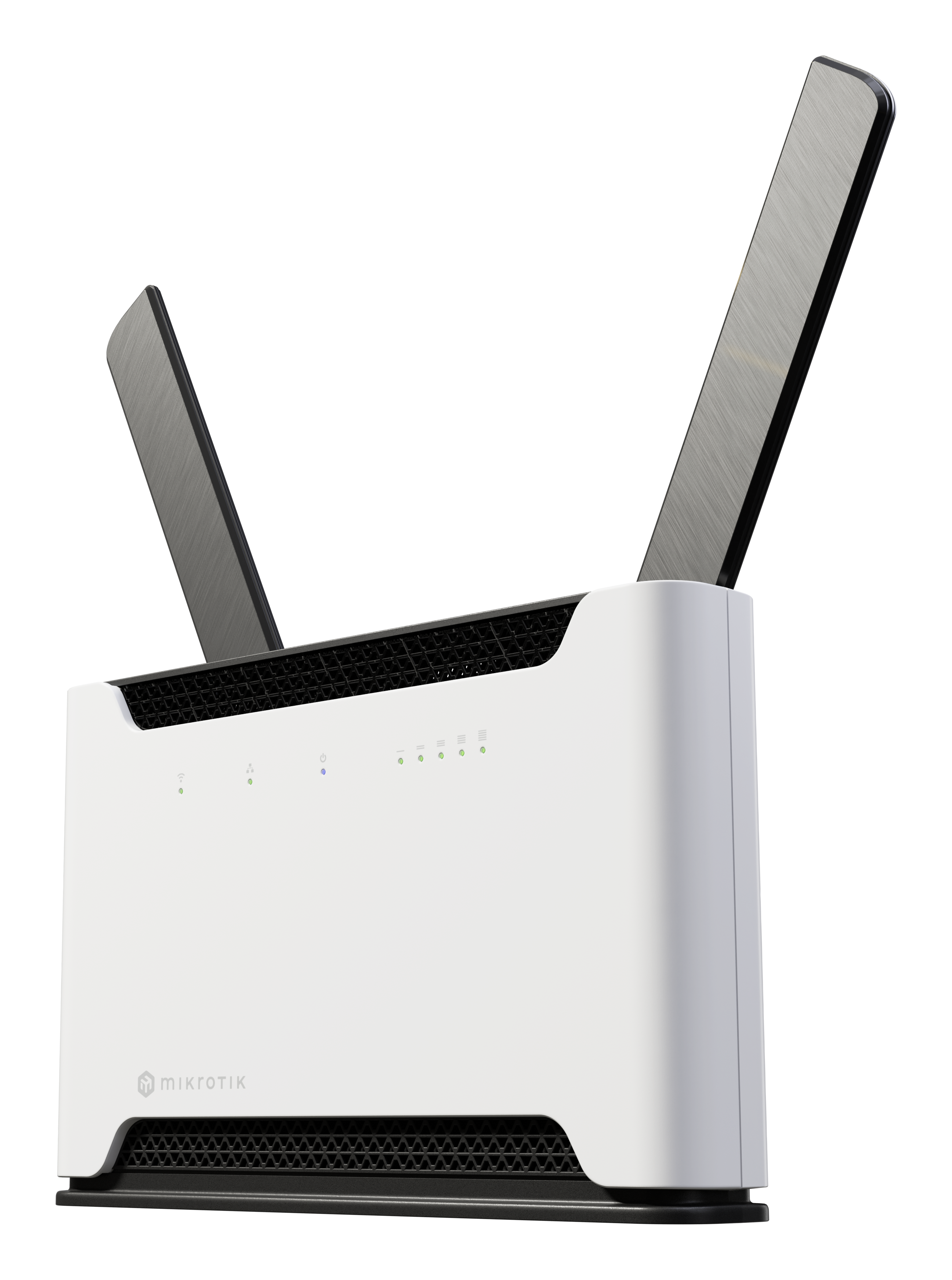
A capable indoor mobile broadband router for buyers who want more control than a typical operator-supplied gateway. Chateau LTE7 ax combines LTE Category 7 connectivity, dual-band Wi-Fi 6, a 2.5 Gigabit Ethernet interface and the flexibility of RouterOS v7 for routing, firewall, VPN, bandwidth management and advanced network policies.
Direct answer for buyers
The MikroTik Chateau LTE7 ax is an indoor LTE and Wi-Fi 6 router intended for home offices, small and medium business sites, temporary locations, branch deployments and managed customer premises that need flexible mobile connectivity. It is mainly used to turn a compatible mobile SIM service into a routed wired and wireless network, with RouterOS controls for firewalling, VPN, traffic management and monitoring. Buyers should consider it when LTE Cat 7 performance is appropriate and when they value advanced configuration options. Before proceeding, confirm local LTE bands, carrier aggregation support, indoor signal conditions, SIM format, expected user load, required VPN or firewall functions, placement, power and whether LTE will be the primary or backup connection.
What it does
Chateau LTE7 ax connects to a supported 3G or 4G LTE network through a Micro SIM and distributes that connection over Ethernet and Wi-Fi. Its R11e-LTE7 modem supports LTE Category 7, with a theoretical downlink rate of up to 300 Mbps and uplink rate of up to 100 Mbps. Real throughput is determined by the mobile operator, signal quality, cell loading, spectrum allocation, band combination, indoor placement and data plan.
Unlike a basic mobile hotspot, it runs RouterOS v7. That gives administrators access to policy routing, firewall filters, NAT, VPN services, traffic queues, monitoring, scripting, routing protocols and other functions. The exact configuration should be designed around the business requirement rather than enabling features without a clear operational need.
Who it suits
This model may suit a small office that relies on mobile broadband, a branch that needs an alternate WAN, a retail or service location awaiting fibre installation, a project team operating from a temporary site, or an ISP and managed service provider that needs a configurable customer-premises router. It can also serve technically capable home-office users who need stronger routing control, VPN flexibility and wired connectivity.
It is less suitable where 5G is mandatory, where an outdoor weatherproof modem is required, where LTE signal is extremely weak without external antenna planning, or where the organisation expects a fully managed enterprise security platform with bundled subscriptions and central security analytics. Those needs should be reviewed before selecting this model.
Business challenges and practical responses
Fixed-line delay
A compatible LTE service can provide interim connectivity while a fixed circuit is being installed. The mobile signal and data allowance must be assessed for the intended workload.
Single-WAN exposure
The LTE modem can be incorporated into a backup-WAN design. Failover behaviour, monitoring targets, route priority and application expectations should be configured and tested.
Basic router limitations
RouterOS provides deeper policy control than many consumer gateways, including firewall, VPN, queues, routing and monitoring. This flexibility requires careful administration.
Mixed wired and wireless users
Five Ethernet interfaces and dual-band Wi-Fi 6 allow the unit to support local wired devices, access points, workstations and wireless clients within its design limits.
Capability overview
Supports up to 300 Mbps downlink and 100 Mbps uplink at the modem category level, subject to the operator network and radio conditions.
Can combine supported LTE carriers to improve spectral use and responsiveness where the network provides a compatible band combination.
Provides 2.4 GHz and 5 GHz 802.11ax connectivity, with two chains on each band for compatible clients.
Offers one 2.5G interface for a high-speed local device or uplink, alongside four 10/100/1000 Ethernet ports.
Supports extensive routing, firewall, VPN, management and automation functions through a Level 4 license.
Product-fit decision matrix
| Requirement | Suitable when | Confirm before ordering |
|---|---|---|
| Primary mobile broadband | LTE Cat 7 capacity is appropriate for the expected workload. | Coverage, bands, carrier aggregation, fair-use policy and signal quality. |
| Backup connectivity | A cellular secondary path is required for a branch or office. | Failover logic, public addressing, VPN reconnection and application tolerance. |
| Advanced routing | The administrator needs RouterOS policy, VPN, firewall or queue controls. | Available skills, configuration ownership, documentation and update process. |
| Office Wi-Fi | One dual-band Wi-Fi 6 access point can cover the intended indoor area. | Floor plan, walls, interference, client count and need for extra access points. |
| High-speed local link | A 2.5G interface is useful for a NAS, switch, workstation or upstream link. | Port role, cable category, connected-device capability and traffic design. |
Verified technical information
The following data is based on the exact MikroTik Chateau LTE7 ax product code shown below. Wireless and LTE figures are interface capabilities, not guaranteed end-user throughput.
| Brand | MikroTik |
|---|---|
| Product name | Chateau LTE7 ax |
| Product code | S53UG+5HaxD2HaxD-TC&R11e-LTE7 |
| Product type | Indoor LTE router and dual-band Wi-Fi 6 access point |
| CPU and architecture | IPQ-6010, quad-core, ARM 64-bit, up to 1.8 GHz according to the product data sheet |
| Memory and storage | 1 GB RAM; 128 MB NAND storage |
| Operating system | RouterOS v7, License Level 4 |
| LTE modem | R11e-LTE7; LTE Category 7; 2×2 MIMO downlink and 1×1 MIMO uplink |
| LTE category rates | Up to 300 Mbps downlink and 100 Mbps uplink, network and conditions dependent |
| LTE FDD bands | 1, 3, 5, 7, 8, 20, 28 and 32 |
| LTE TDD bands | 38, 40 and 41 |
| Wi-Fi 2.4 GHz | 574 Mbit/s maximum interface rate, two chains, 802.11b/g/n/ax, 3 dBi antenna gain |
| Wi-Fi 5 GHz | 1200 Mbit/s maximum interface rate, two chains, 802.11a/n/ac/ax, 6 dBi antenna gain |
| Ethernet | Four 10/100/1000 Ethernet ports and one 2.5 Gigabit Ethernet port |
| SIM and USB | One Micro SIM slot; one USB Type-A port with up to 1 A and power-reset support |
| Power | 12–28 V DC input; maximum power consumption 21.5 W; passive cooling |
| Dimensions | 240 × 156 × 44 mm |
| Operating environment | Indoor desktop device, IP20; tested ambient temperature -40°C to +70°C |
| Included parts | 24 V 1.2 A power adapter and 1.5 m flat UTP cable are shown in the official data sheet; confirm regional package contents before ordering |
| Availability | Contact FourTeck for current UAE options, quantity and lead-time guidance |
Compatibility and dependency notice
Mobile broadband is inherently dependent on the operator network. Support for an LTE band in the router does not guarantee that the chosen operator uses that band at the deployment site, that carrier aggregation will be available, or that the tower can deliver the theoretical category rate. Indoor signal loss, building materials, distance from the serving cell, congestion, spectrum width and operator traffic management all affect performance.
Before procurement, confirm the SIM service, APN settings, LTE band requirements, public or private IP addressing, inbound connectivity needs, VPN design and whether the provider uses carrier-grade NAT. Also confirm that the indoor desktop form factor is suitable. Where signal conditions are difficult, a site survey or a different outdoor LTE solution may be more appropriate than assuming the Chateau alone will correct weak coverage.
A practical purchase and deployment journey
Define the connection role
Decide whether LTE is primary, backup, temporary or part of a multi-WAN design. Record the applications, user count and acceptable outage behaviour.
Validate the mobile service
Check operator coverage, LTE bands, SIM type, APN, data allowance, public addressing and expected signal at the actual indoor placement point.
Design the local network
Assign the 2.5G and Gigabit ports, wireless SSIDs, VLANs, DHCP scopes, DNS, firewall zones and integration with any existing switch or access point.
Configure and secure
Change credentials, update RouterOS, restrict management access, apply firewall policy, configure VPN and establish monitoring and backup procedures.
Test under realistic load
Measure signal, throughput, latency, failover, Wi-Fi coverage and application behaviour. Document the accepted configuration and operational ownership.
LTE Cat 7 connectivity for primary or secondary WAN
The main reason to choose Chateau LTE7 ax is the ability to build a routed business network around a mobile LTE service without being limited to the minimal controls commonly found in carrier-supplied gateways. LTE Category 7 supports carrier aggregation, allowing the modem to use two supported carriers together where the mobile network enables a compatible combination. This can improve responsiveness and available throughput, especially when the serving cell has suitable spectrum resources. It does not remove the variability of cellular service. Performance can change by time of day, location, indoor placement and operator policy.
As a primary connection, the router may be useful for a small site that does not have a practical fixed-line option, a temporary project office, a pop-up retail location, a mobile team or a branch that needs rapid connectivity while permanent infrastructure is pending. Business applications should be assessed carefully. Web access, cloud applications, voice, video meetings, remote support and file transfers place different demands on latency, upload capacity and data allowance. LTE Cat 7 offers a useful balance, but it should not be selected only by reading the maximum modem rate.
As a backup connection, RouterOS can monitor a primary WAN and shift selected traffic to LTE when required. The design should account for sessions that may not survive a path change, VPN tunnels that need to re-establish, DNS behaviour and the possibility that the mobile service uses carrier-grade NAT. A backup link is most useful when it is tested regularly and when the organisation understands which services will remain available. FourTeck can help scope the required failover logic, but final behaviour depends on the complete topology and application design.
Wi-Fi 6 and wired access in one indoor platform
The router includes dual-band Wi-Fi 6 with two wireless chains on both 2.4 GHz and 5 GHz. The 2.4 GHz band can be useful for range and compatibility, while 5 GHz generally offers more capacity in suitable indoor conditions. The published wireless interface rates are 574 Mbit/s on 2.4 GHz and 1200 Mbit/s on 5 GHz. These are radio link rates rather than guaranteed application throughput. Client capability, channel width, interference, regulatory settings, distance and the number of active devices affect usable performance.
For a compact office or home-office environment, the integrated access point can reduce the number of devices required. However, one router should not automatically be expected to cover a large floor, multiple concrete rooms or a warehouse. Placement should be chosen for both LTE reception and Wi-Fi distribution, and those two goals may conflict. The strongest mobile signal may be near an exterior wall or window, while the best Wi-Fi location may be central. A structured design may therefore use the Chateau as the LTE gateway and separate access points for user coverage.
The wired interface layout provides four Gigabit ports and one 2.5 Gigabit port. Buyers can use these for a switch, workstation, network storage, IP phone system, surveillance recorder or another local device, subject to the network plan. The 2.5G interface is valuable when a local device or upstream switch supports the same speed, but it does not increase the LTE modem’s category limit. Its value is primarily local network capacity and deployment flexibility.
RouterOS control, security and operational management
RouterOS v7 is a central part of the product’s value. It provides a broad set of routing, firewall, NAT, VPN, traffic-control, monitoring, automation and management capabilities. This makes Chateau LTE7 ax suitable for administrators who want to create clear network policies rather than accept a fixed consumer-style configuration. The same flexibility also means that configuration quality matters. A poorly designed firewall, exposed management service or outdated software can create avoidable risk.
A sound deployment starts with a current RouterOS release appropriate for the organisation, unique administrative credentials, restricted management access and a documented firewall policy. Remote administration should be protected through an approved VPN or a tightly controlled management path rather than opening services broadly to the internet. Configuration backups should be stored securely, and changes should follow an agreed process. Logging and monitoring can help operators understand LTE signal, interface state, traffic levels and failover events.
The device supports configuration through WebFig, WinBox and the MikroTik mobile application. Businesses should decide who owns the configuration, who is authorised to make changes and how support access will be handled. Managed service providers may also consider TR-069 options for customer management where appropriate to their platform. Any remote-management design should be reviewed for authentication, segmentation, access control and lifecycle maintenance.
RouterOS supports VPN and advanced routing scenarios, but the right protocol and topology depend on the remote endpoint, encryption requirements, available public addressing and performance expectations. Mobile networks may use dynamic or private addressing, and some inbound use cases can require an operator service or an outbound-initiated tunnel. FourTeck can help gather these requirements and define a configuration scope before quotation.
Ideal business environments and use cases
Small office or branch
A compact site can use LTE as its main or secondary WAN while connecting staff over Wi-Fi and Ethernet. User count, cloud usage and VPN needs should be estimated first.
Temporary project location
Construction, events, fit-out teams and short-term operations may need a configurable router before fixed connectivity is available. Power, signal and data consumption remain key checks.
Retail or service outlet
The unit can connect point-of-sale support systems, staff devices and cloud applications. Payment-network requirements and segmentation should be designed separately.
Managed customer premises
ISPs and service providers may use the platform where RouterOS flexibility and remote-management options align with their service model and operating procedures.
Home office with advanced needs
Technical users may value VPN, policy routing, firewall and bandwidth control beyond a standard mobile hotspot, while retaining a clean indoor form factor.
Resilient internet design
LTE can complement fibre or broadband as an alternate path. True resilience requires separate failure domains, suitable routing logic and regular testing.
Integration and operating considerations
Integrating Chateau LTE7 ax into an existing network requires clear decisions about whether it will act as the main router, a dedicated LTE modem-router, a secondary gateway or an edge device behind another firewall. Double NAT can occur when two routing devices are placed in series. This may be acceptable for simple internet access but can complicate inbound services, VPNs, voice systems and troubleshooting. The preferred architecture depends on the upstream and downstream devices.
VLANs, DHCP, DNS and Wi-Fi SSIDs should be planned around users and devices rather than created without purpose. Guest access, business endpoints, IP cameras, voice devices and management interfaces may need separation. The router can support sophisticated policies, but the processor, memory and radio remain those of a compact platform. A very large rule set, numerous tunnels, container workloads or heavy inspection should be tested against the actual performance objective.
For business continuity, document the SIM account, APN, administrative access, RouterOS version, configuration backup, cabling, power adapter and support contacts. Establish a change process and update schedule. The product is passively cooled and designed for indoor desktop use; it should be placed with ventilation, away from moisture and where the antennas and cellular reception are not obstructed. The official manual specifies a minimum 20 cm separation from the body during operation.
Questions to resolve before requesting a quotation
Primary internet, emergency backup, temporary service, travelling use or a managed customer connection?
Confirm bands, APN, data allowance, throttling policy, public addressing and coverage at the site.
Include wired clients, wireless clients, video calls, cloud backup, surveillance and guest access.
Identify remote sites, users, protocols, authentication method, management access and logging needs.
Review the floor plan, walls, interference and the tension between best LTE placement and best Wi-Fi placement.
Assign responsibility for updates, backups, monitoring, troubleshooting and approved configuration changes.
Procurement checklist
✓ Exact product code and required quantity
✓ UAE deployment address and intended placement
✓ Mobile operator, SIM type, APN and LTE bands
✓ Primary, backup or temporary WAN role
✓ Expected users, applications and data usage
✓ Ethernet port assignments and 2.5G requirement
✓ Wi-Fi coverage area and client mix
✓ Firewall, VLAN, VPN and failover scope
✓ Integration with switches, access points or firewall
✓ Installation, configuration and testing requirement
✓ Documentation, backup and support expectations
✓ Current lead time, package contents and warranty guidance
How FourTeck can assist
FourTeck can help turn a product enquiry into a defined requirement. The discussion can cover site location, LTE operator, expected user load, Ethernet design, Wi-Fi coverage, VPN requirements, firewall policy, failover behaviour and the need for installation or configuration. This reduces the risk of ordering a capable router without confirming whether it matches the radio environment and operational model.
For quotation planning, share the exact quantity, deployment city, preferred timeline, mobile operator, intended use and any integration requirements. FourTeck can coordinate product availability guidance, configuration scope and delivery planning after the requirement is reviewed. Configuration and installation are separate scope items when required and should be stated clearly in the quotation.
Explore additional network and security products, review available FourTeck technology services, or send the project requirement for a structured response.
UAE availability and support guidance
Contact FourTeck to confirm current UAE availability for the MikroTik Chateau LTE7 ax. Availability may depend on quantity, vendor lead time, regional supply, package revision and the requested project date. A quotation should identify the exact model, included items, delivery destination and any professional service scope. Buyers should not assume that installation, configuration, SIM service or onsite testing is included unless it is stated.
FourTeck can coordinate enquiries for Dubai, Abu Dhabi, Sharjah and Ajman in one combined project discussion. Share the site count, intended LTE operator, technical contact, network role and required timeline. Delivery and project coordination can be discussed once the exact requirement is confirmed. For broader business technology planning in the UAE, visit the FourTeck UAE website.
GCC Availability
Businesses planning Chateau LTE7 ax deployments across the GCC can contact FourTeck for requirement review, model confirmation, quotation coordination and deployment-scope planning. Projects may involve the United Arab Emirates, Saudi Arabia, Kuwait, Qatar, Bahrain or Oman, but the correct approach is to assess each destination rather than assume one mobile configuration will behave identically across the region. LTE bands, operator services, SIM policies, public addressing, power arrangements, local fulfilment and technical support conditions can vary. Product availability, delivery schedules, onsite service options and vendor lead times also depend on country, quantity and project scope. Share the destination country, number of units, mobile operator, intended use, preferred timeline, configuration requirements and any installation expectations. FourTeck can then advise on the next procurement steps and, where relevant, coordinate discussions through its regional technology channel for Kuwait. No stock position or delivery date should be treated as confirmed until it appears in the approved quotation.
Africa Availability
Organisations evaluating the MikroTik Chateau LTE7 ax for African markets can ask FourTeck to review the intended connectivity role, operator environment, quantity, power conditions, deployment schedule and support expectations. LTE coverage and band use differ across markets, and indoor signal conditions can change significantly between urban offices, remote branches, temporary sites and residential workspaces. Fulfilment may depend on the destination, model availability, shipping arrangements, vendor lead time, regulatory requirements and local project conditions. Buyers should provide the destination country, exact product code, required units, preferred mobile operator, target applications and any configuration or installation scope. FourTeck can support regional procurement planning and help determine whether an indoor Chateau router or a different LTE design is more suitable. For selected East African requirements, buyers may review FourTeck Kenya technology support and FourTeck Uganda solutions; broader enquiries can be coordinated through the Africa technology portal. Availability and onsite coverage must be confirmed for each destination.
Related products and services to consider
Higher-category LTE router
Where greater cellular capacity or additional carrier aggregation is required, compare Chateau LTE18 ax after confirming local operator support and budget.
5G indoor router
Where 5G service is available and required, assess a compatible Chateau 5G model rather than assuming LTE Cat 7 will meet the target throughput.
Outdoor LTE option
For weak indoor signal or outdoor mounting, consider a purpose-built outdoor LTE device after checking bands, cabling, PoE and installation conditions.
Managed Wi-Fi design
Larger sites may need separate access points, switching and central wireless management rather than relying on one integrated indoor radio.
Configuration and failover support
Include RouterOS hardening, VPN, VLAN, traffic policy, LTE monitoring and WAN failover testing in the professional service scope when needed.
Why businesses contact FourTeck
Technology buyers often need more than a part number. They need confirmation that the model fits the mobile operator, site conditions, user load, network topology and support model. FourTeck can help clarify those details, prepare a bill-of-material discussion, identify configuration dependencies and coordinate a quotation that separates hardware from optional professional services.
The objective is practical procurement clarity. That may include confirming the exact model, reviewing whether LTE Cat 7 is sufficient, identifying the need for external network equipment, planning installation, defining RouterOS configuration tasks and documenting assumptions. FourTeck does not need to overstate stock, performance or delivery promises to provide useful support; the correct next step is to confirm the requirement and issue project-specific guidance.
Frequently asked questions
Is Chateau LTE7 ax suitable as a primary business internet router?
It can be suitable for a small site when LTE Cat 7 capacity, signal quality, data allowance and application requirements are acceptable. A site assessment and operator check are recommended because mobile performance varies.
Can it be used as a backup to fibre or broadband?
Yes. RouterOS can support multi-WAN and failover designs. The routing logic, health checks, VPN reconnection and application behaviour should be configured and tested for the complete network.
Does the router guarantee 300 Mbps LTE speed?
No. The 300 Mbps figure is the LTE Category 7 downlink capability. Actual throughput depends on the operator, bands, carrier aggregation, tower load, signal, indoor placement and service plan.
Which SIM card does it use?
The device has one Micro SIM slot. Confirm that the SIM is active, that the APN is available and that the operator service supports the intended deployment and addressing requirements.
Does it support Wi-Fi 6?
Yes. It supports dual-band 802.11ax with two chains on 2.4 GHz and 5 GHz. Coverage and throughput depend on client capability, interference, channel settings and building layout.
What is the purpose of the 2.5G Ethernet port?
It can provide a higher-speed local connection to a compatible switch, NAS, workstation or uplink. It does not raise the LTE modem’s 300 Mbps category limit.
Can FourTeck configure firewall, VPN and failover?
Configuration assistance can be discussed as a separate project scope. Share the topology, remote endpoints, security requirements, addressing and desired failover behaviour for an accurate quotation.
Is the Chateau LTE7 ax an outdoor router?
No. It is an IP20 indoor desktop device. Outdoor or harsh-environment deployments require a suitable purpose-built product and installation approach.
How do I confirm Dubai availability and price?
Send FourTeck the exact model, quantity, delivery location, required timeline and service scope. Current availability, commercial price, package contents and lead time should be confirmed in the quotation.
What warranty applies?
Warranty guidance can depend on the supply channel, region and quotation terms. Ask FourTeck to state the applicable warranty information and return process in the commercial proposal.
Confirm the model, mobile service and deployment scope
Share the site, operator, quantity, user profile, network role and configuration requirements. FourTeck can help prepare a suitable UAE quotation and coordinate optional RouterOS configuration or installation planning.