

Ubiquiti Building Bridge XG UBB-XG in Dubai, UAE
Extend a high-capacity network between nearby buildings without trenching fibre, while retaining a secondary 5 GHz path and integrating through a 10G-capable SFP+ uplink.
Direct answer for buyers
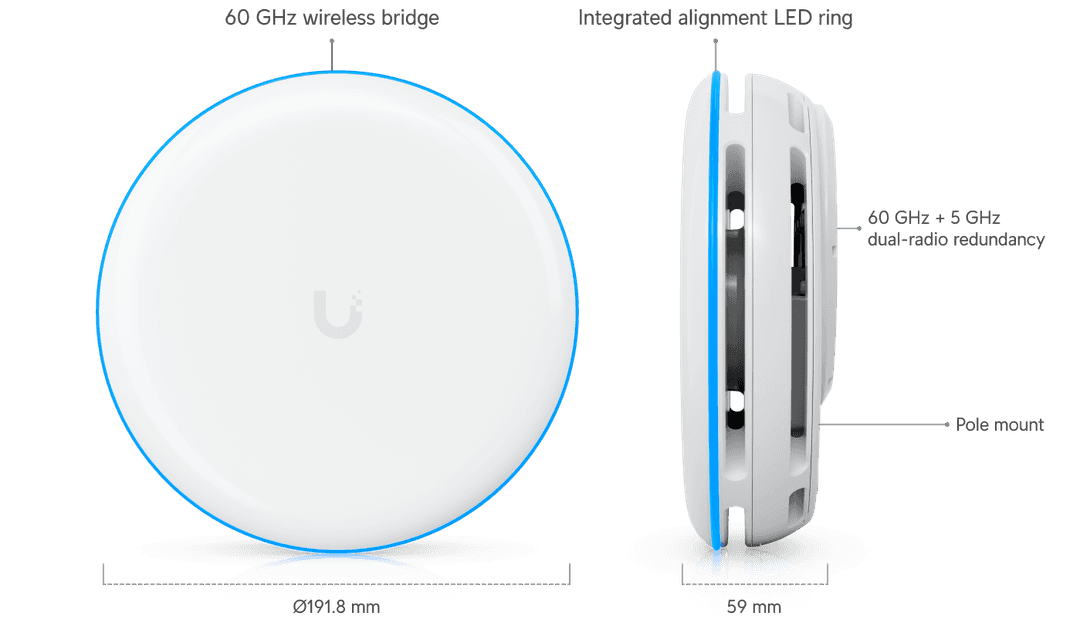
The UBB-XG is a two-endpoint wireless bridge for carrying a network connection between buildings over a clear outdoor path. Its main role is to provide a high-capacity alternative where fibre trenching is unavailable, delayed or unnecessarily disruptive. It is most relevant to organisations that already use, or plan to use, the UniFi management environment and need 10G-capable wired integration at each endpoint. Before proceeding, confirm the actual path length, direct line of sight, mounting height, wind and weather exposure, PoE arrangements, surge protection, SFP+ modules or cabling, and whether the requirement is for a complete two-pack or a replacement single unit.
What the UBB-XG does
The bridge creates a transparent network path between two physically separate locations. One unit is installed at each end, aligned toward the other, and connected into the local switching environment. The 60 GHz radio carries the primary traffic, while the integrated 5 GHz radio acts as a backup path when the main radio is impaired. This architecture is useful for extending LAN services, internet access, voice, surveillance traffic and business applications between nearby buildings without installing a new underground cable route.
The presence of a 1/10G SFP+ port is particularly important for buyers who want the bridge endpoints connected to aggregation or distribution switches without a one-gigabit wired bottleneck. The separate GbE RJ45 interface supports PoE++ or passive PoE powering. Effective end-to-end performance still depends on radio conditions, alignment, network design, protocol overhead, connected switches and the traffic profile.
Who should consider it
UBB-XG is suited to businesses with two buildings inside the supported distance and with an unobstructed view between mounting points. Typical buyers include IT managers connecting a warehouse to an office, schools linking teaching blocks, hotels extending core services to a separate facility, logistics operators connecting security and operations networks, and property teams bringing connectivity to an annex without excavation.
It is less suitable where trees, new construction, signage, cranes or other obstructions may interrupt the path, where the distance exceeds the stated design range, or where the link must deliver the predictability of a protected fibre route under all environmental conditions. Buyers should also evaluate whether a lower-capacity Ubiquiti Building Bridge, a fibre connection or another licensed or unlicensed wireless design would better match the application.
Business challenges this bridge can address
Fibre trenching is disruptive
A properly planned wireless bridge can avoid excavation across roads, landscaped areas, leased property or operational yards. It does not remove the need for structural mounting, power and network cabling at both endpoints.
One building lacks core services
The link can extend VLANs and network access to a remote structure so that users, phones, cameras and other systems can reach central resources, subject to the wider switching and security design.
A one-gigabit endpoint is restrictive
The 10G-capable SFP+ interface allows higher-speed wired attachment at each bridge endpoint. Actual bridge throughput and application performance remain dependent on the complete path and operating conditions.
Operations need managed visibility
UniFi management can place the bridge within the same operational view as other supported UniFi network devices, helping teams monitor status and maintain configuration consistency.
Core capabilities that matter in a buying decision
60 GHz primary link
The main radio supports a stated maximum data rate of 6 Gbps. This is a radio data-rate figure, not a guaranteed application throughput commitment.
5 GHz backup radio
The integrated WiFi 5 path provides a secondary connection option when the 60 GHz path is degraded. Backup performance is lower and environment dependent.
10G SFP+ uplink
A 1/10G SFP+ interface supports connection to suitable switches using compatible optics, direct-attach cabling or other supported media selected for the site.
Outdoor construction
IPX6 weatherproofing, an aluminium-alloy and UV-resistant polycarbonate enclosure, and stainless-steel mounting components support outdoor deployment when installed correctly.
Product-fit matrix
| Requirement | Suitable when | Confirm before ordering |
|---|---|---|
| Building-to-building link | Two sites are within 500 m and have clear line of sight. | Measured distance, obstruction survey and mounting height. |
| High-capacity wired integration | The LAN uses switches with suitable 1/10G SFP+ connectivity. | SFP+ media, VLAN design, switch compatibility and port configuration. |
| Outdoor operation | A secure wall or pole position is available at each end. | Wind exposure, bonding, surge protection, cable route and access. |
| UniFi-managed network | The organisation uses a UniFi Console, Official UniFi Hosting or a self-hosted UniFi Network Server. | Controller ownership, software compatibility and administrative access. |
| New complete link | Both endpoints are required and a paired kit is preferred. | Two-pack variant, included injectors and any regional part-number suffix. |
Verified technical information
| Brand | Ubiquiti |
|---|---|
| Product name | Building Bridge XG |
| Model | UBB-XG |
| Product type | 60 GHz point-to-point wireless bridge with 5 GHz backup radio |
| Maximum stated link distance | 500 m (1,640 ft), subject to line of sight, alignment and local conditions |
| Maximum stated data rate | 60 GHz: 6 Gbps; 5 GHz: 866.6 Mbps at 80 MHz channel width |
| Networking interfaces | One GbE RJ45 port and one 1/10G SFP+ port |
| Power method | PoE++ or passive PoE; 48V DC ±10% |
| Maximum power consumption | 29W |
| PoE adapter | Included; quantity depends on single-unit or two-pack configuration |
| Dimensions | 191.8 mm diameter × 59 mm |
| Weight | Device: 1.7 kg; with mount: 2.9 kg |
| Mounting | Wall or pole; supported pole diameter 25–63.5 mm |
| Weatherproofing | IPX6 |
| Operating temperature | -40°C to 55°C |
| Operating humidity | 5% to 95% non-condensing |
| Management | Ethernet and Bluetooth; managed through a supported UniFi management environment |
| Operating mode | Point-to-point |
| Security | WPA2 AES for the 5 GHz radio |
| Certifications listed by manufacturer | CE, FCC, IC and Terragraph; regional applicability should be confirmed |
| Availability | Contact FourTeck for current UAE variant, quantity and vendor lead time |
Compatibility and dependency notice
The UBB-XG should be treated as one component in a complete link design. The bridge requires a suitable endpoint at each building, supported power delivery, properly rated outdoor cabling, secure mounting, protective bonding and surge-protection planning. The 1/10G SFP+ port also requires compatible transceivers, direct-attach cabling or other supported media, none of which should be assumed to be included unless confirmed in the quotation.
Management requires a UniFi Console, Official UniFi Hosting or a self-hosted UniFi Network Server. The exact software version, region setting and adoption workflow should be checked during deployment. Local radio regulations and available channels may vary. A 500 m maximum range is not a guarantee that every 500 m path will perform correctly; obstructions, alignment error, precipitation, reflective surfaces, interference, heat, structural movement and cable or switch limitations can affect the result.
From requirement to a working link
Define the traffic need
List the applications, expected busy-hour traffic, VLANs, security boundaries and growth assumptions. This determines whether UBB-XG capacity and interfaces are appropriate.
Survey the path
Measure distance, verify uninterrupted line of sight, check roof or pole access, identify obstructions and assess future changes that could block the radio path.
Confirm the bill of materials
Select the two-pack or replacement unit, mounting hardware, surge protection, outdoor cable, SFP+ connectivity and suitable power arrangement.
Install and align
Mount both radios securely, complete bonding and cable protection, align the units precisely and verify link quality before finalising the installation.
Adopt, test and document
Adopt the bridge in UniFi, validate primary and backup behaviour, test expected traffic, record configuration and establish monitoring and support ownership.
High-capacity connectivity without a civil-works project
The strongest commercial argument for a building bridge is often not raw radio speed but deployment practicality. A fibre trench can involve permits, road crossings, duct surveys, reinstatement, landlord approvals and work around active operations. In a suitable line-of-sight scenario, the UBB-XG can create a network path using rooftop, wall or pole positions and existing building-entry routes. That can simplify the project, but it does not make the link installation-free. Both sides still need secure mounting, local power or PoE injection, weather-rated cabling, grounding or bonding in accordance with applicable rules, surge protection and access to the local switching infrastructure.
For buyers comparing fibre with wireless, the right decision should consider more than acquisition price. Fibre generally offers strong predictability, physical isolation from radio conditions and long-term capacity options. Wireless may reduce construction effort and support faster deployment where the site is ready. Some organisations use the bridge as the primary path, while others use it as a temporary service during construction or as a diverse route. FourTeck can help document the business objective so the proposed design is evaluated against availability expectations, traffic sensitivity and operational support requirements rather than chosen only from a headline data rate.
10G-capable endpoint integration
The UBB-XG differs from lower-tier bridge designs by including a 1/10G SFP+ interface. That interface allows each endpoint to connect into a suitable distribution or aggregation layer at more than one gigabit where the switching environment, selected media and complete bridge path support it. This is relevant when the remote building hosts multiple access switches, a substantial camera estate, shared storage access, high-volume application traffic or many simultaneous users.
The port alone does not make every deployment a 10 Gbps link. The manufacturer states a 6 Gbps maximum data rate on the 60 GHz radio, and usable application throughput will be lower after protocol overhead and real-world effects. Buyers should therefore size the link around expected traffic, not around the SFP+ label. They should also confirm whether existing switches support 10G SFP+, which optical or copper medium is appropriate, whether transceivers are mutually compatible, and whether link aggregation, VLAN trunks or spanning-tree behaviour have been designed correctly.
Where only a one-gigabit switch is present, the bridge may still operate in the wider design, but the wired endpoint could become the limiting factor. A staged upgrade may be sensible: deploy the bridge with a carefully documented interface plan, then upgrade switching as demand grows. FourTeck can help review switch ports, uplink media and logical network requirements when preparing the quotation.
Primary and backup radio behaviour
The 60 GHz radio is designed to carry the high-capacity primary path. Millimetre-wave links can offer high data rates and focused point-to-point operation, but they require careful alignment and a clear path. The UBB-XG includes a 5 GHz WiFi 5 radio to provide a secondary path if the primary link is impaired. This dual-radio approach is useful, but buyers should not interpret it as two equal links. The 5 GHz radio has a stated maximum data rate of 866.6 Mbps at 80 MHz channel width and operates in a band that can be affected by local interference and regulatory channel rules.
During design and acceptance testing, the project team should verify how the device reports the active radio, what traffic performance is available during fallback, and whether critical applications remain usable at the lower capacity. A link carrying many cameras, large backups or storage traffic may behave acceptably on the 60 GHz path but become constrained when it moves to 5 GHz. Monitoring thresholds and operational procedures should reflect that difference.
Weather is another planning factor. The product is rated for outdoor installation and IPX6 weatherproofing, but radio propagation and physical installation quality remain separate issues. Proper alignment, rigid mounting and suitable cable protection are essential. Site acceptance should include sustained traffic testing, not only a check that the radios can see each other.
Ideal business environments and use cases
Warehouse and office campus
A distribution centre may need to connect office systems, handheld infrastructure, cameras and access switches in a separate warehouse. The bridge can carry the inter-building trunk when line of sight is available.
School or training campus
Separate teaching blocks can share internet, authentication, voice and central services. The design should account for peak concurrent use and any safeguarding or segmentation requirements.
Hotel and leisure property
A remote facility, staff building or events area may need a backhaul connection to the main network. Mounting visibility and aesthetic constraints should be resolved early.
Industrial or logistics compound
The bridge may extend operational connectivity across a yard. Cranes, stacked containers, moving vehicles and future construction must be considered because they can obstruct the path.
CCTV backhaul
A separate security building or camera cluster can send traffic to central recording. Camera bitrate, retention architecture and fallback capacity should be calculated.
Temporary connectivity
The unit can support a time-limited inter-building path while fibre work is pending, provided mounting, power and management can be implemented without compromising safety or stability.
Integration and operational considerations
VLAN and loop prevention
Document which VLANs cross the bridge and how spanning tree is configured. An unplanned secondary wired path can create loops. The wireless link should be treated as part of the switching topology.
Power and surge protection
Confirm PoE++ or passive PoE delivery, injector location, cable length, outdoor cable rating, protective bonding and surge-protection placement. These details affect reliability and safety.
Management ownership
Decide which UniFi environment will manage the bridge, who has administrative access, how backups are handled and who receives alerts. Avoid deploying a critical link without assigned ownership.
Performance acceptance
Agree test methods before installation. Measure sustained throughput, latency, packet loss and fallback behaviour using representative traffic rather than relying only on a link-quality indicator.
Questions to resolve before requesting a quotation
A map estimate is not enough where roof edges, trees, billboards or future structures may interfere.
A complete new connection normally needs a two-pack; a single unit is generally for replacement or inventory planning.
State the switch models, port speed and whether fibre, DAC or another compatible medium is required.
Confirm the UniFi Console or hosting method, administrator access and desired monitoring process.
The 5 GHz backup has lower capacity, so critical services and acceptable degraded operation should be defined.
Specify access equipment, cable routing, mounting, bonding, testing, documentation and handover expectations.
Procurement checklist
☐ Exact model and regional part-number suffix
☐ Two-pack for a new link or single unit for replacement
☐ Required quantity and destination
☐ Measured endpoint distance
☐ Clear line-of-sight confirmation
☐ Wall or pole mounting arrangement
☐ Outdoor cable and surge-protection requirement
☐ PoE++ or passive PoE design
☐ SFP+ modules, DAC or fibre patching
☐ UniFi management platform and administrator access
☐ VLAN, addressing and security design
☐ Installation, alignment and testing scope
☐ Documentation and handover expectations
☐ Warranty and current availability confirmation
How FourTeck can support the decision
FourTeck can help translate the site requirement into a practical bill of materials. That may include confirming whether the paired kit is needed, reviewing endpoint switch interfaces, identifying SFP+ connectivity, discussing power and surge-protection needs, and defining installation, alignment and acceptance testing. The objective is to reduce avoidable omissions before a purchase order is placed.
For organisations comparing wireless and fibre, FourTeck can also help frame the evaluation around distance, capacity, business criticality, disruption, support ownership and expected operating conditions. Visit the FourTeck technology products area for related infrastructure, explore available installation and configuration services, or share the exact requirement through the Dubai technology contact team.
UAE availability and support guidance
Contact FourTeck to confirm current UAE availability for the Ubiquiti UBB-XG, the required pack size and the correct regional variant. Availability may depend on quantity, vendor lead time and the exact part number. Delivery and project coordination can be discussed after the technical requirement is confirmed. Where installation is required, the quotation should clearly identify mounting, outdoor cabling, surge protection, alignment, UniFi adoption, performance testing and documentation so that hardware supply and professional work are not confused.
FourTeck can coordinate requirements for businesses operating across Dubai, Abu Dhabi, Sharjah and Ajman through one combined project discussion. Site conditions and access arrangements differ, so any onsite activity must be scoped against the actual locations, safety requirements and working hours. A remote pre-assessment using drawings, coordinates and photographs can help establish whether a physical survey is likely to be required.
GCC availability
FourTeck can assist GCC organisations that are evaluating the UBB-XG for a business campus, warehouse, hospitality property, school or industrial compound. The process can include requirement review, confirmation of the two-pack or replacement-unit need, SFP+ and PoE planning, quotation coordination, delivery planning and discussion of installation or configuration scope. Projects in the United Arab Emirates, Saudi Arabia, Kuwait, Qatar, Bahrain and Oman may have different radio, power, logistics, access and service conditions. Product availability, regional part numbers, delivery schedules, service visits and vendor lead times can therefore vary by country, model, quantity and project requirement. Buyers should share the destination country, exact product variant, quantity, endpoint distance, deployment location and expected timeline. For Kuwait-related coordination, the FourTeck Kuwait technology site may provide a useful starting point. No local stock, customs outcome or fixed delivery date should be assumed until confirmed in a formal quotation.
Africa availability
Organisations planning building-to-building connectivity in Africa can contact FourTeck for product evaluation, regional variant guidance, accessory planning and quotation coordination. UBB-XG suitability should be assessed against line of sight, distance, mounting, power stability, surge exposure, switch interfaces and local operational support. Fulfilment may depend on the destination, quantity, radio and regulatory requirements, shipping arrangements, vendor lead time and whether installation or remote configuration assistance is requested. Buyers should provide the destination country, exact quantity, preferred deployment schedule, endpoint details and any support expectations. FourTeck resources for regional Africa technology projects, Kenya business technology requirements and Uganda technology coordination can support an initial discussion. Availability and onsite coverage must be confirmed for the specific project; local inventory, immediate shipping, customs outcomes and guaranteed installation dates are not implied.
Related products and services to evaluate
Ubiquiti Building Bridge UBB
Consider the standard Building Bridge where the traffic requirement and endpoint design do not justify the XG model. Compare verified capacity and interface needs rather than assuming equivalence.
10G-capable UniFi switching
A suitable switch may be required at one or both endpoints to use the SFP+ interface effectively. Port type, PoE design and transceiver support must be checked.
Outdoor surge protection
Surge-protection and bonding requirements should be part of the installation design. Select components according to cable type, building practice and local rules.
Site survey and alignment service
A survey can verify path clearance and mounting feasibility. Installation scope can include alignment, cable testing, UniFi adoption and documented acceptance checks.
Fibre inter-building alternative
Fibre should remain part of the comparison where trenching, ducting or aerial routes are viable and long-term predictability is the primary objective.
Why businesses contact FourTeck
Technology buyers often need more than a unit price. They need confidence that the selected pack, power method, interfaces, mounting accessories and management approach match the site. FourTeck can help clarify the requirement, organise a bill of materials, review compatibility questions, coordinate a quotation and define installation or configuration services where requested. This is particularly useful when procurement teams must compare a wireless bridge with fibre, understand which items are included, or separate product supply from project work.
FourTeck does not need to present every deployment as identical. A small office-to-warehouse link has different traffic, access and support needs from a hotel campus or industrial compound. Sharing the real operating context enables a more useful proposal and helps identify assumptions that should be resolved before purchase.
Frequently asked questions
What is the Ubiquiti UBB-XG used for?
It creates a point-to-point network link between two buildings using a 60 GHz primary radio and a 5 GHz backup radio. It is intended for nearby sites with clear line of sight.
Does a new link need one unit or two?
A complete point-to-point link requires a unit at each end. The paired two-pack is normally appropriate for a new installation, while a single unit is typically purchased as a replacement or spare.
Can the UBB-XG provide 10 Gbps wireless throughput?
The device includes a 1/10G SFP+ wired interface, but the manufacturer states a maximum 60 GHz radio data rate of 6 Gbps. Usable application throughput is lower and depends on conditions and the complete network path.
What happens if the 60 GHz path is degraded?
The integrated 5 GHz WiFi 5 radio provides a backup path. Its capacity is lower, so buyers should test whether critical applications remain acceptable during fallback.
Is clear line of sight required?
Yes. The path should be checked for current and future obstructions such as trees, roof structures, signs, cranes or new construction. Precise alignment is also important.
How is the bridge powered?
It supports PoE++ and passive PoE at 48V DC ±10%. A PoE adapter is included, with quantity dependent on the selected single-unit or two-pack configuration.
Which management platform is required?
The product is managed through a UniFi Console, Official UniFi Hosting or a self-hosted UniFi Network Server. Confirm software compatibility and administrator access before deployment.
Are SFP+ modules included?
Do not assume that SFP+ optics, DAC cables or fibre patching are included. The required media should be selected for the endpoint switches and listed explicitly in the quotation.
Can FourTeck arrange installation and alignment?
Installation, mounting, cabling, alignment, UniFi adoption and testing can be discussed as a project scope. Availability and onsite coverage depend on the location and confirmed requirement.
How can I obtain a Dubai quotation?
Share the quantity, pack requirement, endpoint distance, site photos or coordinates, switch models, desired installation scope and target schedule with FourTeck for current UAE availability and quotation guidance.
Confirm the right UBB-XG configuration before ordering
Send FourTeck the link distance, site details, switch interfaces, quantity and installation expectations for a current Dubai and UAE quotation.

Reviews
There are no reviews yet.