

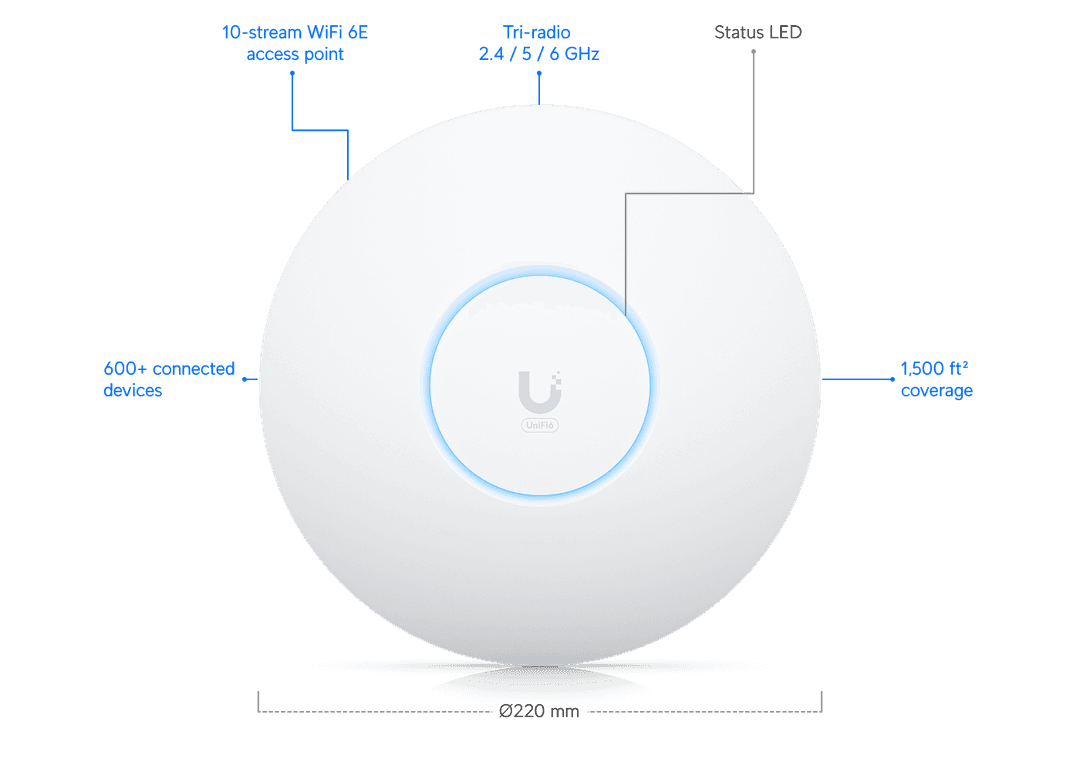
WiFi 6E tri-band design
10 spatial streams
One 1/2.5 GbE RJ45 port
PoE+
6 GHz support is region dependent
Direct answer: what is the U6 Enterprise?
The Ubiquiti U6 Enterprise is an indoor UniFi access point built for high-client-density wireless environments. It serves 2.4 GHz, 5 GHz and 6 GHz bands, supports WiFi 6E, and uses a multigigabit Ethernet uplink so the wired side is less likely to become a bottleneck than a standard 1 GbE connection. It should be considered by organisations refreshing wireless coverage for modern laptops, collaboration traffic, cloud applications, voice, video and dense guest access. Before proceeding, a buyer should confirm local 6 GHz rules, the proportion of WiFi 6E-capable clients, PoE+ availability, switching speed, cable quality, controller requirements, mounting positions and the number of access points required after a site review.
What it does
The access point extends a UniFi network with three wireless bands and provides additional spectrum in 6 GHz for compatible devices. In practical terms, this gives network designers another place to distribute traffic rather than forcing every user onto the traditional 2.4 GHz and 5 GHz bands. The unit is intended to be installed on a ceiling or wall, connected back to a PoE+ switch, adopted into UniFi Network and configured as part of a wider wireless plan. Features such as band steering, fast roaming support, guest isolation, private pre-shared keys, RADIUS-based controls and VLAN assignment can help an IT team create separate access policies for staff, visitors, operational devices and specialised applications.
Who it suits
The model is most relevant where many active users share an indoor coverage area or where an organisation wants to introduce 6 GHz capability without abandoning support for existing 2.4 GHz and 5 GHz clients. Typical buyers include corporate offices, schools, colleges, meeting facilities, healthcare environments, hospitality venues, showrooms, training centres and managed commercial properties. It can also suit technology-focused small and medium businesses with multigigabit switching and a growing base of WiFi 6E devices. It may be unnecessary for a light-use site with only a few legacy clients, a 1 GbE-only switching estate, limited PoE capacity or no realistic requirement for the 6 GHz band.
Business challenges the access point can help address
Crowded traditional bands
In offices where many devices compete in 2.4 GHz and 5 GHz, adding 6 GHz can create more usable channel options for compatible clients. The benefit depends on device support, regulatory permissions and correct radio design.
High user concentration
Meeting rooms, classrooms and shared work areas can place many active clients close together. Ten spatial streams and multi-user capabilities give the designer more resources, though client behaviour and application load still determine real experience.
Uplink limitations
A 2.5 GbE uplink can carry more aggregate traffic than a standard 1 GbE link when connected to suitable switching. Cabling, switch ports, PoE budget and upstream capacity must all support the intended design.
Fragmented wireless operations
UniFi Network provides a central place to adopt, configure and monitor access points. The U6 Enterprise is therefore most useful when it fits an established or planned UniFi management architecture rather than operating as an isolated device.
Core capabilities at a glance
2.4 GHz, 5 GHz and 6 GHz radios let the network serve legacy, current and WiFi 6E-capable endpoints.
Four-by-four operation on 5 GHz and 6 GHz supports demanding environments where many clients are active.
The single RJ45 interface supports 1 GbE or 2.5 GbE, subject to the connected switch and cabling.
UniFi Network is required for adoption, configuration, visibility and policy management.
Product-fit matrix
| Requirement | Suitable when | Confirm before ordering |
|---|---|---|
| 6 GHz wireless | A meaningful share of devices supports WiFi 6E and additional clean spectrum is valuable. | Regional 6 GHz support, client capability and channel plan. |
| Dense user areas | Meeting rooms, classrooms or shared work zones carry many simultaneous sessions. | Concurrency, application mix, RF survey and access-point spacing. |
| Multigigabit LAN | The network has or will deploy 2.5 GbE PoE+ switching. | Switch port speed, PoE budget, cabling and upstream bandwidth. |
| Central management | The organisation uses or plans to use UniFi Network. | Controller location, software version, administrator access and backup process. |
| Simple low-use site | The model may be more than required when only a few basic clients are present. | Whether a lower-tier UniFi access point would meet the requirement more economically. |
Compatibility and dependency notice
The U6 Enterprise should not be selected from the wireless specification alone. Its 6 GHz capability is useful only where local rules permit operation and where client devices support WiFi 6E. Older devices will continue to use 2.4 GHz or 5 GHz, so the design must still account for those bands. A 2.5 GbE uplink also requires a matching multigigabit switch port to provide full wired-side capacity. When connected to a 1 GbE port, the access point can still operate, but aggregate traffic is constrained by that link.
Power must be supplied through PoE+ with adequate switch budget. Cabling should be verified for multigigabit operation, especially in existing buildings. The access point also belongs in a UniFi Network environment, so the controller, gateway, VLAN structure, RADIUS service, guest portal and monitoring approach should be considered as part of the solution. Licences are not generally described as a per-access-point subscription for standard UniFi Network management, but cloud hosting, support services, external identity systems and third-party integrations may have separate commercial terms.
A practical purchase and deployment journey
Define the user demand
Document device counts, concurrent users, application types, roaming needs, guest usage and expected growth. A raw maximum-client figure is not a substitute for traffic planning.
Review the radio environment
Study floor plans, wall materials, ceiling heights, interference, neighbouring networks and areas of concentrated demand. A predictive design or survey helps determine quantity and mounting points.
Check wired readiness
Confirm 2.5 GbE ports, PoE+ power, switch capacity, uplinks, VLANs, DHCP, firewall policy and Category cabling. Wireless performance depends heavily on the infrastructure behind it.
Confirm the bill of materials
Validate exact model, quantity, mounts, PoE source, switches, gateways, controller platform and any installation materials. Regional product variants should be confirmed before purchase.
Configure and test
Adopt the access points, apply SSIDs, security, VLANs and radio settings, then validate coverage, roaming, application performance and guest controls using representative devices.
Using 6 GHz where it creates real value
The main architectural difference between the U6 Enterprise and many dual-band access points is the addition of 6 GHz. This band can provide wider channel availability and a cleaner operating environment because it is not shared with older WiFi generations in the same way as 2.4 GHz and 5 GHz. For a business, that can be valuable in rooms where compatible laptops handle large files, video meetings, virtual desktop sessions or cloud applications. It can also help an IT team separate capable devices from heavily used legacy bands.
However, 6 GHz should be treated as one layer of the design rather than a universal replacement. Signal behaviour at higher frequencies, building materials and lower transmit power rules can affect reach. The practical coverage area may therefore be smaller than a buyer expects from marketing figures, particularly through walls. The right approach is to place access points according to user locations and application requirements, not merely to maximise the distance between units. Client compatibility matters as well: a WiFi 6 device without 6E support cannot use the 6 GHz radio. Before selecting quantity, identify how many current and planned endpoints can use the band and how quickly the device estate will change.
Regulatory support is another essential dependency. Ubiquiti states that 6 GHz operation depends on the country or regulatory region. FourTeck can help a buyer confirm the intended destination and regional requirements before quotation, but the final design should also reflect local spectrum rules and the exact product variant supplied. This avoids purchasing a high-capability access point while assuming a feature will operate identically in every market.
Capacity, spatial streams and realistic expectations
Ten spatial streams give the U6 Enterprise a substantial radio platform: two on 2.4 GHz, four on 5 GHz and four on 6 GHz. This architecture supports simultaneous communication with multiple capable clients and helps the access point serve dense areas more efficiently than a basic two-stream design. In a well-planned network, that can improve the way airtime is shared when many users are active at once.
The published maximum client count of 600+ should not be read as a recommended number of busy users for every installation. Association capacity, usable application performance and acceptable user experience are different measures. Hundreds of mostly idle devices may place a very different load on the network from a smaller number of users in video calls, backups or large downloads. IT teams should therefore size the network around simultaneous activity, airtime demand, minimum signal level, channel reuse, upstream internet capacity and the tolerance of the application. Voice, real-time collaboration and operational systems usually need more conservative design targets than casual guest browsing.
The same caution applies to the stated radio rates of 4.8 Gbps on 5 GHz and 4.8 Gbps on 6 GHz. These are theoretical maximum link rates under suitable channel width, modulation, signal and client conditions. They are not a promise that one device or one user will receive that throughput. Protocol overhead, interference, client radio capability, distance, contention and uplink limits reduce real performance. A buyer should use these figures to compare platform capability, then validate the proposed design against the actual environment.
Management, segmentation and operational control
The U6 Enterprise is managed through UniFi Network, which provides a common interface for access-point adoption, wireless configuration, client visibility and network policy. This is important for organisations that want consistent SSIDs and settings across several floors, branches or access points. Instead of treating each radio as a separate device, administrators can manage the wireless service as part of a wider UniFi environment.
The published feature set includes band steering, 802.11k radio resource management, 802.11r fast roaming and 802.11v transition management. These mechanisms can support better client movement and radio selection, but the client device still makes many roaming decisions. Successful roaming therefore depends on coverage overlap, authentication design, endpoint behaviour and the applications in use. Testing with representative phones, laptops, scanners or voice devices is essential before a production rollout.
For access control, the platform supports functions such as guest isolation, client isolation, private pre-shared keys, RADIUS-based authentication, dynamic VLAN assignment and captive portal options. These tools can help separate employees, visitors, contractors and operational devices. They do not replace a complete security design. VLANs, firewall rules, identity services, endpoint security, logging and administrative access controls should be planned together. FourTeck can help define the configuration scope for a quotation, including whether the requirement covers only access-point supply or also controller setup, SSID creation, VLAN mapping, guest access, RADIUS integration, testing and documentation.
Ideal business environments and use cases
Corporate offices
Suitable for shared workspaces, collaboration rooms and floors where staff use cloud platforms, video conferencing and mobile devices. The design should consider meeting-room peaks rather than only average occupancy.
Education and training
Classrooms and training rooms often place many active clients in one area. Access-point quantity, channel planning and upstream internet capacity should reflect simultaneous learning applications and assessment traffic.
Hospitality and event spaces
Guest devices can appear and disappear quickly, producing unpredictable demand. Captive portal options and isolation features may be useful, while privacy, bandwidth policy and support processes need separate planning.
Healthcare and clinics
The access point can serve staff and visitor connectivity in indoor areas, but clinical devices, regulatory obligations, interference and application criticality require careful validation before deployment.
Showrooms and customer spaces
Modern demonstrations may rely on streaming, interactive displays and cloud services. Separate employee, guest and display-device networks can improve operational control when supported by appropriate switching and firewall rules.
Technology-led SMEs
Businesses already investing in multigigabit switching and modern endpoints may use the model as part of a forward-looking refresh. Smaller low-traffic sites should compare it with less complex UniFi options.
Integration and operational considerations
A wireless access point is one component in a service chain that includes the client device, radio environment, cable, access switch, uplink, gateway, security controls, DNS, DHCP, identity platform, internet connection and the application itself. Troubleshooting is much easier when these dependencies are documented. Before rollout, record switch ports, cable paths, VLAN assignments, SSID purpose, authentication method, IP scope, firewall policy and controller ownership.
For multigigabit operation, confirm that the access switch supports 2.5 GbE on the selected PoE+ port. A switch may advertise PoE+ without providing multigigabit speed on every interface, or may provide adequate port-level power while lacking sufficient total power budget for a large number of access points. The planned quantity multiplied by the device maximum power figure should be reviewed against switch capacity with an operational margin.
Existing cabling should be tested rather than assumed suitable. Short, good-quality Category 5e links may support 2.5 GbE, but installation quality, distance, patch panels and termination condition all matter. Where new cabling is being installed, the contractor should understand the data-rate target, pathway, fire rating, labelling and test-report requirements. Mounting positions should avoid obstructions, metal structures, enclosed ceiling spaces and locations that make maintenance difficult.
Operational ownership also matters. Decide who will administer UniFi Network, approve firmware updates, maintain backups, review alerts, manage guest access and handle changes. A clear responsibility model prevents a technically sound deployment from becoming difficult to support later.
Buyer questions to resolve before ordering
Separate total registered devices from simultaneous high-traffic users.
Create a client inventory to understand how much value 6 GHz will provide now and later.
Confirm the exact country and product variant before relying on the feature.
Check both interface speed and total power budget.
Voice and business-critical applications need stricter signal and capacity design than casual browsing.
Define administrator access, backups, updates, monitoring and change responsibility.
Procurement checklist
☐ Confirm the exact model as U6-Enterprise.
☐ State the required quantity and delivery destination.
☐ Confirm whether the project requires WiFi 6E and 6 GHz.
☐ Identify the number and type of compatible client devices.
☐ Check 2.5 GbE port availability on the access switch.
☐ Verify PoE+ support and the overall switch power budget.
☐ Review cable category, length, testing and patching.
☐ Confirm ceiling or wall mounting locations and access.
☐ Define the UniFi Network controller or gateway platform.
☐ Document SSIDs, VLANs, guest access and authentication.
☐ Decide whether installation and configuration are included.
☐ Include survey, testing and handover requirements where needed.
☐ Confirm regional version, lead time and warranty terms in the quote.
☐ Record the support and change-management responsibility after handover.
How FourTeck can assist
FourTeck can support the buying process by clarifying whether the U6 Enterprise is appropriate for the environment rather than treating the model number as the entire requirement. This can begin with a review of floor plans, user counts, application demand, existing switching, cabling, controller platform and the expected proportion of WiFi 6E devices. The result can be used to define a more accurate quantity and bill of materials.
Quotation support can include the access points, suitable PoE+ and multigigabit switching, gateways, mounting accessories and agreed professional services. Where configuration is requested, the scope should state whether it includes controller setup, firmware alignment, SSID creation, VLAN mapping, security policy, guest access, RADIUS integration, radio tuning, testing and documentation. Installation scope can be discussed separately because ceiling height, cable routes, access permissions and working-hour restrictions vary between sites.
For broader network projects, buyers can review FourTeck technology products, explore network and security services, or send project details through the FourTeck contact team. The objective is to align product supply with the switching, security and operational decisions that determine the final wireless outcome.
UAE availability and support guidance
Contact FourTeck to confirm current UAE availability for the Ubiquiti U6 Enterprise. Availability may depend on the exact regional version, quantity, vendor lead time and the wider project bill of materials. Delivery coordination can be discussed after the destination, required date and product configuration are confirmed. A quotation should also state whether the requirement is hardware supply only or includes switching, cabling, mounting, controller setup, wireless configuration, testing and handover.
For projects covering Dubai, Abu Dhabi, Sharjah and Ajman, FourTeck can review the requirement as one coordinated deployment while still accounting for differences between sites. Buyers should provide floor plans, estimated users, existing network details, installation constraints and preferred project timing. Support options depend on the agreed scope and should be documented in the quotation rather than assumed from the product purchase alone.
GCC Availability
FourTeck can assist organisations planning U6 Enterprise deployments across GCC markets by reviewing the destination, access-point quantity, switching requirements, controller design and installation scope before a quotation is prepared. Projects in the United Arab Emirates, Saudi Arabia, Kuwait, Qatar, Bahrain or Oman may have different regulatory, delivery and service conditions, particularly for 6 GHz operation. Buyers should therefore state the destination country and confirm whether the design depends on WiFi 6E clients. Product availability, regional variants, delivery schedules, service visits and vendor lead times can vary by country, model and quantity. A useful request should include the exact product, required quantity, deployment location, target timeline, existing UniFi environment and whether configuration or installation is needed. FourTeck can then coordinate product selection and project planning without assuming identical fulfilment conditions across the region. For Kuwait-based enquiries, buyers may also review FourTeck Kuwait technology assistance.
Africa Availability
Organisations planning wireless upgrades in Africa can contact FourTeck for guidance on U6 Enterprise suitability, regional product selection, accessories, PoE and switching requirements, controller architecture and deployment scope. Availability and fulfilment depend on the destination, exact model, quantity, regional radio rules, power and cabling conditions, shipping arrangements, vendor lead time and local project constraints. A buyer should share the destination country, number of sites, estimated user density, desired timeline and any installation, configuration or support expectations. This is especially important when 6 GHz operation is part of the business case because spectrum rules and product variants may differ. FourTeck can support requirement review for East African and wider regional projects, including enquiries through FourTeck Kenya, FourTeck Uganda and the FourTeck Africa technology portal. No local inventory, customs outcome or fixed delivery date should be assumed until the project details are reviewed.
Related products, services and alternatives
Ubiquiti U6 Pro
A dual-band WiFi 6 access point that may suit sites without a 6 GHz requirement. Compare client density, uplink needs and future device plans before treating it as an alternative.
U6 Enterprise In-Wall
An in-wall member of the U6 Enterprise range with a different form factor and integrated switch capability. Compatibility and room-level design should be confirmed separately.
Multigigabit PoE switching
A suitable 2.5 GbE PoE+ switch helps the access point use its uplink capability and simplifies power delivery. Port count, PoE budget and uplink capacity must be sized.
Wireless design service
Predictive planning, site assessment and post-installation validation can reduce uncertainty around quantity, placement, channel use and coverage expectations.
Why businesses contact FourTeck
Business buyers often need help turning a product choice into a complete, supportable network requirement. FourTeck can assist with model confirmation, quantity planning, compatibility review, switch and PoE selection, controller requirements, bill-of-material preparation and quotation coordination. This is particularly useful when an access-point refresh must connect to existing gateways, VLANs, authentication systems or cabling that were designed for an earlier wireless generation.
FourTeck can also help define professional-service boundaries. A clear quotation can separate product supply, physical mounting, cable work, controller configuration, SSID and VLAN setup, guest access, testing, documentation and ongoing support. This reduces the risk of a buyer assuming that every activity is included in the hardware price. Organisations considering a broader infrastructure programme can learn more about FourTeck business technology support or submit a requirement through FourTeck UAE contact services.
Frequently asked questions
Is the U6 Enterprise a WiFi 6 or WiFi 6E access point?
It is a WiFi 6E access point. It supports 6 GHz for compatible clients while also serving 5 GHz and 2.4 GHz devices. Use of 6 GHz depends on the regulatory region.
Does every device benefit from the 6 GHz radio?
No. The client must support WiFi 6E and 6 GHz. WiFi 6 clients without 6E support will connect on 2.4 GHz or 5 GHz.
Does the access point require a 2.5 GbE switch?
It can link at 1 GbE or 2.5 GbE, but a 2.5 GbE switch port is needed to use the higher wired uplink rate. The switch must also provide suitable PoE+ power.
Is a PoE adapter included?
The access point uses PoE+. The current bill of materials should be checked because a compatible PoE switch or optional adapter may be required depending on the package and supplier.
How many U6 Enterprise access points are needed?
Quantity depends on floor layout, construction materials, user density, application demand, channel plan and required signal levels. The vendor coverage figure should not be used as a simple area division without a design review.
Can the U6 Enterprise be used without UniFi Network?
The published application requirement is UniFi Network. Buyers should plan where the controller will run, who will administer it and how configuration and backups will be managed.
Does the model support guest and business network separation?
The platform supports guest isolation, client isolation, VLAN-related controls, RADIUS options and captive portal functions. The final security outcome depends on correct switching, gateway and firewall configuration.
Is the published 600+ client figure guaranteed in a busy office?
No. It is a maximum client reference. Practical capacity depends on how many users are active, their applications, signal quality, channel use, client radios and the rest of the network.
Can FourTeck provide installation and configuration?
Installation, configuration, survey, testing and documentation can be discussed as quotation items. The exact scope depends on the site, cabling, controller environment and customer requirements.
What information is needed for a quotation?
Provide the exact model, quantity, delivery location, required date, floor plans, user estimates, existing switches, UniFi controller details and whether installation or configuration services are required.
Plan the U6 Enterprise around your real network
Share your user density, floor plan, switching platform, 6 GHz requirement and deployment location so FourTeck can help confirm the model, quantity, accessories and service scope.

Reviews
There are no reviews yet.