

Direct answer for network buyers
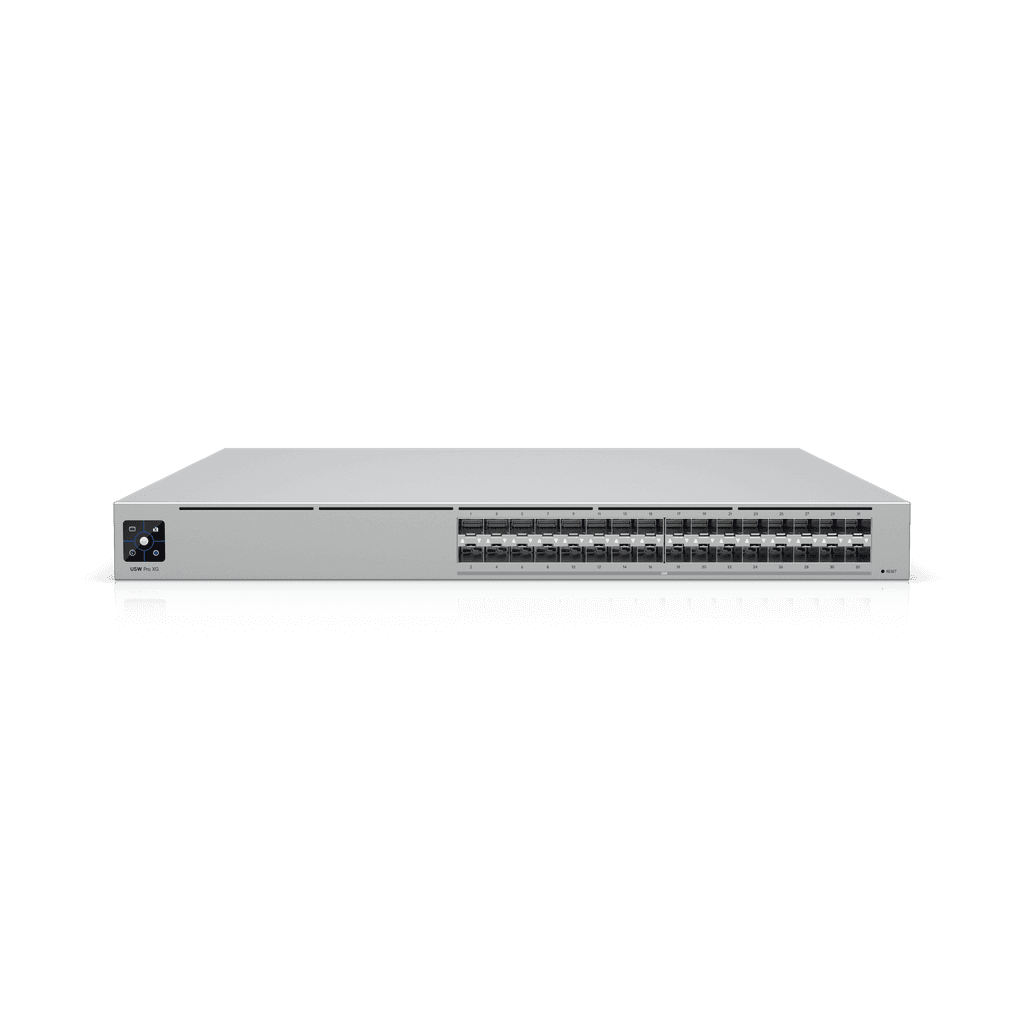
The Ubiquiti Pro XG Aggregation is a high-density Layer 3 fibre aggregation switch with thirty-two SFP28 ports supporting 25G, 10G and 1G connections. It is mainly used to consolidate high-speed links from servers, storage systems, access or distribution switches, media systems and other infrastructure into a centrally managed UniFi network. It is worth considering when a project needs many 25G links, substantial non-blocking capacity and a 1U form factor. Before proceeding, confirm the actual port-speed mix, transceiver or DAC requirements, cable distances, rack depth, airflow, power backup strategy, Layer 3 design and whether the existing UniFi controller environment supports the intended configuration.
What this switch does
The USW-Pro-XG-Aggregation sits at the point where many fast network links need to converge. Rather than serving desks, phones or wireless access points directly, it is designed to carry traffic between high-performance systems. Typical connections include 25G server network adapters, storage appliances, virtualisation hosts, high-speed edge or distribution switches, backup infrastructure and production systems that generate sustained east-west traffic.
Its dense SFP28 layout allows a buyer to build a fibre or direct-attach aggregation layer without consuming several rack units. Because each interface can operate at 25G, 10G or 1G, the switch can also support staged migration. A business may begin with a mixed set of 10G and 25G links, then increase link speeds as servers and downstream switches are upgraded. Actual interoperability still depends on supported optics, cable types, port configuration and the connected equipment.
Who should consider it
This model is most relevant to organisations already using, or deliberately standardising on, the UniFi management environment and needing a strong aggregation layer. Suitable buyers may include larger offices, multi-floor commercial buildings, education campuses, media production companies, data-heavy professional services firms, private-cloud operators, hospitality groups, system integrators and businesses consolidating multiple 10G or 25G network segments.
It is less suitable when a project mainly needs copper access ports, Power over Ethernet, very small port counts or advanced carrier-grade routing functions. In those situations, a different access switch, a smaller aggregation model or a more specialised data-centre platform may fit better. FourTeck can review the intended topology and help determine whether the Pro XG Aggregation belongs at the core, aggregation or server-access layer of the proposed design.
Business challenges this model can help address
Too many high-speed uplinks
Dense SFP28 connectivity helps consolidate numerous server, storage and switch uplinks into one 1U device, reducing the need to spread aggregation across several smaller switches.
10G capacity becoming restrictive
Support for 25G links gives organisations a practical step above 10G for workloads that are growing beyond the capacity of conventional aggregation designs.
Fragmented network administration
For organisations already operating UniFi, using the same management ecosystem can simplify visibility and day-to-day administration compared with adding an unrelated switching platform.
Unclear upgrade path
Multi-rate interfaces allow a planned mixture of 1G, 10G and 25G connections, helping buyers phase migrations rather than replace every connected system at once.
Core capabilities at a glance
Each port supports 25G, 10G or 1G operation, subject to transceiver and connected-device compatibility.
Static routing, inter-VLAN routing, DHCP relay and local-network DHCP server functions are available for appropriate designs.
The published 1.6 Tbps switching capacity and 800 Gbps non-blocking throughput suit dense high-bandwidth aggregation.
Etherlighting and the front touchscreen provide physical port and device information that can assist rack-side identification.
Product-fit decision matrix
| Requirement | Suitable when | Confirm before ordering |
|---|---|---|
| Dense 25G aggregation | Many servers, storage nodes or switches need 25G SFP28 links in a compact rack footprint. | Exact port count, cable distances, optic types and expected oversubscription ratio. |
| Mixed-speed migration | The environment will run 1G, 10G and 25G links during a phased upgrade. | Transceiver compatibility, supported breakout expectations and connected port capabilities. |
| UniFi-centred operations | The organisation prefers central monitoring and configuration within UniFi. | Controller version, gateway design, administrator roles and change process. |
| Access switching | Generally not the right role when endpoints need copper or PoE connectivity. | Whether a separate PoE or copper access layer is included. |
| Resilient power planning | The rack design can use the AC input and optional UniFi RPS DC backup arrangement. | Required RPS equipment, circuit design, UPS capacity and failure scenarios. |
Verified technical information
The following values are based on the manufacturer’s technical information for the exact USW-Pro-XG-Aggregation model. They should be used for initial evaluation, while the final bill of materials should confirm optics, cables, power accessories and regional supply details.
| Brand | Ubiquiti |
|---|---|
| Product name | Pro XG Aggregation |
| Model | USW-Pro-XG-Aggregation |
| Product type | Layer 3 aggregation switch |
| Form factor | 1U rack mount |
| Ports | 32 × SFP28, supporting 25G/10G/1G |
| Switching capacity | 1.6 Tbps |
| Total non-blocking throughput | 800 Gbps |
| Forwarding rate | 1.2 Bpps |
| Supported VLANs | 1,000 |
| MAC address table | 32,000 entries |
| IPv4 static routes | 512 |
| Packet buffer | 8 MB |
| Layer 3 features | Local-network DHCP server, DHCP relay, inter-VLAN routing and static routing |
| Layer 2 features | Includes LACP, STP/RSTP, IGMP controls, 802.1X control, ACLs, port isolation, mirroring, jumbo frames, loop protection and related functions |
| Maximum power consumption | 200W |
| Power input | 100–240V AC, 50/60Hz, plus USP RPS DC input |
| Dimensions | 442.4 × 43.7 × 480 mm |
| Weight | 7.1 kg without mounting bracket; 7.2 kg with mounting bracket |
| Rack support | 19-inch four-post racks, supported post depths 600–1,066 mm |
| Display | 1.3-inch touchscreen |
| Operating temperature | -5 to 40°C |
| Operating humidity | 10–90% non-condensing |
| PoE support | No PoE output; use separate access switches for powered endpoints |
| Availability | Contact FourTeck for current UAE options, quantity and lead-time guidance |
Compatibility and dependency notice
The switch is only one part of a complete high-speed network path. Every link also depends on the network adapter or downstream switch port, transceiver type, fibre grade, connector format, cable length, speed configuration and firmware support. A 25G SFP28 port does not automatically guarantee that any third-party optic will operate correctly. Buyers should confirm whether the design will use direct-attach copper, active optical cable, multimode fibre or single-mode fibre and should match the optical budget to the intended distance.
Layer 3 functions should also be reviewed in the context of the whole network. Some designs keep routing on a UniFi gateway or firewall, while others may use inter-VLAN routing on the aggregation switch. The correct approach depends on security policy, failure domains, traffic patterns, monitoring requirements and operational responsibilities. FourTeck can help document these dependencies before the quotation is finalised.
A practical purchase and deployment journey
Map current traffic
Identify which servers, switches and storage systems exchange the most data, and record current link speeds, utilisation and growth expectations.
Build the port schedule
List every required 1G, 10G and 25G connection, including spare capacity, redundant paths and planned additions over the expected lifecycle.
Select media and optics
Choose DAC, AOC, multimode or single-mode links according to distance, rack layout, patching method, heat, cost and compatibility.
Confirm power and rack fit
Check the 480 mm chassis depth, four-post rack support, ventilation, AC circuit, UPS capacity and any RPS requirement.
Define configuration scope
Document VLANs, trunks, LACP groups, routing, ACLs, multicast behaviour, monitoring, naming and change-control requirements.
High-density 25G aggregation without excessive rack use
One of the strongest reasons to evaluate the USW-Pro-XG-Aggregation is its concentration of thirty-two 25G-capable interfaces in one rack unit. For a business moving beyond a few isolated 10G links, port density becomes an important design and procurement issue. Several small switches may appear easier to purchase initially, but they can consume more rack space, add inter-switch links, complicate topology and create additional management points. A single dense aggregation switch can reduce those practical complications when the architecture genuinely needs a central convergence point.
The capacity is particularly relevant where virtualisation hosts, backup servers, all-flash storage, render nodes or media systems exchange large quantities of data within the local network. These east-west flows may never pass through the internet edge, so increasing the WAN service alone will not solve performance limitations. A carefully designed 25G aggregation layer can give high-demand systems more room to communicate, provided the connected servers, storage arrays and downstream switches are also capable of sustaining the intended throughput.
Buyers should still avoid sizing only from headline port speed. Real performance depends on workload behaviour, packet size, host configuration, storage latency, LACP design and the number of simultaneous flows. FourTeck can assist with a topology review that separates genuine bandwidth constraints from server, storage or application bottlenecks.
Central management and operational control
The value of an aggregation switch is not limited to throughput. It also becomes an operational control point for VLAN trunks, link aggregation groups, access policies, multicast behaviour and traffic visibility. In an organisation already using UniFi gateways, access switches and wireless infrastructure, the Pro XG Aggregation can extend a common management approach into the high-speed backbone. This may reduce the need for administrators to maintain separate interfaces and unrelated workflows for basic monitoring, configuration and device inventory.
The model supports familiar Layer 2 controls including LACP, spanning tree, IGMP snooping, storm control, port isolation, port mirroring and jumbo frames. It also includes Layer 3 functions such as static routing and inter-VLAN routing for local networks. These capabilities give designers several choices, but more choice also requires stronger configuration discipline. Routing boundaries, ACL placement and multicast settings should be documented rather than applied ad hoc.
Etherlighting and the front touchscreen can help engineers identify ports and device status during rack work. That physical visibility is useful in dense cabinets where many similar fibre leads are installed. It should complement, not replace, accurate labelling, patch schedules, configuration backups and change records. FourTeck can include documentation and handover requirements within the implementation scope when requested.
A staged path from 10G to 25G
Many organisations do not upgrade every server, switch and storage system in one project. The multi-rate nature of the SFP28 interfaces allows the USW-Pro-XG-Aggregation to participate in a phased transition. Existing 10G systems may remain connected while new infrastructure is introduced at 25G. This approach can protect previous investments and spread project cost across several budget cycles.
A staged migration should be planned carefully. Port speed is only one consideration. Older fibre runs may not support the desired reach at the new speed, current transceivers may need replacement, and host network adapters may require driver or firmware updates. LACP groups should normally use consistent link speeds, while critical services may need maintenance windows to change network paths. Where storage is involved, multipathing and failover behaviour should be tested before production cutover.
The switch can therefore be a useful migration platform, but it does not remove the need for a structured compatibility review. FourTeck can help buyers create a port-by-port migration plan, identify the required accessories and distinguish components that can be reused from those that should be replaced.
Ideal business environments and use cases
Virtualisation clusters
Multiple hypervisor hosts may use 25G links for virtual-machine traffic, storage access, backup and live migration. The design should separate logical traffic with appropriate VLANs and confirm host adapter capabilities.
Storage and backup networks
High-speed links can support NAS, SAN-related Ethernet traffic, replication and backup windows. Storage performance, multipathing and end-to-end MTU settings must be validated.
Media and production workflows
Studios and content teams may use dense high-bandwidth links for shared editing storage, rendering, NDI or other production traffic. Multicast and latency requirements should be reviewed.
Campus distribution
A campus or large building may aggregate multiple 10G or 25G distribution links into a central core. Resilience, fibre routes and spanning-tree or routed-access design need careful planning.
Private cloud infrastructure
Businesses hosting internal platforms can use the switch as a high-capacity fabric between compute, storage and service networks, subject to architecture and redundancy requirements.
High-speed lab environments
Development, testing and engineering teams can create flexible 10G and 25G network segments for appliances and workloads without relying entirely on production switching resources.
Integration and operational considerations
A high-capacity aggregation switch should be integrated as part of a complete network architecture, not installed as an isolated upgrade. Start by deciding where default gateways will reside. Inter-VLAN routing may remain on a firewall or cloud gateway for central policy enforcement, or selected local networks may be routed on the switch. The correct choice depends on traffic volumes, inspection requirements and failure-domain design.
Next, consider link resilience. LACP can combine multiple physical links where both connected devices support compatible aggregation settings. However, LACP is not a substitute for chassis-level redundancy. A single switch remains a single device, so businesses with strict availability requirements should assess whether the architecture needs dual aggregation switches, alternate paths or another platform supporting the required multi-chassis design.
Multicast-heavy environments should define IGMP querier placement, snooping behaviour and application profiles before deployment. Jumbo frames should be enabled only where every device in the path is configured consistently. Port mirroring can assist troubleshooting, but monitoring bandwidth and destination capacity should be considered. Finally, administrators should plan firmware maintenance, configuration backups, alerting and spare-optic strategy.
Questions to resolve before ordering
- How many 25G, 10G and 1G links are required on day one?
- What growth allowance is needed for the next two to four years?
- Which links use DAC, AOC, multimode or single-mode fibre?
- What are the longest cable distances?
- Are redundant switch paths required?
- Where will inter-VLAN routing and policy enforcement occur?
- Is multicast or professional AV traffic expected?
- Does the rack meet depth, ventilation and power requirements?
- Is configuration, testing or migration support required?
- Which support and warranty options must be confirmed for the region?
Procurement checklist
How FourTeck can assist
Requirement clarification
FourTeck can review the number and type of connected systems, expected bandwidth, cable distances and growth plan to help establish whether this model is appropriately sized.
Bill-of-material guidance
The quotation can identify switch quantity, optics, DACs, fibre accessories, power-related items and any installation services required for the proposed design.
Configuration planning
Buyers can request assistance with VLANs, trunks, LACP, static routes, ACLs, multicast settings, naming standards and management adoption.
Deployment coordination
Installation, rack integration, patching, testing and handover can be discussed as a defined project scope rather than assumed to be included with hardware supply.
Explore additional business networking products, review available deployment and support services, or send your project requirement for quotation guidance.
UAE availability and support guidance
Dubai and UAE buyers should confirm current availability against the required quantity, accessory list and project schedule. Supply can vary according to regional version, vendor lead time and the availability of specific SFP28 modules or cable lengths. A useful enquiry should include the exact model, number of switches, required transceivers, approximate link distances and whether installation or configuration is part of the request.
FourTeck can coordinate requirements for organisations operating across Dubai, Abu Dhabi, Sharjah and Ajman through one combined planning process. This is helpful where a customer has several sites and needs consistent hardware, port standards and documentation. Delivery and project coordination should be discussed after the final bill of materials is agreed. Installation dates, stock status and warranty terms should be confirmed in the formal quotation rather than assumed from a general product page.
GCC availability
FourTeck can assist organisations planning Ubiquiti Pro XG Aggregation deployments across the Gulf region by reviewing the technical requirement before quotation. A regional project may involve the United Arab Emirates, Saudi Arabia, Kuwait, Qatar, Bahrain or Oman, but the correct supply and service approach depends on the destination, model quantity, optics, cable lengths, power requirements and installation scope. Buyers should provide a port schedule, preferred deployment date, delivery location and any need for configuration, testing or documentation. Product availability, licensing conditions where applicable, delivery schedules, service visits and vendor lead times can differ by country and project. FourTeck can help coordinate model selection, quotation preparation, accessory planning and implementation scope, while final logistics and timelines should be confirmed in writing for the specific destination.
For selected regional enquiries, buyers may also review FourTeck Kuwait information or contact the central team with a consolidated multi-site requirement.
Africa availability
Organisations planning high-speed aggregation networks in Africa can ask FourTeck to review the switch, optics, accessories and deployment requirements as one coordinated bill of materials. Projects in East Africa, West Africa, Southern Africa or other markets may have different shipping arrangements, power standards, fibre availability, installation conditions and support expectations. Availability can depend on the destination country, exact quantity, product region, vendor lead time and whether local configuration or onsite assistance is required. Buyers should share the destination, target schedule, required port-speed mix, link distances and any support or documentation needs. FourTeck can help evaluate whether the USW-Pro-XG-Aggregation fits the intended environment and can discuss procurement planning without assuming local inventory, customs outcomes or fixed delivery dates.
Regional information is available through FourTeck Africa, FourTeck Kenya and FourTeck Uganda.
Related options and supporting services
UniFi Hi-Capacity Aggregation
A lower-cost aggregation option may suit networks with a different mixture of 10G and 25G requirements. Exact port specifications should be compared.
25G optics and DACs
Direct-attach cables and optical modules are essential parts of the solution. Selection depends on distance, fibre type, connector format and compatibility.
Rack and power planning
Deep-rack fit, UPS sizing, cable management and optional RPS design should be included where the switch supports critical infrastructure.
Configuration services
FourTeck can discuss adoption, VLANs, trunks, link aggregation, routing, ACLs, multicast and handover documentation as a separate scope.
Why businesses contact FourTeck
Buyers often need more than a product name and quantity. They may need to determine whether thirty-two 25G-capable ports are necessary, whether a smaller aggregation switch is enough, which optics match the fibre plant, how many redundant links should be included and whether routing should stay at the firewall or move closer to the workloads. FourTeck helps turn these questions into a clearer bill of materials and project scope.
Assistance can include requirement clarification, model comparison, accessory selection, compatibility review, quotation coordination, installation planning, configuration definition and handover expectations. This practical approach helps procurement teams compare complete solutions rather than evaluating the switch price in isolation. For company background, visit About FourTeck.
Frequently asked questions
What is the Ubiquiti Pro XG Aggregation used for?
It is used to aggregate high-speed fibre or direct-attach links from servers, storage systems, switches and other infrastructure. Its role is normally in the core, aggregation or high-speed server-access layer rather than at the user edge.
How many 25G ports does it provide?
The switch provides thirty-two SFP28 interfaces. Each supports 25G, 10G or 1G operation, subject to the connected device, optic or cable and port configuration.
Does the USW-Pro-XG-Aggregation provide PoE?
No. It is not a PoE access switch and does not provide copper endpoint ports. Separate PoE access switches are required for wireless access points, cameras, phones and other powered devices.
Can it connect to existing 10G equipment?
Yes, the SFP28 interfaces support 10G operation as well as 25G and 1G. Compatibility with the exact transceiver, DAC and connected port should be confirmed before purchase.
Does it support Layer 3 routing?
The model supports static routing, inter-VLAN routing, DHCP relay and local-network DHCP server functions. The final routing design should be coordinated with the gateway, firewall and security policy.
Which optics or cables are required?
That depends on speed, distance, fibre type and connected equipment. Options may include 25G DACs, active optical cables, multimode modules or single-mode modules. A port schedule helps determine the correct mix.
Can the switch use redundant power?
It has a standard AC input and a USP RPS DC input for supported backup-power design. The required RPS equipment, UPS and circuit arrangement should be confirmed separately.
Is this model suitable for a small office?
It may be oversized for a small office with only a few 10G links. A smaller aggregation switch could be more economical and simpler. The right choice depends on current port count and expected growth.
Is the Ubiquiti Pro XG Aggregation available in Dubai?
Contact FourTeck to confirm current UAE availability, quantity, regional version, accessories and vendor lead time. Availability should be checked against the complete requirement.
What information is needed for an accurate quotation?
Provide the switch quantity, required 1G/10G/25G ports, cable distances, optic preferences, rack location, redundancy needs, configuration scope, delivery destination and expected project schedule.
Plan the switch, optics and deployment as one solution
Share your port schedule, cable distances and network topology with FourTeck. The team can help confirm whether the USW-Pro-XG-Aggregation is the right fit and prepare a quotation covering the required accessories and services.

Reviews
There are no reviews yet.