

Direct answer for buyers
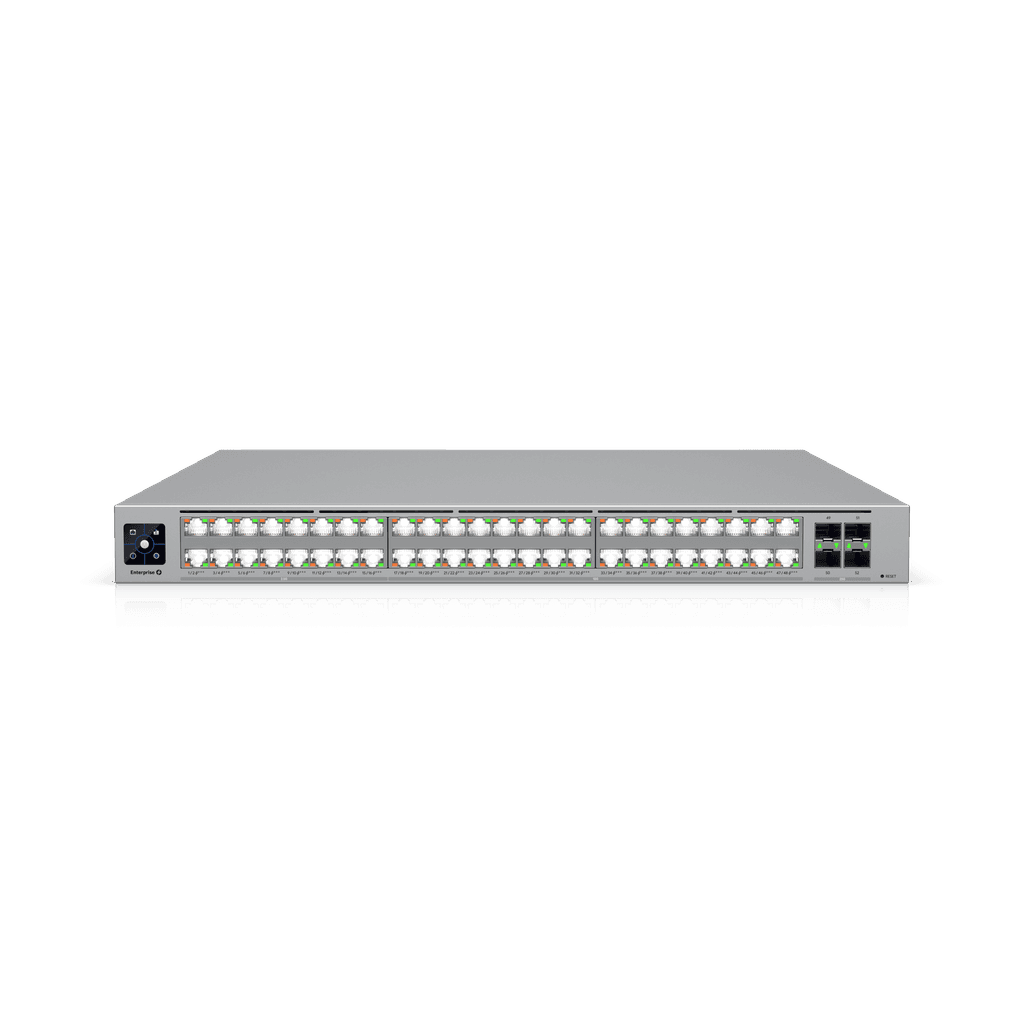
The Ubiquiti Enterprise Campus 48 PoE, model ECS-48-PoE, is a high-capacity managed campus switch for organisations that need multigigabit copper connectivity, high-output PoE and 25G fibre aggregation. It is mainly used to connect and power enterprise access points, cameras, workstations, AV endpoints, building systems and other bandwidth-intensive devices from a central rack. It is most suitable for large offices, education campuses, hospitality sites, healthcare facilities, venues and multi-floor deployments already using or planning the UniFi management platform. Before ordering, confirm the exact PoE load, AC voltage, shared-versus-redundant power design, rack depth, uplink media, UniFi Network software version and any installation or configuration services required.
What it does
The ECS-48-PoE consolidates high-speed edge connectivity and power delivery into one enterprise switch. Its copper ports can support access devices operating at different negotiated speeds, while every copper port can provide up to PoE+++ power when the overall power budget and connected-device requirements permit. Four 25G SFP28 ports provide high-bandwidth uplink options to an aggregation layer, server environment or resilient network core. Layer 2 and Layer 3 capabilities allow the switch to participate in segmented campus designs, local inter-VLAN routing and controlled access policies.
Who it suits
This model is relevant when a project requires more than standard 1 GbE access switching. Typical candidates include sites deploying dense Wi-Fi 7 access points, high-resolution surveillance, professional AV over IP, engineering workstations, media-production endpoints, access-control infrastructure or high-power edge equipment. It may be excessive for small branches with only low-power phones and basic desktops, particularly where rack depth, cooling or electrical capacity is limited. A practical selection should be based on real port-speed and power requirements rather than buying solely for future capacity.
Business challenges this switch can address
Insufficient edge speed
Legacy gigabit access ports can restrict modern wireless access points, storage-connected workstations and AV endpoints. The mixed 2.5 GbE and 10 GbE copper layout provides higher-speed choices without requiring fibre to every endpoint.
Fragmented PoE design
Separate injectors and small PoE switches complicate maintenance. A centrally managed platform can simplify power delivery, provided the total device load is calculated against shared or redundant operating mode.
Limited uplink headroom
Four 25G SFP28 interfaces can reduce aggregation bottlenecks and support resilient uplink designs. Optics, direct-attach cables, distance and the peer-device interface must still be matched carefully.
Maintenance exposure
Hot-swappable power modules and fans can support serviceability. Redundancy depends on how the power modules are configured and on whether the intended PoE load remains within the lower redundant-mode budget.
Capability band
Product-fit matrix
| Requirement | Suitable when | Confirm before ordering |
|---|---|---|
| High-density multigigabit access | Many endpoints need 2.5, 5 or 10 GbE connectivity. | Exact port-speed distribution: 16 ports up to 2.5 GbE and 32 ports up to 10 GbE. |
| High-power devices | Endpoints need PoE, PoE+, PoE++ or up to 90W PoE+++. | Per-device draw, cable standard, total PoE budget and power mode. |
| Resilient power operation | Hot-swappable power supplies and reduced service interruption are important. | Redundant-mode PoE budget is lower than shared mode and must still cover the attached load. |
| 25G aggregation | The core or aggregation layer supports compatible SFP28 links. | Optic or DAC type, fibre category, distance and peer-port support. |
| Compact racks | Only when the enclosure can support a 496 mm full-depth chassis and airflow. | Rack-post spacing, mounting method, cable bend radius and thermal allowance. |
Verified technical information
| Brand | Ubiquiti |
|---|---|
| Product name and model | Enterprise Campus 48 PoE, ECS-48-PoE |
| Product type | Enterprise Layer 3 managed PoE switch |
| 2.5 GbE RJ45 ports | 16, all PoE+++, supporting 2.5G/1G/100M/10M |
| 10 GbE RJ45 ports | 32, all PoE+++, supporting 10G/5G/2.5G/1G/100M/10M |
| SFP28 ports | 4, supporting 25G/10G/1G |
| Maximum PoE output per port | PoE 15.4W, PoE+ 30W, PoE++ 60W, PoE+++ 90W |
| Total PoE availability | 200–240V AC shared mode: 2,150W; 100–120V AC shared mode: 1,750W; 200–240V AC redundant mode: 950W; 100–120V AC redundant mode: 750W |
| Switching capacity | 920 Gbps |
| Non-blocking throughput | 460 Gbps |
| Forwarding rate | 684 Mpps |
| VLAN and route scale | Up to 1,000 supported VLANs, 32,000 MAC addresses and 512 IPv4 static routes |
| Power modules | Two hot-swappable 1,200W AC/DC modules, universal 100–240V AC, 50/60Hz |
| Fan modules | Four hot-swappable fan modules |
| Dimensions and weight | 442.4 × 43.7 × 496 mm; 9.46 kg without brackets, 9.56 kg with brackets |
| Form factor | 1U full-depth rack mount; supported in 19-inch four-post racks with post depths from 650 to 1,000 mm |
| Operating environment | -5°C to 40°C; 10% to 90% non-condensing humidity |
| Management requirement | UniFi Network version 9.0.114 or later |
| Availability and warranty | Contact FourTeck for current UAE availability, lead time, regional warranty guidance and optional coverage choices. |
Power, compatibility and rack dependencies
The headline PoE figure should not be treated as a universal value. At 200–240V AC, the switch can provide up to 2,150W in shared mode, but the available PoE budget falls to 950W in redundant mode. At 100–120V AC, the corresponding values are 1,750W and 750W. A design that loads many ports near 60W or 90W may therefore have enough power in shared mode but not when configured for power-supply redundancy. Buyers should prepare a device-by-device power schedule with nominal and maximum draw, allow reasonable engineering headroom and decide whether power availability or redundancy has priority.
Mechanical planning is equally important. The chassis is almost 500 mm deep and weighs more than nine kilograms. Ubiquiti recommends a four-post rack, or a centre-mount bracket or cantilever shelf where a two-post rack is used. Confirm rack-post depth, rail or shelf compatibility, door clearance, front and rear cabling space, airflow and access for replacing modules. The electrical circuit, UPS capacity and cooling design should account for the switch itself and the connected PoE load.
The four SFP28 ports support 25G, 10G and 1G, but link operation depends on the selected module or direct-attach cable, the remote device, fibre type and supported distance. Do not assume every third-party optic is supported. The management environment must also run UniFi Network 9.0.114 or later. Confirm the controller or UniFi hosting approach, software upgrade plan, administration rights and backup process before commissioning.
Purchase and deployment journey
Inventory the endpoints
List every access point, camera, phone, AV endpoint, workstation and building device, including required data rate and maximum PoE draw.
Design power and uplinks
Choose shared or redundant power operation, calculate headroom and identify the required SFP28 optics, DACs or fibre links.
Validate the rack
Confirm four-post support, usable depth, load capacity, cable routing, power outlets, UPS sizing and thermal conditions.
Confirm management
Review the UniFi Network platform, software version, administrator access, VLAN plan, addressing and monitoring responsibilities.
Build the quotation
Include the exact switch, quantity, optics or cables, mounting accessories, support choices and any installation or configuration scope.
Dense multigigabit access without a mixed-switch patchwork
A common campus problem appears when new wireless access points and high-performance endpoints require more than 1 GbE, but the existing access layer offers only a small number of multigigabit ports. Administrators then add specialist switches in separate racks, use adapters or accept a lower negotiated speed. The ECS-48-PoE provides a deliberate split: sixteen copper ports support up to 2.5 GbE, while thirty-two support up to 10 GbE, with all forty-eight capable of PoE+++ output. This can support a more coherent access-layer design where endpoint speed classes are mapped to suitable port groups.
The port distribution must still be checked against the real device plan. A project with twenty-four 10 GbE workstations cannot place all devices on the sixteen 2.5 GbE ports, but a project with thirty access points that require only 2.5 GbE may not need the full 10 GbE capability of the larger port group. The engineering value lies in using the switch according to the endpoint mix, not merely in selecting the highest number shown on the data sheet.
Copper cabling quality can affect negotiated performance, reach and PoE delivery. Existing cable plant should be surveyed where higher-speed operation is expected, especially in older buildings or long horizontal runs. Patch panels, patch cords and termination quality form part of the channel. FourTeck can help buyers include cabling assessment or remediation requirements in the wider project discussion rather than treating the switch as an isolated purchase.
High-output PoE with an explicit resilience trade-off
The ability to supply up to 90W per port is useful for devices that exceed conventional PoE+ or PoE++ requirements. Examples may include advanced access points, pan-tilt-zoom cameras, displays, AV equipment, access-control assemblies and other powered endpoints. However, per-port capability and total switch capacity are different design questions. Forty-eight ports cannot all draw 90W simultaneously because that would exceed the available system budget. The connected-load calculation must therefore combine each device’s maximum draw with the total budget available in the selected power mode.
Shared mode makes both installed power modules available to support a larger PoE budget. Redundant mode preserves the ability to continue operation after a module failure but provides a lower PoE allowance. In a resilience-focused design, the planned endpoint load should remain within the redundant-mode figure, not merely the shared maximum. Otherwise, the switch may meet normal operating needs but fail to maintain all powered endpoints during a supply-module event.
Power-path planning also includes the upstream electrical system. Two AC inputs can be valuable when fed from independent protected sources, but real redundancy depends on the complete path, including circuits, PDUs and UPS systems. The switch’s maximum power consumption including PoE output can reach 2,400W, so electrical and thermal planning should be completed by qualified personnel. Buyers should state whether the quotation requires UPS capacity review, PDU selection or onsite electrical coordination.
25G uplinks and controlled campus segmentation
Four 25G SFP28 interfaces provide a route from dense access connectivity to an aggregation or core layer with significantly more bandwidth than conventional 10G uplinks. They can support separate uplinks, link aggregation or resilient topology choices, subject to the capabilities of the upstream switch and the adopted design. Ubiquiti recommends pairing the product with Enterprise Campus Aggregation in relevant architectures, but the complete network must still be evaluated for topology, compatibility, optics, addressing and failure behaviour.
The ECS-48-PoE supports LACP, spanning tree and rapid spanning tree, as well as IGMP snooping and advanced multicast controls. These capabilities are useful in converged networks where data, voice, cameras and professional AV traffic share switching infrastructure. Built-in Pro AV profiles cover platforms and protocols such as Dante, Q-SYS, NDI, SDVoE, Shure, AES67 and Crestron. The profile should be selected and tested according to the actual AV design; it is not a substitute for application-specific commissioning.
Layer 3 functions include local DHCP services, DHCP relay, inter-VLAN routing and static routing. Access controls, device isolation, DHCP guarding, 802.1X control and port restrictions can contribute to a segmented access policy. These tools require deliberate configuration, documentation and testing. Buyers should decide whether routing remains at the core or moves partly to the access layer, who owns security policy decisions and how changes will be approved after handover.
Ideal business environments and practical use cases
Enterprise offices and headquarters
Suitable for access layers serving dense wireless, executive floors, collaboration spaces, security devices and high-speed user endpoints across large office deployments.
Education campuses
Can support high-density Wi-Fi, digital classrooms, laboratories, surveillance, access control and AV systems where segmentation and central management are required.
Hospitality and venues
Relevant for properties and event spaces combining guest wireless, cameras, IPTV or AV distribution, staff networks and operational systems.
Healthcare and clinics
May suit facilities with segmented clinical, administrative, voice, wireless and security traffic, subject to application, policy and regulatory review.
Professional AV networks
The multicast controls and AV profiles can support appropriately designed media networks, with application-specific validation and commissioning.
High-resolution surveillance
High PoE capacity and multigigabit uplinks may support camera-heavy deployments where recording bandwidth, retention and uplink design are calculated separately.
Operational and integration considerations
A successful deployment starts with a current logical diagram and an agreed role for the switch. Decide whether it functions as a pure access switch, performs local inter-VLAN routing or provides a mix of both. Define VLANs, trunks, native networks, access controls, authentication requirements, multicast behaviour, voice settings and quality-of-service markings. The configuration should align with the firewall, core switch, DHCP services, identity platform, wireless design and monitoring process.
Change management deserves attention because this is a high-density device. A single configuration error can affect dozens of powered endpoints. Prepare a staged migration plan, document old and new port mappings, label both ends of every cable, validate PoE class and negotiated speed, and keep a rollback route for critical services. Commissioning should test normal operation, uplink failover, power-module behaviour where applicable, VLAN reachability, DHCP, multicast, voice, camera streams and management visibility.
Ongoing operations should cover software updates, configuration backup, alert routing, spare-module strategy, environmental monitoring and support escalation. Etherlighting and the touchscreen can help local technicians identify ports and device states, but they do not replace accurate documentation. Agree who will own the UniFi Network environment after handover and whether FourTeck support, periodic review or configuration assistance should be included separately.
Buyer questions to resolve before ordering
Procurement checklist
☐ Confirm exact model ECS-48-PoE and required quantity.
☐ Record the number of 2.5 GbE and 10 GbE endpoints.
☐ Calculate maximum PoE draw for every connected device.
☐ Select shared or redundant power operation.
☐ Verify local AC voltage, circuits, PDUs and UPS capacity.
☐ Confirm four-post rack depth or approved two-post support method.
☐ Identify all SFP28 optics, DACs, fibre and patch leads.
☐ Validate cabling category and channel quality for target speeds.
☐ Confirm UniFi Network version and hosting location.
☐ Define VLAN, routing, authentication and multicast requirements.
☐ Include installation, migration, testing and documentation scope.
☐ Confirm UAE availability, lead time and warranty guidance.
How FourTeck can assist
FourTeck can help convert a broad switching request into an orderable scope. The process can begin with a review of endpoint quantities, port speeds, PoE classes, rack locations, fibre paths, uplink topology and the existing UniFi environment. This helps identify whether one ECS-48-PoE is appropriate, whether multiple access switches are required and which accessories or project services should be included.
Quotation support can cover the switch, suitable uplink components, mounting considerations, delivery coordination and separately defined installation or configuration work. Where migration is involved, FourTeck can discuss port mapping, change windows, staged cutover, validation and documentation requirements. Scope, timing and responsibilities should be confirmed in writing because site readiness, cabling conditions, electrical work and third-party systems can affect implementation.
For broader requirements, review FourTeck’s technology product range, explore available planning and deployment services, or send the project brief through the FourTeck contact page.
UAE availability and support guidance
Contact FourTeck to confirm current UAE availability for the Ubiquiti ECS-48-PoE. Supply may depend on quantity, vendor lead time, regional channel conditions, optional support choices and the accessories included in the bill of materials. A current quotation should identify the exact model, power configuration, optics or cables, delivery destination and any installation or configuration scope. Prices and lead times can change, so online reference pricing should not be treated as a confirmed FourTeck selling price.
For projects across Dubai, Abu Dhabi, Sharjah and Ajman, FourTeck can discuss requirement review, quotation coordination, delivery planning and project-service options in one combined engagement. Site access, rack readiness, electrical capacity, cabling condition and change-window requirements should be shared early. Installation dates, onsite activities and warranty terms are subject to the final approved quotation and should not be assumed from the product name alone.
GCC availability
FourTeck can assist organisations planning ECS-48-PoE deployments in GCC markets by reviewing the intended campus design, connected-device count, required PoE budget, uplink interfaces, rack environment and management platform before preparing a quotation. Projects in the United Arab Emirates, Saudi Arabia, Kuwait, Qatar, Bahrain or Oman can have different supply routes, lead times, electrical considerations, service-visit requirements and commercial terms. Availability should therefore be checked for the destination country and exact quantity rather than inferred from another regional store.
Buyers should provide the destination, required units, preferred project schedule, AC environment, support expectations and whether optics, direct-attach cables, installation, migration or configuration assistance is needed. License or software requirements, warranty handling and delivery coordination may also vary by country and procurement channel. FourTeck can help clarify these dependencies and prepare an appropriate scope, but local stock, fixed delivery dates, customs outcomes or guaranteed onsite coverage should not be assumed until formally confirmed. For Kuwait-related technology requests, buyers may also review FourTeck Kuwait information.
Africa availability
For African projects, FourTeck can help enterprises, education groups, hospitality operators, integrators and multi-site organisations evaluate whether the ECS-48-PoE fits the network architecture and operating environment. The discussion can cover endpoint speeds, PoE demand, power resilience, fibre uplinks, rack design, configuration, support expectations and the wider bill of materials. Regional procurement planning may also need to account for local voltage, plug or PDU arrangements, shipping routes, import processes, project access and the availability of qualified onsite resources.
Availability and fulfilment depend on the destination, quantity, vendor lead time, transport arrangements and local project conditions. Buyers should share the country, site location, required timeline, exact device count and any installation or support expectations so that FourTeck can provide relevant guidance. Organisations in East Africa can review the Kenya technology portal or Uganda service information, while broader regional enquiries can use the FourTeck Africa site. Local inventory, immediate shipment, customs outcomes and country-wide onsite support are not implied and must be confirmed for each request.
Related options and project components
Enterprise Campus Aggregation
A potential aggregation-layer consideration for compatible high-capacity campus designs. Confirm port speeds, topology and exact model before selection.
25G SFP28 modules
Multimode, single-mode or other optical choices depend on fibre type, distance and peer-device compatibility.
25G direct-attach cables
Useful for short in-rack connections where both devices support the selected DAC and required length.
Rack and power accessories
Four-post rails or approved support, PDUs, UPS capacity and cable-management components should match the installed environment.
Installation and configuration
A defined service scope can include rack installation, adoption, VLAN setup, uplink configuration, migration, testing and documentation.
Lower-capacity alternatives
A smaller Enterprise Campus or Pro-series model may be more appropriate where port count, PoE demand or uplink capacity is lower.
Why businesses contact FourTeck
Enterprise switch selection affects more than a single hardware line item. Buyers contact FourTeck for help clarifying the required port mix, power mode, uplink media, rack fit and management design before purchase. This can reduce the risk of ordering a high-capacity switch without the correct optics, power planning or installation accessories.
FourTeck can also help structure the quotation around supply, configuration, migration and support rather than leaving project responsibilities unclear. Assistance is based on the information available and the agreed scope; compatibility, performance and implementation outcomes still depend on the complete environment. Learn more about FourTeck or send a business technology enquiry.
Frequently asked questions
Is the ECS-48-PoE suitable for Wi-Fi 7 access points?
It provides multigigabit copper ports and up to PoE+++ output, which can suit high-performance access points. Confirm each access point’s negotiated speed, maximum power requirement, cable standard and total device count before finalising the design.
Do all forty-eight ports support 10 GbE?
No. Thirty-two RJ45 ports support up to 10 GbE, while sixteen support up to 2.5 GbE. All forty-eight copper ports support PoE+++.
Can every port deliver 90W at the same time?
No. Each port can provide up to 90W, but the total switch budget is lower than forty-eight times 90W. The connected load must stay within the shared- or redundant-mode budget for the local AC voltage.
What is the difference between shared and redundant power mode?
Shared mode uses both power modules to maximise available PoE. Redundant mode reserves capacity so operation can continue after a module failure, but the permitted PoE budget is substantially lower.
Does the switch require a four-post rack?
Ubiquiti recommends a four-post rack for the full-depth chassis. A centre-mount bracket or cantilever shelf may be used on suitable two-post racks, but support, depth and load capacity must be confirmed.
Which UniFi Network version is required?
The official requirement is UniFi Network version 9.0.114 or later. Review the controller or hosting environment before installation.
Are 25G optics included?
The required optic or direct-attach cable should be confirmed as a separate bill-of-material item. Selection depends on distance, fibre type and the upstream device.
Can FourTeck configure VLANs and uplinks?
Configuration assistance can be discussed and quoted separately. Share the network diagram, VLAN plan, addressing, authentication requirements and change window so the scope can be defined.
How can I confirm UAE availability and price?
Send FourTeck the exact model, quantity, delivery location, required accessories and service scope. Availability, lead time and pricing will be confirmed in the current quotation.
What information is needed for an accurate quote?
Provide quantity, endpoint count, required port speeds, maximum PoE load, power mode, rack details, uplink type, software environment, destination and any installation, migration or support requirements.
Build the ECS-48-PoE requirement around your real network
Share your port map, PoE schedule, rack environment, uplink plan and project location. FourTeck can help organise the product, accessory and service scope for a current UAE quotation.

Reviews
There are no reviews yet.